Showing posts with label The Idea of a University. Show all posts

Friday, August 2, 2024

First Friday in August and Blogging Again

I've neglected the blog lately because I've been working on a project. When you're given only 15 minutes for a presentation, I've found you have to work even harder to put it together, mainly because you have to focus on what you really have to say. I've had to keep telling myself that I don't have time for this idea, or that idea.

And the project I've been working on is all about an idea--The Idea of A University, Saint John Henry Newman's great plan for a truly Catholic and truly universal University. I've been concentrating on the historical context of the his efforts from 1851 to 1858 to found, staff, promote, and teach at the Catholic University of Ireland. 

Just putting together this chronological handout for the participants was time-consuming, but it did afford me the pleasure of reading chapters of Father Ian Ker's great biography of Newman again and dipping into Wilfrid Ward's biography of Newman too:

Timeline of Newman’s involvement in the Catholic University of Ireland

'I want the intellectual layman to be religious, and the devout ecclesiastic to be intellectual.’ Newman’s first University Sermon preached in Dublin, “Intellect, the Instrument of Religious Training”

In England/Ireland: 1829: Catholic Emancipation Act passed: many but not all restrictions on Catholic worship and citizenship were removed in England and Ireland.

In Ireland: 1840’s: Potato Famine; typhoid, cholera, and dysentery epidemics

            Newman: October 9, 1845: Received into the Catholic Church at Littlemore

In England/Ireland: 1845: The Queen's Colleges (Ireland) Act (An Act to enable Her Majesty to endow new Colleges for the Advancement of Learning in Ireland) passed.

In Ireland: December 30, 1845: the Queen’s Colleges of Galway, Belfast, and York incorporated.

In Ireland: 1846-1855: emigration reached its peak

           Newman: September 1846: in Rome to study for the priesthood

           January 1847: decides to become an Oratorian (member of the Oratory of St. Philip Neri) priest; 

           May: ordained a Catholic priest

           February 1848: opens the first Oratory in England; June: opens the London Oratory

In England: Pope Pius IX announces the Restoration of the Catholic Hierarchy; names bishops

            Newman: November 1851: Archbishop Cullen asks him to become the Rector of a new    Catholic University in Dublin: Newman accepts

Newman in Dublin

·         5/10/1852: First of his lectures on The Idea of a University

·         June 21-24: has to leave Dublin to stand trial for libel

·         October 1852: finalizes the lectures on the scope of the university (part one of The Idea of a University)

·         January 1853: Newman has to return to England for sentencing in his libel trial

·         November 1854: the University opens and classes begin; Newman officially named the Rector; begins publishing the Catholic University Gazette

·         1855: Newman delivers his lecture on “Christianity and Scientific Investigation”, chapter 8 in “University Subjects” (part two of The Idea of a University)

·         May 1856: the University church dedicated (Saints Peter and Paul)—now named for Our Lady Seat of Wisdom

·         March 1857: Newman informs the Irish bishops that he wants to resign as the University’s Rector

·         October 26, 1858: Newman returns to Dublin for last lectures

Saturday, November 12, 2022

Professor Mary Katherine Tillman, RIP

While I learned of Father Ian Ker's death on the very day, I just found out about the death of another Newman Scholar, Professor Emerita Mary Katherine Tillman of the University of Notre Dame. She died on October 21 of complications associated with esophageal cancer and her funeral Mass was celebrated at the Basilica of the Sacred Heart at Notre Dame on Friday, October 28. Her obituary, posted by the University of Notre Dame is found here. The South Bend Tribune obituary adds the detail that she married another Professor Emeritus just 12 years ago and that she and her husband, Phillip Sloan, resided in Holy Cross Village at Notre Dame, a senior living community sponsored by the Holy Cross Brothers. 

The Notre Dame obituary highlights her study of Newman:

Tillman was a scholar of St. John Henry Cardinal Newman, writing a book and several extended commentaries on the works of the 19th-century English priest, as well as the history and philosophy of liberal education.

She published widely in scholarly journals and gave lectures throughout the U.S. and Europe, and in 2019 received the Gailliot Award for Lifetime Achievement in Newman Studies from the National Institute for Newman Studies.

According to my records, she visited Wichita twice to give presentations on Newman, focusing on university education and the relationship between faith and reason. In 1995 at the Newman School of Catholic Thought at the Newman Center at WSU, she provided a comprehensive explanation of the works Newman wrote during his "campaign in Ireland" to establish the Catholic University in Dublin, describing how they help us see how he realized his notional ideas of university education, thus demonstrating the "unity of idea and image" in his reflections on education. Tillman provided an overview of Newman's Idea of a University, and the Rise and Progress of Universities, the first presenting the idea, the second the image through descriptions of places of universal knowledge in Athens, Paris, and Oxford, among others. She also spoke on Faith and Reason at that 1995 Newman School of Catholic Thought, in which she compared Newman's Grammar of Assent and Fifteen University Sermons, noting of the latter that they sowed "the seeds of all Newman's future writings".

And she wrote the introductions for critical editions of the Fifteen Sermons and the Rise and Progress of Universities.

In 1998, she presented a lecture at Newman University on "Catholic Higher Education at the Millennium". I know that I attended that lecture but I have no surviving notes from it.

And in 2015, Marquette University Press published a collection of her works on Newman titled John Henry Newman: Man of Letters.

In this collection of essays spanning thirty years of her work in Newman Studies, Tillman elaborates the broad reach of Newman's philosophical, educational, historical and classical acumen. Attentive to his philosophical methodologies and to recent Newman scholarship, she compares Newman's views on a wide range of issues with those of other thinkers, classical and modern. Included in the essays are such topics as Newman's meaning of 'views', of relations between faith and reason, of imagination, on the college in relation to the university, on research, on whether virtue can be taught, on the development of ideas, on prepredicative experience and on phronesis, on 'the gentleman' in relation to the Oratorian, on human nature, and on worldly wisdom in relation to holy wisdom. Newman, Man of Letters, is seen as unique in his prolific and wide-ranging genius.

Eternal rest grant unto her O Lord and may her soul and the souls of all the faithful departed, rest in peace. And may she rest in peace.

Thursday, October 17, 2019

Tracey Rowland Searches for Newman's University

She searches for it, but doesn't find it very often.

Speaking at the Newman the Prophet: A Saint for Our Times conference held at The Angelicum in Rome before the canonization of St. John Henry Newman and the four women saints, Tracey Rowland, the St. John Paul II Chair of Theology at the University of Notre Dame (Australia) and a Member of the International Theological Commission, commented on what she sees:

First I would argue that most of our universities are what Newman would call factories, mints, and treadmills, that is, places where thousands of students, known to the university only by their student numbers, pass exams to qualify for employment in a particular field. Some small number of institutions do however retain an interest in the liberal arts and these cater mostly for students from upper middle class families where there is less concern about being trained for a particular job. However for many of these elite institutions the liberal arts are no longer linked to the transcendentals of truth, beauty and goodness, all of which are regarded as ‘bourgeois nonsense’. Instead in so many of these institutions the liberal arts have morphed into social theory subjects like gender studies and the objective is no longer to produce gentlemen but to form social activists, people who act like trained assassins against the last vestiges of Greco-Roman and Judeo-Christian civilisation.

This leaves us with only a very small number of academic institutions anywhere in the world where something like Newman’s vision has any possibility of success. Most of these institutions operate at the level of liberal arts colleges that are specifically Catholic and have been established by visionary lay people who wanted their children and grandchildren to receive the kind of formation Newman set out in his Idea of a University. Some extremely small number of such institutions can be found at the higher university level. Excluded are numerous institutions with the adjective Catholic in their title where no attempt is made to offer a specifically Christian formation of every aspect of the soul, or a specifically Christian integration of the various disciplines, but where there are merely buildings named after local Catholic worthies, a chapel, a chaplain who is a priest if you are lucky, and lots of opportunities to improve the welfare of minority groups. The accountants who normally run such institutions might be members of the Catholic Church but the institutions themselves, their ethos, the content of their curricula, their marketing strategies, the beliefs of their faculty members, administrators, janitors and librarians and the bureaucratic idioms found in their policies are not only not Christian but in many cases simply the outcome of corporate ideology. Newman would not recognise these institutions as in any sense consistent with his own vision.


Sadly enough, Newman University, our local Catholic university--which has formed a partnership with the Diocese with its School of Catholic Studies to offer undergraduate degrees to the young men in the Diocesan House of Studies before they go off to seminaries in other dioceses--announced the need to eliminate degree programs to confront a budget shortfall. Where do they look for cuts? Theology and Philosophy. among other undisclosed majors:

At their September meeting, the board of trustees at Newman University approved cutting four majors and also decided to realign two other departments.

This comes after the board approved cost cutting recommendations from their financial task force. In an update from the university's newspaper, the Vantage, they confirmed the cutting of four majors while realigning theology and philosophy. . . .

No final decisions have been made regarding which majors are going to be cut, according to Clark Schafer, the Director of University Affairs at Newman University, but classes will still be offered for those particular subjects.


What will that mean for the School of Catholic Studies? What will that mean for Newman University's efforts to fulfill the vision of its patron, whom it just celebrated so joyfully when he was canonized last week?

St. John Henry Newman, pray for us!

Monday, August 19, 2019

On the Son Rise Morning Show: Newman and Literature, Part One


As promised, I'll be on the Son Rise Morning Show bright and early this morning (6:50 a.m. Central/ 7:50 a.m. Eastern) to talk with Anna Mitchell about Newman and Literature, focusing today on Newman's literary style.

Blessed John Newman was once told in a letter that someone thought he was a saint and he replied humbly:

I return you Miss Moore’s letter. You must undeceive her about me, though I suppose she uses words in a general sense. She called Newman a saint. I have nothing of a Saint about me as every one knows, and it is a severe (and salutary) mortification to be thought next door to one. I may have a high view of many things, but it is the consequence of education and of a peculiar cast of intellect—but this is very different from being what I admire. I have no tendency to be a saint—it is a sad thing to say. Saints are not literary men, they do not love the classics, they do not write Tales. I may be well enough in my way, but it is not the ‘high line.’ People ought to feel this, most people do. But those who are at a distance have fee-fa-fum notions about one. It is enough for me to black the saints’ shoes—if St. Philip uses blacking, in heaven. (LD XIII:419).

Some have used this to deprecate Newman's beatification and canonization saying it was somehow against his will--but isn't this what most of us would reply if someone said we were saints? He did not say that he didn't want to be a saint (be in Heaven), but that he did not want to be called a saint while he was still alive.

Nonetheless, Newman was a "literary" man who loved the classics and wrote Tales and who wanted to be a good writer, communicating truth and action to his audience, reaching them to persuade them, console them, excite them to good thoughts, good works, good ways of living.

In a book published in 1932, Favorite Newman Sermons Selected by Daniel M. O'Connell, S.J., the editor included "Newman's Rules for Writing Sermons":

1. A man should be in earnest–by which I mean he should write, not for the sake of writing, but to bring out his thoughts.

2. He should never aim to be eloquent.

3. He should keep his idea in view, and should write sentences over and over again till he has expressed his meaning accurately, forcibly, and in few words.

4. He should aim at being understood by his hearers or readers.

5. He should use words which are likely to be understood. Ornament and amplification will come spontaneously in due time, but he should never seek them.

6. He must creep before he can fly–by which I mean that humility, which is a great Christian virtue, has a place in literary composition.

7. He who is ambitious will never write well; but he who tries to say simply what he feels and thinks, what religion demands, what faith teaches, what the Gospel promises, will be eloquent without intending it, and will write better English than if he made a study of English literature.

Regarding rule number seven, Newman had also made a study of English literature, and he knew the power of all literature (tales, stories, novels, plays, poetry, etc). He had a high view of the power of Literature to move and influence people. In The Idea of the University he argues that if Theology is not part of a university curriculum, Literature could take its place (and so could Science). Literature, however, may be the greater danger to Theology because, if Science “ignores the idea of moral evil”, Literature recognizes and understands it too well, and can make it both attractive and sympathetic to the reader. Newman states that Literature is the voice of “the natural man”, fallen and sinful: 

Literature stands related to Man as Science stands to Nature; it is his history. Man is composed of body and soul; he thinks and he acts; he has appetites, passions, affections, motives, designs; he has within him the lifelong struggle of duty with inclination; he has an intellect fertile and capacious; he is formed for society, and society multiplies and diversifies in endless combinations his personal characteristics, moral and intellectual. All this constitutes his life; of all this Literature is the expression; so that Literature is to man in some sort what autobiography is to the individual; it is his Life and Remains. Moreover, he is this sentient, intelligent, creative, and operative being, quite independent of any extraordinary aid from Heaven, or any definite religious belief; and as such, as he is in himself, does Literature represent him; it is the Life and Remains of the natural man, innocent or guilty. I do not mean to say that it is impossible in its very notion that Literature should be tinctured by a religious spirit; Hebrew Literature, as far as it can be called Literature, certainly is simply theological, and has a character imprinted on it which is above nature; but I am speaking of what is to be expected without any extraordinary dispensation; and I say that, in matter of fact, as Science is the reflection of Nature, so is Literature also—the one, of Nature physical, the other, of Nature moral and social. Circumstances, such as locality, period, language, seem to make little or no difference in the character of Literature, as such; on the whole, all Literatures are one; they are the voices of the natural man.

He counsels that the university should not censure or bowdlerize works of literature and shield students from them. He warns that you cannot “attempt a sinless Literature of sinful man”. The students at a university must read the classic works of literature if they are to be prepared for the world and to develop the philosophical method that he claimed was the purpose of university education.

Newman had studied the art of writing and noted in a lecture to the Philosophy department at the Catholic University of Ireland, as quoted by Father Juan Velez, that:

. . . writing is essentially a personal work, not something that results from production or a natural process. It is not a mere vehicle of things or symbols as is the case with mathematics. “Literature is the personal use or exercise of language.” And this is proved from the fact each author writes differently, and the genius masters language for his purpose: “while the many use language as they find it, the man of genius uses it indeed, but subjects it withal to his own purposes, and moulds it according to his own peculiarities. The throng and succession of ideas, thoughts, feelings, imaginations, aspirations, which pass within him, the abstractions, the juxtapositions, the comparisons, the discriminations, the conceptions, which are so original in him, his views of external things, his judgments upon life, manners, and history, the exercises of his wit, of his humour, of his depth, of his sagacity, all these innumerable and incessant creations, the very pulsation and throbbing of his intellect, does he image forth, to all does he give utterance, in a corresponding language, which is as multiform as this inward mental action itself and analogous to it, the faithful expression of his intense personality…” Language is as the very shadow of an author, it is unique, not someone else’s shadow.

He goes further: “Thought and speech are inseparable from each other. Matter and expression are parts of one: style is a thinking out into language. This is what I have been laying down, and this is literature; not things, not the verbal symbols of things; not on the other hand mere words; but thoughts expressed in language.” Men, unlike animals, exercise logos, the Greek word for both reason and speech. A classical author has both; he thinks and writes his thoughts. He is not like a traveler unable to write who engages a professional letter writer. Excellent writers such as Shakespeare or Walter Scott did not aim at diction for its own sake; instead they poured forth beautiful words because they had beautiful thoughts.


Newman definitely had beautiful thoughts, about Jesus, the Catholic Church, the Blessed Virgin Mary, the Saints, education, the laity, faith and reason, etc. That's why getting used to his writing style, as Ciceronian and Victorian as it is, is worth doing. 

Monday, June 3, 2019

Newman and Education: The Idea of a University

Newman and Education is the theme of our discussion this morning on the Son Rise Morning Show (7:50 a.m Eastern.6:50 a.m. Central). Anna Mitchell and I will continue our Santo Subito! series leading up to Blessed John Henry Newman's canonization later this year (perhaps in October?). Please listen live here.

These introductory paragraphs from a Cardinal Newman Society post summarize Newman's educational career very well, since they are written by Father Ian Ker, who wrote a great biography of Newman:

In 1863, sixty-two-year-old John Henry Newman wrote, “from first to last, education … has been my line.” His career at Oxford had begun with his election in 1822 to a fellowship at Oriel College, “at that time the object of ambition of all rising men in Oxford.” After that he “never wished any thing better or higher than … ‘to live and die a fellow of Oriel.’”[1] In fact, the Oxford or Tractarian Movement might never have begun but for Newman’s dispute with the Provost of Oriel over the role of a college tutor, Newman wanting, as a pioneer of the Oxford tutorial system that was to develop later, a more direct, personal teaching relationship with undergraduates. As a result of being deprived of his tutorship, his teaching career at Oxford—in which his “heart was wrapped up”—came to an end, and he turned to research into the Church Fathers and the history of the early Church. After becoming a Catholic, he was opposed to the restoration of the English hierarchy on the ground that “we want seminaries far more than sees. We want education.”[2]

So when the chance came of helping to found the Catholic University of Ireland in Dublin, he jumped at it, since he had “from the very first month of my Catholic existence … wished for a Catholic University.” Later, he was naturally attracted by the idea of founding the Oratory School in Birmingham; as an educational work, it fell “under those objects, to which I have especially given my time and thought.” And as an old man of sixty-three, he so enjoyed filling in for an absent teacher that he declared that, “if I could believe it to be God’s will, [I] would turn away my thoughts from ever writing any thing, and should see, in the superintendence of these boys, the nearest return to my Oxford life.” He was proud to claim that the school had “led the way in a system of educational improvement on a large scale through the Catholic community.”[3]


Newman's foundation of the Catholic University of Ireland and the discourses he presented in Dublin to describe the kind of educational experience he wanted to develop there resulted in The Idea of a University, one of his greatest works. He envisions--because he had experienced it at Oxford--a university as a place of universal knowledge. 

He believed it was a community of scholars and students: the idea of community was important to him and the image some present of Newman as a reclusive scholar in an ivory tower is false. He thought that students helped each other learn, understand concepts, apply their knowledge, etc. He thought the tutors and teachers in the university community benefited from living in community too.

He believed a university taught more than knowledge as points of data: it taught students how to think, how to learn about something, how to apply the skills of research and understanding to any subject they encountered. He called this a cultivation of mind that gave the students a connected view of all things, a philosophical method for understanding and progressing in knowledge.

He believed a university had to teach Theology: Theology is a body of knowledge that must be included in the curriculum of a university--not comparative religion, not religious studies, not the Bible as literature, not the culture of religion, etc--as a subject with a body of knowledge. Newman argued that even Natural Theology is based upon knowledge: once you admit that God exists, you must study what that means for humanity. Once you admit that God has revealed Himself, and has revealed that He has become Incarnate among us in time as a Man, you must study what this fact means to human history, to morality, and to society.

If a university leaves Theology out of its curriculum another subject will take its place: science, or literature, or economics, or aesthetics will serve as the organizing basis of all the knowledge presented at the university. Once God and what we know of Him from Creation and Revelation is eliminated, something man made will take its place.

This is a great challenge to all the secular universities here in the USA: they do not teach Theology as a body of knowledge. Even Catholic colleges and universities struggle with teaching Theology as Newman envisioned it, being part of all the other sciences and subjects, influencing how ethics and morality are taught, how the natural and social sciences are researched and developed, how the students learn to think and see the world. A Catholic college or university can have an excellent and faithful Theology department but what it teaches may not be integrated into the rest of the subjects at all. They could be taught as if the truths of God's Creation and Revelation mean nothing to them or the students. I think that Newman would say that neither a secular university nor such a compartmentalized Catholic university was teaching its students true knowledge or the true philosophical method of thinking and learning.

Newman also offered a great warning: even a complete university education with Theology in its proper place has its limits. It can produce what he called a gentleman, it may or may not produce a saint.

Quarry the granite rock with razors, or moor the vessel with silken thread; then may you hope with such keen and delicate instruments as human knowledge and human reason to contend against those giants, the passion and the pride of man. 

That's why the first thing he built at the Catholic University of Ireland in Dublin was the university chapel: Mary, Seat of Wisdom. Only the Grace of God can "contend against those giants, the passion and the pride of man."

Sunday, April 29, 2018

Eighth Day Institute's 2018 "Synaxis"


The latest issue of Synaxis is out. Eighth Day Institute (EDI) held a Benedict Hour Friday afternoon and evening at The Ladder to distribute the publication to local members.

As you'll note from the Table of Contents, Editor/Director/Doctor Doom selected a piece of mine based on a lecture I offered at the 2017 Symposium on Newman's The Idea of a University, focused on the place of Theology in a university education. From the description of the presentation:

Abstract: In 1854, John Henry Newman was asked to establish a Catholic university in Ireland. Although his project for the university failed, his great vision for higher education, The Idea of a University, has had great influence on the idea of a liberal arts education. His warning that Theology, the Queen of the Sciences, must have a central role in the curriculum, has not had the influence it should on secular universities, however, and Stephanie Mann will discuss how that circumstance has led to the problem we are addressing today: if the college educated public is not aware of the meaning of theology, how can a theologian influence society and culture?

As I noted, Director Doom (Erin Doom) excerpted the essay I wrote based on that presentation. Here's one of the sections he had to leave out (in the interests of space) at the end of the essay:

The Spirit of Liberalism in Religion

He knew, however, that his audience was affected by the loss of Theological truth in his own age. Newman called it “the spirit of liberalism in religion”, the idea that there is no truth in religion. Remember that he cited this idea as a reason for some universities omitting Theology from the curriculum. When he was named a Cardinal by Pope Leo XIII in 1879, Newman made his memorable biglietto speech, noting that he had resisted this spirit for the past fifty years of his life:
Liberalism in religion is the doctrine that there is no positive truth in religion, but that one creed is as good as another, and this is the teaching which is gaining substance and force daily. It is inconsistent with any recognition of any religion, as true. It teaches that all are to be tolerated, for all are matters of opinion. Revealed religion is not a truth, but a sentiment and a taste; not an objective fact, not miraculous; and it is the right of each individual to make it say just what strikes his fancy. . . . Since, then, religion is so personal a peculiarity and so private a possession, we must of necessity ignore it in the intercourse of man with man. If a man puts on a new religion every morning, what is that to you? It is as impertinent to think about a man's religion as about his sources of income or his management of his family. Religion is in no sense the bond of society.

Hitherto the civil Power has been Christian. Even in countries separated from the Church, as in my own, the dictum was in force, when I was young, that: "Christianity was the law of the land". Now, everywhere that goodly framework of society, which is the creation of Christianity, is throwing off Christianity.
Newman saw this danger spreading and proves a prophet for our time, noting that once Christian Theology has been eliminated from civil discourse, authorities will
. . . substitute first of all a universal and a thoroughly secular education, calculated to bring home to every individual that to be orderly, industrious, and sober, is his personal interest. Then, for great working principles to take the place of religion, for the use of the masses thus carefully educated, it provides—the broad fundamental ethical truths, of justice, benevolence, veracity, and the like; proved experience; and those natural laws which exist and act spontaneously in society, and in social matters, whether physical or psychological; for instance, in government, trade, finance, sanitary experiments, and the intercourse of nations. As to Religion, it is a private luxury, which a man may have if he will; but which of course he must pay for, and which he must not obtrude upon others, or indulge in to their annoyance.
Thus, even when a public theologian speaks today on abortion, marriage, family, religious freedom, human dignity, poverty, health care, etc., the theological grounding of her arguments has been vitiated and utilitarianism or mere sentiment has taken its place in her audience’s ears. Newman saw it coming—he warned the Church; he warned his country—and he was mostly ignored.

If you are an EDI member, you'll receive a copy--if you're not, I think that Eighth Day Books will be selling them; or you could join the cause of renewing culture through faith and learning and read this and many other excellent essays.

Friday, January 13, 2017

At 11:30 a.m. Today

I'll be at the seventh annual Eighth Day Institute Symposium making my presentation on "Long Live the Queen: John Henry Newman and the Place of Theology in a Liberal Arts Education". My reflection is live on the EDI website and will be included in the January issue of Synaxis:

Reading Newman’s Idea and his vision of university education now, so many years later, I am struck by how timely his defense of Theology as a field of study with a body of knowledge is for us today. In the mid-nineteenth century he saw that if Theology was not accepted as an academic subject, with content and knowledge to impart, religious doctrine and practice would devolve into mere feeling. Then religious doctrine and morality will be “based, not on argument, but on taste and sentiment” and “nothing [is] objective”; in fact “everything [is] subjective”. Newman saw that if Theology is only a matter of “taste and sentiment” and Christian doctrine “the bane of true knowledge”, theologians will be rejected. Theologians—the watchmen—will face “a feeling, not merely of contempt, but of absolute hatred” if they dare state that what they say is true and based not on opinion or affection, but on knowledge and experience. Newman seems a prophet in that vision, as in many other things.

Here's the schedule in case you want to come! Of course, bad winter weather is forecast for this weekend in Wichita, so caution is advised, especially on Saturday! 

Friday, December 16, 2016

Newman and Theology in January 2017


Registration for the 2017 Eighth Day Institute Symposium is open:

Earlier this year, Alan Jacobs wrote a piece in the September issue of Harper's Magazine titled "The Watchmen: What Became of the Christian Intellectuals?" Jacobs notes that only half a century ago serious Christian intellectuals held a prominent place on the national stage of America. Back in the 1930s the Hungarian sociologist Karl Mannheim argued that these intellectuals had a "special task to provide an interpretation of the world," to "play the part of watchmen in what otherwise would be a pitch-black night."

So, for our seventh annual Eighth Day Symposium, we ask "Where are the watchmen?" And, "What is the role of theology in the public square?"

We hope you can join us as Frederica Mathewes-Green, Bishop James Massa, Brian Zahnd and others lead us in a wonderful dialogue of love and truth on January 12-14, 2017.

I am one of the "others", as I am going to present on the gap that's left in the Liberal Arts education of a secular university because theology as an academic subject is not included. Blessed John Henry Newman's The Idea of a University and his insistence that theology is necessary for a complete education will be essential to my presentation. You may see the schedule here: my presentation is one of the first Saturday breakout sessions.

Saturday, May 9, 2015

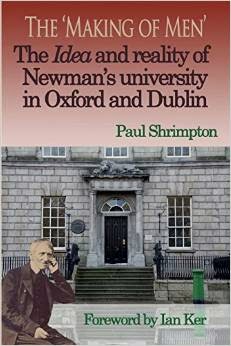
Newman's Idea and Reality of University Education

In The Weekly Standard, Edward Short reviews a new book on Blessed John Henry Newman's theory of university education and its reality:

Until now, the two most highly regarded books on Newman’s treatment of the subject were Fergal McGrath’s Newman’s University: Idea and Reality (1951) and Dwight Culler’s The Imperial Intellect: A Study of Newman’s Educational Ideal (1955). Now, in The ‘Making of Men,’ Paul Shrimpton contends that past studies of Newman’s educational achievement have suffered from failing to take into account the full scope of Newman’s educational endeavors, and he has written his own book to rectify that.

Deeply researched and persuasively argued, The ‘Making of Men’ is a major contribution to our understanding of Newman’s commitment to university education. It will enliven and refine all future discussions of the subject by encouraging readers to revisit not only Newman’s classic text but the practical challenges he addressed—first as fellow of Oxford’s Oriel College, and then as rector of the Catholic University in Dublin. Shrimpton draws on Newman’s copious correspondence and memoranda, as well as “accounts ledgers, buttery records, punishments books, timetables, rules and regulations, prospectuses, minute books, reports of all types, and a host of other documents,” all of which give The ‘Making of Men’ an admirable richness.

Read the rest there. The 'Making of Men' is published by Gracewing in the UK.

Friday, July 11, 2014

This a Job for an English Major!


When I majored in English Language and Literature and then went on to earn an M.A. in the same subject, the question often was--"What are you going to DO with those degrees?" or  "How are you going to get a job?" The common argument for the "usefulness" of the Liberal Arts was that I was going to know how to think, how to do research, how to write, how to express ideas--to teach, to persuade, etc. Now I find out that I--were I a recent graduate--could help airlines apologize, according to this article in The Wall Street Journal, as "Carriers Deploy Software, English Majors to Tell Angry Fliers They're Sorry for Mistakes in Flight":

United Airlines, which had the highest rate of complaints filed at the DOT among major airlines the past three years, has a team of about 450 customer-care agents handling general issues and refunds. Add to that 400 people handing (sic) frequent-flier program issues and about 100 answering baggage-related letters and emails.

Delta Air Lines employs 150 people in Atlanta and Minneapolis to email answers to angry—and complimentary—customers. Many get letter-writing training and are experienced airport agents used to dealing directly with customers.

Airlines say they try to make responses conversational and personal. They aim to apologize and acknowledge the problem, providing more information about the particular situation after research, then offering some compensation as a goodwill gesture, such as some frequent-flier miles. Letters are signed by an employee, though many use pseudonyms.

Complaints are sorted by complexity and by the value of the customer—top-tier frequent fliers and big spenders get priority. A low-level customer may get 3,000 frequent-flier miles for a canceled flight, while a high-value customer who complains is soothed with 10,000 miles.

Agents research incidents to verify and provide explanations. Complaints also are tracked so airlines can peg frequent complainers trawling for extra miles or discounts.

Customer feedback is compiled into reports for top executives, and individual letters—complaint or compliment—do get forwarded to supervisors and employees, airlines say.

American Airlines uses a library of responses built over the years that agents can search and then customize. That allows for consistency and accuracy in responses. "We've gone completely away from corporate-speak to personally showing empathy," said John Romantic, American's managing director of service recovery.

The print article contains additional detail about Southwest Airlines, which employs 200 agents just to respond to customer complaints and compliments. "It's an entry-level job for college graduates. Southwest also employs proofreaders, often English majors."

My first job out of the graduate school as as a proofreader at an advertising agency.

As I was pursuing those degrees, however, my ideal was Blessed John Henry Newman's--that a liberal education was a good in itself, as knowledge is a good in itself, without needing application or usefulness to prove its worth. I'm certainly not sorry about that.