Showing posts with label Maryland. Show all posts

Saturday, November 30, 2019

Much Ado About the End of November

November 30th is an important day: it is the Feast of St. Andrew the Apostle, and thus the day to start the St. Andrew Christmas Novena, with this prayer said 15 (fifteen) times each day for 25 days:

Hail, and blessed be the hour and moment at which the Son of God was born of a most pure Virgin at a stable at midnight in Bethlehem in the piercing cold. At that hour vouchsafe, I beseech Thee, to hear my prayers and grant my desires. (Mention your intentions here) Through Jesus Christ and His most Blessed Mother. Amen.

The prayer is all focused on the Nativity of Jesus (and doesn't even mention St. Andrew) and is named for the saint because we start praying it on his feast day!

As the Tudor Society explains, in 1554, the Feast of Saint Andrew was the date of the official reconciliation between England and the Catholic Church:

In Mary I's reign, 30th November became a day to celebrate the reconciliation of England and the papacy due to it being the anniversary of that reconciliation in 1554. On that day in 1554, Cardinal Reginald Pole, papal legate, announced to Parliament and the King and Queen:

“And we, by the apostolike authoritie given unto us by the most holie lord pope Julius the third […] do absolve and deliver you, and every of you, with the whole realm, and the dominions thereof, from all heresie and schism, and from all and every judgements, censures and pain for that cause incurred. And also wee do restore you againe to the unity of our mother the holie church [...]”

It was decreed that on 30th November every year “a solemn procession shall be held, in which not only the clergy of every place, but also the faithful members of Christ of the secular order, shall gather and renew the memory of so wonderful a blessing received from God... and that on the same day, in the church from which the procession shall set out, during the solemn rites of the mass, a sermon shall be preached to the people in which the reason for this solemnity shall be explained.”

In 1577, St. Cuthbert Mayne suffered martyrdom, found guilty of treason:

He was brought to trial in September; meanwhile his imprisonment was of the harshest order. His indictment under statutes of 1 and 13 Elizabeth was under five counts: first, that he had obtained from the Roman See a "faculty", containing absolution of the queen's subjects; second, that he had published the same at Golden; third, that he had taught the ecclesiastical authority of the pope in Launceston Gaol; fourth, that he had brought into the kingdom an Agnus Dei and had delivered the same to Mr. Tregian; fifth, that he had said Mass.

As to the first and second counts, the martyr showed that the supposed "faculty" was merely a copy printed at Douai of an announcement of the Jubilee of 1575, and that its application having expired with the end of the jubilee, he certainly had not published it either at Golden or elsewhere. As to the third count, he maintained that he had said nothing definite on the subject to the three illiterate witnesses who asserted the contrary. As to the fourth count, he urged that the fact that he was wearing an Agnus Dei at the time of his arrest was no evidence that he had brought it into the kingdom or delivered it to Mr. Tregian. As to the fifth count, he contended that the finding of a Missal, a chalice, and vestments in his room did not prove that he had said Mass.

Nevertheless the jury found him guilty of high treason on all counts, and he was sentenced accordingly. His execution was delayed because one of the judges, Jeffries, altered his mind after sentence and sent a report to the Privy Council. They submitted the case to the whole Bench of Judges, which was inclined to Jeffries's view. Nevertheless, for motives of policy, the Council ordered the execution to proceed. On the night of 27 November his cell was seen by the other prisoners to be full of a strange bright light. The details of his martyrdom must be sought in the works hereinafter cited. It is enough to say that all agree that he was insensible, or almost so, when he was disembowelled.

He is one of the 40 Martyrs of England and Wales.

In 1586/1587, Blessed Alexander Crow was hanged, drawn, and quartered in York. He was included among the 85 Martyrs of England and Wales beatified by Pope St. John Paul II in 1987.

In 1675, Cecilius Calvert, Second Lord Baltimore, "Absolute Lord of Maryland and Avalon" died in England. He had fulfilled his father's goal of establishing a colony in British America where Catholics could worship freely (and other Christians too!). The Catholic Encyclopedia entry for him emphasizes several difficulties in his endeavors:

It was Lord Baltimore's intention, at first to come to America with the colonists, but as there were many enemies of his colonial project at home, he concluded to send his brothers, Leonard and George, at the head of the expedition. The former was appointed governor. The enemies of the charter, chiefly members of the London Company, did everything in their power to defeat the objects of the proprietor. It was claimed that the charter interfered with the grant of land of the Virginia Company and that, owing to its liberality, it would attract people from other colonies and depopulate them. The arguments of the enemies of the charter were of no avail, and finally the colonists, numbering twenty gentlemen and about three hundred labourers, embarked on the Ark and the Dove, in the harbour of Cowes, Nov., 1633. Before sailing, Leonard received instructions for the government of the colonists. Religious toleration was the keynote of Baltimore's policy throughout his long career. In spite of the fact that the Catholics were persecuted when Calvert's government was overthrown, every time his authority was restored persecution ceased and every faith had equal rights. When the Puritans were persecuted in Massachusetts, Baltimore offered them a refuge in Maryland, with freedom of worship. . . .

His absence from the colony produced a peculiar condition, the absence of laws. The charter gave the proprietor the right to make laws with the advice and consent of the freemen. The latter met in 1634-35 and passed "wholesome laws and ordinances." Feeling that this act had infringed on his rights, in his commission to the governor, April, 1637, the proprietor expressed his disapproval of all laws passed by the colonists. For the endorsement of the assembly of 1637-38, he sent a body of laws with his secretary, John Lewger. These laws were rejected by the assembly, as they were considered unsuited to the colony. A few laws not differing materially from those sent by Baltimore were agreed to and sent to the proprietor for his consent. At first his approval was withheld, and the colony was without laws. Later, however, his sanction was given to the laws in a commission to the governor, authorizing him to give his assent to the laws made by the freemen, which would make the laws binding until they were either approved or rejected by the proprietor. With this commission the privilege of initiative in matters of legislation was conceded to the colonists, the proprietor retaining the right of absolute veto. As this power was never used by Baltimore except in extreme cases, the colonists practically enjoyed freedom in self-government. . . .

Cecilius Calvert ruled over the colony for nearly forty years. Although he never interfered with the administration of details, he ruled at every turn with an iron hand.

Saint Andrew the Apostle, pray for us!
Saint Cuthbert Mayne, pray for us!
Blessed Alexander Crow, pray for us!
And may Cecilius Calvert rest in peace!

Sunday, September 25, 2016

The Copley-Maryland Connection

Thomas Copley, former favorite of Elizabeth I, died in exile on September 25, 1584. He was in exile because he had returned to his family's Catholic faith and it was not safe for him to stay in England. His sons and daughter found different ways to deal with their inherited recusancy. According to the Dictionary of National Biography:

of Gatton, Surrey, and Roughay, Sussex, and of the Maze, Southwark, who was knighted (perhaps by the king of France), and created a baron by Philip II of Spain, and who is frequently referred to by contemporaries as Lord Copley, was one of the chief Roman catholic exiles in the reign of Elizabeth. Camden styles him ‘e primariis inter profugos Anglos.’ He was the eldest son of Sir Roger Copley by his wife Elizabeth, daughter of Sir William Shelley of Michelgrove, a judge of the common pleas [q. v.], and was one of the coheirs of Thomas, last lord Hoo and Hastings, whose title he claimed and sometimes assumed. Lord Hoo's daughter Jane married his great-grandfather, Sir Roger Copley. Another daughter married Sir Geoffrey Boleyn, and was the great-grandmother of Anne Boleyn. The lords of the manor of Gatton then, as for nearly three centuries afterwards, returned the members of parliament for the borough, and in 1554 Copley, when only twenty years of age, was returned ‘by the election of Dame Elizabeth Copley’ (his mother) as M.P. for Gatton. He sat for the same place in the later parliaments of 1556, 1557, 1559, and 1563, and distinguished himself in 1558 by his opposition to the government of Philip and Mary (Commons' Journals). He was then a zealous protestant, and was much in favour with his kinswoman Queen Elizabeth at the commencement of her reign. In 1560 she was godmother to his eldest son Henry. According to Father Parsons (Relation of a Trial between the Bishop of Evreux and the Lord Plessis Mornay, 1604) the falsehoods he found in Jewel's ‘Apology’ (1562) led to his conversion to the church of Rome. After suffering (as he intimates in one of his letters) some years' imprisonment as a popish recusant, he left England without license in or about 1570, and spent the rest of his life in France, Spain, and the Low Countries, in constant correspondence with Cecil and others of Elizabeth's ministers, and sometimes with the queen herself, desiring pardon and permission to return to England and to enjoy his estates; but acting as the leader of the English fugitives, and generally in the service of the king of Spain, from whom he had a pension, and by whom he was created baron of Gatton and grand master of the Maze (or Maes) (Camden). He also received letters of marque against the Dutch. His title of baron and these letters form two of the subjects of the correspondence that passed between himself and the queen's ministers (Cal. State Papers, Dom. Ser.) Much of his correspondence is to be found in the ‘State Papers,’ and in the Cottonian, Lansdowne, and Harleian MSS. He died in Flanders in 1584, and in the last codicil to his will styles himself ‘Sir Thomas Copley, knight, Lord Copley of Gatton in the county of Surrey’ (Probate Office). By his wife Catherine, daughter and coheiress of Sir John Luttrell of Dunster, Somerset, he had four sons and four daughters. His eldest son Henry, Queen Elizabeth's godson, died young; William succeeded at Gatton. The third son was Anthony.

According to the History of Parliament for Gatton, William was also a recusant, so his prospects were few:

The manor of Gatton was in the possession of the Copley family by the early sixteenth century. In 1547 the Members were elected by Sir Roger Copley as ‘burgess and sole inhabitant of the borough’.9 However Sir Roger’s son Thomas†, his widow, and his son William, were Catholics, and spent much of the reign of Elizabeth in exile. In their absence, parliamentary patronage was exercised by Lord Burghley (Sir William Cecil†) and Lord Howard of Effingham (Charles Howard†), subsequently 1st earl of Nottingham, the latter being lord lieutenant of Surrey and part owner of Reigate manor.10

William Copley returned from exile and took possession of his lands shortly after the accession of James I, but his prospects of exerting electoral influence were compromised by his continued recusancy.11 Both the Members elected in 1604, Sir Thomas Gresham and Sir Nicholas Saunders, were Surrey gentlemen. Saunders may have had the support of Nottingham, with whom he had served on the Cadiz expedition of 1596. He may also have enjoyed the backing of Copley, for although he conformed to the Church of England he had strong Catholic connections.

One of William's sons became a Jesuit and worked with Lord Baltimore on the mission of Maryland. His real name was Thomas, but his alias was Philip Fisher, according to the Catholic Encyclopedia:

b. in Madrid, 1595-6; d. in Maryland, U. S., 1652. He was the eldest son of William Copley of Gatton, England, of a Catholic family of distinction who suffered exile in the reign of Elizabeth. He arrived in Maryland in 1637, and, being a man of great executive ability, took over the care of the mission, "a charge which at that time required rather business men than missionaries". In 1645, Father Fisher was wantonly seized and carried in chains to England, with Father Andrew White, the founder of the English mission in America. After enduring many hardships he was released, when he boldly returned to Maryland (Feb., 1648), where, after an absence of three years, he found his flock in a more flourishing state than those who had opposed and plundered them. That he made an effort to enter the missionary field of Virginia, appears from a letter written 1 March, 1648, to the Jesuit General Caraffa in Rome, in which he says: "A road has lately been opened through the forest to Virginia; this will make it but a two days' journey, and both places can now be united in one mission. After Easter I shall wait upon the Governor of Virginia upon business of great importance." Unfortunately there is no further record bearing on the projected visit. Neill, in his "Terra Mariae" (p. 70), and Smith in his "Religion under the Barons of Baltimore" (p. VII), strangely confound this Father Thomas Copley of Maryland with an apostate John Copley, who was never a Jesuit. Father Fisher is mentioned with honourable distinction in the missionary annals of Maryland, and, according to Hughes, was "the most distinguished man among the fourteen Jesuits who had worked in Maryland".

The third son Anthony, was a poet. According to the University of Manchester Press, which publishes his magnum opus in its Manchester Spencer series:

Anthony Copley's A Fig for Fortune was the first major poetic response to Edmund Spenser's The Faerie Queene. Written by a Catholic Englishman with an uneasy relationship to the English regime, A Fig for Fortune offers a deeply contestatory, richly imagined answer to sixteenth-century England's greatest poem. Through its sophisticated response to Spenser, A Fig for Fortune challenges a contemporary literary culture in which Protestant habits of thought and representation were gaining dominance. This book comprises the poem's first scholarly edition. It offers a carefully annotated edition of the 2000-line poem, an overview of English Catholic history in the sixteenth century, a full biography of Anthony Copley, an assessment of his engagement with Spenser's Faerie Queene, and information on the book's early print history. Extensive support for student readers makes it possible to teach Copley's poem alongside The Faerie Queene for the first time.

There was a fourth son, John, born in Louvain, who became a Catholic priest but then left the Church, became an Anglican and a Church of England minister. One daughter, Margaret, married John Gage of Barstow Manor in Surrey, but they had no "issue". British History Online refers to her as being "of the noted recusant family."

Wednesday, November 6, 2013

John Carroll, First Catholic Bishop in the United States

On November 6, 1789, Pope Pius VI appointed John Carroll as the first bishop in the new United States of America: in Baltimore, Maryland. According to the History Today website:

On this day in 1789, Pope Pius VI appoints John Carroll bishop of Baltimore, making him the first Catholic bishop in the United States.

Carroll was born in Upper Marlboro, Maryland, in 1735. His mother came from a wealthy family and had been educated in France. At age 13, Carroll sailed for France in order to complete his own education at St. Omer's College in French Flanders. At age 18, he joined the Society of Jesus, and after a further 14 years of study in Liege, he received ordination as a priest at age 34. Pope Clement XIV's decision in 1773 to dissolve the Jesuit order, however, ended Carroll's European career.

Three years after Carroll's return to Maryland, the need to make allies of French Catholics in Canada created an opportunity for him to join a Congressional delegation dispatched to negotiate with the Canadians. Benjamin Franklin served on the same delegation, and although the mission failed, Franklin proved an excellent ally to Carroll. In 1784, Franklin recommended to the papal nuncio in Paris that Carroll assume the position of Superior of Missions in the United States of North America, which removed American Catholics from the authority of the British Catholic hierarchy. In this role, as bishop and ultimately as the first archbishop in the United States (1808), Carroll oversaw the creation of leading Catholic institutions in the new nation, including the nation's first Catholic university (Georgetown University, founded in 1789) and cathedral (Baltimore Basilica, built in 1806).

More about John Carroll and the Carroll family here. The great connection between the Carroll family and the English Reformation is that the Carrolls of Maryland endured similar recusancy laws in colonial Maryland as the Catholics of England--in spite of the fact the Maryland had been founded by the Lords Baltimore as a colony in which both Catholics and Protestants were to be able to practice their religion without government interference--and thus John and his brother Daniel and his cousin Charles attended the College of St. Omers (what we would now call a high school in the USA) in the Spanish Netherlands. Father Robert Parsons, SJ founded St. Omers--now Stonyhurst in England--for the Catholic laymen of England because they could not attend Catholic school in England (or in the English colonies).

Friday, October 4, 2013

More on the Christian Heritage Centre

Lord Alton, Lord Windsor and Jan Graffius, the curator of the Christian Heritage Centre collection at Stonyhurst were on EWTN Live last night and talked about their visit to Washington, DC, displaying some the relics and artefacts they hope to display soon in England. The World Over news show was really all about religious freedom and conscience protections last night, as Raymond Arroyo also interviewed the Little Sisters of the Poor, who have filed a class action law suit against the HHS Mandates.

The Christian Heritage Centre segment was highlighted by close ups of a small crucifix owned by St. Thomas More and also a book from the library at St. Omers, where Stonyhurst College began, with doodles by John Carroll and Charles Carroll. John Carroll was of course the first Catholic bishop in the United States--in Baltimore Maryland--and Charles Carroll of Carrollton was the only Catholic signer of the Declaration of Independence.

The Christian Heritage Centre does have a website and they are accepting donations to build the exhibition space needed to have these objects from English Catholic history from the Middle Ages to the present day.

The Catholic Herald writes about the visit of the three to Washington here:

Lord Nicholas Windsor is this week leading a group from Stonyhurst College, in Lancashire, on a trip to the USA to promote the Stonyhurst Christian Heritage Centre Project.

He is accompanied by Lord Alton of Liverpool, a life peer of the House of Lords, and Stonyhurst’s curator, Jan Graffius, who has with her a number of sacred artefacts from the Stonyhurst collection, including St Thomas More’s crucifix.

Lord Nicholas Windsor and Lord Alton are visiting Washington DC, Baltimore and Boston to promote their joint project and to considerably widen access to the extensive historic collection.
Earlier in the week the group attended morning Mass celebrated by the Archbishop Emeritus, Cardinal Theodore McCarrick, at St Matthew’s Cathedral in Washington DC yesterday. Cardinal McCarrick expressed his support for the Christian Heritage Centre project and said that by properly appreciating and understanding our past “we will be equipped to face the considerable challenges which confront us today and which will continue to face us in the future”.

But while we are remembering the Jesuits who collected these relics of the English martyrs and other artefacts, including relics of their own martyrs like St. Edmund Campion, since today is the feast of St. Francis of Assisi, let us not forget the Franciscan martyrs of the English Reformation. From Blessed John Forest to St. John Wall, they suffered and died for the Catholic faith England.

Thursday, July 4, 2013

Happy Independence Day!


From The Wall Street Journal, by David Dubal:

The best Fourth of July celebration I could give myself would be to play through (even sloppily) Louis Moreau Gottschalk's dazzling display of fireworks, "The Union: Concert Paraphrase on National Airs." It's a terrific concoction of approximately eight minutes of American patriotic tunes, where Gottschalk weaves together "Yankee Doodle," "Hail, Columbia" and "The Star-Spangled Banner," the last not yet the official anthem of the United States. Composed in 1862, Gottschalk (1829-1869) dedicated "The Union" to his favorite Union general, George B. McClellan.

The composition begins with a brilliant cannonade of octaves followed by a downward right-hand cadenza, as the composer leads to an exposition of the "The Star-Spangled Banner" marked malinconico, or melancholy. He then proceeds with trumpet calls and echoes on the piano, followed by droll drum rolls heard no less than 76 times in the left hand deep in the bass while playing "Hail, Columbia" in the right hand. Gottschalk is now ready to combine "Yankee Doodle" in the right hand with "Hail, Columbia" in the left in deft counterpoint. More trumpet calls follow, and then a blast of triple fortissimo octaves, Con Furia, plunging from the key of B-flat into a plush E-flat major, and once more joins "Yankee Doodle" with "Hail, Columbia," this time in glorious chordal pomp. It all ends grandioso, in triumph.

I cannot let the celebration of Independence Day go by without reminding you of the issues of religious liberty that we face in the U.S.A. today. The United States Conference of Catholic Bishops has issued a letter, joined by signatories as diverse as the Krishnas, the Church of Scientology, the Southern Baptist Convention, many Catholic university presidents, the Anglican Church in North America, many other Evangelical Christian organizations, etc, etc, all "Standing Together for Religious Freedom."

And just a couple more reminders about the colonial efforts to promote religious freedom in Maryland with my two part review of Papist Patriots: The Making of American Catholic Identity by Maura Jane Farrelly, here and here. And don't forget that I wrote about Maryland's contribution to religious freedom in OSV's The Catholic Answer Magazine earlier this year.

God Bless America!

Wednesday, May 29, 2013

Symbol of Religious Liberty Rebuilt in Maryland

The National Catholic Register has this story about the rebuilding of a Catholic chapel in historic St. Mary's City, Maryland:

When and where did religious freedom begin in what is now the United States?
 
The answer is 1634, and the place is St. Mary’s City, Maryland.
 
Founded by Catholic proprietor Cecil Calvert, Lord Baltimore, Maryland offered — from the start — liberty of conscience and the free exercise of religion to all. The colony offered a new concept: no established religion funded by the government.
 
One of the most powerful symbols of this policy was expressed in the construction of the first major Catholic church in English America during the 1660s. Preceded by two earlier wooden chapels built by Jesuit Father Andrew White, who is often called the "Apostle of Maryland," the brick chapel was the first brick structure in the colony. At the time, no freestanding Catholic church could be built anywhere else in the English-speaking world. The Catholic, Quaker and Presbyterian faiths, and many others, took root and flourished in early Maryland. However, following a rebellion in 1689 against Lord Baltimore and the imposition of the royal government, Maryland’s revolutionary policy of religious freedom ended.
 
Read the rest here. Here's more information about St. Mary's City and its exhibits--please note that the rebuilt chapel is, as Dr. Miller's article in the National Catholic Register notes, an exhibit (not a site of worship):
 
The chapel is a museum exhibit of Historic St. Mary’s City, but it is also a place for visitors to learn about and contemplate this deep history and pray in a sacred and peaceful setting surrounded by the mortal remains of hundreds of Catholics who first planted the seeds of faith and religious liberty on these shores.
 
The chapel at St. Mary’s is a powerful symbol of the religious freedom and respect for conscience that Lord Baltimore and other Catholics introduced to these shores for the first time in 1634. It is a key place to explore the beginning of these fundamental human rights and the Church in America.

Saturday, March 2, 2013

Believers and Patriots in OSV's The Catholic Answer Magazine

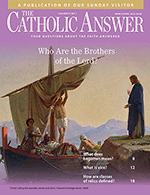
My husband kindly called me at work yesterday to tell me that the March/April 2013 issue contained a feature article written by me! "Believers and Patriots: What is colonial Maryland's legacy of religious freedom?" by Stephanie A. Mann. (Page 30 of The Catholic Answer Magazine; subscription required for on-line access.) It is a very well illustrated article. I wrote it during the Fortnight for Religious Freedom last summer and start off with the installation Mass homily of Archbishop William Lori in Baltimore, Maryland:

On May 16, 2012, Bishop William Lori, the chairman of the U.S. Conference of Catholic Bishop’s Ad Hoc Committee for Religious Liberty, was installed as the Archbishop of Baltimore.

In his homily at his installation Mass, he stressed the need to defend religious liberty, harkening to the foundation of the oldest diocese in the United States of America and its first bishop: “We defend religious liberty . . . because Archbishop John Carroll’s generation of believers and patriots bequeathed to us a precious legacy that has enabled the Church to worship in freedom, to bear witness to Christ publicly, and to do massive and amazing works of pastoral love, education and charity in ways that are true to the faith that inspired them in the first place.”

Archbishop John Carroll’s “generation of believers and patriots” were heirs to the great Maryland experiment in religious liberty in the middle of the 17th century — an experiment that did not last then and has not received the attention it deserves since.

George Calvert founded the Maryland colony as a commercial venture and to demonstrate that it was possible for a person to be a Catholic and loyal to the monarch, a combination long thought impossible in England. He and his heirs struggled to establish the Maryland colony and to maintain religious liberty in its laws and culture. They were swimming against the tide of European religious settlements: subjects were expected to go with the flow of their sovereign’s religion.

Next Saturday, March 9, the Kansas Authors Club District 5 monthly meeting is a read-around by members, and I plan to read from this article. I will also have my book for sale, and distribute information about the Catholic Martyrs of England pilgrimage. The meeting is held at the Wichita Public Library Rockwell Branch, 5939 E. 9th Street, Wichita, KS, 2:00- 4:00 pm--meetings are free and open to the public, so if you're in Wichita, please feel welcome to attend. Refreshments are served!

Thursday, November 22, 2012

A Prayer for Thanksgiving

The first bishop in the United States of America (Baltimore, Maryland), later Archbishop, John Carroll wrote this prayer November 10, 1791, to be recited in parishes throughout his diocese.

We pray, Thee O Almighty and Eternal God! Who through Jesus Christ hast revealed Thy glory to all nations, to preserve the works of Thy mercy, that Thy Church, being spread through the whole world, may continue with unchanging faith in the confession of Thy Name.

We pray Thee, who alone art good and holy, to endow with heavenly knowledge, sincere zeal, and sanctity of life, our chief bishop, Pope N., the Vicar of Our Lord Jesus Christ, in the government of his Church; our own bishop, N., all other bishops, prelates, and pastors of the Church; and especially those who are appointed to exercise amongst us the functions of the holy ministry, and conduct Thy people into the ways of salvation.

We pray Thee O God of might, wisdom, and justice! Through whom authority is rightly administered, laws are enacted, and judgment decreed, assist with Thy Holy Spirit of counsel and fortitude the President of these United States, that his administration may be conducted in righteousness, and be eminently useful to Thy people over whom he presides; by encouraging due respect for virtue and religion; by a faithful execution of the laws in justice and mercy; and by restraining vice and immorality. Let the light of Thy divine wisdom direct the deliberations of Congress, and shine forth in all the proceedings and laws framed for our rule and government, so that they may tend to the preservation of peace, the promotion of national happiness, the increase of industry, sobriety, and useful knowledge; and may perpetuate to us the blessing of equal liberty.

We pray for his excellency, the governor of this state, for the members of the assembly, for all judges, magistrates, and other officers who are appointed to guard our political welfare, that they may be enabled, by Thy powerful protection, to discharge the duties of their respective stations with honesty and ability.

We recommend likewise, to Thy unbounded mercy, all our brethren and fellow citizens throughout the United States, that they may be blessed in the knowledge and sanctified in the observance of Thy most holy law; that they may be preserved in union, and in that peace which the world cannot give; and after enjoying the blessings of this life, be admitted to those which are eternal.

Finally, we pray to Thee, O Lord of mercy, to remember the souls of Thy servants departed who are gone before us with the sign of faith and repose in the sleep of peace; the souls of our parents, relatives, and friends; of those who, when living, were members of this congregation, and particularly of such as are lately deceased; of all benefactors who, by their donations or legacies to this Church, witnessed their zeal for the decency of divine worship and proved their claim to our grateful and charitable remembrance. To these, O Lord, and to all that rest in Christ, grant, we beseech Thee, a place of refreshment, light, and everlasting peace, through the same Jesus Christ, Our Lord and Savior. Amen.

(photo credit: wikipedia)

Happy Thanksgiving!

Monday, October 15, 2012

Pilgrims and Park Rangers; Burning Books and Remembering

Image Catholic Books sent me a copy of The Right to be Wrong: Ending the Culture War over Religion in America by Kevin Seamus Hasson, the founder and chairman of the Becket Fund for Religious Liberty, in connection to a book giveaway, and for my opinion of the book.

I found it to be fascinating read because 1) it made connections for me with my study of the English Reformation and its aftermath, including the affects of religious matters in England on colonial New England, and 2) I was reading--I think for the first time ever!--Fahreinheit 451 by Ray Bradbury, and again, the conflict that Hasson frames by using the Pilgrims on one side and the Park Rangers on the other side of the religious culture war in 21st century America resonated for me. It seemed to me that whoever was in charge of things in Bradbury's dystopia, they were both Pilgrims and Park Rangers, using entertainment and distraction to control people--with a message of nothingness and a public square empty of thought and freedom.

I liked Hasson's use of history to present his argument, at first focused on the Pilgrims, the Puritan and Pilgrim English emigrants who left their homeland to found colonies where THEY could practice their religion freely--but no one else could practice any different faith. Then he introduces the Park Rangers, mostly by citing different court cases, who don't want ANYONE to practice ANY faith in the public square. Along the way, Hasson identifies another crucial difference: between government toleration of different religion(s) and government recognition and protection of the human right to religious freedom. He even cites what I have regarded as the Calvert's Maryland colonial experiment in religious freedom and recognition of religious plurality as a case of toleration, because it was not grounded in the Lords Baltimore recognizing the basic human freedom of conscience and religious practice, but in their more limited view that their governance could arrange this toleration and plurality--so much so, that as I noted from Papist Patriots, they limited free speech, with a list of names the colonists could not call each other. Hasson continues this discussion of tolerance vs. freedom's rights through the history of the First Amendment of the Bill of Rights, and the application of those rights in the States through the Fourteenth Amendment.

On my Radio Maria US radio show on October 13, I discussed this difference between tolerance and freedom of religion in the context of the Emancipation of English Catholics in 1829, which was not a recognition of human freedom but a legal removal of penal and recusant burdens. The proof of that--which I understood more fully after reading Hasson's book--is the restrictions on Jesuit and other orders Parliament included in the Act. The government gave freedom with one hand and took it away with the other!

From the Becket Fund website:

Becket Fund founder Seamus Hasson’s definitive book on religious liberty is now available for purchase in paperback.

Heralded by many as “the best discussion of religious liberty” available, “The Right to Be Wrong” offers an invaluable–and easy to read–examination of the fundamental right of all people to maintain the right to be wrong.

After 20 years of defending the free expression of nearly every religious tradition imaginable: Jews, Christians, Muslims, Buddhists, Sikhs, Native Americans and even Zoroastrians, Hasson dissects stories from both his career at the Becket Fund and American history that illustrate the trenches of the religious liberty culture war.

In one corner are the “Pilgrims,” referencing the early Americans of Plymouth Colony who “thought only the truth was permissible in public” and so restricted the rights of those who disagreed with their definition of truth. In the other corner are “Park Rangers,” a nick-name (with a hilarious back-story) for bureacrats and organizations who think freedom means erasing beliefs from the public square, no matter how harmless.

Pilgrims and Park Rangers, in one form or another, have fought over the place of faith in society since the founding of our country. To end this culture war we must, as Hasson thoroughly points out, defend the free expression of all faiths, even if we disagree with them. “On any given day, I think most of my clients are wrong,” he says in the book’s introduction. “But I firmly believe that, in an important sense, they have the right to be wrong.”

This is the bedrock principle of the Becket Fund, and precisely the reason why we have become the premiere religious liberty law firm for defending the free expression of all, regardless of faith or conviction. To us, there is no better way than this.

I appreciated Hasson's argument and am still thinking about his final discussion of how we can have "a right to be wrong", which he also expresses in the context of The Becket Fund's efforts: “On any given day, I think most of my clients are wrong.  But I firmly believe that, in an important sense, they have the right to be wrong.” This is a provocative statement and Hasson avers that he can believe it without adopting what Blessed John Henry Newman would call the "anti-dogmatic principle of liberalism in religion" aka relativism:

Liberalism in religion is the doctrine that there is no positive truth in religion, but that one creed is as good as another, and this is the teaching which is gaining substance and force daily. It is inconsistent with any recognition of any religion, as true. It teaches that all are to be tolerated, for all are matters of opinion. Revealed religion is not a truth, but a sentiment and a taste; not an objective fact, not miraculous; and it is the right of each individual to make it say just what strikes his fancy. Devotion is not necessarily founded on faith. Men may go to Protestant Churches and to Catholic, may get good from both and belong to neither. They may fraternise together in spiritual thoughts and feelings, without having any views at all of doctrine in common, or seeing the need of them. Since, then, religion is so personal a peculiarity and so private a possession, we must of necessity ignore it in the intercourse of man with man. If a man puts on a new religion every morning, what is that to you? It is as impertinent to think about a man’s religion as about his sources of income or his management of his family. Religion is in no sense the bond of society.

I think what Newman describes as liberalism in religion ends up in the toleration of religion that Hasson identifies as an ineffective response to religious plurality. Hasson develops an argument that religion is "[a] bond of society" because human beings by nature are religious (for example, when we celebrate something--say Christmas--we want to celebrate publicly, not in hiding as though Puritan soldiers were searching for violations of Parliament's law against Christmas). Hasson argues that we cannot ignore religion "in the intercourse of man with man" and he certainly wants us and urges us to get beyond government merely tolerating different religious practice--it's a fascinating dilemma.

More on Fahrenheit 451 tomorrow.

Monday, June 18, 2012

Some Current Events

Four Items of Note:

The 50th Annual International Eucharistic Congress appears to have been a great success in Ireland: crowds larger than expected with international pilgrimages encouraging the Irish Catholics who have been through a rough time with the revelations of abuse by both priests and religious and inaction by the bishops. The program of events began with Mass on Corpus Christi Sunday and wrapped up yesterday: Masses, Eucharist Processions and presentations on the Most Holy Body and Blood of Jesus and the other Sacraments, including Reconciliation.

The third Personal Ordinariate for Anglicanorum Coetibus (groups of Anglicans) has been established in Australia: Our Lady of the Southern Cross. Former Anglican bishop Harry Entwistle is the first Ordinary (although, since he is married, he will not be ordained a bishop)--he's not just a former Anglican bishop, however. He was a bishop (since 2006) of the Anglican Catholic Church in Australia, which is part of the Traditional Anglican Communion.

And finally, the really big news: my husband and I went to see For Greater Glory this weekend. I've been writing and talking about the connections between the Cristeros crisis and the English Reformation, but after watching the movie, one of the great distinctions between the two really came to me: The spirit of irreligion and, indeed, the animus and fear of religion as an influence in society that animated the Calles oppression of the Church. During the English Reformation and its aftermath, the English people came to fear Catholicism and Catholics (and exported that fear among the emigrants sent to New England) but both Anglicans and Catholics in England agreed that religious faith was essential to England. The essential religious faith was Christianity; the issue was which Christian church should be at the center of the culture: the Church of England or the Roman Catholic Church (or even the Reformed Church). For Greater Glory begins with President Calles warning against the dangers of the Church to the State, so he makes the State a grave danger to the Church.

Like any historical epic, the movie had to compress some timelines and smooth out some complexities, yet it expressed the sweep of the events during the 1920s. For instance, President Calles remains the main antagonist in the conflict with Church, yet he was out of office by the time the peace treaty negotiated with input from Dwight Morrow in 1929. Although the end titles might make the audience think about the aftermath, the movie ends with the good news that the treaty allows the Church to function again: the interdict Pope Pius XI proclaimed was lifted, and the church bells rang again in Mexico. Yet even after the treaty was signed, government oppression continued. The hint of trouble is that Tulita Gorostieta, widow of  General Enrique Gorostieta, had to remain in hiding four years after the end of the war, as one of the closing titles informs us.

It's an effective movie--this is the review that I thought summarized the film's ethos:

Like Steven Spielberg’s “War Horse,” “For Greater Glory” is a film displaced in time. This historical adventure feels like a fifty-year-old film minus Charlton Heston. Director Dean Wright (a visual effects master on films like “Lord of the Rings” and “Titanic”) keeps things old fashioned but never crosses the line to pastiche. With sun-soaked cinematography, beautiful panoramic vistas, a lush James Horner score and multitudes of idealist characters and pious speeches, “For Greater Glory” feels like a war movie from a much more innocent time. Though Wright deftly uses that old Hollywood glory against us; he alternates between Hallmark card sentimentality and raw contemporary violence. As the war progresses, the film becomes increasingly violent but never loses its classic film visage, which, whether intentional or not, is eerie and memorable.

Finally, EWTN will be broadcasting a series on The History of Catholicism in the United States by Father Charles Connor tonight -- tomorrow night's episode will focus on Maryland, I'm sure, as the title is "The British Colonies".

Tuesday, May 15, 2012

American English Catholics of the Revolutionary Era

Based on the Introduction, available in this Google book preview, Papist Patriots: The Making of an American Catholic Identity by Maura Jane Farrelly from Oxford University Press looks like a fascinating study (I've ordered my copy, you can be sure):

"The persons in America who were the most opposed to Great Britain had also, in general, distinguished themselves by being particularly hostile to Catholics." So wrote the minister, teacher, and sometime-historian Jonathan Boucher from his home in Surrey, England, in 1797. He blamed "old prejudices against papists" for the Revolution's popularity - especially in Maryland, where most of the non-Canadian Catholics in British North America lived.
Many historians since Boucher have noted the role that anti-Catholicism played in stirring up animosity against the king and Parliament. Yet, in spite of the rhetoric, Maryland's Catholics supported the independence movement more enthusiastically than their Protestant neighbors. Not only did Maryland's Catholics embrace the idea of independence, they also embraced the individualistic, rights-oriented ideology that defined the Revolution, even though theirs was a communally oriented denomination that stressed the importance of hierarchy, order, and obligation. Catholic leaders in Europe made it clear that the war was a "sedition" worthy of damnation, even as they acknowledged that England had been no friend to the Catholic Church. So why, then, did "papists" become "patriots?"
Maura Jane Farrelly finds that the answer has a long history, one that begins in England in the early seventeenth century and gains momentum during the nine decades preceding the American Revolution, when Maryland's Catholics lost a religious toleration that had been uniquely theirs in the English-speaking world and were forced to maintain their faith in an environment that was legally hostile and clerically poor. This experience made Maryland's Catholics the colonists who were most prepared in 1776 to accept the cultural, ideological, and psychological implications of a break from England.

In the Introduction, Farrelly begins a re-examination of John Courtney Murray's analysis of how Catholics could fit into the pluralistic society of the modern United States; from reading it on-line it seemed to me that she was questioning the historical facts on which he based his confident trust in the moral and social structures of U.S. culture and government supporting Catholic morality based upon natural law and revelation. Farrelly seems prepped for deeper investigation into the experience not only of English Catholic colonists in Maryland, but of English Catholics in their homeland during the Stuart and Hanoverian dynasties. My copy should arrive tomorrow and I look forward to diving into it soon. When I come up for air I'll write a review.

Monday, November 14, 2011

Perfect Timing: Charles Carroll and the Maryland Bishops

Charles Carroll of Carrollton, last surviving signer of the Declaration of the Independence, died on November 14, 1832. Just in time for the anniversary of his death, the Catholic bishops of Maryland issued a statement on protecting religious liberty. EWTN's National Catholic Register provides some context:

BALTIMORE (CNA)—Religious freedom is fundamental to a free society, but some political and cultural trends are threatening that freedom, the Catholic bishops of Maryland said in a new statement.

“Efforts to restrict the rights of individuals and institutions because of their religious or moral beliefs are on the rise here in Maryland and around the nation,” the bishops wrote.

“Religious liberty — a right rooted in our human dignity and protected by the First Amendment to the U.S. Constitution — is being silently and subtly eroded.”

The 12-page document, titled “The Most Sacred of All Property: Religious Freedom and the People of Maryland,” was signed by Cardinal Donald Wuerl, archbishop of Washington; Archbishop Edwin O’Brien, the apostolic administrator of Baltimore; and Bishop W. Francis Malooly of Wilmington, Del.

The document took its title from American Founding Father James Madison, who called conscience “the most sacred of all property” and its exercise “a natural and unalienable right.”


The Acton Institute reminds us of all that Charles Carroll risked and all he hoped to gain when he signed the Declaration of Independence:

When the signatories of the Declaration of Independence pledged their “lives, fortunes, and sacred honor,” few men had more to lose than Charles Carroll of Carrollton. A wealthy landowner, businessman, and member of a prominent Maryland family, Carroll risked the confiscation of his estate and the loss of his life if the British had prevailed. Yet when asked if he would sign or not, he replied, “Most willingly,“ and ratified what he called ”this record of glory.” Reflecting on that act fifty years later, Carroll–by then the last surviving signer–concluded that the civil and religious liberties secured by the Declaration and enjoyed by that present generation were “the best earthly inheritance their ancestors could bequeath to them.”

As a Roman Catholic–the only one to sign the Declaration–Carroll also had much to gain. Though many American colonists harbored intense suspicion toward Catholics (it was widely believed that Catholic doctrine was incompatible with republicanism), Carroll and his contemporary co-religionists presciently perceived that the American understanding of liberty entailed not only political and economic freedom but religious freedom as well.


It's too bad the writers of the Maryland bishops' statement did not reference Charles Carroll and the Carroll Family in the document!

Saturday, September 17, 2011

Constitution Day, Daniel Carroll, Thomas Fitzsimmons, and "Bleeding Kansas"

Today is Constitution Day in the U.S.A., although it was really "celebrated" on September 16. Here is a link to the official website, which includes profiles of Daniel Carroll and Thomas Fitzsimmons, the two Catholic signers of the Constitution. Carroll was the cousin of Charles Carroll of Carrolltown and brother of John Carroll, Jesuit priest (until the Society of Jesus was suppressed by the pope) and first Catholic bishop in the U.S.A. More about the Carroll family here:

Charles Carroll of Carrollton (1737-1832) was the most illustrious and best-known of the Carrolls. He was the only signer whose property — Carrollton — was mentioned in the Declaration of Independence. Carrollton was the 10,000-acre estate in Frederick County, Maryland, that Charles Carroll's father had given him on his return to America from his education in Europe.

At the time he signed the Declaration, it was against the law for a Catholic to hold public office or to vote. Although Maryland was founded by and for Catholics in 1634, in 1649 and, later, in 1689 after the Glorious Revolution placed severe restrictions on Catholics in England, the laws were changed in Maryland, and Catholicism was repressed. . . .

Daniel Carroll of Rock Creek (1730-1796) was a member of the Continental Congress (1781-1783), and a signer of the Articles of Confederation. He was a delegate to the Constitutional Convention and one of only two Catholic signers of the United States Constitution. (The other Catholic signer was Thomas Fitzsimons of Pennsylvania.) At the Constitutional Convention, Daniel Carroll played an essential role in formulating the limitation of the powers of the federal government. He was the author of the presumption — enshrined in the Constitution — that powers not specifically delegated to the federal government were reserved to the states or to the people.

Daniel Carroll later became a member of the first United States Congress (1789-1791). He was also a member of the first Senate of Maryland, where he served up to the time of his death. He was appointed by Washington as one of the first three commissioners of the new federal city that is now known as the District of Columbia. In today's terminology, he would have been considered the mayor of Washington, D.C.

John Carroll (1735-1815), Daniel Carroll's younger brother, was educated in Europe, joined the Jesuit order, and was ordained a priest. He founded a private school for boys and named it after the town where it was located, Georgetown, a port on the Potomac River that later became part of Washington, D.C. He went on to be elected — by all the Catholic priests in America — to become America's first Catholic bishop. He later became archbishop of Baltimore. In any procession of American bishops, the archbishop of Baltimore always goes last in recognition of its role as America's oldest diocese. In 1789, John Carroll founded the college in Georgetown that later became known as Georgetown University.


I mentioned the Carroll family attending the Catholic college in St. Omers founded by Father Robert Parsons in Supremacy and Survival: How Catholics Endured the English Reformation.

Finally, I want to report on a fascinating lecture I attended this week at Friends University here in Wichita. Friends U. is a Quaker university--they have a chorus called "The Singing Quakers". Anyway, the Garvey Institute of Law at Friends co-sponsored a Constitution Day Program Tuesday evening on "How much did Kansas Really Bleed? Kansas, the Constitution, and the Civil War in History and Today" with support from the Kansas Humanities Council. The speaker was Dr. Brian Craig Miller, Assistant Professor of History at Emporia State University. His talk was excellent, including opportunities for the audience to answer questions and discuss issues. One of our other universities and my alma mater will present a Constitution Day NEXT week. More details here.

Happy Constitution Day!

Oh, and the answer to the question "How much did Kansas Really Bleed?"--for all the exagerration of the newspapers back east at the time: not so much. Fifty-six (56) were killed during the Bleeding Kansas period from 1854 to 1861 (yes, 2011 is Kansas's sesquescentennial year!). During the Civil War, 20,097 Kansas men signed up for the Union Army--more than 8,000 were killed. Kansas always exceeded the quota for enlistment during the Civil War by two or three times.

Saturday, August 27, 2011

Charles Calvert, Third Baron Baltimore

Grandson of George Calvert, First Baron Baltimore and son of Cecilius Calvert, Second Lord Baltimore, Charles Calvert was born on August 27, 1637. He would succeed his father as Governor of Maryland in 1675, but he would lose the colony after the Glorious Revolution of 1688. His son, Benedict Leonard, Fourth Baron Baltimore, would become an Anglican to regain the family claim to Maryland but died only two months after Charles in 1715. Benedict's son Charles (the Fifth) received the governorship of the colony back from King George I. Unfortunately, Charles the Fifth's son Frederick would be the Sixth and last Baron Baltimore.

But back to today's birthday boy: Charles Calvert's mother was Anne Arundell, whose father was Thomas Arundell, the First Baron of Wardour, a Catholic nobleman who endured imprisonment and suspicion for his faith during Elizabeth I's reign. Charles' grandfather had reverted to the Catholicism of his youth when he resigned as King James I's Secretary of State in 1625 and then began the process of founding a colony on the North American continent that would allow religious freedom. His father Cecilius would implement that vision and Charles struggled to keep it alive.

John D. Krugler, writing about Charles Calvert's vissicitudes in Maryland in his book English and Catholic: The Lords Baltimore in the Seventeenth Century, notes that the Third Lord Baltimore was just not the diplomat and leader his father and grandfather had been. He may have been too complacent about the success of religious toleration and Catholicism in Maryland. What destroyed the great Maryland experiment in religious freedom was not Calvert's complacency, however, but England's anti-Catholicism. After the Glorious Revolution of 1688, the Anglicans in Maryland staged a coup, William and Mary took over the colony, and the Church of England became the official state church. Catholics were not permitted the freedom to worship and the usual round of penal laws imposed. Sad ending to a successful, though always delicate, effort to take the state out of the individual's choice of church and religion.