Showing posts with label The Catholic Answer Magazine. Show all posts

Saturday, December 6, 2014

The Wreck of the Deutschland: A Kulturkampf Anniversary

Today is St. Nicholas' Day--but it is also the anniversary of the Wreck of the Deutschland on December 6, 1875--and I wrote about that naval disaster in the context of the Kulturkampf in Germany for OSV's The Catholic Answer Magazine in this year's November/December issue:

and five Franciscan nuns drowned that night, caught in the perfect storm of the Prussian Kulturkampf instituted by Chancellor Otto von Bismarck.

They had left their convent in Salzkotten, Westphalia, embarking on a voyage to New York and thence to Wheaton, Ill., from the port at Bremerhaven, because Bismarck’s government had passed the Congregation Law of 1875, abolishing religious orders. The Catholic convert and poet Jesuit Gerard Manley Hopkins wrote a narrative poem titled “The Wreck of the Deutschland” commemorating the Franciscans’ deaths (not published until 1918), and the Franciscan Sisters of Wheaton, Ill., honor them every year on the anniversary of their deaths in the cemetery of St. Patrick’s Church in Leytonshire, where four of the five were buried.

Prussian State vs. Catholic Church

Why were these teaching sisters on their way to the United States? Why was Bismarck’s government passing laws restricting Catholic religious orders and other aspects of Catholic life in Prussia through the program of Kulturkampf? The German word Kulturkampf is translated in English as “culture struggle.” The answers to those questions provide us greater insight into the relationship between Church and state and the issues of religious freedom, as well as the struggle Catholics faced in 19th-century Germany.

Otto von Bismarck had served in various state offices in the German Empire, culminating in the office of chancellor from 1871 to 1890 after he led the effort to unify the empire under Prussian control. After the First Vatican Council defined the doctrine concerning infallibility of the pope in matters of faith and morals, Bismarck and his anti-Catholic political allies feared the loyalty and the power of Catholics in mostly Lutheran Germany. Bismarck thought that Protestant Prussia faced a culture war and was under attack by Catholics — a Kulturkampf.

Read the rest here.

The five sisters who perished this night were:

Sr M. Henrica Fassbänder
Sr M. Barbara Hültenschmidt
Sr M. Norberta Reinkober
Sr M. Brigitta Damhorst
Sr M. Aurea Badziura

More information about their mission here.

Sunday, October 5, 2014

A Teaser for November/December


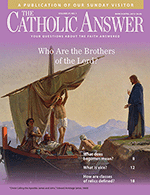
I know it's just the first of October, but I noticed the cover for the November/December issue of OSV's The Catholic Answer Magazine and saw the headline in the lower right corner: "What was the Kulturkampf?" I attempt to answer that question in this forthcoming article on Bismarck's German Culture Wars! I even work in references to Blessed John Henry Newman and Gerard Manley Hopkins! Can't wait to see it in print (but I have to, of course). I'll post it when the issue becomes available on line.

Sunday, September 14, 2014

Lift High the Cross--The Triumph of the Cross


For this Feast of the Triumph of Exaltation of the Cross, I refer you to my article published in the September/October 2013 issue of OSV's The Catholic Answer Magazine, available on-line without subscription:

Each September the Church celebrates the feast of the Exaltation of the Holy Cross on Sept. 14, and the memorial of Our Lady of Sorrows follows on Sept. 15.

The pairing of these celebrations, even in their different levels on the liturgical and sanctoral calendars, properly guides us in our levels of devotion and love of our Savior and Our Lady. He is our Divine Redeemer, to be worshiped and adored; she is His first disciple and our example. Both of these celebrations have a long history and are worthy of meditation.

We have been listening to a recording of Spanish Choral religious music, O Crux, by Coro Cervantes, which features the great Velasquez Crucifixion on its cover:

19th century Spanish music? Thorough research of Spanish Romantic music has unearthed some of Spain's most beautiful and sumptuous sacred choral music, with styles ranging from the unapologetic taste for Italian opera to the strictest counterpoint which can be found since the sixteenth century Spanish Golden Age.  This multiplicity of styles is reflected in works by Arriaga, Sor, Ledesma, Monasterio, Barbieri, Eslava, Bretón, Vives, Albéniz, etc. 

The liner notes explain how the Napoleonic invasion of Spain led to the destruction of the religious choral music tradition and how that destruction continued the 1851 concordat which "reduced the size of music chapels, abolished schools for child choristers and banned anyone who was not a clergyman from performing music in chapels"!

One of the tracks is Fernando Sors' O Crux:

O Crux ave, spes unica,
hoc Passionis tempore!
piis adauge gratiam,
reisque dele criminal.

Monday, May 19, 2014

Our Lady of Laus: Mercy and Reparation


Just a reminder that I'm on the Son Rise Morning Show this morning (a little after 7:45 a.m. Eastern) to discuss Our Lady of Laus, based on the article I wrote for OSV's The Catholic Answer Magazine:

In May 2008, Bishop Jean-Michel di Falco Leandri, the bishop of Gap in the French Alps, celebrated a special Mass to announce the Vatican’s approval of Marian apparitions in that diocese that occurred between 1664 and 1718.
 
Although the location of the apparitions to Venerable Benôite (Benedicta) Rencurel and the shrine founded there have been drawing pilgrims since the late 17th century, Our Lady of Laus is relatively unknown outside of France. The website for the shrine is available only in French and Italian, for example, and the nearest airport is in Grenoble, about 60 mountain miles away.


Read the rest here. Listen live here!

Sunday, May 18, 2014

Who Is Our Lady of Laus? Tune in Tomorrow to Find Out More


I'll be on the Son Rise Morning Show tomorrow after the 7:45 a.m. Eastern/6:45 a.m. Central transition--the last segment of the EWTN broadcast that morning--to talk about Our Lady of Laus (pronounced Low). I had never heard about Our Lady of Laus before Dr. Matthew Bunson asked me to write an article for OSV's The Catholic Answer Magazine! More about Our Lady of Laus and the special distinctions of these approved Marian apparitions in the south of France at the foot of the Alps in the vale of Laus.

Tuesday, February 25, 2014

The Holy Grail in "The Catholic Answer Magazine"


I mentioned last week that I would have another article in OSV's The Catholic Answer Magazine, in the March/April issue. I received my subscription copy in the mail on Saturday, and it's on-line now. Here's an excerpt--read the rest here:

If you’re aware of King Arthur and his Knights of the Round Table — if you’ve heard Richard Wagner’s opera Parsifal or seen movies such as “Indiana Jones and the Last Crusade” — you’ve heard of the Holy Grail.
That object of quest and romance, providing supernatural nourishment and healing, has a long history in literature and legend. Tales about the Holy Grail — as a stone or gem, as the chalice Jesus used, or as the platter on which the Passover lamb was served at the Last Supper before Jesus suffered and died on Calvary — appeared in French, English, German and Italian during the 12th and 13th centuries. The stories include mysterious connections with Joseph of Arimathea, the spear of Longinus (the centurion who pierced Christ’s side on the cross) and even the conversion of England. The Grail was also sometimes described as the cup in which Joseph of Arimathea caught the blood and water that poured from Christ’s side after Longinus pierced Him as He hung dead on the cross, a mysterious sign of the Sacraments of Baptism and the Eucharist and their source in the Sacred Heart of Jesus.

Thursday, February 20, 2014

Other Publications Tab


I have updated the Other Publications tab with new links to all the articles I've had published so far in OSV's The Catholic Answer Magazine. Editor Matthew Bunson told me that he'll be publishing another article he asked me to write in the March/April issue, and yet another in the May/June issue. OSV (Our Sunday Visitor) recently revamped their website and now allows visitors to see all content, regardless of print subscription. Dr. Bunson accepted another article recently, so I'll let you know when it will appear in print and on line. (The covers above are the issues when my article made the cover!)

Wednesday, January 15, 2014

Conscience, the Little Sisters of the Poor, and Blessed John Henry Newman

Since conscience is back in the news again with the matter of the Little Sisters of the Poor protesting against the violation of their conscience and their practice of religion by the HHS Contraceptive Mandates--and since I've just had an article on Blessed John Henry Newman's brilliant explanation of conscience in OSV's The Catholic Answer Magazine: I will be on the Son Rise Morning Show tomorrow morning (Thursday, January 16) at 7:45 a.m. Eastern/6:45 a.m. Central, etc). Please listen live here--podcasts should be posted here.

The crucial difference between the false idea of conscience--which Newman identified in the nineteenth century and has endured to the twenty-first-- and the true nature of conscience is the source and standard of the truth an individual conscience uses to discern what is to be done or not done. To quote my article:

Newman set out to demonstrate that individual Catholics were indeed free to follow the guidance of their consciences. He also showed that conscience is “the voice of God in the nature and heart of man” that needs “training and experience . . . for its strength, growth and due formation.” He says conscience as a natural voice of God’s eternal law is an “aboriginal Vicar of Christ.” But then he contrasts this true definition of conscience to its counterfeit: the common view of conscience as something completely free of any duty to anything outside itself.

In a great expressive passage he shows how this view means nothing more than “the right of self-will,” with no reference to truth. In the same way that Newman would speak of the spirit of “liberalism in religion” in his Biglietto speech of 1879, when Pope Leo XIII had made him a cardinal, he notes this view of conscience means the individual has become the judge of religion, setting the standards of critiquing how well a church’s teaching conforms with his own view. For 18 centuries, Newman comments, “the old, true, Catholic meaning of the word” had been the norm — to Catholics of the past, this counterfeit is unrecognizable.


You may read the rest here. I hope you can listen to the broadcast.

Wednesday, January 1, 2014

January/February 2014 Articles

In the reverse type on the cover of the January/February 2014 issue of the St. Austin Review, you might discern my name:

 
Then if you access the Table of Contents for the issue, you'll see my article on Pope Benedict's English Catholic Legacy listed "Inter Alia". StAR is a print review with limited on-line access, but I have submitted some texts to supplement the article on the StAR blog.
 
In a way, there's a connection between that StAR article and my article in the January/February 2014 issue of OSV's The Catholic Answer Magazine:
 
 
"How Can We Hear the "Voice of God"? Blessed John Henry Newman and conscience" is illustrated with a picture from the 2010 beatification of John Henry Newman. OSV recently updated its website and now all the articles I've written for TCA are available on-line!
 
Happy New Year! 

Saturday, September 14, 2013

The Triumph of the Cross


If you subscribe to OSV's The Catholic Answer Magazine, you could be reading my article on "The Cross Triumphant: What are the Feasts of the Holy Cross and Our Lady of Sorrows?" today on this Feast of the Exaltation of the Cross. If you don't subscribe to that magazine, you could instead read this article from last year's edition of PraytheMass.org, on which The Catholic Answer Magazine article was based (Dr. Bunson requested I rewrite the article for him).

The Church presents us with another beautiful matching of a Feast of Our Savior and a Memorial of Our Mother Mary this month (like the pair of Hearts, Sacred and Immaculate, following the Solemnity of Corpus Christi in June). The Feast of the Exaltation of the Holy Cross is on September 14; the memorial of Our Lady of Sorrows follows on September 15. The pairing of these celebrations, even in their different levels on the liturgical and sanctoral calendars, properly guides us in our devotion and love of Our Savior and Our Lady. Both celebrations have a long history and are worthy of meditation.

The Feast of the Triumph of the Cross was observed in Rome in the late seventh century to commemorate the recovery of the Holy Cross by the Byzantine Emperor Heraclius in 629. St. Helena, Constantine’s mother, had found the True Cross in Jerusalem in the fourth century but the Persians had captured it and returned it after Heraclius defeated the Persian king Khosrau. The emperor returned it to Jerusalem, and this feast recalls that event.

But on a deeper level, of course, the Feast recalls Jesus’ triumph over death and the fulfillment of His great statement, “When I am lifted up from the earth, I will draw everyone to myself.” (John 12:32, which serves as the Communion Antiphon). The liturgy of the Mass for this Feast includes both triumph and sorrow in the readings and prayers, since Jesus both suffers His Passion and defeats sin and death. From the Book of Numbers, the First Reading recalls the story of Moses and the bronze Seraph, raised on a pole—when the people Israel who had been grumbling against God for their sufferings, looked up to the serpent, they were healed of the serpent bites God had sent to afflict them.

Read the rest here.

The painting above is one of Ruben's depictions of the Descent from the Cross. During one of our visits to Belgium, I went on a day tour to Antwerp and saw the great Raising of the Cross, Descent from the Cross, and Resurrection paintings in the Cathedral of Our Lady.

Friday, May 31, 2013

The Dialogues of the Carmelites at the Met Opera


I mentioned yesterday that The Catholic Answer Magazine's cover illustration for my article on the Carmelites of Compiegne was a scene from Poulenc's opera The Dialogues of the Carmelites. The opera was recently revived at the Metropolitan Opera in NYC for three performances, in the John Dexter staging that dates from 1977 (the year I graduated from high school!).

The Wall Street Journal ran this Associated Press review:

One of the most harrowing final scenes in all of opera is the ending of Poulenc's "Dialogues of the Carmelites," when the nuns condemned by the French Revolution walk one by one to the scaffold, singing a gradually thinning chorus punctuated by the slashing sounds of a guillotine.

So emotionally drained was the audience at Saturday afternoon's performance at the Metropolitan Opera that silence lingered in the house for several moments after the curtain fell. Only then did tumultuous applause erupt for the terrific performance that had just taken place. . . .

Dexter's staging looks barely touched by time and remains a marvel of simplicity, starting with the opening image of 13 nuns lying prostrate with arms outstretched on a raised wooden platform shaped like a cross. It reportedly cost less than $100,000 at the time — mere pocket change compared with many lavish and less effective productions that have come and gone from the Met stage since.

And Terry Teachout commented further on the Dexter staging in another article:

The Metropolitan Operarecently presented a three-performance run of "Dialogues of the Carmelites," Francis Poulenc's 1957 opera about a group of nuns who were guillotined in the French Revolution. It was a revival of John Dexter's 1977 production, not a new staging, but I didn't hear anyone complaining. Mr. Dexter's "Dialogues" is universally regarded by connoisseurs as one of the Met's greatest theatrical achievements. It's also, so far as I know, the only stage production by Mr. Dexter, who died in 1990, that continues to be performed. Since he was a much-admired director who was responsible, among other things, for the original Broadway productions of "Equus" and "M. Butterfly," that makes "Dialogues" important by definition.

In a way, "Dialogues" is a kind of operatic time capsule. Long an international byword for artistic conservatism, the Met was notoriously slow to embrace contemporary stagecraft. Not so the modern-minded Mr. Dexter, who had become the company's director of productions in 1974 and was endeavoring to update its creaky style. The stark, monumental-looking set for "Dialogues," which was designed by David Reppa, was a slap in the face to old-fashioned operagoers who preferred big, fancy sets with imitation trees. Today it looks classic, in much the same way that such masterpieces of midcentury modernism as, say, Mies van der Rohe's Seagram Building or Frank Lloyd Wright's Guggenheim long ago ceased to look "modern," at least in the informal sense that most people have in mind when they use the word. They aren't shocking anymore—they're just beautiful.

The Metropolitan Opera provides a program .pdf with a synopsis, analysis and performance history, including notes about its fascinating creative provenance with a libretto by the composer, based on a screen play by Georges Bernanos, based a on a novella by Gertrude von le Fort. More on the opera here.

Thursday, May 30, 2013

Preview of July/August "The Catholic Answer Magazine"


There's my story about the Blessed Carmelite Martyrs of Compiegne on the cover of the July/August issue--illustrated with a scene from Poulenc's Dialogues of the Carmelites!

Watch this space for more information!

Just a little sample from the beginning of the article:

A visitor in Paris today might arrive at the Place de la Nation, a hub of transportation and commerce on the right bank of the Seine River and never know about the Revolutionary deeds of blood committed there.

Restaurants, taxis and buses ring around the Place de la Nation and its statue depicting Marianne, the symbol of the Republic, while locals walk their dogs in the park. But here, in the last hot summer of the French Revolution’s Reign of Terror, on July 17, 1794, fourteen nuns, three lay sisters and two servants of the Carmelite house of Compiègne died for their Catholic Faith.

What brought them to such a bloody end beneath the blade of the guillotine the day after the Feast of Our Lady of Mount Carmel? The answer might be surprising if we presume the ideals of liberty, fraternity and equality truly summarize the spirit of the French Revolution. After the fall of the traditional, absolute monarchy and the rise of the National Assembly with a constitutional monarchy in 1789, the state attacked the Catholic Church, confiscating churches and closing convents. . . .

That introduction is based upon my pilgrimage to the site of the Carmelites' execution and to their place of burial at Cimitiere de Picpus (in November of 2010).

Saturday, March 2, 2013

Believers and Patriots in OSV's The Catholic Answer Magazine

My husband kindly called me at work yesterday to tell me that the March/April 2013 issue contained a feature article written by me! "Believers and Patriots: What is colonial Maryland's legacy of religious freedom?" by Stephanie A. Mann. (Page 30 of The Catholic Answer Magazine; subscription required for on-line access.) It is a very well illustrated article. I wrote it during the Fortnight for Religious Freedom last summer and start off with the installation Mass homily of Archbishop William Lori in Baltimore, Maryland:

On May 16, 2012, Bishop William Lori, the chairman of the U.S. Conference of Catholic Bishop’s Ad Hoc Committee for Religious Liberty, was installed as the Archbishop of Baltimore.

In his homily at his installation Mass, he stressed the need to defend religious liberty, harkening to the foundation of the oldest diocese in the United States of America and its first bishop: “We defend religious liberty . . . because Archbishop John Carroll’s generation of believers and patriots bequeathed to us a precious legacy that has enabled the Church to worship in freedom, to bear witness to Christ publicly, and to do massive and amazing works of pastoral love, education and charity in ways that are true to the faith that inspired them in the first place.”

Archbishop John Carroll’s “generation of believers and patriots” were heirs to the great Maryland experiment in religious liberty in the middle of the 17th century — an experiment that did not last then and has not received the attention it deserves since.

George Calvert founded the Maryland colony as a commercial venture and to demonstrate that it was possible for a person to be a Catholic and loyal to the monarch, a combination long thought impossible in England. He and his heirs struggled to establish the Maryland colony and to maintain religious liberty in its laws and culture. They were swimming against the tide of European religious settlements: subjects were expected to go with the flow of their sovereign’s religion.

Next Saturday, March 9, the Kansas Authors Club District 5 monthly meeting is a read-around by members, and I plan to read from this article. I will also have my book for sale, and distribute information about the Catholic Martyrs of England pilgrimage. The meeting is held at the Wichita Public Library Rockwell Branch, 5939 E. 9th Street, Wichita, KS, 2:00- 4:00 pm--meetings are free and open to the public, so if you're in Wichita, please feel welcome to attend. Refreshments are served!

Tuesday, March 20, 2012

Downton Abbey and Henry VIII

I just started watching the PBS Masterpiece Theatre series Downton Abbey during its second season. The building in which the show is filmed is obviously not an abbey, but it could be on former abbey land. That means that sometime in the sixteenth century, a noble bought the land and buildings from Henry VIII through his Vice Regent in Spiritual's Court of Augmentations. Monsignor Owen Campion of the Our Sunday Visitor newspaper recently reflected on that background in the power context of Henry VIII's reign:

Bringing into line the nobility and the religious communities, such as monasteries and convents that literally were sprinkled across the map of England, was something else. The monarch was not almighty.

Nobles owned, and often occupied, vast tracts of land. Untold thousands of people depended on them. For generations, nobles had developed ties with the people living on their lands or working for them. (Admittedly, not every circumstance was happy.)

The nobles inevitably were rich. The king needed revenues from taxes. Nobles sat in Parliament, in the House of Lords. The king needed their political support, especially in a matter then so revolutionary as breaking religious bonds with the pope.

Then there was the reality of the monasteries. The abbeys and convents were more than houses of prayer. They were magnets for local towns and regions. In them were schools. Often, there were hospitals, at least as such were known in the 16th century. In the monasteries, the poor found relief. They were centers of worship and devotion. Finally, many abbots sat in Parliament.

If unchecked, the monasteries very likely could frustrate the king as he sought to change religion in England.

So, he instituted a policy to dissolve the monasteries. It was an amazing, stupendous undertaking, as if Congress today ordered the closing of every college and university in this country. Brute force played a role. Resistance varied. For example, among the first martyrs of those days were Carthusians from an abbey. They would not acknowledge the king’s order separating the Church from Rome, so they were executed. . . .

As a result, the king in a relatively short period of time had at his disposal huge areas of land, once occupied by the monasteries, along with everything that the monasteries had owned.

A few of the monasteries were kept as Anglican churches, although the monks were expelled. Westminster Abbey is an example.

In many other cases, the king simply seized whatever had belonged to monasteries as his own. Then, on some occasions, he gave the land to nobles whom he wished to placate. Some real-life English nobles today own and occupy land once the site of a Catholic abbey.

In another OSV publication last year, I also wrote about the dissolution of the monasteries, in the November/December issue of The Catholic Answer Magazine: "Henry VIII's Achievement".

Monday, November 7, 2011

The Catholic Writers Guild Blog

Have I mentioned lately how great the Catholic Writers Guild is? Look at this great post developed by Larissa Hoffman, helping me promote:

~~Two radio interviews (on the Son Rise Morning Show and Kresta in the Afternoon);
~~My article in The Catholic Answer Magazine ("Henry VIII's 'Achievement': What was the Dissolution of the Monasteries?");
~~My book; and
~~This blog.

I'll say it again--if you are a Catholic writer, you should belong to and participate in this great organization! The next big event is the annual On-line conference: more info here.

Saturday, October 15, 2011

An Article in November/December's The Catholic Answer Magazine

I certainly hope you subscribe to Our Sunday Visitor's The Catholic Answer Magazine, because I have an article in the November/December issue. The article is titled "Henry VIII's 'Achievement': What Was the Dissolution of the Monasteries?"

Here's just a little sample:

In October, 1536 an army of commoners and gentry advanced from the north of England under banners marked with the Five Wounds of Christ.

Led by Robert Aske, a barrister, they were the Pilgrimage of Grace, protesting the Dissolution of the Monasteries and changes in religious practice since Henry VIII’s Reformation Parliament had proclaimed him “Supreme Head and Governor” of the Church.

There were too many of them—30,000 to 40,000—for Henry’s small mercenary army to handle. Henry’s agent, Thomas Howard, the Duke of Norfolk, pretended to hear their terms to stop the Dissolution, get rid of bad advisors like Thomas Cromwell and restore the freedom of the Church protected in the Magna Carta.


I will be on the air with Al Kresta on Kresta in the Afternoon on November 15 from 4:40 to 5:00 p.m. Eastern time (3:40 to 4:00 p.m. Central time) to discuss this article. I selected that date because it commemorates the execution of the last Abbots of Glastonbury and Reading in 1539. Locally, I will be making a presentation to the Serra Club (Metro chapter) that evening on the Catholic Martyrs of the English Reformation.

Tuesday, August 9, 2011

Kresta in the Afternoon Interview

If you missed my interview on Kresta in the Afternoon last week from the Catholic Marketing Network Trade Show/Catholic Writers Guild Conference, here is a link.

From the Kresta in the Afternoon blog:

"Second Topic - Supremacy and Survival
Stephanie Mann is the author of Supremacy and Survival - How Catholics Endured the English Reformation and has been a guest on the show in anticipation of the Pope's visit to the UK last year. Now she joins us in person here at the Catholic Marketing Network. She tells the story of the Catholic Church's survival and restoration in one land. It serves both as a lesson and a warning of the risks to faith and freedom when absolute power is given free reign. "

At the beginning of the interview, Al Kresta said Supremacy and Survival is "an outstanding book"; he enjoyed it and appreciated my approach and tone, highlighting my "strong academic sense for accuracy but you don't get bogged down in arcane academic debates" and commenting on my "strong sense of Catholic mission but without being triumphalistic or kicking people in the face".

Good recommendation, I think!

I hope to be on his show later in the year when The Catholic Answer Magazine publishes my article on the Dissolution of the Monasteries during Henry VIII's reign.