Showing posts with label University of Oxford. Show all posts

Tuesday, June 16, 2020

Adam de Brome, Founder of Oriel College, RIP

Adam de Brome, the founder of Oriel College of the University of Oxford, died on June 16, 1322 and was buried in St. Mary's the Virgin (then a Catholic Church). His DNB entry is brief:

founder of Oriel College, Oxford, of whose early life nothing is known, was rector of Hanworth in Middlesex in 1315, chancellor of Durham in 1316, archdeacon of Stow in 1319, and in the same year was made vicar of St. Mary in Oxford. He was also a clerk in chancery and almoner of Edward II. In 1324 he received the royal license to purchase a messuage [a dwelling house with outbuildings and land assigned to its use] and found a college in Oxford to the honour of the Virgin Mary. He obtained several benefactions from Edward II for his new foundation, which was to consist of a provost and ten fellows or scholars, who were to devote themselves to the study of divinity, logic, or law. He was appointed the first provost by the king in 1325, and drafted his statutes in the following year. The statutes bear a close resemblance to those which Walter de Merton had framed for Merton College. Brome died in June 1332, and was buried in St. Mary's Church, Oxford.

More about the founder of the college at Oriel's website.

Saint John Henry Newman would succeed Father Brome centuries later as the Vicar of the University Church of St. Mary's the Virgin in 1828, as an Anglican. As this introduction to an article on Newman and Oriel demonstrates, Newman's tenure as Tutor and Fellow at Oriel College was crucial to his development and leadership:

From 12 April 1822 when John Henry Newman was elected a Fellow until 3 October 1845 when he tendered his resignation to Provost Hawkins, Oriel College was to be the centre of Newman's life. As Newman later recorded:

he ever felt this twelfth of April, 1822 to be the turning point of his life, and of all days most memorable. It raised him from obscurity and need to competency and reputation. He never wished anything better or higher than, in the words of the epitaph, 'to live and die a fellow of Oriel'. Henceforth his way was clear before him; and he was constant all through his life, as his intimate friends knew, in his thankful remembrance year after year of this great mercy of Divine Providence, and of his electors, by whom it was brought about.

Newman went on to assert that but for Oriel, he would have been nobody, entirely lacking in influence. It was through Oriel (and the pulpit of the Oriel living of St. Mary the Virgin) that he was able to exert such a dominant religious and pastoral influence on his academic generation and those that followed. It was through Oriel that he would be in a position to emerge by 1833 as the well-known leader of that great movement of religious revival in the Church of England known as the ‘Oxford Movement’ or ‘Tractarianism’ (the name being coined in consequence of the series of Tracts for the Times published by Newman and his cohorts).


And this biographical sketch from the Pitts Theology Library at Emory University also demonstrates how crucial those Oriel years were to Newman:

. . . In 1822, he was elected as a fellow at Oriel, where he developed a friendship with Edward Bouverie Pusey (Mss. 064). On June 13, 1824, he was ordained as a deacon in the Anglican Church and, at Pusey's suggestion, became curate of St. Clement's, Oxford. In 1825, Newman served as vice-principal to Richard Whatley (Mss. 102) at St. Albans Hall. On May 29, 1825, he was ordained into the Anglican priesthood.

From 1826 to 1832 Newman served as a tutor at Oriel College, developing a close relationship with Pusey, John Keble . . . and Hurrell Froude. From 1827 to 1828 he served as public examiner in classics in the university's B.A. degree program. In 1828, he was appointed as vicar of the university church, St. Mary's. By the late 1820's Newman's evangelical, low-church, views were changing, assuming a more eccleastical, high-church, tone. On March 8, 1830, he was dismissed from the Church Missionary Society because of his opinions on Nonconformists and church control of society. Three months later Newman broke his last ties with the low church when he dissolved his relationship with the Bible Society.

From 1831 to 1832 Newman served as university select preacher. . . .

Newman was also the Chaplain of Oriel College's Chapel twice (1826-31,1833-35). 

So the founding of Oriel College by Adam de Brome was consequential for Newman, the Oxford Movement, and the Catholic Church. Oriel College certainly celebrates their former fellow and chaplain.

Image Credit: An image of Adam de Brome in a stained glass window in the hall of Oriel College, Oxford.

Thursday, February 1, 2018

Lawrence Humphrey, RIP

Lawrence Humphrey died on February 1, 1590. Not Blessed Lawrence Humphrey who was martyred at Winchester in 1591 because while delirious with a fever, he was overheard cursing Elizabeth and proclaiming her a heretic. When he recovered he was charged with treason, even though he could not remember saying what witnesses reported! He was hanged, drawn, and quartered anyway.

This Lawrence Humphrey, president of Magdalen College, Oxford, and dean of first Gloucester and then Winchester cathedrals, had some trouble with Elizabeth I too because he did not want to wear the surplice. As Thompson Cooper describes his career and beliefs in the Dictionary of National Biography:

Throughout his life Humphrey advocated advanced protestant opinions. He consequently obtained from the college on 27 Sept. 1553, soon after the accession of Mary, leave to go abroad, on condition that he should not depart from the realm without the royal license. He went first to Basle, and then to Zurich, and his name is subscribed to a letter from the protestant exiles at the latter place to their brethren at Frankfort, dated 13 Oct. 1554. On 24 Dec. 1554, and again on 15 June 1555, the college authorities gave him a further extension of leave, and at the same time helped him to defray the cost of his studies abroad. While at Zurich he associated with Parkhurst, Jewel, and other protestant exiles, and lodged in the house of Christopher Froschover, the printer (Zurich Letters, i. 11). He highly extols the hospitality and kindness of the magistrates and ministers there. As he continued abroad beyond the time for which leave had been granted, his name fell out of the list of fellows of Magdalen College before the July election in 1556. On 23 April 1558 he was admitted into the English protestant congregation at Geneva (Burn, Livre des Anglois à Genève, p. 11). In June 1559 he was living at Basle.

After the death of Queen Mary he returned to England. During his absence he had corresponded on theological subjects with the divines at Geneva, and brought back with him 'so much of the Calvinian, both in doctrine and discipline, that the best that could be said of him was that he was a moderate and conscientious nonconformist' (Wood, Athenæ Oxon. ed. Bliss, i. 558). In 1560, however, he was appointed regius professor of divinity in the university. In the year following he was a candidate for the presidentship of Magdalen College, and obtained letters of recommendation from Archbishop Parker and Grindal, bishop of London, but the fellows, being 'leavened much with popery,' at first refused to choose him. On 28 Nov. 1561, however, he was, on a second scrutiny, unanimously elected, and took the oaths on 17 Dec. He soon discovered that he had succeeded to 'a post of honour, but of small profit,' and accordingly, in January 1561-2, he unsuccessfully applied to Cecil for a canonry of Christ Church, adducing many instances of such pluralities (Cal. State papers, Dom. 1547-80, pp. 192, 193). He graduated B.D. on 10 June 1562, and was created D.D. on the 13th of the following month (Oxf. Univ. Reg., Oxf. Hist. Soc., i. 218). Taking advantage of the important offices he held, Humphrey 'did not only … stock his College with a generation of Nonconformists, which could not be rooted out in many years after his decease, but sowed also in the Divinity School … seeds of Calvinism, and laboured to create in the younger sort … a strong hatred against the Papists' (Athenæ Oxon. i. 559). His zeal against the Roman catholics gained for him the title of `Papistomastix.'


His anti-Catholic zeal did not prevent him from getting in trouble over his choice in vestments, however, and he was brought before Archbishop Matthew Parker and others at Lambeth, and had to retire from Oxford for awhile because he was so adamant that he would not wear the surplice. But Elizabeth I wanted him to wear the surplice and she used some charm to work him around on that subject:

On the queen visiting the university of Oxford in 1566, she was met near Wolvercot by Humphrey, Godwyn, dean of Christ Church, and other doctors in their scarlet habits. After a Latin oration by Marbeck, the queen said to Humphrey, as he was kissing her hand, `Methinks this gown and habit becomes you very well, and I marvel that you are so straight-laced on this point—but I come not now to chide.' When her majesty entered Christ Church Cathedral, Humphrey was one of the four doctors who held a canopy over her.

Soon after that, he began to wear the surplice!

You might recall that Elizabeth I's visit to Oxford in 1566 was St. Edmund Campion's moment to shine before his sovereign. He was selected to make a welcoming speech for her and impressed Elizabeth and Leicester with his eloquence and learning. Gerard Kilroy, the Campion scholar par excellence, has an article in British Catholic History examining that crucial visit in 1566 from the point of view of those remaining scholars who wanted to welcome Elizabeth and prove that their Catholicism did not prevent them from being good loyal subjects. Here is the abstract:

The Queen's visit to Oxford in 1566 has been viewed largely through the prism of John Nichols’ The Progresses of Queen Elizabeth. This article returns to the manuscript sources, all of which survive. All make the disputations central; all but one were written by Catholics who subsequently suffered for their faith: Thomas Neale, John Bereblock and Miles Windsor. The Queen's visit clearly represented for Catholics in Oxford the last chance to try to win her favour. This article explores the complex tensions that existed in early Elizabethan Oxford: between the Calvinists who dominated Christ Church and Magdalen, and those still committed to the ‘old religion’. It highlights the continuities with pre-Reformation and Marian Oxford, arguing that Sir Thomas Pope [who told St. Thomas More about the time and conditions of his execution] and Sir Thomas White had engaged, with the Owens of Godstow, in a coherent programme to preserve as many of the monastic houses as they could. An exploration of the background of the three main witnesses reveals the presence of a determined Catholic resistance to the Earl of Leicester and his Vice-Chancellor, and the beginnings of alternative centres of learning in an ‘underground’ university of halls, taverns and farms that soon included many of the leading scholars: Thomas Neale, George Etheridge, Edmund Rainolds and John Case. It was while moving along this network that Edmund Campion was captured.

Thomas Neale, for example, Regius Professor of Hebrew, wanted Elizabeth to help fund Hebrew language studies at Oxford. He presented her with a guide to Oxford, including a Latin poem, and an argument for Hebrew studies for understanding the Old Testament. Elizabeth did not endow Hebrew studies at Oxford, and Neale, like other Catholics, left Oxford.

Lawrence Humphrey died in Oxford and is buried in the Chapel of Magdalen College.

Saturday, November 7, 2015

Hilaire Belloc and All Souls

In the article/blog post I cited yesterday by Father Lucie-Smith on Purgatory, he highlighted one of the constituent colleges of the University of Oxford: All Souls:

One of the most famous Oxford colleges, All Souls, was founded as a group of clerks who were charged with praying for the dead of the French Wars, in the reign of that most pious king, Henry VI. One of the founders was Archbishop Chichele of Canterbury, whose tomb in Canterbury is so striking. The upper level of the tomb shows the Archbishop fully vested, looking most splendid. The lower level shows a withered cadaver. The message is clear: death is the great leveler. “I was pauper-born,” reads the inscription, “Then to primate raised. Now I am cut down and served up for worms. Behold my grave.” The Archbishop constructed the tomb before he died, and its purpose is to serve not just as a momento (sic) mori, but also as a way of soliciting a prayer for the deceased.
(I visited the basilica of St. Denis north of Paris and saw the cadaver tombs of Louis XII and his wife Anne of Brittany and of Henri II and Catherine de Medici--they do have a great effect!)

Of the history of All Souls, the college website states:

All Souls had two functions. The first, common to all colleges, was religious. The Warden and, originally, forty Fellows were to pray in chapel for the souls of the founders, of those who had fallen in the long wars with France (at the time not being prosecuted with much vigour), and of 'all the faithful departed'. The second function was academic, and in this, then as now, the College was distinctive. Chichele envisaged the medieval equivalent of a graduate college, an institute of advanced study of a very practical kind. With minor exceptions, the College never took in undergraduates. Its Fellows were previously to have studied somewhere else for at least three years and most would already have a BA. Once admitted they were to study or teach for the higher degrees of theology, law (civil and 'canon', or Church, law), and medicine - especially theology and law. The Fellows, all in Holy Orders, had to prepare themselves, not for life in the ivory tower, but for service to Church and government. They were, as Chichele himself put it, an 'unarmed militia', trained for the unashamedly patriotic task of restoring national prestige and good order in the face of heresy at home and stalemate abroad.

Tudor religious changes created much confusion in the College:

The Reformation and the religious changes of the mid-sixteenth century left their mark on the College. John Warner, the Regius Professor of Medicine (Warden from 1536 to 1556 and again from 1559 to 1565) showed notable flexibility in retaining office under Henry VIII, Edward VI, Mary I (for two years), and Elizabeth I, but some Fellows were deprived of their fellowships in both Protestant and Catholic times. The chapel lost its altars, its reredos statues, its organ, and some of its vestments and ornaments; changes in taste as well as religion caused many manuscripts to be withdrawn from the College library, some of which (thanks to the enterprise of Christopher Plantin) are now in the Plantin-Moretus Museum in Antwerp. Such restoration as occurred under Philip and Mary was reversed under their successor, when the chantry functions of the College became much attenuated and a clean sweep was ultimately made of 'idolatrous monuments'. The religious changes of the sixteenth century also affected the college's academic bias. Greek and Latin lecturerships and a Civil Law lecture (seemingly short lived) were established by the Royal Visitors in 1535, and the Commissioners of 1549 even proposed that the College should become devoted exclusively to legal studies. This did not come about (the twenty-four theology fellowships continued to be formally 'artist' places), but the College's reputation as a nursery of lawyers, and especially of civil lawyers practising in the ecclesiastical and admiralty courts, dates from this period.

All Souls selects its Fellows by offering examinations. Hilaire Belloc took the examination and failed to earn a Fellowship after earning a First in History from Balliol College in 1895. This site suggests that he might have failed because he placed a statue of the Blessed Virgin Mary on the desk before his examination. I can imagine Belloc being so demonstrative about his faith. Remember his famous response when running for Parliament. Asked if he was Papist, he took his rosary beads out of his pocket and said, "Sir, so far as possible I hear Mass each day and I go to my knees and tell these beads each night. If that offends you, then I pray God may spare me the indignity of representing you in Parliament." Belloc was, however, very disappointed not to earn the All Souls fellowship--he probably would have started praying for all the souls of the faithful departed!

Saturday, May 9, 2015

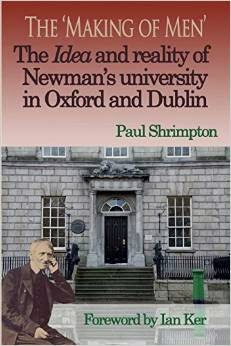
Newman's Idea and Reality of University Education

In The Weekly Standard, Edward Short reviews a new book on Blessed John Henry Newman's theory of university education and its reality:

Until now, the two most highly regarded books on Newman’s treatment of the subject were Fergal McGrath’s Newman’s University: Idea and Reality (1951) and Dwight Culler’s The Imperial Intellect: A Study of Newman’s Educational Ideal (1955). Now, in The ‘Making of Men,’ Paul Shrimpton contends that past studies of Newman’s educational achievement have suffered from failing to take into account the full scope of Newman’s educational endeavors, and he has written his own book to rectify that.

Deeply researched and persuasively argued, The ‘Making of Men’ is a major contribution to our understanding of Newman’s commitment to university education. It will enliven and refine all future discussions of the subject by encouraging readers to revisit not only Newman’s classic text but the practical challenges he addressed—first as fellow of Oxford’s Oriel College, and then as rector of the Catholic University in Dublin. Shrimpton draws on Newman’s copious correspondence and memoranda, as well as “accounts ledgers, buttery records, punishments books, timetables, rules and regulations, prospectuses, minute books, reports of all types, and a host of other documents,” all of which give The ‘Making of Men’ an admirable richness.

Read the rest there. The 'Making of Men' is published by Gracewing in the UK.

Wednesday, January 28, 2015

The Bodleian Library's Founder Dies

Sir Thomas Bodley died on January 28, 1613. His greatest accomplishment was the restoration of the University of Oxford's library, which had been purged during the reign of Edward VI of all its "papist" volumes, according to the library's website:

Duke Humfrey’s library survived in its original form for just over sixty years; in 1550 it was denuded of its books after a visitation by Richard Cox, Dean of the newly-founded Christ Church. He was acting under legislation passed by King Edward VI designed to purge the English church of all traces of Roman Catholicism, including ‘superstitious books and images’. In the words of the historian Anthony Wood, ‘some of those books so taken out by the Reformers were burnt, some sold away for Robin Hood’s pennyworths, either to Booksellers, or to Glovers to press their gloves, or Taylors to make measures, or to Bookbinders to cover books bound by them, and some also kept by the Reformers for their own use’.

Oxford University was not a wealthy institution and did not have the resources to build up a collection of new printed books to replace those dispersed. In 1556, therefore, the desks were sold, and the room was taken over by the Faculty of Medicine.

The library was rescued by Sir Thomas Bodley (1545–1613), a Fellow of Merton College who had travelled extensively in Europe and had between 1585 and 1596 carried out several diplomatic missions for Queen Elizabeth I. He married a rich widow whose husband had made a fortune from trading in pilchards and, in his retirement from public life, decided, in his own words, to ‘set up my staff at the library door in Oxon; being thoroughly persuaded, that in my solitude, and surcease from the Commonwealth affairs, I could not busy myself to better purpose, than by reducing that place (which then in every part lay ruined and waste) to the public use of students’.


His money was accepted in 1598, and the old library was refurnished to house a new collection of some 2,500 books, some of them given by Bodley himself, some by other donors. A librarian, Thomas James, was appointed, and the library finally opened on 8 November 1602. The first printed catalogue followed in 1605; a new edition of 1620 ran to 675 pages.

In 1610 Bodley entered into an agreement with the Stationers’ Company of London under which a copy of every book published in England and registered at Stationers’ Hall would be deposited in the new library. Although at first the agreement was honoured more in the breach than in the observance, it nevertheless pointed to the future of the library as a comprehensive and ever-expanding collection, different in both size and purpose from the libraries of the colleges. More immediately it imposed an extra strain on space within the building, which was already housing many more books than originally foreseen; new gifts of books made the lack of space ever more acute. So in 1610–12 Bodley planned and financed the first extension to the medieval building, known as Arts End.


The website also includes a link to an illustrated brochure of the library's history and Bodley's crucial role in funding and planning its renewal. One of the library's latest acquisitions is the travelling library of Prince Charles, later King Charles I:

This latest addition to the Bodleian Libraries collection is like a 17th century version of a Kindle. Two red leather cases, designed in the 1970s by Sangorski and Sutcliffe to look like two large books, open up to reveal 59 small volumes covering just about everything that a wealthy educated gentleman would want to read on his travels.

Charles I's travelling library arrived at the Bodleian last week and was acquired through a bequest. The collection of tiny books have gold-tooled bindings and some are believed to have been signed by the Prince himself. Titles include classical texts by the poet Ovid and the philosopher Cicero as well as bibles and religious books such as De Imitatione Christi by Thomas A Kempis.

Sunday, January 11, 2015

Orlando Gibbons, Archbishop Laud, and St. John's, Oxford


This is really an Advent text, but since today is the Baptism of the Lord by St. John the Baptist in the Jordan River (in the Ordinary Form) it kind of fits--here is Orlando Gibbons' setting of "This is the record of John":

This is the record of John, when the Jews sent priests and Levites from Jerusalem to ask him, Who art thou? And he confessed, and denied not, and said plainly, I am not the Christ.

And they asked him, What art thou then? Art thou Elias? And he said, I am not. Art thou that Prophet? And he answered, No.

Then said they unto him, What art thou? that we may give an answer unto them that sent us. What say’st thou of thyself? And he said, I am the voice of him that crieth in the wilderness, Make straight the way of the Lord
. (John 1: 19-23)


According to the webpage for St. John's College Chapel:

William Laud endowed the college richly during and after his presidency, and the fine pre-Reformation ecclesiastical vestments that he gave are displayed every term. Laud’s friendship with Orlando Gibbons led to the composition of ‘This is the record of John’ for the choir of St John’s, and this superb setting of a text from the first chapter of John’s gospel is sung regularly in chapel: after centuries of neglect, it is now recognised as one of the supreme English anthems.

The St. John's Chapel Choir has also recorded the anthem. Laud was President of St. John's from 1621 to 1633, after being a Fellow and receiving both his B.A. and M.A. degrees from St. John's.

Saturday, September 27, 2014

WWI Memoir: "Testament of Youth"


I read Testament of Youth while or after watching the 1980 Masterpiece Theatre five episode mini-series starring Cheryl Campbell as Vera Brittain:

All young Vera Brittain wanted at first was the opportunity to go to college, like her brother. That may not sound like much now, but middle class young ladies from small towns were expected to settle down with spouses, not studies, in pre-World War I England. This dramatization of Vera Brittain's 1933 autobiography--a memorial to a generation devastated by World War I--chronicles her experiences as a nurse in London and Malta and at the front in France. It also tells in heartbreaking detail the loss of her brother, her fiancé, and her two best friends on the fields of France and Italy.

Next year a new movie will be released that adapts her memoir. From the early trailer, it looks like the movie might focus on the romance and not continue the story of Brittain's return to Oxford after the war:


The movie filmed earlier this year at the University of Oxford so at least there will be some glimpses of its towers and streets. I wonder if the movie will quote the poem Roland Leighton wrote to Vera:

The sunshine on the long white road
That ribboned down the hill,
The velvet clematis that clung
Around your window-sill
Are waiting for you still.

Again the shadowed pool shall break
In dimples at your feet,
And when the thrush sings in your wood,
Unknowing you may meet
Another stranger, Sweet.

And if he is not quite so old
As the boy you used to know,
And less proud, too, and worthier,
You may not let him go---
(And daisies are truer than passion-flowers)
It will be better so.

I also wonder if Dorothy L. Sayers is featured in the movie at all--they both attended Somerville College, which was opened for women to attend Oxford in 1879. Here are their biographies on the college website: Dorothy L. Sayers and Vera Brittain.

Friday, September 26, 2014

Hebrew Manuscripts at Fox's Corpus Christi

In The Wall Street Journal, Richard Carwardine writes "Out of the Anglo-Jewish Past", about a Hebrew prayer book in the Corpus Christi College library:

Corpus Christi College, which will reach its 500th birthday in 2017, is celebrated as Oxford's first Renaissance institution. The bishop-statesman Richard Fox, right-hand man to the Tudor monarchs Henry VII and Henry VIII, founded the college to instruct students in the sciences and the languages of the Bible: Hebrew and Greek. From the first, Corpus took a lead in Jewish learning and built an acclaimed library. Among the scores of manuscripts the college used for teaching its young men were Hebrew texts, several donated by the first president and noted collector, John Claymond. How and when he acquired them we don't know—and this is only a part of their mystery. They are the jewels of a small but spectacular collection of medieval Anglo-Jewish books.

These materials shaped the scholarship that gave Corpus a primary role in the translation of the King James Bible. The 400th anniversary of that publication, in 2011, sparked particular interest in the Hebrew manuscripts at Corpus. These include commentaries by the acclaimed medieval French rabbi, Rashi; other items present passages from the Hebrew Bible with a literal translation in Latin written, from the outset, directly above the Hebrew text. They point to the cooperation between Jewish and Christian scholars, eager to help non-Jews learn Hebrew and understand the primary sources of a shared scriptural tradition. The texts could equally have been used to teach Jews Latin—not impossible, given that most English law, property transactions and accounting were conducted in Latin. Command of the language would have been especially beneficial to Jewish financiers in doing business.


Read the rest there. Note that Mr Carwardine is the president of Corpus Christi College, which will observe its 500th anniversary in 2017. More about the College's Hebrew manuscripts here at the Bodleian Library website from a previous exhibition.

Sunday, July 6, 2014

St. Thomas More Faces Death: July 6, 1535

From The Life of Sir Thomas More, by William Roper, his son in law (included in the prayer book from CTS at left):

And so upon the next morning, being Tuesday, St. Thomas’ even, and the Octave of St. Peter in the year of our Lord God 1537, according as he in his letter the day before had wished, early in the morning came to him Sir Thomas Pope, his singular friend, on message from the King and his Council, that he should before nine of the clock in the same morning suffer death, and that therefore forthwith he should prepare himself thereto. “Mr. Pope,” saith he, “for your good tidings I most heartily thank you. I have been always bounden much to the King’s Highness for the benefits and honours which he hath still from time to time most bountifully heaped upon me, and yet more bounded I am to his Grace for putting me into this place, where I have had convenient time and space to have remembrance of my end, and so help me God most of all, Mr. Pope, am I bound to his Highness, that it pleased him so shortly to rid me of the miseries of this wretched world. And therefore will I not fail most earnestly to pray for his Grace both here, and also in another world.” ‑ “The King’s pleasure is further,” quoth Mr. Pope, “that at your execution you shall not use many words.” ‑ “Mr. Pope” (quoth he), “you do well that you give me warning of his Grace’s pleasure. For otherwise had I purposed at that time somewhat to have spoken, but of no matter wherewith his Grace, or any other should have had cause to be offended. Nevertheless whatsoever I intend I am ready obediently to conform myself to his Grace’s commandment. And I beseech you, good Mr. Pope, to be a mean unto his Highness, that my daughter Margaret may be present at my burial.” ‑ “The King is well contented already” (quoth Mr. Pope) “that your wife, children, and other friends shall have free liberty to be present thereat.” ‑ “O how much beholden,” then said Sir Thomas More, “am I to his Grace, that unto my poor burial vouchsafeth to have so gracious consideration.” Wherewithal Mr. Pope taking his leave of him could not refrain from weeping, which Sir Thomas More perceiving, comforted him in this wise, “Quiet yourself, good Mr. Pope, and be not discomforted. For I trust that we shall once in heaven see each other full merrily, where we shall be sure to live and love together in joyful bliss eternally.”

Upon whose departure Sir Thomas More, as one that had been invited to a solemn feast, changed himself into his best apparel; which Mr. Lieutenant espying, advised him to put it off, saying, that he that should have it was but a worthless fellow. “What Mr. Lieutenant” (quoth he), “shall I account him a worthless fellow, that will do me this day so singular a benefit? Nay, I assure you, were it cloth of gold I would account it well bestowed on him, as St. Cyprian did, who gave his executioner thirty pieces of gold.” And albeit at length, through Mr. Lieutenant’s persuasions, he altered his apparel, yet, after the example of that holy martyr St. Cyprian, did he of that little money that was left him, send one angel of gold to his executioner. And so was he brought by Mr. Lieutenant out of the Tower, and from thence led towards the place of execution, where going up the scaffold, which was so weak that it was ready to fall, he said to Mr. Lieutenant, “I pray you, I pray you, Mr. Lieutenant, see me safe up, and for my coming down let me shift for myself.” Then desired he all the people thereabouts to pray for him, and to bear witness with him, that he should then suffer death in and for the faith of the holy Catholic Church, which done he kneeled down, and after his prayers said, he turned to the executioner, and with a cheerful countenance spake unto him. “Pluck up thy spirits, man, and be not afraid to do thine office, my neck is very short. Take heed therefore thou shoot not awry for saving thine honesty.” So passed Sir Thomas More out of this world to God upon the very same day in which himself had most desired.

Sir Thomas Pope was the founder of Trinity College at the University of Oxford. Sir Thomas Audley was his patron and Pope benefited greatly from his service at the Court of Augmentations, dividing up the goods of the suppressed monasteries. He founded Trinity on the remains of Durham College, founded in 1268 for the education of Benedictine monks from that northern abbey :

Trinity College was founded by Sir Thomas Pope in 1555. A devout catholic with no surviving children, Thomas Pope saw the Foundation of an Oxford college as a means of ensuring that he and his family would always be remembered in the prayers and masses of its members. He came from a family of small landowners in Oxfordshire, trained as a lawyer, and rose rapidly to prominence under Henry VIII. As Treasurer of the Court of Augmentations he handled the estates of the monasteries dissolved at the Reformation, and amassed a considerable personal fortune. Pope was a discreet and trusted privy counsellor of Mary Tudor, and it was from Mary and Philip that he received Letters Patent and royal approval for his new foundation. Pope died in 1559. Although his religious ideals were never fully realised - Elizabeth I had succeeded her sister and England returned to the Protestant faith - nonetheless the memory of his name, like his college, has endured the fluctuating fortunes of over 400 years. His wife, Lady Elizabeth Pope, was a particularly influential figure in Trinity's early years. Pope's foundation was for a President, twelve Fellows and twelve scholars, all supported by the income from his generous endowment of lands, and for up to twenty undergraduates. The Fellows, all men, were required to take Holy Orders and remain unmarried. The College Statutes set out rules for a simple monastic life of religious observance and study. The Garden was an informal grove of trees, mainly elms, amongst which the members of the College could walk and meditate.

Perhaps a jest that St. Thomas More would enjoy: a Pope came to tell More that he would be beheaded that day for defending the Pope as head of the Catholic Church.

Wednesday, October 16, 2013

Cardinal William Allen, Vatican Librarian

Cardinal William Allen, founder of colleges and seminaries for English Catholics on the Continent in the 16th century, died on October 16, 1594. He was also responsible for the English translation of the Holy Bible, the Douai-Rheims version.

He attended Oriel College at Oxford and became a Fellow there. With the accession of Elizabeth I, he refused to take the Oath of Supremacy. Therefore he had to leave England and went into exile on the Continent, joining other Catholics in Leuven in present-day Belgium.

Allen returned to England before ordination and began to work with Catholics, recognizing that the religious changes legislated by Parliament were not the will of the people. So he returned to the Continent and went to another town in Flanders, Mechelen. (When I visited Belgium many years ago, I had no idea of these connections!) There he was ordained in 1565--and never returned to England.

Allen founded the college and seminary in Douai for the training of English Catholic priests to return to their native land to serve the Catholic people. Allen also founded the English College in Rome for the same purpose.

He had to move the college at Douai to Rheims--all the while working on an English translation of the Holy Bible. First the New Testament was produced at Rheims in 1582; the Old Testament was delayed until 1609--published two years before King James's Authorized Version.

According to the website for the seminary of the diocese of Westminster, named Allen Hall in honor of the Cardinal:

In the consistory of August 7, 1587 Allen was created a Cardinal and by the end of that month he received the red hat and the title of Ss Silvestro e Martino ai Monti. He also received the title of Cardinal of England and was the first English cardinal after the protestant Reformation. On November 10, 1589, King Felipe II of Spain nominated him archbishop of Mechlin but he was never recognized apparently because of the state of destitution of the See and the unwillingness of the king to provide the archbishop with a fitting revenue. Cardinal Allen also participated in the conclave of 1590, and the newly elected Pope, Gregory XIV (1590-1591) named him prefect of the Vatican library and entrusted him, together with Cardinal Ascanio Colonna, with the revision of the Latin Vulgate. As Cardinal, Allen also later participated in the conclaves of 1591 and 1592.

According to the Catholic Encyclopedia, Cardinal Allen wrote many works, theological and controversial:

The following is a list of his printed works: "Certain Brief Reasons concerning the Catholick Faith" (Douay, 1564); "A Defense and Declaration of the Catholike Churches Doctrine touching Purgatory, and Prayers of the Soules Departed" (Antwerp, 1565), re-edited by Father Bridgett in 1886; "A Treatise made in defense of the Lawful Power and Authoritie of the Preesthoode to remitte sinnes &c." (1578); "De Sacramentis" (Antwerp, 1565; Douay, 1603); "An Apology for the English Seminaries" (1581); "Apologia Martyrum" (1583); "Martyrium R. P. Edmundi Campiani, S.J." (1583); "An Answer to the Libel of English Justice" (Mons, 1584); "The Copie of a Letter written by M. Doctor Allen concerning the Yeelding up of the Citie of Daventrie, unto his Catholike Majestie, by Sir William Stanley Knight" (Antwerp, 1587), reprinted by the Chetham Society, 1851; "An Admonition to the Nobility and People of England and Ireland, concerning the present Warres made for the Execution of his Holines Sentence, by the highe and mightie Kinge Catholike of Spain, by the Cardinal of Englande" (1588); "A Declaration of the sentence and deposition of Elizabeth, the usurper and pretended Queene of England" (1588; reprinted London, 1842).

Those are Allen's uncontrovertible achievements; however, he also dabbled in political and diplomatic efforts--and as Blessed John Henry Newman opined, "to touch politics is to touch pitch". There his record is more controversial as he encouraged the excommunication of Elizabeth I, attempts to remove her from the throne, and the Spanish Armada. It was planned that he would follow the victorious Armada and become the Catholic Archbishop of Canterbury! When all these plans came to naught, Allen became a Librarian at the Vatican and helped found another English college in Spain. He died in Rome at the Venerable English College.