Showing posts with label Rome. Show all posts

Friday, May 9, 2025

Preview: The 80th Anniversaries of VE and VJ Day

Since the Papal Conclave has concluded with the Cardinals electing a new pope--I was at Adoration before Mass at St. Paul's Wichita State University and Mass was delayed while the students waited downstairs for Pope Leo XIV to come on the balcony and speak--we'll continue our anniversary series on the Son Rise Morning Show on Monday, May 12, at about 7:50 a.m. Eastern/6:50 a.m. Central. (If Matt and Anna needed more time for conclave analysis etc. I would have yielded my time.)

Please listen live here or catch the podcast later here. Our topic this week will be the 80th anniversaries of the end of World War II: Victory in Europe (May 8) and Victory in Japan (August 15 for England--the date of Japan's stated surrender--and September 2--the date of the formal surrender on the U.S.S. Missouri for the USA).

When victory was declared in Europe--with the German surrender--both Winston Churchill in England and Pope Pius XII in Rome remarked that the second World War wasn't over while the Allies were still fighting the Japanese military.

From Winston Churchill, lauding the English spirit:
"God bless you all. This is your victory! It is the victory of the cause of freedom in every land. In all our long history we have never seen a greater day than this.

"Everyone, man or woman, has done their best. Everyone has tried. Neither the long years, nor the dangers, nor the fierce attacks of the enemy, have in any way weakened the independent resolve of the British nation. God bless you all.

"My dear friends, this is your hour. This is not victory of a party or of any class. It’s a victory of the great British nation as a whole. . . .

"The lights went out and the bombs came down. But every man, woman and child in the country had no thought of quitting the struggle. London can take it.

"So we came back after long months from the jaws of death, out of the mouth of hell, while all the world wondered. When shall the reputation and faith of this generation of English men and women fail? . . .

"Now we have emerged from one deadly struggle – a terrible foe has been cast on the ground and awaits our judgment and our mercy.

"But there is another foe who occupies large portions of the British Empire, a foe stained with cruelty and greed – the Japanese. I rejoice we can all take a night off today and another day tomorrow.

"Tomorrow our great Russian allies will also be celebrating victory and after that we must begin the task of rebuilding our hearth and homes, doing our utmost to make this country a land in which all have a chance, in which all have a duty, and we must turn ourselves to fulfill our duty to our own countrymen, and to our gallant allies of the United States who were so foully and treacherously attacked by Japan. . . . "
Here at last we behold the end of this war, which, during almost six years, has held Europe in the grip of the most atrocious suffering and most bitter sorrow

A cry of humble and ardent gratitude arises from the very depths of our heart to "the Father of Mercies and the God of All Consolation."

But our canticle of thanksgiving is accompanied with the suppliant prayer to implore also of divine omnipotence and goodness the termination, in accord with justice, of the sanguinary warfare in the Far East.

On our knees in spirit before the tombs, before the ravines disturbed and reddened by blood, where repose the innumerable corpses of those who have fallen, victims of the fighting or of inhuman massacres, of hunger or of misery, we recommend them all in our prayers, and especially in the celebration of the Holy Sacrifice, to the merciful love of Jesus Christ, their Saviour and their judge.

And it seems to us that they, the fallen, are giving warning to the survivors of this cruel scourge and are saying to them: Let there arise from the earth, wherein we have been placed as grains of wheat, the molders and builders of a new and better Europe, of a new and better universe, founded on the filial fear of God, on fidelity to His Holy Commandments, on respect for human dignity, on the sacred principle of equality of the rights of all peoples and all states, large and small, weak and strong.

The war has created on all sides chaotic ruin, both material and moral, such as mankind has never known in the entire course of human history. The task of this hour is to rebuild the world. . . .

The war has aroused everywhere discord, suspicion and hatred. If, therefore the world wishes to regain peace, it is necessary that falsehood and rancor should vanish and in their stead that sovereign truth and charity should reign.

Above all, however, in our daily prayers, we should beseech God constantly to fulfill his promise made by the mouth of the Prophet Ezekiel, "And I will give them one heart, and will put a new spirit in their bowels; and I will take away the stony heart out of their flesh: that they may walk in my commandments, and keep my judgments, and do them: and that they may be my people, and I may be their God."

May the Lord God deign to create this new spirit, His spirit, in peoples, and particularly in the hearts of those to whom he has entrusted the responsibility of establishing the future peace.

Then and only then will the reborn world avoid the return of the thunderous scourge of war and there will reign a true, stable and universal brotherhood, and that peace guaranteed by Christ even on earth to those who are willing to believe and trust in His law of love.

In the USA, Harry Truman had succeeded FDR as President only in April that year upon FDR's death. The Truman Library Institute provides this commentary:

President Truman was the Vice-President to FDR for less than 90 days before stepping into the role of President and Commander in Chief. This was April 12, 1945, a mere five months before the world war would come to an end. However, at the time, while the end of the war was longed for and looked by some to be imminent, there was no sure-end of the war in sight. It required a great deal of Presidential action and severe decisions to bring about the conclusion of World War II. While FDR was the President in charge at the beginning of the war, it was Truman’s actions that brought the war to an end.

Within 15 days of taking Presidential office, both Mussolini and Adolf Hitler met their death. A day before Hitler’s death and only two days after the death of Mussolini, German forces in Italy surrendered. This accelerated the end of the war, as German forces in Berlin surrendered to the Allies on May 2nd, marking the third week of Truman’s presidency.

Over the next week German forces would continue to surrender, but that did not bring an end to the war. There was still tension with Japan and Russia, and funding for the war was growing thin.
At this time the three heads of state from the United States, the United Kingdom and the USSR, Truman, Winston Churchill and Joseph Stalin, respectively, met at the Potsdam Conference. This is where the fate of Germany and much of Europe was decided.

The site also reviews his decisions to force Japan's surrender by the use of the atomic bomb.

One essential aspect for me is that because of the August/September surrenders of Japan, my father was honorably discharged from the Army of the United States in October of 1945. He'd been based in England in 203rd Army Air Force as a gunner in a B-17 and might have been sent to the ongoing war against Japan! He came home, settled down in Wichita, Kansas with Rita, bought a house, worked at Boeing, and raised three children, including me.

The motto of his B-17 was "Heaven Can Wait"!

Photo Credits (Public Domain): Winston Churchill waves to crowds in Whitehall in London as they celebrate VE Day, 8 May 1945. From the the balcony of the Ministry of Health, Prime Minister Winston Churchill gives his famous 'V for Victory' sign to crowds in Whitehall on the day he broadcast to the nation that the war with Germany had been won, 8 May 1945 (VE Day); Pius XII with tabard, by Michael Pitcairn, 1951.

Family photo, scanned and retouched (Copyright Stephanie A. Mann, 2025)--Wasn't he handsome? No wonder my mother fell for him on a blind date!

Friday, February 18, 2022

Cardinal Acton, Named In Pectore

On February 18, 1839, Pope Gregory XVI named Charles Januaris Acton (John Dalton-Acton, Baron Acton's uncle) a Cardinal In Pectore (in the heart) at the very young age of 36 (35.9 months exactly). When he was 38.8 years of age, he was publicly named the Cardinal-Priest or Santa Maria della Pace during the January 24, 1842 consistory of the same pope.

According to the Catholic Encyclopedia, he was:

born at Naples, 6 March, 1803; died at Naples, 23 June, 1847. He was the second son of Sir John Francis Acton, Bart. The family, a cadet branch of the Actons of Aldenham Hall, near Bridgnorth, in Shropshire, had settled in Naples some time before his birth. His father was engaged in the Neapolitan trade when he succeeded to the family estate and title through the death of his cousin, Sir Richard Acton, Bart. The Cardinal's education was English, as he and his elder brother were sent to England on their father's death in 1811, to a school near London kept by the Abbé Quéqué. They were then sent to Westminster School, with the understanding that their religion was not to be interfered with. Yet, they not only were sent to this Protestant school, but they had a Protestant clergyman as tutor. In 1819 they went to Magdalen College, Cambridge, where they finished their education. After this strange schooling for a future cardinal, Charles went to Rome when he was twenty and entered the Academia Ecclesiastica, where ecclesiastics intending to be candidates for public offices receive a special training. An essay of his attracted the attention of the Secretary of State, della Somaglia, and Leo XII made him a chamberlain and attaché to the Paris Nunciature, where he had the best opportunity to become acquainted with diplomacy. Pius VIII recalled him and named him vice-legate, granting him choice of any of the four legations over which cardinals presided. He chose Bologna, as affording most opportunity for improvement. He left there at the close of Pius VIII's brief pontificate, and went to England, in 1829, to marry his sister to Sir Richard Throckmorton. Gregory XVI made him assistant judge in the Civil Court of Rome. In 1837 he was made Auditor to the Apostolic Chamber, the highest Roman dignity after the cardinalate. Probably this was the first time it was even offered to a foreigner. Acton declined it, but was commanded to retain it. He was proclaimed Cardinal-Priest, with the title of Santa Maria della Pace, in 1842; having been created nearly three years previously. His strength, never very great, began to decline, and a severe attack of ague made him seek rest and recuperation, first at Palermo and then at Naples. But without avail, for he died in the latter city. His sterling worth was little known through his modesty and humility. In his youth his musical talent and genial wit supplied much innocent gaiety, but the pressure of serious responsibilities and the adoption of a spiritual life somewhat subdued its exercise.

His judgment and legal ability were such that advocates of the first rank said that could they know his view of a case they could tell how it would be decided. When he communicated anything in writing, Pope Gregory used to say he never had occasion to read it more than once. He was selected as interpreter in the interview which the Pope had with the Czar of Russia. The Cardinal never said anything about this except that when he had interpreted the Pope's first sentence the Czar said: "It will be agreeable to me, if your Eminence will act as my interpreter, also." After the conference Cardinal Acton, by request of the Pope, wrote out a minute account of it; but he never permitted it to be seen. The King of Naples urged him earnestly to become Archbishop of Naples, but he inexorably refused. His charities were unbounded. He once wrote from Naples that he actually tasted the distress which he sought to solace. He may be said to have departed this life in all the wealth of a willing poverty.

The Encyclopedia Britannica article on his father, linked above, has this comment about Cardinal Acton and English Catholics:

Cardinal Acton was protector of the English College at Rome, and had been mainly instrumental in the increase, in 1840, of the English vicariates-general to eight, which paved the way for the restoration of the hierarchy by Pius IX. in 1850. . . .

The recent converts John Henry Newman and Ambrose St. John met with Cardinal Acton when they studied for the priesthood at the College of Propaganda from September of 1846 to May of 1847 (they were ordained to the priesthood on May 30, 1847), less than a month before Acton died on June 23 that year. Their contacts with the Cardinal are mentioned twice in Michael Ffinch's 1992 biography, Newman: Towards the Second Spring, published by Ignatius, which I read earlier this week, after purchasing a used copy at Eighth Day Books.

This biography covers Newman's early years, his leadership of the Tractarians/the Oxford Movement, the controversies over Tract 90 and his gradual retirement from Oxford to Littlemore, leading up to his conversion in 1845. Then Ffinch surveys Newman's study for the priesthood in Rome, his decision to become an Oratorian, and his establishment of the Oratory of St. Philip Neri in Birmingham. The Restoration of the Hierarchy in 1850 and Newman's preaching of the Second Spring sermon on July 13, 1852 at the first Synod held since the Restoration of the Hierarchy brings this biography to a close, with a chronological table of dates for the rest of Newman's long life.

Ffinch covers the Tractarian period of Newman's life very well, but I particularly appreciated how he detailed the founding of the Oratory of St. Philip Neri in England, highlighting the difficulties the inclusion of Faber's Wilfridians caused from the start because of different arrangements and commitments made without Newman's knowledge. Pope Pius IX had approved the foundation of the Oratory in Birmingham under Newman, but Bishop Wiseman wanted one in London and Faber's benefactor, the Earl of Shrewsbury, wanted the Oratory to serve a rural community--not the charism of the Oratory at all. Newman had to work with Wiseman, the Earl of Shrewsbury, and Faber to establish the Oratory in Birmingham, and its second house in London. The two would soon be independent of each other because of differences between Faber and Newman in their visions of what the Oratory should be and do.

Ffinch neglects, however, I think to highlight Newman's concern for the Catholic laity; he mentions that Newman gave some talks in 1851 at the Birmingham Oratory on Catholics in England at that time, but he does not name them in the text, as these were the lectures on the Present Position of Catholics in England; nor does he highlight the purpose of the talks, to prepare the Little Brothers of the Oratory in Birmingham to defend what they believed in a hostile environment. This seemed a strange omission to me since the book's supposed terminus is Newman's Second Spring sermon in which he celebrates the renewal of Catholic life in England. Ffinch concludes the book, skipping over a few decades, with some later remarks by Cardinal Newman in 1880 about Catholics in England 30 years after the Restoration of the Hierarchy, the reason for that great 1852 sermon. His goals for the laity seem an essential part of that narrative that Ffinch omits from consideration.

Nevertheless, this a good introduction to Newman's life, up to the events of 1852. I'd recommend the book, provisionally, within its limitations.

Image Credit: Public Domain (painter not identified)

Wednesday, July 14, 2021

Thomas Wolsey's Predecessor at York: Christopher Cardinal Bainbridge, RIP

According to the Catholic Encyclopedia, Christopher Cardinal Bainbridge, Henry VIII's man in Rome and Thomas Wolsey's predecessor in the Archdiocese of York, died on this date in 1514:

Archbishop of York, and Cardinal, b. at Hilton, near Appleby, in Westmoreland, probably 1464; d. at Rome, 14 July, 1514. He proceeded to Oxford, entering Queen's College, of which he became provost in or before 1495, being about that time admitted LL.D.; he became later a liberal benefactor to his college. He held a number of benefices, including the treasurership of the Diocese of London, on Henry VII's presentation, and Master of the Rolls, a post he held till his elevation to the See of Durham, which took place in 1507, nominated thereto by the king, who restored the temporalities of the see to him. He was consecrated on 12 December. This see he held but a short while, being translated to York the next year by a papal Bull dated 20 September, 1508. In 1509 he was sent by Henry VIII as his ambassador to Rome. Julius II created him a cardinal on 10 March, 1511, giving him the title of St. Praxedis, in reward for negotiating Henry's adherence to the pope as against France, for which country he felt a strong antipathy all his life. As cardinal he was commissioned by Julius to lead a military expedition against Ferrara, which he successfully besieged. He endeavoured to secure from Pope Leo X the bestowal on Henry of the title of "Most Christian King" which Louis of France had forfeited by waging war against the pope; but the peace of 1514 made this project abortive. Bainbridge was poisoned by an Italian priest named Rinaldo de Modena, who acted as his steward or bursar, in revenge for a blow which the cardinal, a man of violent temper, had given him. It was hinted that the crime was perpetrated at the instigation of Silvestri de Gigli, Bishop of Worcester, the resident English ambassador at Rome, but de Giglis exonerated himself. Bainbridge was buried in the English Hospice, now known as the English College, Rome. He was a stout upholder of Henry's interests at the Curia.

According to the blog of the Archives of the Venerable English College in Rome:

Bainbridge had other responsibilities. Most notably, for our purposes, he acted as Warden of the English Hospice from 1510, though his trusty secretaries William Burbanke and Richard Pace (c.1483–1536) did much of the day-to-day work. He served in the Roman Rota, the papal court of appeal, and in 1513 became Cardinal Protector of the Cistercian Order.

Dr. Nicholas Schofield offers some insights into the circumstances of his death:

Accounts differ as to the motivation of this crime: some say that Rinaldo was seeking revenge after the cardinal had struck him during an argument, others that he was hired by Gigli. Such rivals had much to gain from the cardinal’s demise: Gigli replaced him as Warden of the Hospice and Wolsey as Cardinal Archbishop of York.

Bainbridge’s Requiem was celebrated in the Hospice chapel, where he was buried; initially his splendid tomb was placed before the High Altar before being moved to the side. It has experienced the ravages of time – when Nicholas Wiseman first saw the chapel in 1818, he described the richly effigied tomb as ‘shattered and defaced’. Its presence takes us back to the days of the Hospice, when the Catholic King of England sent a prelate as his Ambassador to Rome.

The Hospice was ransacked during Charles V's siege of Rome and after Henry VIII's break from Rome was no longer the English Hospice at all. As the VEC History explains:

By the time of the Reformation, the Hospice was badly run and in decline. Church authorities decided to turn it into a seminary. The first six students came from Douai in 1577 and attended lectures at the Jesuit-run Collegio Romano, precursor of the Gregorian University. The following year all the students signed the Missionary Oath in the Liber Ruber, the historic book which to this day records the names and details of every student in the College. The first to sign was St Ralph Sherwin, who swore to return to England “hodie quam cras” (today rather than tomorrow). Pope Gregory XIII issued the bull of foundation of the English College on 1 May 1579, celebrated as Founders’ Day. But the new College got off to a shaky start with acerbic disputes between students and the College authorities which were in time resolved.

Bainbridge’s story also reminds us of a time when Italian priests served as bishops for England. Silvestri de Gigli succeeded his uncle Giovanni de Gigli as Bishop of Worcester in 1498; when Silvestri died in 1521, Girolamo De Ghinucci succeeded him in 1522 and was deprived of his bishopric in 1535 by Henry VIII. For a time, the future Pope Clement VII (Giulio di Giuliano de' Medici) served as apostolic administrator between Gigli and Ghinucci. Hugh Latimer replaced Ghinucci as Henry VIII's choice.

Image Credit (public domain): a 19th century portrait of Bainbridge by  G. Francisi.

Wednesday, February 10, 2021

Book Review: "The Memoirs of Saint Peter"

I purchased this book from Eighth Day Books in 2019 but did not start reading it until last month, since the liturgical Year B for Sunday Cycle in 2020-2021 (November to November) uses the Gospel of St. Mark, supplemented with readings from the other Synoptic Gospels. The Gospel of St. Mark is the shortest Gospel, with only 16 chapters. The timing seemed to be just right.

According to the publisher, Regnery:

The Gospel as You Have Never Heard It Before...

At a distance of twenty centuries, the figure of Jesus of Nazareth can seem impossibly obscure—indeed, some skeptics even question whether he existed. And yet we have an eyewitness account of his life, death, and resurrection from one of his closest companions, the fisherman Simon Bar-Jona, better known as the Apostle Peter.

Writers from the earliest days of the Church tell us that Peter's disciple Mark wrote down the apostle's account of the life of Jesus as he told it to the first Christians in Rome. The vivid, detailed, unadorned prose of the Gospel of Mark conveys the unmistakable immediacy of a first-hand account.

For most readers, however, this immediacy is hidden behind a veil of Greek, the language of the New Testament writers. Four centuries of English translations have achieved nobility of cadence or, more recently, idiomatic accessibility, but the voice of Peter himself has never fully emerged. Until now.

In this strikingly original translation, attentive to 
Peter's concern to show what it was like to be there, Michael Pakaluk captures the tone and texture of the fisherman’s evocative account, leading the reader to a bracing new encounter with Jesus. The accompanying verse-by-verse commentary—less theological than historical—will equip you to experience Mark’s Gospel as the narrative of an eyewitness, drawing you into its scenes, where you will come to know Jesus of Nazareth with new intimacy.

A stunning work of scholarship readily accessible to the layman,
The Memoirs of St. Peter belongs on the bookshelf of every serious Christian.

The author, again according to Regnery, is:

a professor of ethics and social philosophy in the Busch School of Business at the Catholic University of America in Washington, D.C., and a member of the Pontifical Academy of St. Thomas Aquinas. He earned his undergraduate and doctoral degrees at Harvard and studied as a Marshall Scholar at the University of Edinburgh. An expert in ancient philosophy, he has published widely on Aristotelian ethics and the philosophy of friendship and done groundbreaking work in business ethics. His previous books include Other Selves: Philosophers on Friendship, The Appalling Strangeness of the Mercy of God, and most recently The Memoirs of St. Peter: A New Translation of the Gospel according to Mark. He lives in Hyattsville, Maryland, with his wife, Catherine Pakaluk, a professor of economics, and their eight children.

Regnery has now published Professor Pakaluk's new translation of another Gospel: Mary's Voice in the Gospel According to John.

I would disagree with some aspects of this comment by the publisher in the blurb above:

The accompanying verse-by-verse commentary—less theological than historical—will equip you to experience Mark’s Gospel as the narrative of an eyewitness, drawing you into its scenes, where you will come to know Jesus of Nazareth with new intimacy.

The commentary is not really verse-by-verse with each verse of the Gospel included, but Pakaluk comments on aspects of many verses, explaining his translation and the significance of certain word choices, especially the various verb tenses (historical present, imperfect, aorist) and why sometimes as Mark narrates an event, he uses different tenses, because he is recounting Peter's memory of an event. For example, from chapter 15, verses 20-24, Mark describes the Crucifix as if it is happening right now, before Peter's eyes:

So now they are leading him out to affix him to a cross. They press into service a certain man who is passing by, coming in from the country, Simon of Cyrene, the father of Alexander and Rufus, to take his cross. They lead him to the Golgotha area, which means "Area of the Skull". (They gave him wine mixed with gall, which he did not take.) They affix him to the cross. They divide his garments, casting dice, to see who will take them. (p. 266)

Also, his commentary is theological: Pakaluk explains the literal theological meaning of many verses in his translation. Since his thesis is that Mark recorded Peter's memories of the three years he spent with Jesus (a thesis supported by early testimony in the Church) based upon how Peter had taught in Rome, Pakaluk often highlights Peter's intent in recounting certain events. He told certain stories--remember that St. John's Gospel states that many books would have to be written to tell everything that Jesus did and said)--because they were important to his preaching of the Gospel. So when Pakaluk explains the literal meaning of these stories and how Mark/Peter told them, he's explaining the theology, doctrinal, pastoral, and sometimes even moral, meaning and significance behind them. He does not explore the moral or practical, allegorical, or anagogical interpretation of most verses, but focuses on the literal. (For instance in chapter 10, when Jesus teaches against divorce, adultery, and remarriage, Pakaluk cannot help but offer commentary on the moral significance of that passage.)

I agree that this translation makes the narrative vivid, immediate, and fresh. Pakaluk's word choices, like not using the common "Crucify him", instead choosing "Put him on a cross" (or instead of "they crucify him" choosing "they affix him to the cross"), made me stop as I read familiar lines. 

The passage that really impressed me came in chapter 6, verses 39-40:

So he told them to have everyone sit down and form as it were dinner parties, side by side, on the green grass. And they sat down in groups of a hundred and groups of fifty, looking like flower beds sat side to side. (pp. 97-98)

This imagery of "dinner parties" and "flower beds", Pakaluk explains in his commentary, is how Peter remembers it looked that day when Jesus miraculously fed the vast crowd. That's a beautiful detail of a wonderful day.

Image Credit: the publisher Regnery Gateway (fair use for a book review) St. Mark Writing Under the Dictation of St. Peter, attributed to Giuseppe Vermiglio, Musee des Beaux-Arts, Bordeaux, France. (Also attributed to Pasquale Ottino)

Tuesday, December 1, 2020

Vespers at the Venerable English College in Rome

I received some exciting news from the Venerable English College in Rome last week:

This Tuesday [Today!] marks a very important day in the calendar of the VEC. 1st December is Martyrs’ Day. During the recusant period, students would gather around the Martyrs’ Picture in the chapel to sing a Te Deum whenever news reached Rome of a martyrdom of a former student. This tradition continues today, and includes the veneration of the relics of the Martyrs, including proto-martyr St Ralph Sherwin.

The VEC produced forty-four martyrs for the Faith, of whom ten are canonized saints. They are referred to as “the Forty-four.”

The VEC will have a live-stream via You Tube of the evening liturgy on Tuesday, with veneration of the relics and singing of the Te Deum. 

The link is here and it will be live at 20:15 Central European time /2:15 p.m. Eastern Time/1:15 p.m. Central Time.

The College Martyrs, Canonized, Beatified, and declared Venerable:

St Ralph Sherwin, 1581
St Luke Kirby, 1582
St Polydore Plasden, 1591
St Eustace White, 1591
St Robert Southwell S.J., 1595
St Henry Walpole S.J., 1595
St John Almond, 1612
St Henry Morse S.J., 1645
St David Lewis S.J., 1679
St John Wall O.F.M., 1679
Bl. John Shert, 1582
Bl. Joseph Lambton, 1592
Bl. William Lacey, 1582
Bl. Thomas Pormort, 1592
Bl. Thomas Cottam, 1582
Bl. John Cornelius S.J., 1594
Bl. William Hart, 1583
Bl. John Ingram, 1594
Bl. George Haydock, 1584
Bl. Edward Thwing, 1594
Bl. Thomas Hemerford, 1584
Bl. Robert Middleton, 1601
Bl. John Munden, 1584
Bl. Robert Watkinson, 1602
Bl. John Lowe, 1586
Bl. Edward Oldcorne, 1606
Bl. Robert Morton, 1588
Bl. Richard Smith, 1612
Bl. Richard Leigh, 1588
Bl. John Thules, 1616
Bl. Edward James, 1588
Bl. John Lockwood, 1642
Bl. Christopher Buxton, 1588
Bl. John Woodcock O.F.M., 1646
Bl. Christopher Bales, 1590
Bl. Anthony Turner S.J., 1679
Bl. Edmund Duke, 1590
Ven. Thomas Tichborne, 1602
Ven. Brian Tansfield S.J., 1643
Ven. Edward Morgan, 1642
Ven. Edward Mico S.J., 1678

The video will available later in the day; you may also view a report on last year's Martyrs' Day here. I've also been informed that the relics won't be displayed on the Altar because of some COVID-19 restrictions. The relics normally displayed are of St Ralph Sherwin, St Edmund, King and Martyr, St Thomas of Canterbury, and St Philip Howard.

Tuesday, October 27, 2020

St. John Henry Newman in Rome, 1846-1847

St. John Henry Newman's feast day is on October 9, the anniversary of his reception in to the Catholic Church by Blessed Dominic Barberi, the Passionist missionary to England. After his general Confession, reception, and first Holy Communion, he was Confirmed by Dr. Nicholas Wiseman, the Vicar Apostolic of the Midlands Region of England and Titular Bishop of Milopotamos (there weren't any Catholic dioceses in England yet) on November 1, All Saints Day. He took the Confirmation name of Mary. St. John Henry Mary Newman (like St. Anthony Mary Claret!).

Then he left Littlemore for Maryvale, Old Oscott at the invitation of Dr. Wiseman in 1846 on February 22; in September, he left England to study for the priesthood in Rome with one of his followers, Ambrose St. John. They spent five weeks in Milan and thus did not arrive in Rome until November.

Msgr. Jeffrey Steenson, the first Ordinary of the Personal Ordinariate of the Chair of St. Peter, writes for the Coming Home Network about Newman's experiences in Rome:

The Congregation for the Propagation of the Faith, the center of the Holy See’s missionary endeavors, received them and gave them rooms at the Collegio Propaganda near the Spanish Steps. There, Newman and St. John would become ordinary seminarians. But who was going to educate the most perspicacious theologian of his time? It is perhaps comforting to hear his friend St. John report that the lectures were boring and somewhat lacking as pedagogical models, and so Newman would often fall to sleep in class. (Thankfully this does not appear to have been held against Newman in the cause for sainthood!)

Newman was left largely to himself, to continue his brilliant studies of the Church Fathers. Rome’s theologians had some doubts about his recently-published
Essay on the Development of Christian Doctrine. Newman’s argument, that Catholic dogma was not, as it were, handed down from Mount Sinai but unfolded in a divinely-guided process of historical development in the life of the Church, was initially a very disconcerting idea for Catholic theologians hard-pressed to defend a tradition under siege from nearly every quarter. They naturally wondered about how sound this new convert really was.

So Newman, newly arrived from a different ecclesial world, was not well understood, and given his somewhat melancholic temperament, we are left with the distinct impression that his 1846-1847 academic year in Rome was certainly not about “making merry” over the return of a prodigal son of the Church (Lk 15:24). Newman, once the consummate insider of Anglican Oxford, is now an awkward and disoriented guest struggling to learn the customs of the house.

Regarding the Roman reception Newman's Essay on the Development of Christian Doctrine, I don't mean to contradict Monsignor Steenson, but I think he is reflecting Owen Chadwick's view of Newman and his Essay. C. Michael Shea offers a different view:

Newman’s Early Roman Catholic Legacy forces us to substantially revise the commonly received view that, on the issue of doctrinal development, Newman was an unheeded prophetic voice crying in a desiccated Roman wilderness.

Shea’s book corrects the mistaken impression that Newman’s
Essay on the Development of Christian Doctrine (1845) fell upon deaf ears in the Catholic world, only to be rediscovered in the mid-twentieth century and then all but canonized at Vatican II. While Newman’s theology did indeed bear abundant twentieth-century fruit (see Ian Kerr’s [sic] 2014 book on the subject and Andrew Meszaro’s excellent article arguing that Dei verbum 8, via Yves Congar, has Newmanian roots), it bore fruit in his own day as well. What makes Shea’s book more than just an intriguing historical reappraisal is that he all but proves that Newman’s impact on the Jesuit Giovanni Perrone (1794–1876), the foremost theologian of the “Roman School” at midcentury (and a close advisor to Pope Pius IX), was an implicit but significant factor in the preparations for the promulgation of the dogma of Mary’s Immaculate Conception in 1854. . . .

Shea’s thesis puts to the rest the persistent impression which arose from certain influential studies that Newman, while generally admired, was an unheeded prophet. In Shea’s convincing narrative, Owen Chadwick’s From Bossuet to Newman (1957) – while eminently readable like all of Chadwick’s work – shoulders a fair amount of the blame for this particular misappraisal. Chadwick contrasted a reigning Catholic “fixisme” which totally rejected doctrinal development (epitomized by the great Gallican, Bishop Bossuet) with the startling and new theory of Newman. According to Chadwick, Newman was considered – at least on this issue – as at best eccentric, and at worst doctrinally suspect. Shea shows that Chadwick far overestimated the impact and importance of the American convert Orestes Brownson’s polemic against Newman, and he contends that Chadwick misread the evidence regarding Newman’s encounters with Perrone, Pius IX, and others during Newman’s preparation for ordination in Rome. (One also wonders if Chadwick over-emphasized the incompatibility of the Gallican theological method with the idea of doctrinal development, since Shea points out that Henri Maret, one of the staunchest Gallican opponents of papal infallibility at Vatican I, actually affirmed development in his classic anti-infallibilist text).

Please read the rest of Shaun Blanchard's review of Shea's book in Faith & Culture: The Journal of the Augustine Institute.

Sunday, October 25, 2020

Today: The 40 at 50


Today is the 50th anniversary of the canonization of the 40 Martyrs of England and Wales in Rome by Pope Paul VI.

The Bishop of Plymouth, Mark O'Toole, issued a Pastoral Letter:

This weekend we mark an historic moment - the fiftieth anniversary of the Canonisation of the forty martyrs of England and Wales, which took place on 25th October 1970. On that occasion, Pope Paul VI reminded us:

"We have among the 40 holy Martyrs secular and regular priests, religious of various orders, and of different rank, lay people of very noble descent, as well as of modest condition; we have women who were married, mothers with a family. What unites them all is that interior attitude of fidelity to the call of God asked of them, as an answer of love…….The drama of the existence of these martyrs, was that their honest and sincere loyalty to the civil authority came to be in conflict with fidelity to God and with what, according to the dictates of their conscience illuminated by the Catholic faith, they knew to involve the revealed truths, especially to the Holy Eucharist and on the inalienable prerogatives of the successor of Peter, who, at the behest of God, is the universal Pastor of the Church of Christ." (Pope Paul VI, Homily at the Canonisation of the Forty Martyrs)

Bishop O'Toole then highlighted the diocesan martyr among the 40, St. Cuthbert Mayne:

Today, as we keep the memory of this great and well-loved saint, we see where his martyrdom can be truly rooted. It is founded on the death of Jesus, on His supreme sacrifice of love, consummated on the Cross, that we might have life (cf. Jn 10: 10). It is these two truths - the sacrifice of Jesus manifest anew in the sacrifice of the Mass and communion with the Holy Father - for which he and so many others died. These two truths have, for many centuries, been the hallmarks of the Catholic Faith in these islands.

St Cuthbert's strength to face martyrdom, came from his deep and intimate union with Jesus Christ. We know that in the months he spent in the dark prison cell in Launceston Castle, before his death, St. Cuthbert never lost heart. He spent his long wait by encouraging his fellow prisoners. He often fell on his knees to say his prayers, which lasted far into the night. On one occasion, just after midnight, it is recorded, St. Cuthbert was meditating and praying, and suddenly a bright light shone around him, lighting up the terrible wall of the dungeon. It awakened the other prisoners who wondered where the light was coming from. St. Cuthbert gently told them to go back to sleep and would not talk about it the following day. A miraculous consolation had been given to him in his dismal dungeon. Indeed, the Holy Spirit was preparing him for an eloquence beyond human speech.

At the Jesuits in Britain website, Father Dennis Blackledge shares his memories of the canonization, which he attended. The Arundel Cathedral website offers a downloadable booklet for a Votive Mass celebrating the anniversary which includes brief biographies of each of the martyrs.

On the Calendar of the Roman Missal of 1962 for the Extraordinary Form of the Latin Mass, today is the Feast of Christ the King as established by Pope Pius XI in 1925:

28. Therefore by Our Apostolic Authority We institute the Feast of the Kingship of Our Lord Jesus Christ to be observed yearly throughout the whole world on the last Sunday of the month of October - the Sunday, that is, which immediately precedes the Feast of All Saints. We further ordain that the dedication of mankind to the Sacred Heart of Jesus, which Our predecessor of saintly memory, Pope Pius X, commanded to be renewed yearly, be made annually on that day. This year, however, We desire that it be observed on the thirty-first day of the month on which day We Ourselves shall celebrate pontifically in honor of the kingship of Christ, and shall command that the same dedication be performed in Our presence. It seems to Us that We cannot in a more fitting manner close this Holy Year, nor better signify Our gratitude and that of the whole of the Catholic world to Christ the immortal King of ages, for the blessings showered upon Us, upon the Church, and upon the Catholic world during this holy period.

29. It is not necessary, Venerable Brethren, that We should explain to you at any length why We have decreed that this feast of the Kingship of Christ should be observed in addition to those other feasts in which his kingly dignity is already signified and celebrated. It will suffice to remark that although in all the feasts of our Lord the material object of worship is Christ, nevertheless their formal object is something quite distinct from his royal title and dignity. We have commanded its observance on a Sunday in order that not only the clergy may perform their duty by saying Mass and reciting the Office, but that the laity too, free from their daily tasks, may in a spirit of holy joy give ample testimony of their obedience and subjection to Christ. The last Sunday of October seemed the most convenient of all for this purpose, because it is at the end of the liturgical year, and thus the feast of the Kingship of Christ sets the crowning glory upon the mysteries of the life of Christ already commemorated during the year, and, before celebrating the triumph of all the Saints, we proclaim and extol the glory of him who triumphs in all the Saints and in all the Elect. Make it your duty and your task, Venerable Brethren, to see that sermons are preached to the people in every parish to teach them the meaning and the importance of this feast, that they may so order their lives as to be worthy of faithful and obedient subjects of the Divine King.

You might remember that it was Pope Pius XI who beatified 29 of the 40 Martyrs of England and Wales in 1929 and who canonized Saint John Fisher and Saint Thomas More in 1935. 

These 40 Martyrs of England and Wales truly knew what King they served and to whom they owed faithful obedience! Here is a Litany of these Saints (for private devotion).

Christ the King, have mercy on us!
Holy Martyrs of England and Wales, pray for us!

Image Credit for Christ in Majesty: Romanesque illuminated manuscript Gospel Book, c.1220 (public domain).

Sunday, June 7, 2020

Ratification of the Lateran Treaty

The Parliament of Italy ratified the Lateran Treaty, which had been signed on February 11 at the Lateran Palace, on June 7, 1929. This Treaty created the Vatican City-State, the sovereignty of the Holy See, recognized buildings belonging to the Vatican outside the small territory pictured on the map at left, including the Lateran Basilica (the Cathedral of the Pope as the Bishop of Rome), other major basilicas, educational institutions, headquarters of several congregations, and the Bambino Gesu hospital. All these properties are in Rome; certain properties outside Rome, like Castel Gandolfo, were also included in the Treaty. The Pope was recognized as the head of the Vatican City-State.

D.D. Emmons explains the background to this treaty in an Our Sunday Visitor article from July last year:

Beginning in 1850, King Victor Emmanuel II of Piedmont-Sardinia started his quest to consolidate all of Italy under one government and become the king of a unified Italy. The largest of the many independent Italian states were those controlled by the pope, who at the time was Pius IX (r. 1846-78), a serious stumbling block to Italian unification. The king, either through negotiations or threat of force, began annexing areas of Italy under a new national government. Pope Pius refused to relinquish any of his holdings, but the king occupied one Papal State after another, until by 1860 he had seized all the papal holdings except for the city of Rome. The new central government wanted Rome as the nation’s capital city, but the pope would have none of it. Protected by a French garrison, Pius refused to recognize Victor Emmanuel’s government and decried what he considered to be the robbery of the Papal States: the seizure of Church property belonging to all Catholics. . . .

On September 20, 1870, after the French garrison protecting the pope departed to fight in the Franco-Prussian war, King Victor’s army forcibly occupied Rome. The papal domain, once over 16,000 square miles, was reduced to the Vatican’s one-sixth of a square mile. Victor, by now king of all of Italy, offered considerable concessions to Pope Pius IX if he would acknowledge the new government and the annexation of the Papal States. These concessions, called the Law of Guarantees, recognized the pope as the head of the Catholic Church in Italy, accorded the pope all the rights of a sovereign monarch and provided compensation to the Church for the Papal States. The pope adamantly declined, believing that such agreement would be tantamount to placing the papacy under the rule of and subject to the king of Italy. . . .

From 1870 to 1929, Popes Pius IX, Leo XIII, Pius X, Benedict XV, and Pius XI had considered themselves "Prisoners of the Vatican" until Pope Pius XI agreed to negotiations with the Italian Government, led by Benito Mussolini, Victor-Emmanuel's prime minister. Secretary of State, Cardinal Pietro Gasparri, represented the Pope. 

Negotiations took a few years, starting in 1926.

D.D. Emmons outlines other matters agreed to in the Treaty:

Among the treaty agreements, the Holy See acknowledged the legitimacy of the Italian government and its right to the Papal States; the Vatican was, in turn, financially compensated; and Vatican City was created and designated a sovereign nation, independent of Italy, with the pope as head of state. Catholicism became the religion of Italy; marriage laws were placed under the rule of the Church, and Catholic religious training was included in every school. The Italian government provided Vatican City with a train station, a telephone and telegraph office, a post office and a radio station. The pope was once again ruler of a sovereign nation and in no way subject to an earthly potentate. . . .

Please read the rest there

When my late husband and I went to Rome in November 2002 with our former chaplain at the WSU Newman Center, Father Carr, we noted each time we left Italy and entered Vatican City, and vice versa, crossing the border with ease!

Image credit (public domain): Boundary map of Vatican City, taken from the annex of the Lateran Treaty

Thursday, October 17, 2019

Tracey Rowland Searches for Newman's University

She searches for it, but doesn't find it very often.

Speaking at the Newman the Prophet: A Saint for Our Times conference held at The Angelicum in Rome before the canonization of St. John Henry Newman and the four women saints, Tracey Rowland, the St. John Paul II Chair of Theology at the University of Notre Dame (Australia) and a Member of the International Theological Commission, commented on what she sees:

First I would argue that most of our universities are what Newman would call factories, mints, and treadmills, that is, places where thousands of students, known to the university only by their student numbers, pass exams to qualify for employment in a particular field. Some small number of institutions do however retain an interest in the liberal arts and these cater mostly for students from upper middle class families where there is less concern about being trained for a particular job. However for many of these elite institutions the liberal arts are no longer linked to the transcendentals of truth, beauty and goodness, all of which are regarded as ‘bourgeois nonsense’. Instead in so many of these institutions the liberal arts have morphed into social theory subjects like gender studies and the objective is no longer to produce gentlemen but to form social activists, people who act like trained assassins against the last vestiges of Greco-Roman and Judeo-Christian civilisation.

This leaves us with only a very small number of academic institutions anywhere in the world where something like Newman’s vision has any possibility of success. Most of these institutions operate at the level of liberal arts colleges that are specifically Catholic and have been established by visionary lay people who wanted their children and grandchildren to receive the kind of formation Newman set out in his Idea of a University. Some extremely small number of such institutions can be found at the higher university level. Excluded are numerous institutions with the adjective Catholic in their title where no attempt is made to offer a specifically Christian formation of every aspect of the soul, or a specifically Christian integration of the various disciplines, but where there are merely buildings named after local Catholic worthies, a chapel, a chaplain who is a priest if you are lucky, and lots of opportunities to improve the welfare of minority groups. The accountants who normally run such institutions might be members of the Catholic Church but the institutions themselves, their ethos, the content of their curricula, their marketing strategies, the beliefs of their faculty members, administrators, janitors and librarians and the bureaucratic idioms found in their policies are not only not Christian but in many cases simply the outcome of corporate ideology. Newman would not recognise these institutions as in any sense consistent with his own vision.


Sadly enough, Newman University, our local Catholic university--which has formed a partnership with the Diocese with its School of Catholic Studies to offer undergraduate degrees to the young men in the Diocesan House of Studies before they go off to seminaries in other dioceses--announced the need to eliminate degree programs to confront a budget shortfall. Where do they look for cuts? Theology and Philosophy. among other undisclosed majors:

At their September meeting, the board of trustees at Newman University approved cutting four majors and also decided to realign two other departments.

This comes after the board approved cost cutting recommendations from their financial task force. In an update from the university's newspaper, the Vantage, they confirmed the cutting of four majors while realigning theology and philosophy. . . .

No final decisions have been made regarding which majors are going to be cut, according to Clark Schafer, the Director of University Affairs at Newman University, but classes will still be offered for those particular subjects.


What will that mean for the School of Catholic Studies? What will that mean for Newman University's efforts to fulfill the vision of its patron, whom it just celebrated so joyfully when he was canonized last week?

St. John Henry Newman, pray for us!

Saturday, March 16, 2019

Book Review: The Catholic Restoration in Art


According to the publisher, Sophia Institute Press:

Not long after Martin Luther’s defiance of the Church in 1517, dialogue between Protestants and Catholics broke down, brother turned against brother, and devastating religious wars erupted across Europe. Desperate to restore the peace and recover the unity of Faith, Catholic theologians clarified and reaffirmed Catholic doctrines, but turned as well to another form of evangelization: the Arts.

Convinced that to win over the unlettered, the best place to fight heresy was not in the streets but in stone and on canvas, they enlisted the century’s best artists to create a glorious wave of beautiful works of sacred art — Catholic works of sacred art — to draw people together instead of driving them apart.


How Catholic Art Saved the Faith tells the story of the creation and successes of this vibrant, visual-arts SWAT team whose war cry could have been “art for Faith’s sake!” Over the years, it included Michelangelo, of course, and, among other great artists, the edgy Caravaggio, the graceful Guido Reni, the technically perfect Annibale Carracci, the colorful Barocci, the theatrical Bernini, and the passionate Artemisia Gentileschi. Each of these creative souls, despite their own interior struggles, was a key player in this magnificent, generations-long project: the affirmation through beauty of the teachings of the Holy Catholic Church.

Here you will meet the fascinating artists who formed this cadre’s core. You will revel in scores of their full-color paintings. And you will profit from the lucid explanations of their lovely creations: works that over the centuries have touched the hearts and deepened the faith of millions of pilgrims who have made their way to the Eternal City to gaze upon them.

Join those pilgrims now in an encounter with the magnificent artworks of the Catholic Restoration — artworks which from their conception were intended to delight, teach, and inspire. As they have done for the faith of so many, so will they do for you.


The language in the blurb ("this vibrant, visual-arts SWAT team whose war cry could have been "art for Faith's sake!"'; "the affirmation through beauty of the teachings of the Holy Catholic Church"; "lucid explanations of their lovely creations";) is matched by Lev's writing style: bold, almost strident in describing the theological differences between Protestant and Catholic teaching, insightful expression of the Church teaching defended in the individual artworks; cogent analysis of how each artist succeeded in technique, adaptation of the tradition, and creativity.

She is rather dismissive of medieval art and architecture insofar as the Gothic did not suit the new challenges to Catholic teaching: she rejects the rood screen for example because it blocked the view of the Altar--during the Middle Ages the Eucharist was usually reserved in a pyx not a Tabernacle-- and contrasts the static "sacred conversations" of Jesus, Mary, certain saints, and the donors of the work on the side with the dramatic, even emotional depictions of pilgrims and laity before the Blessed Virgin Mary (Caravaggio's Our Lady of Loreto or Our Lady of the Rosary)--and she rejects vehemently the idea that Jesus is pointing to the younger man counting the money in Caravaggio's Call of St. Matthew!

The first two parts of the book, "The Sacraments" and "Intercession" are the most successful demonstration of the premise of the book: that the images and architecture of Counter-Reformation Rome, starting with the reign of Pope Sixtus V helped the Church defend and revive the doctrines and religious devotions codified at the Council of Trent. The Real Presence, the Sacrament of Penance, Holy Orders, Baptism, the Communion of Saints, the Blessed Virgin Mary, prayer for the Poor Souls in Purgatory, miracles, repentance, etc: Lev matches the restated doctrine to certain paintings exactly.

The third part, "Cooperation" did not explore the thesis of how Catholic Art Saved the Faith but how the Church continued our mission to preach the Gospel to the whole world. The hall of maps and Bernini's Fountain of the Four Rivers are at a remove from the work of the Church in the later sixteenth and early seventeenth century. The chapter on "Faith and Empiricism" also deviates from the thesis as Lev explores the relationship between faith and reason; the Church and science. I don't think she clarified effectively the difference between Aristotelian/Scholastic Empiricism and the modern Empiricism of Locke and Hume.

The later chapters, on the martyrs, the dignity of women, and the war on sin get back on track, and Lev ends her analysis of faith and art with a discussion of Michelangelo's Last Judgement in the Sistine Chapel. She also provides some good hints for making great Catholic art part of our lives; brief biographies of the major artists, photo credits, and a bibliography.

The blurb highlights the many color plates: most of them are excellent, but a few are low resolution and rather grainy. At least once--when discussing the statue of St. Thomas the Apostle by le Gros in St. John Lateran--no image accompanies the text. (Image Credit)

I mentioned re-reading a chapter from Sir Kenneth Clark's Civilisation, earlier this week. As soon as I started reading this book I remembered Clark's chapter and episode on the Catholic Counter Reformation in Rome through art and architecture. He outlines the same thesis:

The leaders of the Catholic Reformation had made the inspired decision not to go half-way to meet Protestantism in any of its objections, but rather to glory in those very doctrines that the Protestants had most forcibly, and sometimes, it must be admitted, most logically, repudiated. Luther than repudiated the authority of the Pope: very well, no pains must be spared in making a giant assertion that St. Peter, the first bishop of Rome, had been divinely appointed as Christ's Vicar on Earth. Ever since Erasmus, intelligent men in the north had spoken scornfully of relics: very well, their importance must be magnified . . . The veneration of relics was connected with the cult of the saints and this had been equally condemned by the reformers. Very well, the saints should be made more insistently real to the imagination and in particular their sufferings and their ecstasies should be vividly recorded.

In all these ways the Church gave imaginative expression to deep-seated human impulses. . . . (pp. 177-178)

Lev displays none of the diffidence that Clark did about this program of seventeenth century "new evangelization" re-asserting Catholic doctrine and worship to the citizens of Rome, pilgrims, and other visitors. (Kenneth Clark explains some of that diffidence by referring to his English education which denigrated the recovery of the Catholic Church after the Reformation as depending on "the Inquisition, the Index and the Society of Jesus"-- p. 175.) Nevertheless, his prior testimony supports her assertion that the art and architecture of Catholic Reformation Rome "saved the faith" among confused and distracted Catholics after the divisions of the Protestant Reformation. And remember that Kenneth Clark became a Catholic on his deathbed!

This book deserves to be on the bookshelf next to Thomas E. Wood Jr.'s How the Catholic Church Built Western Civilization and other historical, cultural apologetics like Rodney Stark's Bearing False Witness.

Please note that I purchased the book.

Friday, June 29, 2018

Knox and Caswall, and Faber: "Decora Lux" Translations


The June issue of Magnificat includes an art essay on a mosaic in the Church of St. Prassede in Rome and cites the ancient hymn honoring St. Peter and St. Paul, Decora Lux, words attributed to Elphis, the wife of Boethius. Ronald Knox translated the hymn (read more about its development here) thus:

What fairer light is this than time itself doth own,
The golden day with beams more radiant brightening?
The princes of God’s Church this feast day doth enthrone,
To sinners heavenward bound their burden lightening.

One taught mankind its creed, one guards the heavenly gate,
Founders of Rome, they bind the world in loyalty;
One by the sword achieved, one by the cross his fate;
With laurelled brows they hold eternal royalty.

Rejoice, O Rome, this day; thy walls they once did sign
With princely blood, who now their glory share with thee.
What city’s vesture glows with crimson deep as thine?
What beauty else has earth that may compare with thee?

To God the three in one eternal homage be,
All honor, all renown, all songs victorious,
Who rules both heaven and earth by one divine decree,
To everlasting years in empire glorious. 

The Oratorian Father Edward Caswall translated it as Bathed in Eternity's All-Beauteous Beam in his Lyra Catholica in 1849. Another Oratorian, Father Frederick Faber, translated it as It Is No Earthly Summer's Ray. More about the hymn in this book , The Hymns of the Breviary and Missal (, on page 262.

Tuesday, April 17, 2018

Meeting King Henry IX on the Grand Tour

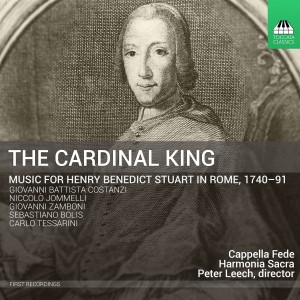
So if you were an English lord on the Grand Tour, and you've already heard the Sistine Chapel choir sing Palestrina and Victoria, and you wanted to hear the latest and greatest music being performed in churches in and around Rome, you might run into the Cardinal Pretender himself, Henry Benedict Stuart, James II's grandson and Bonnie Prince Charlie's younger brother. At least, that's what Peter Leech says:

“Mainstream academic music texts will often tell you that anything interesting, as far as sacred music in eighteenth-century Rome is concerned, more or less came to an end with the death of Alessandro Scarlatti in 1725. They also tend to make claims about many of his colleagues and successors being slavish imitators of the Palestrina style who did nothing to advance sacred music in a city apparently dominated by Papal conservatism.

“Whilst it is undoubtedly true that in the Sistine Chapel the
stile antico prevailed until the end of the 1700s (and indeed in Rome’s four Papal basilicas), outside the immediate boundaries of the Vatican, in many important parish churches, sacred music was anything but conservative and, in the hands of leading composers, reached new heights of expressive power with distinctly modern and, in the wider European sense, ‘classical’ flavours.

“One such church was San Lorenzo in Damaso, attached to the Cancelleria, the palace of the Vice-Chancellor of the Roman Church. In the early eighteenth century the Cardinal-Priest of San Lorenzo was Pietro Ottoboni, famous patron of Arcangelo Corelli. From 1763 this church came under the protection of Cardinal Henry Benedict Stuart (1725-1807), who had been elevated to the sacred purple in 1747. [when he was 22 years old!]

“Henry, the brother of Bonnie Prince Charlie and grandson of King James II of England, was devout, sincere and musically trained. He spent lavishly on sacred music at San Lorenzo, where composers such as Giovanni Battista Costanzi and Sebastiano Bolis enjoyed particular favour."

On the website for Toccata Classics, which has released a CD of music by composers employed by Cardinal Stuart, Leech provides more background into his process of discovery:

My interest in Roman sacred music of the eighteenth century had for many years been confined to composers active before 1760, such as Alessandro and Domenico Scarlatti, Pietro Paolo Bencini and Giuseppe Pitoni. The second half of the century had never been a major concern until 2011, when I started looking at music manuscripts in the vast Santini collection in Münster. I was intrigued to come across the dedication page of a Mass setting with its composer, Sebastiano Bolis, described as maestro di cappella, at San Lorenzo in Damaso, to Cardinal Henry Benedict Stuart, the grandson of King James II of England, brother of Bonnie Prince Charlie and last in the direct line of Jacobite succession.

Cardinal Henry, whose artistic patronage has been documented in books on eighteenth-century painting, sculpture and poetry, was well known to me through my work on the cultural life of the British Catholic community at home and abroad, but I was hitherto unaware of his musical patronage after he was made a Cardinal in 1747 by Pope Benedict XIV. It was a subject entirely untouched by modern scholarship.

One thing naturally led to another. I found several Bolis works in the Santini collection carrying the same dedicatory descriptions, and further searches revealed works by Bolis in the catalogues of various Roman parish church archives, and, significantly, in at least one British source.


Peter Leech's interest in this era of sacred music is also reflected on an earlier release with another choral group he founded, Harmonia Sacra.

If you were an English Catholic gentleman completing your education abroad, you might be a little careful about meeting the Cardinal Pretender, but once the Old Pretender, Henry's father James Francis Edward Stuart--James III to Jacobite supporters--died on January 1, 1766, the Holy See recognized the Hanoverian dynasty as the rightful kings of England, the danger may have lessened. Henry Cardinal Stuart never pressed his claim to the throne after his clerical career and his devotion to his religious duties developed, anyway.

Wednesday, January 18, 2017

The Final Session of the Council of Trent Opens

The third and final session of the Council of Trent opened on January 18, 1562, convened by Pope Pius IV, a good Medici. This session decided many details about priestly formation: bishops were to ordain only suitable men to holy orders and to supervise their moral life; clergy were to reside in their parishes and to perform regular duties; a seminary was to be established in every diocese; the discipline of clerical celibacy was upheld, etc.

This was the session of the Council attended by the last Catholic Bishop of St. Asaph's, Thomas Goldwell. He had been appointed by Mary I and he gave the last rites to Reginald Cardinal Pole, but had to go into exile at the beginning of Elizabeth I's reign without ever really becoming the ordinary of his diocese in Wales. As the Catholic Encyclopedia explains:

He was the only English bishop at the Council of Trent, where he was treated with marked respect. He was there engaged in the revision of the Breviary and the Missal; and also urged the council to excommunicate Queen Elizabeth. His mere presence at Trent was a cause of such excessive annoyance to Elizabeth that she wrote the following extraordinary farrago of falsehood to her German envoy Mundt: "We think it may be that one Goldwell, a very simple and fond man, having in our late sister's time been named to a small bishopric in Wales called St. Asaph, though never thereto admitted, flying out of the realm upon our sister's death, is gone to Rome as a renegade, and there using the name of a bishop, without order or title, is perhaps gone in the train of some Cardinal to Trent, and so it is likely the speech hath arisen of a bishop of England being there."

Not only did Thomas Goldwell attend the third session of the Council of Trent, but he was active in implementing its reforms:

In 1563 Goldwell was vicar-general to the Archbishop of Milan, St. Charles Borromeo. In 1567 he was made vicar of the cardinal archpriest in the Lateran, and in 1574 the Cardinal Vicar Savelli made him his vicegerent; he thus became, so to speak, the "working" bishop of Rome. . . . One of the last acts of his long and strenuous career was to serve on the Congregation for the Revision of the Roman Martyrology, in 1582. On the death of the Bishop of Lincoln, in 1584, Goldwell became the sole survivor of the ancient English hierarchy. He died the next year [on April 3], and was buried at St. Sylvester's.

He had even tried to accompany St. Edmund Campion, Father Robert Persons, et al on the mission to England in 1580 but became too ill during the journey on the Continent from Rome to the coast. He had to turn back at Reims. 

Sunday, January 1, 2017

The Old Pretender Dies

James Francis Edward Stuart--James III to Jacobite supporters--died on January 1, 1766 in Rome at the Palazzo Muti. Popes Clement XI and Innocent XIII had supported his claim to the throne of England, and he could have become King James III, if he had renounced the Catholic faith and become an Anglican. Father Dwight Longenecker explains in a post from the Imaginative Conservative:

The story of King James III is a romantic tale of a man who refused to give up his Catholic faith for the throne of England. . . .

On his death in 1701 James’ II’s oldest son became the rightful claimant of the throne of England. James Francis Edward Stuart, Prince of Wales was recognized as King James III by France, Spain and the Papal States, but he was accused of treason at home and known by his enemies as “The King Over the Water” or “The Old Pretender.” In 1708 James attempted an invasion of England through Scotland but was intercepted by the English. The French admiral in charge of James’ fleet retreated. By 1710 James’ other half-sister Anne was on the throne of England. She offered for James to be restored to the throne if he converted to the Protestant faith. He refused.

Three years later Queen Anne was close to death. In 1714 her agents were in secret correspondence with James III. They told him the queen was dying and indicated that if he converted to the Protestant faith the way would be open for him to ascend the throne. He wrote, “I have chosen my own course, therefore it is for others to change their sentiments.” Because of James’ refusal to give up his Catholic faith, the English looked for another monarch. More than fifty members of the royal houses of Europe were a closer blood relation to Queen Anne, but they were barred from the throne by their Catholic religion. Therefore at the Queen’s death, a German prince from the House of Hanover was offered the throne of England and became George I.

Pope Clement XI offered the disappointed King the Palazzo Muti in Rome and James set up his court in exile. His attempts to regain the throne failed and he suffered from melancholy and depression. He became known as “Old Mr. Misfortunate” and grew increasingly frail and despondent.

The Old Pretender's marriage to Maria Clementina Sobieska, grand-daughter of the great victor of Vienna, was unhappy. She accused him of adultery and fled to a convent; it was two years before they reconciled. James III had been raised at St. Germain-en-Laye in France to be a king, receiving the education necessary to prepare him for that role; but he had also been raised as an observant Catholic and would not apostatize. His son, the Young Pretender, Bonnie Prince Charlie, would attempt a brief foray into Anglicanism, hoping to find support for the throne, but failed too and then repented and returned to the Catholic faith.
 
James III is rather the opposite of Henri IV of France--England was not well worth giving up the Mass! 

After his death, the body lay in state for five days at the Basilica of the Holy Apostles before being interred in the crypt of St. Peter's Basilica. Last year (2016!) marked the 250th anniversary of his death and the British ambassador to the Holy See laid a wreath at James III's tomb in memory of his funeral on January 8, 1766--with the permission of Her Majesty, Queen Elizabeth II:

The commemoration ceremony consisted of a simple wreath-laying and the appropriate Collect (in English) by HM Ambassador Baker, the reading of the Rite of Commendation (in Latin) by HE Angelo Cardinal Comastri, Archpriest of St Peter’s Basilica, and the sung Antiphon In Paradisum Deducant Te Angeli.

[In paradisum deducant te Angeli; in tuo adventu suscipiant te martyres, et perducant te in civitatem sanctam Ierusalem. Chorus angelorum te suscipiat, et cum Lazaro quondam paupere æternam habeas requiem."May the angels lead you into paradise; may the martyrs receive you at your arrival and lead you to the holy city Jerusalem. May choirs of angels receive you and with Lazarus, once (a) poor (man), may you have eternal rest."]

HM Ambassador was accompanied by the Rt Rev Monsignor Charles Burns, Ecclesiastical Advisor at the British Embassy to the Holy See. H.E. Archbishop Paul Gallagher, Holy See Secretary for Relations with States, and H.E. Archbishop Arthur Roche, Secretary Congregation for Divine Worship and the Discipline of Sacraments, attended from the Holy See.

Other participants included Lord and Lady Nicholas Windsor, the Polish and Irish Ambassadors to the Holy See, the Rectors of the Pontifical Beda, Scots, Irish and Venerable English Colleges, and ecumenical representatives.

Wednesday, July 20, 2016

The O'Neill Dies in Rome

Hugh O'Neill, Earl of Tyrone, "The O'Neill", died on July 20, 1616, in Rome. He is buried in San Pietro in Montorio, famous for Bramante's Il Tempietto. HistoryToday.com provides this background on his conflict with Elizabeth I and his final exile to Rome:

O’Neill surrendered to the English the following year on the day before Queen Elizabeth’s death. He went to London and met the new king, James I who, it seemed for a time, would be more understanding, but after the Gunpowder Plot of 1605 patience with Catholicism ran out and the English regime returned to the whittling away of the O’Neill and O’Donnell estates. Hugh O’Neill hoped to argue his case again in London, but Red Hugh’s successor, his younger brother Rory O’Donnell, Earl of Tyrconnel, decided to get away abroad. O’Neill realized that the English would take this to mean he was plotting another uprising and that he himself would be implicated. He decided he must go too and said a sad farewell to his friends.

O’Neill and O’Donnell and more than ninety followers set sail in a French ship from Rathmullan in Donegal. They landed in Normandy, went on to the Spanish Netherlands and were quickly packed off to Italy, where the pope provided them with a house in Rome paid for by Philip of Spain. Pleas for Spanish help in Ireland were ignored. The English government was surprised and delighted by the departure of the earls, which in the opinion of the attorney-general of Ireland, Sir John Davies, enabled it to complete the work of St Patrick, who ‘did only banish the poisonous worms, but suffered the men full of poison to inhabit the land still.’ O’Donnell soon died, in 1608, and was buried in the church of San Pietro di Montorio. British agents keeping an eye on O’Neill in Rome reported that after a good dinner he liked to talk of the prospect of ‘a good day in Ireland’.

Hugh O’Neill never saw his good day in Ireland. Almost blind in his final years, he died of fever in 1616 in his sixties and was interred beside O’Donnell. The Protestant plantation of Ulster proceeded apace and the flight of the earls would be the first of many departures from Ireland by native Irish over the following centuries.


You can see the marker for his grave on the church's website.

Image credit