Showing posts with label EWTN Radio. Show all posts

Friday, September 30, 2022

Preview: St. Thomas More's Eucharistic Revival on the Son Rise Morning Show

On Monday, October 3, we'll start a new series on the Son Rise Morning Show in keeping with the USCCB's Eucharistic Revival program. Anna Mitchell or Matt Swaim and I will discuss Saint Thomas More's Treatise to Receive the Blessed Body of Our Lord each Monday during the month of October.

I'll be on the Son Rise Morning Show at my usual time: about 6:50 a.m. Central/7:50 a.m. Eastern time. Please listen live on EWTN Radio.
 
In a 1999 article for Catholic Answer's magazine (which I think was titled This Rock at that time), James Monti wrote about St. Thomas More's works defending the unity and the teachings of the Catholic Church. 

For example, More defended prayer for the holy souls in Purgatory in the Supplication of Souls; in his Dialogue Concerning Heresy, More defended the consistent Catholic view that the Church preceded the Bible, teaching according to the oral tradition of Jesus Christ and the Apostles, and that the Church was therefore most qualified to interpret the Bible; after all, she wrote it (the New Testament), she canonized its contents, she read it and taught it; in the same work, he defended prayer and devotion to the saints, the veneration of images and relics, the practice of pilgrimages (while acknowledging errors and superstition), and other matters--all with some good humor and patience for his interlocutor, "The Messenger". He responded directly to Luther's response to Henry VIII's Assertio Septem Sacramentorum and Tyndale's attacks on Church teaching in his own works (as the Supplication of Souls was a response to Simon Fish's Supplication of Beggars).

More wrote these apologetic works while serving King Henry VIII--foregoing sleep to study and write them at the request of the bishops, having permission from them to read the dissenters' works--and continued to write and publish them after he resigned as Henry's Lord Chancellor. 

Monti, the author of The King's Good Servant but God's First : The Life and Writings of Saint Thomas More from Ignatius Press (1997), writes in this article about More's defense of the Catholic doctrine of Holy Communion as the Real Presence of Jesus Christ, Body, Blood, Soul, and Divinity in several works:

It is in defense of the Church’s teachings regarding the Eucharist that Thomas More writes most effusively. He would devote three whole works to the subject: Answer to a Poisoned Book, in which he develops at length St. John Chrysostom’s assertions of the Real Presence of Christ in this sacrament; Letter against Frith, a shorter treatise published at the same time as the Answer (December 1533); and A Treatise to Receive the Blessed Body of Our Lord, a devotional work regarding the worthy and fruitful reception of Holy Communion. More’s scriptural commentary A Treatise upon the Passion includes an extended apologetic exposition on the Mass and the doctrine of transubstantiation.

The first two works might have found approval by Henry VIII, who upheld orthodox Catholic teaching about the Real Presence. Henry was present at the questioning of John Lambert, burnt at the stake for heresy in 1538 (three years after More's execution) and he attainted Robert Barnes for the same denial of the Real Presence, sending him to Smithfield along with William Jerome and Thomas Gerrard to be burnt at the stake on July 30, 1540. On that same day, Blesseds Thomas Abell, Edward Powell and Richard Fetherston, who all supported Queen Catherine of Aragon and refused to swear the oaths Henry VIII demanded, were hanged, drawn, and quartered at Smithfield.

The last two works, like The Sadness of Christ and A Dialogue of Comfort, were written while More was in the Tower of London, most scholars agree. From his letters to his daughter Meg we know that More had decided to spend his time in the Tower, where he presumed he would die, meditating on the Passion of Our Lord. The order of the Tower Works written in 1534, after he'd been arrested on April 17, likely is:
  1. A Treatise upon the Passion
  2. A Treatise to Receive the Blessed Body of Our Lord
  3. A Dialogue of Comfort
  4. De Tristitia (The Sadness of Christ)
But even as he was preparing for his death by such meditations, he was still dedicated to defending the teachings of the Catholic Church against the false teachings of the sacramentarians like Frith and Lambert, etc., who denied not only the Real Presence of Jesus in the Eucharist and Transubstantiation but the Lutheran idea of a sacramental union and Consubstantiation, and held that the Blessed Sacrament was just a symbol. Garry Haupt, who edited the Yale University Press edition of A Treatise to Receive the Blessed Body of Our Lord and A Treatise upon the Passion, notes that More may have meditating on the Passion in his own preparation for death but he wrote these works to help others increase their knowledge and devotion.

In this short treatise on Holy Communion, More connects true belief in the Real Presence (doctrine) with the devotionally and spiritually effective reception of Holy Communion, as he states at the very beginning:

They receive the Blessed Body of our Lord both Sacramentally and Virtually which in due manner and worthily receive the Blessed Sacrament. When I say worthily, I mean not that any man is so good, or can be so good, that his goodness could make him of very right and reason worthy to receive into his vile, earthly body, that Holy, Blessed, Glorious Flesh and Blood of Almighty God Himself, with His Celestial Soul therein, and with the Majesty of His Eternal Godhead: but that he may prepare himself, working with the Grace of God, to stand in such a state as the incomparable goodness of God will of His liberal bounty, vouchsafe to take and accept for worthy, to receive His own inestimable, Precious Body into the body of so simple a servant.

Immediately, More's concern is that a Catholic who plans to receive Holy Communion when attending Mass has done what she can to be sure she's as well prepared as she can be. She knows that she can't be worthy by her own efforts to receive the Sacrament--as More says no one "can be so good that his goodness could make him" worthy to receive the Body, Blood, Soul, and Divinity of Jesus Christ. He has to cooperate with the "Grace of God". 

We can't do it alone, just as we can't save ourselves just by being morally good (Pelagianism!) This is a humbling thought, but remember that St. Thomas More was a Christian humanist: he believed in the innate dignity of the human person, made in the Image and Likeness of God. He believed that men and women could be educated in knowledge and wisdom, developing and practicing the virtues. He just didn't believe that we could do it all on our own.

Such is the wonderful bounty of Almighty God that, He not only doth vouchsafe, but also doth delight, to be with men, if they prepare to receive Him with honest and clean souls, whereof He saith, "Deliciae meae esse cum filiis hominum." [My delight and pleasures are to be with the sons of men.]

More quotes Proverbs 8:31 and then goes on to demonstrate how true that statement is:

And how can we doubt, that God delighteth to be with the sons of men, when the Son of God, and very Almighty God Himself, liked not only to become the Son of Man, that is to wit, the son of Adam, the first man, but over that, in His innocent manhood, to suffer His painful Passion for the Redemption and Restitution of man.

In this brief paragraph, More aligns the Incarnation, the Paschal Mystery, and Holy Communion! No wonder he was so concerned that Catholics understand as fully as they can, the immense gift of Holy Communion, and prepared themselves, as well as they can, to receive it with forethought and preparation.

Blessed be Jesus in the most holy Sacrament of the altar!
Saint Thomas More, pray for us!

Sunday, November 7, 2021

Preview: Martinmas and Armistice Day on the Son Rise Morning Show

Tomorrow, Monday, November 8, I'll be on the Son Rise Morning Show to discuss the upcoming celebrations of the feast of Saint Martin of Tours, Armistice Day (in Europe) and Veterans Day (in the USA). Please listen live on EWTN Radio or on your local EWTN affiliate at my usual time, 7:50 a.m. Eastern/6:50 a.m. Central. You should have all your clocks set correctly for Daylight Savings Time by then!

St. Martin of Tours is the first non-martyr saint canonized by the Church before there really was a process for canonization. He is a confessor for Christ. He is best known and most frequently depicted as a soldier mounted on a horse, handing half of his cloak to a beggar. (El Greco pictures him as a 16th century Spaniard.)  After his conversion, brought about by a visit from Jesus revealing Himself to have been that beggar, Martin left the Roman army, became a hermit, and eventually was ordained priest and bishop. We have an early life written by Sulpicius Severus, who knew him! Martin was born in Pannonia, which is now in Hungary, in 316 or 336 A.D. and had become a catechumen in the Church--when the preparation for receiving the Sacraments of the Initiation took much longer than it does now--before he began to serve the Emperor Julian (Julian the Apostate) in the Roman army.

Martin finally decided he had to chose between Jesus and Julian and he chose Jesus and refused to fight in a battle in Germany. He was jailed and offered to go unarmed at the head of the troops into battle but because there was peace treaty, was allowed to leave the army.

St. Martin upheld the Church's true doctrine about the Divine Person of Jesus Christ, opposing the Arians and supporting St. Hilary of Poitiers against those heretics. Martin established monasteries: Liguge Abbey and Marmoutier Abbey near Tours; he really wanted to live as a hermit or monk but was selected as the bishop of Tours in 371; he died on November 8, 397 and his cult spread quickly. 

More about Martinmas, one of those feasts that anchored the Medieval year in custom and liturgical observance:

Famous for his generosity towards a drunken beggar, with whom he shared his cloak, St Martin is the patron saint of beggars, drunkards and the poor. As his feast day falls during the wine harvest in Europe, he is also the patron saint of wine growers and innkeepers.

As Martinmas coincided with the gathering in of the harvest, during the Middle Ages it was a time for feasting, to celebrate the end of autumn and the start of preparations for winter. Martlemass beef, salted to preserve it for the winter, was produced from cattle slaughtered at this time. Traditionally, goose and beef were the meats of choice for the celebrations, along with foods such as black pudding and haggis.

Martinmas is also a Scottish term day. The Scottish legal year is divided into four term and quarter days: Candlemas [February], Whitsunday [May], Lammas [August] and Martinmas [November]. On these days servants would be hired, rent would be due and contracts would begin or end. Traditionally therefore, Martinmas was also the time of hiring fairs, at which agricultural labourers and farm hands would seek employment.

Liturgically, the feast of St. Martin of Tours ends the Octave of All Souls Day, an intense period of prayer for Holy Souls in Purgatory. 

Interesting note: Martin Luther was baptized on November 11, 1483, and thus was named for the saint! 

Like Saint Joan of Arc, St. Martin of Tours was a popular saint in France during times of war and particularly in the First World War. In the November issue of the Magnificat prayer book, Anthony Esolen provides us with the link between the feast of St. Martin of Tours and Armistice Day, when the fighting of World War I ended on the Western Front and Germany surrendered. 

Marshall Ferdinand Foch, the Supreme Allied Commander in Europe and Lord Admiral Rosslyn Wemyss, the British legate, met the representatives of Germany and Austria-Hungary in the forest of Compiegne early in the morning of November 11, 1918. As Esolen explains, the Armistice "will go into effect, by Foch's order, at 11 AM, the eleventh hour of the eleventh day of the eleventh month. Foch, whose brother [Germain] was a [Jesuit]priest, had in mind Saint Martin, that soldier for peace." (p. 206) 


Between that early morning armistice and the cessation of battle, 
2,738 men died.

Foch came to the United States in 1921 to be present at the groundbreaking ceremony of the Liberty Memorial in Kansas City, Missouri on November 1. On November 6 he was made the one millionth member of the Knights of Columbus during Mass at Holy Name Cathedral in Chicago, Illinois, and he was also present at the Armistice Day celebrations at Arlington Cemetery. Sadly, he knew the Armistice was not a true peace treaty; he predicted it would last only 20 years. He died on March 20, 1929 and is buried in the Hôtel des Invalides in Paris.

Image Credit (shared under a CC BY-SA 4.0): Tomb of Ferdinand Foch – Hôtel des Invalides

In 1954, Armistice Day, an official holiday in the USA since 1928, became known as Veterans Day, a Federal Holiday to honor all Veterans.

Saint Martin of Tours, pray for us!

Saturday, October 16, 2021

Preview: Saint Philip Howard and the Jesuit Connection

Anna Mitchell of the Son Rise Morning Show asked me to come on their second EWTN hour on Monday, October 18 at my usual time (about 7:50 a.m. Eastern/6:50 a.m. Central) to talk about the feasts of St. Philip Howard and of the North American Martyrs on October 19. Please listen live on EWTN Radio or on your local EWTN affiliate.

There is a connection between this English lay martyr in chains in the Tower of London and these Jesuit missionaries in North America: the Jesuit Connection.

St. Philip Howard died on October 19, 1595, condemned to death at a time and date of Queen Elizabeth I's pleasure, found guilty of praying for the success of the Spanish Armada. 

It was the influence of two English Jesuit missionaries--and his own wife's faith--that brought Howard to the Tower and his long imprisonment (1585-1595): St. Edmund Campion, SJ and Father William Weston, SJ.

First, he witnessed one of Saint Edmund Campion's debates with the Anglican divines in the Tower of London in 1581, based on Campion's "Decem Rationes" (Ten Reasons). Campion did so well in proving his case in these debates that he never had the opportunity to go through all his Ten Reasons. Howard was impressed by Campion's brilliance and convinced that the Anglicans, while being unfair (they had books and Campion didn't; they could ask questions and Campion couldn't) hadn't proved the Jesuit wrong. Certainly, Campion had made Howard think about the Catholic Church.

Second, Howard was reconciled to the Catholic Church by Father William Weston, SJ on September 30, 1584 at Arundel Castle in Sussex. At the same time, Howard reconciled with his wife Anne and became a devoted husband.

Howard tried to leave England, knowing that he was not welcome at Court because of his conversion (which showed in his changed behavior). He was arrested at sea in 1585 and imprisoned in the Tower. His wife was pregnant with their second child, the son he would never see.

There's a third Jesuit connection during his imprisonment: another martyr, St. Robert Southwell, SJ, who was Anne's chaplain, wrote An Epistle of Comfort for him. When Southwell was held in the Tower before his execution, Howard and he communicated through messages carried by Howard's dog.

Saint Philip Howard died of dysentery on October 19, 1595. He is now buried in the Cathedral of Our Lady and St. Philip Howard in Arundel. His wife, Anne Howard, the Countess of Arundel died on April 19, 1630 when she was 73 years old. She never remarried after his death and struggled to survive during Elizabeth I's reign; King James I restored her jointure lands, which she'd received as her own when she married, so that solved some of her financial troubles.

As to the Northern American or Canadian Martyrs, they aren't just connected to the Society of Jesus, they are Jesuits:
  • Saint Rene Goupil (lay brother), martyred in 1642
  • Saint Isaac Jogues and Saint Jean de Lalande, martyred in 1646
  • Saint Antoine Daniel, in 1648, 
  • Saints Jean de Brebeuf, Noel Chabanel, Charles Garnier, and Gabriel Lalement, in 1649
Unlike the Jesuit priests and martyrs who returned to England after study on the Continent, ministering to hidden Catholics, wearing disguises, sought by authorities for treason, these French Jesuits prepared for missions to the Native Americans, the Algonquins and Hurons, etc. As this panegyric to their efforts proclaims:

Members of the Society of Jesus who dedicated themselves to the conversion of the American Indians took Christ’s words very literally. They journeyed from Renaissance France to the frontiers of North America that they might preach and baptize. After pouring the saving waters of Baptism on a dying Indian child, Saint John de Brebeuf, the great pioneer of this mission, exclaimed with joy, “For this one single occasion I would travel all the way from France; I would cross the great ocean to win one little soul for Our Lord!” And so pleased was God with the genuine zeal and the extraordinary sacrifices of these Jesuit apostles that He bestowed upon Father Brebeuf and seven of his fellow missionaries the glorious crown of martyrdom. . . .

The Society of Jesus had been founded by Saint Ignatius of Loyola during the turbulent times following the Protestant Revolution. By the dawning of the seventeenth century the Jesuits had won renown as zealous missionaries and ardent defenders of the Catholic Faith.

The Order was still at the peak of its power, prestige, and holiness when a new mission field began to unfold. France, eldest daughter of the Church, was beginning to colonize North America, and the vast untamed regions of the New World were inhabited by pagan natives who had never before been evangelized.

They achieved some success among the Hurons, learning their language, living with them, and were martyred, mostly, by the Iroquois, who were constant enemies of the Huron, after horrendous torture.

This is beyond the scope of our discussion on Monday, but I should mention here that English Jesuits were still suffering arrest and execution in their native land in approximately the same years as these eight North American martyrs:


(All at Tyburn.) I don't know if these English and French Jesuits would have ever met on the Continent; the English had separate colleges and seminaries established for them. There's another research topic!

Saint Philip Howard, pray for us!
Saint Rene Goupil, pray for us!
Saint Isaac Jogues, pray for us!
Saint Jean de Lalande, pray for us!
Saint Antoine Daniel, pray for us!
Saint Jean de Brebeuf, , pray for us!
Saint Noel Charbanel, pray for us! 
Saint Charles Garnier, pray for us!
Saint Gabriel Lalement, pray for us!

Friday, January 18, 2019

Newman's Life Part II: The Catholic Years

On Monday, January 21, I'll continue the overview of Newman's life, focusing on the Catholic half, on the Son Rise Morning Show. Either Anna Mitchell or Matt Swaim and I will discuss the many challenges and achievements of Blessed John Henry Newman as Oratorian, educator, defender of Catholic teaching, etc, etc, a little after 7:45 a.m. Eastern/6:45 a.m. Central. Listen live here. The segment will also be repeated during the EWTN hour later in the week.

Here is an adapted chronology of events and works of Blessed John Henry Newman's Catholic life (supplemented by this resource):

1845 Received into the Catholic Church on October 9
Essay on the Development of Christian Doctrine

1846 Ordained to the priesthood in May

1848 Establishes Birmingham Oratory
Loss and Gain

1849 Discourses Addressed to Mixed Congregations

1851 Becomes Rector of Catholic University of Ireland
Lectures on the Present Position of Catholics in England

Achilli Trial Begins

1852 The Idea of a University
Newman preaches “The Second Spring” for the first Synod since the Restoration of the Hierarchy in England

1853 Newman loses the Achilli trial and is fined 100 pounds

1856 Callista: A Sketch of the Third Century

1857 Sermons Preached on Various Occasions


1864 Charles Kingsley attacks Newman on his truthfulness; Newman responds with his Apologia Pro Vita Sua

1865 "The Dream of Gerontius"

1866 A letter to Pusey on occasion of his recent Eirenicon

1868 Parochial and Plain Sermons

1870 Essay in Aid of a Grammar of Assent

1875 Publication of A Letter to the Duke of Norfolk in answer to Gladstone’s accusation that Catholics are not loyal subjects of the State.

1877 Elected honorary fellow of Trinity College

1879 Becomes a cardinal; Motto is "Cor ad cor loquitor" ("Heart speaks to heart")

1889 Says his last Mass on Christmas Day (memorized two Masses in case he could celebrate again (his sight had failed)

1890 Dies on August 11; Epitaph reads "Ex umbris et imaginibus in veritatem" ("Out of shadows and pictures into truth")

Saturday, December 16, 2017

EWTN's Register Radio Today


The National Catholic Register asked me to write an article about how Christmas was banned in England and in the English American Colonies, and so I did:

The English Victorian Christmas is an ideal: the glowing Christmas tree, the carols, figgy pudding, Christmas goose or turkey, special charity for the poor, and the holly and the ivy. Then there’s the more extended English medieval Christmas: wassail, the Yule log and the festive Twelve Days of Christmas until the feast of the Epiphany. There’s a mixture of English, Welsh, German and French traditions in these images.

Even if we have to face the ghosts of Christmases past (or present and future), we want that perfect celebration of family and faith. Between the medieval era and the Victorian, however, the very idea of celebrating the birth of Our Savior with feasting and revelry was banned in 17th-century England. Every December was like Narnia because, although it was winter and it might be cold and snowy, there was no Christmas.


I manage to work in Charles Dickens, A Christmas Carol, Louisa May Alcott, Little Women, Ulysses S. Grant, and all the trappings of Christmas--it should be in the next print edition.

Then they asked me to appear on a segment of EWTN's Register Radio, and so I did. It will be broadcast this evening at 6:00 Central and repeated on Sunday at 10:00 a.m. Central. The broadcast will be archived here.

Wednesday, March 29, 2017

Blessed John Hambley, Pray for Us!

Just a reminder that I'll be on the Son Rise Morning Show during the EWTN hour this morning (5:00 to 6:00 a.m. Central Daylight Savings Time/6:00 to 7:00 a.m. Eastern DST) to talk about the Stations of the Cross, Blessed John Henry Newman's Meditation on the Ninth Station, and Blessed John Hambley! Listen live here. Remember that you can catch up with the podcasts on the Son Rise Morning Show here.

Then check out my latest blog for the National Catholic Register where I discuss those three subjects more completely than is possible in a brief radio interview, especially the story of Blessed John Hambley, who is remembered on the Roman Martyrology today:

All the priests who came to England knew that they could suffer imprisonment, torture, and horrendous execution. They had the example of their protomartyr, Father Cuthbert Mayne in 1577, and then of Fathers Edmund Campion, Ralph Sherwin, and Alexander Briant—and others—in 1581. Nearly every year they learned of another priest being martyred. The Venerable English College in Rome, where many priests studied, started the tradition of a seminarian preaching a sermon on martyrdom before the pope on the feast of St. Stephen, the first martyr. The founder of the Oratorians, St. Philip Neri, greeted the students in the streets with the salutation, “Salvete flores martyrum” (Hail! flowers of the martyrs).

But Father John Hambley, in spite of all these examples, was not ready to suffer. He had given up everything to become a Catholic and a priest, but the threat of physical suffering undid him, according to the 1914 edition of The Lives of the English Martyrs. He was born around 1560 in an Anglican family, but a Catholic friend encouraged him to read a book by Father Robert Persons, SJ and soon he became a Catholic. Because he had stopped attending Church of England services, he left his native Cornwall and then left England for the Continent. Hambley studied for the priesthood in Reims and was ordained on September 22, 1584. On April 6, 1585 he returned to England as a missionary priest under the guidance of Father John Cornelius, SJ (who would be martyred in 1594).

Before Easter in 1586, he was arrested in Taunton, Somerset, tried for being a priest, convicted, and sentenced to death. To save his life, Hambley promised to renounce his Catholic faith; then he escaped from prison. Recaptured on August 14, he faced the same horrible death of being hanged, drawn and quartered—and he fell again. He not only promised to become an Anglican, but he told the authorities everything he knew. Hambley told them about where he said Mass, who attended, who helped him; he told them the names of 15 other priests serving in England and others who are studying abroad. 

Strangely, the judges did not trust his statements, perhaps because he gave them so willingly, so Hambley was held in prison in Salisbury until the next public trials, the Assizes, in March of 1587. The judge asked him again if he was ready to renounce the Catholic faith, and Father Hambley said he was—his third fall. Awaiting release, he was given a letter; after he read it, he changed. The next day, he told the judge that he would not renounce the faith and that he regretted his weakness. This time, the threat of “a most cruel death” did not move him to cowardice, and he suffered execution bravely.

Blessed John Hambley, pray for us! Help us to be resolute in our Lenten devotions and in our journey to eternal life!

Friday, March 10, 2017

Don't Forget: St. Ogilvie on EWTN Radio!

If you listen to EWTN Radio early in the morning, the Son Rise Morning Show has an hour broadcast from 5:00 to 6:00 a.m. Central time/6:00 to 7:00 a.m. Eastern! The Son Rise Morning Show will include my segment with Anna Mitchell to tell the story of St. John Ogilvie this morning during that hour today! Listen live here.

Here's a prayer for the intercession of St. John Ogilvie, SJ:

God our Father, fountain of all blessing, We thank you for the countless graces that come to us in answer to the prayers of your saints. With great confidence we ask you in the name of your Son and through the prayers of St John Ogilvie to help us in all our needs.

Lord Jesus, you chose your servant St John Ogilvie to be your faithful witness to the spiritual authority of the chief shepherd of your flock. Keep your people always one in mind and heart, In communion with Benedict our Pope, and all the bishops of your Church.

Holy Spirit, you gave St John Ogilvie light to know your truth, wisdom to defend it, and courage to die for it. Through his prayers and example bring our country into the unity and peace of Christ’s kingdom. Amen.


More details about this great Scottish saint and martyr here from yesterday's post!

Monday, January 2, 2017

Starting the New Year with the Son Rise Morning Show


I'll start 2017 bright and early with Annie Mitchell on the Son Rise Morning Show, discussing the English Reformation connection to the Feast of the Holy Name of Jesus, which is observed on January 2 on the Extraordinary Form and on January 3 on the Ordinary Form calendars. It will be live on air a little after 7:45 a.m. Eastern time/6:45 a.m. Central time--so listen here!

Richard Whitford was a friend of St. Thomas More and a priest of the famed Briggitine House of Syon Abbey. Both Whitford and Richard Reynolds opposed Henry VIII’s Supremacy: Reynolds was one of the protomartyrs of the English Reformation on May 4, 1535, but Whitford was granted a pension and protection by Charles Blount, Baron Mountjoy when Syon Abbey was suppressed in 1539 and survived on a pension in Mountjoy’s household until he died in 1542.

Whitford translated The Imitation of Christ and wrote many devotional works. One of the most popular was the Jesus Psalter, a series of 15 petitions to Jesus, praying for mercy, wisdom, fear of the Lord, and other graces. It emphasizes, with the words of Acts 4:12, that “There is no other Name under heaven given to men whereby we may be saved” and was very popular during the Recusant era. Whitford was continuing a tradition of other English spiritual writers to pray with the name of Jesus. Richard Rolle, the fourteenth century hermit, wrote “If you think on the name Jesus continually and hold it stably, it purges your sin and kindles your heart” and Walter Hilton, author of
The Scale of Perfection, also encouraged meditation on the Name of Jesus, which is “full of comfort and delight.”

Then my first post of the new year at the National Catholic Register will be online January 3 and the Son Rise Morning Show will repeat my interview during the national EWTN hour that morning! (From 6:00 to 7:00 a.m. Eastern/5:00 to 6:00 a.m. Central).

Merry Christmas and Happy New Year!

Image Credit: IHS monogram, Montmorency, France

Monday, March 28, 2016

Mother Mary Angelica, RIP

Mother Angelica, foundress of the Eternal Word Television Network, of two religious orders, and EWTN radio, died Easter Sunday, March 27, 2016. My husband and I were running an errand when we heard the news. After praying for her departed soul, we said almost at the same time that she and her network had, apart from our crucial formation during college at St. Paul's Parish-Newman Center, the greatest impact on our life as Catholics. Because of EWTN, we benefited from so many resources: the programming, the books, the people, the outlook on the traditional devotion and piety--which has certainly informed our love for the Extraordinary Form of the Latin Rite Mass. We first listened to her radio programming on shortwave radio! Now we have access to EWTN on-line, on broadcast radio, on cable, on Roku, in print (The National Catholic Register), etc, etc.

Our debt to her is great.

One more thing: it was being on EWTN, both the television network and the radio programming, that gave real support to my work on the English Reformation. The day EWTN broadcast the Bookmark I had taped with Doug Keck in January of 2010 was Sunday, September 19, 2010. Pope Benedict XVI had just beatified John Henry Newman. The first printing of Supremacy and Survival sold out in November.

Thank you, Mother Angelica! I am certain that there are dozens and dozens of Catholic writers who would, could, and should express the same gratitude--some on a much greater scale!

Eternal rest grant unto her O Lord and let light perpetual shine upon her. May the souls of the faithful departed, through the mercy of God, rest in peace. Amen.

Santo Subito!

Monday, July 20, 2015

Church History Apologetics: Blessed Junipero Serra

It's the third Monday of the month, so I'll be talking Church History Apologetics with Matt Swaim on the Son Rise Morning Show during the last national segment on EWTN: after the 7:45 a.m. Eastern/6:45 a.m. Central news break with Annie Mitchell. We'll discuss the controversy over Blessed Junipero Serra and Spanish colonization in California.

Pope Francis will canonize the Mallorca-born missionary priest when he visits the United States in September this year. There has been some controversy about this because some people accuse Blessed Junipero Serra of abusing the natives in California while establishing the missions. The first thing to establish is that critics are chronologically confused, according to Professor Ruben Mendoza of California State University, Monterey Bay, in this National Catholic Reporter article:

The professor has been involved in research and conservation projects at several California missions founded by Serra. He said many of the Spanish missionary's critics are confusing the impact of Spanish colonizing and missionary activity on the native communities with what happened after California became a U.S. territory in 1848.

"A decimation of the Native American population," Mendoza said, occurred "in the period after 1850; Serra had no connection to that phenomenon. Those who criticize Serra the most tend to conflate the American period with that of the missionaries."

Another major objection to Serra's canonization involves reports that Native American adults at his mission were beaten.

"There is no documentation that Serra himself abused any Native American," Mendoza said. "The system under which he operated did use corporal punishment, but that was also used for transgressors from all walks of life, including soldiers."


Mendoza supports the canonization and said he believes it "has much to offer the peoples of Latin America, especially those of us of Mexican-Indian heritage who currently live under a shadow of doubt and denigration."

Just as with St. Thomas More during the Wolf Hall controveries, I've seen some articles with the headline or comment: "Saint or sinner?" and the answer, just as with St. Thomas More, is: both! Sainthood does not mean that the canonized confessor or martyr was perfect or never sinned; it means that the Church has determined that the confessor practiced the theological virtues heroically and that, by evidence of both devotion and miracles through the intercession of the saint, the Church is certain that the confessor is in heaven. Everyone in heaven is a saint, canonized and recognized by the Church or not; that's one reason we have the glorious feast of All Saints Day.

As the head of the Knights of Columbus noted, these attacks on Father Serra are part of the "Black Legend":

The “black legend” is a term historians use to explain a propaganda war of English speaking nations against Spain. It originally arose when Spain had a vast empire and England was competing with Spain.

We all know, for example, the story of the Spanish Armada trying to invade England. It has come down through history as a prejudice against Spaniards as being unusually cruel, unusually greed, unusually untrustworthy. . . .


The presumption of the black legend is that the Indians — the native peoples — were treated cruelly, maybe were tortured, were exploited. When the fact of the matter is, what drove and motivated Junípero Serra and the other missionaries was the message of Our Lady of Guadalupe, that these people have dignity. When she appeared to Juan Diego, she said: “Am I not your Mother?” Did she not come with their appearance, as one of them. She also said: “I have the honor to be your mother.”

Disciples of Our Lady of Guadalupe understand that she is coming out of respect. And therefore, evangelization does not mean domination; it doesn’t mean exploitation. It means bringing the Gospel to people and cultures that you respect.


And Carl Anderson notes that it was the State of California, in the days of the 49ers, that abused the natives:

And that’s the key to understanding Junípero Serra. In fact, many of the horrible things that people want to say occurred under the Spanish missionaries actually occurred after Spain and Mexico were driven out of California. It is during the gold rush — in 1849 and 1850 — that you see the suppression of the Indian people, i.e. the natives of California. . . .

You even have the governor of the time saying the Indians must be exterminated. There was no thought of treating the native people with the kind of respect and multiculturalism that Junípero Serra wanted. The governor stated this quite clearly and used the word ‘extermination’, so it’s very clear what was going on.


The Black Legend is one of those sloppy, easy ways to think (or not think) about history, using some simplistic, generalized framework to sort out the heroes and the villains. We know that history is more complex than that but this propaganda device is hard to dislodge from popular culture.

A final aspect of this issue is the statue of Blessed Junipero Serra in the U.S. Capitol’s National Statuary Hall Collection (pictured above/public domain)--there was a move to have it replaced with one of Sally Ride, but that has been put on hold, at least until after Pope Francis' visit. St. Damien of Molokai, the Leper priest, is the other Catholic saint depicted in the hall. Do you know which historic figures represent your state? Perhaps I'll quiz Matt on who represents Ohio!

Thursday, July 18, 2013

How to Measure the Success of an Interview

In my full time job I work at a corporation and of course corporations measure everything (especially P&L!).  As I work in my free time to promote my book and my ideas, using this blog, facebook, twitters, articles, and radio interviews, I do try to measure my success. I can't really measure my success in dollars, because the return on a book through royalties is rather low. So I have used other measures--contact; connections; comments; compliments; even complaints. These measures tell me that I have had some impact.   
                                                                 
Last Saturday, I spoke to Barbara McGuigan on EWTN Radio for two hours on her "The Good Fight" radio show, and I invited listeners to search for my blog by "googling" supremacy and survival blog--and I know that 10 people found my blog by using that search. Five more found it by googling stephanie mann supremacy survival, and two or three by combinations like Stephanie Mann blog or stephanie mann barbara mcguigan. Overall page views on my blog increased. Therefore, the interview did produce measurable results. Two listeners left comments on my English History: from Henry VIII to John Henry Newman (1500-1900) facebook page (see badge in the right hand column on this blog) and I received one direct email comment.

Even though Barbara and I were discussing the Blessed Carmelite Martyrs of Compiegne and the history of de-Christianization of France during the French Revolution, we did bring up the English Reformation and Barbara kindly plugged my book several times. I did see some movement in the ranking on Amazon.com for my book, but I have no way of knowing of any other book sales (at EWTN or other sites or even bookstores) that might have occurred because of her comments.

Of course what's impossible to measure was the satisfaction and fun of speaking with Barbara and with the listeners who called in with questions or comments--two callers even mentioned the operatic connections of Picpus Cemetery: Andrea Chenier and the Carmelites, which I knew about--and, indirectly, Beethoven's Fidelio (not to mention Fernando Paer's version of the same story, and two other operas), which I did not know about--inspired by Adrienne de Noailles Lafayette's efforts to help her husband, the Marquis de Lafayette, escape from prison in Olmütz. You can read more about the Marquise here and more about the operas inspired by their imprisonment here. When the family was finally released from that prison, they probably felt like the prisoners in the great chorus of Fidelio:


So now whenever I hear one of Beethoven's Leonore overtures or listen to my recording of Fidelio (the Klemperer, Ludwig, Vickers classic), I'll think of the Marquise Adrienne de Noailles Lafayette! That kind of enrichment is really immeasurable.

Wednesday, July 10, 2013

The Carmelites of Compiegne on "The Good Fight"

I'll be on EWTN Radio this Saturday, July 13, talking with Barbara McGuigan on "The Good Fight": our topic will be the Carmelite Martyrs of Compiegne, in anticipation of their memorial on July 17. If you have any questions or comments about these great martyrs of the French Revolution, please call in at 1-877-573-7825.

"The Good Fight" airs from 1:00 to 3:00 p.m. Central time; 2:00 to 4:00 p.m. Eastern, etc--and you may listen live online at EWTN here.

Barbara and I will examine the heroic story of these martyrs, the campaign of de-Christianization in France during the French Revolution, and apply the lessons of their sacrifice to our lives today. We'll also look at the connection between the Carmelites' story and the English Reformation!


Friday, June 14, 2013

Summer Reading List on the Son Rise Morning Show

I'll be on the Son Rise Morning Show a little earlier than I usually am--at 7:35 a.m. Eastern, 6:35 a.m. Central--this morning. I'll be sharing my summer reading recommendations with Brian Patrick and the listeners of the EWTN Radio Network.

I have one nonfiction and three fiction books to recommend:

I'll post my review of Ryan S. Topping's Rebuilding Catholic Culture: How the Catechism Can Shape Our Common Life this weekend, but others much more influential and important than I have praised and recommended this book, per the Sophia Institute Press website:

"This book deserves to take its place among the Catholic classics."
Fr. Aidan Nichols, O.P.
Prior of Blackfriars, Cambridge

"This extraordinary book should be read by every Catholic parent, pastor, educator, politician — in fact, everyone."
Michael O'Brien
Author of A Father's Tale: A Novel

"This profound work of scholarship is a delight to read. It is shot through with gentle humor, and has a Chestertonian sense of paradox and irony. His exposition of the liturgy is particularly powerful."
Fr. John Saward
Oxford University, and author of Sweet and Blessed Country

"Ryan Topping wields the Catechism as a weapon of wisdom with which he demolishes the nonsense of the worldly philosophies and the sophistries they espouse."
Joseph Pearce
Writer-in-Residence at the Thomas More College of Liberal Arts

Three works of fiction, starting with The Mirrored World by Debra Dean, which I reviewed here.

Treason: A Catholic Novel of Elizabethan England, which I reviewed here. 
And Mr. Blue, which I discussed here and reviewed here

What are your summer reading recommendations or plans? Have you read any of these books and have any comments about them? Please share if you like.

Tuesday, June 11, 2013

Sunday Mornings at Our House: Ireland on the Radio

We are up betimes at our house Sunday morning--except for the dogs, who go back to sleep--getting ready to attend 8:00 a.m. at the Church of St. Anthony of Padua. One highlight every Sunday is EWTN's Catholic Connection, with Kathy Kinnott broadcasting from Cork, Ireland--it's on at 6 a.m.

On Sunday, June 1 she had a really great episode on a publication distributed  in Ireland called Alive! and an interview with an English professor at Ave Maria University:

One of Ireland's most popular Catholic newspaper is the Alive! Kathy talks to founder and editor of Alive! Fr. Brian McKevitt, OP about the ups and downs of publishing a Catholic newspaper in an often hostile secular media environment. Part 2. The great British poets Gerard Manley Hopkins, Samuel Taylor Coleridge and Blessed John Henry Newman were masters of the art of verse in their day. Kathy and her guest to Dr. (Michael) Raiger, assistant professor of literature, Ave Maria University Florida, talk about how the beauty and depths of their poetry are interwoven with the beauty of God and his creation.

Here's a blog post from Ave Maria University that gives excellent background to Dr. Raiger's in the interview:

Dr. Michael Raiger, Assistant Professor of Literature at the university, has devoted much of his academic career to recovering Coleridge’s Trinitarian thought. Embedded in the life of Coleridge was a stay in Malta, from 1804 to 1805, followed by a nine-month sojourn through Italy, including five weeks in the Vatican where he studied Catholic art and architecture during the Easter season of 1806. It is during his stay in Malta that Coleridge’s decade-long fling with Unitarianism (Coleridge’s father was an Anglican minister in the Devonshire village Ottery-St. Mary) ended with an acceptance of the doctrine of the Trinity—we have the precise moment recorded in one of his notebooks, dated Feb. 12, 1805, 1:30 p.m., in which Coleridge wrote: “No Christ, No God…No Trinity, No God…Unitarianism in all its forms is Idolatry.” It is this seminal moment, argues Raiger, and the lengthy stay in the Sistine Chapel the following year, that informs Coleridge’s most important reflections on the relationship between art and aesthetics on the one hand, and religious sensibility and theological speculation on the other. The claim is a bold one, and goes against forty years of scholarship on Coleridge, which sees him as borrowing bits and pieces from German Idealism, mostly Kantian, in the construction of a rather esoteric and inconsistent defense of Christianity. To the end of countering this position, Dr. Raiger will travel to Malta in mid-November to deliver a paper entitled, “The Italian Influences on Coleridge’s Later Poetic Principles,” at the international conference “Encountering Malta: British Writers and the Mediterranean, 1760-1840.”  . . .

As a follow up to his discussion of poetry and Romanticism, here's one of Hopkins' "nature" poems, "As Kingfishers Catch Fire"--

As kingfishers catch fire, dragonflies draw flame;

As tumbled over rim in roundy wells
Stones ring; like each tucked string tells, each hung bell's
Bow swung finds tongue to fling out broad its name;
Each mortal thing does one thing and the same:
Deals out that being indoors each one dwells;
Selves -- goes itself; myself it speaks and spells,
Crying What I do is me: for that I came.

I say more: the just man justices;
Keeps grace: that keeps all his goings graces;
Acts in God's eye what in God's eye he is --
Christ. For Christ plays in ten thousand places,
Lovely in limbs, and lovely in eyes not his
To the Father through the features of men's faces. 

Monday, December 10, 2012

December 10, 1591 On the "Son Rise Morning Show"


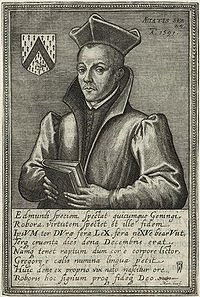
I'll be on the Son Rise Morning Show, broadcast on the EWTN Global Radio Network from Sacred Heart Radio in Cincinnati, Ohio this morning at 7:45 a.m. Eastern, 6:45 a.m. Central to discuss the executions of a group of Catholic martyrs on December 10, 1591 on Gray's Inn Road in London:

St. Swithun Wells was hanged for NOT attending a Catholic Mass in Elizabethan England. His wife Alice attended the Mass held in his house near Gray's Inn in London, but he wasn't there when the priest hunters burst in during the Mass celebrated by Father Edmund Gennings. Those attending held the pursuivants off. His wife, Fathers Gennings (pictured at right) and Polydore Plasden, and two other laymen, John Mason and Sidney Hodgson were arrested at the end of the Mass. Swithun was arrested when he came home.

At his trial, he said he wished he could have attended that Mass and that was enough for the Elizabethan authorities! He was hung near his home on Gray's Inn Road in London, and he spoke to Richard Topcliffe before he died, hoping that this persecutor and torturer of Catholics would convert! He said, "I pray God make you a Paul of a Saul, of a bloody persecutor one of the Catholic Church's children." St. Swithun as a school master had for a time conformed to the official church but then had returned to the Catholic faith.

As he was led to the scaffold, Wells saw an old friend in the crowd and called out to him: "Farewell, dear friend, farewell to all hawking, hunting, and old pastimes. I am now going a better way"!

St. Swithun's wife Alice received a reprieve from her death sentence, but died in prison in 1602. The two priests and the other three laymen were all executed on December 10. Sir Walter Raleigh was present at the execution and heard Father Polydore pray for Queen Elizabeth. Raleigh then asked him about his loyalty to Queen Elizabeth as the rightful ruler of England and liked his answers, so ordered him to be hung until dead, thus avoiding the rest of the torture of his execution. On the other hand, Topcliffe made sure that Father Gennings suffered all the tortures of being hung and quartered: he was left to hang but a short time and was fully conscious as the executioner started cutting him up. Father Gennings had said, "I know not ever to have offended the Queen. If to say Mass be treason, I confess to have done it and glory in it."

The two priests and the house owner have been canonized: St. Edmund Gennings, St. Polydore Plasden, and St. Swithun Wells--among the Forty Martyrs of England and Wales in 1970. The two laymen who helped defend St. Edmund Gennings at Mass and were sentenced to death for that felony (sic) were beatified (Blessed John Mason and Blessed Sidney Hodgson) by Pope Pius XI in 1929.

But these were not the only martyrdoms in London that day in 1591--Father Eustace White and layman Brian Lacey were executed at Tyburn. St. Eustace White was a convert to Catholicism--his anti-Catholic father cursed him and White endured permanent estrangement from his family. In 1584 Eustace began studies for the priesthood in Rheims, France and Rome, Italy, and was ordained at the Venerable English College in Rome in 1588. In November 1588 he returned to the west of England to minister to covert Catholics. The Church was going through a period of persecution in England, made even worse by the attack of the Armada from Catholic Spain. Arrested in Blandford, Dorset, England on 1 September 1591 for the crime of being a priest. He was lodged in Bridwell prison in London, and repeatedly tortured.

He endured the torture technique developed by Richard Topcliffe and used on St. Robert Southwell and others, being hung by the wrists. As he wrote to Fr. Henry Garnet, SJ from prison:

"The morrow after Simon and Jude's day I was hanged at the wall from the ground, my manacles fast locked into a staple as high as I could reach upon a stool: the stool taken away where I hanged from a little after 8 o'clock in the morning until after 4 in the afternoon, without any ease or comfort at all, saving that Topcliffe came in and told me that the Spaniards were come into Southwark by our means: 'For lo, do you not hear the drums' (for then the drums played in honour of the Lord Mayor). The next day after also I was hanged up an hour or two: such is the malicious minds of our adversaries."

At his trial he forgave the judges who sentenced him to death. He is also one of the Forty Martyrs of England and Wales.You could read more about him in this book.   Brian Lacey was a Yorkshire country gentleman. Cousin, companion and assistant to Blessed Father Montford Scott. Arrested in 1586 for helping and hiding priests. Arrested again in 1591 when his own brother Richard betrayed him, Brian was tortured at Bridewell prison to learn the names of more people who had helped priests. Finally arraigned down the Old Bailey, he was condemed to death for his faith, for aiding priests and encouraging Catholic. Pope Pius XI also beatified him in 1929. Blessed Brian Lacey was also related to Blessed William Lacey, a 1582 martyr in York.

Monday, July 9, 2012

On the Radio

I'll be on the Son Rise Morning Show tomorrow morning at 7:45 a.m. Eastern (6:45 a.m. Central). Brian Patrick and I will discuss my cover story in the July/August issue of OSV's The Catholic Answer Magazine, "Two Kinds of Saints: Martyrs and Confessors".  You have to be a subscriber to the print magazine to read the story on-line, but you can listen live here and get the gist of the article.

Tuesday, November 22, 2011

The Art of Newman

Early each Sunday morning we listen to Celtic Connections on EWTN Radio. Host Kathy Sinnott has some great guests and this weekend she featured Frank Cottrell Boyce on Blessed John Henry Newman as an artist and writer. The Catholic Herald also commented on the presentation Boyce made in October as the first Newman Lecture:

On the evening of Friday October 28 the award-winning screenwriter and acclaimed author Frank Cottrell Boyce delivered the Inaugural Newman Lecture.

The lecture, which was delivered at Notre Dame University in Trafalgar Square, London, was entitled “A footling little parson: The greatest of English prose writers” and focused on the craft of writing, exploring the source of a writer’s creativity and inspiration. . . .

The Newman Lecture is offered in support of the legacy of the 2010 papal visit to Britain and is an initiative of the bishops’ conference department for evangelisation and catechesis.

Bishop Kieran Conry, chairman of the department, said: “Cardinal Newman was a very imaginative writer whose works not only influenced theological debate but he also left a treasure for people of all faiths and none in his hymns, prayers and meditations. The aim of the first Newman Lecture is to affirm the craft of writing and stimulate reflection and discussion about what makes for good writing and where does creativity and inspiration find its source.”

Although Newman is so often praised as a master of English prose style, many find that very style difficult to read because of long periodic sentences. But Newman was an artist: a novelist, a poet, and a musician. You can find the text of Boyce's lecture here.

I like this excerpt: 

Newman too had strong ideas about where writing would take him - it would keep him safely cloistered in his beloved Oxford. And he was fairly sure about that definite purpose - he was going to reconnect the Anglican Church with its Roman roots - and maybe even possibly reconcile those two churches. It didn’t work out like that. After years of agonising he became a Roman Catholic and that meant saying goodbye to his friends, his living and hardest of all, to Oxford. This is what he wrote about leaving Trinity ...

“…there used to be much snapdragon growing on the walls opposite my freshman’s rooms there and I had for years taken it as the emblem of my own perpetual residence even unto death in my University.

On the morning of the 23rd I left the Observatory. I have never seen Oxford since, excepting its spires, as they are seen from the railway.”

That’s a brilliant, heart-stopping paragraph. I love the detail of the snapdragons. I love the way he smuggles in that epic, medieval atmosphere - emblem, perpetual, and that “even unto” and I love the way he puts the boot in to all of that with that blunt “the railway”. You can see there why Joyce said that no one had ever written prose to compare with Newman’s.

Saturday, September 3, 2011

Blow-by-Blow on "The Good Fight"

EWTN has posted the audio from my interview on "The Good Fight" with Barbara McGuigan.

She began the show with the story of Blessed William Hartley as an example of the dangers Catholic priests endured in England, since the three saints and martyrs we were discussing all died because they had protected priests when English law determined to do so was a felony, punishable by death.

I then told the story of each of the martyrs (St. Margaret Clitherow, St. Margaret Ward, and St. Anne Line) and we discussed them in turn.

We had a few technical difficulties and lost a couple of calls. I enjoyed the calls we did receive, with two from former Anglicans commenting on their conversions to the Catholic Church.

Barbara was then kind enough to mention my book on her Tuesday, August 30 Open Line program!

Thursday, August 25, 2011

THE GOOD FIGHT Radio Interview--August 27, 2011

This Saturday, August 27 I will be on the air with Barbara McGuigan on her "The Good Fight" radio interview/call-in show. We will be discussing two great Catholic martyrs of the English Reformation, St. Margaret Ward and St. Anne Line (we will also reference St. Margaret Clitherow, although we discussed her before). Barbara McGuigan has already sent me a great list of issues and questions as we will examine the historical context of their martyrdoms and their witness to us today. These three women share the same memorial on the liturgical calendar of England and Wales: August 30, the date of St. Margaret Ward's execution in 1588--more about that next week. You can call in and ask me a question: toll free: 1-877-573-7825. The show airs live from 1:00 to 3:00 p.m. Central Time!

(Illustration: DVD cover for Mary's Dowry Productions film on St. Margaret Ward.)