Showing posts with label Tyburn Tree. Show all posts

Friday, December 1, 2023

Preview: Saint Edmund Campion, SJ in Father Bowden's "Mementoes"

There are many reasons to admire, imitate and be inspired by Saint Edmund Campion, SJ: his intelligence, his courage, his care for his flock (he went back to a house to minister to the Catholics there and was thus captured), his ability to defend the teachings of the Church, and of course, his holiness, well attested by his martyrdom. 

Thus it's no surprise that Father Henry Sebastian Bowden mentions Campion 20 (twenty) times in his Mementoes of the English Martyrs and Confessors For Every Day in the Year, not counting the poem Saint Henry Walpole, SJ wrote about his mentor in martyrdom (Campion's blood splashed on Walpole and he left London to study for the priesthood and return to England as a missionary and martyr) included as an appendix ("Why do I use my paper, ynke and penne?") 

And it's no surprise that we'll look at what Father Bowden says about Campion's martyrdom in our next segment on the Son Rise Morning Show on Monday, December 4.

I'll be on the Son Rise Morning Show at my usual time at about 6:50 a.m. Central/7:50 a.m. Eastern, the last segment in the second national hour on EWTN Radio. Please listen live here and/or catch the podcast later here.

I chose the most dramatic of the mementoes Father Bowden offers, the description of the day of Campion's martyrdom, December 1, 1581, with the title "A Sight to God and Man" because of the richness of the details in the account. As we read the description, we can try to imagine what that day was like, as though we are witnessing it:

In the splash and mud of a wet December morning, Campion was led forth from the Tower, still in his old gown of Irish frieze. Undaunted he saluted the vast crowd, saying, “God save you all, gentlemen! God bless you and make you all good Catholics!” 

Irish frieze was a coarse, woven woolen cloth, very durable, with the nap left on one side. This garment would have been stripped from Campion once his execution began. On his way to a horrible death, Campion is both undaunted and loyal to his mission as a Catholic priest: to offer blessings and good will.

After kneeling in prayer he was strapped on the hurdle, Sherwin and Briant being together bound on a second hurdle. They were dragged at the horses’ tails through the gutter and filth, followed by an insulting crowd of ministers and rabble. 

Saint Ralph Sherwin, SJ (31 years old) and Saint Alexander Briant (25 years old) had been imprisoned, tortured, and tried at the same as Campion (41 years old). They and other Catholic priests had been accused of complicity in the Rome and Reims Plot, an invention of the Court. The gutters and streets would have been wet, and dirty not just from mud but from horses' dung and other waste. That was below them; above them were insults and curses.

Still some Catholics were consoled by a word from him, and one gentleman, like Veronica on another Via Dolorosa, most courteously wiped his face all spattered with mire and filth. Passing under the arch of Newgate, whereon still stood an image of Our Lady, Campion raised himself and saluted the Queen of Heaven, whom he hoped so soon to see. 

These two gestures of honor, one to comfort Campion and the other to show devotion to the Blessed Virgin Mary, are moving intervals as the martyrs are drawn to brutal executions.


At the gallows he began with a sweet firm voice, “Spectaculum facti sumus Deo Angelis et hominibus,”* but the Sheriffs interrupted him, and urged him to confess his treason. He repeatedly maintained his innocence, and having declined to join in prayer with the ministers, asked all Catholics for a Credo for him in his agony, and while again professing his loyalty to the Queen he went to his reward.

Campion begins by citing the verse Father Bowden includes in this memento, from St. Paul's First Letter to the Corinthians: *“ We are made a spectacle to the world, to angels and to men.”—1 Cor. 5:9. 

In his biography of Saint Edmund Campion, Richard Simpson cited the martyr's last words:
"I am a Catholic man and a priest; in that faith have I lived, and in that faith do I intend to die. If you esteem my religion treason, then am I guilty; as for other treason, I never committed any, God is my judge. But you have now what you desire. I beseech you to have patience, and suffer me to speak a word or two for discharge of my conscience."

He was not allowed to continue and his execution was almost another trial as he was questioned again about his loyalty to the Pope as the head of the Catholic Church and/or to the Queen of England. His final statement was:

"Wherein have I offended her? In this I am innocent. This is my last speech; in this give me credit — I have and do pray for her." Then the Lord Charles Howard asked of him for which queen he prayed, whether for Elizabeth the queen. To whom he answered, "Yea, for Elizabeth, your queen and my queen, unto whom I wish a long quiet reign with all prosperity."
Then he was stripped, hanged until barely conscious, eviscerated, beheaded, and quartered. During this agony, his blood splashed on the bystander, Henry Walpole. Then Sherwin and Briant endured the same agony. 

How long could I -- or you -- have watched it?

He and his companions, and Henry Walpole, were canonized among the 40 Martyrs of England and Wales by Pope St. Paul VI in Rome on October 25, 1970.

Saint Edmund Campion, pray for us!
Saint Ralph Sherwin, pray for us!
Saint Alexander Briant, pray for us!
Saint Henry Walpole, pray for us!

Monday, July 13, 2020

This Morning: Saints Payne and Kirby


Just a reminder that I'll be on the Son Rise Morning Show at about 7:50 a.m. Eastern/6:50 a.m. Central to continue our series on the 40 Martyrs of England and Wales. Matt Swaim and I will discuss Saint John Payne and Saint Luke Kirby.

Please listen live here; the podcast will be archived here.

As I noted before, Saints Payne and Kirby are the last two saints from the group beatified by Pope Leo XIII in 1886. All of the saints canonized from the Elizabethan era in that group, except for Saint Cuthbert Mayne, were found guilty and condemned to the death of traitors in connection with the Rome and Reims Plot, which was an invention of the government. That's why it was so important that these five priests, Campion, Briant, Sherwin, Payne, and Kirby proclaimed their innocence of involvement in any plot against Queen Elizabeth I on the scaffold, and insisted that they were dying because they were Catholic priests. According to the expectations of the period, they were supposed to declare their guilt and the justice of their punishment. These priests refused to do that. They did fulfill the custom of the era by assuring the queen of their prayers and loyalty to her as a secular--not religious--head of state.

The rest of the Elizabethan era martyrs--and half of the 40 Martyrs of England and Wales suffered during that reign--were in the 1929 group beatified by Pope Pius XI and they comprise a much more diverse group of priests, laymen, and laywomen. Anna Mitchell and I will begin to discuss those martyrs next Monday.


Saint John Payne, pray for us!
Saint Luke Kirby, pray for us!

Friday, July 10, 2020

Preview: Saints John Payne and Luke Kirby


The two saints I'll discuss with Matt Swaim on Monday, July 13 on the Son Rise Morning Show both have connections to martyrs we've previously covered: St. John Payne came to England on the mission with St. Cuthbert Mayne; St. Luke Kirby was in the group of priests accused in the Rome and Reims plot that included Sts. Edmund Campion, Alexander Briant, and Ralph Sherwin. Also, Father Payne was accused of a plot against Elizabeth I by Father Campion's betrayer, George Eliott.

St. John Payne was executed on April 2, 1582 at Chelmsford, Colchester, Essex; St. Luke Kirby at Tyburn Tree in London on May 30, 1582 with Blessed William Filby, Blessed Lawrence Johnson, and Blessed Thomas Cottam SJ.

St. John Payne was born in 1532 and went to the English College in Douai in 1574, ordained in 1576, and returned to England with Cuthbert Mayne the same year. Once they arrived in England, Mayne and Payne separated and went to different areas of England, both residing with noble recusant Catholics (Mayne with Sir Francis Tregian; Payne with Lady Anne Petre, widow of Sir William Petre at Ingatestone Hall:

Mayne headed for his native South West England, and Payne headed for Essex. In early July 1851, he and another who had come to England were arrested in Warwickshire while staying at the estate of Lady Petre. It was through the efforts of George “Judas” Eliot, a known criminal, murderer, rapist and thief, who made a career out of denouncing Catholics and Priests for bounty. After being examined at Greenwich, they were committed to the Tower of London on July 14th. Eliot was a Catholic, and had been employed in positions of trust in the Petre household where he had embezzled sums of money. He enticed a young woman to marry him, and then approached Fr. Payne. When he refused, Elliot was determined to make his revenge, and a profit as well, by turning him in.

Fr. John Payne was indicted at Chelmsford on March 22, on a charge of treason for conspiring to murder the Queen and her leading officers. John denied the charges, and affirmed his loyalty to the Queen in all that was lawful; contesting the reliability of the murderer Eliot how had turned him in. No attempt was made to corroborate Eliot’s story, which had been well rehearsed. The guilty verdict was a foregone conclusion. 


The "another" who was arrested with Father Payne was Father George Godsalve or Godsalf, whom Payne had called back to the Catholic Church and who had been ordained at Douai in 1577 (Godsalve had previously been ordained a Catholic deacon during Mary I's reign). He was not executed by the Elizabethan regime, but held in prison for several years, finally released from Marshalsea in 1585 and died in Paris in 1592. Father Payne was racked in August and October and then taken to Chelmsford, the county seat of Essex, in March of 1582 for his trial, in which Eliot was the main witness, and the well rehearsed story was again, the Rome and Reims Plot.

Payne's execution was a wild scene, as he had one more opportunity to defend himself:

At his execution, he was dragged from prison on a hurdle to the place of execution and first prayed on his knees for almost thirty minutes. He then kissed the scaffold, made a profession of faith, and publicly declared his innocence. He was called upon to repent of his treason, and again, Payne denied it. A Protestant minister shouted out that he knew of Payne’s treason, from his brother, years prior. Fr. Payne admitted that his brother was an earnest Protestant, but that he would never had said such a lie. Fr. Payne asked that his brother who was in the same vicinity, be brought in and asked. The execution proceeded and John Payne was at their mercy. What was supposed to be a smooth, quiet execution was anything but that. The crowd had become so sympathetic to John Payne that they hung on his feet to speed up his death and prevented the infliction of the quartering until he was dead.

Robert Rich, 3rd Baron Rich, 1st Earl of Warwick, grandson of Richard "but for Wales" Rich who testified against Saint Thomas More, was the one who urged Payne to repent of the treason he had not committed. Anne Browne, Lady Petre died in April 1582 but her son, John Petre later 1st Baron Petre (a title purchased from James I) remained a Catholic recusant, as did his successors. Ingatestone Hall is partially open to the public with two priest's holes on display.

With Father Luke Kirby, we reach the last of the 40 Martyrs of England and Wales who had been beatified by Pope Leo XIII in 1889. Please see this blog, authored by a Benedictine Monk in Ireland with the same last name. Some excerpts:

Saint Luke Kirby, priest and martyr. Born in 1549 in England under Edward VI -- an England severed from its Catholic roots -- Saint Luke was educated at Cambridge. He abjured Protestantism and was reconciled to the Catholic Church at Louvain. He studied for the priesthood at Douai College, then in Rome, and was ordained at Cambrai in 1577 for the English mission. . . .

Travelling with Fathers Edmund Campion, Ralph Sherwin and others, he was was arrested almost immediately after he'd landed at Dover.

Imprisoned and Tortured

Five days after his transfer to the Tower of London, Saint Luke was subjected to "the Scavenger's Daughter." This was a hinged hoop of iron; the prisoner was required to kneel and draw himself into a ball, the hoop was placed under his legs and across his back, and then drawn tight, the torturer helping the fit by kneeling on the prisoner's shoulders. Among other things, it caused a flow of blood from the nostrils and sometimes from the tips of the fingers and toes. Father Kirby was tried and found guilty, together with Father Campion and other priests on November 16, 1581. Saint Luke was kept in prison until the end of May, the last four weeks in chains.

His execution was also like another trial--the authorities wanted the priests to admit their treason publicly probably because they knew the trial and guilt verdict would not stand close attention:

Tyburn

When Saint Luke was brought to Tyburn to be executed on May 30th, 1582, Blessed William Filby's body was still hanging from the dreaded 'triple tree'. Standing in the cart beneath the gallows, he declared himself innocent of the treason alleged against him and said that he was, in fact, about to die for the Catholic faith. A number of officials began wearisome discussions with him, arguing points of law and doctrine. They tried in several ways to induce him at first to denounce the Pope and finally to yield in any slight point of doctrine or practice. Father Kirby held fast to the Catholic faith.

Pater Noster

Finally, the Queen’s preachers bid him pray with them, in English, in his last moments: they would pronounce the prayer and asked Luke, if he found nothing objectionable, to repeat their words after them. “Oh,” he said, “you and I are not of one faith, therefore I think I should offend God if I should pray with you.” At this the people began to cry, “Away with him!” So, Saint Luke Kirby, an Englishman saying his Pater Noster in Latin, the language of the Church of Rome, ended his life. After the hanging, his body was gutted and quartered.

Saint John Payne, pray for us!
Saint Luke Kirby, pray for us!

Image Credit: Published under a Attribution-ShareAlike 4.0 International (CC BY-SA 4.0) license: the Scavenger's Daughter (or Skevington's Daughter) invented by Sir Leonard Skevington, one of Henry VIII's Lieutenants of the Tower of London.

Thursday, June 27, 2019

His Faith Was His Crime: St. John Southworth

The Archdiocese of Westminster celebrates its martyr saint today, St. John Southworth, executed for the crime of being a priest in 1654. He had been arrested and protected by Queen Henrietta Maria and suffered imprisonment several times. Southworth assisted St. Henry Morse, SJ, during an attack of the plague. Finally, he was arrested and executed during Oliver Cromwell's Protectorate.

As the Westminster Cathedral website explains:

In 1618, John Southworth was ordained a priest at the English College, Douai (Douay) in Northern France. After returning to England, he was arrested and condemned to death in Lancashire in 1626, and imprisoned first in Lancaster Castle, and afterwards in the Clink Prison, London. On 11 April, 1630, he and some other priests were delivered to the French Ambassador for transportation abroad, but, in 1636, he was reported to have been released from the Gatehouse, Westminster, and was living at Clerkenwell. From there it seems he frequently visited the plague-stricken dwellings of Westminster to administer the sacraments and comfort the sick and the dying. In 1637, he appears to have been based in Westminster, where he was arrested on 28 November, before being again sent to the Gatehouse. From there he was transferred to the Clink and, in 1640, was brought before the Commissioners for Causes Ecclesiastical, who sent him back there.

On 16 July, John Southworth was again freed, but by 2 December he was once more imprisoned in the Gatehouse. After his final apprehension on 19 June 1654, he was tried at the Old Bailey, where he insisted on pleading guilty to being a priest. He was reluctantly condemned to be hung, drawn and quartered. On the day of his martyrdom, he was allowed to make a long speech at the gallows.


Among his last words:

“My faith and obedience to my superiors is all the treason charged against me; nay, I die for Christ’s law, which no human law, by whomsoever made, ought to withstand or contradict… To follow His holy doctrine and imitate His holy death, I willingly suffer at present; this gallows I look on as His Cross, which I gladly take to follow my Dear Saviour…I plead not for myself…but for you poor persecuted Catholics whom I leave behind me.
"My faith is my crime, the performance of my duty the occasion of my condemnation. I confess I am a great sinner; against God I have offended, but am innocent of any sin against man, I mean the Commonwealth, and the present Government."

The Venetian Secretary reported on his execution: he was hanged, and was not dead when the executioner "cut out his heart and entrails and threw them into a fire kindled for the purpose, the body being quartered . . . Such is the inhuman cruelty used towards the English Catholic religious."

The Spanish ambassador returned his corpse to Douai for burial. His corpse was sewn together and parboiled, to preserve it. Following the French Revolution, his body was buried in an unmarked grave for its protection. The grave was discovered in 1927 and his remains were returned to England. They are now kept in Westminster Cathedral in London. He was beatified in 1929. In 1970, he was canonized by Pope Paul VI as one of the Forty Martyrs of England and Wales. The Cathedral honors him with a guild and the diocese celebrates his feast today.

Last year, the Cardinal Archbishop of Westminster, Vincent Nichols, highlighted St. John Southworth in a pastoral letter asking everyone to pray for their priests, including those who were being ordained that year:

St John Southworth is a key patron saint of the priests of this diocese. He is an inspiration and an intercessor for us. We bring his body into the central aisle of the cathedral not only for his feast day but so that he is there among the candidates for the priesthood on the day of their ordination. Next Saturday, in the cathedral, six men will be ordained priests for service in our parishes. During the singing of the Litany of the Saints, they will prostrate themselves, face down on the floor. In their midst will be the prostrate body of the Martyr. But he lies face up, reflecting the glory of God shining in him as he now enjoys the fullness of God's grace in heaven. He is indeed our special patron. 

Today I ask you to pray for all our priests. Pray particularly for the six new priests and the priest(s) serving in your parish. Our lives may not be as dramatic nor as full of public conflict as the life of St John Southworth. Yet we priests strive to express in our daily ministry exactly the same dedication to the mission of Jesus Our Lord as he did. Like him, we depend on the support and love of faithful people. For St John Southworth that was literally a matter of life and death. While that deadly drama has ended, over the centuries a marvellous tradition has remained of genuine love for priests and a readiness to support them, through thick and thin. I ask you, today, to continue that tradition and share it with your families.


St. John Southworth, pray for us! St, John Southworth, pray for good, holy priests!

Friday, December 22, 2017

Blessed Thomas Holland, SJ: Acts of Faith, Hope and Love

From The Jesuit Curia in Rome:

Thomas Holland (1600-1642) suffered from poor health during the whole of the seven years he spent in active ministry in his native England. Despite his suffering he fearlessly moved around London to bring the sacraments to Catholics during a period of oppression.

He was born in Lancashire and attended the English College at Saint-Omer in Flanders for six years. He moved to Valladolid, Spain, in August 1621, to attend the English College there and then returned to Flanders in 1624 so that he could enter the Jesuits. He did his novitiate and theological study in Flanders and was ordained there before being assigned to be the spiritual director of the scholastics at Saint-Omer. In 1635 he was assigned to the English mission in the hope that his native air would meliorate the poor health he had begun to suffer.

The conditions in which he had to live in England made his health worse, not better. He had to stay indoors all day and travel only at night because of the danger of arrest by priest-hunters. The hardships he endured caused a loss of appetite, which only worsened his condition. Ill health, however, did not keep from ministry; and he continued until his arrest on Oct. 4, 1642 on suspicion of being a priest. He was detained at New Prison in London for two weeks and then taken to Newgate at the time of his trial. No evidence could be put forth proving that he was a priest, and he had been very careful in prison not to be caught praying, but when the court asked him to swear that he was not a priest, he refused; the jury found him guilty and condemned him to die. The French ambassador offered to intervene to try to win his freedom, but Holland said he preferred martyrdom. Some Capuchin friends smuggled Mass supplies into prison so he could celebrate the Eucharist one last time. On the morning of Dec. 12 he was dragged to Tyburn to be executed. He prayed for those who had condemned him and for King Charles I, the royal family, parliament and the nation. He gave the hangman the little money he had, forgave him for what he was about to do and then was hanged until he was dead. His body was then beheaded and quartered and exposed on London bridge.

This Jesuit site provides more details about his execution and his beatification:

Fr Holland was dragged to Tyburn at mid-morning of the 12th and seeing a crowd had gathered in silence, he spoke: “I have been brought here to die a traitor, a priest and a Jesuit; but in truth none of these things has been proved.” Then mounting the cart, he placed the noose about his neck and told the people that he was truly a priest and a Jesuit and that he pardoned the judge and jury that had condemned him.. He recited his acts of faith, hope, charity and contrition and then prayed for King Charles I and the nation “for whose prosperity and conversion to the Catholic faith, if I had as many lives as there are hairs on my head, drops of water in the ocean, or stars in the firmament, I would most willingly sacrifice them all.” These words brought cheers from the crowd. He then forgave his executioner for what he is about to do and gave him the few coins he still had in his pocket.

With eyes closed in prayer, Fr Holland looked at a priest in the crowd and received absolution.
[So he had opened his eyes!] After he was hanged, his body was beheaded and quartered and exposed on London Bridge. Fr Holland was only forty-two years of age and a Jesuit for eighteen years. Pope Pius XI beatified him on December 15, 1929.

Blessed Thomas Holland, pray for us!

Wednesday, October 5, 2016

From Montmartre to Tyburn


From The Catholic Herald:

The Vatican has agreed to open the Cause for the canonisation of Mother Marie Adele Garnier, the foundress of the Tyburn Nuns.

Mother Garnier, who died in Tyburn Convent, near Marble Arch, London, in 1924, has been given the title “Servant of God” after the Congregation for the Cause of Saints concluded that there were “no obstacles” to her candidacy.

She began her order at Montmartre in Paris at the end of the 19th century, but had to leave France because of the anti-clerical Law of Associations in 1901, which "suppressed nearly all of the religious orders in France and confiscated their property", according to the Encyclopedia Britannica entry on anti-clericalism.

They came first to Notting Hill then in 1903, with the help of a cash gift, purchased a house on the north side of Hyde Park, just yards from the site of the Tyburn gallows, upon which 105 Catholic martyrs perished during the Protestant Reformation.

Today Mother Garnier’s tomb has become a place of pilgrimage for people from across the globe.

Her order of contemplative Benedictine nuns – properly called the Adorers of the Sacred Heart of Jesus of Montmartre – has also spread rapidly around the world and in the last few decades has opened new convents in South America, Africa, France and New Zealand.

At the Tyburn convent, the nuns have supported the cause and memory of the Catholics martyred at Tyburn, including the replica of Tyburn Tree seen above, where pilgrims may venerate relics of the martyrs.

More about Servant of God Mother Marie Adele Garnier here. The prayer for canonization:

FATHER, all-powerful & ever-living God,

we give you glory, praise and thanks for the life and virtue

of your beloved daughter, Marie Adele Garnier.


Filled with the riches of your grace

and preferring nothing to the love

of the Heart of Jesus Christ,

she devoted her whole life

to the adoration, praise and glory
 of your Name;


she sacrificed herself by prayer and penance

for the unity & holiness of your Church;

she loved her neighbour with a charity

full of humility and compassion.

Above all, she found the SUN of her life 
in the Holy Mass,

and so was consumed with zeal
 for liturgical worship

and eucharistic adoration,
 and abandoned herself with all her heart

to your most Holy Will in all things.

In your mercy Lord, hearken to our prayer

"Glorify your Servant
Mother Marie Adele Garnier,

that your Servant
 may glorify YOU".

We ask you this through our Lord
 Jesus Christ, Your Son
who lives and reigns with You in the unity of the Holy Spirit,
one God, world without end. AMEN.

Image Credit: John D. Smith, Cwmbran (2011); Used by permission.

Friday, September 2, 2016

Martyrs and Contemplatives


The Provost at the London Oratory writes about the martyrs of the past and the contemplatives of the present at Tyburn:

Close to Marble Arch there is a traffic island at the beginning of the Edgware Road. At its centre lies a stone disc engraved with the words “The site of Tyburn Tree”. It was here that, between 1535 and 1681, 105 Catholic priests and laity suffered the horrible ordeal of being hanged, drawn and quartered, all for remaining loyal to the Faith of their fathers. Gentrification of the area in the eighteenth century would obliterate all reminders of the public executions, with the gallows removed, and Tyburn Road and Tyburn Lane becoming Oxford Street and Park Lane.

This intersection must be one of the noisiest and busiest corners of the city. Nearby, however, is a place of extraordinary tranquillity. In the early twentieth century a convent of Benedictine nuns was founded in the Bayswater Road. The crypt chapel of their convent is now filled with relics of the English Martyrs. There is even a replica of the gallows over the altar. Upstairs, in the public chapel, the sisters pray day and night before the exposed Blessed Sacrament.

The memory of Tyburn Tree, then, is kept alive at Tyburn Convent. As the nuns keep vigil before the Sacred Host, they offer up a constant stream of prayers for the well-being and the conversion of our city and our realm. They have chosen the “better part” or “good portion” which Our Lord attributes to St Mary Magdalene in the Gospel. This “good portion” is the life of contemplation, lived at the foot of the Cross. We can be sure that if we make it to Heaven, we shall see just what extraordinary graces and blessings were secured for us, for the Church and for the human race in general by these lives devoted to prayer.

Father Julian Large goes on to discuss the different roles of martyrs and contemplatives in the Church; of course, sometimes Catholics are both. Among the many martyrs of England and Wales, there are several contemplatives who suffered martyrdom: most notably the Carthusians. Even the most active missionaries set time aside for contemplation. The Jesuit martyrs all practiced the Spiritual Exercises of St. Ignatius. 

Wednesday, February 3, 2016

Blessed John Nelson, SJ and the Trees of Tyburn


According to the Jesuit Curia in Rome, today's martyr was not only a late vocation to the priesthood (after age 40) but a late joiner of the Society of Jesus too:

John Nelson (1535-1578) became a Jesuit in prison just before he was martyred. A man of unshakeable convictions, he died two years before the English mission began, but he provided the same fearless service to Catholics that Jesuits later lived and died for. The son of Sir Nicholas Nelson, he was born in Yorkshire about 1535. He was firm in his conviction that Catholics should be bold in professing their faith and did not accept the practice of attending Protestant services to avoid penalties. Finally he left England when he was almost 40 and studied at the English College in Douai. He was ordained a priest at Bynche in June 1576 and set out with four other newly ordained priests the following November to return to England.

Little is known about Father Nelson's ministry except that it lasted only one year before he was arrested on the evening of Dec. 1, 1577 when priest-catchers burst into his residence as he was reading his breviary. They arrested him on suspicion of being a Catholic; but when he was brought before the queen's high commissioners and asked who the head of the Church was, he boldly answered that it was the pope, thus sealing his fate. His trial took place February 1 and featured the comments he made before the commissioners; since he refused to take the oath acknowledging the queen's supremacy in religious matters, he was found guilty of high treason and condemned to be executed as a traitor. Nelson had admired the Jesuits but their mission to England did not begin until two years after his death. He wrote to the French Jesuits asking to be admitted, and they were pleased to accept a priest about to be martyred. He was kept in a foul dungeon for two days and then dragged to Tyburn to be executed. As he gave his final words to onlookers, he was hanged but then cut down while he was still alive and disembowelled. He was beheaded and quartered with his body parts exhibited on London Bridge and the city gates as a warning.

This Jesuit website provides more detail about his execution and his beatification:

Just before he was hanged, Fr Nelson asked the Catholics present to pray with him and aloud he recited the Creed, the Our Father and the Hail Mary, all in Latin. He then encouraged the bystanders to remain steadfast in their faith, asked forgiveness of all whom he might have offended and beseeched God to forgive his enemies and executioners. Just as he was finishing these words he was hanged. He was cut down while still alive to make him further suffer disembowelment. His severed head was then displayed on London’s Bridge and portions of his body exhibited at each of the city’s four gates.

Fr Nelson had been an admirer of the Jesuits since he had met them in France and as there was no Jesuit mission in England until 1580, 2 years after his death, he had written to the French Jesuits during his imprisonment for permission to be admitted to the Society. The Jesuits were happy to accept him, especially one about to be martyred for Christ. Fr John Nelson was beatified by Pope Leo XIII on December 9 1886 together other Jesuit martyrs of England and Wales.

I missed this story (in 2014) from the Archdiocese of Westminster about how the marker of the site of Tyburn Tree near Marble Arch has been embellished with the addition of three trees, representing the Triple Tree of Tyburn where 105 beatified and canonized martyrs died:

The tree planting and restoration of the damaged roundel was a joint project between the Edgware Road Partnership, Tyburn Convent, Westminster City Council and Transport for London. It was marked by a ceremony in which Fr Christopher Pedley, a Jesuit priest from Farm Street parish, Mayfair, blessed the roundel with holy water.

He and fellow Jesuit Fr Dominic Robinson, nuns of Tyburn Convent, and other Catholics then honoured the martyrs by kneeling down to kiss the roundel in the centre of the traffic island.

Afterwards Fr Pedley said: ‘They have arranged the trees triangularly in a way which resembles the gallows used for executions. It is very significant, because it is the place where Catholic martyrs died and particularly a number of Jesuit martyrs between 1571 and 1679.’ The site is so significant for the Society of Jesus that when the order’s Superior General came to London he was brought to visit this spot.

At a reception in Tyburn Convent after the ceremony, Councillor Robert Davis, deputy leader of Westminster City Council, said the event was a ‘hugely important commemoration of one of the most poignant aspects of Westminster’s, London’s and the nation’s history.’

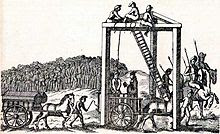
Tyburn, which means ‘boundary stream’ and refers to a tributary of the Thames, first became a place of public execution in the 12th century. By the 16th century it had become the ‘King’s gallows’ and on 4 May 1535 Charterhouse prior St John Houghton and four others became the first martyrs of the Reformation when they were hanged, drawn and quartered for refusing to take the oath attached to the Act of Succession.

Queen Elizabeth I rebuilt the gallows into the infamous three-sided Tyburn Tree in 1571 and frequently used them to execute Catholics in the religious persecution in the years afterwards. The last hanging there was in November 1783.

Blessed John Nelson, pray for us!

Wednesday, July 1, 2015

The Fortnight for Freedom: Blessed Thomas Maxfield

A martyrdom in London during James I's reign was an event with international implications--the Spanish ambassadors were quite active around this time in pursuing pardons or even exile (knowing the priest would very likely return). 

Blessed Thomas Maxfield was born in Stafford gaol, about 1590, martyred at Tyburn, London, Monday, 1 July, 1616. He was one of the younger sons of William Macclesfield of Chesterton and Maer and Aston, Staffordshire (a firm recusant, condemned to death in 1587 for harbouring priests, one of whom was his brother Humphrey), and Ursula, daughter of Francis Roos, of Laxton, Nottinghamshire. William Macclesfield is said to have died in prison and is one of the prætermissi as William Maxfield; but, as his death occurred in 1608, this is doubtful. Thomas arrived at the English College at Douai on 16 march, 1602-3, but had to return to England 17 May, 1610, owing to ill health. In 1614 he went back to Douai, was ordained priest, and in the next year came to London. Within three months of landing he was arrested, and sent to the Gatehouse, Westminster. After about eight months' imprisonment, he tried to escape by a rope let down from the window in his cell, but was captured on reaching the ground. This was at midnight 14- 15 June, 1616. For seventy hours he was placed in the stocks in a filthy dungeon at the Gatehouse, and was then on Monday night (17 June) removed to Newgate, where he was set amongst the worst criminals, two of whom he converted. 

On Wednesday, 26 June, he was brought to the bar at the Old Bailey, and the next day was condemned solely for being a priest, under 27 Eliz., c, 2. The Spanish ambassador* did his best to obtain a pardon, or at least a reprieve; but, finding his efforts unavailing, had solemn exposition of the Blessed Sacrament in his chapel during the martyr's last night on earth. The procession to Tyburn early on the following morning was joined by many devout Spaniards, who, in spite of insults and mockery, persisted in forming a guard of honour for the martyr. Tyburn-tree itself was found decorated with garlands, and the ground round about strewn with sweet herbs. The sheriff ordered the martyr to be cut down alive, but popular feeling was too strong, and the disemboweling did not take place till he was quite senseless. 

He was beatified by Pope St. John Paul II as one of the 85 Martyrs of England and Wales.

Downside Abbey, the Tyburn Convent near Marble Arch, and Holy Trinity Catholic in Staffordshire each honor his relics. See this site for a picture of an altar in Holy Trinity depicting the martyr.

*The Spanish Ambassador at that time was Diego Sarmiento de Acuña, 1st Count of Gondomar, who had succeeded in obtaining the release of Luisa de Carvajal in 1614.

Saturday, May 30, 2015

May 30, Tyburn Tree in 1582 and 1612


Saint Luke Kirby, Blessed William Filby, Blessed Lawrence Johnson, and Blessed Thomas Cottam SJ, four priests and martyrs suffered at Tyburn Tree on May 30, 1562.  More about them here.

Thirty years after St. Luke Kirby and his companions suffered at Tyburn, two more Catholic priests joined the blessed clouds of witnesses at the site of martyrdom: Blessed William or Maurus Scott, OSB and Blessed Richard Newport. Read more about them here.

Holy and blessed martyrs of England, pray for us!

Thursday, February 12, 2015

Blessed George Haydock and Companions


Blesseds George Haydock, James Fenn, Thomas Hemerford, John Nutter, and John Mundyn were all executed at Tyburn on the charge of conspiring against Elizabeth  on February 12, 1584.

What of course truly sealed Father Haydock's fate was his answer to the question: Who is the head of the Church in England? which he even wrote down, according to Dom Bede Camm's telling of his imprisonment and trial:

For a year and three months, i.e. until May, 1583, George Haydock was kept in a narrow cell in an out-of-the-way part of the Tower, and access to him was for the most part strictly forbidden. On one occasion, however, a priest managed to obtain admission to his cell by a ruse, and gave him Holy Communion. On another occasion, as the Annals of the English College at Rome record, a Protestant minister came to dispute with him, and finding, after a lengthy discussion, that he made no way, asked him in a fit of rage whether or not the Queen was the head of the English Church. 'By what authority,' replied the priest, 'do you ask me this question? It must be remembered that, as this question involves danger of goods and life, none may put it unless under warrant from the Crown.' The minister answered, ‘Were you a true servant of Christ, you would surely not inquire as to my authority, but would make open profession of your belief before everybody'. ‘Do you, heretic as you are,' replied the priest, reproach me with cowardice in the cause of God? I believe that the Queen neither is, nor can be, the head of the English Church.' The minister asked, 'Who then?' 'The Roman Pontiff,' replied the other. ‘Traitor!' exclaimed the minister; you dare to say as much, because there are no fit witnesses to convict you of your saying.' ‘Not so,' rejoined the priest, but to make confession of my faith.' ‘If so,' said the minister, ' put down in writing what you have said just now.' ‘But,' said the priest, 'I have neither ink nor paper, yet will I gratify you to the best of my power,' and taking a piece of charcoal he wrote as follows on the door of his cell: Gregory XIII is head of the English and of the Universal Church, to whom the whole world must be subject if it would be saved'. He thus confounded the minister, and so impressed his gaoler that he was less opposed than heretofore to the Catholic religion."

On 5 February, 1583-4, he was indicted, with James Fenn and seven other priests, for having conspired against the Queen at Rheims, 23 September, 1581, and for agreeing to come to England on I October, and for setting out for England on I November. The absurdity of the accusation has been pointed out by Father Pollen. On the next day he and Fenn and three fellow-martyrs, whose indictments were equally erroneous, were brought before the Queen's Bench at Westminster. George Haydock had long ago chosen St. Dorothy as his patron, and was accustomed to commend himself and his actions day by day to her guidance. He therefore regarded it as of so happy an augury that he should be brought to the bar on her day, “that he made a note of it in the calendar of his breviary, which, on the eve of his departure from the prison of his body and soul, he presented to the venerable Archbishop of Armagh, then also a prisoner of Jesus Christ", On his appearance at the bar, George Haydock, though not, so far as we know, a member of the Society of Jesus, "was in Jesuit's weed". "So grave a man," says an eye-witness, "as ever I sett my eyes upon, he wore a coate of black very low and upon the same a cloke of black downe almost to the rounde. He had in his hand a black staff and upon his head a velvet coyfe, and there upon a broade seemly black felt." He pleaded Not Guilty. The next day the jury found all the five priests Guilty, and they were sentenced to death; but, whereas the other four were committed in shackles to the "pit" in the Tower, George Haydock, probably because his health was such that it was thought he was unlikely to outlive the rigours of that pestilential dungeon, went back to his old quarters. 

The Archbishop of Armagh, held in the Tower of London, was Richard Creagh. According to the Catholic Encyclopedia:

From his repeated examinations before the English Privy Council his enmity to Shane O'Neill [one of the great chiefs of Ulster] and his unwavering loyalty to England were made plain. But his steadfastness in the Faith and his great popularity in Ireland were considered crimes, and in consequence the Council refused to set him free. Not content with this his moral character was assailed. The daughter of his jailer was urged to charge him with having assaulted her. The charge was investigated in public court, where the girl retracted, declaring her accusation absolutely false. It has been said that Creagh was poisoned in prison, and this, whether true or false, was believed at the time of his death. His grand-nephew, Peter Creagh, was Bishop of Cork about 1676. He was imprisoned for two years in consequence of the false accusations of Titus Oates, but acquitted (1682), was transferred to the Archdiocese of Tuam in 1686. He followed James II to the Continent, was appointed Archbishop of Dublin in 1693, but was never able to return and take possession. He became Coadjutor Bishop of Strasburg, where he died (July, 1705).

Blesseds George Haydock, James Fenn, Thomas Hemerford, John Nutter, and John Mundyn were all among the 85 Martyrs of England and Wales beatified by Pope St. John Paul II in 1987.

Tuesday, July 1, 2014

July 1, 1616 and 1681: Two Martyrdoms at Tyburn

July 1, 1616: A martyrdom in London during James I's reign was an event with international implications--the Spanish ambassadors were quite active around this time in pursuing pardons or even exile (knowing the priest would very likely return).

Blessed Thomas Maxfield was born in Stafford gaol, about 1590, martyred at Tyburn, London, Monday, 1 July, 1616. He was one of the younger sons of William Macclesfield of Chesterton and Maer and Aston, Staffordshire (a firm recusant, condemned to death in 1587 for harbouring priests, one of whom was his brother Humphrey), and Ursula, daughter of Francis Roos, of Laxton, Nottinghamshire. William Macclesfield is said to have died in prison and is one of the prætermissi as William Maxfield; but, as his death occurred in 1608, this is doubtful. Thomas arrived at the English College at Douai on 16 march, 1602-3, but had to return to England 17 May, 1610, owing to ill health. In 1614 he went back to Douai, was ordained priest, and in the next year came to London. Within three months of landing he was arrested, and sent to the Gatehouse, Westminster. After about eight months' imprisonment, he tried to escape by a rope let down from the window in his cell, but was captured on reaching the ground. This was at midnight 14-15 June, 1616. For seventy hours he was placed in the stocks in a filthy dungeon at the Gatehouse, and was then on Monday night (17 June) removed to Newgate, where he was set amongst the worst criminals, two of whom he converted. On Wednesday, 26 June, he was brought to the bar at the Old Bailey, and the next day was condemned solely for being a priest, under 27 Eliz., c, 2. The Spanish ambassador* did his best to obtain a pardon, or at least a reprieve; but, finding his efforts unavailing, had solemn exposition of the Blessed Sacrament in his chapel during the martyr's last night on earth. The procession to Tyburn early on the following morning was joined by many devout Spaniards, who, in spite of insults and mockery, persisted in forming a guard of honour for the martyr. Tyburn-tree itself was found decorated with garlands, and the ground round about strewn with sweet herbs. The sheriff ordered the martyr to be cut down alive, but popular feeling was too strong, and the disembowelling did not take place till he was quite senseless.

Downside Abbey, the Tyburn Convent near Marble Arch, and Holy Trinity Catholic in Staffordshire each honor his relics. See this site for a picture of an altar in Holy Trinity depicting the martyr.

*The Spanish Ambassador at that time was Diego Sarmiento de Acuña, 1st Count of Gondomar, who had succeeded in obtaining the release of Luisa de Carvajal in 1614.

Glorious Martyr, St. Oliver,
who willingly gave your life for your faith,
help us also to be strong in faith.
May we be loyal like you to the see of Peter.
By your intercession and example
may all hatred and bitterness
be banished from the hearts of Irish men and women.
May the peace of Christ reign in our hearts,
as it did in your heart,
even at the moment of your death.
Pray for us and for Ireland. Amen.  
 
July 1, 1681: St. Oliver Plunkett, the Archbishop of Armagh in Ireland, was executed at Tyburn in London on July 1, 1681. He was the last priest to be executed there and the final victim of the "Popish Plot"--that fraudulent, perjured plot cooked up by the BBC's Worst Briton of the 17th Century: Titus Oates.

So in the Catholic dioceses of England and Wales AND Ireland, today is the memorial/feast of St. Oliver Plunkett, Archbishop of Armagh, victim of Stuart injustice during the Anti-Catholic madness of Oates' fake plot.

The Whigs in Parliament, opposed most of all to the succession of Charles II's Catholic brother, James the Duke of York, jumped at the opportunity to attack Catholics--and James--when Titus Oates fabricated the story of a great conspiracy. Charles II did not believe most of the elements of the plot Oates "revealed", especially when the perjurer implicated his own queen, Catherine of Braganza, and his brother.

Once Oates was able to compound English fear of Jesuits and Catholics with English fear of Irish Catholics, Plunkett was in grave danger. St. Oliver Plunkett was brought to London from Ireland and accused of conspiring to bring French soldiers and recruit members of his diocese to mount a rebellion against the King and Parliament. There was, of course, no evidence of these accusations and Plunkett could bring no witnesses to testify for him--they were in Ireland and not permitted to come to England. He had been tried before in Ireland--no double jeopardy applied here--and English authorities like Shaftesbury were convinced that no Irish jury (even if packed with Protestants) would convict him.

On the day of his execution he was able to give a long discourse, in which he re-presented the evidence that proved he was not involved in any conspiracy, and which concluded with forgiveness and prayers:

as one of the said deacons (to wit, holy Stephen) did pray for those who stoned him to death; so do I, for those who, with perjuries, spill my innocent blood; saying, as St. Stephen did, "O Lord! lay not this sin to them." I do heartily forgive them, and also the judges, who, by denying me sufficient time to bring my records and witnesses from Ireland, did expose my life to evident danger. I do also forgive all those, who had a hand, in bringing me from Ireland, to be tried here; where it was morally impossible for me to have a fair trial. I do finally forgive all who did concur, directly or indirectly, to take away my life; and I ask forgiveness of all those whom I ever offended by thought, word, or deed.

I beseech the All-powerful, that his Divine Majesty grant our king, queen, and the duke of York, and all the royal family, health, long life, and all prosperity in this world and in the next, everlasting felicity.

Now, that 1 have shewed sufficiently (as I think) how innocent I am of any plot or conspiracy: I would I were able, with the like truth, to clear myself of high crimes committed against the Divine Majesty's commandments, often transgressed by me, for which, I am sorry with all my heart; and if I should or could live a thousand years, I have a firm resolution, and a strong purpose, by your grace, O my God! never to offend you; and I beseech your Divine Majesty, by the merits of Christ, and by the intercession of his Blessed Mother, and all the holy angels and saints, to forgive me my sins, and to grant my soul eternal rest. Miserere mei Deus, etc. Parce anima, etc. In manus tuas, etc.

St. Oliver Plunkett was born in 1629 in Loughcrew, County Meath, Ireland of well-to-do parents and studied for the priesthood at the Irish College in Rome. While Oliver Cromwell was inflicting the "righteous judgement of God" on the Irish who had rebelled against English rule during Charles I's reign, Plunkett had been unable to return to serve his people as a priest after ordination in 1654. He therefore remained in Rome and taught theology. In 1669 he was appointed the Archbishop of Armagh and the Primate of All Ireland and finally returned to Ireland the next year. For a time, Charles II's Restoration leniency allowed Plunkett to accomplish many reforms and reorganizations in education and catechesis. As Archbishop, he confirmed thousands (48,000!) but in 1673, persecution of Catholics in England's colony forced him to go into hiding and close the schools. Arrested in connection with Oates' plot, he was imprisoned at Dublin Castle. He was canonized by Pope Paul VI in 1975 and in 1997 he was named the Patron Saint of Peace and Reconciliation in Ireland. His trial and execution were so manifestly unfair that even Shaftesbury realized things had gone too far--yet, with the Popish Plot's true conspirators, Oates and companions, finally being mistrusted and the whole matter winding down, Charles II did nothing to stop the execution of St. Oliver Plunkett. This site contains a wealth of information, including the prayers and readings for a Mass honoring his Feast.

When Pope Paul VI canonized the martyr, he began his remarks in Gaelic: Dia's muire Dhíbh, a chlann Phádraig! Céad mile fáilte rómhaibh! Tá Naomh nua againn inniu: Comharba Phádraig, Olibhéar Naofa Ploinéad. (God and Mary be with you, family of Saint Patrick! A hundred thousand welcomes! We have a new Saint today: the successor of Saint Patrick, Saint Oliver Plunkett). Today, Venerable Brothers and dear sons and daughters, the Church celebrates the highest expression of love-the supreme measure of Christian and pastoral charity. Today, the Church rejoices with a great joy, because the sacrificial love of Jesus Christ, the Good Shepherd, is reflected and manifested in a new Saint. And this new Saint is Oliver Plunkett, Bishop and Martyr-Oliver Plunkett, successor of Saint Patrick in the See of Armagh-Oliver Plunkett , glory of Ireland and Saint, today and for ever, of the Church of God, Oliver Plunkett is for all-for the entire world-an authentic and outstanding example of the love of Christ. And on our part we bow down today to venerate his sacred relics, just as on former occasions we have personally knelt in prayer and admiration at this shrine in Drogheda.

Sunday, December 1, 2013

December 1, 1581: The Martyrdoms of Campion, Briant, and Sherwin

Today, of course, is the First Sunday of Advent, but it is also the anniversary of the 1581 executions of  St. Edmund Campion, SJ; St. Alexander Briant, SJ, and St. Ralph Sherwin.

St. Edmund Campion was born on January 25, 1540 in London, the son of a bookseller. He was raised a Catholic, given a scholarship to St. John's College, Oxford, when fifteen, and became a fellow when only seventeen. His brilliance attracted the attention of such leading personages as the Earl of Leicester, Robert Cecil, and even Queen Elizabeth. He took the Oath of Supremacy acknowledging Elizabeth head of the church in England and became an Anglican deacon in 1564. Doubts about Protestanism increasingly beset him, and in 1569 he went to Ireland where further study convinced him he had been in error, and he returned to Catholicism. Forced to flee the persecution unleashed on Catholics by the excommunication of Elizabeth by Pope Pius V, he went to Douai, France, where he studied theology, joined the Jesuits, and then went to Brno, Bohemia, the following year for his novitiate. He taught at the college of Prague and in 1578 was ordained there. He and Father Robert Persons were the first Jesuits chosen for the English mission and were sent to England in 1580. His activities among the Catholics, the distribution of his Decem rationes at the University Church in Oxford, and the premature publication of his famous Brag (which he had written to present his case if he was captured) made him the object of one of the most intensive manhunts in English history. He was betrayed at Lyford, near Oxford, imprisoned in the Tower of London, and when he refused to apostatize when offered rich inducements to do so, was tortured and then hanged, drawn, and quartered at Tyburn on December 1 on the technical charge of treason, but in reality because of his priesthood.

St. Alexander Briant (1556-1581) was a diocesan priest who entered the Jesuits just before he was executed. He studied at Oxford at Hertford (then Hart Hall) College where he met and became a follower of Robert Parsons at Balliol who later became a Jesuit and slipped into England with Campion. Briant crossed the Channel in August 1577 to attend the English College at Douai where he was reconciled to the Catholic Church. He was ordained in 1578 and in August 1579 returned to his homeland and took up ministry in his native shire (Somerset). He was only able to care for Catholics for two years before priest-hunters caught him by accident.

They searched unsuccessfully for Fr. Persons in one house, and then went to a neighboring house where they discovered Fr. Briant. His captors kept him without food and with little to drink for six days hoping to force information from him about Persons. He refused to speak so he was transferred to the Tower for further interrogation and torture on the rack. He wrote to the English Jesuits about his torture, saying that he kept his mind so firmly set on Christ's Passion that he felt no pain during the torture, only afterwards. He also wrote that just before he was tortured a second time, he had determined to enter the Jesuits if he were released from prison. However, since he doubted that he would be released, he asked to be accepted into the Society. The Jesuits accepted him upon receiving his letter.


St. Alexander Briant had carved a small wooden cross and held it in his hands in the courtroom. When one of the judges took it from him (Why?) he said, "You can take it out of my hands, but not out of my heart." Taking the cross from him seems an act of petty cruelty. I guess when you've tortured a man so much that the man using the rack boasts that the victim will be a foot longer, you'll do just about anything.

St. Ralph Sherwin: Born 1550: Rodsley, Derbyshire. Ralph Sherwin was the nephew of John Woodward, rector of Ingatestone in Essex from 1556 to 1566. In 1568, Sir William Petre of Ingatestone Hall, nominated Ralph to one of eight fellowships he had founded at Exeter College, Oxford; Ralph took his MA there in 1574.

Brought up as a Protestant, Ralph converted to the Catholic faith in 1575, and went to the English college at Douai where he was ordained in 1577. He continued his studies at the English College in Rome, his name being the first in the College register. When an oath requiring students to consent to the English mission was required, Ralph readily agreed, saying, ‘Today rather than tomorrow’.

Ralph returned to England on 1st August 1580, but on 9th November 1580 he was arrested in London and committed to the Marshalsea prison. He was transferred to the Tower of London where he was alternately tortured on the rack and thrown out into the December snow. He was once kept upon the rack for five consecutive days without food. He was offered a bishopric if he would conform to the authorised religion, but refused.

On 20th November 1581, Ralph was tried at Westminster Hall, accused of treason. He wrote a letter to his uncle, John Woodward, saying, "Innocency is my only comfort against all the forged villainy which is fathered on my fellow priests and me." His last words were: "Jesu, Jesu, Jesu, esto mihi Jesus!" "Jesus, Jesus, Jesus, be to me Jesus (Saviour)".


When they were found guilty, St. Edmund Campion told the judges: "In condemning us you condemn all your own ancesters--all the ancient priests, bishops, and kings--all that was once the glory of England, the island of saints, and the most devoted child of the See of Peter. For what have we taught, however you may qualify it with the odious name of treason, that they did not uniformly teach? To be condemned with these lights--not of England only, but of the world--by their degenerate descendants, is both gladness and glory to us."

Upon hearing the sentence of death, the three sang "Te Deum Laudamus".

At Tyburn Tree, St. Alexander Briant watched the brutal execution meted out to those found guilty of treason inflicted on Sherwin and Campion. It's hard to imagine the fortitude and faith necessary to witness such horrors and know that in a moment, you will endure the same--at least humanly speaking. Only the theological virtues of faith, hope and love grants that kind of strength.

These three holy men were canonized by Pope Paul VI among the Forty Martyrs of England and Wales in 1970.

Monday, July 1, 2013

Two Martyrs (in 1616 and 1681) on the Son Rise Morning Show

I'll be on much earlier than usual on the Son Rise Morning Show today to discuss two martyrs (Blessed Thomas Maxfield and St. Oliver Plunkett)--at 7:20 a.m. Eastern/6:20 a.m.Central:

July 1, 1616: A martyrdom in London during James I's reign was an event with international implications--the Spanish ambassadors were quite active around this time in pursuing pardons or even exile (knowing the priest would very likely return).

Blessed Thomas Maxfield was born in Stafford gaol, about 1590, martyred at Tyburn, London, Monday, 1 July, 1616. He was one of the younger sons of William Macclesfield of Chesterton and Maer and Aston, Staffordshire (a firm recusant, condemned to death in 1587 for harbouring priests, one of whom was his brother Humphrey), and Ursula, daughter of Francis Roos, of Laxton, Nottinghamshire. William Macclesfield is said to have died in prison and is one of the prætermissi as William Maxfield; but, as his death occurred in 1608, this is doubtful. Thomas arrived at the English College at Douai on 16 march, 1602-3, but had to return to England 17 May, 1610, owing to ill health. In 1614 he went back to Douai, was ordained priest, and in the next year came to London. Within three months of landing he was arrested, and sent to the Gatehouse, Westminster. After about eight months' imprisonment, he tried to escape by a rope let down from the window in his cell, but was captured on reaching the ground. This was at midnight 14-15 June, 1616. For seventy hours he was placed in the stocks in a filthy dungeon at the Gatehouse, and was then on Monday night (17 June) removed to Newgate, where he was set amongst the worst criminals, two of whom he converted. On Wednesday, 26 June, he was brought to the bar at the Old Bailey, and the next day was condemned solely for being a priest, under 27 Eliz., c, 2. The Spanish ambassador* did his best to obtain a pardon, or at least a reprieve; but, finding his efforts unavailing, had solemn exposition of the Blessed Sacrament in his chapel during the martyr's last night on earth. The procession to Tyburn early on the following morning was joined by many devout Spaniards, who, in spite of insults and mockery, persisted in forming a guard of honour for the martyr. Tyburn-tree itself was found decorated with garlands, and the ground round about strewn with sweet herbs. The sheriff ordered the martyr to be cut down alive, but popular feeling was too strong, and the disembowelling did not take place till he was quite senseless.

Downside Abbey, the Tyburn Convent near Marble Arch, and Holy Trinity Catholic in Staffordshire each honor his relics. See this site for a picture of an altar in Holy Trinity depicting the martyr.

*The Spanish Ambassador at that time was Diego Sarmiento de Acuña, 1st Count of Gondomar, who had succeeded in obtaining the release of Luisa de Carvajal in 1614.

Glorious Martyr, St. Oliver,
who willingly gave your life for your faith,
help us also to be strong in faith.
May we be loyal like you to the see of Peter.
By your intercession and example
may all hatred and bitterness
be banished from the hearts of Irish men and women.
May the peace of Christ reign in our hearts,
as it did in your heart,
even at the moment of your death.
Pray for us and for Ireland. Amen.  
 
July 1, 1681: St. Oliver Plunkett, the Archbishop of Armagh in Ireland, was executed at Tyborn in London on July 1, 1681. He was the last priest to be executed there and the final victim of the "Popish Plot"--that fraudulent, perjured plot cooked up by the BBC's Worst Briton of the 17th Century: Titus Oates.

So in the Catholic dioceses of England and Wales AND Ireland, today is the memorial/feast of St. Oliver Plunkett, Archbishop of Armagh, victim of Stuart injustice during the Anti-Catholic madness of Oates' fake plot.

The Whigs in Parliament, opposed most of all to the succession of Charles II's Catholic brother, James the Duke of York, jumped at the opportunity to attack Catholics--and James--when Titus Oates fabricated the story of a great conspiracy. Charles II did not believe most of the elements of the plot Oates "revealed", especially when the perjuror implicated his own queen, Catherine of Braganza, and his brother.

Once Oates was able to compound English fear of Jesuits and Catholics with English fear of Irish Catholics, Plunkett was in grave danger. St. Oliver Plunkett was brought to London from Ireland and accused of conspiring to bring French soldiers and recruit members of his diocese to mount a rebellion against the King and Parliament. There was, of course, no evidence of these accusations and Plunkett could bring no witnesses to testify for him--they were in Ireland and not permitted to come to England. He had been tried before in Ireland--no double jeopardy applied here--and English authorities like Shaftesbury were convinced that no Irish jury (even if packed with Protestants) would convict him.

On the day of his execution he was able to give a long discourse, in which he re-presented the evidence that proved he was not involved in any conspiracy, and which concluded with forgiveness and prayers:

as one of the said deacons (to wit, holy Stephen) did pray for those who stoned him to death; so do I, for those who, with perjuries, spill my innocent blood; saying, as St. Stephen did, "O Lord! lay not this sin to them." I do heartily forgive them, and also the judges, who, by denying me sufficient time to bring my records and witnesses from Ireland, did expose my life to evident danger. I do also forgive all those, who had a hand, in bringing me from Ireland, to be tried here; where it was morally impossible for me to have a fair trial. I do finally forgive all who did concur, directly or indirectly, to take away my life; and I ask forgiveness of all those whom I ever offended by thought, word, or deed.

I beseech the All-powerful, that his Divine Majesty grant our king, queen, and the duke of York, and all the royal family, health, long life, and all prosperity in this world and in the next, everlasting felicity.

Now, that 1 have shewed sufficiently (as I think) how innocent I am of any plot or conspiracy: I would I were able, with the like truth, to clear myself of high crimes committed against the Divine Majesty's commandments, often transgressed by me, for which, I am sorry with all my heart; and if I should or could live a thousand years, I have a firm resolution, and a strong purpose, by your grace, O my God! never to offend you; and I beseech your Divine Majesty, by the merits of Christ, and by the intercession of his Blessed Mother, and all the holy angels and saints, to forgive me my sins, and to grant my soul eternal rest. Miserere mei Deus, etc. Parce anima, etc. In manus tuas, etc.

St. Oliver Plunkett was born in 1629 in Loughcrew, County Meath, Ireland of well-to-do parents and studied for the priesthood at the Irish College in Rome. While Oliver Cromwell was inflicting the "righteous judgement of God" on the Irish who had rebelled against English rule during Charles I's reign, Plunkett had been unable to return to serve his people as a priest after ordination in 1654. He therefore remained in Rome and taught theology. In 1669 he was appointed the Archbishop of Armagh and the Primate of All Ireland and finally returned to Ireland the next year. For a time, Charles II's Restoration leniency allowed Plunkett to accomplish many reforms and reorganizations in education and catechesis. As Archbishop, he confirmed thousands (48,000!) but in 1673, persecution of Catholics in England's colony forced him to go into hiding and close the schools. Arrested in connection with Oates' plot, he was imprisoned at Dublin Castle. He was canonized by Pope Paul VI in 1975 and in 1997 he was named the Patron Saint of Peace and Reconciliation in Ireland. His trial and execution were so manifestly unfair that even Shaftesbury realized things had gone too far--yet, with the Popish Plot's true conspirators, Oates and companions, finally being mistrusted and the whole matter winding down, Charles II did nothing to stop the execution of St. Oliver Plunkett. This site contains a wealth of information, including the prayers and readings for a Mass honoring his Feast.

When Pope Paul VI canonized the martyr, he began his remarks in Gaelic: Dia's muire Dhíbh, a chlann Phádraig! Céad mile fáilte rómhaibh! Tá Naomh nua againn inniu: Comharba Phádraig, Olibhéar Naofa Ploinéad. (God and Mary be with you, family of Saint Patrick! A hundred thousand welcomes! We have a new Saint today: the successor of Saint Patrick, Saint Oliver Plunkett). Today, Venerable Brothers and dear sons and daughters, the Church celebrates the highest expression of love-the supreme measure of Christian and pastoral charity. Today, the Church rejoices with a great joy, because the sacrificial love of Jesus Christ, the Good Shepherd, is reflected and manifested in a new Saint. And this new Saint is Oliver Plunkett, Bishop and Martyr-Oliver Plunkett, successor of Saint Patrick in the See of Armagh-Oliver Plunkett , glory of Ireland and Saint, today and for ever, of the Church of God, Oliver Plunkett is for all-for the entire world-an authentic and outstanding example of the love of Christ. And on our part we bow down today to venerate his sacred relics, just as on former occasions we have personally knelt in prayer and admiration at this shrine in Drogheda.