Showing posts with label Eighth Day Institute. Show all posts

Thursday, January 26, 2023

Report on the 13th Annual EDI Symposium: "Be Not Afraid!"

Evidently, no one who attended the 13th Annual EDI Symposium starting on Friday, January 13, suffers from or succumbed to Paraskevidekatriaphobia, taking the title to heart: Be Not Afraid! (of Friday the 13th)!

One of the banners near the speaker's table featured a stanza from this poem by Saint John Henry Newman:

Consolation
"It is I; be not afraid."

WHEN I sink down in gloom or fear,
Hope blighted or delay'd,
Thy whisper, Lord, my heart shall cheer,
"'Tis I; be not afraid!"


Or, startled at some sudden blow,
If fretful thoughts I feel,
"Fear not, it is but I!" shall flow,
As balm my wound to heal.

Nor will I quit Thy way, though foes
Some onward pass defend;
From each rough voice the watchword goes,
"Be not afraid! ... a friend!" 

And oh! when judgment's trumpet clear
Awakes me from the grave,
Still in its echo may I hear,
"'Tis Christ; He comes to save."

At Sea.
June 23, 1833.

The symposium this year featured James Matthew Wilson (Catholic), Jake Meador (Protestant), & Fr. John Strickland (Orthodox), and was held at St. George Orthodox Cathedral here in Wichita, Kansas. Eighth Day Books had an annex of the store on-site selling books, icons, etc, especially featuring the presenters' publications and books on associated topics.

The main feature I want to mention is the post-Covid atmosphere of the event. That may be controversial to say, but since James Matthew Wilson's first presentation was "T. S. Eliot, Four Quartets, & Quarantine Notebook: What Writing Taught Me About Our Divided Times", it seems appropriate. Wilson provided an overview of the historical occasion of Eliot's The Four Quartets, inspired in part to demonstrate that there was an "England" to be defended, fought for, and died for during World War II, and then discussed his own poetic production of news reports in iambic pentameter published serially in Dappled Things online. As Wilson noted, the composition of the poems bore two fruits: "The concrete fruit was a book-length poem; the intellectual fruit was a new and deepened perspective on the divisions in our country and the strange commonality Americans experience in and through that division." 

As the keynote speaker, he also presented a second Plenary session  ("A World without Beauty: von Balthasar, Plato, & the Ordering of the Soul"), which a close friend of mine really enjoyed because she's studied and read the works of Hans Urs von Balthasar since she wrote her master's thesis, titled "Von Balthasar’s Aesthetic Method in Theology with an examination of its operation in his Ecclesiology". She and Wilson enjoyed their after Festal Banquet discussion too on their shared interest.

It's also appropriate to bring up this post-Covid aspect because this year all our speakers could attend and arrive on time (in spite of the FAA shut down earlier in the week). Last year Rod Dreher HAD Covid and could not even offer his presentations via Zoom (laryngitis!). Nevertheless everything went well last year: we just all stayed in the Fellowship Hall for all the presentations.

We had competing breakouts this year, with two held in the Cathedral's chapel which I did not attend (described here and here), and two held in the Fellowship Hall, which I did attend (described here and here).

As usual, we had a beautiful Festal Banquet Friday night, with music, including hymns and chants by the St. George Orthodox Cathedral Choir, the story of the saint honored that night, St. Paul of Thebes, a desert hermit whose story we know because St. Anthony of the Desert visited him--and we know the story of that visit because St. Athanasius wrote about in his Life of St. Anthony! The three speakers also presented reflections.

After all that talk of the desert, the only way your table could have dessert after dinner was if someone at the table won a dessert in the raffle!! I won three $!$!$! (Shared one at our table; shared another at a table without a dessert; saved one (cinnamon rolls) for breakfast at the second day of the Symposium.)

We ended the Symposium on Saturday with a panel discussion and then with a special meeting of those Eighth Day Institute members who had attended--with a wine and cheese reception.

As I've said before, the EDI Symposium is a great event, well worth travelling to each Martin Luther King, Jr. Holiday Weekend! The Dates and Theme for the 2024 Symposium are already set:

The Dates: January 10 through 13, 2024 (January 10 and 11 for the Pre-Symposium Seminar at the EDI Ladder and January 12 and 13 for the Symposium at St. George Orthodox Cathedral). 

The Theme: "Attend Unto Thyself". At least one speaker is confirmed: Mark Bauerlein of Emory University and First Things

Please bookmark the EDI website, sign up for email updates, and join us--as a member and an attendee--for "Conversations you can't have anywhere else!" with friends you didn't know you had!

Friday, May 27, 2022

Beginning my Newman Summer, the Summer of '22

As I prepare to enter into a very Newman Summer with my Ad Fontes "Newman Lecture" next Thursday and the class I begin teaching on line the Monday after that ("Newman and the New Evangelization/Newman for Catechists") for Newman University's Graduate program in Theology, and one other Newmanian thing TBA, I read this Coming Home Network conversion story by Brian Besong. 

It includes this marvelous, miraculous dream of Newman:

. . . One afternoon, my mom and I were discussing Catholicism. At a certain point in the conversation, she interrupted me and said something along the lines of “Oh my goodness…” with a long pause, and then “Oh my gosh…” Of course, I asked her what was going on. She began to get choked up and told me that she had just remembered a dream she had the night before. She had dreamt that she was with my dad’s mom at a Catholic Mass. At the end of the Mass, my mom and my grandmother left and saw that the priest who had celebrated the Mass who was (as she described him repeatedly) “beautiful” and “glowing.” The memory of him was the reason she had been choked up and when she began actually describing him, she started to cry outright and quickly got off the phone with me. This was very out of character.

That happened on a Friday night and I thought about the dream all weekend. I didn’t think that an ordinary dream could have had such a powerful effect on my mom. On the following Sunday, I told my dad that I thought the dream wasn’t an ordinary dream and that the beautiful priest whom she saw glowing was not just some imagination, but a real Catholic saint who had interceded on her behalf and whom God had granted to show up in her dream. Thus, I told him that my expectation would be that at some point she would see a picture of the saint who was in her dream and recognize who it was. He asked me who I thought the priest might have been and I told him that the first one that sprang to mind was the English Cardinal John Henry Newman, a convert from Anglicanism. He hadn’t heard of him and afterward I talked to my mom for a few minutes and then got off the phone.

About ten minutes later, I got a frantic phone call from my mom. She had told me that “a very weird goose bump thing just happened.” The reason she was frantic was that, after getting off the phone with me, my dad had pulled up a picture of Blessed Cardinal Newman online. He didn’t say anything to her about it, but had simply pulled up the picture and asked her if she recognized the person. She instantly recognized him as the “saint” that was in her dream, but my dad refused to explain who he was and told her to call me to find out. I quickly explained to her who Cardinal Newman was and his significance; she was flabbergasted. Needless to say, she had never heard of Cardinal Newman, nor had she seen his picture. She talked to me for a few minutes more and got off the phone (she was, after all, still officially a Protestant at this point, though on the fence about converting).

I chose the painting of Newman above because he is smiling and almost glowing--I don't know what image Brian's father showed his mother, but this one seemed most suitable.

After all the years (since 1979). I've studied Newman, I still remember how some argued that he should be canonized just because of all the conversions he'd inspired in his lifetime and in the 20th century. But no, the answer came, he needs to be canonized through the usual development of devotion and intercession, following the process of study, evaluation, and miracles. 

So the experience of this family brings Newman's journey to being raised to the honors of the altar full circle from those old thoughts: like a miraculous vision, it led to Brian's mother becoming a Catholic--and, when you read the rest of the story, you'll discover that it was in answer to a prayer that such a dream would help his mother. And that there's even something more than that!

As the long summer days of heat and humidity (in Kansas, at least) come upon us, this prayer is so appropriate:

May He support us all the day long
till the shades lengthen
and the evening comes
and the busy world is hushed
and the fever of life is over
and our work is done.
Then in His mercy
may He give us a safe lodging
and a holy rest
and peace at the last. Amen.

Saint John Henry Newman, pray for us!

Image Credit (Public Domain): Painting of Cardinal Newman, by Jane Fortescue Seymour, Lady Coleridge, circa 1876

Thursday, May 5, 2022

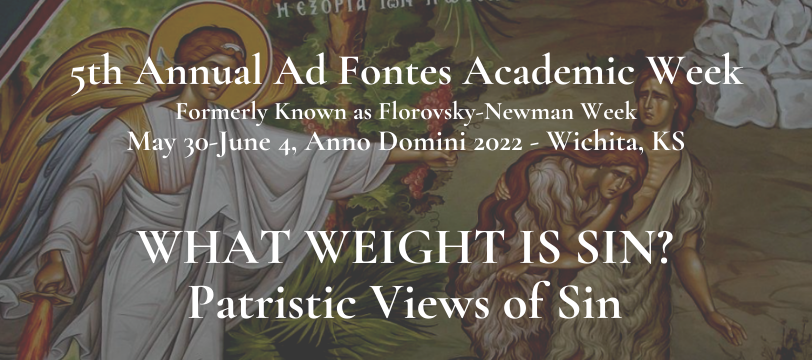
This Year's EDI Academic Week: Now Named "Ad Fontes"


Beginning June 1st with the Festal Banquet at Newman University and continuing with prayers, lectures, academic papers, and Plenary Dialogues at Newman University and St. George Catholic Christian Cathedral on June 2nd, 3rd, and 4th, Eighth Day Institute's annual academic theological event has been announced:

Co-sponsored by St George Orthodox Christian Cathedral and the Gerber Institute for Catholic Studies, the Ad Fontes Academic Week promotes a “return to the sources for Christian unity.” Heeding Fr. Florovsky's advice, rather than simply overlooking differences, this conference seeks to overcome the different views of sin. And we do so by returning to the common Tradition, by learning to read the Fathers as living masters, rather than as historical documents.

In years past, this conference has been known as the Florovsky-Newman Week. This year we have decided to broaden our perspective by honoring Thomas F. Torrance together with our other two patrons. Torrance was a Protestant who, like the Orthodox Fr. Georges Florovsky and Catholic St. John Henry Newman, called for a return to patristic sources as a guide for the modern Church..

Join us for this unique event as we return to the sources—ad fontes—in order to explore, challenge, and encourage one another to better love God and neighbor, and to work towards unity by way of the Fathers.

The topic this year is "What Weight Is Sin? Patristic Views of Sin" and the schedule, still being refined, is posted here.

Also note that there is a pre-Ad Fontes seminar: "Sin in the Bible, the Fathers, the Liturgy, & Literature" with texts still to be announced. I've attended two of those seminars and they are wonderful, as participants discuss the texts.

I'll be presenting the annual Newman Lecture on Thursday, June 2 at 9:00 a.m. at Newman University. My topic is "Newman on Hypocrisy and Holiness in the Life of a Christian":

John Henry Cardinal Newman, before his canonization in 2019, may have been studied mostly for his controversial works like the Essay on the Development of Christian Doctrine, The Letter to the Duke of Norfolk, or classics like the Apologia pro Vita Sua and Idea of a University. Interest in his spiritual influence as an Anglican preacher in the Parochial and Plain Sermons and as the founder of the Oratory of St. Philip Neri in England, has been increasing, however, as his cause for canonization progressed (and succeeded on October 13, 2019).

This annual Newman lecture will focus on his efforts as the Vicar of the University Church of St. Mary the Virgin in Oxford to help his congregation free themselves from the corruptions of what he called the “Religion of the Day” and their comforts as part of the establishment in England to lead true Christian lives, loving God fully and avoiding the besetting sin of hypocrisy.

The continuity of that effort will also be briefly explored through some of his Meditations and Devotions, prepared for the boys of the Oratory School in Birmingham. 

Watch for updates (including the other speakers' abstracts and the list of academic papers to be presented) on the EDI website or Facebook page.

Monday, January 17, 2022

EDI's 2022 Symposium: "Sex and Lies: Delusions of the Self in the 21st Century"

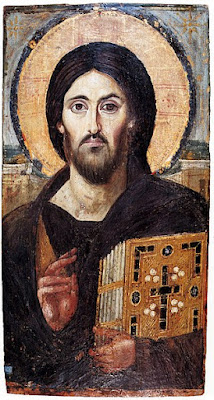
Our Eighth Day Institute 2022 Symposium was a wonderful event, held Friday and Saturday, January 14 and 15 at St. George's Orthodox Cathedral in Wichita, Kansas. Of course there were some glitches--the main one being that Rod Dreher, one of the plenary speakers, could not come to Wichita because he had tested positive for Covid and had lost his voice so he couldn't even participated digitally. All of the speakers spoke to everyone attending because we had no breakout sessions. And the presentations were wonderfully balanced between practical matters of current issues and theological explorations of the true model and how we should imitate Him: Jesus Christ. Thus, the icon for the event: The Pantocrator from Saint Catherine's Monastery.

Carl R. Trueman, from Grove City College in western Pennsylvania, a fellow at the Ethics and Public Policy Center in DC, and author of The Rise and Triumph of the Modern Self: Cultural Amnesia, Expressive Individualism, and the Road to Sexual Revolution among other books offered two presentations, analyzing the cultural changes in the way we identify ourselves. Dr. J (Jennifer Roback Morse) of the Ruth Institute also gave two presentations on the effects of those changes on the family, on fathers and mothers, on children, on schools, etc, etc. While he outlined the situation we face, Dr. J offered tactics, ways of thinking and responding, all at the service of renewing the true doctrine of the family: a man and woman who marry for the sake, not of their appetites and whims, but for the loving stability of a home for children, who know who their parents are, know their identities, and live with both parents, unless a tragedy occurs.

Then Father Alexis Torrance and the Reverend Hans Boersma offered some theological and spiritual foundations--above and beyond the practical steps we have to take to help our culture to return to the reality of humanity, the family, and the common good--upon which to base our efforts. Boersma outlined how Hugh of St. Victor offered his monks a model of lectio divina based on spiritual analogies within the structures of Noah's Ark:

Sex and the Imagination: Focusing the Mind: Delusions of the self—and the sexual problems linked to them—do not just happen. They are caused by a wandering imagination. This talk discusses how the 12th-century spiritual master Hugh of Saint Victor tried to anchor his students’ character: through a mural painting of Noah’s Ark. We will turn to Noah’s Ark in our own 21st-century pursuit of focus and stability.

Here's another version of his presentation.

And the final presentation, by Father Torrance, was based on his 2020 book from Oxford University Press, Human Perfection in Byzantine Theology: Attaining the Fullness of Christ. He offered some insights from four saints based on chapters from that book:

2. Perpetual progress or eternal rest? Contemplating the eschaton in St Maximus the Confessor
3. Perfection before our eyes: St Theodore the Studite on the humanity of Christ
4. I am called by two names, human and divine: dogma and deification in St Symeon the New Theologian
5. The energy of deification and the person of Jesus Christ in St Gregory Palamas

We were disappointed that Rod Dreher could not come and that he was ill. Nonetheless, I though it was a very successful gathering--in part, just because we gathered--in which we confronted issues Catholics, Protestants, and Orthodox Christians face in our families, workplaces, churches, and friendships and were reminded and consoled by the victory of Jesus Christ over sin and death through His Incarnation and Paschal Sacrifice.

I think the Symposium, of all the events we present at Eighth Day Institute, is the most accessible and important. Ad Fontes--the summer theological week--purposefully emphasizes the differences between and among Catholics, Protestants, and Orthodox Christians (our different views of Baptism, Salvation and sin (this summer's topic) and is the more scholarly gathering. The Inklings Festival is a family Oktoberfest event, celebrating Tolkien, Lewis, Chesterton, Sayers, et al. It's fun and literary at the same time, which as an English major I appreciate.

The Symposium, though, gives us all a chance to gather and think about our lives as Christians, the challenges we face inside and out, and thus offers renewal so we may do as St. Peter the Apostle advises:

But even if you do suffer for doing what is right, you are blessed. Do not fear what they fear, and do not be intimidated, but in your hearts sanctify Christ as Lord. Always be ready to make your defence to anyone who demands from you an account of the hope that is in you; yet do it with gentleness and reverence. Keep your conscience clear, so that, when you are maligned, those who abuse you for your good conduct in Christ may be put to shame. (1 Peter 3:14-16)

I certainly hope that anyone reading this could come to an Eighth Day Symposium some day: perhaps next January?!?

Tuesday, June 8, 2021

Report on the Fourth Annual Florovsky-Newman Week


I did not attend every session of this Academic Conference, but I did attend the Wednesday night banquet, the Thursday and Friday academic paper sessions (presenting on Thursday), and the Thursday night plenary session (meaning I missed two plenary sessions). Members--that is, supporters--of the Eighth Day Institute receive documentation of the conference after it is held, so I'll be able to catch up on what I missed (the content of it, not the experience of it).

This is an academic conference--the plenary speakers are members of the academia (university professors) and several of the presenters on Thursday and Friday mornings are doctoral and undergraduate students--but there were a couple of pastors presenting too. I may have been the only "independent scholar"! The presentations explored different Christians' beliefs about Baptism, the Fathers of the Church on Baptism, and certain crises and difficulties some groups faced when determining their beliefs about Baptism, including the founders/fathers of the Baptist churches in the 17th century and the Quakers--and St. Augustine urging the Donatists to come home!

The purpose of the Florovsky-Newman week is really to "air our differences": we don't condemn or proselytize each other, nor do we collaborate on any joint statement. We don't have the authority to do so on behalf of our churches and communities. The description for the week from our website summarizes our efforts, although I don't think we really overcame "our different views of baptism":

Heeding Fr. Florovsky's advice, rather than simply overlooking differences, this conference seeks to overcome the different views of baptism. And we do so by returning to the common Tradition, by learning to read the Fathers as living masters, rather than as historical documents. Our hope is for you to deepen your understanding of baptism by examining it from our respective traditions as Orthodox, Catholic, and Protestant Christians. Join us for this unique event as we dive into the Church Fathers in order to explore, challenge, and encourage one another to better love God and neighbor.

The main takeaways I had from the conference:

1) The search for a "pure Church" is dangerous. Jesus did not found His Church for the perfect, but for sinners--He said He did not come to call the Righteous. His purpose for the Church is to save sinners, forgive them of their sins, sanctify them, and prepare them for Heaven. If only pure, perfect Christians can be members of the Church, there would be no Church. 

Young John Henry Newman learned that after he became a minister of the Church of England, while a Deacon serving in a parish. One of his first Oxford mentors, Dr. Edward Hawkins, convinced him that he shouldn't divide up the parishioners of St. Clement's into the saved and the unsaved (influenced by Calvinist Predestination), seeking to lead the Church of the Elect, but to be a pastor of the Church of the Baptized. The Donatists, John Smyth of the early Baptist movement, some of the Quakers, etc., have sought this pure Church, rejecting those who didn't conform to their versions of the perfect Christian disciple and ultimately ended up with a Christian community far, far from what they'd sought at the beginning or one that had divided itself so far from the rest of the followers of Jesus that it could hardly participate or evangelize the world!

2) The issue of the source of mediated authority in Christian communities in our lives--since we know that the Holy Trinity is the ultimate authority for all things in the Heavens and on the earth--is the basis of our disagreements. 

Is it the Bible? is it the Church AND the Bible? what is the role of Tradition? who decides what the Tradition or the Bible says? The Pope and the Bishops? the Ecumenical Councils and/or the Fathers of the Church? the individual believer?

I trust the latter least.

3) Getting together in peace and amity is the only way to discuss these issues: radio and television live discussions (questions and answers; explanations and clarifications) may be a close second, but only this kind of meeting, with people meeting each other will bear any fruit.  Facebook and Twitter comments avail nothing.

We don't just agree to disagree but we do agree to treat each other with respect, without anger, bitterness, or hatred. There's no condemnation, but there is still sorrow that we are so divided. As Shakespeare's Prince Escalus of Verona says at the end of Romeo and Juliet, all are punish'd:


I am already looking forward to next year's topic and event, God willing!

Image credit (public domain): the Baptism of Jesus by Aert de Gelder, a Dutch painter, c.1710.

Sunday, May 23, 2021

COVID-19 and Ecumenism at the Eighth Day Institute

Our Eighth Day Institute 4th annual Florovsky-Newman Week is coming up, May 31 to June 5, including an Icon workshop, a separate seminar, and a festal banquet before the presentation of plenary and academic papers. Our topic this year is Baptism:

The Patristic View of Baptism: Public Proclamation or Salvific Sacrament?

Co-sponsored by St George Orthodox Christian Cathedral and the Gerber Institute for Catholic Studies, the Florovsky-Newman Week promotes a “return to the sources for Christian unity.” Heeding Fr. Florovsky's advice, rather than simply overlooking differences, this conference seeks to overcome the different views of baptism. And we do so by returning to the common Tradition, by learning to read the Fathers as living masters, rather than as historical documents. Our hope is for you to deepen your understanding of baptism by examining it from our respective traditions as Orthodox, Catholic, and Protestant Christians. Join us for this unique event as we dive into the Church Fathers in order to explore, challenge, and encourage one another to better love God and neighbor.

The plenary speakers are Matthew Levering (Catholic), Marcus Plested (Orthodox) and Charles Raith II (Protestant). Here's the schedule of their presentations--which include responses from the other speakers.

I'm giving one of the academic papers Thursday or Friday morning (don't know the full schedule yet):

Newman’s “Religious Opinions” and Infant Baptism

John Henry Cardinal Newman, recently canonized by the Catholic Church, wrote his Apologia pro Vita Sua in response to challenges to his integrity and honesty by Charles Kingsley in 1863. Newman had to answer Kingsley’s charge that truth didn’t matter to Catholic priests and that Newman had even stated that truth shouldn’t matter to Catholic priests and so he told the story of his conversion to demonstrate his integrity and honesty.

In four chapters Newman tells the history of his religious opinions: up to 1833, from 1833 to 1839, 1839-1841, and 1841-1845; after that he says he has “no further history of my religious opinions to narrate”. Before the crucial date of October 9, 1845 when he became a Catholic, Newman changed his mind several times about various religious matters—including Baptism and what it means to be baptized and a member of the Church.

This presentation will explore Newman’s thoughts about Baptism through a brief biographical sketch and an examination of an 1828 sermon he preached as Vicar of the University Church of St. Mary’s the Virgin in Oxford: “Infant Baptism”. 

EDI has been trying to present opportunities for fellowship and discussion during the COVID shut-downs, online, outside, and properly socially distanced. Registration is slow right out and we, the Director and the Board of Directors, hope it picks up soon. You can't really have ecumenical discussions, sharing different religious doctrines and theologies, online or virtually. One of the best things about the Florovsky Newman Week is the format of the plenary sessions. When the Catholic speaker presents a Catholic view, the Orthodox and Protestant speakers respond; when the Orthodox speakers presents his paper, the Protestant and the Catholic respond; when the Protestant presents, the Catholic and Orthodox--so there's real exchange of ideas and scholarly community.

We're hoping that registration picks up soon and we're thinking of incentives to bring more EDI members and friends to this great week. I enjoyed the 2018 and 2019 events. (Last year it had to be virtual event with online presentations!)

Thursday, August 6, 2020

The Transfiguration of Our Lord


At the end of this Leap Year February, I attended an Eighth Day Institute Seminar on Holiness: in The Bible, the Fathers, the Liturgy, and Literature. A small group of us read and discussed The Song of Songs, a passage on the Transfiguration of Our Lord from St. Maximus the Confessor, the Vespers of the Feast of the Transfiguration, and Flannery O'Connor's short story "Revelation".

O'Connor has been much in the news since Loyola University of Maryland cancelled her, citing racist passages in her letters. Jessica Hooten-Wilson cited "Revelation" in a defense of Flannery O'Connor and so did Lorraine V. Murray.

But the standout of the readings was Saint Maximus the Confessor's Ambiguum 41 on the Transfiguration of Our Lord. This blog cites the entire passage, but I will highlight just a few of the sections that were astounding to me, as Maximus describes what God wanted to achieve in His Creation by finally creating Man:

This is why man was introduced last among beings— like a kind of natural bond mediating between the universal extremes through his parts, and unifying [1305C] through himself things that by nature are separated from each other by a great distance — so that, by making of his own division a beginning of the unity which gathers up all things to God their Author, and proceeding by order and rank through the mean terms, he might reach the limit of the sublime ascent that comes about through the union of all things in God, in whom there is no division, completely shaking off from nature, by means of a supremely dispassionate condition of divine virtue, the property of male and female, which in no way was linked to the original principle of the divine plan concerning human generation, so that he might be shown forth as, and become solely a human being according to the divine plan, not divided by the designation of male and female (according to the principle by which he formerly came into being), nor divided into the parts that now appear around him, [1305D] thanks to the perfect union, as I said, with his own principle, according to which he exists.

Then, once he had united paradise and the inhabited world through his own proper holy way of life, man would have fashioned a single earth, not divided by him in the difference of its parts, but rather gathered together, for to none of its parts would he be subjected. After this, having united heaven and earth through a life identical in virtue in every manner with that of the angels (as much as this is humanly possible), he would have made the sensory creation absolutely identical and indivisible [1308A] with itself, not in any way dividing it into places separated by distances, for he would have become nimble by means of the spirit, without any corporeal weight holding him to the earth, and thus proceed unhindered in his ascent to the heavens, for his nous would no longer behold such things, but hasten purely to God, and in the wisdom of his gradual ascent to God, just as if he were traveling on an ordinary road, he would naturally overcome any obstacles standing in his way.

But we know what happened: Adam and Eve sinned and broke away from God through disobedience--and so the Father sent His Son to restore the original wholeness coming as "perfect man, having assumed from us, and for us, and consistent with us, everything that is ours, lacking nothing, but without sin . . .

Then, having sanctified our inhabited world by the dignity of His conduct as man, He proceeded unhindered to paradise after His death, just as He truly promised to the thief, saying: Today, you will be with me in paradise. Consequently, since there was for Him no difference between paradise and our inhabited world, He appeared on it, and spent time together with His disciples after His resurrection from the dead, demonstrating that the earth is one and not divided against itself, for it preserves the principle of its existence free of any difference caused by division. Then, by His ascension into heaven, it is obvious that He united heaven and earth, for He entered heaven with His earthly body, which is of the same nature and consubstantial with ours, [1309C] and showed that, according to its more universal principle, all sensory nature is one, and thus He obscured in Himself the property of division that had cut it in two. Then, in addition to this, having passed with His soul and body, that is, with the whole of our nature, through all the divine and noetic orders of heaven, He united sensory things with noetic things, displaying in Himself the fact that the convergence of the entire creation toward unity was absolutely indivisible and beyond all fracture, in accordance with its most primal and most universal principle. . . .

And with us and for us He encompassed the extremes of the whole creation through the means, as His own parts, and He joined them around Himself, each with the other, tightly and indissolubly: paradise and the inhabited world, heaven and earth, the sensory and the noetic, since like us He possesses a body, sense perception, soul, and nous, to which (as His own parts) He associated individually the extreme that was thoroughly akin to each one of them (i.e., His parts), according to the mode described above, and He recapitulated in Himself, in a manner appropriate to God, all things, showing that the whole creation is one, as if it were another human being, completed by the mutual coming together of all its members, inclining [1312B] toward itself in the wholeness of its existence, according to one, unique, simple, undefined, and unchangeable idea: that it comes from nothing. Accordingly, all creation admits of one and the same, absolutely undifferentiated principle: that its existence is preceded by nonexistence.

You have to read this passage several times to comprehend the vision of unity, integrity, and holiness Saint Maximus is conveying. In our divided, troubled, uncertain world, it is clear that Jesus Christ is only way to wholeness and holiness, the only icon of God the Father's plan for us.

Image Credit: 15th century Icon of the Transfiguration by Theophanes the Greek.

Wednesday, February 19, 2020

EDI's Seminar on Holiness


Before the Eighth Day Institute Symposium on Holiness in January, EDI held a two day Seminar on "Holiness in the Bible, the Fathers, the Liturgy, and Literature" at The Ladder, the institute's headquarters. Next Friday and Saturday, February 28 and 29, they are repeating the event and a friend and I are attending:

This four-session Seminar will be conducted in a Shared Inquiry format, the method of approaching texts used in the classrooms of St. John's College, Thomas Aquinas College, and other "great books" curriculum schools.

A good friend once said, "shared-inquiry is a way to read a book with more than one brain." This is an apt description, because one often discovers that a passage which proves difficult is illumined by someone else, and vice versa. Shared-inquiry facilitates a communal engagement with a given text so that we are informed and transformed together.

Seating is limited to first 12 registrants.

Readings include The Song of Songs from the Old Testament, selections from St. Maximus the Confessor (who was the patron saint of the Symposium in January), the Orthodox liturgy for the Feast of the Transfiguration of Our Lord, and Flannery O'Connor's "Revelation".

If you are in the Wichita area, please check it out here.

Wednesday, January 29, 2020

Book Review: "Liturgical Mysticism" by David Fagerberg

The Tenth Annual Eighth Day Institute Symposium was held this past weekend: I saw many friends, volunteered to pick up bagels for breakfast and help at registration on Friday and to introduce David W. Fagerberg at his Saturday break-out session. I also drove him to Mass Saturday evening after attending Great Vespers at St. George's Orthodox Cathedral, and then on to Eighth Day Books for that evening's reception. But I came home after that to our dogs Joey and Brandy and congratulated myself that I only bought one new book (David Lyle Jeffrey's Scripture and the English Poetic Imagination): I'd picked it up off one of the Eighth Day Books displays; Jessica Hooten Wilson, one of the speakers, was standing next to me and said, "Yes: get that" so I bought it. She reviewed it here.

But here's my review of David W. Fagerberg's Liturgical Mysticism, his latest book on Liturgy, Theology, Spirituality, Sacramentality, and Mysticism. He began his break-out session with the comment that he wrote this book with Mrs. Murphy, the late Father Aidan Kavanaugh's image of a Catholic attending Mass and becoming a liturgical theologian, in mind. As I read the book, I thought of myself, Mrs. Mann, a Catholic attending Mass and becoming a liturgical theologian and how this book could help me grow as a liturgical theologian, a liturgical ascetic, and a liturgical mystic. Jesus has given us the Sacraments, especially the Holy Sacrifice of the Mass, as the primary means to receive Sanctifying Grace. I experience this sanctification--being made holy--in the midst of "the vastly complex vocabulary of experiences had, prayers said, sights seen, smells smelled, words said and heard and responded to, emotions controlled and released, sins committed and repented, children born and loved ones buried, and in many other ways no one can count or always account for", as Father Kavanaugh, OSB wrote.

As Kavanaugh's student, Professor Fagerberg explores the meaning of his teacher's statement: "All who are engaged in liturgy are theologians precisely because the liturgy is the Church’s faith." Fagerberg goes further to state that if Mrs. Murphy or Mrs. Mann is engaged in the liturgy--if she even begins to comprehend what happens at Mass every day--she is not just a theologian, she is a mystic and an ascetic. The Holy Mass represents such a great mystery that if I participate in it and know that what I'm participating is the re-presentation of the Paschal Mystery, I must become a mystic. Since the Holy Sacrifice of the Mass is making present on earth, in a particular church at a particular time, the saving sacrifice of Jesus dying on the Cross, descending to the dead, and rising from the dead, I am a mystic, breaking the bonds of earth, my own limitations, and time and space. Since it is through the suffering of Jesus on the cross that I receive communion with God, I must become an ascetic as I imitate Jesus, being conformed to Him more and more through the liturgy. Receiving and cooperating with the Graces of the liturgy are a path to holiness and sanctification.

Fagerberg illuminates these truths much more gracefully than I do. On her Facebook page, Kris McGregor posted "Kindle Quotes" (I read a real book so had to write out quotations on paper and type them out on my laptop!) that offer examples of his scintillating prose. From the Prologue:


Also from the Prologue:


Fagerberg also notes that "Liturgical mysticism is when liturgy takes up residence in our lives." (p. xxi) And later, in an excellent example of polysyndeton, he writes, "Liturgical theology is written with incense and icon and temple and feast and sacrament and relic"! (p. 14)

At the end of the Prologue, he offers a summation of the themes he will explore in the book: "Liturgical mysticism is the Trinitarian mystery, mediate by sacramental liturgy and hypostasized as personal liturgy, to anchor the substance of our lives." (p. xxi)

The Table of Contents of the book:

Prologue
Chapter 1. An Enthralling Liturgy
Chapter 2. Ordinary Liturgical Mysticism
Chapter 3. Quickening the Liturgical Person
Chapter 4. The Narrow Gate
Chapter 5. The Path through Cross to Resurrection
Chapter 6. The Pathway Home
Chapter 7. Coming Home
Epilogue
Bibliography
Index


In Chapter 1, he establishes that for the liturgy to make this development of graces possible, we have to stop thinking of liturgy as something we attend for our own satisfaction and enjoyment, such that we determine whether or not we get something out of it: "Liturgy must not conform to us but we to it." (p. 6) That's why liturgy is formal, repetitive, directed to God, worshipful (dulia) and pious (latria): year after year we "keep the liturgical year and its feasts", we "exercise the sacramentals in every nook of our lives", and we "let the prayer of the Church pass through our lips in the Divine Office" (p. 20)

In Chapter 2, Fagerberg cites Reginald Garrigou-Lagrange in support of his assertion that the ordinary Catholic Christian should be both a "secular ascetic" and a "mundane mystic": finding that this "infused contemplation of the mysteries of faith [celebrated in the liturgy] to be 'the normal way of sanctity and to be necessary to the full perfection of Christian life.'" (p. 26) Since Heaven will be mystical, adoring and loving God, we need to prepare for that meditative and peaceful mystical everlasting life. While there is an extraordinary mysticism experienced by a few, all Christians should prepare themselves for this ordinary mysticism by participating in the Church's liturgy.

In Chapter 3, he focuses on the "quickening of our baptism" in and with the Church: "Liturgical mysticism is ecclesial in form and sacramental in nature. It does not leave the Church behind . . . [it] is a liturgical life that sprouts from baptism and seeks union with God through his mysteries, on a mystical level." (p. 42)

Fagerberg offered a Saturday breakout session at the Symposium, based upon a section in Chapter 4, that highlighted one of the ways liturgical asceticism develops the graces we receive through the Sacraments as we deal with temptations along the purgative way. He explores Evagrius of Pontus's descriptions of the eight evil tempting thoughts or logismoi: gluttony, impurity, avarice, sadness, anger, acedia (the noonday demon), vainglory, and pride. They stand in the way of us participating in the Mystery of he liturgy, but the Mystery of the  liturgy and the sacraments help us avoid giving into those temptations. That Mystery orients us away from ourselves, to whom each of these temptations point us, and instead toward God and the opposite virtues of Faith in God, Hope in Heaven, and Love of God and neighbor.

In his plenary session on Friday, Fagerberg highlighted one of the Western spiritual writers he's been reading lately, Venerable Francis Libermann (more about him on Sunday, February 2 on this blog). He drew Libermann's spiritual advice, shared in letters with his family and with members of the missionary order he led, the Spiritans, from Chapter 5. Venerable Libermann urged his correspondents, in imitation of Jesus, to take up their crosses, bear them willingly, rejoice in their burdens for the sake of sanctification, the love of God and the love of neighbor.

In Chapters 6 and 7, Fagerberg continues this exploration of how liturgical mysticism guides us on our way in this life and how it points us to the eschaton, the end of this life and the beginning of the next. In the Epilogue, he concludes:
The liturgy that occurs within the hidden spaces of the heart is the liturgy hypostasized in the soul. Liturgical asceticism kneads both body and soul with that Resurrection power; liturgical mysticism looks fixedly at the mystery, who is Christ risen; and liturgical theology illuminates our world and our place in it. Liturgical mysticism is the Trinitarian mystery, mediated by sacramental liturgy and hypostasized as personal liturgy, to anchor the substance of our lives. (p. 149)
The bibliography is extensive, featuring titles by Louis Bouyer, Jean Danielou, Reginald Garrigou-Lagrange, C.S. Lewis, Joseph Ratzinger, and Alexander Schmemann, among others. Reading this book was a transcendent experience and I'm glad I had the opportunity to meet and hear the author speak. Recommended without reservation.

Monday, December 2, 2019

Being in Time with W.H. Auden

On Black Friday, the super shopping day after Thanksgiving, I did some online shopping and some real shopping (after Mass, at a Catholic gift/bookstore, with friends before lunch). But in the evening, I went to an event at the Eighth Day Institute's headquarters, The Ladder, and joined four good gentlemen in reading W.H. Auden's Christmas Oratorio, For the Time Being. Alan Jacobs edited and annotated the poem for Princeton University Press:

For the Time Being is a pivotal book in the career of one of the greatest poets of the twentieth century. W. H. Auden had recently moved to America, fallen in love with a young man to whom he considered himself married, rethought his entire poetic and intellectual equipment, and reclaimed the Christian faith of his childhood. Then, in short order, his relationship fell apart and his mother, to whom he was very close, died. In the midst of this period of personal crisis and intellectual remaking, he decided to write a poem about Christmas and to have it set to music by his friend Benjamin Britten. Applying for a Guggenheim grant, Auden explained that he understood the difficulty of writing something vivid and distinctive about that most clichéd of subjects, but welcomed the challenge. In the end, the poem proved too long and complex to be set by Britten, but in it we have a remarkably ambitious and poetically rich attempt to see Christmas in double focus: as a moment in the history of the Roman Empire and of Judaism, and as an ever-new and always contemporary event for the believer. For the Time Being is Auden’s only explicitly religious long poem, a technical tour de force, and a revelatory window into the poet’s personal and intellectual development. This edition provides the most accurate text of the poem, a detailed introduction by Alan Jacobs that explains its themes and sets the poem in its proper contexts, and thorough annotations of its references and allusions.

I was assigned the roles of Mary, Rachel, the Semi-Chorus, one of the Wise Men, the Chorus of Angels, and "Feeling"! The long soliloquy of King Herod, in prose, was hilariously Stoic!

The end of the poem offers the challenge of Advent and Christmas, to prepare and then be in that time being of anticipation and fulfillment that really only the liturgy and liturgical prayer provide: to be on the tip-toe of a great event and yet live in it in the midst of all the distractions and griefs and troubles. To keep Christmas--the Incarnation--in my heart everyday:

                                        . . .To those who have seen
The Child, however dimly, however incredulously,
The Time Being is, in a sense, the most trying time of all.
For the innocent children who whispered so excitedly
Outside the locked door where they knew the presents to be
Grew up when it opened. Now, recollecting that moment
We can repress the joy, but the guilt remains conscious;
Remembering the stable where for once in our lives
Everything became a You and nothing was an It.
And craving the sensation but ignoring the cause,
We look round for something, no matter what, to inhibit
Our self-reflection, and the obvious thing for that purpose
Would be some great suffering. So, once we have met the Son,
We are tempted ever after to pray to the Father;
"Lead us into temptation and evil for our sake."
They will come, all right, don't worry; probably in a form
That we do not expect, and certainly with a force
More dreadful than we can imagine. In the meantime
There are bills to be paid, machines to keep in repair,
Irregular verbs to learn, the Time Being to redeem
From insignificance. The happy morning is over,
The night of agony still to come; the time is noon:
When the Spirit must practice his scales of rejoicing
Without even a hostile audience, and the Soul endure
A silence that is neither for nor against her faith
That God's Will will be done, That, in spite of her prayers,
God will cheat no one, not even the world of its triumph.

IV
Chorus

He is the Way.
Follow Him through the Land of Unlikeness;
You will see rare beasts, and have unique adventures.

He is the Truth.
Seek Him in the Kingdom of Anxiety;
You will come to a great city that has expected your return for years.

He is the Life.
Love Him in the World of the Flesh;
And at your marriage all its occasions shall dance for joy.


I say that the liturgy and prayer--especially liturgical prayer--are the best ways to be in that time because the Holy Sacrifice of the Mass makes the great mysteries of the Incarnation and the Paschal Sacrifice present to us NOW. As Joseph Cardinal Ratzinger wrote in The Spirit of the Liturgy, summarizing his argument at the end of an article, "The Relationship of the Liturgy to Time and Space":

When we look back on our reflections hitherto in this essay, we see that we twice encountered—in different contexts—a three-step process. The liturgy, as we saw, is characterized by a tension that is inherent in the historical Pasch of Jesus (his Cross and Resurrection) as the foundation of its reality. The ever-abiding form of the liturgy has been shaped in what is once and for all; and what is everlasting—the second step—enters into our present moment in the liturgical action and—the third step— wants to take hold of the worshipper’s life. The immediate event—the liturgy—makes sense and has a meaning for our lives only because it contains the other two dimensions. Past, present, and future interpenetrate and touch upon eternity. Earlier we became acquainted with the three stages of salvation history, which progresses, as the Church Fathers say, from shadow to image to reality. We saw that in our own time, the time of the Church, we were in the middle stage of the movement of history. The curtain of the Temple has been torn. Heaven has been opened up by the union of the man Jesus, and thus of all human existence, with the living God. But this new openness is only mediated by the signs of salvation. We need mediation. As yet we do not see the Lord ‘‘as he is’’. Now if we put the two three-part processes together—the historical and the liturgical—it becomes clear that the liturgy gives precise expression to this historical situation. It expresses the ‘‘between-ness’’ of the time of images, in which we now find ourselves. The theology of the liturgy is in a special way ‘‘symbolic theology,’’ a theology of symbols, which connects us to what is present but hidden.

In so saying, we finally discover the answer to the question with which we started. After the tearing of the Temple curtain and the opening up of the heart of God in the pierced heart of the Crucified, do we still need sacred space, sacred time, mediating symbols? Yes, we do need them, precisely so that, through the ‘‘image,’’ through the sign, we learn to see the openness of heaven. We need them to give us the capacity to know the mystery of God in the pierced heart of the Crucified. Christian liturgy is no longer replacement worship but the coming of the representative Redeemer to us, an entry into his representation that is an entry into reality itself. We do indeed participate in the heavenly liturgy, but this participation is mediated to us through earthly signs, which the Redeemer has shown to us as the place where his reality is to be found. In liturgical celebration there is a kind of turning around of exitus to reditus, of departure to return, of God’s descent to our ascent. The liturgy is the means by which earthly time is inserted into the time of Jesus Christ and into its present. It is the turning point in the process of redemption. The Shepherd takes the lost sheep onto his shoulders and carries it home.


We can't be in the time being with Jesus on our own: we need His love and His grace. In the Holy Sacrifice of Mass in Roman Rite or the Divine Liturgy of the Eastern Rites "earthly time is inserted into the time of Jesus Christ and into its present". 

Blessed Advent to you all!

Monday, October 21, 2019

Confessions, Surprises, and Apologies

On Saturday evening last, Jessica Hooten Wilson, Associate Professor at John Brown University, presented "'Maddened Beauty': Imagination as Knowing in C. S. Lewis" at the Inklings Festival for Eighth Day Institute. It was an interesting lecture, but did not seem to fulfill all the promise of the abstract:

All over C. S. Lewis’s work (fictional and nonfiction), Lewis speaks of imagination as a way of knowing. We’ll consider The Abolition of Man, Experiment in Criticism, The Discarded Image, Reflections on the Psalms, and even Lewis’ biography Surprised by Joy to understand what this means for us. How might poetry and Norse mythology offer knowledge that arguments will never grasp? What’s the difference between irrational, rational, and transrational? Lewis compels us to cultivate our imaginations not as a path of escape but as a deeper road to understanding reality and as a higher road towards the knowledge, ultimately, of God.

We really did not "consider The Abolition of Man, Experiment in Criticism, The Discarded Image, Reflections on the Psalms", although she mentioned the Experiment in Criticism and The Discarded Image. Her focus was Surprised by Joy and how to understand the role of imagination in Lewis' conversion and his conversion story. She began by citing an important hint in the Preface to Surprised by Joy: "The book aims at telling the story of my conversion and is not a general autobiography, still less "Confessions" like those of St. Augustine or Rousseau." She noted that if Lewis told us that we should know what not to expect in Lewis' book.

Then she read the beginning of Rousseau's Confessions:

I have entered upon a performance which is without example, whose accomplishment will have no imitator. I mean to present my fellow-mortals with a man in all the integrity of nature; and this man shall be myself.

I know my heart, and have studied mankind; I am not made like any one I have been acquainted with, perhaps like no one in existence; if not better, I at least claim originality, and whether Nature did wisely in breaking the mould with which she formed me, can only be determined after having read this work.

Whenever the last trumpet shall sound, I will present myself before the sovereign judge with this book in my hand, and loudly proclaim, thus have I acted; these were my thoughts; such was I. With equal freedom and veracity have I related what was laudable or wicked, I have concealed no crimes, added no virtues; and if I have sometimes introduced superfluous ornament, it was merely to occupy a void occasioned by defect of memory: I may have supposed that certain, which I only knew to be probable, but have never asserted as truth, a conscious falsehood. Such as I was, I have declared myself; sometimes vile and despicable, at others, virtuous, generous and sublime; even as thou hast read my inmost soul: Power eternal! assemble round thy throne an innumerable throng of my fellow-mortals, let them listen to my confessions, let them blush at my depravity, let them tremble at my sufferings; let each in his turn expose with equal sincerity the failings, the wanderings of his heart, and, if he dare, aver, I was better than that man.


Contrasting the beginning of St. Augustine's Confessions:

Great art Thou, O Lord, and greatly to be praised; great is Thy power, and Thy wisdom infinite. And Thee would man praise; man, but a particle of Thy creation; man, that bears about him his mortality, the witness of his sin, the witness that Thou resistest the proud: yet would man praise Thee; he, but a particle of Thy creation. Thou awakest us to delight in Thy praise; for Thou madest us for Thyself, and our heart is restless, until it repose in Thee. Grant me, Lord, to know and understand which is first, to call on Thee or to praise Thee? and, again, to know Thee or to call on Thee? for who can call on Thee, not knowing Thee? for he that knoweth Thee not, may call on Thee as other than Thou art. Or, is it rather, that we call on Thee that we may know Thee? but how shall they call on Him in whom they have not believed? or how shall they believe without a preacher? and they that seek the Lord shall praise Him: for they that seek shall find Him, and they that find shall praise Him. I will seek Thee, Lord, by calling on Thee; and will call on Thee, believing in Thee; for to us hast Thou been preached. My faith, Lord, shall call on Thee, which Thou hast given me, wherewith Thou hast inspired me, through the Incarnation of Thy Son, through the ministry of the Preacher.

And how shall I call upon my God, my God and Lord, since, when I call for Him, I shall be calling Him to myself? and what room is there within me, whither my God can come into me? whither can God come into me, God who made heaven and earth? is there, indeed, O Lord my God, aught in me that can contain Thee? do then heaven and earth, which Thou hast made, and wherein Thou hast made me, contain Thee? or, because nothing which exists could exist without Thee, doth therefore whatever exists contain Thee? Since, then, I too exist, why do I seek that Thou shouldest enter into me, who were not, wert Thou not in me? Why? because I am not gone down in hell, and yet Thou art there also. For if I go down into hell, Thou art there. I could not be then, O my God, could not be at all, wert Thou not in me; or, rather, unless I were in Thee, of whom are all things, by whom are all things, in whom are all things? Even so, Lord, even so. Whither do I call Thee, since I am in Thee? or whence canst Thou enter into me? for whither can I go beyond heaven and earth, that thence my God should come into me, who hath said, I fill the heaven and the earth.


Tracing Lewis' encounters with "Joy" in his childhood imagination, Hooten Wilson developed the theme of that longing for "Joy" that Lewis tried to describe and hold on to--the yearning, aching, desire for something beyond himself:

The first is itself the memory of a memory. As I stood beside a flowering currant bush on a summer day there suddenly arose in me without warning, and as if from a depth not of years but of centuries, the memory of that earlier morning at the Old House when my brother had brought his toy garden into the nursery. It is difficult to find words strong enough for the sensation which came over me; Milton's "enormous bliss" of Eden (giving the full, ancient meaning to "enormous") comes somewhere near it. It was a sensation, of course, of desire; but desire for what? not, certainly, for a biscuit-tin filled with moss, nor even (though that came into it) for my own past. [Greek: Ioulian pothô] --and before I knew what I desired, the desire itself was gone, the whole glimpse withdrawn, the world turned commonplace again, or only stirred by a longing for the longing that had just ceased. It had taken only a moment of time; and in a certain sense everything else that had ever happened to me was insignificant in comparison.

The second glimpse came through Squirrel Nutkin; through it only, though I loved all the Beatrix Potter books. But the rest of them were merely entertaining; it administered the shock, it was a trouble. It troubled me with what I can only describe as the Idea of Autumn. It sounds fantastic to say that one can be enamoured of a season, but that is something like what happened; and, as before, the experience was one of intense desire. And one went back to the book, not to gratify the desire (that was impossible--how can one possess Autumn?) but to re-awake it. And in this experience also there was the same surprise and the same sense of incalculable importance. It was something quite different from ordinary life and even from ordinary pleasure; something, as they would now say, "in another dimension".

The third glimpse came through poetry. I had become fond of Longfellow's
Saga of King Olaf: fond of it in a casual, shallow way for its story and its vigorous rhythms. But then, and quite different from such pleasures, and like a voice from far more distant regions, there came a moment when I idly turned the pages of the book and found the unrhymed translation of Tegner's Drapa and read

I heard a voice that cried,
Balder the beautiful
Is dead, is dead----

I knew nothing about Balder; but instantly I was uplifted into huge regions of northern sky, I desired with almost sickening intensity something never to be described (except that it is cold, spacious, severe, pale, and remote) and then, as in the other examples, found myself at the very same moment already falling out of that desire and wishing I were back in it.


Then Lewis describes how that joy left him through bad education and poor choices for achievement (reading the right books, knowing the right people, etc) and how he rediscovered it when he began to read Norse mythology again, drawn by Arthur Rackham's illustrations for Siegfried and the Twilight of the Gods.

But I admit that when she started talking about Lewis' childhood experiences of Joy, I thought of the beginning of another story of a conversion, Newman's Apologia pro Vita Sua--also a work unlike either Rousseau's or Augustine's Confessions or Lewis' Surprised by Joy--but one that begins in imagination:

IT may easily be conceived how great a trial it is to me to write the following history of myself; but I must not shrink from the task. The words, "Secretum meum mihi," keep ringing in my ears; but as men draw towards their end, they care less for disclosures. Nor is it the least part of my trial, to anticipate that, upon first reading what I have written, my friends may consider much in it irrelevant to my purpose; yet I cannot help thinking that, viewed as a whole, it will effect what I propose to myself in giving it to the public.

I was brought up from a child to take great delight in reading the Bible; but I had no formed religious convictions till I was fifteen. Of course I had a perfect knowledge of my Catechism.

After I was grown up, I put on paper my recollections of the thoughts and feelings on religious subjects, which I had at the time that I was a child and a boy,—such as had remained on my mind with sufficient prominence to make me then consider them worth recording. Out of these, written in the Long Vacation of 1820, and transcribed with additions in 1823, I select two, which are at once the most definite among them, and also have a bearing on my later convictions.

1. "I used to wish the Arabian Tales were true: my imagination ran on unknown influences, on magical powers, and talismans … I thought life might be a dream, or I an Angel, and all this world a deception, my fellow-angels by a playful device concealing themselves from me, and deceiving me with the semblance of a material world."

Again: "Reading in the Spring of 1816 a sentence from [Dr. Watts's] Remnants of Time, entitled 'the Saints unknown to the world,' to the effect, that 'there is nothing in their figure or countenance to distinguish them,' &c. &c., I supposed he spoke of Angels who lived in the world, as it were disguised."

2. The other remark is this: "I was very superstitious, and for some time previous to my conversion" [when I was fifteen] "used constantly to cross myself on going into the dark."


Newman displays some of the same diffidence that Lewis does about disclosing so much about himself and risking irrelevance. But for both Newman and Lewis, those childhood glimpses of something beyond themselves lasted for a lifetime. Newman's recollections of fairy stories and a dream world, and angels in disguise in the real world did have a bearing on his later convictions, so much so that they inform his chosen epitaph: Ex umbris et imaginibus in veritatem (From shadows and images into truth).

Jessica Hooten Wilson is an elegant and winsome presenter; it was good of her to fill in when the scheduled speaker could not come because of his wife's illness; I look forward to her participation in the 2020 Symposium: For I Am Holy: The Command to Be Like God!!

Saturday, October 19, 2019

A Pause for Lewis and Eighth Day Books

As I continue to observe my personal Octave of celebrating Newman's canonization, I make brief pause to consider one of the leaders of another Oxford Movement, C.S. Lewis. This evening, the Eighth Day Institute, as one of the events of its Fifth Annual Inklings Festival presents Jessica Hooten Wilson, Associate Professor at John Brown University, lecturing on "'Maddened Beauty': Imagination as Knowing in C. S. Lewis."

The abstract:

All over C. S. Lewis’s work (fictional and nonfiction), Lewis speaks of imagination as a way of knowing. We’ll consider The Abolition of Man, Experiment in Criticism, The Discarded Image, Reflections on the Psalms, and even Lewis’ biography Surprised by Joy to understand what this means for us. How might poetry and Norse mythology offer knowledge that arguments will never grasp? What’s the difference between irrational, rational, and transrational? Lewis compels us to cultivate our imaginations not as a path of escape but as a deeper road to understanding reality and as a higher road towards the knowledge, ultimately, of God.

After her presentation, we'll proceed to celebrate Eighth Day Book's 31st (THIRTY-FIRST) anniversary at the book store. I'm bringing cupcakes and congratulations!

Of course, there's a Newman connection here, for he also "speaks of imagination as a way of knowing". For example, this famous quotation from the Tamworth Reading Room, his argument against Sir Robert Peel's library without any books of "controversial divinity":

The heart is commonly reached, not through the reason, but through the imagination, by means of direct impressions, by the testimony of facts and events, by history, by description. Persons influence us, voices melt us, looks subdue us, deeds inflame us. Many a man will live and die upon a dogma: no man will be a martyr for a conclusion. A conclusion is but an opinion; it is not a thing which is, but which we are "certain about;" and it has often been observed, that we never say we are certain without implying that we doubt. To say that a thing must be, is to admit that it may not be. No one, I say, will die for his own calculations; he dies for realities. This is why a literary religion is so little to be depended upon; it looks well in fair weather, but its doctrines are opinions, and, when called to suffer for them, it slips them between its folios, or burns them at its hearth.

Newman specialists like Gerard Magill, Bernard Dive, and Ian Ker have authored studies of Newman and the religious imagination through the years (Magill focused on religious morality). This article from America Magazine summarizes various aspects of Newman's view of imagination as a way of knowing. As Father Robert P. Imbelli writes, Newman wants us to know Jesus Christ above all:

At the heart of Newman’s religious faith and theological vision stands the person of Jesus Christ. Here human yearning finds its consummation, and “all the providences of God” cohere around this vivifying center. Thus Incarnation is the central idea or principle that grounds and sustains Christian life and imagination. Moreover, Cardinal Newman views Incarnation not merely as remedy for sin, but as fulfillment of God’s creative and sanctifying purpose. In this he consciously resembles his great Oxford predecessor Duns Scotus.

But in Newman’s thought, the idea of Incarnation is no impersonal notion. It has all the concrete particularity of its historical embodiment in Jesus Christ. In Jesus men and women encounter the Word of God in person and are called to genuine newness of life.


O God, who bestowed on the Priest Saint John Henry Newman the grace to follow your kindly light and find peace in your Church; graciously grant that, through his intercession and example, we may be led out of shadows and images into the fulness of your truth. Through our Lord Jesus Christ, your Son, who lives and reigns with you in the unity of the Holy Spirit, one God, for ever and ever. Amen.

St. John Henry Newman, pray for us!

Wednesday, June 12, 2019

Florovsky-Newman Week in Review

I attended almost all of the official events at the Eighth Day Institute's Florovsky-Newman Week from June 6 through 8, mostly held on the campus of Newman University, with excursions to Eighth Day Books, and a closing session at St. George's Cathedral. The topic was:

The Patristic View of Authority: Bible, Pope, or Conciliarity?

Co-sponsored by Eighth Day Institute and the Gerber Institute for Catholic Studies, the Florovsky-Newman Week promotes a “return to the sources for Christian unity.” Heeding Fr. Florovsky's advice, rather than simply overlooking differences, this conference seeks to overcome the different views of church authority. And we do so by returning to the common Tradition, by learning to read the Fathers as living masters, rather than as historical documents. Our hope is for you to deepen your understanding of the authority by which the Church grounds her faith and morals, examining authority from our respective traditions as Orthodox, Catholic, and Protestant Christians. Join us for this unique event as we dive into the Church Fathers in order to explore, challenge, and encourage one another to better love God and neighbor.

The event began with a banquet, which Bishop Carl Kemme of the Catholic Diocese of Wichita attended. Erin Doom, Director of the Eighth Day Institute made his presentation: Ways of History: Return(ing) to the Fathers with Florovsky & Newman.

Thursday and Friday mornings were dedicated to academic papers: 12 were presented and I heard nine of them and presented one myself. Five papers were presented by Newman University students or graduates and two of those by seminarians in the Catholic Diocese of Wichita! Two faculty members (one professor and one adjunct) from Friends University; one Antiochian Orthodox priest; one Christian Reformed Church pastor, and one student at Concordia Theological Seminary preparing to be a pastor in the Lutheran Church-Missouri Synod--and one Mormon! The latter presentation was intriguing because the speaker had to admit up front that his church has rejected the Fathers of the Church outright because of its teaching on the Great Apostasy!

Before each Plenary session, Director Doom read from either Florovsky or Newman: first Florovsky on the Ascension, then Newman on the Ascension, and then Florovsky on Pentecost. (The Orthodox celebrated Ascension Thursday on June 6.)

The Protestant view of Authority in the Church was presented Thursday night by Father Geoffrey R. Boyle, a local Lutheran pastor and EDI member. His presentation emphasized Sola Scriptura of course in a specifically Lutheran way, based on the Lutheran Confessions and Congregations. The major question for him, especially posed by the speaker representing the Orthodox view of Authority in the Church, Professor Alexis Torrance, was why do you say Sola Scriptura when you admit that Scripture is NOT alone in your Lutheran beliefs? You have tradition and doctrine, etc, that have been interpreted from the Holy Bible and in fact you are relying on the ancient Church's decisions of what books are in that Holy Bible, which did not come with a table of contents. Father Boyle did not have a really good answer to that question, except to say that the Lutheran Church always appeals to the Holy Bible ultimately. Also, as he stressed that he was a Lutheran, not just a Protestant, his presentation begs the question of all the different Protestant views of the Holy Bible and authority, including the believer at home reading the Bible and making decisions/interpretations on his or her own, without a community or any tradition at all. Father Boyle's presentation was both pastoral and doctrinal, stressing the authority of the Church helping the Christian live to serve, love, and worship Jesus Our Savior.

The Catholic view of Authority in the Church was not presented Friday by Professor Adam DeVille (I've already informed Director Doom of my opinion of this presentation). He started out with a program of "structural and psychological reform" without ever explaining what he wanted to reform (except abuse). He never addressed the question of the conference to describe "the authority by which the [Catholic] Church grounds her faith and morals" but jumped right into what to do about the horrible McCarrick scandal, by which a serial abuser and harasser of seminarians and a young boy was raised through the ranks of the hierarchy to become a Cardinal, a prince of the Church! This is horrific indeed and Catholics are suffering a crisis of trust in our authorities, our bishops, the highest ranking bishops/cardinals in the USA, and even the pope (to some extent that means Pope St. John Paul II, Pope Emeritus Benedict XVI, and Pope Francis--but especially the latter because it seems clear that Benedict tried to confront the scandal of a globe-trotting Cardinal abuser and Francis removed the restrictions Benedict had placed on McCarrick). But DeVille's answer was Oedipal: he referenced Freud and paternal projection/rejection. He mentioned but certainly did not want to address the Orthodox theologian John Zizioulas's call for a theological justification of Papal Primacy but I think thought it best to ignore it completely in the quest for a greater freedom in the Church in Christ, to "bear our freedom" without looking for a human authority (a father) on earth. In looking to the Fathers of the Church, he sought out the pre-Nicene Church before the bishops adopted the structures of the Roman Empire. 

Much that he said was thought-provoking but it assumed a knowledge and understanding of "the authority by which the [Catholic] Church grounds her faith and morals" that he never articulated. Director Doom has invited me and a friend of mine to write responses to this presentation and he wants to link this post to his Director's Letter to the membership. Professor Torrance, in providing an Orthodox response to this presentation, "took the bull by the horns" and read the chapter from Pastor Aeternus describing the great authority of the Papacy not by Infallibility but by Primacy to decide the discipline and government of the Catholic Church and how this is the great obstacle to East-West unity. There's the great issue we face; it's hard to go back to the Pre-Nicene days of the Church when Vatican I and Vatican II have documented this teaching on Papal Primacy.

Despite my misgivings about Professor DeVille's presentation, I want to read--and have already purchased from Eighth Day Books--his book Orthodoxy and the Roman Papacy: Ut Unum Sint and the Prospects of East-West Unity from the University of Notre-Dame Press.

Professor Torrance presented the Orthodox view of Authority on Saturday after Ninth Hour Prayer in St. George's Cathedral. He explored Doctrine and Praxis through the Charismatic Structures of Authority (the Patriarchs and Bishops), Synodality and Councils, Scripture and Tradition. It was a comprehensive and elegant discourse. He highlighted the fact that the monks of Mount Athos consider Mary the Mother of God, the Theokotos to be their Abbess (no other woman is allowed there!)

The Florovsky-Newman Week closed with the thought that Orthodox, Catholics, and Protestants learn more about each other, how we think, how we use words, how we pray, worship, read the Bible, etc., every time we hold these meetings. Our prejudices and false images of each other are stripped away. We exchange ideas: we have not reached conclusions but we continue on the journey to achieve what Jesus wants: Ut Unim Sint (that they may be one as He and the Father are One). We have to continue until we reach that destination: until then we are failing Our Lord and Savior and we are failing in the world!