Showing posts with label Popish Plot. Show all posts

Tuesday, July 12, 2016

Another Catholic Howard Born

Henry Howard, who would become the 6th Duke of Norfolk, was born on July 12, 1628. According to the Catholic Encyclopedia, he was the

Second son of Henry Frederick Howard, third Earl of Arundel and Lady Elizabeth Stuart, was educated abroad, as a Catholic. In 1660 he went as ambassador extraordinary to Morocco. In 1677 he succeeded his brother as duke, having previously been made hereditary earl-marshal. During the Commonwealth and Protectorate he lived in total seclusion. In January, 1678, he took his seat in the House of Lords, but in August the first development of the Titus Oates Plot was followed by an Act for disabling Catholics from sitting in either house of Parliament. He would not comply with the oath and, suspected of doubtful loyalty, withdrew to Bruges for three years. There he built a house attached to a Franciscan convent and enjoyed freedom of worship and scope for his munificence. He was a man of benevolent disposition and gave away the greater part of his splendid library, and grounds and rooms to the Royal Society, and the Arundelian marbles to Oxford University. Jealous of the family honour, he compounded a debt of £200,000 contracted by his grandfather.

The Wikipedia entry for this duke includes more detail about his reaction to the Popish Plot and the Test Acts, because he remained in the House of Lords

long enough to sit as a peer at the trial for treason of his close relative William Howard, 1st Viscount Stafford, a fellow victim of the Popish Plot; unfortunately for Stafford, "a man not beloved", he had quarreled with most of his relatives, including Norfolk, and with the exception of the future 7th Duke of Norfolk all the Howard peers present (seven out of eight) including the 6th Duke, voted him Guilty. Stafford was beheaded on 29 December; the Duke does not seem to have interceded for his cousin's life.

He died on January 13, 1684 and was succeeded by his son Thomas by his first marriage to Anne Somerset--he married his mistress Jane Bickerton in 1676 or 1677. More information about his second marriage here.

Saturday, June 20, 2015

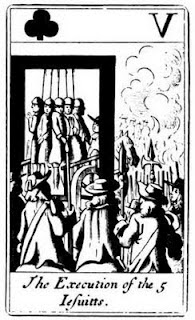
Five Jesuit Victims of the Popish Plot

The Jesuits in Britain website gives some background to the Popish Plot, specifically how intra-Catholic conflict contributed to the anti-Jesuit, anti-Catholic conspiracy dreamed up by Titus Oates:

There were two separate forces behind the Popish Plot (known to some Catholics as the Presbyterian Plot). One was political. For many years the old Cromwellian Lord Shaftesbury and the puritan (Whig) faction had been stoking the fires of religious hatred against Catholics and France, in a long game to end absolute monarchy and once again to depose a king. Charles II openly favoured religious toleration of Catholics. This meant a significant minority in parliament always voted with the king. The Whigs therefore wanted to eliminate the Catholics in parliament. The Plot was constructed against the Catholics at court – the Queen, the Duke and Duchess of York, and their clergy, many of whom were Jesuits. The ultimate target, the King, exerted his energy to defend his Queen and his brother. He could not defend all the accused despite the clearly absurd nature of the accusations.

Non Jesuit Catholics were seeking an oath of allegiance to the King which could be accepted by Rome and allow them constitutional rights. Jesuits always blocked this, being unable to compromise their obedience to the pope. In this way they made an enemy of Dr. Sergeant, a secular Catholic priest – the secondary force which caught so many Jesuits in the plot. Early in the onset of hysteria Dr. Sergeant made false denunciations of Jesuits to the Privy Council which lent credence to the plotters. . . .


More on Father John Sergeant here, who seems to have been a contentious figure. This page on the Jesuits in Britain website includes his portrait.

On June 20, 1679, Fathers John Gavan, William Harcourt, Anthony Turner, Thomas Whitbread, and John Fenwick all suffered execution at Tyburn, but not without added drama:

Some of the first to be arrested were the Jesuits who had spurned Oates at St. Omer – William Ireland and Bl Thomas Whitbread who was English provincial. Fr Whitbread was tried in June 1679 alongside fellow Jesuits John Fenwick, John Gavan, William Harcourt and Anthony Turner. Fr Gavan, who was the spokesman, presented an eloquent defence. A brave group of Jesuit novices travelled from St. Omer to give evidence that Oates had been at St Omer's on crucial dates when he claimed to be in London witnessing Jesuit plotting. But the judges argued that as Catholic witnesses could receive a papal dispensation to lie on oath, they were not credible.

The five were hanged at Tyburn where the crowd stood in silence for an hour while each made a speech maintaining his innocence. On the scaffold they were offered the King’s pardon on condition they admit their guilt, but all refused.

Pope Pius XI beatified these five martyrs in 1929; St. Giles-in-the-Fields would be well-worth a visit on a pilgrimage to London, as they, and six other Popish Plot martyrs, are buried there. Perhaps they should be exhumed, however, and reburied at Stonyhurst, where they could receive more appropriate honors and devotion?

Thursday, May 9, 2013

A Benedictine Popish Plot Victim: Blessed Thomas Pickering

Blessed Thomas Pickering was a Benedictine lay brother and martyr caught up in Titus Oates' duplicitous plot; a member of an old Westmoreland family, b. c. 1621; executed at Tyburn, 9 May, 1679. He was sent to the Benedictine monastery of St. Gregory at Douai, where he took vows as a lay brother in 1660. In 1665 he was sent to London, where, as steward or procurator to the little community of Benedictines who served Queen Catherine of Braganza's chapel royal, he became known personally to the queen and Charles II; and when in 1675, urged by the parliament, Charles issued a proclamation ordering the Benedictines to leave England within a fixed time, Pickering was allowed to remain, probably on the ground that he was not a priest.

In 1678 came the pretended revelations of Titus Oates, and Pickering was accused of conspiring to murder the king. No evidence except Oates's word was produced and Pickering's innocence was so obvious that the queen publicly announced her belief in him, but the jury found him guilty, and with two others he was condemned to be hanged, drawn, and quartered. The king was divided between the wish to save the innocent men and fear of the popular clamour, which loudly demanded the death of Oates's victims, and twice within a month the three prisoners were ordered for execution and then reprieved. At length Charles remitted the execution of the other two, hoping that this would satisfy the people and save Pickering from his fate. The contrary took place, however, and 26 April, 1679, the House of Commons petitioned for Pickering's execution. Charles yielded and the long-deferred sentence was carried out on the ninth of May. A small piece of cloth stained with his blood is preserved among the relics at Downside Abbey.

The British Museum has a page dedicated to the deck of the Popish/Oates Plot playing cards, one of which depicted Brother Thomas Pickering's fictitious attempt on Charles II's life--and so does the V&A, providing this background:

Object Type
These playing cards are engravings. The images were made by cutting lines into the surface of a flat piece of metal, inking the plate and then transferring the ink held in the lines onto a sheet of paper. Francis Barlow's original drawings for the engravings are in the British Museum, London.

Subject
The Popish Plot was a fictitious Catholic conspiracy to kill Charles II that the Reverend Titus Oates claimed to have uncovered in 1678.The pictures on these cards tell the story of the plot and show the dire penalties meted out to alleged Roman Catholic enemies of the state. Sets of playing cards depicting historical events were very popular in the last quarter of the 17th century. There are other political packs from the time of the Popish Plot depicting 'All the Popish Plots' and the Rye House Plot, a conspiracy to assassinate Charles II and his brother, James, Duke of York.

Historical Context
There was great fear in Britain at the time of Catholic intrigue and a very real apprehension that on the death of Charles his Roman Catholic brother, James, would be placed on the throne. Prints were used to fuel public anxiety, and playing cards were another ideal means of spreading political propaganda at a low cost. Many packs were designed and engraved by leading artists of the day.

Tuesday, October 23, 2012

Brief Hiatus

I won't have internet access for the next eight days, but I'll be back in November, perhaps with some new pictures of Paris (and London perhaps) as my husband and I take a long-planned for vacation. I've posted some highlights for important dates, but won't be updating or moderating comments. A bientot!

Today is the anniversary of Blessed Thomas Thwing's martyrdom during the Popish Plot--here's a link to his story.

Wednesday, August 22, 2012

A Kemble Cup; A Kemble Pipe: A Catholic Martyr in Monmouthshire

As The Catholic Herald noted two years ago:

John Kemble (1599-1679) was a much-loved Catholic priest martyred during the madness of the “Popish Plot”.

In normal times, despite harsh anti-Catholic laws, the extent of persecution depended upon the sympathies of local landowners and JPs. Around Hereford and Monmouth, for example, where the Catholic Earls (from 1642 Marquesses) of Worcester held sway at Raglan Castle, the old religion was for long periods practised with impunity. From 1622 there was even a Jesuit College at Cwm, near Welsh Newton. At nearby Dingestow 20-odd worshippers at the parish church would see some 60 Catholics trooping past on their way to Mass.

In 1678 the farrago of lies concocted by Titus Oates, that there was a Jesuit conspiracy to murder the King, gave disgruntled Protestants and ambitious chancers their opportunity. A Monmouthshire rogue called William Bedloe laid false information against the leading Catholics of the area.

One of those who suffered in the prevailing hysteria was John Kemble. Born into a Catholic family at St Weonards, some five miles north of Welsh Newton, he had studied for the priesthood at the English College in Douai.

Ordained in 1625, he returned to Monmouthshire and served more than 50 years as an itinerant priest, winning admirers even among Protestants. Based at Pembridge Castle, which his brother had leased in 1630, he had seemed immune from prosecution.

Moreover in 1651 his nephew Richard Kemble saved Charles II’s life at the battle of Worcester. The King, however, was not a man to remember past services when his own preservation was at stake.

As the anti-Catholic furore boiled over in 1678 John Kemble rejected all warnings, declaring that he could do no better than to die for Christ. . . .

Because he responded with the news of his impending execution with the requests to finish his pipe and enjoy a last drink, the terms a "Kemble Pipe" and a "Kemble Cup" became part of popular culture. He even had to encourage this hangman to do his job!

There is an annual pilgrimage to the site of his grave in an Anglican churchyard, held this year on August 19:

The Annual Pilgrimage to the grave of St John Kemble at Welsh Newton will take place on Sunday 19th August 2012. His Grace Archbishop George Stack will be in attendance. The programme is as follows:

10 a m: MONMOUTH
The walk begins from St Mary’s Church, Monmouth. Pilgrims are advised to bring a packed lunch.

3 p m: WELSH NEWTON
Rosary, Readings and prayers at the grave of St John Kemble in the churchyard of St Mary the Virgin, Welsh Newton, Herefordshire.

4:15 p m: MONMOUTH
Benediction at St Mary's Church, Monmouth. Following Benediction, tea will be served in the garden.

Here is a Kyrie from a Mass in his honor. St. John Kemble, pray for us!

A Popish Plot Franciscan Martyr: St. John Wall

The Francisan Province of Great Britain celebrates all their martyrs on July 12 (the date of St. John Jones' martyrdom), but St. John Wall was martyred on August 22, 1679--at the center of the "Popish Plot" even though he was not a Jesuit, Oates' main targets:
John Wall was born in 1620, probably at Chingle Hall, near Preston in Lancashire. As a young man he entered the English College in Douai where he was taught by the famous Dr. Kellison. In 1641 he transferred to the English College in Rome, where he was ordained a priest in 1645. After a brief spell as a missionary in England he returned to Douai and asked to enter the Franciscan College of St. Bonaventure which John Gennings had erected there in his restoration of the Franciscan Province of England. In January 1651 he was accepted into the Order and took the name Joachim of St. Anne. Five friars from that friary had already been martyred.

John Joachim, although only 6 months professed was appointed Guardian of the college and later Master of Novices. In 1656 he assumed the false name Francis Webb and re-entered England as a missionary in Worcestershire. He remained there for 22 years ministering to the Catholics of the area. In 1678 he went to London to meet the Jesuit Claude de la Colombière, and the two spoke together of their desire for martyrdom. The context of this meeting was the renewed persecution that was unleashed in the wake of the murderous lies of Titus Oates and his invented Catholic plot against King Charles II.

Returning from this encounter, John was staying with a friend in Rushock Court. There he was mistaken for one of the so-called plotters, Francis Johnson, and arrested. When he refused to swear to the religious supremacy of the King, he was imprisoned for five months of dreadful suffering. At the end of this time, on 25th April 1679, he was condemned to death for high treason, since he was a priest who had been ordained abroad and returned to exercise his ministry in contravention to the Elizabethan anti-Catholic laws. He argued in vain that Charles II's amnesty of 1660 should have covered him, as indeed it should. Instead he was sent to London to be interrogated by Oates, Bedloe, Dugdale and Pranse. He was found innocent of the accusation of complicity in the “Papist Plot” but because of his priestly ordination and ministry, his death sentence was nevertheless confirmed and he was sent back to Worcester, where he was hanged on 22nd August 1679.

His fellow friar William Leveson, whose own brother Francis Leveson would himself be martyred at the age of 34 in 1680, looked after John Wall in his last days in prison. He recounted the condemnation and death of the martyr in a letter. John Wall's body was buried in the cemetery of the church of St. Oswald in Worcester, and his head returned to Douai, where it was venerated as a holy relic.

Along with John Jones and 38 other English martyrs John Wall was beatified by Pius XI on 15th December 1929 and canonised by Paul VI on 25th October 1970.

According to this website, St. John Wall used Harvington Hall as a base of operations.The Hall, parts of which are open to the public (owned by the Archdiocese of Birmingham), is well known for the "priest hides" built there by Saint Nicholas Owen, Jesuit lay brother and martyr.

Sunday, July 22, 2012

More Popish Plot Victims and Martyrs

As this site notes, Sunday, July 22, 2012 is the anniversary of the martyrdom of St. John Lloyd and St. Philip Evans, SJ--333 years ago.

St John Lloyd [was] a Welsh priest who was hanged, drawn and quartered together with St Philip Evans on 22 July 1679 at Gallows Field in Cardiff, Wales. To have spent 25 years ministering to Welsh Catholics without being caught by the authorities is a rather amazing achievement compared to the majority of the other priests among the Forty Martyrs of England and Wales.

St John Lloyd was born around the year 1630 in Breconshire, Wales, into a fervent Catholic family. One of his brothers became a priest and died in prison for the Faith and one of his sisters joined the Blue Nuns. Growing up, the stories of the priestly martyrs who preceded him must have inspired young John to follow in their footsteps. By the age of 19 John had travelled to Spain to enrol at the seminary of the Royal college of St Alban at Valladolid, and had taken the missionary oath to return to Wales to serve as a priest. After 4 years of study John was ordained in 1653 or 1654, and sent back to Wales.

John’s missionary territory consisted of the South Wales counties of Glamorgan and Monmouthshire. For the next 24-25 years John travelled between homes of loyal Catholics, administering the sacraments and encouraging his flock to remain faithful. Things were going OK on the quiet, until the political climate changed with the Titus Oates plot. With the motivation for persecution refreshed, priest hunters tried extra hard and soon arrested John in November 1678 at the home of the recusant John Turberville at Penllyn. . . .

More information on St. Philip Evans, SJ, see this story of his life and death by the great 20th century historian of the martyrs of the English Reformation, Jesuit Father Philip Caraman.

Saturday, July 14, 2012

A Lay Victim of The Popish Plot

Blessed Richard Langhorne (c. 1624 – 14 July 1679) was a barrister executed as part of the Popish Plot. He was admitted to the Inner Temple in May 1647 and called to the bar in November 1654. He provided legal and financial advice for the Jesuits.

His wife, Dorothy, was a Protestant from Havering in Essex. His sons Charles and Francis were both priests. When, in October 1677, Titus Oates was expelled from the English College at St Omer "for serious moral lapses", Charles Langhorne entrusted Oates with a letter to his father. Oates returned to St Omer with a letter from Richard thanking the Jesuits for all they had done for his sons.

When Oates and Israel Tonge unleashed their Popish Plot in September 1678, three Jesuits and a Benedictine were arrested. Langhorne was arrested a week later, imprisoned at Newgate and charged with Treason. Oates claimed, corroborated by William Bedloe, that Langhorne's earlier correspondence dealt with treason.

He was found guilty of High Treason. As the result of a petition by his wife, a ‘true Protestant’, he received a month's reprieve to tidy the affairs of his clients. He was executed at Tyburn, London, on 14 July 1679. According to the Benedictines at Tyburn Convent, "He declared on the scaffold at Tyburn, that not only a pardon, but many preferments and estates had been offered to him if he would for sake his religion.As the hangman was placing the rope round his neck, he took it into his hands and kissed it."

On 15 December 1929, he was beatified by Pope Pius XI.

As I've noted before on this blog when discussing the Popish Plot, England's justice system benefitted the accuser and gave little leeway to a defendant trying to prove a negative: Langhorne could not prove their interpretation of his letters was wrong. Samuel Pepys and other defendants finally received some measure of justice because Judge Scrogg figured out Oates' and his confreres' perjury. Samuel Pepys was accused that same year of giving naval secrets to the French and of being a Catholic, just because of his loyalty to James, the Duke of York. He spent six months in the Tower of London and eventually established, not his innocence per se, but his accuser's guilt. Pepys was cleared of charges and reinstated as Secretary to the Admirality--in 1684!

Sunday, July 1, 2012

The Last Catholic Priest at Tyburn: An Irish Archbishop

Oliver Plunkett, the Archbishop of Armagh in Ireland, was executed at Tyborn in London on July 1, 1681. He was the last priest to be executed there and the final victim of the "Popish Plot"--that fraudulent, perjured plot cooked up by the BBC's Worst Briton of the 17th Century: Titus Oates.

So in the Catholic dioceses of England and Wales AND Ireland, today is the memorial/feast of St. Oliver Plunkett, Archbishop of Armagh, victim of Stuart injustice during the Anti-Catholic madness of Oates' fake plot.

The Whigs in Parliament, opposed most of all to the succession of Charles II's Catholic brother, James the Duke of York, jumped at the opportunity to attack Catholics--and James--when Titus Oates fabricated the story of a great conspiracy. Charles II did not believe most of the elements of the plot Oates "revealed", especially when the perjuror implicated his own queen, Catherine of Braganza, and his brother.

Once Oates was able to compound English fear of Jesuits and Catholics with English fear of Irish Catholics, Plunkett was in grave danger. St. Oliver Plunkett was brought to London from Ireland and accused of conspiring to bring French soldiers and recruit members of his diocese to mount a rebellion against the King and Parliament. There was, of course, no evidence of these accusations and Plunkett could bring no witnesses to testify for him--they were in Ireland and not permitted to come to England. He had been tried before in Ireland--no double jeopardy applied here--and English authorities like Shaftesbury were convinced that no Irish jury (even if packed with Protestants) would convict him.

On the day of his execution he was able to give a long discourse, in which he re-presented the evidence that proved he was not involved in any conspiracy, and which concluded with forgiveness and prayers:

as one of the said deacons (to wit, holy Stephen) did pray for those who stoned him to death; so do I, for those who, with perjuries, spill my innocent blood; saying, as St. Stephen did, "O Lord! lay not this sin to them." I do heartily forgive them, and also the judges, who, by denying me sufficient time to bring my records and witnesses from Ireland, did expose my life to evident danger. I do also forgive all those, who had a hand, in bringing me from Ireland, to be tried here; where it was morally impossible for me to have a fair trial. I do finally forgive all who did concur, directly or indirectly, to take away my life; and I ask forgiveness of all those whom I ever offended by thought, word, or deed.

I beseech the All-powerful, that his Divine Majesty grant our king, queen, and the duke of York, and all the royal family, health, long life, and all prosperity in this world and in the next, everlasting felicity.

Now, that 1 have shewed sufficiently (as I think) how innocent I am of any plot or conspiracy: I would I were able, with the like truth, to clear myself of high crimes committed against the Divine Majesty's commandments, often transgressed by me, for which, I am sorry with all my heart; and if I should or could live a thousand years, I have a firm resolution, and a strong purpose, by your grace, O my God! never to offend you; and I beseech your Divine Majesty, by the merits of Christ, and by the intercession of his Blessed Mother, and all the holy angels and saints, to forgive me my sins, and to grant my soul eternal rest. Miserere mei Deus, etc. Parce anima, etc. In manus tuas, etc.

St. Oliver Plunkett was born in 1629 in Loughcrew, County Meath, Ireland of well-to-do parents and studied for the priesthood at the Irish College in Rome. While Oliver Cromwell was inflicting the "righteous judgement of God" on the Irish who had rebelled against English rule during Charles I's reign, Plunkett had been unable to return to serve his people as a priest after ordination in 1654. He therefore remained in Rome and taught theology. In 1669 he was appointed the Archbishop of Armagh and the Primate of All Ireland and finally returned to Ireland the next year. For a time, Charles II's Restoration leniency allowed Plunkett to accomplish many reforms and reorganizations in education and catechesis. As Archbishop, he confirmed thousands (48,000!) but in 1673, persecution of Catholics in England's colony forced him to go into hiding and close the schools. Arrested in connection with Oates' plot, he was imprisoned at Dublin Castle. He was canonized by Pope Paul VI in 1975 and in 1997 he was named the Patron Saint of Peace and Reconciliation in Ireland. His trial and execution were so manifestly unfair that even Shaftesbury realized things had gone too far--yet, with the Popish Plot's true conspirators, Oates and companions, finally being mistrusted and the whole matter winding down, Charles II did nothing to stop the execution of St. Oliver Plunkett. This site contains a wealth of information, including the prayers and readings for a Mass honoring his Feast.

Wednesday, June 20, 2012

With Ropes Around Their Necks, An Offer of a Pardon

Today is the anniversary of the martyrdoms of five Jesuit Popish Plot Martyrs on June 20, 1679, who died as a result of the false, perjurous claims there was a vast, Jesuit, Catholic-wing conspiracy to assassinate Charles II and bring the Catholic Duke of York, James, his brother to the throne. Oates convinced the Whigs in Parliament that he knew who was in on this plot and he was given the authority to round up the suspects. At the trials for his accused, any witnesses they brought forward would be discounted by the Prosecution and the Judge, because, of course, they were also Catholics and if not in on the plot were probably in favor of the plot! After one of these manifestly unfair trials, five Jesuits were martyred on June 20, 1679 at Tyburn Tree in London:

John Gavan
William Harcourt
Anthony Turner
Thomas Whitbread
John Fenwick

Fathers John Fenwick and William Ireland were arrested in September of 1678 and held in prison. Then Oates captured Fathers Thomas Whitbread and Edward Mico, who were ill with the plague and living in the household of the Spanish ambassador. By December that year Father Whitbread was well enough to join Fathers Fenwick and Ireland in Newgate Prison; Father Mico died in custody. Father William Ireland was executed in January of 1679 with the Jesuit laybrother John Grove, but Fenwick and Whitbread awaited their fate and another trial. They had given evidence that refuted Oates', so Oates needed more time to gather more evidence! Fathers John Gavan, William Harcourt, and Anthony Turner in the meantime had been arrested and they were brought together with Father Fenwick and Whitbread (tried for the second time--no double jeopardy in Charles II's courts for Catholics!)

At the trial, the defense produced plenty of  witnesses from Saint-Omer to testify that Oates hadn't even been in England the day he was supposed to have heard the Jesuits plotting to assassinate King Charles II--he was at the college in St. Omer's that day. But the Court told the jury to trust Oates' evidence over the Catholic witnesses. The jury returned a verdict of guilty, condemning the five Jesuits to die for treason.

The circumstances of their execution were quite dramatic. All five were standing in a cart under the scaffold, with their hands bound and the nooses around their necks. They had each spoken, each prepared themselves for death, when suddenly, a rider galloped up, crying "A Pardon, A Pardon!"

Charles II issued them a conditional pardon to spare their lives--all they had to was admit their guilt and tell him all they knew about the plot. Trouble was that they weren't guilty of any plot and they couldn't tell him what they knew because there wasn't any plot in the first place! They declined the pardon, protesting that they could not lie to save their lives--they could not risk their immortal souls to save their physical bodies.

Therefore, they prepared themselves again for death--the rider returned to Charles II with the news--the cart pulled away and they were hung until dead before their bodies were quartered and their heads cut off. They were buried in the churchyard of St. Giles in the Fields. According to the church's website, there are actually eleven of twelve martyrs originally buried there in the churchyard:

The testimony of Titus Oates, led during 1678-81, to the burial in St Giles Churchyard of twelve Roman Catholic martyrs who were later beatified - Whitebread, Harcourt, Fenwick, Gavan, Turner, Coleman, Langhorne, Mico, Ireland, Grove, Pickering and Oliver Plunket, Archbishop of Armagh. All were priests except Coleman, who was secretary to the Duchess of York, Langhorne, who was a barrister, Grove, and Pickering, who was a laybrother; and all except Mico, who died after his arrest, had been executed at Tyburn (then close to where Marble Arch now stands). The first five are the Jesuit fathers with whom Plunket asked to be buried in the churchyard of St. Giles. The burial place is said to be near the north wall of the church. Though the body of Oliver Plunket, who was canonised in 1975, was later exhumed and taken to Lamspringe in Germany (the head being now at Drogheda and the body at Downside), there is in the St. Giles Burial Register for 1 July, 1681 a most legible entry of the burial.

Saturday, October 29, 2011

The Martyrs of Douai, 1577-1680

In the Archdiocese of Westminster in London, today is the feast of the Martyrs of Douai College which was transplanted from the Spanish Netherlands to London:

The English College at Douai was established by William Allen, later Cardinal, on Michaelmas Day, 29th September, 1568. It offered an opportunity to form clergy for England in accordance with the system laid down by the Council of Trent.

Originally it was intended as a college home for exiles from England, a place where they could continue their studies in a way no longer possible for Catholics at the English Universities. In time Allen recognised its potential as a place for training clergy ready for the return to England when 'the new religion' had run its course. The new priests, however, proved unwilling to wait for that event and quickly Douai College found itself dedicated very largely to the training of missionary priests.

Between 1577, the date of the martyrdom of St Cuthbert Mayne, the college's protomartyr, and 1680, the date of the execution of Thomas Thwing, the college's last martyr, one hundred and fifty eight college members, priests and layman, secular and religious, met with a martyr's death.

The College was suppressed in 1793, and the collegians imprisoned for thirteen months at Doullens, Picardy. They were released in November 1794, returning to Douai for only a few months before obtaining permission to return to England. They found their first refuge at Old Hall Green, Ware, and dedicated the new work of the college to St Edmund of Canterbury on his feast day, November 16th, 1794.

The webpage lists the martyrs by year--the class of 1588 was the largest: Nicholas Garlick, Robert Ludlam, Richard Sympson, William Dean, William Gunter, Robert Morton, Hugh More, Thomas Holford, James Claxton, Thomas Felton, Robert Wilcox, Edward Campion, Christopher Buxton, Ralph Crocket, Edward James, John Robinson, William Hartley, John Hewett, and Robert Leigh.

The bookends (just to switch metaphors) are St. Cuthbert Mayne and St. Thomas Thwing:

St. Cuthbert Mayne was the first Englishman prepared for the priesthood at Douai and he is the protomartyr of the English seminaries established on the Continent. Born in Devonshire, he was ordained an Anglican minister but became Catholic in the early 1570's while at Oxford. He returned to England in 1575, serving in Cornwall, and was arrested a year later. One of the charges against him was that he had an Agnus Dei, an image of Jesus as the Lamb of God, blessed by the pope. He was hung, drawn and quartered in Cornwall on November 29, 1577.

St. Thomas Thwing suffered during the Popish Plot hysteria in 1680. From 1664 to 1679 he served as a missionary priest in England. He and other members of Sir Thomas Gasciogne's household, including the master, were accused of a conspiracy to kill King Charles II and brought to London for trial. The others were acquited but he was found guilty and condemned; the King pardoned him but the House of Commons demanded his execution. Of course he was innocent of any charges of conspiracy; he was guilty of being a Catholic priest.

One could research each of the names on that list and read a common, yet individual pattern of vocation, service, suffering, and martyrdom. At the bottom of the list of names, there is a quote from William Allen, founder of Douai College--

"Joy in the Lord because the victory won by Christ's confessors predominates over earthly sorrow
at the grievousness of their suffering."

Sunday, October 23, 2011

Blessed Thomas Thwing, Popish Plot Martyr (and his uncle)

According to this biography, today's martyr was

Born at Heworth Hall, near York, in 1635, he was the son of George Thwing, Esquire, of Kilton Castle, Brotton, and Heworth Hall, and was the nephew of the Catholic martyr Edward Thwing. His mother was Anne, sister of the Sir Thomas Gascoigne, of Barnbow Hall, Barwick in Elmet, Yorkshire. Thomas Thwing was educated at St Omer and at the English College, Douai, ordained a priest and sent from there to minister on the English mission in 1665, which he did for some 14 years. Until April 1668, he was chaplain at Carlton Hall, Carlton-juxta-Snaith, the seat of his cousins the Stapletons. He next opened a school at Quo-usque, the Stapletons' dower-house. When in 1677 Mary Ward's "Institute of the Blessed Virgin Mary" began their foundation in the house given by his uncle Thomas Gascoigne at Dolebank, it was in some sense natural that Thwing become their chaplain, three of his sisters being of the community. It was there that he was arrested in the early part of 1679.

Notice his connection to Venerable Mary Ward and her Institute. She had come to Heworth in 1642 and died there in 1645 on January 30. Thwing was also connected to the Gascoignes and the Stapletons, great Catholic families in Yorkshire.

At the time of the Titus Oates scare, two servants, who had been discharged from Sir Thomas Gascoigne's service for dishonesty, sought vengeance and reward by revealing a supposed plot by Gascoigne and others to murder the king. At first the allegation made no mention of Thwing. Nevertheless, Gascoigne [pictured above left], Thwing and others were arrested on the night of July 7, 1679, at the Gascoigne's house, Barnbow Hall, and he remained for a year prisoner at York Castle. He was arraigned at York on March 17 with Mary Fenwick, Lady Tempest and Sir Miles Stapleton, but many jurors were challenged and this led to the trial being postponed to the summer assizes. He was brought to the bar on July 29 and Gascoigne's former servant Bolron testified against him. The prosecution played upon a list of Catholics which had been found the night of the arrest, in reality not conspirators but supporters of the new convent. Despite this Thwing was promptly found guilty on the very same evidence upon which his relatives had been acquitted, the sentence being pronounced separately from the felons and murderers found guilty at the same assizes, not out of consideration for his being a priest but because of his social status. Upon hearing it, he humbly bowed his head and said in Latin, "I am innocent." Thomas Thwing was beatified by Pope Pius XI on December 15, 1929.

The others were acquitted in what is known as the Barnbow Plot, named after the Hall, reported by Robert Bolron, and inspired by Titus Oates' Popish Plot:

Excited by the story of Oates' success and in revenge for his dismissal, Bolron conceived the idea of 'discovering' a Popish Plot at Barnbow. Having concocted what he thought might be a credible story he communicated, in the first place, with Mr Normanton, a clergyman of Water Fryston, who sent him to Mr Tindall, a justice of the peace, who referred him to Mr William Lowther, another justice. Growing bolder as he found himself taken seriously he determined to go to London, armed with a letter from Tindall to lay his story before the Privy Council. On the road, at Ware, he lost the letter, but coming to the Green Dragon in Bishophate Street he told his business to the landlord who took him to Sir Robert Clayton who introduced him to Lord Shaftesbury, President of the Council.


The story that Bolron told was this. Some time in 1675 he had overheard a conversation between Sir Thomas Gascoigne and Sir Miles Stapylton in which they discussed a plan to kill the king, the former repeating the steps he had taken for securing his property against forfeiture in case of failure and how he had sent £3000 to the Jesuits in London to aid the carrying out of the scheme.

Notice that Blessed Thomas Thwing's uncle was also a martyr, beatified by Pope John Paul II in 1987.  Edward Thwing was also born in Yorkshire. He went to Reims, France in the summer of 1583 to study for the priesthood and then went to the Jesuit community at Pont-a-Mousson, evidently intending to enter the order. But within two years, he was back at the English College. After completing his studies with a stay in Rome, he returned to France for his ordination in Laon on December 20, 1590. His return to England was delayed by health problems. In 1597, he was finally able to go to England but was captured by the Elizabethan authorities as soon as he arrived. He and a fellow priest, (Blessed) Robert Nutter, managed to escape from their prison, and eluded arrest for the next three years. In May of 1600, they were re-captured. On July 26, 1600, Father Thwing was executed at Lancaster by drawing and quartering, together with Father Nutter.

Friday, August 26, 2011

August 26 Memorial in Wales: The Last Welsh Martyr

The National Calendar for the Catholic Church in England and Wales honors two missionaries from very different eras today. In England the memorial honors Blessed Dominic Barberi--in Wales, St. David Lewis.

Like St. John Kemble and St. John Wall on August 22, St. David Lewis was a victim of the Popish Plot.

The particularly repellent aspects of the Popish Plot are

1) There was no plot at all: Titus Oates perjured himself and made it all up
2) Parliament's leaders, like Lord Shaftesbury, Anthony-Ashley Cooper, fomented it
3) Charles II knew it was not true and yet seemed powerless to prevent it
4) The vaunted English Court system was duped by it and was an accessory to multiple injustices--like that experienced by today's saint!

It took the Courts far too long to recognize this injustice--at which time it started finding the accused not guilty--and Parliament never truly admitted its culpability. Titus Oates was found guilty of perjury but was soon rewarded by the regime of William and Mary with a pension. Charles II protected his brother and his wife, although James and Mary Beatrice fled to Ireland in exile. Charles did not give in to the desire of Parliament to bypass his Catholic brother the succession, either.

St. David Lewis was born and raised in a Protestant family but when he went to Paris at age 16 he was moved to become a Catholic! He was ordained in 1642 in Rome and joined the Jesuit order in 1645--like St. John Kemble he served in Monmouthshire for some years.

In November of 1678, he was arrested, taken to London and questioned in connection with the Popish Plot. Lord Shaftesbury offered him freedom if he gave information about the Plot and renounced his Catholicism. David said he had no knowledge of the Plot and would not renounce his faith.

St. David Lewis was then returned to Monmouthshire and executed in Usk on August 27, 1679. He is the last Welsh marytr. Like Blessed Dominic Barberi, his memorial is on August 26 to avoid conflict with that of St. Monica, St. Augustine's mother. This blog contains some great detail about the Last Welsh Martyr!

Monday, August 22, 2011

Two Popish Plot Martyrs

St. John Kemble was found guilty of being a priest in England, though not of conspiring against King Charles II in the non-existent Popish Plot and executed on August 22, 1679 in Herefordshire. Herefordshire is not too far from the border of Wales.

St. John Wall, OFM, was executed on August 22, 1679 in Worcester under the same circumstances. Worcestershire is northwest of London.

St. John Kemble was butchered by another incompetent executioner (see the story of Blessed Hugh Green) in Hereford after serving Catholics in Monmouthshire for more that 50--fifty!--years. The Anglicans in the area respected him and he had dwelt unmolested in his brother's castle (Pembridge). He was betrayed by the husband of one of his parishioners.

He was taken to London, where nothing could be proved against him in connection with the Popish Plot (since Titus Oates had made the whole thing up and had perjured himself before Parliament!). Therefore, he was found guilty of the old Elizabethan statute against the presence of Catholic priests in England. (He was born near the end of Elizabeth's reign in 1599 of a recusant family and ordained in 1625, so he was certainly guilty and had been for a long time).

On August 22, 1679 he suffered, forgiving his enemies and proclaiming that he died for the religion that had made England Christian! Before his death, he asked for time to finish his prayers and smoke his last pipe and imbibe a last cup of wine, shared by the undersheriff (who after all had not arrested him for the last fifty years!) . Evidently, this is still remembered in Herefordshire in the sayings "a Kemble pipe" and "a Kemble cup". He had to encourage the executioner to do his work, because he was ready.

The famous stage family, including Sarah (Kemble) Siddons, are related to this great priest and martyr. He is buried in an Anglican churchyard and area Catholics make a pilgrimage to his grave each August 22nd. His left hand is preserved in the Catholic church in Hereford, St. Francis Xavier.

St. John Wall was born in Lanchasire in 1620. He served the people of Worcestershire for more than twenty years. He was arrested in 1678. When he refused to swear to the religious supremacy of the King, he was imprisoned for five months of dreadful suffering. At the end of this time, on 25th April 1679, he was condemned to death for high treason, since he was a priest who had been ordained abroad and returned to exercise his ministry in contravention to the Elizabethan anti-Catholic laws. He argued in vain that Charles II's amnesty of 1660 should have covered him, as indeed it should. Instead he was sent to London to be interrogated by Oates, Bedloe, Dugdale and Pranse. He was found innocent of the accusation of complicity in the “Papist Plot” but because of his priestly ordination and ministry, his death sentence was nevertheless confirmed and he was sent back to Worcester, where he was hanged on 22nd August 1679.

PLEASE NOTE: I will be on the Son Rise Morning Show at 7:45 a.m. Eastern/6:45 a.m. Central to discuss these two martyrs with Brian Patrick! I hope you know that it's "a better way to start your day!" (the Son Rise Morning Show, that is!).

Friday, July 15, 2011

The End of a Rebellion

James Scott, the First Duke of Monmouth, Charles II's favorite illegitimate son, was executed on July 15, 1685. He had been captured after his defeat at the Battle of Sedgmoor, as he was leading the first of many Stuart attempts to take the throne after Charles II died. (Only one succeeded, of course: William of Orange's invasion on November 5, 1688.)

He had been the prime candidate for succession to the throne for the Whigs in the Exclusionist Crisis of 1679. After the fraud of the Popish Plot had been discovered, the real Rye House Plot of 1683 to assassinate both Charles II and James, the Duke of York forced Monmouth to leave England. When his father died, Monmouth invaded to wrest the crown from Catholic James II, landing at Lyme Regis and proclaiming himself "James II". After his capture, he was Attainted a traitor by Parliament and set for execution.

Unfortunately, executioners in England weren't what they had been. The Tudor monarchs had kept them in good practice and even knew where to get specialists for certain jobs (e.g., the swordsman from Calais for Anne Boleyn)--although there had been some shortages at times of practiced axemen because of issues of supply and demand (e.g., the inept execution of Blessed Margaret Pole at the Tower when there was so much to do in the north of England in the aftermath of the Pilgrimage of Grace). Jack Ketch was singularly inept and might have taken as many as EIGHT blows to sever Monmouth's head--the official count is FIVE. Poor Monmouth suffered horribly and his cries of agony were terrifying. Guards had to protect Ketch after the execution as the crowds were so enraged. And this after Monmouth had paid him in gold to do a good job, reminding him of the very bad job he'd done on Lord Russell after the Rye House Plot. Perhaps that reminder made him nervous.

Ketch was replaced as executioner for a time but recalled when his successor was hanged. (Gallows humor, anyone?)

James Scott was married, but following his father's example, was not faithful to his wife. Anne Scott, a wealthy Scottish heiress and he were married in 1663 and had eight children, four of whom survived infancy. His widow remarried: Charles Cornwallis, 3rd Baron Cornwallis. Monmouth also had children with his mistress, Eleanor Needham. In John Dryden's satiric and allegorical poem Absalom and Achitophel, Monmouth is Absalom, Charles II is King David, and Lord Shaftesbury, leader of the Exclusionist Whigs, is Achitophel.

Another important aspect of this story is that James II's army had many Roman Catholic officers. As he began his efforts to extend not just toleration but freedom of religion in England through his Declaration of Indulgence, James referenced the loyalty of these Catholic soldiers. He argued that their service should not be rewarded by the Test Act which would require their loss of rank and pay.

Tuesday, July 12, 2011

More Franciscan Martyrs of the Recusant And Popish Plot Era

The blesseds honored on the Franciscan calendar today are:

Blessed Arthur (Francis) Bell (1590 – 1643): Arthur Bell was born at Temple Broughton in Worcestershire on 13th August 1590 and brought up in a Catholic family. After beginning his education at his mother Dorothy's knee, he was sent for its continuation to his maternal uncle, a gentleman in Suffolk. At the age of 24 he went to Saint Omer to study with the Jesuits who then sent him on to Valladolid in Spain. There he was ordained a priest on 14th April 1618.
He discovered the Franciscans through a friend from Oxford who had joined the friars. Inspired by his life of penitence and simplicity, Arthur sought entry to the Franciscans and on 9th August 1618 was vested with the Franciscan habit, given the name Francis and sent to the newly erected College of St. Bonaventure in Douai to join his compatriots. There he became Guardian and later a Provincial Definitor. In 1632 he became Minister Provincial and attended the Toledo General Chapter in 1633, where the German and Belgian Provinces, including the newly restored Province of England, passed the strict General Constitutions that would govern them until the late 19th Century.
He returned to England in 1634 and spent nine years working to consolidate the presence of the friars and sustain the faith of his fellow Catholics. He was captured on 7th November 1643 in Hertford. He was tried before Parliament in a trial that lasted from 22nd November to the 8th December. Condemned, he was imprisoned in Newgate prison from where he was taken for execution at Tyburn just three days later. The serenity with which Arthur faced his death convinced his executioner to abjure his Anglicanism and reconcile to the Catholic Church.
Arthur Bell was beatified along with 129 other martyrs of England and Wales on 22nd November 1987 by Pope John Paul II.

Blessed John (Martin) Woodcock (1603 – 1646): John Woodcock was born to a “Church Papist” Anglican Father in 1603 at Woodcock Hall in Lancashire. He was sent to Saint Omer to study with the Jesuits there and after finishing his humanities studies he was sent to Rome to complete his theological formation. There he no doubt met the Irish Franciscans who took over at the College of St. Isidore in the same year. He asked to enter the Capuchins but was dismissed from their novitiate after a few months, perhaps because of precarious health. He wandered around Europe aimlessly for three years until he arrived in Douai. There his desire to be a Franciscan was realised when he entered the novitiate of the Friars Minor in 1631. He was given the name Martin of St. Felix and made great progress both in his studies and in sanctity. He was ordained a priest just four years later in 1635. he went to England on the mission but, after a few years, was forced to return on account of his ill health.
His medics sent him to the baths at Spa to recuperate and he there met the Observant General Commissary. He begged permission to return to England where his co-religionists were suffering renewed persecution in the Puritan-led Commonwealth. The Commissary gave him permission and John set out, landing in Newcastle in 1644. He went to his paternal home, but his father, scared for the safety of his son since many would have known that he had spent years abroad and studied for the priesthood, sent him away. The soldiers of the local garrison had, however, already been informed of his arrival and he was arrested immediately and imprisoned in Lancaster Castle, where he lived for two years. He was martyred on 7th August 1646, hanged at Bomber-Bridge while he exhorted the crowd to understand why he had been condemned. John Woodcock was beatified along with 129 other martyrs of England and Wales on 22nd November 1987 by Pope John Paul II.

Blessed Charles Meehan-Mahoney (1639 – 1679): Charles was born in Ireland between 1639 and 1640. It is not known when he joined the Irish Province but, like several other Irish friars of the time, he completed his formation with the English friars in their college at Douai. In 1679 he was aboard a ship bound for Ireland which was forced to put into port in Wales. He came ashore at precisely the wrong time, since England and Wales were engulfed in the anti-Catholic hysteria aroused by Titus Oates's invented Papist Plot. Charles searched for a passage to Ireland, but, suspected of being a Catholic and a priest, he was arrested and in June 1678, imprisoned in Denbigh gaol. He was tried in Spring 1679 and was condemned to be killed at Ruthin. The sentence was carried out on 12th August. He died saying: “Since God has pleased to give me the grace of martyrdom, blessed be his Holy Name.”
Charles Meehan was beatified along with 129 other martyrs of England and Wales on 22nd November 1987 by Pope John Paul II.

The Franciscan Martyrs of the Recusant and Popish Plot Eras

Often when we consider the priest-martyrs of the English Reformation era, we think of the Jesuits: Saints Edmund Campion, Robert Southwell, Henry Walpole, etc. But the Franciscans, who had been the major mendicant order in England before Henry VIII's break from Rome, also had a group of martyrs. This site provides detail about the two martyrs canonized by Pope Paul VI:

Saint John (Godfrey) Jones 1530? - 1598: John Jones was born to a Catholic family in Clymag Faur in the county of Canaervon in Wales around the year 1530. In his youth Queen Mary Tudor accomplished the restoration of the Catholic Church after the brief reign of Edward VI had taken the Church of England into the Calvinist fold. Mary's accession had allowed the English friars who had fled into exile to Flanders and Scotland to return and in April 1555 the friary at Greenwich, in which Mary and Elizabeth had been baptised, was reopened. John joined the friary and took the name Godfrey Maurice, becoming known for his piety. At Mary's untimely death in 1558, however, her half-sister Elizabeth assumed the throne and it was not long before Catholics were once more persecuted in England. John Jones, although still a novice was forced to flee to France. The English Observant Franciscans fled to a friary in Pontoise where John was professed and trained. He was probably ordained a priest at Rheims, where there was another friary of the exiled English Province.

Towards 1590 John was sent to the friary of Ara Coeli in Rome, the General headquarters of the Order. From there he wished to return to England to take part in the mission to care for faithful Catholics, who risked their livelihoods and often their lives to sustain their missionary priests. The priests themselves were subject to the dreadful death of hanging, drawing and quartering as traitors for the simple fact of exercising their priesthood. John begged an audience with the Pope and Clement VIII embraced him, gave him a solemn blessing and told him: “Go, because I believe you to be a true son of Saint Francis. Pray to God for me and for his holy Church."

In England John Jones exercised an heroic hidden ministry, animating the Catholic faith among recusants and prudently seeking to reconcile those who had submitted to Elizabeth's Church of England. The existence of a missionary priest in England was one of frequent moves, constant vigilance and continued flight from Elizabeth's vigilant secret services, supervised by William Cecil and Francis Walsingham.

Despite his care, John Jones was caught in late 1595 or early 1596 by Richard Topcliffe, who nurtured a cruel hatred for the Catholic faith and was sanctioned by the Queen to maintain a private torture chamber in his house for the Catholic priests he apprehended. John Jones was accused of being a spy and sent to the notorious Clink prison, from which we derive the expression “being in clink”. There he languished for nigh on two years awaiting trial. In prison Jones continued his ministry and converted many, including Saint John Rigby, who was himself martyred two years after John Jones (on 21st June 1600). On 3rd July 1598 John Jones was finally brought to trial for having exercised his ministry as a Catholic priest in England. He was sentenced to hanging, drawing and quartering at Saint Thomas Watering, but was meanwhile imprisoned at Marshalsea prison. The Jesuit Henry Garnet recounts in a letter that on 12th July 1598 John was tied to a trellis and dragged to the place of his torment. He was held there for an hour before execution during which time Topcliffe harangued the crowd with his supposed crimes. Garnet recounts that the crowd was touched more by John's prayers than by the calumnies of his torturer and executioner. His remains were hung up on the road between Newington and Lambeth.

With John Wall and 38 other English martyrs, John Jones was beatified by Pius XI on 15th December 1929 and canonised by Paul VI on 25th October 1970.


Saint John (Joachim) Wall (1620 – 1679): John Wall was born in 1620, probably at Chingle Hall, near Preston in Lancashire. As a young man he entered the English College in Douai where he was taught by the famous Dr. Kellison. In 1641 he transferred to the English College in Rome, where he was ordained a priest in 1645. After a brief spell as a missionary in England he returned to Douai and asked to enter the Franciscan College of St. Bonaventure which John Gennings had erected there in his restoration of the Franciscan Province of England. In January 1651 he was accepted into the Order and took the name Joachim of St. Anne. Five friars from that friary had already been martyred.

John Joachim, although only 6 months professed was appointed Guardian of the college and later Master of Novices. In 1656 he assumed the false name Francis Webb and re-entered England as a missionary in Worcestershire. He remained there for 22 years ministering to the Catholics of the area. In 1678 he went to London to meet the Jesuit Claude de la Colombière, and the two spoke together of their desire for martyrdom. The context of this meeting was the renewed persecution that was unleashed in the wake of the murderous lies of Titus Oates and his invented Catholic plot against King Charles II.

Returning from this encounter, John was staying with a friend in Rushock Court. There he was mistaken for one of the so-called plotters, Francis Johnson, and arrested. When he refused to swear to the religious supremacy of the King, he was imprisoned for five months of dreadful suffering. At the end of this time, on 25th April 1679, he was condemned to death for high treason, since he was a priest who had been ordained abroad and returned to exercise his ministry in contravention to the Elizabethan anti-Catholic laws. He argued in vain that Charles II's amnesty of 1660 should have covered him, as indeed it should. Instead he was sent to London to be interrogated by Oates, Bedloe, Dugdale and Pranse. He was found innocent of the accusation of complicity in the “Papist Plot” but because of his priestly ordination and ministry, his death sentence was nevertheless confirmed and he was sent back to Worcester, where he was hanged on 22nd August 1679.

His fellow friar William Leveson, whose own brother Francis Leveson would himself be martyred at the age of 34 in 1680, looked after John Wall in his last days in prison. He recounted the condemnation and death of the martyr in a letter. John Wall's body was buried in the cemetery of the church of St. Oswald in Worcester, and his head returned to Douai, where it was venerated as a holy relic.

Along with John Jones and 38 other English martyrs John Wall was beatified by Pius XI on 15th December 1929 and canonised by Paul VI on 25th October 1970.

Note that St. John Wall had been able to work for 22 years in England before the Popish Plot's anti-Catholic hysteria. Worcestershire authorities had not been diligent about finding the Franciscan, or the Providence of God and his Guardian Angel had been protecting him--or a little of both. See the next post for details on the beati honored on this day.

Saturday, July 2, 2011

The Second of July: A Collection of Events

On July 2, 1489, Thomas Cranmer was born.

On July 2, 1644, Parliamentary forces defeated the Royalists in the Battle of Marston Moor.

On July 2, 1681, Charles II ordered that Anthony Ashley Cooper, the Earl of Shaftesbury be arrested and charged with high treason.

On July 2, 1687, James II disbanded Parliament.

What significance do these dates have to the subject of this blog?

The first is obvious: Thomas Cranmer supported Henry VIII's efforts to obtain the objects of his desire (marriage to Anne Boleyn and hopes for a male heir); he became Henry's Archbishop of Canterbury and pronounced his marriage to Catherine of Aragon null and void after having officiated at the (then bigamous) wedding of Henry and Anne. During the reign of Henry's son, Edward the Sixth of that name, he compiled the Book of Common Prayer and the Thirty-Nine/Forty-Two Articles of the Protestant Church of England. During the reign of Henry and Catherine's daughter, Mary, the First of that name, he was arrested, tried and convicted of treason against the rightful heir; then he was tried, convicted and burned at the stake in Oxford for Heresy.

The Battle of Marston Moor is significant because it established the reputation of Oliver Cromwell as a great military leader. His influence over the events of the English Civil War and over Parliament would continue to grow--including the execution of Charles I in 1649 and the dismissal of the Long Parliament in 1653. A staunch Calvinist/Protestant, he would lead his New Model Army on campaigns in Ireland; he was dedicated to preventing the celebration of the Catholic Mass and justified the massacre of noncombatants at Drogheda as "a righteous judgment of God upon these barbarous wretches". He ruled as Lord Protector from 1653 to 1658; his son Richard succeeded him, but General Monck brought the New Model Army to London, supported by Anthony Ashley Cooper, to make the Restoration of the Monarchy under Charles II possible. That Restoration Parliament also restored the Book of Common Prayer and the Thirty-Nine Articles, which Interregnum Parliaments had proscribed.

Charles II arrested his erstwhile friend the Earl of Shaftesbury because he opposed the succession of James, the Duke of York, who was Catholic. Shaftesbury supported the Exclusion Bill and argued that Charles should divorce the Catholic Catherine of Braganza and marry again to guarantee a legitimate Protestant male heir. He had become the leader of the Whig Party in Parliament and prosecuted those accused by the perjurer Titus Oates. Although the charges were dropped, Shaftesbury fled England when the Tory Party--who supported the succession of James, even though he was a Catholic--gained a majority in Parliament again. He feared that a Tory Court would find him guilty; he died on January 21, 1683 in Amsterdam.

James II dismissed Parliament in 1687 because he wanted new elections held and he sought to influence those elections so that Parliament would support his efforts to proclaim religious liberty for Catholics and Dissenters in his kingdoms (England, Ireland, and Scotland). He sought the revocation of the Test Act--which the Earl of Shaftesbury had supported in the attempt to prevent James from inheriting the Crown--and the end of the Penal Laws, as he proclaimed in his Declaration of Indulgence. The next Parliament was called by William of Orange after his invasion of England on November 5, 1688: the Convention Parliament, which would pronounce that James II effectively abdicated by fleeing England and would name William and Mary as King and Queen, victors of the so-called Glorious Revolution.

So four seemingly random dates are revealed to be most relevant to the subject of this blog: the history of the English Reformation as demonstrated through the relationship between the Church and the State, particularly as it effected Catholics in England!

Monday, June 20, 2011

Five Popish Plot Martyrs

I am working on a new project and am deep in the history of The Popish Plot. I've mentioned before that I think the Catholic Martyrs of the English Reformation can be divided into three groups: first are the Supremacy Martyrs, who would not swear Henry VIII's Oath of Supremacy that set him up as the Supreme Head and Governor of the Church in England. Then come the Recusant Martyrs, a varied group of witnesses during the reigns of Elizabeth I, James I and Charles I, including the Interregnum period. Finally, the Popish Plot Martyrs, who died as a result of the false, perjurous claims there was a vast, Jesuit, Catholic-wing conspiracy to assassinate Charles II and bring the Catholic Duke of York, James, his brother to the throne.

Titus Oates convinced the Whigs in Parliament that he knew who was in on this plot and he was given the authority to round up the suspects. At the trials for his accused, any witnesses they brought forward would be discounted by the Prosecution and the Judge, because, of course, they were also Catholics and if not in on the plot were probably in favor of the plot! After one of these manifestly unfair trials, five Jesuits were martyred on June 20, 1679 at Tyburn Tree in London:

John Gavan
William Harcourt
Anthony Turner
Thomas Whitebread
John Fenwick

The circumstances of their execution were quite dramatic. All five were standing in a cart under the scaffold, with their hands bound and the nooses around their necks. They had each spoken, each prepared themselves for death, when suddenly, a rider galloped up, crying "A Pardon, A Pardon!"

Charles II issued them a conditional pardon to spare their lives--all they had to was admit their guilt and tell him all they knew about the plot. Trouble was that they weren't guilty of any plot and they couldn't tell him what they knew because there wasn't any plot in the first place! They declined the pardon, protesting that they could not lie to save their lives--they could not risk their immortal souls to save their physical bodies.

Therefore, they prepared themselves again for death--the rider returned to Charles II with the news--the cart pulled away and they were hung until dead before their bodies were quartered and their heads cut off.