Showing posts with label recusancy. Show all posts

Thursday, April 28, 2022

Shakespeare's Catholic Language

When the issue of Shakespeare's Catholicism or crypto-Catholicism, or Church Papism comes up, I always think of the Catholic language and imagery of his plays; the good friars, the true nun, etc. This article from The Guild of Our Lady of Ransom reminds us of how Shakespeare reminded his audiences of their Catholic past:

Shakespeare lived during the worst religious division England has known. It has been remarked that one of the most curious aspects of his writing is the apparent absence of any plays on the main themes of the age – belief, religion, and the church. . .

Nevertheless, he was born when the Catholic religion was effectively in retreat and indeed under accelerating persecution, under forbidding injunctions intending that ‘there remain no memory of the same’.‍ . . .‍

The official hope was that Catholic belief and practice would abate with the dying out of priests, places of worship and the forms of prayer and devotion that legislation now banned. . . .

The author, Edmund Matyjaszek, then cites two examples of Shakespeare recalling very Catholic words, practices, and images, one from Richard II and the other from Henry V:

'I’ll give my jewels for a set of beads,
My gorgeous palace for a hermitage,
My gay apparel for an almsman’s gown,
My figured goblets for a dish of wood,
My sceptre for a palmer’s walking staff,
My subjects for a pair of carved saints,
And my large kingdom for a little grave,
A little, little grave …
(Act 3, scene 2)

and 

‘Do we all holy rites:
Let there be sung Non Nobis and Te Deum,
The dead with charity enclosed with clay:
And then to Callice, and to England then
Where ne’er from France arrived more happy men.’
(Act 4, scene 8)

He could have also cited Henry V's words about how he was trying to make up for his father's sins against Richard II, before the Battle of Agincourt:

Not today, O Lord,
O, not today, think not upon the fault
My father made in compassing the crown.
I Richard’s body have interrèd new
And on it have bestowed more contrite tears
Than from it issued forcèd drops of blood.
Five hundred poor I have in yearly pay
Who twice a day their withered hands hold up
Toward heaven to pardon blood. And I have built
Two chantries where the sad and solemn priests
Sing still for Richard’s soul.
More will I do—
Though all that I can do is nothing worth,
Since that my penitence comes after all,
Imploring pardon. (Act 4, scene 1)

Although those last three lines seem to call the effectiveness of all those efforts of prayers and Masses for Richard's soul and his father's pardon into doubt. Nevertheless, as in Hamlet, Shakespeare has recalled the practice of Prayer for the Dead in Purgatory to the minds of his audience.

As Matyjaszek concludes his article:

How did the works of this possible crypto-Catholic (certainly one steeped in its imagery), spread throughout the whole world carrying this rich, resonant and sacramental imagery? At the core of all this is the “echo chamber of remembrance “ that is, in effect, the English language itself.‍

This continued to appear and inform the language and the culture throughout the 270 years of Catholic suppression, emerging to inform Newman’s ‘Second Spring’ that inspired the foundation of our Guild. This language not only underpins our country and its culture, but is still evident – and potent – in the most unlikely places today.

Tuesday, January 25, 2022

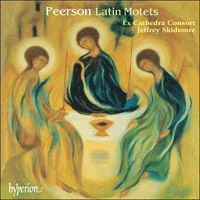
Martin Peerson, Lapsed Recusant Composer

I just stumbled upon a recording of Latin Motets by this English composer, Martin Peerson (1590?–1651?)--and just in time too as Hyperion indicates there are few copies of the CD left--who was convicted of recusancy in 1606, but seems to have at least outwardly conformed to the Church of England. 

One of his patrons was Fulke Greville, First Baron Brooke, a firm Calvinist, poet, statesman, and biographer of Sir Philip Sidney. Greville died horribly of infection after being stabbed by a servant: his doctors stuffed his wounds with pig fat which turned rancid!

Peerson (or Pearson or Pierson) may have been convicted of recusancy because of his connection to Ben Jonson, according to the CD liner notes:

Martin Peerson (c1572–1651) was probably born at March, Cambridgeshire, although the little that is known of his life relates to London and its immediate environs. An early connection was with the playwright Ben Jonson, for whose entertainment The Penates, Jonson’s May-Day production for the king and queen at Highgate in 1604, Peerson wrote the madrigal See, O see who is here come a-maying. Two years later Peerson, along with Jonson and others, was apparently convicted of recusancy. If Peerson had Catholic sympathies at that time they probably did not last very long, for he graduated BMus at Oxford (through Lincoln College) in 1613, for which acceptance of the Thirty-nine Articles was a requirement. . . . 

Richard Rastall, who edited the edition of Peerson's works, also judges that merely composing motets based on Catholic liturgical texts does not indicate that the composer was a crypto-Catholic or Church Papist:

The composition of Latin motets does not necessarily imply that Peerson was a Catholic when he wrote them. These motets do not demonstrate the kind of underground protest that we can see in Byrd’s Latin compositions of the 1580s, for instance. Some of the texts can be traced to the pre-Reformation liturgy, but nothing here would have been unacceptable in the services of those Anglican institutions allowed to perform music with Latin texts. They could have been sung in Westminster Abbey, which is a royal peculiar and where, as already noted, Peerson was sacrist from 1623 until 1630. This would place them among Peerson’s late works, which stylistic considerations would suggest in any case.

Yet, he concludes:

If they did nothing else, these works would demonstrate Peerson’s mastery of this aspect of composition, and this is one reason why these pieces are regarded as probably relatively late works. But they show much more than this, and both listener and singer will be struck by the sheer performability of the lines and the dramatic and expressive effects of the texture as a whole. Such passages as his setting of ‘Jesu miserere mei’ near the beginning of No 1 (Deus omnipotens), or the wonderfully luminous passage for ‘neque dormiet qui custodit te’ in No 4 (Levavi oculos meos), show not merely a highly intelligent composer at work, but a human being of immense compassion and religious faith.

Makes it rather sad that we really so little of him--even his grave is gone because of the Fire of London and the destruction of Old St. Paul's--and what his religious convictions really were and what struggles he faced in reconciling them (or not) to the laws of his country and sovereign.

I've listened to the excerpts available at the Hyperion website, and look forward to listening to the entire recording when it arrives. I think it's intriguing that an "Interpretation of Rublev's Icon of the Trinity" (1995) by Sophia Hacker was used as the cover illustration. 

Saturday, October 3, 2020

A Handy Guide to Recusancy in England

While looking for something else, I found this website, which offers an excellent guide to all the laws and events of the Recusant or Penal era in England:

The period of Roman Catholic persecution is often referred to as the ‘Penal Times’ and lasted from 1534 to 1778. Throughout these years Catholics and other nonconformists suffered varying degrees of persecution which generated useful genealogical records. Although the measures were often harsh, many anti-Catholic laws were not always strictly enforced. After the restoration of Charles II in 1660 Protestant recusants became known as nonconformists.

The Catholic Relief Acts of 1778 and 1791 and The Catholic Emancipation Act of 1829 ended the discrimination and granted freedom to Catholics.

Timeline of Roman Catholic Persecution and Tolerations
1534 Act of Supremacy. Henry VIII assumed authority over religious matters in England.
1552 Second Act of Uniformity. Attendance at Church of England services made compulsory.
1559 Third Act of Uniformity. The Act imposed a fine of 12d on people who refused to attend Anglican worship at their parish church and banned the celebration of Catholic mass. The fines imposed in the 1559 Act of Uniformity for failure to attend church were collected by churchwardens and so do not appear in the central government records and details of those fined will be found amongst quarter session records
1563 The death penalty was imposed on priests who said mass. It was also forbidden to defend papal supremacy and those that did, were liable to have their property seized by the authorities. . . .

In addition to the acts passed by Parliament through the centuries, the timeline also lists events that exacerbated the persecution and prosecution of Catholics: The Babington Plot, the Spanish Armada, The Gunpowder Plot, etc. 

Very handy; I've bookmarked it among my favorites and shared it here so I--and you--can always find it!!

While I'm sharing resources, here's another great one: from the Diocese of Salford, England, a list of English confessors and martyrs.

Image above: the executions of Saints Edmund Campion, Alexander Briant, and Ralph Sherwin, December 1, 1581.

Wednesday, January 11, 2017

Publisher of Catholic Books: Blessed William Carter

Today's English Catholic martyr's story reveals some of the debates and conflicts between Catholics during the Elizabethan era. The Jesuits and a group of secular or seminary priests called the Appellants disagreed about the divided loyalties of Catholics in England and what they could do about them. You might remember this was an issue brought up in the 2011 book, The Trials of Margaret Clitherow--and she was completely opposed to the Appellant view. Some thought that Catholics could attend Church of England services sometimes: to be part of the only Christian community openly available to them and to avoid the recusancy fines. They would abstain from the Anglican holy communion, ignore Anglican/Reformed preaching, and remain true to Catholic doctrine, sacraments, and devotions. They would certainly be loyal to their queen Elizabeth I in temporal matters but remain true to the Catholic Church in spiritual and religious matters--except that by attending the Church of England services, they paid manifestly public "lip service" to her governance of the Church of England! The Jesuits and others like St. Margaret Clitherow who agreed with them believed that any outward compliance would lead to inward compliance and represented betrayal and division.

The reason for this background is the title of the book Blessed William Carter printed and for which he was arrested, tortured, and executed: Dr. Gregory Martin's "A Treatise of Schisme: Shewing, that Al Catholikes Ought in Any Wise to Abstaine Altogether From Heretical Conunenticles, to Witt, Their Prayers, Sermons, &c". According to the 1913 Catholic Encyclopedia, Dr. Gregory Martin (c. 1542 to 28 October 1582) was the 

Translator of the Douai Version of the Bible from the Latin Vulgate; b. in Maxfield, parish of Guestling, near Winchelsea, in Sussex; d. at Reims, 28 October, 1582. In preparing the translation he was assisted by several of the other great scholars then living in the English College at Douai, but Gregory Martin made the whole translation in the first instance and bore the brunt of the work throughout. He was well qualified for the undertaking. During his thirteen years' residence at Oxford, he bore the reputation of a brilliant scholar and linguist, whose abilities were only equalled by his industry. He entered as one of the original scholars of St. John's College, in 1557. Among those who entered at the beginning was Edmund Campion, the renowned Jesuit martyr. At this period of his life, however, he was possessed with the ambitions of youth, and although at heart a Catholic, he conformed to the Established Church, and even accepted ordination as a deacon. Gregory Martin was his close friend throughout his Oxford days, and himself remained a devout Catholic. When he found it necessary to quit the university, he took refuge as tutor in the family of the Duke of Norfolk, where he had among his pupils Philip, Earl of Arundel, also subsequently martyred. During his residence with the Duke, Martin wrote to Campion, warning him that he was being led away into danger by his ambition, and begging him to leave Oxford. It is said that it was in great measure due to this advice that Campion migrated to Dublin in 1570, and accepted a post in the university there. He continued to conform to the established religion outwardly; but his Catholic sentiments were no secret.

In the meantime, Gregory Martin left the house of the Duke of Norfolk, and crossing the seas, presented himself at Dr. Allen's College at Douai as a candidate for the priesthood, in 1570. During his early days there, he wrote once more to Campion, who yielded to his entreaties, and the following year saw the two friends once more united within the venerable walls of the English College at Douai. Campion was now a professed Catholic, and he received minor orders and the subdiaconate, after which he proceeded to Rome and eventually entered the Society of Jesus. Having finished his theology, Gregory Martin was ordained priest in March, 1573. Three years later he went to Rome to assist Allen in the foundation of the English College there, known by the title of the "Venerabile". Campion, however, was at that time absent from Rome. Martin remained two years, during which time he organized the course of studies at the new college; when he was recalled by Allen to Reims, whither the college had been removed from Douai in consequence of political troubles. Martin and Campion met once more in this world, when the latter made a short stay at Reims in the summer of 1580, on his way to the English Mission, and-as it turned out-to early martyrdom. . . .

The following is a list of Martin's works: "Treatise of Schisme" (Douai, 1578); "Discovery of the Manifold Corruptions of the Holy Scriptures by the Heretikes of our Daies" (Reims, 1582); Reims Testament and Douay Bible; "Treatise of Christian Peregrination" (Reims, 1583); "Of the Love of the Soul" (St. Omer, 1603); "Gregorius Martinus ad Adolphum Mekerchum pro veteri et vera Græcarum Literarum Pronunciatione" (Oxford, 1712); several other works in MS. mentioned by Pitts.

Today's martyr, 
Blessed William Carter was born in London, 1548; suffered for treason at Tyburn on 11 January 1584. Son of John Carter, a draper, and Agnes, his wife, he was apprenticed to John Cawood, queen's printer, on Candlemas Day, 1563, for ten years, and afterwards acted as secretary to Nicholas Harpsfield, last Catholic archdeacon of Canterbury, then a prisoner. Note that Harpsfield wrote an early biography of Thomas More, left England during the reign of Edward VI for Louvain, returned during the reign of Mary I and participated in heresy trials, and finally, opposed the ordination of Matthew Parker as Archbishop of Canterbury, for which he was imprisoned in the Fleet with his brother John. Therefore, William Carter was very brave, associating with an imprisoned cleric who had refused the Oath of Supremacy!


When Harpsfield died (after release from prison on grounds of ill health) Carter married and set up a press on Tower Hill. Among other Catholic books he printed a new edition (1000 copies) of Dr. Gregory Martin's "A Treatise of Schisme", in 1580, for which he was at once arrested and imprisoned in the Gatehouse. Before this he had been in the Poultry Compter--a small prison run by a Sheriff in the City of London--from 23 September to 28 October 1578. He was transferred to the Tower, 1582, and paid for his own diet there down to midsummer, 1583. Having been tortured on the rack, he was indicted at the Old Bailey--the central criminal court in England—on 10 January 1584, for having printed Dr. Martin's book, in which was a paragraph where confidence was expressed that the Catholic Hope would triumph, and a pious Judith would slay Holofernes. This was interpreted as an incitement to slay the queen. His wife died while he was in prison.

He was beatified in 1987 by Blessed Pope John Paul II.

Printing 1000 copies of Martin's book?--that seems a considerable press run. Evidently he knew there were customers for that book, Catholics concerned about the conflict between the Appellants and the Jesuits and what they should do. Carter was a well-to-do man, as he was able to pay for his room and board in prison for perhaps a year. The government tortured him to discover names of any "Judiths" out there ready to behead "Holofernes"--if they had found any evidence of a conspiracy they would have used better evidence than the interpretation of a certain line in a book! But that was the atmosphere of fear and suspicion at that time.

Image at the Top: Judith slaying Holofernes by Artemisia Gentileschi, 1614–18

Image at the Bottom: Caravaggio, Judith Beheading Holofernes (c. 1598-1599)

Tuesday, September 20, 2016

The Tichborne Traitors

Chidiock Tichborne was a Babington Plot conspirator against Elizabeth I (seen in the Pelican Portrait by Nicholas Hilliard, which symbolizes her love for her country--the pelican mother would pierce its own breast and feed her young with her blood) and he was brutally executed on September 20, 1586 at St. Giles Field, along with other conspirators. The night before he wrote his own elegy and sent it to his wife Agnes:

My prime of youth is but a frost of cares,
My feast of joy is but a dish of pain,
My crop of corn is but a field of tares,
And all my good is but vain hope of gain;
The day is past, and yet I saw no sun,
And now I live, and now my life is done.

My tale was heard and yet it was not told,
My fruit is fallen and yet my leaves are green,
My youth is spent and yet I am not old,
I saw the world and yet I was not seen;
My thread is cut and yet it is not spun,
And now I live, and now my life is done.

I sought my death and found it in my womb,
I looked for life and saw it was a shade,
I trod the earth and knew it was my tomb,
And now I die, and now I was but made;
My glass is full, and now my glass is run,
And now I live, and now my life is done.


Chidiock's uncle, Nicholas Tichborne, had also betrayed his monarch because of his obdurate recusancy, as Francis Aidan Gasquet describes in his Hampshire Recusants: A Story of Their Troubles in the Time of Queen Elizabeth (1895):

In the year 1589, Nicholas Tichborne of Hartley Maudit, three miles from Alton, died. He had been in the gaol of Winchester for nine years a prisoner, as he says himself in his petition for relief "for not repairing unto my parish church," or as the Sheriff puts it, "in execution for a great sum of money due unto Her Majesty by reason of his recusancy." We have a glimpse of his sad condition in a letter written by him in 1585. In October of that year, orders were sent down to the officials in the various counties to demand from each recusant gentleman or woman one "light horse" for the queen's service, or £25 in money. George Cotton, apparently, was the only one in this part of the country who was " contented " to furnish the horse. Poor Nicholas Tichborne pleaded "non-ability" to do what was required. "I and such other recusants," he writes, "have reported ourselves, notwithstanding our recusancy, to be as good subjects as any other Her Majesty's subjects, which before God I do acknowledge and profess. And hereupon. Her Majesty having present service for certain light horsemen to be sent into Flanders, Her Majesty's will and pleasure is to require of me to have a light horse in readiness, with all the furniture thereunto belonging, by the 26th day of the month of October, or else £25". "I," he continues, "am a younger brother and son of a younger brother," and had only one little farm, "for the maintenance of myself, my poor wife and eight young children." The "lease whereof with all such goods as I had upon the same was sold by Robert White, Esq., late Sheriff of the said county, and the money for the same was paid into the receipt of Her Majesty's Exchequer, to Her Majesty's use in the Michaelmas term in the 25th year of Her Majesty's reign." . . . Tichborne declares that since he has been in prison and all his little property taken away, his family has lived upon the alms of the charitable. He is sorry he is unable to do anything in the way of finding the horse to show " his loyalty and true obedience to Her Majesty . . . He was left consequently in the Winchester Gaol till he died, as I have said, in 1589. The Bishop of the diocese, Dr. Cooper, refused to allow his body to be buried in any church or cemetery, declaring that his conscience would not permit him to suffer a papist to be buried in any of his churches or cemeteries. By the advice of an old Catholic the body was carried to the summit of a hill about a mile from the city and interred in the old disused cemetery of St. James, now known in Winchester as the Catholic Cemetery.

Nicholas' sons, Thomas and Nicholas were executed like Chidiock, but are considered martyrs--they were not part of a conspiracy, but were a Catholic priest present in England (Father Thomas) and a Catholic layman assisting a Catholic priest (Nicholas). They have both been declared Venerable by the Church but have not been beatified in either of the large groups in the 19th and 20th centuries.

From the Catholic Encyclopedia, Venerable Thomas Tichborne:

Born at Hartley, Hampshire, 1567; martyred at Tyburn, London, 20 April, 1602. He was educated at Rheims (1584-87) and Rome, where he was ordained on Ascension Day, 17 May, 1592. Returning to England on 10 March, 1594, he laboured in his native county, where he escaped apprehension till the early part of 1597. He was sent a prisoner to the Gatehouse in London, but in the autumn of 1598 was helped to escape by his brother, Ven. Nicholas Tichborne, and Ven. Thomas Hackshot, who were both martyred shortly afterwards. Betrayed by Atkinson, an apostate priest, he was re-arrested and on 17 April, 1602, was brought to trial with Ven. Robert Watkinson (a young Yorkshire man who had been educated at Rome and ordained priest at Douai a month before) and Ven. James Duckett, a London bookseller. On 20 April he was executed with Ven. Robert Watkinson and Ven. Francis Page, S.J. The last named was a convert, of a Middlesex family though born in Antwerp. He had been ordained at Douai in 1600 and received into the Society of Jesus while a prisoner in Newgate. Ven. Thomas Tichborne was in the last stages of consumption when he was martyred.

Note that Watkinson, Page and Duckett have been beatified (in 1929 by Pope Pius XI). Why not Thomas Tichborne?


b. at Hartley Mauditt, Hampshire; suffered at Tyburn, London, 24 Aug., 1601. He was a recusant at large in 1592, but by 14 March, 1597, had been imprisoned. On that date he gave evidence against various members of his family. Before 3 Nov., 1598, he had obtained his liberty and had effected the release of his brother, Venerable Thomas Tichborne, a prisoner in the Gatehouse, Westminster, by assaulting his keeper. He is to be distinguished from the Nicholas Tichborne who died in Winchester Gaol in 1587. [His father, as described above]

With him suffered Venerable Thomas Hackshot (b. at Mursley, Buckinghamshire), who was condemned on the same charge, viz. that of effecting the escape of the priest Thomas Tichborne. During his long imprisonment in the Gatehouse he was "afflicted with divers torments, which he endured with great courage and fortitude."

According to the English government at the time, all four of these men were in some way traitors. Nicholas, the father, refused to accept the Elizabethan religious settlement by not going to the Anglican services held each Sunday in his formerly Catholic church. He and his family lost all of their material possessions because of his refusal. He could be considered a martyr in chains. His wife, Mary (Myll) must have been just as loyal to the Catholic faith and his sons also remained true. Note, however, that Nicholas (the younger) must have wavered a bit, because in 1597 he "gave evidence against various members of his family". Nevertheless, he helped his brother, Father Thomas, escape from prison a year or so later. Then they were both recaptured, tried, and sentenced to death.


Chidiock's father, Peter, was also a recusant, who spent time in jail for not paying his fines and refusing to attend Anglican services. Chidiock, however, joined in the conspiracy to kill Elizabeth I and place Mary, the former Queen of Scots, on the throne. Reports are that the executions by hanging, drawing and quartering were so cruelly carried out on September 20, 1586 that Elizabeth I ordered the next round of conspirators to be hung by the neck until dead before beheading and quartering. Chidiock was only 24 years old; his youth and agony evidently moved the spectators.

The Babington Plot finally sealed Mary of Scotland's fate, and she was executed in February of 1587. 

Wednesday, March 9, 2016

Music and Politics: Va Pensiero


On March 9, 1842, Giuseppe Verdi's Nabucco premiered in Milan, Italy. One of the highlights of the opera is the Hebrew Slaves' chorus, "Va pensiero". It is traditionally encored, as in this performance. This BBC website provides some background to explain its political significance:

When Nabucco had its premiere at La Scala in 1842, ‘Italy’ was simply a cluster of geographically contiguous kingdoms and principalities with little more to unite them than a common language.

So when Italians sang the Chorus of the Hebrew Slaves at Verdi’s funeral procession, it wasn’t just because it was a catchy tune they knew the words to. Its subject – the Israelites giving poignant voice to their longing for the promised land – had become a powerful analogue for the long-frustrated desires of the Italian people. When they cried “Viva Verdi!” during the funeral procession, they were still acutely conscious of the slogan’s double meaning and its clandestine resonance for the agitators of ‘the Risorgimento’, as the cause of Italian nationalism was known. The letters VERDI also spelled out the name of the King of Sardinia who, in 1861, finally took the throne of a unified nation for the first time since the 6th Century – Victor Emmanuele Re D’Italia.


But this article from The Guardian argues that the political impact of the chorus is more complicated than that:

In spite of all this latter-day boosting, there is, alas, no evidence that the chorus excited patriotic fervour in its early years (a often-repeated tale about it being encored on opening night by enflamed patriots is a blatant invention), True, it was popular with choral societies from the very start, both in Italy and abroad; and it also featured in the repertoire of the barrel organs whose proliferation so annoyed the emerging middle-classes in so many European cities. Indeed, there very few signs that Verdi's music in general was particularly inflammatory.

The most remarkable negative evidence comes from revolutionary Milan, in which so much of Verdi's early activity was centred. In March 1848, for a few brief months, the Milanese drove the Austrians out of their city. Artistic events in the wake of this insurrection were surprisingly plentiful: several theatres started up with patriotic plays; operas appeared soon after; Verdi's publisher Ricordi advertised a long series of patriotic hymns, including one by Rossini. Milan experienced a period of heady freedom; artistic endeavours were for the most part geared unequivocally to the political situation. But during the entire time, there was virtually no mention of Verdi. The composer supposed to have inspired the masses to the barricades, the very artistic symbol of the Risorgimento, was somehow ignored in the press of events.


By August, the Austrians were back in Milan. La Scala re-opened at the end of the year. In the midst of an extreme clampdown on any behaviour that could lead to further civil unrest, the authorities staged revivals of three of Verdi's most popular operas; two others (one of them Nabucco!) followed soon after. It seems impossible that any of these works had been actively associated with the failed revolution or its build-up.

Alas, the choice comes again: the truth or the legend? "When the legend becomes fact, print the legend." John Ford's movies (The Man Who Shot Liberty Valance and Fort Apache) chose the latter, but let us entertain the former. Should opera companies stop encoring the chorus because the opening night encore is a deceptive legend?

The lyrics of "Va pensiero" are based on Psalm 136, which Phillipe De Monte and William Byrd set to music during the Recusant/Penal era in England, as this CD, The Word Unspoken explores:

Byrd was by no means the only major Catholic composer working in England during these years. Furthermore, there were English composers whose faith drove them to work abroad, as well as foreign composers who offered sympathy and encouragement to English catholics. Included in this latter category was the Flemish composer Phillipe De Monte who entered into a fascinating compositional correspondence with Byrd. Verses of Psalm 136 Super Flumina Babylonis (containing many allegorical references to the plight of catholics (sic) unable to practice their faith openly) were set to music and exchanged, in what is now seen as an encoded message of mutual support and friendship between brothers in faith.

The texts reveal the Catholic community’s sense of isolation (How shall we sing the Lord’s song in a strange land?—Quomodo Cantabimus) and bereavement (Jerusalem is wasted
Ne Irascaris), and the elaborate, poetic nature of the encoded messages distributed within it through music.

Thursday, March 3, 2016

Father Francis Walsingham, SJ

From the Worcester Cathedral Library and Archive blog: the other Francis Walsingham--not the spymaster Secretary of Elizabeth I--convert, controversialist, and Jesuit:

Francis Walsingham is best known as Elizabeth I’s secretary and spymaster. As Elizabeth’s trusted ally and a master of political and military intelligence, Walsingham was also a staunch supporter of the Protestant cause. He was one of the instigators of the execution of Mary, Queen of Scots (the rival Catholic claimant to Elizabeth’s throne), and directed English espionage on their Spanish enemies. You can well imagine my surprise then to find a 17th Century Jesuit tract authored by a Francis Walsingham, outlining the causes of his conversion from Anglicanism to Catholicism. What had caused a man so committed to Protestantism to suddenly renounce his faith?

The answer is that there are in fact two different Francis Walsinghams, distantly related to one another and born 35 years apart. The younger Walsingham could not be more different in his religious outlook than his elder relative. Yet the younger Walsingham was still an apostate – he had been a Deacon in the Church of England, before traveling to Rome and entering a seminary to train as a Catholic Priest. In 1609 he published his A Search Made into Matters of Religion – the copy held at Worcester Cathedral Library is a second edition of 1615. It was deemed so effective as Jesuit propaganda that it was used until well into the 18th Century as the standard recruitment textbook to be shown to Protestants inclining towards Catholicism.

Naturally, such a work would not be without controversy. In 17th Century England, the lot of Roman Catholics did tend to fluctuate with the time, but it can’t be said to have ever been a happy one. There were notable outbreaks of persecution following the Gunpowder plot of 1605 and Titus Oates fabricated ‘Popish Plot’ of 1678-81, with attacks on Catholic individuals, property and books. While I have been unable to find any evidence that Walsingham’s book was ever officially proscribed, many similar works did suffer that fate at one point or another. What we can state for certain is that the circulation and ownership of this book would have been limited and largely taboo.


By "taboo" the author means that possessing this book would have been considered evidence that the owner was a Catholic, perhaps himself a convert, perhaps hoping to convert another, perhaps assisting priests, knowing where a priest would be saying Mass, perhaps attending Mass--and therefore violating several English laws. Someone found with Father Walsingham's book, or any other Catholic book, would be arrested, detained, questioned, and depending on the dedication of the pursuivant, tortured for information (in spite of the fact that was illegal). The term "apostate" earlier in the post is also rather startling--after all, England had been thoroughly Catholic before Henry VIII's breakaway. 


WALSINGHAM, FRANCIS (1577–1647), jesuit, who assumed the name John Fennell, the son of Edward Walsingham of Exhall, near Alcester, Warwickshire, was born at Hawick, Northumberland, early in 1577. His father died before his birth, and his mother, who was a Roman catholic, brought him to London. His uncle, Humphrey Walsingham, who was kindred of Sir Francis, placed him at St. Paul's school. As the result of his instruction there he read the protestant divines Foxe, Jewell, Calvin, and Beza, and in 1603 was ordained deacon by Martin Heton, bishop of Ely. Doubts were raised as to the validity of his orders and of his belief by reading the ‘Manual’ of Robert Parsons (1546–1610) [q. v.], and in October 1606 Walsingham entered the English College at Rome. He was ordained priest on 12 April 1608, and early next year, having entered the Society of Jesus, he visited England, and there published his ‘Search made into Matters of Religion, by F. W., before his change to the Catholike’ (s. l. 1609, 4to; 2nd edit. St. Omer, 1615). The work was dedicated to James I, to whom the author states he had formerly submitted his religious difficulties. Down to the time of Alban Butler it has been frequently commended to those showing an inclination to Roman catholicism, and has been often reprinted and abridged. In the controversial parts, and especially in the attack upon the ‘falsities’ of Matthew Sutcliffe [q. v.], it is probable that the author was aided by Father Parsons. In 1618 Walsingham published his ‘Reasons for embracing the Catholic Faith’ (London, 16mo). Two years previously he had been formally attached to the ‘English mission,’ and served in Leicestershire. In 1633 he removed to the college of the Immaculate Conception, Derbyshire, and there he died on 1 July 1647. He left in manuscript at the convent at Newhall, Essex, a little prayer manual, ‘The Evangelique Pearle,’ dedicated to the abbess of the English nunnery at Pontoise.

Saturday, September 26, 2015

A Presentation and An Article


I wrote an article for the October issue of Tudor Life: The Tudor Society Magazine (membership/ prescription required) on "The Choices Catholics Faced in Tudor England", tracing religious change through the reigns of Henry VIII, Edward VI, Mary I, and Elizabeth I and what those changes meant for a Catholic who just wanted to attend Mass, receive the Sacraments, and live as his or her English ancestors had for years. Editor Gareth Russell specifically asked me to write an article from the Catholic perspective for this special Reformation issue.

On Tuesday, September 29, my sister and I will drive to Hutchinson, Kansas, where I'll make a presentation to the Hutchinson Theology on Tap group on "The Continuing Relevance of the English Reformation". I'll cover some highlights of English Reformation history but mostly discuss how that history is so relevant today, with examples of current events like changes in the Royal succession, the burial of Richard III (Anglican or Catholic service?), Pope Benedict XVI's visit to Scotland and England five years ago, the Anglican Ordinariate, religious freedom issues, etc. More information here on the facebook page for TOT in Hutchinson.

Friday, November 14, 2014

New Blog to Follow: Recusants and Renegades

A facebook friend Martin Robb messaged me with a link to his new blog, Recusants and Renegades:

My name is Martin Robb and I’m a university lecturer, blogger and very amateur historian, based in Hitchin, England.

This blog grew out of my work on family history, and more specifically my interest in my sixteenth- and seventeenth-century Kent and Sussex ancestors, including the Fowle family, who seem to have held on to their Catholic faith, either openly or covertly, through the turbulent events of the Reformation. Now that my research has strayed into exploring a network of families only loosely connected with my own ancestors, I've decided to relocate this part of my research to a separate site. (New readers are encouraged to start here.)


Readers sometimes ask me about ancestry and research--and I really haven't gotten in to that. I probably should and perhaps one day shall. One of my aunts on my mother's side, Aunt Eileen, researched their Threlfall and Smithhisler ancestry so she could become a member of the Daughters of the American Revolution. The links are on the Threlfall side as I recall going back to colonial Maryland.

Friday, October 17, 2014

Saint Richard Gwyn, Troublemaker and Martyr

In 2011, The Catholic Herald featured St. Richard Gwyn as the Saint of the Week on its website. He put up quite a fight against the Elizabethan authorities who tried to force him to worship as the state dictated:

Richard Gwyn (1537-1584) was a victim of Queen Elizabeth I’s persecution of Catholics, conducted with increasing intensity after 1581.

Born in Llanidloes in central Wales, Gwyn matriculated at Oxford before removing swiftly to Cambridge where, at St John’s, he lived by the charity of Dr Bullock, the college’s Catholic Master.

After the death of Queen Mary in 1558, however, Bullock refused to take the oath of supremacy administered by Elizabeth’s government and was ejected from the Mastership.

Gwyn fled to the continent, spending some time at Douai. Around 1562 he returned to Wales and for the next 16 years worked as a schoolmaster, mainly in Wrexham and Overton. He was much loved, not merely for his excellence and dedication as a teacher, but also for “other good partes known to be in him”. . . .

When his persecutors laid him in heavy shackles before the pulpit of a Protestant church in Wrexham Gwyn “so stirred his legs that with the noise of his irons the preacher’s voice could not be heard”.

Placed in the stocks as a punishment, he was taunted by an Anglican priest who claimed to possess the keys of the Church as surely as St Peter did. “There is this difference,” Gwyn riposted, “namely that, whereas Peter received the keys to the Kingdom of Heaven, the keys you received were obviously those of the beer cellar.”

Indicted for high treason, Gwyn was eventually condemned to be hanged, drawn and quartered at the Beast Market in Wrexham in October 1584. “I have been a jesting fellow,” he told the crowd from the scaffold, “and if I have offended any that way, or by my songs, I beseech them for God’s sake to forgive me.”

The execution was hideously bungled, so that Gwyn remained conscious throughout his disembowelment. His last words, in Welsh, were: “Iesu, have mercy on me.”

It is clear that he did nothing to oppose the reign of Elizabeth I but practice his Catholic faith. For that he was harassed, mistreated, tortured, and brutally executed. As a beloved teacher, his Catholicism made him liable for accusations of trying to bring pupils or families to the Catholic faith. Wikipedia has these details about his trial:


Richard Gwyn, John Hughes and Robert Morris were indicted for high treason in 1583 and were brought to trial before a panel headed by the Chief Justice of Chester, Sir George Bromley. Witnesses gave evidence that they retained their allegiance to the Catholic Church, including that Gwyn composed "certain rhymes of his own making against married priests and ministers" and "[T]hat he had heard him complain of this world; and secondly, that it would not last long, thirdly, that he hoped to see a better world [this was construed as plotting a revolution]; and, fourthly, that he confessed the Pope's supremacy." The three were also accused of trying to make converts.

Despite their defences and objections to the dubious practices of the court Gwyn and Hughes were found guilty. At the sentencing Hughes was reprieved and Gwyn condemned to death by hanging, drawning and quartering. 


His relics are venerated and he is remembered at Wrexham Cathedral in North Wales, dedicated to Our Lady of Sorrows and elsewhere, with a high school named for him. Mary's Dowry has produced a documentary of his life and death. While he was executed on October 15, his memorial is observed in Wales today, since St. Teresa of Avila's memorial is on October 15.

Friday, June 13, 2014

Book Review: Persecution without Martyrdom

From the publisher, Gracewing:

Persecution Without Martyrdom: The Catholics of North-East England in the Age of the Vicars Apostolic 1688-1850
by Leo Gooch

978 0 85244 819 9  -  488 pages   -  £20.00 (I received a review copy from the publisher for my honest opinion and review: see below)

Until comparatively recently, historical studies of English Catholicism have lavished attention on the ‘Age of Martyrs’ of the sixteenth and seventeenth centuries or on the ‘Second Spring’ of the nineteenth century, while the eighteenth, a century of ‘persecution without martyrdom’ as Edwin Burton described the life and times of Richard Challoner, is largely passed over. That neglect is wholly unwarranted. The creation of the four Vicariates Apostolic in 1688 marks the foundation of the modern Roman Catholic Church in England ND Wales and a series of significant ecclesiastical developments affecting the disposition and operation of the mission followed over the next century and a half: its emergence from ‘seigneurial’ rule, its shift from its rural strongholds into the towns, and its metamorphosis into a centrally-managed organization. In the secular field, this was the age when major political crises relating to Catholicism arose, when Catholics threw off discrimination and oppression and by degrees emerged from recusancy to full citizenship; and when the sociological character of the English Catholics changed completely. Theses were all important enough singly, but cumulatively they amounted to nothing less than a radical transformation of the structure and outlook of the English Catholics. The later achievements of the Church of Cardinals Manning, Wiseman and Newman could not possibly have been won without the perseverance and vigour of the eighteenth-century recusants.

This book is a tremendous resource for understanding the status of Catholics in north-east England after the Glorious Revolution and up to the 1850 restoration of the diocesan hierarchy. The range of dates from 1688 to 1850 means that the period covered includes the Jacobite attempts to restore the Catholic Stuarts, the end of the Stuart dynasty and the beginning of the Hanoverians (1714--three hundred years ago!), and the slow restoration of freedom to worship and civil rights  for Catholics, leading up to Emancipation in 1829. The first four chapters offer a compelling narrative of Catholic gentry in the northeast of England surviving the fall of James II, continuing their family's traditions and education, working for their freedom of religion and worship, and responding to the presence of the Vicars Apostolic.The last two chapters provide tremendous detail about the chapels and the chaplains established by the gentry on their estates, breaking off from the narrative of the first four chapters.

In chapter one, Gooch provides statistical surveys of the recusant Catholics throughout the period, noting the ebbs and falls of their population. He demonstrates that while they had to be careful and discrete, they were committed to practicing their faith. He notes that Catholic gentry often played down their wealth--to avoid confiscation and fines by the government--by various financial arrangements, loans, and leases. The gentry provided both the chapels and the chaplains for the celebration of Catholic Mass and the other Sacraments--and Gooch gives much more detail of these arrangements in the last two chapters.

Gooch depicts the education, travel and intellectual avocations of north-east Catholic gentry in chapter two. The Catholic gentry were better educated than their Anglican peers, because they attended the Jesuit colleges on the Continent while Cambridge and Oxford were still serving primarily as educational institutions for  Anglican clergy. Catholic gentlemen traveled extensively on the Continent on long Grand Tours, collecting books and artwork. They usually were accompanied by a chaplain cum chaperone, spending Holy Week in Rome and celebrating the Feast of the Ascension in Venice. 

The Catholic Question--the issue of Catholic freedom to worship and take full part in English political and social life--occupies our interest in chapter three. Could Catholics be trusted? Gooch notes that not many of the north-eastern Catholic gentry had supported the Jacobite cause, and that as the English gentry negotiated with the government, they were often ready to compromise on certain aspects like government approval of episcopal appointments or allowing the government to read official church correspond with the Holy See, just so they could be free of the fines or threat of fines for not attending the Church of England services, exempted as they were from the Toleration Act of 1689.

In chapter four Gooch discusses the Vicars Apostolic (V.A.) of the Northern District, Titular Bishops without geographical dioceses or sees, and how they changed the structures of ecclesiastical power. They had titles like Titular Bishop of Marcopolis, Bolina, Trachis, Abydus, or Samosata. The latter was the title of the V.A. of the Northern District, William Hogarth, who became the Bishop of Hexham in 1850. We have to remember that the gentry were hiring--and firing--the clergy for their private estate chapels. As Gooch will demonstrate in the last two chapters, this practice meant that if the head of the  family conformed to the established Church of England, the chapel could be lost to the Catholics on the estate--or if there was some disagreement between the chaplain and family, he could be fired. The Vicars Apostolic, of course, wanted to establish a more stable infrastructure of "parish" chapels with assigned pastors. Their efforts before Emancipation and between Emancipation and the restoration of the hierarchy are what Gooch argues helped prepare Catholicism in England for the achievements of bishops and archbishops like Hogarth, Briggs (another V.A. in the north who became a diocesan bishop in 1850, of Beverley), Wiseman, Ullathorne, Manning, etc. after them.  I do not think that including Cardinal Newman in the blurb was necessary or appropriate, since he was never a bishop and was named a Cardinal Deacon late in life by Pope Leo XIII as a personal honor rather than as a hierarchical office or position (he continued his work at the Oratory in Birmingham in fact, not moving to Rome as usually required at that time for a Cardinal Deacon).

The last two chapters, while providing the great wealth of detail about different estates, their families, chapels, and chaplains, really should have been placed in an appendix. After stating that the Vicars Apostolic had, as the blurb above notes, worked to create a "centrally-managed organization", two chapters describing the "seigneurial rule" in such detail contradicted--at least structurally--the argument. Throughout the book, Gooch's attention to detail and excellent research, with tremendous notes and sources consulted, is obvious. I also wish the publishers could have included maps or some illustrations--especially the maps, which would have helped an American reader not familiar with the territory. Certainly, this is a great achievement and resource.

Saturday, April 12, 2014

"History Today"--April Issue On-line Highlights

I'm not sure how long these stories will be available for free online, but there are several that interest me today:

A discussion of the last king of the House of Valois, Henri III, by the author of a new biography of the same:

In the 19th century, Henry appeared in the novels of Alexandre Dumas and other works of fiction. In 1941 Pierre Champion began a biography, but died before completing it. Following the Second World War, historical biography fell into disrepute among French academics, who preferred to study man as part of a group, but in the last decades the form has regained academic respectability. In 1985 Pierre Chevallier published a substantial biography of Henry III bearing the subtitle: ‘a Shakespearean king’. Since then Jacqueline Boucher, Nicolas Le Roux, Denis Crouzet, Monique Chatenet, Xavier Le Person and others have revolutionised our understanding of the reign. Unfortunately their contributions remain largely unknown to English-speaking readers. The only biography of Henry III in English, by Martha Walker Freer, dates from 1858.

Recent research has exploded the myth of Henry as an ineffectual and pleasure-seeking monarch surrounded by mignons, effeminate young men with absurd hair-dos. Henry is now seen as a highly intelligent and conscientious monarch who tried to bring peace to his troubled kingdom. Pleasure loving he may have been, but Boucher has shown that he spent long hours reading official reports and replying to them. Hundreds of his letters have been published by the Société de l’Histoire de France since 1959. Intellectually, Henry was also keen to learn: he set up a Palace Academy at the Louvre, where leading scholars discussed philosophy, astronomy or other topics. As for the mignons, far from being the parvenus of legend, they were mostly the sons of long-serving provincial nobles. They represented an attempt by Henry to use men of his own generation rather than older ministers chosen by his mother, Catherine de’ Medici.


A comparison between modern surveillance and the Tudor spy network:

Analogies between modern Britain and early modern England can also be seen in the history of social welfare. Beveridge and the creators of the welfare state hoped that by making benefits universal they would remove the stigma associated with poverty. Welfare benefits would simply be ‘social’ rights that would be as generally acceptable as property and political rights. However, opposition to taxation, benefits means testing and fears over fraud have led to the wholesale sharing of data between government bodies such as the Department of Work and Pensions and HM Revenue and Customs. ‘Troubled’ families are now targeted for various forms of social intervention to prevent them from becoming a burden on the state.

Similarly, during the English Reformation, the Dissolution of the Monasteries led to the destruction of institutions such as hospitals, which had traditionally assisted the poor. The Reformation’s emphasis on salvation by faith also undermined the belief in the spiritual efficacy of charitable works, although that does not mean that Christian charity vanished. These religious, economic and social shifts led to a perceived crisis of welfare. The response of the Tudor state was to supplement the promptings of Christian charity with the legal requirements of the Poor Laws. Each locality was to raise funds through a poor rate and disburse them to those in need via overseers. Over the following centuries this system came to be seen by the poor as a right. Yet the response of rate payers was increasingly to view the poor as a nuisance to be controlled. Consequently the Poor Laws spawned a vast system of surveillance to determine the circumstances of families and the parentage of illegitimate children.


The recounting of an exorcism conducted by a missionary Catholic priest in Elizabethan London by Jessie Childs, set in the context of the English Reformation:

Few periods of English history have endured such liberal applications of hindsight as the Golden Age of Good Queen Bess. It may indeed have been a time of glorious national achievement, but the country was not, with a nod to Sellar and Yeatman, ‘bound to be C of E’. The children of Henry VIII (whose own brand of reformation was unpredictable) had hardly imbued their subjects with a sense of religious stability. As Daniel Defoe put it, the country had swung ‘from the Romish religion to reformed, from reformed back again to Romish, and then to reformed again’. By 1586 Elizabeth I had been on the throne for just over a quarter of a century, long enough for the dizziness to have subsided, long enough for a new generation to have been raised on the Book of Common Prayer and long enough – just – for the word ‘Protestant’ to have become an acceptable term of self-reference. It was not so long, however, for Elizabethan Catholics to have stopped praying for one more swing of the pendulum. Often their prayers were linked to those for ‘God’s prisoner’, Mary, Queen of Scots, still alive in 1586 and still, for most people, England’s putative heir.

Church attendance was compulsory in Elizabethan England, the fine for absenteeism having been raised in 1581 from 12 pence to a swingeing £20 a month. Most Catholics conformed, some only occasionally or partially, and suffered the label ‘church papist’ or ‘schismatic’ for their sins. Those who persisted in their nonconformity were known as recusants (from the Latin recusare: to refuse). Many of them hoped, not only for freedom of worship, but also for the restoration of the Catholic faith in England. They were a minority – thousands in a population of around four million – but they had a loud voice, amplified by powerful friends on the Continent. ‘God has already granted’, declared Mary I’s widower, Philip II of Spain, ‘that by my intervention and my hand that kingdom has previously been restored to the Catholic Church once.’ It was an ominous statement of chutzpah and intent.


And from the magazine's blog, this examination of Jacques le Goff's legacy as an Annales historian:

By showing how it could be applied meaningfully to transform perceptions of major problems in the study of the past, Le Goff ensured that the Annales School had an enduring relevance for historical scholarship. Thanks to works such as La Naissance du Purgatoire and Pour un autre Moyen Âge, its influence both in medieval studies and more widely has become palpable. Not only are undergraduates now introduced to the Annalistes’ ideas as a matter of course, but the scholarly value of such topics as popular culture and environmental history is also appreciated by historians around the world, especially in those regions (such as Britain and the US) which were previously most hostile to the Annales approach. And it was only right that by the time of Le Goff’s death on April 1st, 2014, he had been elevated to the pantheon of modern historians.

But if Le Goff’s contribution should be celebrated for having resurrected the Annales School from its mid-century Purgatory, his death is also an occasion to reflect once again on the future of the nouvelle histoire. While it may be true that few scholars now doubt the merit of the approach he pioneered, it is striking that the grand vision which marked both his work and that of his most eminent colleagues has perhaps not survived the test of time as well as it might.


Much good reading there on four interesting topics.

Tuesday, March 25, 2014

Good Friday, March 25, 1586

U.K.'s The Catholic Herald highlights St. Margaret Clitherow, crushed to death on March 25, 1586 for refusing to make a plea in her arrest for harboring a Catholic priest in York:

Margaret was arrested in 1586 for harbouring Catholic clergy. She refused to plead guilty to the charge because she knew her children would be brought forward as witnesses and consequently might be subjected to torture.

Margaret was executed by being crushed to death on Good Friday in 1586. The two sergeants hired to kill her used four beggars to do the deed instead. It took her 15 minutes to die as she was crushed with rocks and stones. Her last words were “Jesu! Jesu! Jesu! have mercy on me!”

Her body was left for six hours until the weight was removed. Her hand was saved following her death and is now a relic in the chapel of the Bar Convent in York.

When Elizabeth I heard of Margaret’s horrific death, she wrote to the citizens of York condemning the act and arguing that women should not be executed. Her son William also became a priest and her daughter Anne became a nun in Louvain, Belgium. Margaret was beatified in 1929 by Pope Pius XI and canonised in 1970 by Pope Paul VI. She is one of the Forty Martyrs of England and Wales.

When St. Margaret Clitherow was prepared for her execution, she was laid on her back with a sharp stone underneath. Her arms were spread and tied down as though she was on a cross, with her feet tied down. Did her executioners realize that she was imitating Jesus on the Cross so exactly, on Good Friday?

Monday, January 13, 2014

"Recusancy and Regicide" from Penn History Review

Carolyn Vinnicombe, at that time a junior at the University of Pennsylvania, wrote this analysis of the Jesuit mission in Reformation England, published in the Spring 2012 issue of the Penn History Review:

Introduction: In pursuing their goals of reviving the religious zeal of the English Catholic community by converting them to religious opposition in the later sixteenth and earlier seventeenth centuries, the drivers of the Jesuit mission in England, under the guidance of the Jesuit Robert Persons, failed. They did so not because Catholic doctrine lacked appeal in protestant Elizabethan England, but because their conversion strategy was wholly unsuited to the political realities of the times. Instead, the aggregate effects of the Church’s clerical infighting over the issues of conformity and disputation as a conversion device, failure to understand the practical needs of the average Catholic, and Person’s ill-fated political plotting polarized the English against the Jesuits and created a religious and political environment so toxic that it cannibalized the mission’s own conversion efforts. Though the Jesuits saw later success with the publication of their non-polemic spiritual texts, they never succeeded in gaining back the ground they lost as a result of their catastrophic early strategy.

The issue of conformity to the Elizabethan Settlement of 1569 presented a dilemma without an absolute solution for the English Catholic community. When Pope Pius V’s Regans in Excelsis of 1570, excommunicated the queen, and prompted her regime to mandate attendance at protestant services, it left English Catholics floundering to find traction on the plane of religious devotion. Could they still call themselves Catholics if they yielded to the state and attended protestant services, but maintained Catholicism in their hearts, or were only those who defied the state and refused to attend services worthy of the “Catholic” label and, indeed, salvation? This was a question for which neither the laity nor the Church had a clear answer.

Read the rest of the article here.

Sunday, December 15, 2013

Johannes Vermeer, RIP, December 15, 1675

Believe it or not, there is a connection between the death of Johannes Vermeer and the English Reformation, the topic of this blog! The connection is the relationship between Church and State, always fraught with difficulty, but especially when the State chooses an official church and religion. The artist Johannes Vermeer became a Catholic when he married, and this site notes:

By the time Vermeer's parents were married in 1615, the suppression of the public celebration of the Catholic faith in Delft was complete. But even though national decrees denied Catholics the right to serve public office, many areas of the Netherlands remained solidly Roman Catholic. Despite the hostility, Dutch Catholics continued to worship and educate their children throughout the 17th century. In large cities like Amsterdam, Haarlem and Utrecht, commercial concerns dampened repeated calls for anti-Catholic laws. Although intolerance existed in the United Provinces, on the whole Dutch Catholics enjoyed remarkable freedoms compared with religious minorities elsewhere in early modern Europe. Penal laws against Catholics were occasionally enforced and Catholics were vulnerable to extortion, but things could have been far worse.

Vermeer very probably converted to Catholicism upon his marriage to Catharina Bolnes [in 1653] and there is no sign that his decision had negative repercussions on his career. The most influential painter in Delft and friend of the Vermeer family, Leonaert Bramer as well as the popular painter of Dutch family life, Jan Steen were noted Catholics.


So, like Catholics in England, Catholics in the Netherlands had to worship secretly--that line "things could have been far worse" might indeed be applied to English Catholics during the 17th century. Since this painting dates to 1670-1672, English Catholics were still under the Penal and Recusancy laws that made it an act of treason for a priest to be in England and a felony for a layperson to assist a Catholic priest in any way--although there was a hiatus in the persecution of Catholics during those years of Charles II's reign. It would start up again after the Fire of London and while Titus Oates' nefarious conspiracy of a conspiracy ran its perjurous course.

Catholics in the Netherlands were allowed to worship in schiulkerk, or hidden churches, as long as they kept it quiet.

The Metropolitan Museum of Art in New York City has this Vermeer currently on display. Its description:

One of Vermeer's most unusual pictures, this large canvas was probably commissioned by a Catholic patron. The subject was adopted from a standard handbook of iconography, Cesare Ripa's "Iconologia." Vermeer interpreted Ripa's description of Faith with the "world at her feet" literally, showing a Dutch globe published in 1618. The divine world is suggested by the glass sphere hanging overhead. The painting of the Crucifixion on the wall copies a work by Jacob Jordaens. Among the several Christological symbols, the most prominent are the apple, emblem of the first sin, and the serpent (Satan) crushed by a stone (Christ, the "cornerstone" of the church). Dating from about 1670, the work strikes a balance between abstraction and haunting similitude.

Painted about 1670–72, this picture presents an allegory of Vermeer's adopted religion, and was probably made expressly for a private Catholic patron or for a schuilkerk, a hidden Catholic church. It is unlike any other work by Vermeer, though it shows compositional similarities to The Art of Painting (Kunsthistorisches Museum, Vienna) of about 1666–68. The latter work is also allegorical in subject, but only nominally, as it was intended mainly as a virtuosic display of the artist's abilities. In the MMA canvas, Vermeer shifts his late style towards a more classicist and schematic manner.

The choice and interpretation of the imagery included here would have been discussed by the artist and his patron. For many of the allegorical motifs, Vermeer must have turned to Cesare Ripa's emblem book, Iconologia (Rome, 1603), translated in a Dutch edition by Dirck Pietersz Pers (Amsterdam, 1644). The female figure represents the Catholic Faith, wearing white, a symbol of purity, and blue, the "hue of heaven". A hand raised to the heart indicates the source of living faith. She rests her foot on a globe, published in 1618 by Jodocus Hondius, to illustrate Ripa's description of Faith with "the world under her feet". In the foreground, Vermeer shows the "cornerstone" of the Church (Christ) crushing a serpent (Satan). The nearby apple, which has been bitten, stands for original sin. The table is transformed into an altar with the addition of a chalice, crucifix, and a Bible or, more likely because of its proximity to other objects used for the Mass, a missal. The glass sphere, hanging from a ribbon, was a popular decorative curiosity; in this context, it may be viewed as a symbol of heaven or God. The room itself, with its high ceiling, marble floor, and a large altarpiece based on a work by Jacob Jordaens (possibly identical with one in Vermeer's estate), was meant to be recognized by contemporary viewers as a private chapel installed within a large house or some other secular building. Though apparently an illusionistic device, the tapestry at left would also have been understood as part of a very large hanging, drawn aside to reveal a normally secluded space.


This book, published by Harvard University Press, covers the era: Faith on the margins: Catholics and Catholicism in the Dutch Golden Age by Charles H. Parker and this book even compares the two minority communities of Catholics in England and the Netherlands. And Vermeer is in the news with the release of Tim's Vermeer, a movie about a man's efforts to figure out how Vermeer composed his paintings so perfectly balancing light and shadow, using a camera obscura.

Sunday, November 24, 2013

The Solemnity of Christ the King and the English Martyrs

It was on the Solemnity of Jesus Christ the King of the Universe in 1987 (November 22) that Blessed John Paul II beatified the Eighty-Five Martyrs of England and Wales:

This feast of Christ the King proclaims that all earthly power is ultimately from God, that his Kingdom is our first and lasting concern and that obedience to his laws is more important than any other obligation or loyalty.

Thomas More, that most English of saints, declared on the scaffold: “I die the King’s good servant but God’s servant first". In this way he witnessed to the primacy of the Kingdom.

Today we have declared Blessed another eighty-five martyrs: from England, Scotland and Wales, and one from Ireland. Each of them chose to be "God’s servant First". They consciously and willingly embraced death for love of Christ and the Church. They too chose the Kingdom above all else. If the price had to be death they would pay it with courage and joy.

Blessed Nicholas Postgate welcomed his execution "as a short cut to heaven". Blessed Joseph Lambton encouraged those who were to die with him with the words "Let us be merry, for tomorrow I hope we shall have a heavenly breakfast". Blessed Hugh Taylor, not knowing the day of his death, said: "How happy I should be if on this Friday, on which Christ died for me, I might encounter death for him". He was executed on that very day, Friday 6 November 1585. Blessed Henry Heath, who died in 1643, thanked the court for condemning him and giving him the "singular honour to die with Christ".

Among these eighty-five martyrs we find priests and laymen, scholars and craftsmen. The oldest was in his eighties, and the youngest no more than twenty-four. There were among them a printer, a bartender, a stable-hand, a tailor. What unites them all is the sacrifice of their lives in the service of Christ their Lord.

The priests among them wished only to feed their people with the Bread of Life and with the Word of the Gospel. To do so meant risking their lives. But for them this price was small compared to the riches they could bring to their people in the Holy Sacrifice of the Mass.

The twenty-two laymen in this group of martyrs shared to the full the same love of the Eucharist. They, too, repeatedly risked their lives, working together with their priests, assisting, protecting and sheltering them. Laymen and priests worked together; together they stood on the scaffold and together welcomed death. Many women, too, not included today in this group of martyrs, suffered for their faith and died in prison. They have earned our undying admiration and remembrance.

These martyrs gave their lives for their loyalty to the authority of the Successor of Peter, who alone is Pastor of the whole flock. They also gave their lives for the unity of the Church, since they shared the Church’s fait, unaltered down the ages, that the Successor of Peter has been given the task of serving and ensuring "the unity of the flock of Christ". He has been given by Christ the particular role of confirming the faith of his brethren.

The martyrs grasped the importance of that Petrine ministry. They gave their lives rather than deny this truth of their faith. Over the centuries the Church in England, Wales and Scotland has drawn inspiration from these martyrs and continues in love of the Mass and in faithful adherence to the Bishop of Rome. The same loyalty and faithfulness to the Pope is demonstrated today whenever the work of renewal in the Church is carried out in accordance with the teachings of the Second Vatican Council and in communion with the universal Church.

Central to this renewal, to which the Holy Spirit calls the Church, is work for that unity among Christians for which Christ himself prayed. We must all rejoice that the hostilities between Christians, which so shaped the age of these martyrs, are over, replaced by fraternal love and mutual esteem.

Seventeen years ago [1970] forty of the glorious company of martyrs were canonized. It was the prayer of the Church on that day that the blood of those martyrs would be a source of healing for the divisions between Christians. Today we may fittingly give thanks for the progress made in the intervening years towards fuller communion between Anglicans and Catholics. We rejoice in the deeper understanding, broader collaboration and common witness that have taken place through the power of God.

In the days of the martyrs whom we honour today, there were other Christians who died for their beliefs. We can all now appreciate and respect their sacrifice. Let us respond together to the great challenge which confronts those who would preach the Gospel in our age. Let us be bold and united in our profession of our common Lord and Master, Jesus Christ.

Last year the Archbishop of Westminster, Vincent Nichols, celebrated Mass in thanksgiving for the 25th anniversary of these beatifications--and in his sermon he noted the detail that 10,000 English Catholics attended the ceremony in Rome! You may find a link to his sermon here.

Blessed Martyrs of England and Wales, pray for us!