Showing posts with label Saint Edmund Campion. Show all posts

Friday, August 30, 2024

Four English Catholic Martyrs on "Church and Culture"

On Wednesday, I recorded an hour of the Ave Maria Radio Program hosted by Deal Hudson, "Church and Culture": Telling the stories of four English Catholic Martyrs from the Tudor era. 

It will air tomorrow, Saturday August 31 at 3 p.m. Central/4 p.m. Eastern, during the second hour of "Church and Culture". You may listen live here. Deal Hudson will post about the episode on his Facebook page here.

I selected two each from the reigns of Henry VIII and Elizabeth I:

Saint John Fisher and Blessed Margaret Pole from Henry VIII's reign. Their ties to the Tudor family are close but certainly did not save them when they opposed, or in the case of Margaret Pole, even seemed to oppose Henry VIII's plans, marital and ecclesial!

Saint Edmund Campion, SJ and Saint Anne Line from Elizabeth I's reign. He represents the many priest-martyrs, beatified and canonized, and she represents many women, canonized or not, who sheltered priests during the recusant era in England.

You know how often I've written about these martyrs on this blog and elsewhere.

If you can't listen to it live, it will be archived here. And Deal will send me a link too so I'll update my Facebook page!

The picture above is the article from our diocesan Catholic Advance, when Deal came to Wichita to serve as the first Visiting Chair of the Gerber Institute for Catholic Studies--so when he refers to our long acquaintance at the beginning of the program, that's why!

And, we'll schedule a conversation about the English Catholic Martyrs of the Stuart era in the future.

Friday, December 1, 2023

Preview: Saint Edmund Campion, SJ in Father Bowden's "Mementoes"

There are many reasons to admire, imitate and be inspired by Saint Edmund Campion, SJ: his intelligence, his courage, his care for his flock (he went back to a house to minister to the Catholics there and was thus captured), his ability to defend the teachings of the Church, and of course, his holiness, well attested by his martyrdom. 

Thus it's no surprise that Father Henry Sebastian Bowden mentions Campion 20 (twenty) times in his Mementoes of the English Martyrs and Confessors For Every Day in the Year, not counting the poem Saint Henry Walpole, SJ wrote about his mentor in martyrdom (Campion's blood splashed on Walpole and he left London to study for the priesthood and return to England as a missionary and martyr) included as an appendix ("Why do I use my paper, ynke and penne?") 

And it's no surprise that we'll look at what Father Bowden says about Campion's martyrdom in our next segment on the Son Rise Morning Show on Monday, December 4.

I'll be on the Son Rise Morning Show at my usual time at about 6:50 a.m. Central/7:50 a.m. Eastern, the last segment in the second national hour on EWTN Radio. Please listen live here and/or catch the podcast later here.

I chose the most dramatic of the mementoes Father Bowden offers, the description of the day of Campion's martyrdom, December 1, 1581, with the title "A Sight to God and Man" because of the richness of the details in the account. As we read the description, we can try to imagine what that day was like, as though we are witnessing it:

In the splash and mud of a wet December morning, Campion was led forth from the Tower, still in his old gown of Irish frieze. Undaunted he saluted the vast crowd, saying, “God save you all, gentlemen! God bless you and make you all good Catholics!” 

Irish frieze was a coarse, woven woolen cloth, very durable, with the nap left on one side. This garment would have been stripped from Campion once his execution began. On his way to a horrible death, Campion is both undaunted and loyal to his mission as a Catholic priest: to offer blessings and good will.

After kneeling in prayer he was strapped on the hurdle, Sherwin and Briant being together bound on a second hurdle. They were dragged at the horses’ tails through the gutter and filth, followed by an insulting crowd of ministers and rabble. 

Saint Ralph Sherwin, SJ (31 years old) and Saint Alexander Briant (25 years old) had been imprisoned, tortured, and tried at the same as Campion (41 years old). They and other Catholic priests had been accused of complicity in the Rome and Reims Plot, an invention of the Court. The gutters and streets would have been wet, and dirty not just from mud but from horses' dung and other waste. That was below them; above them were insults and curses.

Still some Catholics were consoled by a word from him, and one gentleman, like Veronica on another Via Dolorosa, most courteously wiped his face all spattered with mire and filth. Passing under the arch of Newgate, whereon still stood an image of Our Lady, Campion raised himself and saluted the Queen of Heaven, whom he hoped so soon to see. 

These two gestures of honor, one to comfort Campion and the other to show devotion to the Blessed Virgin Mary, are moving intervals as the martyrs are drawn to brutal executions.


At the gallows he began with a sweet firm voice, “Spectaculum facti sumus Deo Angelis et hominibus,”* but the Sheriffs interrupted him, and urged him to confess his treason. He repeatedly maintained his innocence, and having declined to join in prayer with the ministers, asked all Catholics for a Credo for him in his agony, and while again professing his loyalty to the Queen he went to his reward.

Campion begins by citing the verse Father Bowden includes in this memento, from St. Paul's First Letter to the Corinthians: *“ We are made a spectacle to the world, to angels and to men.”—1 Cor. 5:9. 

In his biography of Saint Edmund Campion, Richard Simpson cited the martyr's last words:
"I am a Catholic man and a priest; in that faith have I lived, and in that faith do I intend to die. If you esteem my religion treason, then am I guilty; as for other treason, I never committed any, God is my judge. But you have now what you desire. I beseech you to have patience, and suffer me to speak a word or two for discharge of my conscience."

He was not allowed to continue and his execution was almost another trial as he was questioned again about his loyalty to the Pope as the head of the Catholic Church and/or to the Queen of England. His final statement was:

"Wherein have I offended her? In this I am innocent. This is my last speech; in this give me credit — I have and do pray for her." Then the Lord Charles Howard asked of him for which queen he prayed, whether for Elizabeth the queen. To whom he answered, "Yea, for Elizabeth, your queen and my queen, unto whom I wish a long quiet reign with all prosperity."
Then he was stripped, hanged until barely conscious, eviscerated, beheaded, and quartered. During this agony, his blood splashed on the bystander, Henry Walpole. Then Sherwin and Briant endured the same agony. 

How long could I -- or you -- have watched it?

He and his companions, and Henry Walpole, were canonized among the 40 Martyrs of England and Wales by Pope St. Paul VI in Rome on October 25, 1970.

Saint Edmund Campion, pray for us!
Saint Ralph Sherwin, pray for us!
Saint Alexander Briant, pray for us!
Saint Henry Walpole, pray for us!

Friday, May 19, 2023

Preview: Two Martyrs from Campion's Class of 1581-1582


On Monday, May 22, I'll be on the Son Rise Morning Show at my usual time to discuss Father Henry Bowden's "Mementoes" of two martyrs executed on May 28, 1582. Blesseds John Shert and Thomas Ford were among the 20 priests, including St. Edmund Campion, accused of conspiring against Queen Elizabeth I in the fictitious "Rome and Reims" plot.

Please listen live here at about 6:50 a.m. Central/7:50 a.m. Eastern, or check out the podcast later here.

In 1581, it was not yet Treasonous for an Englishman to return to his native land as a Catholic priest: the 1585 Act Against the Jesuits and the Seminary Priests made it easier to condemn him to death. So when 20 (twenty) priests were arrested in 1581, they had to be charged under existing treason laws. So they were accused of conspiracy, one they'd developed in meetings held in Rome and Reims. Except they hadn't formed any conspiracy, and they testified at trial that they were in England when they were supposed to be in Rome or Reims. Since the guilty verdicts were a foregone conclusion, even after Campion and others had been questioned and tortured, that didn't matter.

On page 175 of  Mementoes of the English Martyrs and ConfessorsFather Henry Sebastian Bowden recounts Blessed John Shert's last words at Tyburn on May 28, 1582, with the title "Praise and Thanksgiving" and the verse "Offer to God the Sacrifice of Praise and pay thy vows to the Most High" (Psalm 49:14). Blessed Thomas Ford, who had been captured with Campion at Lyford Grange in Berkshire, was still hanging from Tyburn Tree and Shert exclaimed:

"O happy Thomas! Happy art thou that didst run the happy race! O benedicta anima! O blessed soul, thou art in a good case! Thou blessed soul, pray for me."

When he was rebuked for "praying to the dead", he continued:

"O Blessed Lady, Mother of God, pray for me, and the saints of heaven, pray for me."

Then he made an Act of Thanksgiving:

"O Blessed Lord, to Thee be all honor and praise" and rejoiced that he would die "so happy a death for Thy Sake"!

Then he was hanged, drawn, and quartered. 

As for Blessed Thomas Ford, Bowden provides some insight into the traps the authorities tried to catch him in--to prove the conspiracy--in an entry titled "The Snares of the Pharisees" with the verse "And the Pharisees watched . . . that they might find an accusation against Him " (Luke 6:7) on page 177. 

They wanted him to say that he was in England to enforce Pope Pius V's Bull Regnans in Excelsis and further the efforts of the Northern Rebellion. He answered them:

. . .  He could not reply as to the legality of the bull of Pius V against Elizabeth, as he was not privy to its circumstances . . .

. . . As to the pope's authorization of the Northern Rebellion, being a private subject, he cannot answer . . .

As Bowden notes, this questioning "was a mere pretext, and Fr. Ford saw through the device . . ."

He, like Saint John Henry Newman centuries later, was a graduate of Trinity College at the University of Oxford. As Bowden notes, Ford began to express "Catholic sympathies," and he "abjured Protestantism and went to Douay" in 1570, and returned to England in 1576. Blessed John Shert was also an Oxford man, earning his degree from Brasenose College. The Catholic Encyclopedia offers this brief outline:

Successively schoolmaster in London, and servant to Dr. Thomas Stapleton at Douai, he entered the seminary in 1576, and was ordained subdeacon. He was ordained priest from the English College, Rome, of which he was the senior of the first six scholars. He left Reims for England 27 August, 1579, and was sent to the Tower 14 July 1581.

Along with Blessed John Shert and Thomas Ford, Blessed Robert Johnson was also executed at Tyburn on May 28. 1582. Father Bowden provides a memento of his martyrdom on page 169: Father Johnson began to pray in Latin and was admonished to "Pray as Christ taught." He replied, "Do you think Christ taught in English?"

The spirit of the martyrs! Keeping their wits about them and being witty too!

Blessed John Shert, pray for us!

Blessed Thomas Ford, pray for us!

Blessed Robert Johnson, pray for us!

Saint Edmund Campion, pray for us!

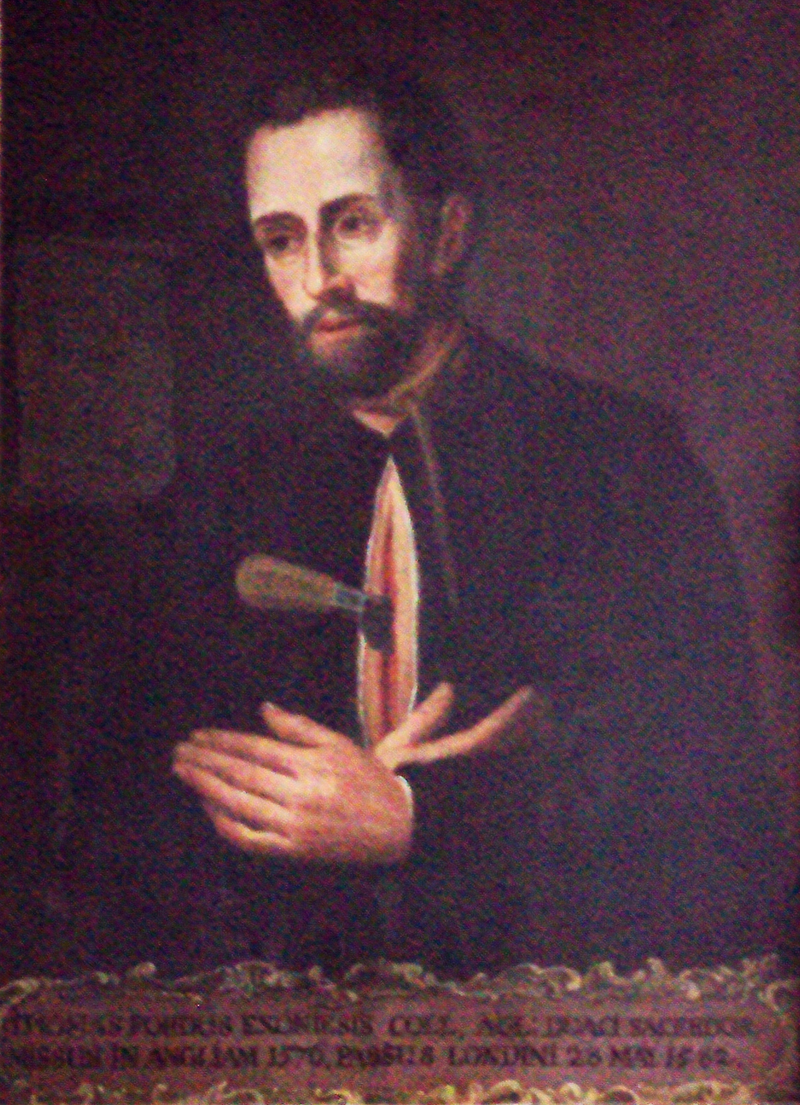
Image Credit (Public Domain): Portrait of Blessed Thomas Ford in The English Convent in Bruges (NB: the long wound on his chest and the knife protruding, signifying that he was disemboweled at his execution.)

Monday, July 6, 2020

This Morning: Last Words at Tyburn

Just a reminder that I'll be on the Son Rise Morning Show at about 7:50 a.m. Eastern/6:50 a.m. Central to continue our series on the 40 Martyrs of England and Wales. Anna Mitchell and I will discuss Saints Campion, Briant, and Sherwin, three of the most well-known martyrs of the Elizabethan era, primarily because of the greatness of St. Edmund Campion, SJ.

Please listen live here; the podcast will be archived here.

Richard Simpson researched and published the martyrs' last words at Tyburn on December 1, 1581 (pp 451-457) in his biography of Edmund Campion:

Campion suffered first. Before his execution, he proclaimed:

"I am a Catholic man and a priest; in that faith have I lived, and in that faith do I intend to die. If you esteem my religion treason, then am I guilty; as for other treason, I never committed any, God is my judge. But you have now what you desire. I beseech you to have patience, and suffer me to speak a word or two for discharge of my conscience."

He was not allowed to continue and his execution was almost another trial as he was questioned again about his loyalty to the Pope as the head of the Catholic Church and/or to the Queen of England. His final statement was:

"Wherein have I offended her? In this I am innocent. This is my last speech; in this give me credit — I have and do pray for her." Then the Lord Charles Howard asked of him for which queen he prayed, whether for Elizabeth the queen. To whom he answered, "Yea, for Elizabeth, your queen and my queen, unto whom I wish a long quiet reign with all prosperity." 

After Campion was butchered (although he may have been dead after hanging), it was Ralph Sherwin's turn:

When he had done with Campion, the hangman, with his hands and bare arms all bloody, seized hold on the next victim, saying to him, "Come, Sherwin, take thou also thy wages." But the martyr, nothing dismayed, reverently kissed the blood on his hands, and climbed up into the cart, where he stood some moments in prayer, with his eyes shut and hands lifted up to heaven. Then he asked if the people looked for any speech from him. Many of the people and some of the more honourable sort crying out "Yes," he began, with a manly courage and loud voice, first to render thanks to each of the three Persons of the Eternal Trinity for the mercies and blessings bestowed upon him; and then was about to give an account of his faith, when Sir Francis Knowles bade him confess his treason. "I am innocent of any such crime," was his reply. Being farther pressed, he said, "I have no occasion to tell a lie: it is a case where my soul is at stake ; and although in this short time of mortal life I am to undergo the infamy and punishment of a traitor, I make no doubt of my future happiness through Jesus Christ, in whose death, passion, and blood I only trust." 

He was again pressed to acknowledge his guilt and finally said:

"If to be a Catholic only, if to be a perfect Catholic, is to be a traitor, then am I a traitor."

Before he was hanged he proclaimed: "Jesu, Jesu, Jesu, be to me a Jesus!"

And finally, Briant:

After his butchery it was Briant's turn. He spoke little, making only a brief profession of faith and protestation of innocency from all offence, not only in deed, but in thought, against the Queen. But with his innocent and angelic face — he was a very fair young man, not more than twenty-eight years of age — he greatly affected all who saw him, especially when he said that he rejoiced exceedingly that God had chosen him and made him worthy to suffer death for the Catholic faith in company with Father Campion, whom he revered with all his heart. And, indeed, it was only his intimacy with the Fathers, and his refusal, amidst the most exquisite tortures, to reveal anything about them, that was the real cause of his death.

Saint Edmund Campion, pray for us!
Saint Ralph Sherwin, pray for us!
Saint Alexander Briant, pray for us!

Friday, July 3, 2020

Preview: Saints Edmund Campion, Alexander Briant and Ralph Sherwin

On Monday, July 6 (the 485th anniversary of St. Thomas More's execution), Anna Mitchell and I will discuss the martyrs of 1581 in the group of the 40 Martyrs of England and Wales: the Jesuits Edmund Campion and Alexander Briant and the secular priest Ralph Sherwin, who were all hanged, drawn, and quartered on December 1, 1581.

I'll be on the air at about 7:50 a.m. Eastern/6:50 a.m. Central time. Please listen live here; the podcast will be archived here.

St. Edmund Campion was born on January 25, 1540 in London, the son of a bookseller. He was raised a Catholic--making a speech for Queen Mary I in London--given a scholarship to St. John's College, Oxford when fifteen, and becoming a fellow when only seventeen. His brilliance attracted the attention of such leading personages as the Earl of Leicester, Robert Cecil, and even Queen Elizabeth. He took the Oath of Supremacy acknowledging Elizabeth head of the church in England and became an Anglican deacon in 1564. After studying the Fathers of the Church he reverted to Catholicism. Forced to flee the persecution unleashed on Catholics by the excommunication of Elizabeth by Pope Pius V, he went to Douai, France, where he studied theology, joined the Jesuits, and then went to Brno, Bohemia, the following year for his novitiate. He taught at the college of Prague and in 1578 was ordained there. 

He and Father Robert Persons were the first Jesuits chosen for the English mission and were sent to England in 1580. His activities among the Catholics, the distribution of his Decem rationes (Ten Reasons) at the University Church of St. Mary the Virgin in Oxford, and the premature publication of his famous Brag (which he had written to present his case if he was captured) made him the object of one of the most intense manhunts in English history. He was betrayed at Lyford, near Oxford, imprisoned in the Tower of London, and when he refused to apostatize when offered rich inducements to do so, was tortured. Accepting his challenge to debate his Ten Reasons, Anglican divines found themselves defeated in public sessions and continued them in private. 

St. Alexander Briant (1556-1581) was a diocesan priest who entered the Jesuits just before he was executed. He studied at Oxford at Hertford (then Hart Hall) College where he met and became a follower of Robert Parsons at Balliol who later became a Jesuit and slipped into England with Campion. Briant crossed the Channel in August 1577 to attend the English College at Douai where he was reconciled to the Catholic Church. He was ordained in 1578 and in August 1579 returned to his homeland and took up ministry in his native shire (Somerset). He was only able to care for Catholics for two years before priest-hunters caught him by accident.

They searched unsuccessfully for Fr. Persons in one house, and then went to a neighboring house where they discovered Fr. Briant. His captors kept him without food and with little to drink for six days hoping to force information from him about Persons. He refused to speak so he was transferred to the Tower for further interrogation and torture on the rack. He wrote to the English Jesuits about his torture, saying that he kept his mind so firmly set on Christ's Passion that he felt no pain during the torture, only afterwards. He also wrote that just before he was tortured a second time, he had determined to enter the Jesuits if he were released from prison. However, since he doubted that he would be released, he asked to be accepted into the Society. The Jesuits accepted him upon receiving his letter.

St. Alexander Briant had carved a small wooden cross and held it in his hands in the courtroom. When one of the judges took it from him (Why?) he said, "You can take it out of my hands, but not out of my heart." Taking the cross from him seems an act of petty cruelty. I guess when you've tortured a man so much that the man using the rack boasts that the victim will be a foot longer, you'll do just about anything.

St. Ralph Sherwin was born 1550 in Rodsley, Derbyshire. Ralph Sherwin was the nephew of John Woodward, rector of Ingatestone in Essex from 1556 to 1566. In 1568, Sir William Petre of Ingatestone Hall, nominated Ralph to one of eight fellowships he had founded at Exeter College, Oxford; Ralph took his MA there in 1574.

Brought up as a Protestant, Ralph converted to the Catholic faith in 1575, and went to the English college at Douai where he was ordained in 1577. He continued his studies at the English College in Rome, his name being the first in the College register. When an oath requiring students to consent to the English mission was required, Ralph readily agreed, saying, "Today rather than tomorrow."

Ralph returned to England on August 1, 1580, but on November 9, 1580 he was arrested in London and committed to the Marshalsea prison. He was transferred to the Tower of London where he was alternately tortured on the rack and thrown out into the December snow. He was once kept upon the rack for five consecutive days without food. He was offered a bishopric if he would conform to the authorized religion, but refused. He wrote a letter to his uncle, John Woodward, saying, "Innocency is my only comfort against all the forged villainy which is fathered on my fellow priests and me." 

Campion, Briant, Sherwin, and many other priests were all tried for treason against Queen Elizabeth in a fictitious conspiracy the government called the Rome and Rheims Plot, designating the cities in which they, with William Allen and others, plotted to raise a rebellion against the government, depose Elizabeth, and reestablish Catholicism in England. There was no plot and the men could provide evidence that they weren't in either Rome or Rheims when they were supposed to be plotting this coup d'etat. They were really being tried because they were Catholic priests in England before it was against the law to be a Catholic priest in England. The Rome and Rheims Plot was a dress rehearsal for the Popish Plot, except that the government concocted the plot itself.

When they were found guilty, St. Edmund Campion told the judges: "In condemning us you condemn all your own ancestors--all the ancient priests, bishops, and kings--all that was once the glory of England, the island of saints, and the most devoted child of the See of Peter. For what have we taught, however you may qualify it with the odious name of treason, that they did not uniformly teach? To be condemned with these lights--not of England only, but of the world--by their degenerate descendants, is both gladness and glory to us." Upon hearing the sentence of death, the three sang "Te Deum Laudamus".

At least two conversions resulted from Saint Edmund Campion's trial and death--and two are among the 40 Martyrs of England and Wales--Saint Philip Howard and Saint Henry Walpole, SJ.

Saint Luke Kirby, another of the 40 Martyrs of England and Wales, was executed on the same false charge of treason on May 30, 1582 with Blesseds William Filby, Lawrence Johnson, and Thomas Cottam SJ. Two days before, four other Blessed Martyrs were executed: Blesseds Thomas Ford, Lawrence Richardson, John Shert, and Robert Johnson; all these supposed Rome and Rheims conspirators were beatified in 1886 by Pope Leo XIII. One of the priests found guiltyJames Bosgravewas exiled at the request of the King of Poland Stephen Báthory, Queen Anna Jagiellon's husband. Bosgrave died in 1621.

Tuesday, June 30, 2020

Sir Francis Tregian and Thomas Pounde, SJ

Sir Francis Tregian, who was imprisoned for almost thirty years after the execution of St. Cuthbert Mayne on November 29, 1577, finally released after Elizabeth I's death in 1603 with the accession of King James VI of Scotland, was sent a poem by another prisoner he shared incarceration in Marshalsea Prison, Thomas Pounde, the Jesuit lay brother sometime after December 1, 1581. Pounde was also in prison for almost 30 years, moving around quite a bit:

b. at Beaumond (or Belmony), Farlington, Hampshire, 29 May, 1538; d. there, 26 Feb., 1612-13; eldest son of William Pounde and Helen, sister or half-sister to Thomas Wriothesley, Earl of Southampton. He is reported to have been educated at Winchester College. He was admitted to Lincoln's Inn, 16 Feb., 1559-60, and his father dying the same month, he then succeeded to Beaumond, and soon after was appointed esquire of the body to Queen Elizabeth. He acted the part of Mercury in Gascoigne's Masque, performed before the queen at Kenilworth in 1565. During the reveries (sic) of Christmastide, 1551, after dancing before the queen, he received a public affront from her, which induced him to retire from the court.

Shortly afterwards he was reconciled to the Church, probably by Father Henry Alway, and after some time of seclusion at Beaumond, began an active career as a proselytizer. He was in the Marshallsea for six month in 1574; in Winchester Gaol for some months in 1575-6; and in the Marshallsea again from 9 March, 1575-76. to 18 Sept., 1580, being made a Jesuit lay-brother by a letter dated 1 Dec., 1578 from the Father-General Mercurian, sent at the instance of Father Thomas Stevens, S.J., the first Englishman to go to India. From the Marshalsea Pounde was removed to Bishop's Stortford Castle, and thence to Wisbech. Then he was in the Tower of London, 13 Aug., 1581 to 7 Dec., 1585. He was in the White Lion, Southwark, from 1 Sept., 1586, till he was sent back to Wisbech in 1587, where he remained nearly ten years. He was again in the Tower of London, from Feb., 1596-7, to the autumn of 1598, when he was again committed to Wisbech. From Wisbech he was relegated to Wood Street Counter where he remained for six weeks from 19 Dec., 1598. After that he was in the Tower again until 7 July, 1601. He was then in Framlingham castle for a year. In 1602 he was in Newgate, and in the following year he was indicted at York. Afterwards he was in the Gatehouse, Westminster, for some time, and then in the Tower (for the fourth time) for four months, and lastly in the Fleet for three months. He was finally liberated in late 1604 or early in 1605, having spent nearly thirty years in prison. These facts are but the dry bones of the career of an heroic man, whose real biography has yet to be written. . . .

Note Pounde's early Court experience in performance before Queen Elizabeth I. He was also a poet, who sent--from the Tower of London--a long poem commemorating the martyrdom of Saint Edmund Campion, SJ and companions to Tregian, then held in the Fleet Prison. The 19th century convert and biographer of then Blessed Edmund Campion, Richard Simpson, discovered the poem.

The text may be found in Robert S. Miola's Early Modern Catholicism: An Anthology of Primary Sources.

Since Saints Edmund Campion, SJ, Ralph Sherwin, and Alexander Briant, SJ will be the next subjects in our series on the 40 Martyrs of England and Wales on the Son Rise Morning Show (Monday, July 6), this poem and its provenance is a nice link in the chain between the martyrs. Look for the preview of this episode on the First Friday of July this week.