Showing posts with label Reign of Terror. Show all posts

Friday, July 17, 2020

Blessed Carmelite Martyrs of Compiegne


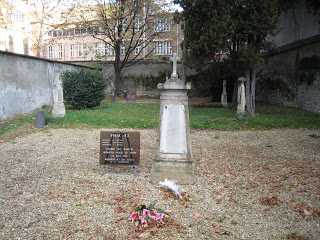
Ten years ago this November, I visited the graves of the Blessed Carmelite Martyrs of Compiegne--the mass graves behind a gate and wall in Picpus Cemetery (more than one thousand victims of the Reign of Terror were dumped into those graves between June 14 and July 18, 1794 after being beheaded at Place du Trone-Renverse, today Place de la Nation, which I also visited that day):

Just outside that wall was the grave marker for Lafayette and his wife:


And also nearby was the gate through which their decapitated bodies were brought in a wagon to be dumped without prayers or ceremony:


I also visited the Chapel of Our Lady of Peace, Notre-Dame-de-la-Paix, before entering the cemetery park grounds:


And there, I tried to take a picture of the massive memorial to all those executed that summer:


Among the names:

Mother Teresa of St. Augustine, prioress
Mother St. Louis, sub-prioress
Mother Henriette of Jesus, ex-prioress
Sister Mary of Jesus Crucified
Sister Charlotte of the Resurrection, ex-sub-prioress and sacristan
Sister Euphrasia of the Immaculate Conception
Sister Teresa of the Sacred Heart of Mary
Sister Julie Louise of Jesus, widow
Sister Teresa of St. Ignatius
Sister Mary-Henrietta of Providence
Sister Constance, novice
Sister St. Martha
Sister Mary of the Holy Spirit
Sister St. Francis Xavier
Catherine Soiron
Thérèse Soiron

The date of their feast is so historically and liturgically appropriate: yesterday was the feast of Our Lady of Mount Carmel, so they were able to celebrate the Carmelite Order's devotion to Our Lady; three days before was the anniversary of the fall of the Bastille, which is now celebrated as the Fête nationale of France. and ten days later the Reign of Terror ended.

Blessed Carmelite Martyrs of Compiegne, pray for us!

Wednesday, July 17, 2013

The Carmelite Martyrs of Compiegne on the Son Rise Morning Show


Today I'll be on the Son Rise Morning Show at 6:45 a.m. Central/7:45 a.m. Eastern because this is the memorial (in France) of the Carmelite martyrs of Compiegne, victims of the Committee for Public Safety and French Revolution, executed in Paris in 1794. Brian Patrick and I will discuss the sacrificial martyrdom of these Carmelites, who swore to offer their deaths for the peace of France. The Catholic martyrs of the French Revolution are probably as little known as the martyrs of the English Reformation have been, although I hope I've made a dent in that ignorance. Many priests and nuns suffered torture, execution--and exile during the Reign of Terror.

The Carmelites' story also has a great connection to the English Reformation and the Dissolution of the Monasteries. The exiled French priests and nuns who fled the Civil Constitution of the Clergy and the dangers of the Terror provoked feelings of sympathy in England. The fact that they were allowed to practice their faith while English Catholics were not contributed to the Catholic Relief movement in Parliament. Among those exiles were actually English Benedictine nuns from Cambrai--they were English nuns in exile on the Continent who then founded a new monastery at Stanbrook Abbey. The foundress of the Cambrai house was none other than Helen More, the great-great-granddaughter of St. Thomas More. Her name in religion became Dame Gertrude More. The Benedictines of Our Lady of Comfort in Cambrai wore the secular clothing of the Carmelites on their journey "home". Stanbrook Abbey was the inspiration for Rumer Godden's novel, In This House of Brede, one of my favorite books. According to her New York Time's obituary:

To do research on ''In This House of Brede,'' Ms. Godden lived for three years near Stanbrook Abbey. Her experience with the nuns there contributed to her decision to convert to Roman Catholicism in 1968. In many of her stories and novels, Ms. Godden would write about the rewards and perils of the contemplative life.

A couple of years ago, I went on a mini-pilgrimage in Paris to the site of the Blessed Carmelites' execution and then to the cemetery behind which their remains were dumped into mass graves: here are links to those posts: the site of execution and the chapel at Picpus, the cemetery grounds at Picpus, and the mass graves.

There were sixteen martyrs in all on July 17, 1794:

Choir Nuns
Mother Teresa of St. Augustine, prioress (Madeleine-Claudine Ledoine) b. 1752
Mother St. Louis, sub-prioress (Marie-Anne [or Antoinett] Brideau) b. 1752
Mother Henriette of Jesus, ex-prioress (Marie-Françoise Gabrielle de Croissy) b. 1745
Sister Mary of Jesus Crucified (Marie-Anne Piedcourt) b. 1715
Sister Charlotte of the Resurrection, ex-sub-prioress and sacristan (Anne-Marie-Madeleine Thouret) b. 1715
Sister Euphrasia of the Immaculate Conception (Marie-Claude Cyprienne) b. 1736
Sister Teresa of the Sacred Heart of Mary (Marie-Antoniette Hanisset) b. 1740
Sister Julie Louise of Jesus, widow (Rose-Chrétien de la Neuville) b. 1741
Sister Teresa of St. Ignatius (Marie-Gabrielle Trézel) b. 1743
Sister Mary-Henrietta of Providence (Anne Petras) b. 1760
Sister Constance, novice (Marie-Geneviève Meunier) b. 1765

Lay Sisters
Sister St. Martha (Marie Dufour) b. 1742
Sister Mary of the Holy Spirit (Angélique Roussel) b. 1742
Sister St. Francis Xavier (Julie Vérolot) b. 1764

Externs:
Catherine Soiron b. 1742
Thérèse Soiron b. 1748

[Image Source: wikipedia commons--from the Carmel in Quidenham, Norfolk!]

Thursday, May 30, 2013

Preview of July/August "The Catholic Answer Magazine"


There's my story about the Blessed Carmelite Martyrs of Compiegne on the cover of the July/August issue--illustrated with a scene from Poulenc's Dialogues of the Carmelites!

Watch this space for more information!

Just a little sample from the beginning of the article:

A visitor in Paris today might arrive at the Place de la Nation, a hub of transportation and commerce on the right bank of the Seine River and never know about the Revolutionary deeds of blood committed there.

Restaurants, taxis and buses ring around the Place de la Nation and its statue depicting Marianne, the symbol of the Republic, while locals walk their dogs in the park. But here, in the last hot summer of the French Revolution’s Reign of Terror, on July 17, 1794, fourteen nuns, three lay sisters and two servants of the Carmelite house of Compiègne died for their Catholic Faith.

What brought them to such a bloody end beneath the blade of the guillotine the day after the Feast of Our Lady of Mount Carmel? The answer might be surprising if we presume the ideals of liberty, fraternity and equality truly summarize the spirit of the French Revolution. After the fall of the traditional, absolute monarchy and the rise of the National Assembly with a constitutional monarchy in 1789, the state attacked the Catholic Church, confiscating churches and closing convents. . . .

That introduction is based upon my pilgrimage to the site of the Carmelites' execution and to their place of burial at Cimitiere de Picpus (in November of 2010).