Showing posts with label Christ the King. Show all posts

Tuesday, June 9, 2026

Learning Something New, Again: The Origins of a Famous Hymn

Pope Pius XI instituted the Solemnity of Christ the King in 1925 (we covered it last year during the Son Rise Morning Show survey of anniversaries). In the last paragraphs of Quas Primas, he outlined the fruits of the celebration of this new feast and devotion:
30. We would now, Venerable Brethren, in closing this letter, briefly enumerate the blessings which We hope and pray may accrue to the Church, to society, and to each one of the faithful, as a result of the public veneration of the Kingship of Christ.

31. When we pay honor to the princely dignity of Christ, men will doubtless be reminded that the Church, founded by Christ as a perfect society, has a natural and inalienable right to perfect freedom and immunity from the power of the state; and that in fulfilling the task committed to her by God of teaching, ruling, and guiding to eternal bliss those who belong to the kingdom of Christ, she cannot be subject to any external power. The State is bound to extend similar freedom to the orders and communities of religious of either sex, who give most valuable help to the Bishops of the Church by laboring for the extension and the establishment of the kingdom of Christ. By their sacred vows they fight against the threefold concupiscence of the world; by making profession of a more perfect life they render the holiness which her divine Founder willed should be a mark and characteristic of his Church more striking and more conspicuous in the eyes of all.

32. Nations will be reminded by the annual celebration of this feast that not only private individuals but also rulers and princes are bound to give public honor and obedience to Christ. It will call to their minds the thought of the last judgment, wherein Christ, who has been cast out of public life, despised, neglected and ignored, will most severely avenge these insults; for his kingly dignity demands that the State should take account of the commandments of God and of Christian principles, both in making laws and in administering justice, and also in providing for the young a sound moral education.
33. The faithful, moreover, by meditating upon these truths, will gain much strength and courage, enabling them to form their lives after the true Christian ideal. If to Christ our Lord is given all power in heaven and on earth; if all men, purchased by his precious blood, are by a new right subjected to his dominion; if this power embraces all men, it must be clear that not one of our faculties is exempt from his empire. He must reign in our minds, which should assent with perfect submission and firm belief to revealed truths and to the doctrines of Christ. He must reign in our wills, which should obey the laws and precepts of God. He must reign in our hearts, which should spurn natural desires and love God above all things, and cleave to him alone. He must reign in our bodies and in our members, which should serve as instruments for the interior sanctification of our souls, or to use the words of the Apostle Paul, as instruments of justice unto God. (Romans 6:13) If all these truths are presented to the faithful for their consideration, they will prove a powerful incentive to perfection. It is Our fervent desire, Venerable Brethren, that those who are without the fold may seek after and accept the sweet yoke of Christ, and that we, who by the mercy of God are of the household of the faith, may bear that yoke, not as a burden but with joy, with love, with devotion; that having lived our lives in accordance with the laws of God's kingdom, we may receive full measure of good fruit, and counted by Christ good and faithful servants, we may be rendered partakers of eternal bliss and glory with him in his heavenly kingdom.
What I remember most about the celebration of this feast when I was growing up here in the USA is homilies starting with the idea that we US citizens might have trouble understanding the concept of kingship, used as we are to an elected, not hereditary, executive, etc. But reading this article from the Adoremus bulletin by John William Davis demonstrated a far greater insight from a German-born priest in Saint Louis, Missouri in the lates 1930's/early 1940's. As Davis explains, it was another encyclical by Pope Pius XI that inspired Father Martin B. Hellriegel (1890-1981):
Far away in the little Baden neighborhood of St. Loius (sic), MO, an American community settled by Germans on the banks of the Mississippi, a parish priest was composing a song that would strike the Nazi a blow from which they would never recover. Father Martin Hellriegel, a German immigrant and pastor to several communities in the St. Louis, MO area, considered the rise of racial nationalism in his former homeland. As Hellriegel read in the 1937 papal encyclical of Pius XI, Mit brennender Sorge (With Burning Anxiety), the only Encyclical ever issued in the German language, the Pope outlined how Germans had lost their way. . . . The new German paganism maintained “revelation” was not God’s word to man, but suggested rather the triumph of a master race over lesser peoples. The Pope further noted that to suggest—as the Nazi did of Hitler—that even the greatest of men was on a par with Christ, our Savior from sin and death, would be to make that man a “Prophet of Nothingness.”
As the rest of the article explains Father Hellriegel brilliantly chose a familiar hymn tune, ICH GLAUB AN GOTT, and wrote clear, simple lyrics to remind his German congregations to Whom they owed true loyalty and fidelity:

To Jesus Christ, our Sov'reign King,
Who is the world's salvation,
All praise and homage do we bring,
And thanks and adoration.

Refrain:
Christ Jesus Victor, Christ Jesus Ruler!
Christ Jesus, Lord and Redeemer!

2. Thy reign extend, O King benign,
To ev'ry land and nation,
For in Thy kingdom, Lord divine,
Alone we find salvation.
(Refrain)

3. To Thee and to Thy Church, great King,
We pledge our hearts' oblation,
Until before Thy throne we sing,
In endless jubilation.
(Refrain)

Please read the rest of the article there. It seems to me that Father Hellriegel applied paragraphs 31 through 33 of Quas Primas very well to his hymn.

Sunday, October 25, 2020

Today: The 40 at 50


Today is the 50th anniversary of the canonization of the 40 Martyrs of England and Wales in Rome by Pope Paul VI.

The Bishop of Plymouth, Mark O'Toole, issued a Pastoral Letter:

This weekend we mark an historic moment - the fiftieth anniversary of the Canonisation of the forty martyrs of England and Wales, which took place on 25th October 1970. On that occasion, Pope Paul VI reminded us:

"We have among the 40 holy Martyrs secular and regular priests, religious of various orders, and of different rank, lay people of very noble descent, as well as of modest condition; we have women who were married, mothers with a family. What unites them all is that interior attitude of fidelity to the call of God asked of them, as an answer of love…….The drama of the existence of these martyrs, was that their honest and sincere loyalty to the civil authority came to be in conflict with fidelity to God and with what, according to the dictates of their conscience illuminated by the Catholic faith, they knew to involve the revealed truths, especially to the Holy Eucharist and on the inalienable prerogatives of the successor of Peter, who, at the behest of God, is the universal Pastor of the Church of Christ." (Pope Paul VI, Homily at the Canonisation of the Forty Martyrs)

Bishop O'Toole then highlighted the diocesan martyr among the 40, St. Cuthbert Mayne:

Today, as we keep the memory of this great and well-loved saint, we see where his martyrdom can be truly rooted. It is founded on the death of Jesus, on His supreme sacrifice of love, consummated on the Cross, that we might have life (cf. Jn 10: 10). It is these two truths - the sacrifice of Jesus manifest anew in the sacrifice of the Mass and communion with the Holy Father - for which he and so many others died. These two truths have, for many centuries, been the hallmarks of the Catholic Faith in these islands.

St Cuthbert's strength to face martyrdom, came from his deep and intimate union with Jesus Christ. We know that in the months he spent in the dark prison cell in Launceston Castle, before his death, St. Cuthbert never lost heart. He spent his long wait by encouraging his fellow prisoners. He often fell on his knees to say his prayers, which lasted far into the night. On one occasion, just after midnight, it is recorded, St. Cuthbert was meditating and praying, and suddenly a bright light shone around him, lighting up the terrible wall of the dungeon. It awakened the other prisoners who wondered where the light was coming from. St. Cuthbert gently told them to go back to sleep and would not talk about it the following day. A miraculous consolation had been given to him in his dismal dungeon. Indeed, the Holy Spirit was preparing him for an eloquence beyond human speech.

At the Jesuits in Britain website, Father Dennis Blackledge shares his memories of the canonization, which he attended. The Arundel Cathedral website offers a downloadable booklet for a Votive Mass celebrating the anniversary which includes brief biographies of each of the martyrs.

On the Calendar of the Roman Missal of 1962 for the Extraordinary Form of the Latin Mass, today is the Feast of Christ the King as established by Pope Pius XI in 1925:

28. Therefore by Our Apostolic Authority We institute the Feast of the Kingship of Our Lord Jesus Christ to be observed yearly throughout the whole world on the last Sunday of the month of October - the Sunday, that is, which immediately precedes the Feast of All Saints. We further ordain that the dedication of mankind to the Sacred Heart of Jesus, which Our predecessor of saintly memory, Pope Pius X, commanded to be renewed yearly, be made annually on that day. This year, however, We desire that it be observed on the thirty-first day of the month on which day We Ourselves shall celebrate pontifically in honor of the kingship of Christ, and shall command that the same dedication be performed in Our presence. It seems to Us that We cannot in a more fitting manner close this Holy Year, nor better signify Our gratitude and that of the whole of the Catholic world to Christ the immortal King of ages, for the blessings showered upon Us, upon the Church, and upon the Catholic world during this holy period.

29. It is not necessary, Venerable Brethren, that We should explain to you at any length why We have decreed that this feast of the Kingship of Christ should be observed in addition to those other feasts in which his kingly dignity is already signified and celebrated. It will suffice to remark that although in all the feasts of our Lord the material object of worship is Christ, nevertheless their formal object is something quite distinct from his royal title and dignity. We have commanded its observance on a Sunday in order that not only the clergy may perform their duty by saying Mass and reciting the Office, but that the laity too, free from their daily tasks, may in a spirit of holy joy give ample testimony of their obedience and subjection to Christ. The last Sunday of October seemed the most convenient of all for this purpose, because it is at the end of the liturgical year, and thus the feast of the Kingship of Christ sets the crowning glory upon the mysteries of the life of Christ already commemorated during the year, and, before celebrating the triumph of all the Saints, we proclaim and extol the glory of him who triumphs in all the Saints and in all the Elect. Make it your duty and your task, Venerable Brethren, to see that sermons are preached to the people in every parish to teach them the meaning and the importance of this feast, that they may so order their lives as to be worthy of faithful and obedient subjects of the Divine King.

You might remember that it was Pope Pius XI who beatified 29 of the 40 Martyrs of England and Wales in 1929 and who canonized Saint John Fisher and Saint Thomas More in 1935. 

These 40 Martyrs of England and Wales truly knew what King they served and to whom they owed faithful obedience! Here is a Litany of these Saints (for private devotion).

Christ the King, have mercy on us!
Holy Martyrs of England and Wales, pray for us!

Image Credit for Christ in Majesty: Romanesque illuminated manuscript Gospel Book, c.1220 (public domain).

Sunday, October 30, 2016

Newman on Christ the King


Today in the Extraordinary Form, we celebrate the Feast of the Kingship of Our Lord Jesus Christ. While he was an Anglican, Blessed John Henry Newman preached about Jesus as King:

Yet it must be borne in mind, that even before He entered into His glory, Christ spoke and acted as a King. It must not be supposed that, even in the days of His flesh, He could forget who He was, or "behave Himself unseemly" by any weak submission to the will of the Jewish people. Even in the lowest acts of His self-abasement, still He showed His greatness. Consider His conduct when He washed St. Peter's feet, and see if it were not calculated (assuredly it was) to humble, to awe, and subdue the very person to whom He ministered. When He taught, warned, pitied, prayed for, His ignorant hearers, He never allowed them to relax their reverence or to overlook His condescension. Nay, He did not allow them to praise Him aloud, and publish His acts of grace; as if what is called popularity would be a dishonour to His holy name, and the applause of men would imply their right to censure. The world's praise is akin to contempt. Our Lord delights in the tribute of the secret heart. Such was His conduct in the days of His flesh. Does it not interpret His dealings with us after His resurrection? He who was so reserved in His communications of Himself, even when He came to minister, much more would withdraw Himself from the eyes of men when He was exalted over all things.

I have said, that even when a servant, Christ spoke with the authority of a king; and have given you some proof of it. But it may be well to dwell upon this. Observe then, the difference between His promises, stated doctrinally and generally, and His mode of addressing those who came actually before Him. While He announced God's willingness to forgive all repentant sinners, in all the fulness of loving-kindness and tender mercy, yet He did not use supplication to these persons or those, whatever their number or their rank might be. He spoke as one who knew He had great favours to confer, and had nothing to gain from those who received them. Far from urging them to accept His bounty, He showed Himself even backward to confer it, inquired into their knowledge and motives, and cautioned them against entering His service without counting the cost of it. Thus sometimes He even repelled men from Him.

For instance: When there went "great multitudes with Him ... He turned and said unto them, If any man come to Me, and hate not his father and mother, and wife and children, and brothers and sisters, yea, and his own life also, he cannot be My disciple." These were not the words of one who courted popularity. He proceeds;—"Which of you intending to build a tower, sitteth not down first, and counteth the cost, whether he have sufficient to finish it? ... So likewise, whosoever he be of you, that forsaketh not all that he hath, he cannot be My disciple." [Luke xiv. 25-33.] On the other hand, observe His conduct to the powerful men, and the learned Scribes and Pharisees. There are persons who look up to human power, and who are pleased to associate their names with the accomplished and cultivated of this world. Our blessed Lord was as inflexible towards these, as towards the crowds which followed Him. They asked for a sign; He named them "an evil and adulterous generation," who refused to profit by what they had already received [Matt. xii. 39; xxi. 23-27.]. They asked Him, whether He did not confess Himself to be One with God; but He, rather than tell such proud disputers, seemed even to abandon His own real claim, and made His former clear words ambiguous [Note 1]. Such was the King of Israel in the eyes both of the multitude and of their rulers; a "hard saying," a "rock of offence even to the disobedient," who came to Him "with their lips, while their hearts were far from Him." Continue this survey to the case of individuals, and it will still appear, that, loving and merciful as He was most abundantly, yet still He showed both His power and His grace with reserve, even to them, as well as to the fickle many, or the unbelieving Pharisees.

Read the rest there.

Image: Jesus before Pilate (Duccio)

Sunday, October 23, 2016

Christ the King

Next Sunday, the last Sunday of October, on the Calendar for the Extraordinary Form of the Latin Rite, will be the Feast of The Kingship of Our Lord Jesus Christ.  I wrote about that Feast and the celebration of the Solemnity of Jesus Christ, King of the Universe in the Ordinary Form--which falls on Sunday, November 20 this year, for the National Catholic Register:

My husband and I attend Sunday Mass in both forms of the Roman Rite: the Ordinary Form in the vernacular and the Extraordinary Form in Latin. Because we have this opportunity, at least partially because of Pope Benedict XVI’s 2007 Summorum Pontificum, and mostly because of the generosity of several priests, we will celebrate the feast of Christ the King twice this fall—once before Election Day and once after. Thus, no matter who is elected President, Christ will be King.

1925: Pope Pius XI

On the Extraordinary Form calendar the Feast of the Kingship of Our Lord Jesus Christ is celebrated on the last Sunday of October. Pope Pius XI issued the encyclical “Quas Primas” on December 11, 1925 to establish the feast and provided this reason for its scheduling:
The last Sunday of October seemed the most convenient of all for this purpose, because it is at the end of the liturgical year, and thus the feast of the Kingship of Christ sets the crowning glory upon the mysteries of the life of Christ already commemorated during the year, and, before celebrating the triumph of all the Saints, we proclaim and extol the glory of him who triumphs in all the Saints and in all the Elect.
The propers of the Mass (Introit, Collect, Epistle, Gradual, Alleluia, Gospel, Offertory, Secret, Communion Verse, and Post Communion prayer) all emphasize what Pope Pius XI stated as truths about Jesus Christ’s Kingship. He reigns as the maker and enforcer of Law; His Kingdom, as he told Pilate, is not of this world: it is “spiritual and concerned with spiritual things”; nevertheless, He is King of all the nations on earth, whether their citizens are Catholic or not, baptized or not, and He reigns as the King of peace.

Please read the rest there.

Image credit. (Christ Pantocrator (“ruler over all”) from the Hagia Sophia in Instanbul)

Monday, November 23, 2015

Blessed Miguel Pro, SJ--Viva Christo Rey!

How appropriate that Blessed Miguel Pro's memorial comes this year the day after the Solemnity of Our Lord Jesus Christ King of the Universe! He was executed by firing squad on November 23, 1927 after crying out "Viva Christo Rey"--"Long Live Christ the King"!

This brief EWTN biography sums up his life:

Miguel Pro was born January 13, 1891, at Guadalupe Zacatecas, Mexico. From his childhood, high spirits and happiness were the most outstanding characteristics of his personality. The loving and devoted son of a mining engineer and a pious and charitable mother, Miguel had a special affinity for the working classes which he retained all his life.

At 20, he became a Jesuit novice and shortly thereafter was exiled because of the Mexican revolution. He traveled to the United States, Spain, Nicaragua and Belgium, where he was ordained in 1925. Father Pro suffered greatly from a severe stomach problem and when, after several operations his health did not improve, in 1926 his superiors allowed him to return to Mexico in spite of the religious persecution in the country.

The churches were closed and priests were in hiding. Father Pro spent the rest of his life in a secret ministry to the sturdy Mexican Catholics. In addition to fulfilling their spiritual needs, he also carried out the works of mercy by assisting the poor of Mexico City with their temporal needs. He adopted many disguises to carry out his secret ministry. In all that he did, he remained filled with the joy of serving Christ, his King, and obedient to his superiors.

Falsely accused in a bombing attempt on the President-elect, Pro became a wanted man. He was betrayed to the police and sentenced to death without the benefit of any legal process.

On the day of his death, Father Pro forgave his executioners, prayed, bravely refused the blindfold, and died proclaiming "Long Live Christ the King!"

Christ the King, by the intercession of Blessed Miguel Pro, I beg you to answer my prayers. Give me the grace and the strength necessary to follow your heroic example and to live my Catholic faith in spite of all temptations and adversities. Amen.

Evelyn Waugh referenced Pro's martyrdom in the second edition of his biography, Edmund Campion, in 1946 (the first edition was in 1935). Waugh also refers to a nineteenth century biography of Campion by Richard Simpson:

We have come much nearer to Campion since Simpson's day. He wrote in the flood-tide of toleration with Elizabeth's persecution seemed as remote as Diocletian's. We know now that his age was a brief truce in an unending war. The Martyrdom of Father Pro in Mexico re-enacted Campion's in faithful detail. We are nearer Campion then when I wrote of him. . . . The haunted, trapped, murdered priest is our contemporary and Campion's voice sounds to us across the centuries as though he were walking at our elbow.

Blessed Miguel Pro was not executed by being hung, drawn, and quartered, so that's not the "faithful detail" that Waugh highlights. The parallels between Campion and Pro are that they had served the Catholic people in disguise since their vocation as priest had been declared illegal by the state; that they were arrested and tried for a conspiracy that did not exist, and that they offered their lives for the true king of the world, Jesus Christ, and His Church.

Sunday, November 22, 2015

Christ the King and the English Martyrs


It was on the Solemnity of Jesus Christ the King of the Universe in 1987 (November 22 that year also, 28 years ago) that Blessed John Paul II beatified the Eighty-Five Martyrs of England and Wales:

This feast of Christ the King proclaims that all earthly power is ultimately from God, that his Kingdom is our first and lasting concern and that obedience to his laws is more important than any other obligation or loyalty.

Thomas More, that most English of saints, declared on the scaffold: “I die the King’s good servant but God’s servant first". In this way he witnessed to the primacy of the Kingdom. 

Today we have declared Blessed another eighty-five martyrs: from England, Scotland and Wales, and one from Ireland. Each of them chose to be "God’s servant First". They consciously and willingly embraced death for love of Christ and the Church. They too chose the Kingdom above all else. If the price had to be death they would pay it with courage and joy. 

Blessed Nicholas Postgate welcomed his execution "as a short cut to heaven". Blessed Joseph Lambton encouraged those who were to die with him with the words "Let us be merry, for tomorrow I hope we shall have a heavenly breakfast". Blessed Hugh Taylor, not knowing the day of his death, said: "How happy I should be if on this Friday, on which Christ died for me, I might encounter death for him". He was executed on that very day, Friday 6 November 1585. Blessed Henry Heath, who died in 1643, thanked the court for condemning him and giving him the "singular honour to die with Christ". 

Among these eighty-five martyrs we find priests and laymen, scholars and craftsmen. The oldest was in his eighties, and the youngest no more than twenty-four. There were among them a printer, a bartender, a stable-hand, a tailor. What unites them all is the sacrifice of their lives in the service of Christ their Lord. 

The priests among them wished only to feed their people with the Bread of Life and with the Word of the Gospel. To do so meant risking their lives. But for them this price was small compared to the riches they could bring to their people in the Holy Sacrifice of the Mass. 

The twenty-two laymen in this group of martyrs shared to the full the same love of the Eucharist. They, too, repeatedly risked their lives, working together with their priests, assisting, protecting and sheltering them. Laymen and priests worked together; together they stood on the scaffold and together welcomed death. Many women, too, not included today in this group of martyrs, suffered for their faith and died in prison. They have earned our undying admiration and remembrance. 

These martyrs gave their lives for their loyalty to the authority of the Successor of Peter, who alone is Pastor of the whole flock. They also gave their lives for the unity of the Church, since they shared the Church’s fait, unaltered down the ages, that the Successor of Peter has been given the task of serving and ensuring "the unity of the flock of Christ". He has been given by Christ the particular role of confirming the faith of his brethren. 

The martyrs grasped the importance of that Petrine ministry. They gave their lives rather than deny this truth of their faith. Over the centuries the Church in England, Wales and Scotland has drawn inspiration from these martyrs and continues in love of the Mass and in faithful adherence to the Bishop of Rome. The same loyalty and faithfulness to the Pope is demonstrated today whenever the work of renewal in the Church is carried out in accordance with the teachings of the Second Vatican Council and in communion with the universal Church. 

Central to this renewal, to which the Holy Spirit calls the Church, is work for that unity among Christians for which Christ himself prayed. We must all rejoice that the hostilities between Christians, which so shaped the age of these martyrs, are over, replaced by fraternal love and mutual esteem. 

Seventeen years ago forty of the glorious company of martyrs were canonized. It was the prayer of the Church on that day that the blood of those martyrs would be a source of healing for the divisions between Christians. Today we may fittingly give thanks for the progress made in the intervening years towards fuller communion between Anglicans and Catholics. We rejoice in the deeper understanding, broader collaboration and common witness that have taken place through the power of God. 

In the days of the martyrs whom we honour today, there were other Christians who died for their beliefs. We can all now appreciate and respect their sacrifice. Let us respond together to the great challenge which confronts those who would preach the Gospel in our age. Let us be bold and united in our profession of our common Lord and Master, Jesus Christ. 

Blessed Martyrs of England and Wales, pray for us!

Sunday, November 23, 2014

Christ the King


Today is the Solemnity of Christ the King of the Universe in the Ordinary Form; it is also the last Sunday of Ordinary Time--Advent begins next Sunday. In the Extraordinary Form we celebrated the Solemnity of Christ the King on the last Sunday of October, before the Solemnity of All Saints. The New Liturgical Movement site posted a link to an explanation of the different purposes of the different timings of this great solemnity--as originally intended by Pope Pius XI in 1925 and as intended after the Second Vatican Council:

Pius XI’s intention, as can be gleaned from n. 29 [of the Encyclical Letter Quas Primas, which proclaimed the feast], is to emphasize the glory of Christ as terminus of His earthly mission,a glory and mission visible and perpetuated in history by the saints. Hence the feast falls shortly before the Feast of All Saints, to emphasize that what Christ inaugurated in His own person before ascending in glory, the saints then instantiate and carry further in human society, culture, and nations. It is a feast primarily about celebrating Christ’s ongoing kingship over all reality, including this present world, where the Church must fight for the recognition of His rights, the actual extension of His dominion to all domains, individual and social.

Indeed, there's also the obvious fact, unmentioned in Quas Primas but surely in everyone's mind, that the last Sunday in October had, for centuries, been celebrated as Reformation Sunday. A Catholic counter-feast, reminding the world not only of the comprehensive Kingship of Jesus Christ—so often denied socially and culturally by various teachings of Protestantism—but also of the worldwide kingly authority of His Church, would certainly be a reasonable application of the principle lex orandi, lex credendi.

In the liturgical reforms following the Second Vatican Council, its place was changed to the last Sunday of the Church year—that is, so that one week later would fall the first Sunday of Advent. This new position emphasizes rather the eschatological dimension of Christ’s kingship: the Kingdom of Jesus Christ, though begun in time, is here present “as in a mystery” (as
Lumen Gentium phrases it) and in a “crucified” way. This Kingdom will be perfected and fully manifested only at the end of time, with the Second Coming. Hence in the new calendar the feast comes at the very end of the Church’s year, as the summation of the whole of salvation history and the symbol of what we hope for:expectantes … adventum salvatoris nostri Jesu Christi, as the liturgy in the Ordinary Form proclaims after the Lord’s Prayer.

Read the rest here.

Sunday, November 24, 2013

The Solemnity of Christ the King and the English Martyrs

It was on the Solemnity of Jesus Christ the King of the Universe in 1987 (November 22) that Blessed John Paul II beatified the Eighty-Five Martyrs of England and Wales:

This feast of Christ the King proclaims that all earthly power is ultimately from God, that his Kingdom is our first and lasting concern and that obedience to his laws is more important than any other obligation or loyalty.

Thomas More, that most English of saints, declared on the scaffold: “I die the King’s good servant but God’s servant first". In this way he witnessed to the primacy of the Kingdom.

Today we have declared Blessed another eighty-five martyrs: from England, Scotland and Wales, and one from Ireland. Each of them chose to be "God’s servant First". They consciously and willingly embraced death for love of Christ and the Church. They too chose the Kingdom above all else. If the price had to be death they would pay it with courage and joy.

Blessed Nicholas Postgate welcomed his execution "as a short cut to heaven". Blessed Joseph Lambton encouraged those who were to die with him with the words "Let us be merry, for tomorrow I hope we shall have a heavenly breakfast". Blessed Hugh Taylor, not knowing the day of his death, said: "How happy I should be if on this Friday, on which Christ died for me, I might encounter death for him". He was executed on that very day, Friday 6 November 1585. Blessed Henry Heath, who died in 1643, thanked the court for condemning him and giving him the "singular honour to die with Christ".

Among these eighty-five martyrs we find priests and laymen, scholars and craftsmen. The oldest was in his eighties, and the youngest no more than twenty-four. There were among them a printer, a bartender, a stable-hand, a tailor. What unites them all is the sacrifice of their lives in the service of Christ their Lord.

The priests among them wished only to feed their people with the Bread of Life and with the Word of the Gospel. To do so meant risking their lives. But for them this price was small compared to the riches they could bring to their people in the Holy Sacrifice of the Mass.

The twenty-two laymen in this group of martyrs shared to the full the same love of the Eucharist. They, too, repeatedly risked their lives, working together with their priests, assisting, protecting and sheltering them. Laymen and priests worked together; together they stood on the scaffold and together welcomed death. Many women, too, not included today in this group of martyrs, suffered for their faith and died in prison. They have earned our undying admiration and remembrance.

These martyrs gave their lives for their loyalty to the authority of the Successor of Peter, who alone is Pastor of the whole flock. They also gave their lives for the unity of the Church, since they shared the Church’s fait, unaltered down the ages, that the Successor of Peter has been given the task of serving and ensuring "the unity of the flock of Christ". He has been given by Christ the particular role of confirming the faith of his brethren.

The martyrs grasped the importance of that Petrine ministry. They gave their lives rather than deny this truth of their faith. Over the centuries the Church in England, Wales and Scotland has drawn inspiration from these martyrs and continues in love of the Mass and in faithful adherence to the Bishop of Rome. The same loyalty and faithfulness to the Pope is demonstrated today whenever the work of renewal in the Church is carried out in accordance with the teachings of the Second Vatican Council and in communion with the universal Church.

Central to this renewal, to which the Holy Spirit calls the Church, is work for that unity among Christians for which Christ himself prayed. We must all rejoice that the hostilities between Christians, which so shaped the age of these martyrs, are over, replaced by fraternal love and mutual esteem.

Seventeen years ago [1970] forty of the glorious company of martyrs were canonized. It was the prayer of the Church on that day that the blood of those martyrs would be a source of healing for the divisions between Christians. Today we may fittingly give thanks for the progress made in the intervening years towards fuller communion between Anglicans and Catholics. We rejoice in the deeper understanding, broader collaboration and common witness that have taken place through the power of God.

In the days of the martyrs whom we honour today, there were other Christians who died for their beliefs. We can all now appreciate and respect their sacrifice. Let us respond together to the great challenge which confronts those who would preach the Gospel in our age. Let us be bold and united in our profession of our common Lord and Master, Jesus Christ.

Last year the Archbishop of Westminster, Vincent Nichols, celebrated Mass in thanksgiving for the 25th anniversary of these beatifications--and in his sermon he noted the detail that 10,000 English Catholics attended the ceremony in Rome! You may find a link to his sermon here.

Blessed Martyrs of England and Wales, pray for us!

Wednesday, November 28, 2012

The "Octave" of Christ the King and the English Martyrs

It was on the Solemnity of Jesus Christ the King of the Universe in 1987 (November 22) that Blessed John Paul II beatified the Eighty-Five Martyrs of England and Wales:

This feast of Christ the King proclaims that all earthly power is ultimately from God, that his Kingdom is our first and lasting concern and that obedience to his laws is more important than any other obligation or loyalty.

Thomas More, that most English of saints, declared on the scaffold: “I die the King’s good servant but God’s servant first". In this way he witnessed to the primacy of the Kingdom.

Today we have declared Blessed another eighty-five martyrs: from England, Scotland and Wales, and one from Ireland. Each of them chose to be "God’s servant First". They consciously and willingly embraced death for love of Christ and the Church. They too chose the Kingdom above all else. If the price had to be death they would pay it with courage and joy.

Blessed Nicholas Postgate welcomed his execution "as a short cut to heaven". Blessed Joseph Lambton encouraged those who were to die with him with the words "Let us be merry, for tomorrow I hope we shall have a heavenly breakfast". Blessed Hugh Taylor, not knowing the day of his death, said: "How happy I should be if on this Friday, on which Christ died for me, I might encounter death for him". He was executed on that very day, Friday 6 November 1585. Blessed Henry Heath, who died in 1643, thanked the court for condemning him and giving him the "singular honour to die with Christ".

Among these eighty-five martyrs we find priests and laymen, scholars and craftsmen. The oldest was in his eighties, and the youngest no more than twenty-four. There were among them a printer, a bartender, a stable-hand, a tailor. What unites them all is the sacrifice of their lives in the service of Christ their Lord.

The priests among them wished only to feed their people with the Bread of Life and with the Word of the Gospel. To do so meant risking their lives. But for them this price was small compared to the riches they could bring to their people in the Holy Sacrifice of the Mass.

The twenty-two laymen in this group of martyrs shared to the full the same love of the Eucharist. They, too, repeatedly risked their lives, working together with their priests, assisting, protecting and sheltering them. Laymen and priests worked together; together they stood on the scaffold and together welcomed death. Many women, too, not included today in this group of martyrs, suffered for their faith and died in prison. They have earned our undying admiration and remembrance.

These martyrs gave their lives for their loyalty to the authority of the Successor of Peter, who alone is Pastor of the whole flock. They also gave their lives for the unity of the Church, since they shared the Church’s fait, unaltered down the ages, that the Successor of Peter has been given the task of serving and ensuring "the unity of the flock of Christ". He has been given by Christ the particular role of confirming the faith of his brethren.

The martyrs grasped the importance of that Petrine ministry. They gave their lives rather than deny this truth of their faith. Over the centuries the Church in England, Wales and Scotland has drawn inspiration from these martyrs and continues in love of the Mass and in faithful adherence to the Bishop of Rome. The same loyalty and faithfulness to the Pope is demonstrated today whenever the work of renewal in the Church is carried out in accordance with the teachings of the Second Vatican Council and in communion with the universal Church.

Central to this renewal, to which the Holy Spirit calls the Church, is work for that unity among Christians for which Christ himself prayed. We must all rejoice that the hostilities between Christians, which so shaped the age of these martyrs, are over, replaced by fraternal love and mutual esteem.

Seventeen years ago forty of the glorious company of martyrs were canonized. It was the prayer of the Church on that day that the blood of those martyrs would be a source of healing for the divisions between Christians. Today we may fittingly give thanks for the progress made in the intervening years towards fuller communion between Anglicans and Catholics. We rejoice in the deeper understanding, broader collaboration and common witness that have taken place through the power of God.

In the days of the martyrs whom we honour today, there were other Christians who died for their beliefs. We can all now appreciate and respect their sacrifice. Let us respond together to the great challenge which confronts those who would preach the Gospel in our age. Let us be bold and united in our profession of our common Lord and Master, Jesus Christ.
Blessed Martyrs of England and Wales, pray for us!

Sunday, November 25, 2012

The Last Sunday of The Year: Christ the King of the Universe!


For this great Solemnity on the Liturgical Calendar, I refer you to my post this month on the PraytheMass.org site:

As a citizen of the United States, I have always heard the common comment in homilies for the Solemnity of Christ the King that we Americans don’t really understand or connect with the idea of kingship. After all, our forefathers fought a Revolutionary War to free us from the control of a king. If we think of this feast only in the context of earthly kingship, with its hereditary succession and the possibility of tyranny and despotism, we will miss the point of the Solemnity of Christ the King.

Pope Pius XI established the feast of Christ the King in his encyclical letter, Quas Primas (“In the first which”) issued on December 11, 1925. He referenced his first encyclical letter at the beginning (thus the title) and continued to address “the chief causes of the difficulties under which mankind was laboring”. The source of those difficulties? “That the majority of men had thrust Jesus Christ and his holy law out of their lives”; that they had decided Jesus and his holy law “had no place either in private affairs or in politics”.

Read the rest here.

I also refer you to my post last year, in which I asked:

I wonder what Henry VIII would have thought of a Pope establishing a feast which pointed out an authority above the King of England? Henry was a Christian, of course, with devotion to Jesus as Saviour and Redeemer; he worshipped Jesus in the Sacrament of the Altar. Would he have been able to separate his own Temporal claims to authority in England and the Pope's proclamation of Jesus's supremacy over all the world, superceding any nationalist claims? I find it interesting that the Church of England celebrates the Feast of Christ the King, but they also mark this Sunday as "Stir up Sunday". The collect for the last Sunday of the liturgical year begins with the words "Stir up, we beseech thee, O Lord, the wills of thy faithful people" and it is the day to start making the Christmas pudding!!
 
Here are some comments on the Anglican adoption of the Feast of Christ the King from Christ Church Cathedral in Oxford from the sermon last year:  

And if really want to be picky and Little Britain‐ish about the Feast of Christ the King you would perhaps regret that the Feast itself is of Continental and Catholic origin, inaugurated by Pope Pius XI in 1925 as a counterblast to secularism and fascism. It was meant to bring confidence to a Church that was beleaguered, and to send a signal to aspiring European politicians that the Church was still a forceful presence in society. When the Feast was adopted by the Church of England there was not in fact much controversy. Those who looked naturally towards Rome wanted to be in tune with the Roman calendar; those of more evangelical and Protestant persuasion had long been drawn by the theme of the Kingship of Christ, and the only real murmurings of liturgical dissent came from those liberal minded republicans in the Church of England who disliked the emphasis on Christ as king on grounds that it smacks of triumphalism. Something of that nervousness broke through when the Church debated the naming of this season leading up to Advent which was being called the Kingdom season. Nervousness prevailed, and though we boldly call this the Kingdom Season here at Christ Church, the liturgical books call the season From All Saints to Advent.

Oh well, the Catholic Church in the Roman Rite calls the season between Easter and Advent "Ordinary Time"--in the Novus Ordo at least (it has been the season After Pentecost on the Extraordinary Form calendar and today is the last Sunday of that season with the same Collect to get stirred up!)

Sunday, November 4, 2012

Sunday Mass in Paris

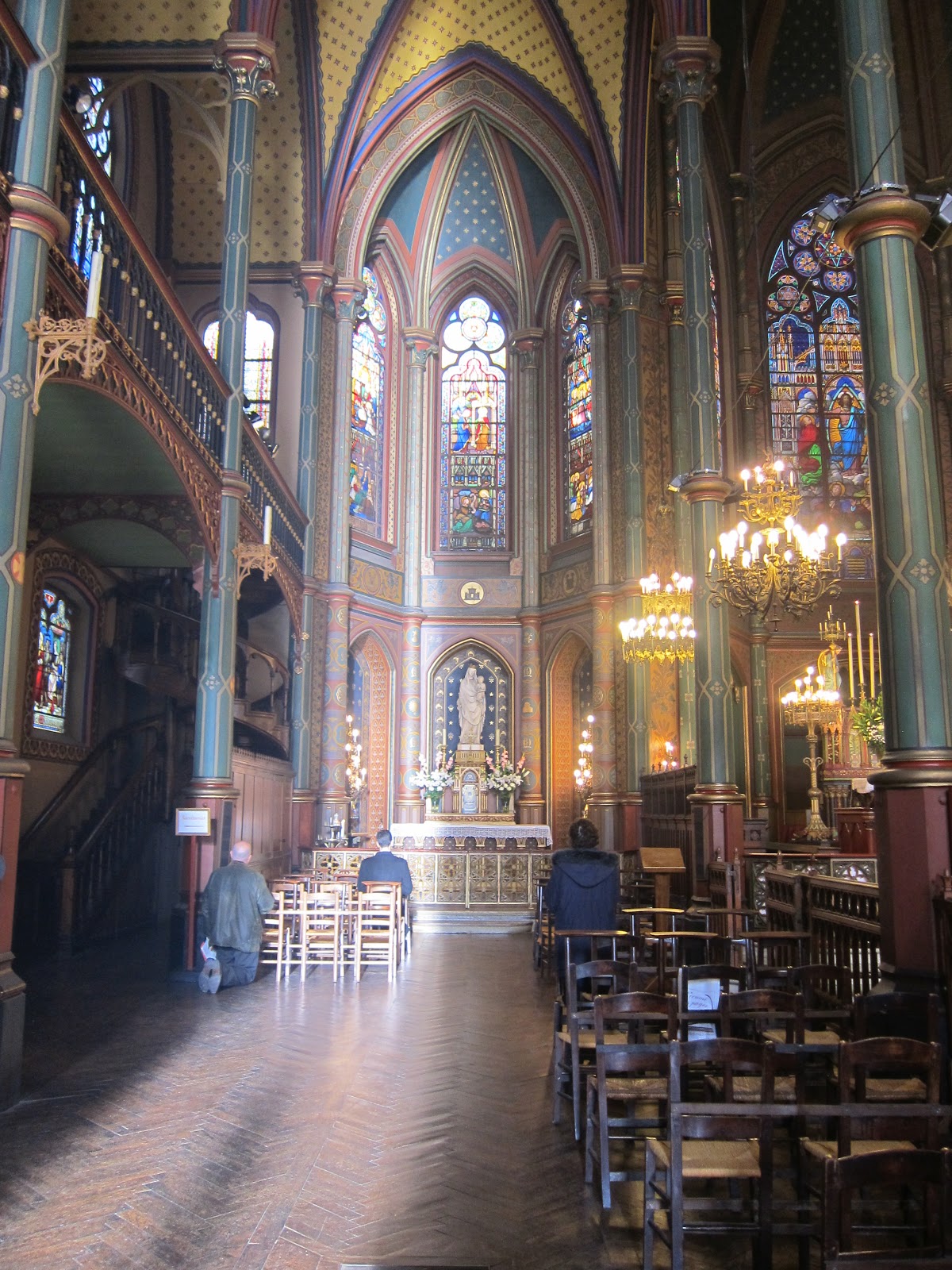
My husband and I attended Mass last Sunday in Paris at St. Eugene-Ste. Cecile, a double-named parish with daily Mass in the Extraordinary Form of the Latin Rite and a splendid choir in keeping with the second saint. The Saint Eugene in the church's name is an early Church martyr: and his feast day, which the church will certainly celebrate, is on November 15th. St. Eugene was a Bishop, martyr and a companion of St. Dionysius [note: St. Dionysius was converted by Saint Paul (Acts 17:34) and early writers say he became the first bishop of Athens and was martyred (c. 95).] St. Eugene was supposedly martyred near Paris, France. He was originally listed as a bishop of Toledo, Spain. His relics were reportedly translated to Toledo. Ste Cecile, or Saint Cecilia, of course, is one of the virgin martyrs of the early Church and patroness of music. The choir of the the church is named for her! Note that they will commemorate her feast with Gounod's St. Cecilia Mass!

We were there for the last Sunday in October, which is the Feast of Christ the King on the calendar of the Extraordinary Form. The homily is available on-line:

Vous connaissez peut-être la virulence avec laquelle le Pape Pie XI a institué la fête du Christ Roi en 1925 : « La peste de notre époque – écrivait-il - c'est le laïcisme, ainsi qu'on l'appelle, avec ses erreurs et ses entreprises criminelles. Ce fléau n'est pas apparu brusquement. Depuis longtemps, il couvait au sein des Etats. On commença par nier la souveraineté du Christ sur toutes les nations… peu à peu on assimila la religion du Christ aux fausses religions... On la soumit… à l'autorité civile… on la livra au bon plaisir des princes et des gouvernants… Il se trouva même des Etats qui… firent consister leur religion dans… l'oubli conscient et volontaire de Dieu. Fruits de cette apostasie, un égoïsme démesuré qui, ne poursuivant que les satisfactions et les avantages personnels, apprécie toute chose à la mesure de son propre intérêt. Fruits encore de cette apostasie, la paix domestique bouleversée par l'oubli des devoirs et l'insouciance de la conscience ; l'union et la stabilité des familles chancelantes ; toute la société, enfin, ébranlée et menacée de ruine. Une fête célébrée chaque année chez tous les peuples en l'honneur du Christ-Roi sera souverainement efficace pour incriminer et réparer en quelque manière cette apostasie publique, si désastreuse pour la société, qu'a engendrée le laïcisme. »

Read the rest here. The Abbe was referring to Pope Pius XI's Quas Primas, the encyclical establishing the feast of Christ the King, and citing this section:

We shall minister to the need of the present day, and at the same time provide an excellent remedy for the plague which now infects society. We refer to the plague of anti-clericalism, its errors and impious activities. This evil spirit, as you are well aware, Venerable Brethren, has not come into being in one day; it has long lurked beneath the surface. The empire of Christ over all nations was rejected. The right which the Church has from Christ himself, to teach mankind, to make laws, to govern peoples in all that pertains to their eternal salvation, that right was denied. Then gradually the religion of Christ came to be likened to false religions and to be placed ignominiously on the same level with them. It was then put under the power of the state and tolerated more or less at the whim of princes and rulers. Some men went even further, and wished to set up in the place of God's religion a natural religion consisting in some instinctive affection of the heart. There were even some nations who thought they could dispense with God, and that their religion should consist in impiety and the neglect of God. The rebellion of individuals and states against the authority of Christ has produced deplorable consequences.

The musical program was incredible! Some highlights:

~~Kyriale & Credo : de la Messe royale du 1er ton d’Henry du Mont, sous-maître de la chapelle du roi Louis XIV
~~After the Consecration : O salutaris hostia – François Giroust (1738 † 1799), maître de chapelle du roi Louis XVI (he was was the last person in that post!)
~~During Communion: Pendant la communion: Dixit Dominus (H. 197) de Marc-Antoine Charpentier (1643 † 1704), maître de chapelle de Mademoiselle de Guise (Marie de Lorraine), du Dauphin (Louis, Le Grand Dauphin, Louis XIV's son, who predeceased him), des Jésuites (at St. Paul-St. Louis in the Marais) et de la Sainte Chapelle (for which he wrote the Assumpta Est Maria Mass) 

Mass lasted almost two hours, but I was not aware of the time at all!
After Mass, we searched the 9th Arrondisement for a place to eat lunch and found Le Corail, 79, rue Lafayette! Bon dimanche!

Sunday, October 28, 2012

The Extraordinary Form in Paris

Today, the last Sunday of October, is the Feast of Christ the King on the calendar of the Extraordinary Form of the Latin Rite. The feast was moved from the end of the post-Pentecost season to the end of the season of Ordinary Time (the last Sunday before Advent) by Pope Paul VI.

We intend, as of this writing, to attend Mass at St. Eugene-St. Cecile (photo credit: wikipedia commons). Just hope we make it on time, because Europe ends "Summer Time" on October 28! We will "fall behind" twice this year--once in October and again in November.

After Mass and lunch, we plan a visit either to the Basilica of St. Denis or to this museum, filled with casts from great churches and cathedrals.

Sunday, November 20, 2011

The Feast of Christ the King

To Jesus Christ our Sovereign King
who is the world's salvation,
All praise and homage do we bring
and thanks and adoration

Your reign extend O King benign,
to every land and nation;
For in your kingdom Lord divine
Alone do we find salvation

To you and to your Church, great King
We pledge our heart's oblation;
Until before your throne we sing
In endless jubilation

Christ Jesus, Victor!
Christ Jesus, Ruler!
Christ Jesus, Lord and Redeemer

The Liturgical Year in the Catholic Church (and in other liturgical churches) ends today with the Feast of Christ the King. Pope Pius XI proclaimed this feast in 1925 and it was celebrated on the last Sunday of October--and still is in the Extraordinary Form of the Latin Rite. Pope Paul VI renamed the Feast and moved its celebration to the last Sunday of Ordinary Time as a Solemnity.

According to this site:

Pope Pius XI universally instituted The Feast of Christ the King in 1925 in his encyclical Quas Primas. Pope Pius connected the denial of Christ as king to the rise of secularism. At the time of Quas Primas, secularism was on the rise, and many Christians, even Catholics, were doubting Christ's authority, as well as the Church's, and even doubting Christ's existence. Pius XI, and the rest of the Christian world, witnessed the rise of dictatorships in Europe, and saw Catholics being taken in by these earthly leaders. Just as the Feast of Corpus Christi was instituted when devotion to the Eucharist was at a low point [I'm not sure about that], the Feast of Christ the King was instituted during a time when respect for Christ and the Church was waning, when the feast was most needed. In fact, it is still needed today, as these problems have not vanished, but instead have worsened.

Pius hoped the institution of the feast would have various effects. They were:

1. That nations would see that the Church has the right to freedom, and immunity from the state (Quas Primas, 32).

2. That leaders and nations would see that they are bound to give respect to Christ (Quas Primas, 31).

3. That the faithful would gain strength and courage from the celebration of the feast, as we are reminded that Christ must reign in our hearts, minds, wills, and bodies (Quas Primas, 33).

I wonder what Henry VIII would have thought of a Pope establishing a feast which pointed out an authority above the King of England? Henry was a Christian, of course, with devotion to Jesus as Saviour and Redeemer; he worshipped Jesus in the Sacrament of the Altar. Would he have been able to separate his own Temporal claims to authority in England and the Pope's proclamation of Jesus's supremacy over all the world, superceding any nationalist claims? I find it interesting that the Church of England celebrates the Feast of Christ the King, but they also mark this Sunday as "Stir up Sunday". The collect for the last Sunday of the liturgical year begins with the words "Stir up, we beseech thee, O Lord, the wills of thy faithful people" and it is the day to start making the Christmas pudding!!