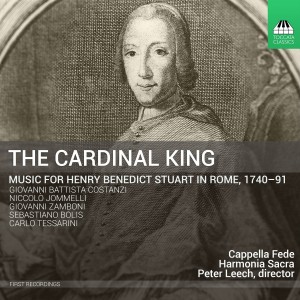
“Mainstream academic music texts will often tell you that anything interesting, as far as sacred music in eighteenth-century Rome is concerned, more or less came to an end with the death of Alessandro Scarlatti in 1725. They also tend to make claims about many of his colleagues and successors being slavish imitators of the Palestrina style who did nothing to advance sacred music in a city apparently dominated by Papal conservatism.
“Whilst it is undoubtedly true that in the Sistine Chapel the stile antico prevailed until the end of the 1700s (and indeed in Rome’s four Papal basilicas), outside the immediate boundaries of the Vatican, in many important parish churches, sacred music was anything but conservative and, in the hands of leading composers, reached new heights of expressive power with distinctly modern and, in the wider European sense, ‘classical’ flavours.
“One such church was San Lorenzo in Damaso, attached to the Cancelleria, the palace of the Vice-Chancellor of the Roman Church. In the early eighteenth century the Cardinal-Priest of San Lorenzo was Pietro Ottoboni, famous patron of Arcangelo Corelli. From 1763 this church came under the protection of Cardinal Henry Benedict Stuart (1725-1807), who had been elevated to the sacred purple in 1747. [when he was 22 years old!]
“Henry, the brother of Bonnie Prince Charlie and grandson of King James II of England, was devout, sincere and musically trained. He spent lavishly on sacred music at San Lorenzo, where composers such as Giovanni Battista Costanzi and Sebastiano Bolis enjoyed particular favour."
On the website for Toccata Classics, which has released a CD of music by composers employed by Cardinal Stuart, Leech provides more background into his process of discovery:
My interest in Roman sacred music of the eighteenth century had for many years been confined to composers active before 1760, such as Alessandro and Domenico Scarlatti, Pietro Paolo Bencini and Giuseppe Pitoni. The second half of the century had never been a major concern until 2011, when I started looking at music manuscripts in the vast Santini collection in Münster. I was intrigued to come across the dedication page of a Mass setting with its composer, Sebastiano Bolis, described as maestro di cappella, at San Lorenzo in Damaso, to Cardinal Henry Benedict Stuart, the grandson of King James II of England, brother of Bonnie Prince Charlie and last in the direct line of Jacobite succession.
Cardinal Henry, whose artistic patronage has been documented in books on eighteenth-century painting, sculpture and poetry, was well known to me through my work on the cultural life of the British Catholic community at home and abroad, but I was hitherto unaware of his musical patronage after he was made a Cardinal in 1747 by Pope Benedict XIV. It was a subject entirely untouched by modern scholarship.
One thing naturally led to another. I found several Bolis works in the Santini collection carrying the same dedicatory descriptions, and further searches revealed works by Bolis in the catalogues of various Roman parish church archives, and, significantly, in at least one British source.

Peter Leech's interest in this era of sacred music is also reflected on an earlier release with another choral group he founded, Harmonia Sacra.
If you were an English Catholic gentleman completing your education abroad, you might be a little careful about meeting the Cardinal Pretender, but once the Old Pretender, Henry's father James Francis Edward Stuart--James III to Jacobite supporters--died on January 1, 1766, the Holy See recognized the Hanoverian dynasty as the rightful kings of England, the danger may have lessened. Henry Cardinal Stuart never pressed his claim to the throne after his clerical career and his devotion to his religious duties developed, anyway.


