Showing posts with label The Jacobite Pretenders. Show all posts

Tuesday, April 17, 2018

Meeting King Henry IX on the Grand Tour

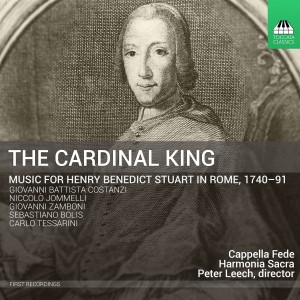
So if you were an English lord on the Grand Tour, and you've already heard the Sistine Chapel choir sing Palestrina and Victoria, and you wanted to hear the latest and greatest music being performed in churches in and around Rome, you might run into the Cardinal Pretender himself, Henry Benedict Stuart, James II's grandson and Bonnie Prince Charlie's younger brother. At least, that's what Peter Leech says:

“Mainstream academic music texts will often tell you that anything interesting, as far as sacred music in eighteenth-century Rome is concerned, more or less came to an end with the death of Alessandro Scarlatti in 1725. They also tend to make claims about many of his colleagues and successors being slavish imitators of the Palestrina style who did nothing to advance sacred music in a city apparently dominated by Papal conservatism.

“Whilst it is undoubtedly true that in the Sistine Chapel the
stile antico prevailed until the end of the 1700s (and indeed in Rome’s four Papal basilicas), outside the immediate boundaries of the Vatican, in many important parish churches, sacred music was anything but conservative and, in the hands of leading composers, reached new heights of expressive power with distinctly modern and, in the wider European sense, ‘classical’ flavours.

“One such church was San Lorenzo in Damaso, attached to the Cancelleria, the palace of the Vice-Chancellor of the Roman Church. In the early eighteenth century the Cardinal-Priest of San Lorenzo was Pietro Ottoboni, famous patron of Arcangelo Corelli. From 1763 this church came under the protection of Cardinal Henry Benedict Stuart (1725-1807), who had been elevated to the sacred purple in 1747. [when he was 22 years old!]

“Henry, the brother of Bonnie Prince Charlie and grandson of King James II of England, was devout, sincere and musically trained. He spent lavishly on sacred music at San Lorenzo, where composers such as Giovanni Battista Costanzi and Sebastiano Bolis enjoyed particular favour."

On the website for Toccata Classics, which has released a CD of music by composers employed by Cardinal Stuart, Leech provides more background into his process of discovery:

My interest in Roman sacred music of the eighteenth century had for many years been confined to composers active before 1760, such as Alessandro and Domenico Scarlatti, Pietro Paolo Bencini and Giuseppe Pitoni. The second half of the century had never been a major concern until 2011, when I started looking at music manuscripts in the vast Santini collection in Münster. I was intrigued to come across the dedication page of a Mass setting with its composer, Sebastiano Bolis, described as maestro di cappella, at San Lorenzo in Damaso, to Cardinal Henry Benedict Stuart, the grandson of King James II of England, brother of Bonnie Prince Charlie and last in the direct line of Jacobite succession.

Cardinal Henry, whose artistic patronage has been documented in books on eighteenth-century painting, sculpture and poetry, was well known to me through my work on the cultural life of the British Catholic community at home and abroad, but I was hitherto unaware of his musical patronage after he was made a Cardinal in 1747 by Pope Benedict XIV. It was a subject entirely untouched by modern scholarship.

One thing naturally led to another. I found several Bolis works in the Santini collection carrying the same dedicatory descriptions, and further searches revealed works by Bolis in the catalogues of various Roman parish church archives, and, significantly, in at least one British source.


Peter Leech's interest in this era of sacred music is also reflected on an earlier release with another choral group he founded, Harmonia Sacra.

If you were an English Catholic gentleman completing your education abroad, you might be a little careful about meeting the Cardinal Pretender, but once the Old Pretender, Henry's father James Francis Edward Stuart--James III to Jacobite supporters--died on January 1, 1766, the Holy See recognized the Hanoverian dynasty as the rightful kings of England, the danger may have lessened. Henry Cardinal Stuart never pressed his claim to the throne after his clerical career and his devotion to his religious duties developed, anyway.

Tuesday, March 7, 2017

Pope Clement XIII and the Hanoverians

The future Pope Clement XIII, Carlo della Torre di Rezzonico, was born on March 7, 1693 in Venice. He was educated by the Jesuits and supported that order throughout his pontificate, from 1758 to 1769.

His connection to the story of Catholics in England after the English Reformation is that he recognized the Hanoverian monarchs after the death of James III (the Old Pretender, James Francis Edward Stuart) on January 1, 1766. Clement honored King James with a great state funeral on January 8, but would not recognize his son, Bonnie Prince Charlie, Charles Edward Stuart, who failed in the best opportunity the Jacobites had, the '45, as the Stuart claimant to the throne of England, Ireland, Scotland and Wales.

King George III may have been encouraged to sign the Papists Act of 1778, which included an oath that abjured the Pretender, and the Roman Catholic Relief Act of 1791, but he would not go any further than that. He was concerned that he would be violating his coronation oath to protect the Church of England.

On the other hand, Henry Cardinal Stuart, the Young Pretender's younger brother, was unhappy with the pope's "betrayal" of the Jacobite cause. He seems to have become reconciled however, to this change, and concentrated on fulfilling his duties as Cardinal York. As for the Young Pretender, he even thought about being an Anglican to try to assert his claim to the throne!

Monday, October 27, 2014

American Jacobites? "The Royalist [American] Revolution"

From Harvard University Press:

Generations of students have been taught that the American Revolution was a revolt against royal tyranny. In this revisionist account, Eric Nelson argues that a great many of our “founding fathers” saw themselves as rebels against the British Parliament, not the Crown. The Royalist Revolution interprets the patriot campaign of the 1770s as an insurrection in favor of royal power—driven by the conviction that the Lords and Commons had usurped the just prerogatives of the monarch.

Leading patriots believed that the colonies were the king’s own to govern, and they urged George III to defy Parliament and rule directly. These theorists were proposing to turn back the clock on the English constitution, rejecting the Whig settlement that had secured the supremacy of Parliament after the Glorious Revolution. Instead, they embraced the political theory of those who had waged the last great campaign against Parliament’s “usurpations”: the reviled Stuart monarchs of the seventeenth century.

When it came time to design the state and federal constitutions, the very same figures who had defended this expansive conception of royal authority—John Adams, Alexander Hamilton, James Wilson, and their allies—returned to the fray as champions of a single executive vested with sweeping prerogatives. As a result of their labors, the Constitution of 1787 would assign its new president far more power than any British monarch had wielded for almost a hundred years. On one side of the Atlantic, Nelson concludes, there would be kings without monarchy; on the other, monarchy without kings.

HUP posted an interview with the author in July this year and Jack N. Rakove reviews it, with some reservations, for The Weekly Standard:

Eric Nelson is a young historian of political thought at Harvard whose basic ambition is to transform every topic he studies. He has published three books in the past decade, and each seeks to transform a major subject in the study of early modern (16th-18th century) political ideas. His first book, The Greek Tradition in Republican Thought (2004), identifies a mode of thinking about the collective use of property that departs sharply from the emphasis on political liberty and personal independence that dominates the scholarly interpretation of early modern republicanism. Nelson built on this argument in his second book, The Hebrew Republic (2010), by noting how early modern thinkers used the biblical idea of the half-century Jubilee to support the redistribution of property. But that book’s greater contribution lies elsewhere. Nelson argues that the Jews’ desire to replace direct divine rule with monarchy, as expressed in 1 Samuel 8:4-9 and rabbinic commentaries, provides a basis for preferring representative government to arbitrary royalty. The use of these sources by early modern writers demonstrates that creative political thinking was profoundly informed by religious texts and concerns and was not merely a secular development.

In
The Royalist Revolution, Nelson turns his attention from Europe to revolutionary America. His argument will alternately surprise, shock, distress, and outrage many scholars, but it will also help to reshape a debate about the origins of the presidency, a topic that gravely matters as we agonize over the role of the post-9/11 executive in our impassioned and impasse-ridden politics.

Nelson’s argument begins with an ingenious analysis of a surprising claim that American revolutionaries made just before independence. Resistance leaders and the Continental Congress repeatedly urged George III to take their side in the struggle against Parliament’s assertion that it possessed unlimited authority to enact laws governing the colonies “in all cases whatsoever.” In their view, the king should act as a wholly independent monarch who would treat each of his empire’s representative assemblies as possessing essentially the same authority. If Parliament overstepped its power in enacting laws for the colonists, the king should intervene, wielding his royal veto against unjust legislation. He should act, as Thomas Jefferson memorably wrote in 1774, as “the balance of a great, if a well poised empire.” Far from clinging unthinkingly to the Glorious Revolution settlement of 1688 and its aftermath, which made the British king a decidedly constitutional and limited monarch, George III should reclaim his prerogative and vigorously exercise the independent powers that custom and theory located in the executive. The clearest exponent of this view was James Wilson of Pennsylvania, who later played a critical role in shaping the novel presidency that emerged from the Constitutional Convention of 1787.

Other scholars, myself included, have never known quite what to make of these claims. Taken at face value, they imply an ignorance of British governance so profound as to make the colonists seem like political idiots. Perhaps the claims can be read as an ultimatum to Britain’s ruling class. The colonists really did not believe that the king would take this part. They simply wanted to demonstrate that they would no longer recognize any parliamentary jurisdiction over America, beyond allowing it to regulate imperial trade, a power that had to be lodged somewhere.

Nelson powerfully demonstrates that there was a depth to this position that other scholars have simply missed. In his view, some (though hardly all) American leaders had become “patriot royalists” who were strikingly sympathetic to the monarchist arguments that the “execrable” Stuart monarchs of the 17th century had made against Parliament. The key texts here pivot on a largely forgotten struggle in the 1620s, when Parliament tried to enact legislation regulating American fisheries, and James I and Charles I each wielded the royal prerogative to insist that the colonies were not subject to parliamentary governance. For patriot royalists arguing within the precedent-laden traditions of Anglo-American governance, the Stuart success on this point in the 1620s provided crucial evidence that the colonists could revive and deploy a century-and-a-half later.

Read the rest of the detailed review there.