Showing posts with label Sacred Music. Show all posts

Wednesday, September 30, 2020

Saint Francis Borgia, SJ

Phyllis McGinley wrote a book titled Saint-Watching in 1969; one of my History professors gave me a copy after I'd taken a class on Eighteenth Century English History--an independent study class--and I remember her comments about how unlikely "we" think a Borgia saint would be. The Borgias, so notorious for intrigue, poisoning, nepotism, a bad pope (Alexander VI), Cesare and Lucretia--and yet Francis Borgia, the former 4th Duke of Gandia, Superior General of the Society of Jesus, was canonized a saint in 1620.

He lived two vocations in one lifetime: first as a husband and father of eight and then, after the death of his wife Eleanor, as a Jesuit priest and the third Superior General of the Society of Jesus as this Loyola Press Ignatian Spirituality post explains (quoting Bert Ghezzi's Voices of the Saints):

St. Francis Borgia, a relative of Pope Alexander VI, King Ferdinand of Aragon, and Emperor Charles V, joined Spain’s imperial court at age eighteen. The next year he married Eleanor de Castro, who bore him eight children. In 1539, shortly after experiencing a religious conversion, Francis left the court but continued in public life as viceroy of Catalonia. At this time under the influence of Peter of Alcántara and Peter Favre, he progressed in prayer and the spiritual life.

In 1543, Francis succeeded his father as duke of Gandia, but when his wife died three years later he decided to become a Jesuit. He provided for his children and joined the society in 1550. While he preferred a quiet life of solitude, the Jesuits felt differently and promoted him so that he could use his great administrative talents for the church. In 1554, St. Ignatius appointed Francis commissary for Spain, where he founded twelve colleges and a novitiate. The Jesuits chose Francis as their general in 1565. His consolidation of the society and expansion of its ministry has caused him to be recognized as the second founder of the order. He established disciplined novitiates in every Jesuit province, writing regulations and books of spiritual instruction for them.

So he was Superior General during the reign of Queen Elizabeth I, before the great Jesuit missions were founded for England. In reading his entry in the Catholic Encyclopedia, England is never even mentioned. Saint Francis Borgia was focused on Missions to the East and West Indies and establishing colleges and foundations in Europe. As the Jesuit historian Thomas McCoog explains, that situation had an impact in England:

Even within Jesuit Britain, Borgia is overlooked. With the exception of the Jesuit residential district in East Anglia, named in honour of Blessed Francis Borgia in 1625 after his beatification in 1624 – a name abandoned when the residence was re-branded as the College of the Holy Apostles after William, Lord Petre’s endowment in 1632 – the English and later British Province has dedicated nothing to him.

There is one intriguing comment in the Catholic Encyclopedia article, however, and that was Borgia's interest in liturgical music while serving Charles V, the Holy Roman Emperor:

The newly-created Marquess of Lombay enjoyed a privileged station. Whenever the emperor was travelling or conducting a campaign, he confided to the young equerry the care of the empress, and on his return to Spain treated him as a confidant and friend. In 1535, Charles V led the expedition against Tunis unaccompanied by Borgia, but in the following year the favourite followed his sovereign on the unfortunate campaign in Provence. Besides the virtues which made him the model of the court and the personal attractions which made him its ornament, the Marquess of Lombay possessed a cultivated musical taste. He delighted above all in ecclesiastical compositions, and these display a remarkable contrapuntal style and bear witness to the skill of the composer, justifying indeed the assertion that, in the sixteenth century and prior to Palestrina, Borgia was one of the chief restorers of sacred music.

Also, as the University of Dayton website notes, Borgia, like Pope Francis today, was most devoted to the image of the Mother of God as the Salus Populi Romani. And this website, from Macau, highlights Saint Francis Borgia's influence on the diffusion of the image throughout the world:

It was only in the middle of the 16th century when Francis Borgia proposed the image to be installed permanently at the Pauline Chapel [of the Basilica of Saint Mary Major in Rome] in 1569. Until this time, copies of this image were never made. In this regard, [St.] Francis Borgia (1510-1572), then the third Superior General of the Society of Jesus, was the central figure. Likewise, the founder St Ignatius of Loyola as well as St Stanislaus Kostka were devoted to this image.

In June 1569, Pius V (1504-1572) granted the permission to reproduce the image. The order’s particular devotion to this image played a significant role in obtaining a mobility to elsewhere in the world. It was a revolutionary event, breaking with custom. The significance of this event is evidenced by the 17th century engraving of St Francis Borgia with the Salus Populi Romani Madonna in his hand, at the Archivum Romanum Societatis Iesu.

Saint Francis Borgia died on September 30, 1572. His feast was celebrated on the the Roman Calendar on October 10 until the revision in 1970. The Society of Jesus celebrate his feast on October 3.

Saint Francis Borgia, pray for us!

Tuesday, April 17, 2018

Meeting King Henry IX on the Grand Tour

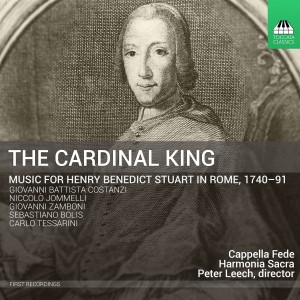
So if you were an English lord on the Grand Tour, and you've already heard the Sistine Chapel choir sing Palestrina and Victoria, and you wanted to hear the latest and greatest music being performed in churches in and around Rome, you might run into the Cardinal Pretender himself, Henry Benedict Stuart, James II's grandson and Bonnie Prince Charlie's younger brother. At least, that's what Peter Leech says:

“Mainstream academic music texts will often tell you that anything interesting, as far as sacred music in eighteenth-century Rome is concerned, more or less came to an end with the death of Alessandro Scarlatti in 1725. They also tend to make claims about many of his colleagues and successors being slavish imitators of the Palestrina style who did nothing to advance sacred music in a city apparently dominated by Papal conservatism.

“Whilst it is undoubtedly true that in the Sistine Chapel the
stile antico prevailed until the end of the 1700s (and indeed in Rome’s four Papal basilicas), outside the immediate boundaries of the Vatican, in many important parish churches, sacred music was anything but conservative and, in the hands of leading composers, reached new heights of expressive power with distinctly modern and, in the wider European sense, ‘classical’ flavours.

“One such church was San Lorenzo in Damaso, attached to the Cancelleria, the palace of the Vice-Chancellor of the Roman Church. In the early eighteenth century the Cardinal-Priest of San Lorenzo was Pietro Ottoboni, famous patron of Arcangelo Corelli. From 1763 this church came under the protection of Cardinal Henry Benedict Stuart (1725-1807), who had been elevated to the sacred purple in 1747. [when he was 22 years old!]

“Henry, the brother of Bonnie Prince Charlie and grandson of King James II of England, was devout, sincere and musically trained. He spent lavishly on sacred music at San Lorenzo, where composers such as Giovanni Battista Costanzi and Sebastiano Bolis enjoyed particular favour."

On the website for Toccata Classics, which has released a CD of music by composers employed by Cardinal Stuart, Leech provides more background into his process of discovery:

My interest in Roman sacred music of the eighteenth century had for many years been confined to composers active before 1760, such as Alessandro and Domenico Scarlatti, Pietro Paolo Bencini and Giuseppe Pitoni. The second half of the century had never been a major concern until 2011, when I started looking at music manuscripts in the vast Santini collection in Münster. I was intrigued to come across the dedication page of a Mass setting with its composer, Sebastiano Bolis, described as maestro di cappella, at San Lorenzo in Damaso, to Cardinal Henry Benedict Stuart, the grandson of King James II of England, brother of Bonnie Prince Charlie and last in the direct line of Jacobite succession.

Cardinal Henry, whose artistic patronage has been documented in books on eighteenth-century painting, sculpture and poetry, was well known to me through my work on the cultural life of the British Catholic community at home and abroad, but I was hitherto unaware of his musical patronage after he was made a Cardinal in 1747 by Pope Benedict XIV. It was a subject entirely untouched by modern scholarship.

One thing naturally led to another. I found several Bolis works in the Santini collection carrying the same dedicatory descriptions, and further searches revealed works by Bolis in the catalogues of various Roman parish church archives, and, significantly, in at least one British source.


Peter Leech's interest in this era of sacred music is also reflected on an earlier release with another choral group he founded, Harmonia Sacra.

If you were an English Catholic gentleman completing your education abroad, you might be a little careful about meeting the Cardinal Pretender, but once the Old Pretender, Henry's father James Francis Edward Stuart--James III to Jacobite supporters--died on January 1, 1766, the Holy See recognized the Hanoverian dynasty as the rightful kings of England, the danger may have lessened. Henry Cardinal Stuart never pressed his claim to the throne after his clerical career and his devotion to his religious duties developed, anyway.

Friday, October 10, 2014

BBC and the Sixteen (Harry Christophers) on Sacred Music


Over the past couple of weeks, my husband and I have watched this DVD set from the BBC/CORO: Sacred Music, hosted by Simon Russell Beale, with musical excerpts and commentary by The Sixteen and Harry Christophers. Note the words "musical excerpts"; The Sixteen perform parts of the works under discussion as examples. These are not complete performances.

The four episodes are:

Episode 1: The Gothic Revolution
Episode 2: Palestrina & the Popes
Episode 3: Tallis, Byrd & the Tudors
Episode 4: Bach & the Lutheran Legacy

The only one I did not enjoy as much as the others was Palestrina & the Popes, mainly because Simon Russell Beale presented the Renaissance/Reformation popes so unfairly. What do I mean by that? First he speaks of one pope as being totally corrupt and reprehensible--and that's very bad. Then Beale speaks of another pope as being devout and and ready to impose reforms and improve morals--and that's even worse! 

The first episode I love because it's set in Paris and Notre Dame with a trip to St. Denis, and because of its fascinating explanation of the development from plainchant to polyphony. The episode on Tallis and Byrd offers the great insight into how much William Byrd focused on the words of the sacred texts of the Mass and the Holy Bible to write his music. Byrd was not using plainchant forms or models to adapt them to the words, but beginning with the words to create the most beautiful and appropriate music he could to elucidate their meaning.

The fourth episode focuses on Luther's changes to liturgical prayer to include congregational singing, the vernacular, and the organ -- and how those changes influenced Bach. Johann Sebastian Bach created more than a thousand works of music, most of them for the Lutheran church. We had recently started listening to Actus Tragicus, a CD of early cantatas from Harmonia Mundi, so we were glad to learn more about Bach's choral music.

I recommend the DVD set, with the warning that the discs do not present complete performances and my discontent with the second episode noted.

Sunday, November 4, 2012

Sunday Mass in Paris

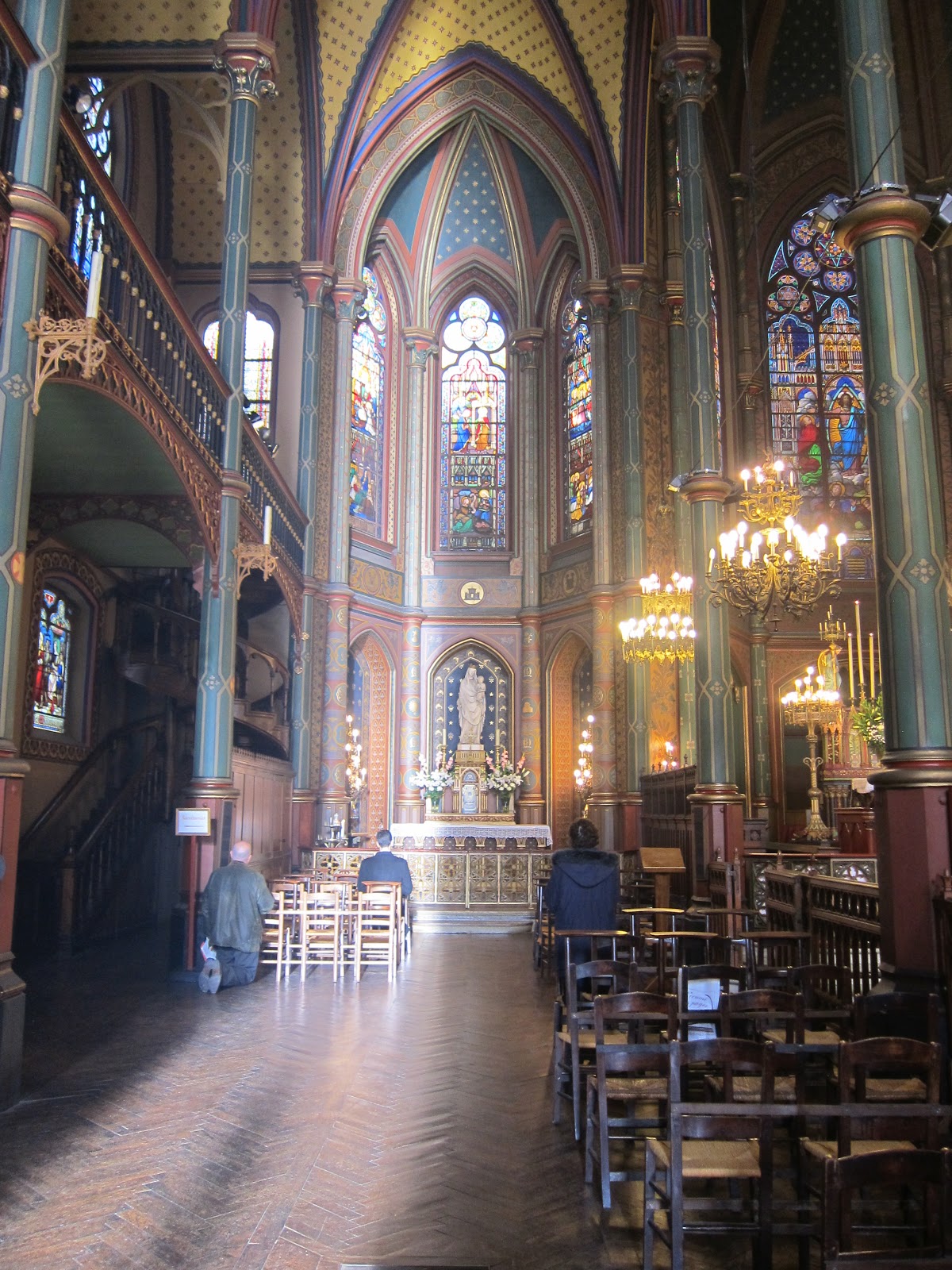
My husband and I attended Mass last Sunday in Paris at St. Eugene-Ste. Cecile, a double-named parish with daily Mass in the Extraordinary Form of the Latin Rite and a splendid choir in keeping with the second saint. The Saint Eugene in the church's name is an early Church martyr: and his feast day, which the church will certainly celebrate, is on November 15th. St. Eugene was a Bishop, martyr and a companion of St. Dionysius [note: St. Dionysius was converted by Saint Paul (Acts 17:34) and early writers say he became the first bishop of Athens and was martyred (c. 95).] St. Eugene was supposedly martyred near Paris, France. He was originally listed as a bishop of Toledo, Spain. His relics were reportedly translated to Toledo. Ste Cecile, or Saint Cecilia, of course, is one of the virgin martyrs of the early Church and patroness of music. The choir of the the church is named for her! Note that they will commemorate her feast with Gounod's St. Cecilia Mass!

We were there for the last Sunday in October, which is the Feast of Christ the King on the calendar of the Extraordinary Form. The homily is available on-line:

Vous connaissez peut-être la virulence avec laquelle le Pape Pie XI a institué la fête du Christ Roi en 1925 : « La peste de notre époque – écrivait-il - c'est le laïcisme, ainsi qu'on l'appelle, avec ses erreurs et ses entreprises criminelles. Ce fléau n'est pas apparu brusquement. Depuis longtemps, il couvait au sein des Etats. On commença par nier la souveraineté du Christ sur toutes les nations… peu à peu on assimila la religion du Christ aux fausses religions... On la soumit… à l'autorité civile… on la livra au bon plaisir des princes et des gouvernants… Il se trouva même des Etats qui… firent consister leur religion dans… l'oubli conscient et volontaire de Dieu. Fruits de cette apostasie, un égoïsme démesuré qui, ne poursuivant que les satisfactions et les avantages personnels, apprécie toute chose à la mesure de son propre intérêt. Fruits encore de cette apostasie, la paix domestique bouleversée par l'oubli des devoirs et l'insouciance de la conscience ; l'union et la stabilité des familles chancelantes ; toute la société, enfin, ébranlée et menacée de ruine. Une fête célébrée chaque année chez tous les peuples en l'honneur du Christ-Roi sera souverainement efficace pour incriminer et réparer en quelque manière cette apostasie publique, si désastreuse pour la société, qu'a engendrée le laïcisme. »

Read the rest here. The Abbe was referring to Pope Pius XI's Quas Primas, the encyclical establishing the feast of Christ the King, and citing this section:

We shall minister to the need of the present day, and at the same time provide an excellent remedy for the plague which now infects society. We refer to the plague of anti-clericalism, its errors and impious activities. This evil spirit, as you are well aware, Venerable Brethren, has not come into being in one day; it has long lurked beneath the surface. The empire of Christ over all nations was rejected. The right which the Church has from Christ himself, to teach mankind, to make laws, to govern peoples in all that pertains to their eternal salvation, that right was denied. Then gradually the religion of Christ came to be likened to false religions and to be placed ignominiously on the same level with them. It was then put under the power of the state and tolerated more or less at the whim of princes and rulers. Some men went even further, and wished to set up in the place of God's religion a natural religion consisting in some instinctive affection of the heart. There were even some nations who thought they could dispense with God, and that their religion should consist in impiety and the neglect of God. The rebellion of individuals and states against the authority of Christ has produced deplorable consequences.

The musical program was incredible! Some highlights:

~~Kyriale & Credo : de la Messe royale du 1er ton d’Henry du Mont, sous-maître de la chapelle du roi Louis XIV
~~After the Consecration : O salutaris hostia – François Giroust (1738 † 1799), maître de chapelle du roi Louis XVI (he was was the last person in that post!)
~~During Communion: Pendant la communion: Dixit Dominus (H. 197) de Marc-Antoine Charpentier (1643 † 1704), maître de chapelle de Mademoiselle de Guise (Marie de Lorraine), du Dauphin (Louis, Le Grand Dauphin, Louis XIV's son, who predeceased him), des Jésuites (at St. Paul-St. Louis in the Marais) et de la Sainte Chapelle (for which he wrote the Assumpta Est Maria Mass) 

Mass lasted almost two hours, but I was not aware of the time at all!
After Mass, we searched the 9th Arrondisement for a place to eat lunch and found Le Corail, 79, rue Lafayette! Bon dimanche!

Sunday, September 30, 2012

More Byrd, With a Side of Monte

Yet another disc of William Byrd sacred music? Yes, with a Spanish connection, presenting in musical form the correspondence and exchange between William Byrd and Philippe de Monte. As the liner notes from Gallicantus's third cd release describe the exchange:

The connection that brings together the music of William Byrd (c.1540-1623) and Philippe de Monte (1521-1603) is a most unusual one: a very rare documented instance of two composers from distant parts of Europe engaging in a personal musical exchange. According to an 18th-century manuscript in the British Library, de Monte had come to England in 1554 as a singer in the choir that accompanied his employer, the Spanish king Philip II, as he contracted a dynastic marriage to Mary Tudor. It seems that de Monte may have made contact with the young William Byrd, for some 30 years later he sent him the eight-part motet Super flumina Babylonis, and the following year, Byrd responded with his own eight-part Quomodo cantabimus, whose words are drawn from verses of that same psalm, no. 136. Exactly what occasioned this musical transaction is not known, but the words must have held particular resonance for Byrd at that time, as this famous psalm of captivity and exile would surely be interpreted as a barely veiled allusion to the dangerous situation that he and his fellow recusant Catholics were facing under a Protestant regime in England at a time when political tensions were aggravating the existing religious ones; perhaps word of these developments had reached de Monte, either in Prague or via his benefice at Cambrai, near the Catholic English College at Douai.

The CD is available from Signum Classics and the website highlights the key to the hidden meaning of Byrd's setting of these texts: "The texts reveal the Catholic community’s sense of isolation (“How shall we sing the Lord’s song in a strange land?” – Quomodo Cantabimus) and bereavement (“Jerusalem is wasted” – Ne Irascaris), and the elaborate, poetic nature of the encoded messages distributed within it through music.'