Thursday, January 21, 2016

One of the Forty Martyrs: St. Alban Roe, OSB and Companion

Also on January 21, but in 1642, one of the canonized Forty Martyrs of England and Wales suffered execution after many years of service in England. As the parish church named for him in Wildwood, Missouri, USA tells his story:

Bartholomew Roe was born at Suffolk, England in 1583 during the reign of Queen Elizabeth. He was reared in a good Anglican home and later attended Cambridge University. It was while he was attending this university, during a summer break, that he visited the Abbey of St. Alban just north of London. At that time, the Abbey was a prison for Catholics. It was named after the first English martyr, Alban, who died around the end of the third century, our secondary patron Saint.

It was at this Abbey that Bartholomew met a prisoner, whose name is unknown to this day, who inspired him to take a good hard look at the faith of his forefathers. Returning to Cambridge, this inspiration grew into the decision to join the Catholic Church. Not content with this, he decided to become a priest in Post Reformation England and he left for France to study for the priesthood.

He was accepted by the Benedictine Community in France, the same community that had fled Westminster during the reign of Henry VIII. He began to care for Catholic prisoners. He was soon imprisoned but continued to minister with his cheerful disposition.

The Abbey of St. Albans referred to above, had of course been suppressed in the Dissolution; the Gatehouse was used as a prison while the people of the town had bought the abbey church from Henry VIII. According to BHO (British History Online):

After the Suppression, the monastic buildings, excepting the Lady chapel and the Great Court, were granted, in 1550, to Sir Richard Lee. The abbey church was retained by the Crown till 1553, when it was sold to the mayor and burgesses of St. Albans, to be their parish church instead of St. Andrews, which was then pulled down; and the Lady chapel was at the same date cut off to be used as a grammar school.

The maintenance of the great church must at all times have been a heavy charge on the parish funds, and it is not to be wondered at that when, in the last century, repairs were undertaken on a large scale, it was found that the building was in a very unsafe state. It has emerged from the ordeal with the loss of many of its ancient features, but is at least structurally sound. As it stands to-day [1908], its great length, and the warm tone of its ancient brickwork, suffice to make it a striking and picturesque building; but not even time can ever make the new fronts of the transepts tolerable. The central tower, with parts of the north transept and the eastern bays of the nave, are the only parts of the building which preserve an ancient exterior, and have undoubtedly gained by the loss of their original coating of plaster and whitewash. The west wall of the north transept is the most characteristic piece of early masonry, with courses of Roman brick alternating, though irregularly, with lines of large undressed flints, while the more careful work of the central tower is entirely faced with brickwork, the only other material employed being the Barnack stone of the shafts and capitals. The walling of the clearstory of the presbytery retains its thirteenth-century surface of reused Roman brick, with a band of later and more deeply-coloured brickwork above it, but hardly any other part of the exterior has any claim to antiquity. Roofs, gables, buttresses, pinnacles, windows, all are alike new, and it will be long before the cathedral church regains that look of reverend antiquity which was one of the chief charms of the abbey church a generation ago.

In 2015, the Anglican bishop of London, Richard Chartres, dedicated a new series of statues for the rood screen, including St. Alban Roe, according to this story. (Also note that every Friday in the Anglican Cathedral, a Catholic Mass is celebrated.) St. Alban Roe, OSB is depicted with playing cards in his hands. He played cards in the alehouses near the Fleet prison during his 17 year stay there--with prayers as wagers.

His companion, Blessed Thomas Green or Reynolds (Green was the surname he was born with), was 80 years old when he suffered being hung, drawn, and quartered. He had been a priest for about 50 years and had been exiled once from England, in 1606, after the Gunpowder Plot. Obviously, Fatehr Green returned to England to continue his service. He had been sentenced to death 14 years before his execution and been held in similar circumstances at St. Alban Roe. They were able to pray together and absolve each other before suffering.

Martyrs and Their Witness

When St. Edmund Campion suffered execution on December 1, 1581, drops of his blood fell on Henry Walpole. Walpole then left England to study for the priesthood and thus returned as a missionary like Campion. Just like Campion--but only more quickly--he was captured, then imprisoned, tortured, and executed. In the same way, on January 21, 1586, Blesseds Edward Stransham and Nicholas Wheeler (or Woodfen) were executed at Tyburn; Blessed William Freeman, who would suffer their fate nine years later, witnessed their hanging, drawing, and quartering and yet was inspired to follow their path to exile, study, ordination, and return as a missionary priest.

~Blessed Edward Stransham, priest and martyr--A native of Oxford, born about 1554, earning his BA from St. John's College in 1575-76. Then he went to Douai in 1577 and Reims in 1578. Because he was ill he returned to England to recuperate; then went back to Reims in 1579; ordained in 1580. In 1581 he returned to England as a missionary priest, but was still suffering from consumption; he left England in 1583, bringing 12 Oxford converts with him to Reims. After a stay in Paris, he returned to England and was arrested while saying Mass in Bishopsgate Street Without, London, 17 July, 1585 and held for trial.
~Blessed Nicholas Wheeler (or Woodfen), priest and martyr--Born at Leominster in 1550, he studied for the priesthood in Reims, after ordination he returned to England with Edward Stransham, and was executed with him at Tyburn in 1586. Dressed like a lawyer, he had lived near the Inns of Court, one of the legal training schools in London, serving covert Catholics studying there.

Blessed William Freeman witnessed the executions of Stransham and Wheeler. He became a Catholic, went to Reims, was ordained and returned to England as a missionary priest. He was hung, drawn, and quartered for that crime on 13 August 1595 in Warwick, after spending some time in Stratford-on-Avon.

Although Blesseds Stransham and Wheeler were martyred first, Blessed William Freeman was beatified before they were, by Pope Pius XI in 1929. Today's martyrs were named Venerable on November 10, 1986 and then beatified November 22, 1987 by Pope Saint John Paul II.

Wednesday, January 20, 2016

From OUP Next Month: Bad Queen Bess?


From the publisher, Oxford University Press:

Bad Queen Bess? analyses the back and forth between the Elizabethan regime and various Catholic critics, who, from the early 1570s to the early 1590s, sought to characterize that regime as a conspiracy of evil counsel. Through a genre novel - the libellous secret history - to English political discourse, various (usually anonymous) Catholic authors claimed to reveal to the public what was "really happening" behind the curtain of official lies and disinformation with which the clique of evil counsellors at the heart of the Elizabethan state habitually cloaked their sinister maneuvers. Elements within the regime, centred on William Cecil and his circle, replied to these assaults with their own species of plot talk and libellous secret history, specializing in conspiracy-driven accounts of the Catholic, Marian [Mary, Queen of Scots], and then, latterly, Spanish threats.

Peter Lake presents a series of (mutually constitutive) moves and counter moves, in the course of which the regime's claims to represent a form of public political virtue, to speak for the commonweal and true religion, elicited from certain Catholic critics a simply inverted rhetoric of private political vice, persecution, and tyranny. The resulting exchanges are read not only as a species of "political thought," but as a way of thinking about politics as process and of distinguishing between "politics" and "religion." They are also analyzed as modes of political communication and pitch-making - involving print, circulating manuscripts, performance, and rumor - and thus as constitutive of an emergent mode of "public politics" and perhaps of a "post reformation public sphere." While the focus is primarily English, the origins and imbrication of these texts within, and their direct address to, wider European events and audiences is always present. The aim is thus to contribute simultaneously to the political, cultural, intellectual, and religious histories of the period.

Oxford also notes that in Bad Queen Bess?: Libellous Politics, Secret Histories and the Politics of Publicity in Elizabethan England, Peter Lake, University Distinguished Professor of History and co-author (with Michael Questier) of The Trials of Margaret Clitherow:
  • Puts Catholic polemical and political activity at the center of Elizabethan politics
  • Focuses on the emergence of a style of public politics consequent on the religious conflicts and uncertainties of the age
  • Emphasises the interaction between performance, manuscript, rumor, and print in the conduct of public politics, both by the state and its enemies
  • Draws upon the emergent genre of the libellous secret history as a type of historical analysis
While this sounds fascinating, it does give me pause: This book uses the lies, half-truths, and deceptions the government and its critics used against each other to present the truth about history! See the table of contents here.

Tuesday, January 19, 2016

Vespers from Brompton

Tomorrow the BBC will broadcast Vespers for the feast of Saints Fabian (Pope and Martyr) & Sebastian (Roman Soldier and Martyr) from the Brompton Oratory on its long-running Choral Evensong program. The musical program includes:

Organ Prelude: Intonatio del ottavo tono (Andrea Gabrieli)
Invitatory: Anon (17th century)
Psalms 128-132 (Gregorian chant and falsi-bordoni)
Office Hymn: Sanctorum meritis (Gregorian chant and Palestrina)
Magnificat sexti toni (Lassus)
Antiphon of Our Lady: Alma Redemptoris Mater (L’Héritier)
Organ Voluntary: Praeludium in D minor, BuxWV140 (Buxtehude)

Celebrant: The Revd Father Michael Lang
Director of Music: Patrick Russill
Organist: Ben Bloor

Father Michael Uwe Lang is the author of three books on the liturgy published by Ignatius Press. The latest is Signs of The Holy One: Liturgy, Ritual, and Expression of the Sacred and it features a cover photo of the Easter Vigil at the London Oratory. Father Lang has an M.A. in theology from the University of Vienna and a Ph.D. in theology from the University of Oxford. In addition to being a priest of the Oratory of Saint Philip Neri in London, he is currently Lecturer in Theology at Heythrop College, University of London, and on the Visiting Faculty at the Liturgical Institute in Mundelein, Ill. His other books published by Ignatius are Turning Towards the Lord and The Voice of the Church at Prayer.

The director of music at the Oratory of St. Philip Neri in London, Patrick Russill

is recognised as one of the leading figures in English church music. Following organ studies with Nicholas Danby while organ scholar at New College, Oxford, he was appointed Organist of the London Oratory in 1977 at the age of 23 in succession to Ralph Downes, on Downes’ nomination. In 1999 he was appointed Director of Music at the Oratory, assuming overall responsibility for its choral tradition and especially for its famous professional choir, which under his direction ‘remains among the finest mixed-voice choirs in the country’ (Choir & Organ). . . .

As an organ recitalist he has played at the Royal Festival Hall and Queen Elizabeth Hall, in Europe, Asia and all over the UK. He introduced the reconstructed Tudor organs of the Early English Organ Project to London’s South Bank in a Queen Elizabeth Hall recital acclaimed by the Independent on Sunday, in its classical review of 2007, as the outstanding London keyboard concert of the year.

The Guardian also reviewed that recital, highlighting the sad destruction and loss of many organs in the churches of England after the Reformation:

Time, and the zealotry of Protestant reformers, have ensured that, of the thousands of organs in cathedrals, churches and religious foundations in pre-Reformation England, none have survived. But the discovery in Suffolk of a couple of substantial fragments in the shape of original wooden soundboards has allowed the reconstruction of two instruments, both played in this concert by Patrick Russill.

We have also lost a great deal of the music that would have sounded on the originals. But enough remains, even in fragmentary form, of the works of John Redford, Thomas Preston and John Blitheman, as well as better known figures such as Thomas Tallis and William Byrd, to indicate that the 16th century was a high point of English keyboard composition. Virtuoso fancies by Byrd contained in My Ladye Nevell's Booke showed a secular side to a composer best known for his sacred music, and offered Russill a welcome opportunity for some right-hand flamboyance, which he seized.

After the live broadcast, the program is repeated on Sunday and then is available on demand on-line for a time.

Monday, January 18, 2016

The Third Monday of the Month: On the Son Rise Morning Show


This morning on the Son Rise Morning Show, Matt Swaim and I will discuss recent events in the Anglican Communion. I'll be on the air after the 7:45 a.m. Eastern/6:45 a.m. Central break. You may listen live here.

I'm referring to the meeting of the 37 Primates of the Anglican Communion last week in Canterbury. The big announcement last week was that after agreeing to the agenda, the Primates addressed the issue that threatened to destroy the Anglican Communion by temporarily suspending the Episcopal Church in the USA from the Anglican Communion's official functions, while it is still part of the Anglican Communion:

The meeting started by agreeing the agenda. The first agreed item was to discuss an important point of contention among Anglicans worldwide: the recent change to the doctrine of marriage by The Episcopal Church in the USA.

Over the past week the unanimous decision of the Primates was to walk together, however painful this is, and despite our differences, as a deep expression of our unity in the body of Christ. We looked at what that meant in practical terms.

We received the recommendation of a working group of our members which took up the task of how our Anglican Communion of Churches might walk together and our unity be strengthened. Their work, consistent with previous statements of the Primates’ meetings, addressed what consequences follow for The Episcopal Church in relation to the Anglican Communion following its recent change of marriage doctrine. The recommendations in paragraphs 7 and 8 of the Addendum A below are:

“It is our unanimous desire to walk together. However given the seriousness of these matters we formally acknowledge this distance by requiring that for a period of three years The Episcopal Church no longer represent us on ecumenical and interfaith bodies, should not be appointed or elected to an internal standing committee and that while participating in the internal bodies of the Anglican Communion, they will not take part in decision making on any issues pertaining to doctrine or polity.

“We have asked the Archbishop of Canterbury to appoint a Task Group to maintain conversation among ourselves with the intention of restoration of relationship, the rebuilding of mutual trust, healing the legacy of hurt, recognising the extent of our commonality and exploring our deep differences, ensuring they are held between us in the love and grace of Christ.”

These recommendations were adopted by the majority of the Primates present.

It just cannot be coincidental that this statement was issued on the same day as the fifth anniversary of the founding of the Personal Ordinariate of Our Lady in Walsingham, which was followed by the organizing of an Anglican Ordinariate in the USA a year later. Nor can it be ignored that the Vatican had arranged for two great relics of England's Catholic past to be on display at Canterbury: the staff of Pope St. Gregory the Great and the bloodied vestment of St. Thomas of Canterbury.

Most commentators note that this is just puts off the harder decisions about marriage in the Anglican Communion, because the Episcopalians and other "liberals" are not going to change their teaching, while the more "conservative" Anglicans, from Africa for example, are not going to change theirs or allow the "liberals" to change Anglican teaching throughout the Communion. This semi-suspension just "kicks the can" down the road for another meeting to reconsider where the two sides are.

Sunday, January 17, 2016

Jakob Balde, SJ and Thomas More

Yesterday at the Eighth Day Institute Symposium, I met Patrick Callahan, Dean of Humanitas and Kowalski Chair in Catholic Thought of the Institute for Faith and Culture at the Newman Center on the campus of the University of Kansas. KU is in Lawrence and the Newman Center is named for St. Lawrence! The Institute publishes a journal titled Thesauri Ecclesiae (Treasures of the Church), referencing St. Laurence the Deacon's response to the Roman authorities when they ordered him to turn in the treasures of the Church--he gathered the poor around him.

In the Spring 2015 issue of the publication, I noticed a poem about Thomas More, "Thomae Mori Constantia" which Dean Callahan had translated ("The Steadfastness of Thomas More"). The poem was written by a German Jesuit, Jakob Balde. As the entry in the 1913 Catholic Encyclopedia explains, Balde was:

A German poet, b. 4 January, 1604, in the Imperial free town of Ensisheim in Upper Alsace; d. at Neuburg, 9 August, 1668. He studies the classics and rhetoric in the Jesuit college of his native town, philosophy and law at the University Ingolstadt, where on 1 July, 1624, he was admitted into the Society of Jesus. Having undergone the usual ascetical and literary training he taught classics and rhetoric in the colleges of Munich and Innsbruck, and in his leisure hours composed the Latin mock-heroic poem "Batrachomyomachia" (The Battle of the Frogs and the Mice). After completing his theological studies at Ingolstadt, where he was ordained priest in 1633, he was appointed professor of eloquence in the university. Called to Munich a few years later to educate the sons of Duke Albert, he soon after received the office of court preacher to the elector Maximilian. Owing to failing health he was, in 1654, sent to Neuburg on the Danube, where he became the intimate friend and adviser of the Count Palatine Philipp Wilhelm. Here he died. The poetical works of Balde are marked by a brilliant imagination, noble thoughts, wit and humour, strength and tenderness of feeling, great learning, love of nature, and knowledge of the human heart. His mastery of classical Latin was such that he wielded it with astonishing power and originality, and he used the ancient metres and poetical forms with consummate ease and skill. His poetical themes are the world and religion, friendship and fatherland, art and letters. His patriotic accents, says Herder, have made him a German poet for all time. He witnessed the horrors of the Thirty Years War, and the devastation and disruption of his country, and while lamenting the fate of Germany, sought the re-awaken in the hearts of the people the old national spirit.

Balde was above all a lyric poet, many of his odes to the Virgin Mother of God being of surpassing beauty, but he has also written epic and pastoral poems, satires, elegies, and drams. During his lifetime he was acclaimed "the German Horace", but soon after his death he fell into neglect, until Herder, towards the end of the eighteenth century, by his translation of many of Balde's lyrics, published in the periodical "Terpsichore", revived the poet's memory and the fame of his genius among scholars. Balde, however, could never have become a popular poet in the wider sense of the word, as nearly all his works were written in Latin, which was in his time the international language of the cultured classes, whereas German was too unwieldy and crude a vehicle of poetical expression. Balde's poetry is not faultless; he occasionally offends against good taste, burdens his verses with mythological lore, and odes not always keep his luxuriant imagination under control. The only complete edition of his works was published in eight volumes at Munich in 1729.

Dean Callahan gave me permission to share a little bit of the poem and his translation. Balde depicts examples of More's constancy even in the face of prison and his family's importunings:

Not prison nor his wife Alice moved him
Off course: and not his trembling son-in-law
Nor Margaret with a woman's pleading sobs
   And tears in front of her father.

Non carcer illum, non Aloysia,
Dimovit uxor: nec trepidus gener.
Nec ante Patrem Margarita
   Faemineo lacrymosa questu.

Balde states that More was more steadfast than King Henry and absolutely resolute from beginning to end, hastening to prison, "grim-faced but glad" as others wept about him:

Full of the future, where for the tomb he stood,
And having calmed the hangman's shaking hand
With his reward, he gave his neck
   To be struck by the bloody iron.

Plenus futuri quo tumulo stetit,
Postquam paventem Carnificis manum
Mercede firmasset, cruento
   Colla dedit ferienda ferro.

Karl Maurer, Associate Professor in the Department of Classics at the University of Dallas, also offers texts and translations of some of Balde's poetry here. Many thanks to Dean Callahan for allowing me to share portions of his translation on my blog.

Saturday, January 16, 2016

Edward Gibbon, RIP

Edward Gibbon died on January 16, 1794 at the age of only 56. Of course, he is most famous for The History of the Decline and Fall of the Roman Empire, which he blamed on Christianity in part. As Donald S. Prudio commented last year, the 250th anniversary of Gibbon's inspiration to write Decline and Fall:

Edward Gibbon sat upon the steps of Ara Coeli. He could just look over the crest of the hill where there spread out the expanse of the Roman forum, the domain of Cato, Cicero, and Caesar. He would not have had to face the brooding monstrosity of the Victor Emmanuel monument, a towering oversized expanse of white marble, charitably called by Romans “the dentures.” Its absence made for a clear view to the Basilica of San Marco and the Cancelleria, next to the tenements of the contemporary Piazza Venezia. To his left was the marvelous Campidoglio of Michelangelo, echoing for Gibbon the attempt to rescue the city from its medieval torpor, and bring pagan Rome back to life.

Just at that moment the Franciscan friars began one of the hours of the Divine Office. Their chants echoed out to Gibbon. Here were these Catholic religious in sole possession of this monument of Western humanity. Why had the magnificent civilization fallen, which Gibbon prized so highly? The concatenation of chant and ruin bore powerfully on the young man. Gibbon was an archetype for his own generation. His outlook was that of the Enlightenment, at one with men like Voltaire, straining against the forces of tradition which they considered to retard social development. Chief among these was the Catholic Church. Though the young man had a yearlong dalliance with Catholicism a decade before, it ended with a desultory reconversion to Protestantism, perhaps a factor in his later writing.

Gibbon began to turn over the matter in his mind. These chanting friars behind him were the cause of the fall of Roman dominion, for they had exchanged the spirited pagan search for glory for an otherworldly promise of salvation. In short, the Roman Empire had died of Christianity. It was a febrile religion, which had unmanned the ancient world. Rome became terminally ill when it converted to the Church because, to use his famous term, it suffered a “loss of nerve.”


Two other historians later visited the ruins of the great Forum and set out to refute Gibbon: Blessed Frederic Ozanam and Christopher Dawson. I just read Robert Royal's introduction and analysis of Christopher Dawson's project to understand the role of religion in culture and civilization, and specifically the role of Christianity in Western Culture in A Deeper Vision: The Catholic Intellectual Tradition in the Twentieth Century, and as ever when this is mentioned, I'm so surprised when Royal mentions how Dawson, who was so influential in mid-century Catholic and mainstream academic history, is relatively unknown. I've known about Dawson for decades, so I guess I was ahead of the curve. He--like Ozanam--was introduced to me when I was a sophomore in college at the Newman Center at WSU, and his Religion and the Rise of Western Culture was an assigned text in a Medieval History course. Eighth Day Books has featured that work and others of his on its shelves and in its annual catalog (formerly published) for years. I did not know that he had fallen out of favor at all!

Friday, January 15, 2016

457 Years Ago--and Just Five Years Ago--Today


Four hundred and fifty-seven years ago, on January 15, 1559 Elizabeth Tudor was crowned and anointed Queen of England and Ireland in Westminster Abbey with a ceremony based on that developed for her half-sister Mary Tudor five years or so earlier. There are reports that she left the sanctuary area when the Bishop of Carlisle elevated the Sacred Host and that she did not receive Holy Communion. She was only 25 years old--after the succession of a boy king, too young (legally) to reign, and of a middle aged woman, perhaps too old to reign, her youth must have been very refreshing. Her subjects anticipated her marriage.

Her first Parliament would establish the Via Media of the Church of England while the Convocation of Bishops as constituted by the late Reginald Cardinal Pole, Archbishop of Canterbury, almost to the man, refused to swear the Oaths of Supremacy and Uniformity demanded by it. Elizabeth appointed Matthew Parker, who had been one of her mother's chaplains, as her Archbishop of Canterbury--she was, after all, Supreme Governor of the Church, as determined by Parliament. The bishops, priests and officials at the universities of Oxford and Cambridge who refused to take her oaths and follow his leadership would be deposed from their positions, exiled or imprisoned.

Five years ago today, the Personal Ordinariate of Our Lady of Walsingham was founded, and tomorrow the Ordinary of the Ordinariate will celebrate this extraordinary anniversary with Mass at the Church of the Most Precious Blood in London.

Late last year, the OLW (Our Lady of Walsingham) Ordinariate conducted a survey to discuss the next steps for the groups that had been formed since January 15, 2011, and noted:

As the project team (made up of three experienced Ordinariate priests and a member of the lay faithful with experience in strategic planning) visited groups, there was a real sense in which we became aware that we were walking on “holy ground.” Even in the smallest groups there was an excitement and joy as people told their stories of the past few years. In many places and in many different ways excellent work is being done. The sharing of treasure referred to in Anglicanorum Coetibus is happening as diocesan Catholics join the Ordinariate in worship and members of the Ordinariate join in the life of the wider Catholic community. Throughout our visits we experienced an appreciation and affection for the Ordinary but also a clear concern that he is overworked and under supported. Similarly, without exception, there was a clear sense that the groups were well cared for by their priests but a concern as to how supported their priests were. Most groups remain enthusiastic but there is also, inevitably, a little weariness and realisation that we have reached the stage where further development of the structures of the Ordinariate is necessary in order to share the vision of Pope Benedict XVI as we enter the next phase in our mission. 

Thursday, January 14, 2016

Aubrey Beardsley at London's NPG


Miguel Cullen writes about an exhibition of Aubrey Beardsley's portraits at London's National Portrait Galley in The Catholic Herald:

A small exhibition of portraits of Aubrey Beardsley at the National Portrait Gallery reveals a touching detail involving the socialite illustrator’s premature death. There is a picture of him in the Hotel Cosmopolitan, in Menton, France, where he died of tuberculosis aged 25. To the left is a crucifix: Beardsley had converted to Catholicism a year previously, and died with a rosary in his fingers. The next day his mother and sister arranged a Requiem Mass for him at Menton Cathedral; he was buried in the adjacent cemetery.

Beardsley’s passage “from Decadence to Catholicism” was one that was well-trodden. After him came Lord Alfred Douglas; John Gray, the poet and translator of Verlaine’s Catholic poems; the writer Ernest Dowson and Oscar Wilde’s friend Robbie Ross. All were artist-converts of fin-de-siècle England.

Beardsley was the ultimate Victorian hipster. He drew spindly, Japonism-inspired subjects taken from mythology on a flat perspective. His circle was inextricably linked with Oscar Wilde’s. When Wilde was arrested at the Cadogan Hotel, headlines screamed : “Oscar Wilde Arrested: Yellow Book Under His Arm”. Beardsley was art editor of The Yellow Book, an avant-garde magazine. In the public’s eye, they were arrogant, too-clever-by-half peddlers in obscenity (according to the Daily Mail). On the day of Wilde’s arrest, offices of the similarly “obscene” Yellow Book were vandalised by crowds.


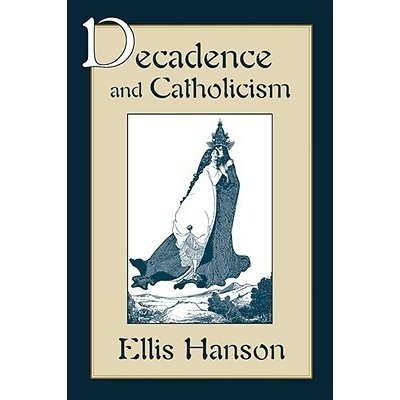
With that list of "artist-converts of fin-de-siècle England" moving "from Decadence to Catholicism" Cullen almost references the title of Ellis Hanson's 1998 book from Harvard University Press, Decadence and Catholicism, which included Beardsley's "The Ascension of Saint Rose of Lima" on its cover. At least one reviewer found it a deeply flawed and confusing work, noting that:

In Decadence and Catholicism, there is no faith but Catholicism and these decadents are its prophets. Hanson frequently uses 'Catholic' as a synonym for 'Christian,' slipping between these terms in the same paragraphs (68, 231, 368-369). Indeed, virtually any reference to souls, faith, religion, guilt, spirit, or sin is triumphantly adduced as proof of underlying Catholicism -- regardless of the fact that these terms were fashionable in their own right in the nineteenth century or that they occupied a common lexicon shared by anyone with religious training or operating in the Anglican-based cultural environment of nineteenth-century Britain. In Hanson's world, anyone with the slightest interest in the soul must be a closet Catholic. Nor does he ever extend to other religions the kind of respect he gives Catholicism. Any decadent man who is not Catholic is just a proto-Catholic or a might-as-well-be Catholic, with no understanding of how an upbringing in particular Protestant denominations (or, in Raffalovich's case, in Judaism) might have specifically shaped religious experience. This unremitting Catholic-centrism leads him to make identifications that are unintentionally funny, as when he calls Gilbert and Sullivan's "Patience" a "religious satire" (242) -- presumably because "Patience" parodies the medieval revival, which Hanson equates with ritualism, thus Anglo-Catholicism, and therefore Catholicism itself.

While Hanson tends to spy Catholics under every bed, he is curiously ambivalent about their faith. With an introduction and conclusion sure to alienate Catholic scholars with its provocative attack on the Church (amongst other things, he views the Church as a corporate behemoth and "the bulwark of reactionary politics throughout the world" (371)), he spends the rest of the book giving heartfelt, emotional testimony about the power and beauty and necessity of what he calls 'the Faith' in a way sure to make poststructuralists uneasy.

Men and women don't convert to any religion because of the aesthetics of art and architecture, ritual and music--those change. Gerard Manley Hopkins protested that his conversion was not to the beautiful liturgy and churches of Catholicism; the newly re-established Catholic church in England didn't offer those glories. If he wanted beautiful churches and liturgy, the ritualistic movement of the Tractarians provided that, with incense and candles and ceremony.

There has to be some content, some meaning beyond the surface if the conversion is going to be real, effective, and lasting. A surer guide to conversion than Walter Pater's aesthetics or the pre-Raphaelite fascination with the Middle Ages was needed, and this author suggests it was Blessed John Henry Newman, but even he doubts the depths of these decadent conversions:

John Henry Newman (1801–1890) had a considerable impact on English Catholic thinking throughout the Victorian period and after. For fin de siècle Catholics, he was the glorious forebear and the fatherly reference. As the leading figure of the Oxford Movement, he played an essential role in the Tractarian attempt at restoring a sacramental spirituality and re-establishing the authority of tradition. The Movement, whose ideas were expressed in the Tracts for the Times published between 1833 and 1841, was in the end torn by internal conflicts that led to a number to conversions to Roman Catholicism, the most famous of which being Newman’s in 1845. The Ritualistic phase followed the Tractarian moment in the second half of the century, focusing on liturgical reforms and introducing ceremonials in which the sacramental emphasis marked an appropriation of Roman doctrine. 

All fin de siècle Catholic literature is influenced by Tractarian thought. The Decadents share with the Oxford theologians the rejection of modernity and religious liberalism. They are also highly receptive to the Tractarian focus on rituals and sacraments, on the sacred role of the ordained priest, and on the antiquity of the Christian religion; they also have the same admiration for the mediaeval Church as Tractarian authors like Richard Hurrell Froude. The refusal of any form of compromise with contemporary society and the importance given to the liturgy had a profound impact on the vision of Catholicism that can be found in Decadent writing. The ritualistic dimension of late Tractarianism certainly left a more lasting imprint on fin de siècle converts than the dogmatic and ecclesiological reflection with which the movement had started and which they did not show much interest in, with the notable exception of Lionel Johnson, who was according to W. B. Yeats the theologian of the group (“Lionel Johnson was to be our critic, and above all our theologian, for he had been converted to Catholicism and his orthodoxy, too learned to question, had accepted all we did.”) . . .

The Decadent converts drew their inspiration from a variety of sources, preferring the “Art-Catholic” works of Rossetti, the French poetry of Parnassians and Symbolists and the writings of Newman over the great English and Protestant tradition represented in the 19th century by Arnold, Ruskin, Browning and Tennyson. And of course, there is also the seminal influence of Pater, which led many critics, most famously T. S. Eliot in his essay on Arnold and Pater, to dismiss fin de siècle conversions as superficial and unsubstantial. Eliot’s rebuttal of “aesthetic religion” is unfair, though, as these authors’ various spiritual itineraries often reflect a real and profound search for religious meaning. Although their quest was expressed in aesthetic rather than theological terms, although the subjectivity of experience often took pre-eminence over the sense of ecclesiastic belonging, although their beliefs and modes of life were at times rather eccentric, their religion was in no way less valid than the more orthodox and dogmatic faith of later Catholic writers such as G. K. Chesterton or Hilaire Belloc. The importance given to aesthetic emotions as part of religious experience is not only the fruit of a superficial reading of Pater’s writings, as T. S. Eliot seems to imply: it also bears the imprint of a theological tradition going back to Newman (who is rarely accused of shallowness), which places the emphasis on the personal dimension of faith rather than on intellectual obedience. One might argue that this focus on the individual over the ecclesial is fundamentally Protestant. The literary converts of the Decadence, despite their vocal rejection of the Reformation’s heritage, were all deeply marked by their Protestant upbringing, and their writings often represent a rather un-Catholic Catholicism, as if their vision of the Roman Church was distorted through a Protestant prism. The over-dramatic, romanticised religion that they describe is often closer to the depictions that can be found in the Gothic novel and in anti-Catholic pamphlets than to the actual faith practised by the average Catholic under Victoria’s reign.

Father John Henry Newman, among the working-class families of Birmingham, would have been a model for that "actual faith".

Wednesday, January 13, 2016

The Chapel Royal and The Martyrs' Remains


Early next month, another concert of Tudor church music (through the modern era) in another Chapel Royal, Saint Peter ad Vincula, at the Tower of London, celebrating five hundred of "royal" music:

In this historic and intimate Chapel, nestled in the shadow of the Tower of London’s mighty White Tower, the acclaimed Choir of the Chapels Royal, HM Tower of London, directed by Colm Carey will perform works from Tudor times through to the modern day, including works by Byrd, Parry and Handel.

The Tower of London is one of the world’s most famous fortresses, and one of Britain’s most visited historic sites. In the shadow of the great White Tower stands a small chapel, constructed on the orders of King Henry VIII around 1515.

Now known as the Chapel Royal of St Peter ad Vincula this ecclesiastical gem has been a place of worship for royalty, residents of the Tower and condemned prisoners for the past 500 years. It is the final resting place of three queens of England, as well as Thomas More and John Fisher.

The intimacy and atmosphere of this historic Chapel provides a unique platform on which to experience music making. The Chapel Royal has always been associated with the finest music and finest musicians, and this concert celebrates 500 years of royal composers, from Tudor times through to the 20th century.

"It is the final resting place of three queens of England, as well as Thomas More and John Fisher." That sentence from the announcement gave me pause:

Shouldn't Saint John Fisher be resting in a Catholic church (St. John Fisher in Rochester) or cathedral, like the Cathedral of St. George in the Diocese of Southwark (since the Catholic diocese of Rochester was suppressed after its last ordinary, Maurice Griffith died in 1558)? If his remains were buried there in an appropriate tomb, Catholics would be able to pay homage to him without paying admission to the Tower of London! 

Shouldn't Saint Thomas More be resting in the Catholic church near Chelsea (Our Holy Redeemer and St. Thomas More), for the same reason? Catholics shouldn't have to try to visit an Anglican church in Canterbury (his head is entombed with the Roper family at St. Dunstan's  or pay admission to the Tower of London to visit the tomb of this great saint!

Saint Philip Howard's body was reclaimed from the Chapel Royal and reburied in the Cathedral of Arundel in West Sussex, and the Cathedral itself changed dedication from St. Philip Neri to St. Philip Howard (with Our Lady in pride of place).

I think Saint John Fisher and Saint Thomas More should be reclaimed from the Church of England and the Chapel Royal of the monarch! What do you think?