Further research and information on the English Reformation, English Catholic martyrs, and related topics by the author of SUPREMACY AND SURVIVAL: HOW CATHOLICS ENDURED THE ENGLISH REFORMATION
Showing posts with label book previews. Show all posts
Sunday, October 29, 2017
Newman and History
Coming soon from Gracewing Publishing, Edward Short's new book on Blessed John Henry Newman: Newman and History:
The author has already promised me a review copy!
Friday, June 9, 2017
The Fires of Smithfield
Simon Caldwell reviews an upcoming book about the Protestant (and one Catholic) martyrs of Smithfield for The Catholic Herald:
Although it is possible to detect that the author’s own sympathies tend to lie with the Protestants, it is generally even-handed. St Thomas More does not come across marvellously for his persecution of heretics, for instance, knowing what their fate was likely to be, but Rounding does not accept the slur that he tortured them.
Nor does she uncritically accept Protestant martyrologist John Foxe’s sneering interpretation of the death of Blessed John Forest, the Franciscan friar burned as a heretic in 1538 because of his fidelity to Rome. Forest was the only Catholic to suffer this fate at Smithfield, yet nearly a full chapter is dedicated to his execution, with a description of how he was suspended by chains for slow-roasting over a fire fuelled in a large part by a huge wooden statue of Derfel, a Welsh saint, while either Thomas Cromwell or Hugh Latimer (a Reformer who was to suffer immolation under Mary I) reportedly yelled: “Burn him! Burn him!”
To Rounding, Forest, like the other Smithfield martyrs, was an example of the rare type of person willing to die for his or her convictions. She reflects on what could have possibly motivated them to endure such agonies and also examines the evolution of the social and cultural contexts in which violent executions were considered the norm. Again, the Catholic Church does not come off too well in this respect, given that burning for heresy was given papal approval in the 13th century.
Yet in this balanced account, Rounding rightly points out that Protestants were not only burned by Henry VIII and his pyromaniac [sic] daughter but were also burned by Protestants for being the wrong kind of Protestant, with Anabaptists sent to the stake under both Elizabeth I and James I, even in the 17th century.
Please read the rest there.
I object to the term "pyromaniac" being applied to Mary I. A pyromaniac is one who cannot resist impulses to deliberately start fires because of the emotional or psychological release and satisfaction. She did not start fires; Mary did not witness these executions and enjoy them. Her Parliament revived the Heresy Laws (previously aimed at suppressing Lollardy). Church tribunals and secular courts dealt with those who were found to hold heretical views, and we know that some of those burned alive for heresy would have been heretics according to either Lutheran or Reformed doctrine (denying the divinity of Jesus, for example).
From the publisher, St. Martin's Press:
Smithfield, settled on the fringes of Roman London, was once a place of revelry. Jesters and crowds flocked for the medieval St Bartholomew's Day celebrations, tournaments were plentiful and it became the location of London's most famous meat market. Yet in Tudor England, Smithfield had another, more sinister use: the public execution of heretics.
The Burning Time is a vivid insight into an era in which what was orthodoxy one year might be dangerous heresy the next. The first martyrs were Catholics, who cleaved to Rome in defiance of Henry VIII's break with the papacy. But with the accession of Henry's daughter Mary - soon to be nicknamed 'Bloody Mary' - the charge of heresy was leveled against devout Protestants, who chose to burn rather than recant.
At the center of Virginia Rounding's vivid account of this extraordinary period are two very different characters. The first is Richard Rich, Thomas Cromwell's protégé, who, almost uniquely, remained in a position of great power, influence and wealth under three Tudor monarchs, and who helped send many devout men and women to their deaths. The second is John Deane, Rector of St Bartholomew's, who was able, somehow, to navigate the treacherous waters of changing dogma and help others to survive.
The Burning Time is their story, but it is also the story of the hundreds of men and women who were put to the fire for their faith.
Due out in the UK: 10/31/2017
Friday, September 30, 2016
"This book will challenge everything you think you know about history."
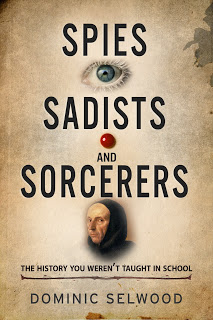
Dominic Selwood is an author and columnist, who has collected a series of columns offering different views of historical events into a book: Spies, Sadists and Sorcerers: The History You Weren't Taught in School (available on Kindle for $.99!).
Nancy Bilyeau interviews him on her blog, highlighting his revisionist view of the English Reformation, which certainly coincides with mine (and hers, too, I think).
Selwood's website provides generous excerpts from the book, including this "unintended Reformation" moment, discussing Walpurgisnacht and the saint it should be honoring:
It is pure coincidence that Walburga was canonized on May Day, thus giving her name to the festivities of the night before. But it is also strangely fitting, as popular belief in the healing properties of saints’ relics (and oils) is inseparable from our historical attachment to magic.
Nancy Bilyeau interviews him on her blog, highlighting his revisionist view of the English Reformation, which certainly coincides with mine (and hers, too, I think).
Selwood's website provides generous excerpts from the book, including this "unintended Reformation" moment, discussing Walpurgisnacht and the saint it should be honoring:
It is pure coincidence that Walburga was canonized on May Day, thus giving her name to the festivities of the night before. But it is also strangely fitting, as popular belief in the healing properties of saints’ relics (and oils) is inseparable from our historical attachment to magic.
And here is where something fascinating happens. As the Reformation swept away faith in popular and largely benign Christian miracles, it instead offered belief in a much darker magic —one that would quickly lead to the horror of the witch-craze and fantastical legends like the sabbaths on the Brocken.
It is deeply ironic that the Protestant reformers, in abolishing what they saw as harmful superstitious claptrap, replaced it with terrifying magical fears that would end with the brutal and pointless murder of tens of thousands of innocent women.
Before the Reformation there had, of course, been some scattered witch trials. But the same reforming theologians who lambasted what they saw as the crude and irrational magical beliefs underpinning the cult of saints and relics rapidly convinced themselves that hundreds of towns and villages were sheltering the foulest witches and demons, whose unnatural rites jeopardized the health and salvation of Christendom. They saw them flying on diabolical beasts, covering vast distances in the blink of an eye. They found on them folds of skin used for suckling demons in the form of familiars. They accused them of sexually molesting decent folk, invading their beds as lustful incubi and succubi. They were convinced they possessed infernal powers to see the past, the present (at great distance), and the future. But above all, they feared the witches were working ceaselessly to destroy their new, rational churches.
As the reformers set about ridding the world of these devilish handmaidens, the great burnings began, peaking in the late 1500s and early 1600s, before petering out in the early 1700s. In that time, somewhere between 40,000 and 100,000 people (predominantly, but not exclusively, women) were torched alive on suspicion of practising magic.
Looks like a fascinating, if episodic, review of events in history seen from different angles.
Sunday, April 17, 2016
St. Robert Southwell's Influence
Next month, from St. Augustine's Press: Southwell's Sphere: The Influence of England's Secret Poet by Dr. Gary Bouchard:
Once feared by Queen Elizabeth I and admired by William Shakespeare, Robert Southwell, s.j. (1561–1595), clings today to a thinning canonical presence in English literature among a sphere of other writers incongruously called the metaphysical poets. Southwell’s Sphere lifts this sixteenth century Jesuit priest and prolific writer from the obscurity in which he too often resides and places him instead at the center of a sphere of English poets upon whom his life and works exerted an observable influence. As he weaved his religious content into the familiar loom of Elizabethan form and style, this young missionary priest was seeking not just to catechize those whom he regarded as the faithful and the fallen, but to intentionally reform the verse of his native England. Remarkably, during his brief six-year mission, he actually managed in many respects to do so. Surviving for six years by successfully navigating and fostering a complicated underground Catholic network in and around London before being captured, tortured and imprisoned, Southwell was brought to trial and executed at Tyburn at age 33. He therefore never knew most of the “skillfuller wits” that he called upon to direct their poetic skills to the service of God. And like the marks upon his tortured body, the poetic marks of influence that his work left upon individual writers of this era were in many cases deliberately concealed. Southwell’s Sphere seeks to rediscover those marks and offer the reader a renewed appreciation for this subverted and subverting literary force in Early Modern England. In individual explicative chapters this book examines works by six poets whose verse may be appreciated differently in light of Robert Southwell’s life and work. The author makes the case that Southwell’s works, posthumously and prolifically published, instructed William Alabaster, provoked Edmund Spenser, prompted George Herbert, haunted John Donne, inspired Richard Crashaw and — two and a half centuries later — consoled Gerard Manley Hopkins, s.j. With the exception of Spenser, all of these poets were, like Southwell, ordained ministers. The particular personal, political and religious complexities of each of their lives notwithstanding, what they most shared in common with Southwell was their priestly vocation, their talent as English poets and the inevitable and inextricable joining of these two activities in their lives. While it would have made little sense for any of these poets to acknowledge Southwell as a poetic peer, each of them authored important verse that can best be appreciated within the sphere of this improbably successful and influential English poet.
“Hanged, Drawn, Quartered and Published: Robert Southwell and the Reformation of English Poetry”
Dr. Gary Bouchard - Dr. Bouchard is a professor in the English Department of Saint Anselm College, Manchester, NH. Since 1987, he has served the College in a variety of capacities, including a five-year term as the College’s Executive Vice-President from 1998 to 2003. He currently serves as secretary of the Executive Board of New Hampshire Catholic Charities, as a trustee of Catholic Medical Center, and on boards at Bishop Brady High School and The Villa Augustina. Dr. Bouchard specializes in Early Modern lyric and narrative poetry. His book Southwell’s Sphere: The Influence of England’s Secret Poet (due out in January 2016) [sic?] discusses Southwell’s influence on seventeenth-century poets.
Once feared by Queen Elizabeth I and admired by William Shakespeare, Robert Southwell, s.j. (1561–1595), clings today to a thinning canonical presence in English literature among a sphere of other writers incongruously called the metaphysical poets. Southwell’s Sphere lifts this sixteenth century Jesuit priest and prolific writer from the obscurity in which he too often resides and places him instead at the center of a sphere of English poets upon whom his life and works exerted an observable influence. As he weaved his religious content into the familiar loom of Elizabethan form and style, this young missionary priest was seeking not just to catechize those whom he regarded as the faithful and the fallen, but to intentionally reform the verse of his native England. Remarkably, during his brief six-year mission, he actually managed in many respects to do so. Surviving for six years by successfully navigating and fostering a complicated underground Catholic network in and around London before being captured, tortured and imprisoned, Southwell was brought to trial and executed at Tyburn at age 33. He therefore never knew most of the “skillfuller wits” that he called upon to direct their poetic skills to the service of God. And like the marks upon his tortured body, the poetic marks of influence that his work left upon individual writers of this era were in many cases deliberately concealed. Southwell’s Sphere seeks to rediscover those marks and offer the reader a renewed appreciation for this subverted and subverting literary force in Early Modern England. In individual explicative chapters this book examines works by six poets whose verse may be appreciated differently in light of Robert Southwell’s life and work. The author makes the case that Southwell’s works, posthumously and prolifically published, instructed William Alabaster, provoked Edmund Spenser, prompted George Herbert, haunted John Donne, inspired Richard Crashaw and — two and a half centuries later — consoled Gerard Manley Hopkins, s.j. With the exception of Spenser, all of these poets were, like Southwell, ordained ministers. The particular personal, political and religious complexities of each of their lives notwithstanding, what they most shared in common with Southwell was their priestly vocation, their talent as English poets and the inevitable and inextricable joining of these two activities in their lives. While it would have made little sense for any of these poets to acknowledge Southwell as a poetic peer, each of them authored important verse that can best be appreciated within the sphere of this improbably successful and influential English poet.
Professor Bouchard wrote about Southwell and his legacy in the July/August 2014 St. Austin Review and he will be speaking later this month at the Catholic Literature Conference in New Hampshire:
Dr. Gary Bouchard - Dr. Bouchard is a professor in the English Department of Saint Anselm College, Manchester, NH. Since 1987, he has served the College in a variety of capacities, including a five-year term as the College’s Executive Vice-President from 1998 to 2003. He currently serves as secretary of the Executive Board of New Hampshire Catholic Charities, as a trustee of Catholic Medical Center, and on boards at Bishop Brady High School and The Villa Augustina. Dr. Bouchard specializes in Early Modern lyric and narrative poetry. His book Southwell’s Sphere: The Influence of England’s Secret Poet (due out in January 2016) [sic?] discusses Southwell’s influence on seventeenth-century poets.
A poem by St. Robert Southwell, "Look Home"--could it have influenced John Donne?
Retired thoughts enjoy their own delights,
As beauty doth in self-beholding eye ;
Man's mind a mirror is of heavenly sights,
A brief wherein all marvels summed lie,
Of fairest forms and sweetest shapes the store,
Most graceful all, yet thought may grace them more.
The mind a creature is, yet can create,
To nature's patterns adding higher skill ;
Of finest works with better could the state
If force of wit had equal power of will.
Device of man in working hath no end,
What thought can think, another thought can mend.
Man's soul of endless beauty image is,
Drawn by the work of endless skill and might ;
This skillful might gave many sparks of bliss
And, to discern this bliss, a native light ;
To frame God's image as his worths required
His might, his skill, his word and will conspired.
As beauty doth in self-beholding eye ;
Man's mind a mirror is of heavenly sights,
A brief wherein all marvels summed lie,
Of fairest forms and sweetest shapes the store,
Most graceful all, yet thought may grace them more.
The mind a creature is, yet can create,
To nature's patterns adding higher skill ;
Of finest works with better could the state
If force of wit had equal power of will.
Device of man in working hath no end,
What thought can think, another thought can mend.
Man's soul of endless beauty image is,
Drawn by the work of endless skill and might ;
This skillful might gave many sparks of bliss
And, to discern this bliss, a native light ;
To frame God's image as his worths required
His might, his skill, his word and will conspired.
All that he had his image should present,
All that it should present it could afford,
To that he could afford his will was bent,
His will was followed with performing word.
Let this suffice, by this conceive the rest,
He should, he could, he would, he did, the best.
All that it should present it could afford,
To that he could afford his will was bent,
His will was followed with performing word.
Let this suffice, by this conceive the rest,
He should, he could, he would, he did, the best.
Thursday, April 14, 2016
The Prince of Wales in Spain
This is a good summary of the events behind the subject of Laura Cumming's book The Vanishing Velazquez:
In the spring of 1623 Charles, Prince of Wales, the young heir to the English and Scottish thrones donned a false wig and beard and slipped out of England under the assumed name of John Smith in order to journey to Madrid and secure for himself the hand of the King of Spain's daughter. His father James I and VI had been toying with the idea of a Spanish match for his son since as early as 1605, despite the profoundly divisive ramifications such a policy would have in the face of the determined 'Puritan' opposition in parliament, committed to combatting the forces of international Catholicism at every opportunity. With the Spanish ambassador, the machiavellian Count of Gondomar's encouragement to 'mount' Spain, Charles impetuously took matters into his own hands and as the negotiations stalled he departed secretly in the guise of Mr Smith to win with his romantic and foolhardy daring what his father could not achieve through diplomacy. The eventual failure and public humiliation that followed his journey to Madrid has been cited as a major influence on Charles's subsequent development and policies as king.
Another result of this journey was that Diego Velazquez painted a portrait of Prince Charles, the erstwhile suitor of the Infanta, and that portrait has been lost and found, particularly by one man in the nineteenth century, John Snare. And that's the story Laura Cummings tells, according to the publisher, Simon & Schuster:
From one of the world’s most expert art critics, the incredible true story—part art history and part mystery—of a Velazquez portrait that went missing and the obsessed nineteenth-century bookseller determined to prove he had found it.
When John Snare, a nineteenth-century provincial bookseller, traveled to a liquidation auction, he stumbled on a vivid portrait of King Charles I that defied any explanation. The Charles of the painting was young—too young to be king—and yet also too young to be painted by the Flemish painter to which the work was attributed. Snare had found something incredible—but what?
His research brought him to Diego Velazquez, whose long-lost portrait of Prince Charles has eluded art experts for generations. Velazquez (1599–1660) was the official painter of the Madrid court, during the time the Spanish Empire teetered on the edge of collapse. When Prince Charles of England—a man wealthy enough to help turn Spain’s fortunes—ventured to the court to propose a marriage with a Spanish princess, he allowed just a few hours to sit for his portrait. Snare believed only Velazquez could have met this challenge. But in making his theory public, Snare was ostracized, victim to aristocrats and critics who accused him of fraud, and forced to choose, like Velazquez himself, between art and family.
A thrilling investigation into the complex meaning of authenticity and the unshakable determination that drives both artists and collectors of their work, The Vanishing Velazquez travels from extravagant Spanish courts in the 1700s to the gritty courtrooms and auction houses of nineteenth-century London and New York. But it is above all a tale of mystery and detection, of tragic mishaps and mistaken identities, of class, politics, snobbery, crime, and almost farcical accident. It is a magnificently crafted page-turner, a testimony to how and why great works of art can affect us to the point of obsession.
A few scattered sightings of the portrait follow in Britain. In 1898 it was up for auction by the executors of the late Edward Snare, but it did not sell. Most likely, it was returned to a safe-deposit box at the Snares’ old bank, but again, the lead grows cold. Historians consider the painting lost, but Ms. Cumming holds out a faint hope that it will resurface one day.
In the spring of 1623 Charles, Prince of Wales, the young heir to the English and Scottish thrones donned a false wig and beard and slipped out of England under the assumed name of John Smith in order to journey to Madrid and secure for himself the hand of the King of Spain's daughter. His father James I and VI had been toying with the idea of a Spanish match for his son since as early as 1605, despite the profoundly divisive ramifications such a policy would have in the face of the determined 'Puritan' opposition in parliament, committed to combatting the forces of international Catholicism at every opportunity. With the Spanish ambassador, the machiavellian Count of Gondomar's encouragement to 'mount' Spain, Charles impetuously took matters into his own hands and as the negotiations stalled he departed secretly in the guise of Mr Smith to win with his romantic and foolhardy daring what his father could not achieve through diplomacy. The eventual failure and public humiliation that followed his journey to Madrid has been cited as a major influence on Charles's subsequent development and policies as king.
When John Snare, a nineteenth-century provincial bookseller, traveled to a liquidation auction, he stumbled on a vivid portrait of King Charles I that defied any explanation. The Charles of the painting was young—too young to be king—and yet also too young to be painted by the Flemish painter to which the work was attributed. Snare had found something incredible—but what?
His research brought him to Diego Velazquez, whose long-lost portrait of Prince Charles has eluded art experts for generations. Velazquez (1599–1660) was the official painter of the Madrid court, during the time the Spanish Empire teetered on the edge of collapse. When Prince Charles of England—a man wealthy enough to help turn Spain’s fortunes—ventured to the court to propose a marriage with a Spanish princess, he allowed just a few hours to sit for his portrait. Snare believed only Velazquez could have met this challenge. But in making his theory public, Snare was ostracized, victim to aristocrats and critics who accused him of fraud, and forced to choose, like Velazquez himself, between art and family.
A thrilling investigation into the complex meaning of authenticity and the unshakable determination that drives both artists and collectors of their work, The Vanishing Velazquez travels from extravagant Spanish courts in the 1700s to the gritty courtrooms and auction houses of nineteenth-century London and New York. But it is above all a tale of mystery and detection, of tragic mishaps and mistaken identities, of class, politics, snobbery, crime, and almost farcical accident. It is a magnificently crafted page-turner, a testimony to how and why great works of art can affect us to the point of obsession.
I wonder if we ever see the portrait in the book? The Wall Street Journal's review of this book (written by Henrik Bering) indicates that the painting has gone underground again:
I have this book on my pile to read some day: The Spanish Match: A Novel of Catholic Spain by Brennan Pursell.
Wednesday, January 20, 2016
From OUP Next Month: Bad Queen Bess?
From the publisher, Oxford University Press:
Peter Lake presents a series of (mutually constitutive) moves and counter moves, in the course of which the regime's claims to represent a form of public political virtue, to speak for the commonweal and true religion, elicited from certain Catholic critics a simply inverted rhetoric of private political vice, persecution, and tyranny. The resulting exchanges are read not only as a species of "political thought," but as a way of thinking about politics as process and of distinguishing between "politics" and "religion." They are also analyzed as modes of political communication and pitch-making - involving print, circulating manuscripts, performance, and rumor - and thus as constitutive of an emergent mode of "public politics" and perhaps of a "post reformation public sphere." While the focus is primarily English, the origins and imbrication of these texts within, and their direct address to, wider European events and audiences is always present. The aim is thus to contribute simultaneously to the political, cultural, intellectual, and religious histories of the period.
Oxford also notes that in Bad Queen Bess?: Libellous Politics, Secret Histories and the Politics of Publicity in Elizabethan England, Peter Lake, University Distinguished Professor of History and co-author (with Michael Questier) of The Trials of Margaret Clitherow:
- Puts Catholic polemical and political activity at the center of Elizabethan politics
- Focuses on the emergence of a style of public politics consequent on the religious conflicts and uncertainties of the age
- Emphasises the interaction between performance, manuscript, rumor, and print in the conduct of public politics, both by the state and its enemies
- Draws upon the emergent genre of the libellous secret history as a type of historical analysis
While this sounds fascinating, it does give me pause: This book uses the lies, half-truths, and deceptions the government and its critics used against each other to present the truth about history! See the table of contents here.
Saturday, January 9, 2016
Starting Off the New Year Royally
I am about half way through Robert Royal's A Deeper Vision: The Catholic Intellectual Tradition in the Twentieth Century, published by Ignatius Press:
In this wide-ranging and ambitious volume, Robert Royal, a prominent participant for many years in debates about religion and contemporary life, offers a comprehensive and balanced appraisal of the Catholic intellectual tradition in the twentieth century. The Catholic Church values both Faith and Reason, and Catholicism has given rise to extraordinary ideas and whole schools of remarkable thought, not just in the distant past but throughout the troubled decades of the twentieth century.
Royal presents in a single volume a sweeping but readable account of how Catholic thinking developed in philosophy, theology, Scripture studies, culture, literature, and much more in the twentieth century. This involves great figures, recognized as such both inside and outside the Church, such as Jacques Maritain, Bernard Lonergan, Joseph Pieper, Edith Stein, Alasdair MacIntyre, Charles Taylor, Romano Guardini, Karl Rahner, Henri du Lubac, Karol Wojtyla, Joseph Ratzinger, Hans Urs von Balthasar,Charles Peguy, Paul Claudel, George Bernanos, Francois Mauriac, G. K. Chesterton, Gerard Manley Hopkins, Christopher Dawson, Graham Greene, Sigrid Undset, J. R. R. Tolkien, Czeslaw Milosz, and many more.
Royal argues that without rigorous thought, Catholicism – however welcoming and nourishing it might be – would become something like a doctor with a good bedside manner, but who knows little medicine. It has always been the aspiration of the Catholic tradition to unite emotion and intellect, action and contemplation. But unless we know what the tradition has already produced – especially in the work of the great figures of the recent past – we will not be able to answer the challenges that the modern world poses, or even properly recognize the true questions we face.
This is a reflective, non-polemical work that brings together various strands of Catholic thought in the twentieth century. A comprehensive guide to the recent past - and the future.
In this wide-ranging and ambitious volume, Robert Royal, a prominent participant for many years in debates about religion and contemporary life, offers a comprehensive and balanced appraisal of the Catholic intellectual tradition in the twentieth century. The Catholic Church values both Faith and Reason, and Catholicism has given rise to extraordinary ideas and whole schools of remarkable thought, not just in the distant past but throughout the troubled decades of the twentieth century.
Royal presents in a single volume a sweeping but readable account of how Catholic thinking developed in philosophy, theology, Scripture studies, culture, literature, and much more in the twentieth century. This involves great figures, recognized as such both inside and outside the Church, such as Jacques Maritain, Bernard Lonergan, Joseph Pieper, Edith Stein, Alasdair MacIntyre, Charles Taylor, Romano Guardini, Karl Rahner, Henri du Lubac, Karol Wojtyla, Joseph Ratzinger, Hans Urs von Balthasar,Charles Peguy, Paul Claudel, George Bernanos, Francois Mauriac, G. K. Chesterton, Gerard Manley Hopkins, Christopher Dawson, Graham Greene, Sigrid Undset, J. R. R. Tolkien, Czeslaw Milosz, and many more.
Royal argues that without rigorous thought, Catholicism – however welcoming and nourishing it might be – would become something like a doctor with a good bedside manner, but who knows little medicine. It has always been the aspiration of the Catholic tradition to unite emotion and intellect, action and contemplation. But unless we know what the tradition has already produced – especially in the work of the great figures of the recent past – we will not be able to answer the challenges that the modern world poses, or even properly recognize the true questions we face.
This is a reflective, non-polemical work that brings together various strands of Catholic thought in the twentieth century. A comprehensive guide to the recent past - and the future.
So far, I've read the chapters about the Thomist revival encouraged by Pope Leo XIII at the end of the nineteenth century in both philosophy and theology, the impact of the Second Vatican Council, and Royal's profiles and evaluations of Jacques Maritain, Bernard Lonergan, Joseph Pieper, Edith Stein, Alasdair MacIntyre, Charles Taylor, Romano Guardini, Karl Rahner, Henri du Lubac, Karol Wojtyla, Joseph Ratzinger, Hans Urs von Balthasar, and others. I'm starting the two chapters on Scripture studies now, and really looking forward to part two of the book, "Creed and Culture", in which Royal will discuss Charles Peguy, Paul Claudel, George Bernanos, Francois Mauriac, G. K. Chesterton, Gerard Manley Hopkins, Christopher Dawson, Graham Greene, Sigrid Undset, J. R. R. Tolkien, Czeslaw Milosz, and "many more".
Royal is providing context for my reading list for the past few decades of my life, as, except for the more technical philosophical and theological works, I've been reading--outside of my research on the English Reformation--so many of those authors, especially Romano Guardini, Karol Wojtyla (especially his papal encyclicals and documents as Pope St. John Paul II), Joseph Ratzinger (especially his papal encyclicals and documents as Pope Benedict XVI), Edith Stein, Henri du Lubac, and all those poets, novelists, and historians: Charles Peguy, Paul Claudel, George Bernanos, Francois Mauriac, G. K. Chesterton, Gerard Manley Hopkins, Christopher Dawson, Graham Greene, Sigrid Undset, J. R. R. Tolkien, etc.
I wonder if among the many more Royal will discuss Dietrich von Hildebrand, Robert Hugh Benson, or Hilaire Belloc?
Friday, December 18, 2015
'the true life of a man is in his letters'
From Oxford University Press comes this new book about Blessed John Henry Newman:
John Henry Newman was one of the most eminent of Victorians and an intellectual pioneer for an age of doubt and unsettlement. His teaching transformed the Victorian Church of England, yet many still want to know more of Newman's personal life. Newman's printed correspondence runs to 32 volumes, and John Henry Newman: A Portrait in Letters offers a way through the maze.
Roderick Strange has chosen letters that illustrate not only the well-known aspects of Newman's personality, but also those in which elements that may be less familiar are on display. There are letters to family and friends, and also terse letters laced with anger and sarcasm. The portrait has not been airbrushed. This selection of letters presents a rounded picture, one in which readers will meet Newman as he really was and enjoy the pleasure of his company. As Newman himself noted, 'the true life of a man is in his letters'.
Over the years I have read many books about Newman: biographies, studies, monographs. I have read Newman's major works and many of his sermons. I have taught classes on Cardinal Newman. When I picked up this book to read as a review before attending a seminar at Christ Church at the University of Oxford, I really did not expect to learn anything new.
With that preface out of the way--this book truly impressed me. Father Strange reveals Newman's influence and impact on his life and vocation as a priest in so many wonderful ways, so that the book has a very appropriate "heart speaks to heart" quality (Cor ad cor loquitor/Heart Speaks to Heart was Newman's motto as Cardinal).
He provides an excellent overview of Cardinal Newman's life and his major efforts and works. The chapter on Marian Doctrine and Devotion, not always a theme expected in an introductory study of Newman, was truly revelatory. Newman's apologetic for the dogma of the Immaculate Conception of Mary, like his explanation of the First Vatican Council's declaration on Papal Infallibility, provides a clear defense of the Church's teachings while placing them in their proper context of the Divine Economy of Salvation.
Father Strange also enlightens when describing Newman's understanding of God's providence in his life (and in the lives of all Christians), the course of Newman's sermons at the Church of St. Mary the Virgin during the Oxford Movement, his efforts to help the laity, and to advance Christian unity.
The last two chapters are perhaps the most extraordinary: a comparison of St. Thomas More and Venerable John Henry Newman as a meditation on sanctity and canonization and an analysis of Newman's epic poem, "The Dream of Gerontius".
The title may indicate that this book is on an introductory level, it's true (in the U.K. the title was "John Henry Newman: A Mind Alive" which does not have such a college course catalog flavor about it). The writing is clear and accessible, but the richness of Father Strange's introduction goes far beyond just an acquaintance or chance meeting--it reveals friendship and understanding. Highly recommended to anyone wanting to know more about Venerable (soon to be Beatified) John Henry Newman.
John Henry Newman was one of the most eminent of Victorians and an intellectual pioneer for an age of doubt and unsettlement. His teaching transformed the Victorian Church of England, yet many still want to know more of Newman's personal life. Newman's printed correspondence runs to 32 volumes, and John Henry Newman: A Portrait in Letters offers a way through the maze.
Roderick Strange has chosen letters that illustrate not only the well-known aspects of Newman's personality, but also those in which elements that may be less familiar are on display. There are letters to family and friends, and also terse letters laced with anger and sarcasm. The portrait has not been airbrushed. This selection of letters presents a rounded picture, one in which readers will meet Newman as he really was and enjoy the pleasure of his company. As Newman himself noted, 'the true life of a man is in his letters'.
The Contents:
Acknowledgments
Abbreviations
Introduction
A Chronology of John Henry Newman
1. Early Years (1801-33)
2. The Oxford Movement (1833-39)
3. Under Siege (1839-43)
4. From Oxford to Rome (1843-46)
5. Early Catholic Years (1846-51)
6. The Pressure of Crises (1852-58)
7. Dark Days (1859-63)
8. The Apologia and the Oxford Mission (1863-65)
9. Answering Pusey and Anticipating the Vatican Council (1865-69)
10. Vatican I and Answering Gladstone (1870-76)
11. Honorary Fellow of Trinity and Cardinal (1876-81)
12. Final Year (1881-90)
Index of Correspondents
Abbreviations
Introduction
A Chronology of John Henry Newman
1. Early Years (1801-33)
2. The Oxford Movement (1833-39)
3. Under Siege (1839-43)
4. From Oxford to Rome (1843-46)
5. Early Catholic Years (1846-51)
6. The Pressure of Crises (1852-58)
7. Dark Days (1859-63)
8. The Apologia and the Oxford Mission (1863-65)
9. Answering Pusey and Anticipating the Vatican Council (1865-69)
10. Vatican I and Answering Gladstone (1870-76)
11. Honorary Fellow of Trinity and Cardinal (1876-81)
12. Final Year (1881-90)
Index of Correspondents
Amazon.com offers a generous preview and/or Kindle sample.
Strange is an excellent interpreter of Newman's life and thought. Next to Father Ian Ker and Edward Short, he is one of the best. Several years ago, I read his Newman 101 published by Ave Maria Press and reviewed it for Amazon:
With that preface out of the way--this book truly impressed me. Father Strange reveals Newman's influence and impact on his life and vocation as a priest in so many wonderful ways, so that the book has a very appropriate "heart speaks to heart" quality (Cor ad cor loquitor/Heart Speaks to Heart was Newman's motto as Cardinal).
He provides an excellent overview of Cardinal Newman's life and his major efforts and works. The chapter on Marian Doctrine and Devotion, not always a theme expected in an introductory study of Newman, was truly revelatory. Newman's apologetic for the dogma of the Immaculate Conception of Mary, like his explanation of the First Vatican Council's declaration on Papal Infallibility, provides a clear defense of the Church's teachings while placing them in their proper context of the Divine Economy of Salvation.
Father Strange also enlightens when describing Newman's understanding of God's providence in his life (and in the lives of all Christians), the course of Newman's sermons at the Church of St. Mary the Virgin during the Oxford Movement, his efforts to help the laity, and to advance Christian unity.
The last two chapters are perhaps the most extraordinary: a comparison of St. Thomas More and Venerable John Henry Newman as a meditation on sanctity and canonization and an analysis of Newman's epic poem, "The Dream of Gerontius".
The title may indicate that this book is on an introductory level, it's true (in the U.K. the title was "John Henry Newman: A Mind Alive" which does not have such a college course catalog flavor about it). The writing is clear and accessible, but the richness of Father Strange's introduction goes far beyond just an acquaintance or chance meeting--it reveals friendship and understanding. Highly recommended to anyone wanting to know more about Venerable (soon to be Beatified) John Henry Newman.
Tuesday, October 27, 2015
Eagerly Awaiting: "Adventures in the Book Pages"
My review copy is in the mail, coming from across the pond and through US Customs, but Francis Phillips of The Catholic Herald has already read it and reviews Adventures in the Book Pages: Essays and Reviews here, with some insights from Edward Short on the art of reviewing books:
Short is also a Catholic, whose insights and assessments are informed by his faith. As a book reviewer myself, who often asks herself, “What is the point of reviewing?”, I asked Short what he thinks the task of a Catholic reviewer is. He tells me he is tempted to answer “one is not a Catholic reviewer but only a reviewer who happens to be Catholic” but then adds, “Yet there is a sense in which my faith does give me a special charge whenever I review books. I am on my mettle not only to write sensibly and fairly but also charitably. I also try to look at my subjects, as far as I can, sub specie aeternitatis. Lastly, I am always careful not to bore the reader.”
Reviewing, he thinks, is a “lowly enterprise, but it is precisely its lowliness that ensures its usefulness. Good reviewing – and I would argue, proper Catholic reviewing especially – demands good reading; also humility and self-effacement.”
Does being a Catholic reviewer leave one open to the charge of bias? Short reminds me that “all writing is biased. Certainly a Catholic bias is better than a nihilist or liberal bias, both of which tend to underestimate good books and overestimate those that are meretricious or highly regarded by the wrong people for the wrong reasons.” He believes that proper Catholic bias “gives one depth and balance, as well as sympathy and zest. And it puts one beyond the pale of fashion. The good Catholic reviewer should always be ready to be a sign of contradiction; a just and generous guide to the good work of others – but always a defender of the good, the beautiful and the true, even when it exposes him to obloquy.” He adds with conviction, “We must denounce the idiocies of the age.”
Can reviewing be a creative activity in its own right? Short reminds me that many of the personalities he covers in his book, such as Chesterton, Auden, Eliot, Greene and Waugh, wrote reviews expressly to fuel their own creative work. He thinks Graham Greene was an excellent critic, as was Waugh. He is grateful for the books he gets sent as they give him the opportunity “to learn about a subject or author that could very well serve as good creative grist to my own work.” As an example, he mentions Jane Ridley’s biographies of Edwin Lutyens and Edward VII which have been “an education not only in biography but history and narrative and that often elusive, subtle thing, style.”
Short also tells me that as his work on Newman is rooted in his 19th century English context, he tends to review books by or about figures of that period, such as Henry Mayhew, Ruskin, AWN Pugin, Gladstone, Thackeray and Hopkins. His favourite authors in his book “tend to be those from whom I learn the most, such as the historian Michael Burleigh.” He adds that “I have also learnt a fair amount from Fr Ian Ker, whose critical biographies of Newman and Chesterton are full of good things.”
Edward Short recently reviewed The Oxford Movement: Europe and the Wider World 1830-1930, edited by Stewart J. Brown and Peter B. Nockles and published by Cambridge University Press for The Catholic World Report, so he is probably preparing volume two of his adventures.
Sunday, August 16, 2015
A Fifteenth Anniversary: St. Thomas More as Patron of Politicians
Edited by Travis Curtright, Director of Humanities and Liberal Studies and Associate Professor of Humanities and Literature at Ave Maria University and research fellow of the Center for Thomas More Studies at the University of Dallas, this forthcoming book celebrates an unusual and perhaps now controversial anniversary:
The year 2015 marks the fifteenth anniversary of Thomas More’s becoming Patron Saint of Statesmen and Politicians. Yet during these years no serious answer has been given by a community of scholars as to why More would be the choice of over 40,000 leaders from ninety-five countries. What were More’s guiding principles of leadership and in what ways might they remain applicable? This collection of essays addresses these questions by investigating More through his writings, his political actions, and in recent artistic depictions.
Introduction: Why Patron of Statesmen (Travis Curtright)
Chapter 1: Thomas More on Liberty, Law, and Good Rule (Gerard Wegemer)
Chapter 2: Statesmanship, Tyranny, and Piety: Thomas More’s Response to Lucian’s The Tyrannicide (Carson Holloway)
Chapter 3: Utopia’s Images of the Statesman (James R. Stoner, Jr.)
Chapter 4: Passing Strange, Yet Wholly True: On the Political Tales of Plato’s Critias and More’s Hythlodaeus (Jeffrey S. Lehman)
Chapter 5: Thomas More’s Utopia and Catholic Social Doctrine (J. Brian Benestad)
Chapter 6: Faith, Reason, and Order: Thomas More and Natural Law (Samuel Gregg)
Chapter 7: Sir Thomas More and his Opposition to Henry VIII in 1533 (Travis Curtright)
Chapter 8: Thomas More: Patron Saint of Leading Citizens (Stephen W. Smith)
Chapter 9: What Bolt Got Right and What Mantel Got Wrong (Louis Karlin)
Chapter 10: The Place of Sir Thomas More in Political Philosophy: A Reflection on “A Man for All Seasons.” (James V. Schall, S. J.)
Appendix: Apostolic Letter, Issued Motu Proprio, Proclaiming Saint Thomas More Patron of Statesmen and Politicians. (Pope John Paul II.)
As its fifteenth anniversary approaches in October, Pope John Paul II’s proclamation of More as Patron Saint of Statesmen remains widely ignored and often misunderstood. John Paul II’s understanding of More not only recapitulates Catholic social teaching; it also emphasizes many of the same key attributes that are highlighted in Robert Bolt’s famous play, A Man for all Seasons (1960).
Bolt’s More possesses an “adamantine sense of self” that derives from his “conscience.” This characterization of More comports with John Paul II’s longstanding account of conscience. As early as 1962, while auxiliary Bishop of Krakow, he wrote: “The conscience provides the basis for the definitive structure [of the self] and defines me as that unique and unrepeatable self or I.” Bolt’s distaste for Catholicism notwithstanding, he and the pope both stress the inseparability of selfhood and conscience.
Integrity emerges in those leaders who follow their conscience. The Vatican proclamation emphasizes More’s “unity of life,” his commitment to pursue sanctity through and within his legal and political work. Integrity in government leaders best serves the common good because, as Bolt’s More observes, “when statesmen forsake their own private conscience for the sake of their public duties … they lead their country by a short route to chaos.”
As John Paul II puts it, More’s “defense of the Church’s freedom from unwarranted interference by the State is at the same time a defense, in the primacy of conscience, of the individual’s freedom vis-à-vis political power.” The Church’s freedom, in other words, cannot be untethered from that of the individuals who uphold its teachings. More himself made this point in self-defense, invoking the Magna Carta Libertatum (1215)—and its doctrine that the Church shall be free—at his trial. So both More and John Paul II argue that no definition of the individual’s conscience can exclude God’s moral law or the Church that interprets and teaches it.
On this point, the pope’s treatment of More invokes the earlier encyclical Veritatis Splendor (1993). That document teaches that “human freedom and God’s law meet and are called to intersect” because “man’s free obedience to God’s law effectively implies that human reason and human will participate in God’s wisdom and providence.” Thus, the pope proposes conscience as the actualization of humanity’s highest faculties and the proper exercise of freedom as a participation in divine life, a point exemplified by More’s life and death.
Do John Paul II and Robert Bolt really paint a historically accurate image of More? Or are they merely making anachronistic impositions upon history?
This would be a fascinating study to read, due out next month (but very expensive!) This is a book for Inter Library Loan!
The year 2015 marks the fifteenth anniversary of Thomas More’s becoming Patron Saint of Statesmen and Politicians. Yet during these years no serious answer has been given by a community of scholars as to why More would be the choice of over 40,000 leaders from ninety-five countries. What were More’s guiding principles of leadership and in what ways might they remain applicable? This collection of essays addresses these questions by investigating More through his writings, his political actions, and in recent artistic depictions.
In the book:
Chapter 1: Thomas More on Liberty, Law, and Good Rule (Gerard Wegemer)
Chapter 2: Statesmanship, Tyranny, and Piety: Thomas More’s Response to Lucian’s The Tyrannicide (Carson Holloway)
Chapter 3: Utopia’s Images of the Statesman (James R. Stoner, Jr.)
Chapter 4: Passing Strange, Yet Wholly True: On the Political Tales of Plato’s Critias and More’s Hythlodaeus (Jeffrey S. Lehman)
Chapter 5: Thomas More’s Utopia and Catholic Social Doctrine (J. Brian Benestad)
Chapter 6: Faith, Reason, and Order: Thomas More and Natural Law (Samuel Gregg)
Chapter 7: Sir Thomas More and his Opposition to Henry VIII in 1533 (Travis Curtright)
Chapter 8: Thomas More: Patron Saint of Leading Citizens (Stephen W. Smith)
Chapter 9: What Bolt Got Right and What Mantel Got Wrong (Louis Karlin)
Chapter 10: The Place of Sir Thomas More in Political Philosophy: A Reflection on “A Man for All Seasons.” (James V. Schall, S. J.)
Appendix: Apostolic Letter, Issued Motu Proprio, Proclaiming Saint Thomas More Patron of Statesmen and Politicians. (Pope John Paul II.)
Travis Curtright contributed an article to Crisis Magazine previewing his introduction, I presume, which I think reflects too much on Robert Bolt's heroic More:
Bolt’s More possesses an “adamantine sense of self” that derives from his “conscience.” This characterization of More comports with John Paul II’s longstanding account of conscience. As early as 1962, while auxiliary Bishop of Krakow, he wrote: “The conscience provides the basis for the definitive structure [of the self] and defines me as that unique and unrepeatable self or I.” Bolt’s distaste for Catholicism notwithstanding, he and the pope both stress the inseparability of selfhood and conscience.
Integrity emerges in those leaders who follow their conscience. The Vatican proclamation emphasizes More’s “unity of life,” his commitment to pursue sanctity through and within his legal and political work. Integrity in government leaders best serves the common good because, as Bolt’s More observes, “when statesmen forsake their own private conscience for the sake of their public duties … they lead their country by a short route to chaos.”
As John Paul II puts it, More’s “defense of the Church’s freedom from unwarranted interference by the State is at the same time a defense, in the primacy of conscience, of the individual’s freedom vis-à-vis political power.” The Church’s freedom, in other words, cannot be untethered from that of the individuals who uphold its teachings. More himself made this point in self-defense, invoking the Magna Carta Libertatum (1215)—and its doctrine that the Church shall be free—at his trial. So both More and John Paul II argue that no definition of the individual’s conscience can exclude God’s moral law or the Church that interprets and teaches it.
On this point, the pope’s treatment of More invokes the earlier encyclical Veritatis Splendor (1993). That document teaches that “human freedom and God’s law meet and are called to intersect” because “man’s free obedience to God’s law effectively implies that human reason and human will participate in God’s wisdom and providence.” Thus, the pope proposes conscience as the actualization of humanity’s highest faculties and the proper exercise of freedom as a participation in divine life, a point exemplified by More’s life and death.
Do John Paul II and Robert Bolt really paint a historically accurate image of More? Or are they merely making anachronistic impositions upon history?
This would be a fascinating study to read, due out next month (but very expensive!) This is a book for Inter Library Loan!
Monday, December 22, 2014
Next to Read: Robert Barlett's History of Saints
One of my birthday presents is Robert Bartlett's Why Can the Dead Do Such Great Things? from Princeton University Press:
Bartlett takes his title from St. Augustine's The City of God. Looks fascinating. Here's the first chapter.
From its earliest centuries, one of the most notable features of Christianity has been the veneration of the saints--the holy dead. This sweepingly ambitious history from one of the world's leading medieval historians tells the fascinating story of the cult of the saints from its origins in the second-century days of the Christian martyrs to the Protestant Reformation. Drawing on sources from around the Christian world, Robert Bartlett examines all of the most important aspects of the saints--including miracles, relics, pilgrimages, shrines, and the saints' role in the calendar, literature, and art.
As this engaging narrative shows, a wide variety of figures have been venerated as saints: men and women, kings and servant girls, legendary virgins and highly political bishops--and one dog. The book explores the central role played by the bodies and body parts of saints, and the special treatment these relics received: how they were treasured and enshrined, used in war and peace, and faked and traded. The shrines of the saints drew pilgrims, sometimes from hundreds of miles, and the book describes the routes, dangers, and rewards of pilgrimage, including the thousands of reported miracles. The book surveys the rich literature and images that proliferated around the saints, as well as the saints' impact on everyday life--from the naming of people and places to the shaping of the calendar. Finally, the book considers how the Christian cult of saints compares with apparently similar aspects of other religions.
At once deeply informative and entertaining, this is an unmatched account of an immensely important and intriguing part of the religious life of the past--as well as the present.
Robert Bartlett is the Bishop Wardlaw Professor of Mediaeval History at the University of St. Andrews in Scotland and a fellow of the British Academy. His books include The Making of Europe, joint winner of the Wolfson History Prize, andThe Hanged Man: A Story of Miracle, Memory, and Colonialism in the Middle Ages (Princeton). He has also written and presented documentaries on the Middle Ages for BBC television.
Tuesday, November 18, 2014
What I'm Reading Now: Newman as Spiritual Director
I purchased this book in the Kindle edition to read for more background to the Newman lecture next February:
John Henry Newman (1801-1890) was a man who sought to integrate life and holiness. He believed that the spiritual life needed to be lived in an active and dynamic way, touching a person's fundamental attitudes and actions.
Although Newman rejected the title of spiritual director as such, it is obvious from his correspondence that directing others through various facets of the Christian life was one of his dominant concerns. Surprisingly, comparatively little has been written about Newman's idea of spiritual direction. This book investigates Newman's understanding of spiritual direction during his life as a Roman Catholic, 1845-1890. It examines the major areas in which Newman gave spiritual direction through an analysis of the correspondence from his Catholic years. It also explicates those principles of Newman's own spiritual life that found expression in his direction of others.
Newman had a mammoth "apostolate of correspondence." His Letters and Diaries have been edited and published in a series of thirty-two volumes, embracing more than twenty thousand letters. The first ten volumes deal with Newman's Anglican period; the remaining twenty-two volumes cover his Catholic period and are the primary source for this book. These volumes have been studied chronologically in order to determine and extract the major areas in which Newman gave spiritual direction to others, and to investigate the stages of development in his spiritual advice.
One thing that caught my eye about the book was one of the blurbs:
--William Fey, OFM Cap., Bishop of Kimbe, Papua New Guinea
Bishop Fey spoke years ago at the St. Paul's Parish-Newman Center at WSU on his book about Newman on Faith, Doubt, and Certainty--it was soon after the 1979 Newman School of Catholic Thought, but my notes aren't dated.
Monday, November 10, 2014
For My Review: Gareth Russell's Tudor Overview
Amberley Publishing sent me a review copy of Gareth Russell's new book, An Illustrated Introduction to THE TUDORS, part of their "Illustrated Introduction" series. My first impressions are that this is a well-illustrated (as befits the title) biographical survey of the Tudor dynasty and its origins. From what I have read so far, Russell acknowledges the fascination of the Tudors and supplies amble evidence of why we are so intrigued by the six monarchs (Henry VII, Henry VIII, Edward VI, Jane Dudley, Mary I and, Elizabeth I) of this royal family. He has prepared a helpful timeline and list of suggested reading. Full review forthcoming.
On his blog Gareth has announced that he is working on a biography of Henry VIII's fifth wife, Catherine Howard, to be published by Simon & Schuster and HarperCollins: Young and Damned and Fair: The Life and Tragedy of Catherine Howard at the court of King Henry VIII.
Thursday, August 7, 2014
New From Father Ian Ker: Newman on Vatican II
Oxford University Press will publish a new book by Father Ian Ker, Newman on Vatican II, this fall (September 28, 2014). This will clearly be an important book, as it addresses one of the most common statements about Blessed John Henry Newman and the Second Vatican Council:
John Henry Newman is often described as "the Father of the Second Vatican
Council." He anticipated most of the Council's major documents, as well as being
an inspiration to the theologians who were behind them. His writings offer an
illuminating commentary both on the teachings of the Council and the way these
have been implemented and interpreted in the post-conciliar period. This book is
the first sustained attempt to consider what Newman's reaction to Vatican II
would have been. As a theologian who on his own admission fought throughout his
life against theological liberalism, yet who pioneered many of the themes of the
Council in his own day, Newman is best described as a conservative radical who
cannot be classed simply as either a conservative or liberal Catholic. At the
time of the First Vatican Council, Newman adumbrated in his private letters a
mini-theology of Councils, which casts much light on Vatican II and its
aftermath.
Noted Newman scholar, Ian Ker, argues that Newman would have greatly welcomed the reforms of the Council, but would have seen them in the light of his theory of doctrinal development, insisting that they must certainly be understood as changes but changes in continuity rather than discontinuity with the Church's tradition and past teachings. He would therefore have endorsed the so-called "hermeneutic of reform in continuity" in regard to Vatican II, a hermeneutic first formulated by Pope Benedict XVI and subsequently confirmed by his successor, Pope Francis, and rejected both "progressive" and ultra-conservative interpretations of the Council as a revolutionary event. Newman believed that what Councils fail to speak of is of great importance, and so a final chapter considers the kind of evangelization -- a topic notably absent from the documents of Vatican II -- Newman thought appropriate in the face of secularization.
Saturday, December 21, 2013
And It Arrived on My Birthday! A Review Copy from Gracewing
This looks like a fascinating study of a period that's not so well known in the history of Catholicism in England after the English Reformation--and I do agree that the usual view of that era is that it was very quiet and stagnant: Persecution Without Martyrdom: The Catholics of North-East England in the Age of the Vicars Apostolic 1688-1850, by Leo Gooch
Publisher's Blurb: Until comparatively recently, historical studies of English Catholicism have lavished attention on the ‘Age of Martyrs’ of the sixteenth and seventeenth centuries or on the ‘Second Spring’ of the nineteenth century, while the eighteenth, a century of ‘persecution without martyrdom’ as Edwin Burton described the life and times of Richard Challoner, is largely passed over. That neglect is wholly unwarranted. The creation of the four Vicariates Apostolic in 1688 marks the foundation of the modern Roman Catholic Church in England AND Wales and a series of significant ecclesiastical developments affecting the disposition and operation of the mission followed over the next century and a half: its emergence from ‘seigneurial’ rule, its shift from its rural strongholds into the towns, and its metamorphosis into a centrally-managed organization. In the secular field, this was the age when major political crises relating to Catholicism arose, when Catholics threw off discrimination and oppression and by degrees emerged from recusancy to full citizenship; and when the sociological character of the English Catholics changed completely. Theses were all important enough singly, but cumulatively they amounted to nothing less than a radical transformation of the structure and outlook of the English Catholics. The later achievements of the Church of Cardinals Manning, Wiseman and Newman could not possibly have been won without the perseverance and vigour of the eighteenth century recusants.
I look forward to reading it and reviewing it.
Sunday, August 25, 2013
This Week's Reading Assignment
I'm almost to Italy in this book by Jo Anne Cammarata Sylva from Newman House Press--by that I mean that John Henry Newman is discussing that essential Mediterranean journey with Richard Hurrell Froude. Of course, Italy, including his visits to Rome and Sicily on that trip in 1833 are important sign posts on Newman's way to the Catholic Church. He would return to Rome as a seminarian preparing for the Catholic priesthood after his conversion in 1846, and then briefly on Oratory business in 1856, and finally in 1879 when he received his cardinal's hat. Sister and Dr. Brigitte Maria Hoegemann FSO wrote about Blessed John Henry Newman's visits to Rome particulary in the June 2008 Newsletter of the International Centre of Newman Friends:
Long before the Anglo-Catholic Oxford don actually saw the city, its name must have resonated with John Henry Newman, evoking not just images of the ancient city, kingdom, republic and empire, its history of three thousand years, its rise and the fall, but also its huge claim to power and its unique culture of antiquity both pagan and Christian. Rome was not only a subject of special interest to the young Oxford student, but also the visible centre of the Catholic Church from the time of the apostles. Yet the don still had the conviction, learned as a boy at Ealing, that the Christian faith in Rome had over time become so corrupt as to be the work of Antichrist. The mere name of the city aroused in Newman notions, emotions and convictions both happy and painful. He describes an Anglican looking down on the city, who remarked: “the Christian can never survey (it) without the bitterest, the most loving and the most melancholy thoughts.”[1]
Professor Sylva goes beyond Rome, of course, in this book, and looks at other crucial Italian influences in Newman's life--and pride of place must surely be Blessed Dominic Barberi, whose memorial we celebrate tomorrow! I'll let you know. Here is an interview with the author of How Italy and Her People Shaped Cardinal Newman: Italian Influences on An English Mind (a title I think should have been reversed!)
Wednesday, August 21, 2013
Edward Short's Newman Trilogy
Edward Short sent me this link to the T&T Clark blog about a presentation he'll be making in London this September and more information about his Newman Trilogy: Newman and His Contemporaries; Newman and His Family; and Newman and His Critics:Edward Short on Newman and his Family, the 2nd volume in his trilogy on John Henry Newman
Edward Short will be delivering a talk intitled Newman and the Idea of Sanctity on the 5th of September, 8pm at St Wilfrid's Hall, The London Oratory, UK. Below he speaks about his second book in his trilogy on Cardinal Newman.
“Newman and his Family is the second volume in my trilogy about the great priest, poet, satirist, novelist, educator, philosopher and theologian, John Henry Newman. If in the trilogy’s first volume, Newman and his Contemporaries, I looked at Newman and his friendships with Edward Pusey, John Keble, Emily Bowles, William Froude, and Lady Georgiana Fullerton, as well as his influence on such prominent Victorian figures as Thackeray, Matthew Arnold, Arthur Hugh Clough and Richard Holt Hutton, in my second book I look at Newman’s relationships with his immediate family.
These were close and complex relationships, and they were instrumental in shaping how Newman viewed not only English society in its social, intellectual, religious and moral aspects but himself and his evolving Christian faith as well. Accordingly, there are chapters on each of the parents and each of his five siblings, Charles, Frank, Harriet, Jemima and Mary. There is also a chapter on his nephew, John Rickards Mozley, with whom Newman entered into a fascinating exchange of letters in 1875. Mozley inherited something of the scepticism of late Victorian Cambridge, with, however, nagging reservations, and I discuss how in many ways he resembles other uneasy sceptics of that age—Henry Sidgwick most particularly. Then, again, I discuss how Mozley and Sidgwick corroborated Newman’s sense of the diffidence of doubt, which only strengthened his appreciation for the appeal of faith, even for those most dubious about the grounds for faith.
These are some of the intellectual and philosophical aspects of Newman’s familial relationships but in some of the other chapters, particularly those on Mary, Jemima, Harriett and Frank Newman I try to share with readers the deep love that Newman felt for his family, which, despite many trials, never wavered. In writing his mother from Lyons on his way back from the Mediterranean in July, 1833, Newman confessed how “The thought of home has brought tears in my eyes for the last two months.” The interrelated themes of home and love suffuse my book. So many of the differences that Newman experienced with his family and indeed with his contemporaries, especially after his conversion, arose as a result of conflicting ideas of home. And this, in turn, caused so much thwarted love! My book, then, as anyone familiar with the joys and sorrows of family life can see, is, in essence, a work of family history.
Then he previews the third book that he's working on now:
Now I am at work on the third book of the trilogy, which is entitled Newman and his Critics. In this final volume, I show what an enormous debt Newsman owed his critics. After all, they forced him to defend himself, to defend his various positions on faith and reason, orthodoxy and liberalism, belief and unbelief. They put him on his mettle. Consequently, one of the underlying contentions of this final book of the trilogy is that if Newman had not done battle with so many of his contemporaries--in most cases, affable, charitable, constructive battle—he would never have become the great defender of the faith that he became. It was precisely because he spent so much time addressing those who did not share his faith—and among those we must number many in his own family—that Newman became such a compelling apologist.
The critics in my upcoming book include such lively, combative figures as Charles Kingsley and Sir James Fitzjames Stephen, as well as such former disciples as Mark Pattison and Anthony Froude. What is striking about these figures is how they hearken back to Newman’s brothers, Charles and Frank, who would never suffer their brilliant brother to persuade them of the tenability of faith, certainly not the Roman Catholic faith. In all three books, I have endeavored to show my readers that it is only by putting Newman in his immediate context, with his family and his contemporaries and his critics that we can begin to understand the full caritas and genius of the man.”
I certainly look forward to seeing my review copy of Newman and His Family!
Wednesday, July 31, 2013
From 1986 to 2013: The Debate On The English Reformation
Rosemary O'Day, Emeritus Professor and Senior Research Associate in History at the Open University, has revised her 1986 book on the historiography of the English Reformation. From Manchester University Press:
Extensively revised and updated, this new edition of The debate on the English Reformation combines a discussion of successive historical approaches to the English Reformation with a critical review of recent debates in the area, offering a major contribution to modern historiography as well as to Reformation studies. It explores the way in which successive generations have found the Reformation relevant to their own times and have in the process rediscovered, redefined and rewritten its story. It shows that not only people who called themselves historians but also politicians, ecclesiastics, journalists and campaigners argued about interpretations of the Reformation and the motivations of its principal agents. The author also shows how, in the twentieth century, the debate was influenced by the development of history as a subject and, in the twenty-first century, by state control of the academy. Undergraduates, researchers and lecturers alike will find this an invaluable and essential companion to their studies.
Introduction
1. Contemporary historiography of the English Reformation, 1525–70
2. Interpretations of the Reformation from Fuller to Strype
3. Historians and contemporary politics: 1780–1850
4. The Church of England in crisis: the Reformation heritage
5. The Tudor revolution in religion: the twentieth-century debate
6. The Reformation and the people: Discovery
7. The Church: how it changed
8. The Debate in the age of peer review
9. The Place of the Reformation in modern biography, fiction and the media
Conclusion: Reformation: Reformulation, Reiteration and Reflections
Further Reading
Name index
Subject index
I've indicated the completely new chapters with bold type, but as the publisher's blurb notes that the book is "extensively revised and updated" I would not be surprised to see new material in the other chapters, too. Should be a fascinating update on a text which helped me considerably in my early research.
Friday, July 19, 2013
Aidan Nichols on the Anglican Ordinariate
Yesterday, I came home from work to find this book in my mail! I had requested a review copy from Gracewing and it has arrived--a lovely combination of subject, author, and even the cover photo. Father Aidan Nichols, OP is one of my favorite authors (I've read several of his books, including Catholic Thought since the Enlightenment. A Survey; G.K. Chesterton, Theologian; Rome and the Eastern Churches: A Study in Schism; The Panther and the Hind. A Theological History of Anglicanism; The Realm: An Unfashionable Essay on the Conversion of England; and Christendom Awake: On Re-energizing the Church in Culture.
And of course, you know of my abiding interest in the Anglican Ordinariate; so please watch this space for a review. According to the publisher:
When in 1993 Aidan Nichols revived the long-dormant idea of an Anglican Uniate Church, united with the See of Peter but not absorbed, the reaction of many was incredulity. The ideal of modern Ecumenism was, surely, the corporate reunification of entire Communions. This he roundly declared to be unrealistic, for the Protestant and Liberal elements in Anglican history (and Anglicanism's present reality) could never be digested by Roman stomachs. What was feasible was, rather, the reconciliation of a select body Catholic enough to be united, and Anglican enough not to be absorbed. Just over a dozen years later Pope Benedict XVI, responding to the petitions of various Anglican bishops, promulgated the Apostolic Constitution Apostolorum coetibus and the deed was done. The three 'Ordinariates' now established for 'Catholics of the Anglican Patrimony' in Britain, Australia and North America have been described as the first tangible fruit of Catholic Ecumenism. In this short book Nichols reflects on the historical, theological, and liturgical issues involved. He also shows the congruence of the new development with Benedict's wider thinking, and outlines a specific missionary vocation for reconciled Anglicans in England.
You might remember that early in Pope Francis' reign there was concern that he was not that supportive of the Anglican Ordinariate. A recent announcement alleviates that concern completely, as Damian Thompson reported in his blog:
Opponents of the Personal Ordinariate of Our Lady of Walsingham, set up by Benedict XVI to allow ex-Anglicans to worship together with their own liturgy, were so excited when it was reported that Pope Francis, when Archbishop of Buenos Aires, wasn't keen on the initiative. But if that were ever the case, then he has changed his mind.
This week it emerged that Francis has widened the remit of the Ordinariates in Britain, America and Australia. Until now, only ex-Anglicans and their family members could join the new body. But, thanks to a new paragraph inserted into the Ordinariate's constitution by Francis, nominal Catholics who were baptised but not confirmed can join the structure. Indeed, the Holy Father wants the Ordinariates to go out and evangelise such people. Put bluntly, this suggests that English bishops who wanted to squash the body – and whose allies were rushing to get to the new Pope in order to brief against it – have been thwarted.
Here's the fine print, from the Ordinariate's website:
Pope Francis has approved a significant amendment to the Complementary Norms which govern the life of the Personal Ordinariates established under the auspices of Anglicanorum Coetibus.
On 31 May 2013, the Holy Father made a modification to Article 5 of the Norms, in order to make clear the contribution of the Personal Ordinariates in the work of the New Evangelisation.
This paragraph has been inserted into the Complementary Norms as Article 5 §2:
A person who has been baptised in the Catholic Church but who has not completed the Sacraments of Initiation, and subsequently returns to the faith and practice of the Church as a result of the evangelising mission of the Ordinariate, may be admitted to membership in the Ordinariate and receive the Sacrament of Confirmation or the Sacrament of the Eucharist or both.
This confirms the place of the Personal Ordinariates within the mission of the wider Catholic Church, not simply as a jurisdiction for those from the Anglican tradition, but as a contributor to the urgent work of the New Evangelisation.
As noted by the Congregation for the Doctrine of the Faith, enrolment into a Personal Ordinariate remains linked to an objective criterion of incomplete initiation (i.e. baptism, eucharist, or confirmation are lacking), meaning that Catholics may not become members of a Personal Ordinariate ‘for purely subjective motives or personal preference’.
So there you have it: a ringing affirmation of the Ordinariate's mission from a supposedly sceptical pontiff. Now what the new body needs is money and perhaps a little more courage to stick its head above the parapet. The Catholic Bishops of England and Wales have so far declined to organise a nationwide second collection at Mass to help their new brethren. They should do so without delay.
It just makes sense that Pope Francis would "embrace" the Anglican Ordinariate, since it is a great means of evangelization, and that's the great theme of his pontificate, putting the "New Evangelization" promoted by Blessed John Paul II and Pope Emeritus Benedict XVI into action!
Subscribe to:
Posts (Atom)