Showing posts with label Letter to Pusey. Show all posts

Friday, August 26, 2022

Preview: St. J.H. Newman on Mary as the Second Eve in his Letter to Pusey

In our concluding discussion on Saint John Henry Newman and the Blessed Virgin Mary on the Son Rise Morning Show this month, on Monday, August 29, we'll look at one of his controversial works, A Letter Addressed to the Rev. E.B. Pusey, D.D., on Occasion of His Eirenicon

I'll be on the air at my usual time, about 6:50 a.m. Central/7:50 a.m. Eastern. Please listen live here or on your local EWTN affiliate station.

In Newman's collected works, this Letter is accompanied by his 1875 Letter to the Duke of Norfolk regarding Papal Infallibility as Volume 2 of Certain Difficulties Felt by Anglicans in Catholic Teaching

In this work, Newman responds to Pusey's comments about the recently proclaimed doctrine of the Immaculate Conception of the Blessed Virgin Mary and what that proclamation might mean for the issues of Anglican and Catholic unity. Remember that Newman had been challenged by Charles Kingsley just two years before on his integrity and truthfulness about his conversion, writing his Apologia pro Vita Sua in response. He and his old Oxford Movement colleagues, John Keble and Edward Pusey had met again after almost 20 years of tension and distance.

As I've commented in a couple of previous posts (here and here), I'd never read this work through before. While it's like a mini-Apologia pro Vita Sua, Newman seems very comfortable responding to Pusey directly, although he fears that he might wound his friend as his friend has wounded him. He bases his arguments against Pusey's work on their shared study of the Fathers of the Church. Pusey knows that the Fathers of the Church described the Blessed Virgin Mary as being the Second Eve, and thus he can and should follow Newman's argument carefully.

In fact, in the fifth chapter of this public correspondence with Pusey ("Anglican Misconceptions and Catholic Excesses in Devotion to the Blessed Virgin"), Newman remonstrates with his old friend that he hasn't been as forthcoming as he could be regarding his own knowledge of and devotion to the Mother of God:

. . . that the height of our offending in our devotion to the Blessed Virgin would not look so great in your Volume as it does, had you not deliberately placed yourself on lower ground than your own feelings towards her would have spontaneously prompted you to take. I have no doubt you had some good reason for {90} adopting this course, but I do not know it; what I do know is, that, for the Fathers' sake who so exalt her, you really do love and venerate her, though you do not evidence it in your book. I am glad then in this place to insist on a fact which will lead those among us, who know you not, to love you from their love of her, in spite of what you refuse to give her; and lead Anglicans, on the other hand, who do know you, to think better of us, who refuse her nothing, when they reflect that, if you come short of us, you do not actually go against us in your devotion to her.

2. As you revere the Fathers, so you revere the Greek Church; and here again we have a witness on our behalf, of which you must be aware as fully as we are, and of which you must really mean to give us the benefit. In proportion as the Greek ritual is known to the religious public, that knowledge will take off the edge of the surprise of Anglicans at the sight of our devotions to our Lady. It must weigh with them, when they discover that we can enlist on our side in this controversy those "seventy millions" (I think they do so consider them) of Orientals, who are separated from our communion.

Pusey already knew the answer to Newman's question in chapter 3 ("The Belief of Catholics concerning the Blessed Virgin, as distinct from their Devotion to her"), "What is the great rudimental teaching of Antiquity from its earliest date concerning her?": that Mary is the Second Eve:

Now let us consider what this implies. Eve had a definite, essential position in the First Covenant. The fate of the human race lay with Adam; he it was who represented us. It was in Adam that we fell; though Eve had fallen, still, if Adam had stood, we should not have lost those supernatural privileges which were bestowed upon him as our first father. Yet though Eve was not the head of the race, still, even as regards the race, she had a place of her own; for Adam, to whom was divinely committed the naming of all things, named her "the Mother of all the living," a name surely expressive, not of a fact only, but of a dignity; but further, as she thus had her own general relation to the human race, so again had she her own special {32} place, as regards its trial and its fall in Adam. In those primeval events, Eve had an integral share. . . . As the history stands, she was a sine-qua-non, a positive, active, cause of it. And she had her share in its punishment; in the sentence pronounced on her, she was recognized as a real agent in the temptation and its issue, and she suffered accordingly. In that awful transaction there were three parties concerned,—the serpent, the woman, and the man; and at the time of their sentence, an event was announced for a distant future, in which the three same parties were to meet again, the serpent, the woman, and the man; but it was to be a second Adam and a second Eve, and the new Eve was to be the mother of the new Adam. "I will put enmity between thee and the woman, and between thy seed and her seed." The Seed of the woman is the Word Incarnate, and the Woman, whose seed or son He is, is His mother Mary. This interpretation, and the parallelism it involves, seem to me undeniable; but at all events (and this is my point) the parallelism is the doctrine of the Fathers, from the earliest times; and, this being established, we are able, by the position and office of Eve in our fall, to determine the position and office of Mary in our restoration.

Then Newman provides many excerpts from the works of the Fathers of the Church on this doctrine, commenting summarily:

Such is the rudimental view, as I have called it, which the Fathers have given us of Mary, as the Second Eve, the Mother of the living: I have cited ten authors. I could cite more, were it necessary: except the two last, they write gravely and without any rhetoric. . . .

He then outlines Mary's role in our Redemption, in a parallel contrast to Eve's role in our Fall: 

She holds, as the Fathers teach us, that office in our restoration which Eve held in our fall:—now, in the first place, what were Eve's endowments to enable her to enter upon her trial? She could not have stood against the wiles of the devil, though she was innocent and sinless, without the grant of a large grace. And this she had;—a heavenly gift, which was over and above and additional to that nature of hers, which she received from Adam, a gift {45} which had been given to Adam also before her, at the very time (as it is commonly held) of his original formation. This is Anglican doctrine, as well as Catholic . . .

Now, taking this for granted, because I know that you and those who agree with you maintain it as well as we do, I ask you, have you any intention to deny that Mary was as fully endowed as Eve? is it any violent inference, that she, who was to co-operate in the redemption of the world, at least was not less endowed with power from on high, than she who, given as a help-mate to her husband, did in the event but cooperate with him for its ruin? If Eve was raised above human nature by that indwelling moral gift which we call grace, is it rash to say that Mary had even a greater grace? And this consideration gives significance to the Angel's salutation of her as "full of grace,"—an interpretation of the original word which is undoubtedly the {46} right one, as soon as we resist the common Protestant assumption that grace is a mere external approbation or acceptance, answering to the word "favour," whereas it is, as the Fathers teach, a real inward condition or superadded quality of soul. And if Eve had this supernatural inward gift given her from the first moment of her personal existence, is it possible to deny that Mary too had this gift from the very first moment of her personal existence? I do not know how to resist this inference:—well, this is simply and literally the doctrine of the Immaculate Conception. I say the doctrine of the Immaculate Conception is in its substance this, and nothing more or less than this (putting aside the question of degrees of grace); and it really does seem to me bound up in the doctrine of the Fathers, that Mary is the second Eve. . . .

Mary may be called, as it were, a daughter of Eve unfallen. You believe with us that St. John Baptist had grace given to him three months before his birth, at the time that the Blessed Virgin visited his mother. He accordingly was not immaculately conceived, because he was alive before grace came to him; but our Lady's case only differs from his in this respect, that to her the grace of God came, not three months merely before her birth, but from the first moment of her being, as it had been given to Eve.

Newman deals with some other objections, most notably what the Catholic Church means by Original Sin as contrasted with Anglican/Protestant views (that "it is a term denoting Adam's sin as transferred to us, or the state to which Adam's sin reduces his children; but by Protestants it seems to be understood as sin, in much the same sense as actual sin. We, with the Fathers, think of it as something negative, Protestants as something positive."). Thus he concludes:

All this we teach, but we deny that she had original sin; for by original sin we mean, as I have already said, something negative, viz., this only, the deprivation of that supernatural unmerited grace which Adam and Eve had on their first formation,—deprivation and the consequences of deprivation. Mary could not merit, any more than they, the restoration of that grace; but it was restored to her by God's free bounty, from the {49} very first moment of her existence, and thereby, in fact, she never came under the original curse, which consisted in the loss of it. And she had this special privilege, in order to fit her to become the Mother of her and our Redeemer, to fit her mentally, spiritually for it; so that, by the aid of the first grace, she might so grow in grace, that, when the Angel came and her Lord was at hand, she might be "full of grace," prepared as far as a creature could be prepared, to receive Him into her bosom.

I have drawn the doctrine of the Immaculate Conception, as an immediate inference, from the primitive doctrine that Mary is the second Eve. The argument seems to me conclusive: and, if it has not been universally taken as such, this has come to pass, because there has not been a clear understanding among Catholics, what exactly was meant by the "Immaculate Conception." To many it seemed to imply that the Blessed Virgin did not die in Adam, that she did not come under the penalty of the fall, that she was not redeemed, that she was conceived in some way inconsistent with the verse in the Miserere Psalm. If controversy had in earlier days so cleared the subject as to make it plain to all, that the doctrine meant nothing else than that in fact in her case the general sentence on mankind was not carried out, and that, by means of the indwelling in her of divine grace from the first moment of her being (and this is all the decree of 1854 has declared), I cannot believe that the doctrine would have ever been opposed . . .

As we conclude this Son Rise Morning Show series on Saint John Henry Newman's assent and defense of Catholic doctrines regarding the Mother of God, it's wonderful to realize that Newman, in this work, as he would later in the Letter to the Duke of Norfolk regarding Papal Infallibility, provided an argument that has been accepted in so many ways to justify Catholic Church teaching. 

As least part of the reason he could argue so convincingly was that he knew that Pusey (and Keble) shared the same foundation for these insights: their study of the Fathers of the Church, the early interpreters of the Holy Bible and the Tradition of the Church. As he reminds his old friends: "The Fathers made me a Catholic, and I am not going to kick down the ladder by which I ascended into the Church. . . . with the Fathers I am content . . . Here, let me say, as on other points, the Fathers are {25} enough for me." One could say that this was Saint John Henry Newman's "Old Time Religion": "If it was good enough for Justin Martyr. it's good enough for me;" "If it was good enough for Irenaeus of Lyon, it's good enough for me" . . . but maybe one shouldn't.

Holy Mary, Mother of God, pray for us!
Queen conceived without original sin, pray for us!
Saint John Henry Newman, pray for us!

Image Credit (public domain): Vanity Fair caricature, 1875 of E.B. Pusey.
Image Credit (public domain): Tiepolo's Inmaculada Concepción, 281 × 155 cm. Madrid, Museo del Prado.

Tuesday, August 23, 2022

Saint J.H. Newman on Shakespeare and Catholic Churches

There were two other passages in Newman's "Letter Addressed to the Rev. E.B. Pusey, D.D., on the Occasion of his Eirenicon" that impressed me. They don't immediately touch upon the topic of Newman and Marian doctrine and devotion in the Catholic Church, our subject for this month's Son Rise Morning Show series, which will conclude on August 29th. So that's why I'm posting them separately.

One concerns the waxing and waning of Shakespeare's reputation in England. Newman uses it as an example of the distinction he wants to make between faith and devotion. Shakespeare has been considered a great poet and playwright (faith) but national affection has varied; he has fallen out of fashion or returned to center stage:

By "faith" I mean the Creed and assent to the Creed; by "devotion" I mean such religious honours as belong to the objects of our faith, and the payment of those honours. Faith and devotion are as distinct in fact, as they are in idea. We cannot, indeed, be devout without faith, but we may believe without feeling devotion. Of this phenomenon every one has experience both in himself and in others; and we bear witness to it as often as we speak of realizing a truth or not realizing it. It may be illustrated, with more or less exactness, by matters which come before us in the world. For instance, a great author, or public man, may be acknowledged as such for a course of years; yet there may be an increase, an ebb and flow, and a fashion, in his popularity. {27} And if he takes a lasting place in the minds of his countrymen, he may gradually grow into it, or suddenly be raised to it. The idea of Shakespeare as a great poet, has existed from a very early date in public opinion; and there were at least individuals then who understood him as well, and honoured him as much, as the English people can honour him now; yet, I think, there is a national devotion to him in this day such as never has been before. This has happened, because, as education spreads in the country, there are more men able to enter into his poetical genius, and, among these, more capacity again for deeply and critically understanding him; and yet, from the first, he has exerted a great insensible influence over the nation, as is seen in the circumstance that his phrases and sentences, more than can be numbered, have become almost proverbs among us.

Indeed, the Folger Library and other sites provide many examples of those "phrases and sentences" from Shakespeare's works that have been become so commonly used that we forget their source.

And the other passage--both of these are from Chapter 3. The Belief of Catholics concerning the Blessed Virgin, as distinct from their Devotion to her--is Newman's description of the interior of a Catholic church. It is so vivid that it calls to mind many memories of churches I've visited. It's a demonstration of what we talked about so often in the class I taught for Newman University in June and July this summer: Newman's ability to help his congregation or audience see something in a new way by engaging their imaginations:


This distinction is forcibly brought home to a convert, as a peculiarity of the Catholic religion, on his first introduction to its worship. The faith is everywhere one and the same, but a large liberty is accorded to private judgment and inclination as regards matters of devotion. Any large church, with its collections and groups of people, will illustrate this. The fabric itself is dedicated to Almighty God, and that, under the invocation of the Blessed Virgin, or some particular Saint; or again, of some mystery belonging to the Divine Name or the Incarnation, or of some mystery associated with the Blessed Virgin. Perhaps there are seven altars or more in it, and these again have their several Saints. Then there is the Feast proper to this or that day; and during the celebration of Mass, of all the worshippers who crowd around the Priest, each has his own particular devotions, with which he follows the rite. No one interferes with his neighbour; agreeing, as it were, to differ, they pursue {29} independently a common end, and by paths, distinct but converging, present themselves before God.
  

Then there are confraternities attached to the church,—of the Sacred Heart, or of the Precious Blood; associations of prayer for a good death, or for the repose of departed souls, or for the conversion of the heathen; devotions connected with the brown, blue, or red scapular; not to speak of the great ordinary Ritual observed through the four seasons, or of the constant Presence of the Blessed Sacrament, or of its ever-recurring rite of Benediction, and its extraordinary forty hours' Exposition. Or, again, look through such manuals of prayers as the Raccolta, and you at once will see both the number and the variety of devotions, which are open to individual Catholics to choose from, according to their religious taste and prospect of personal edification.


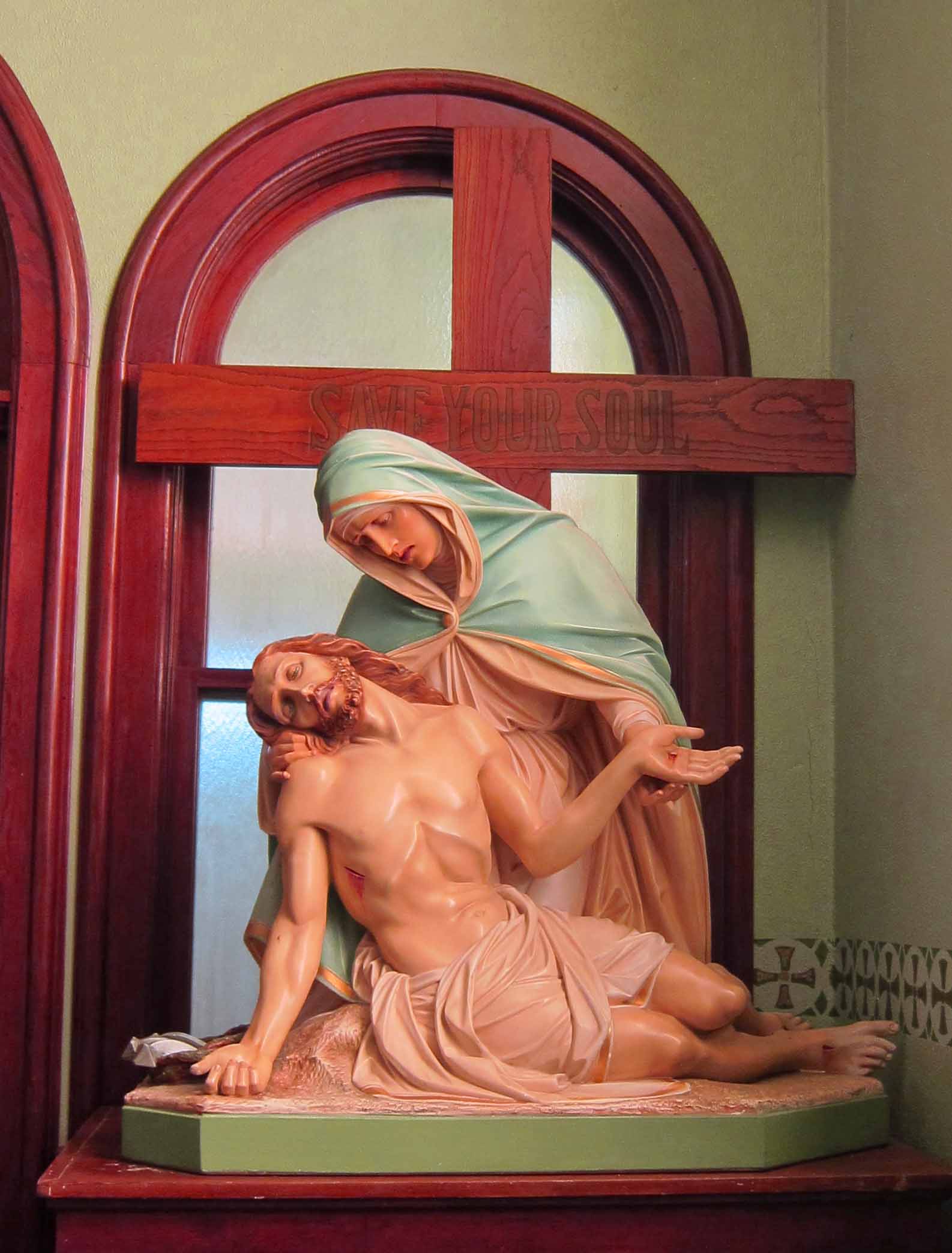
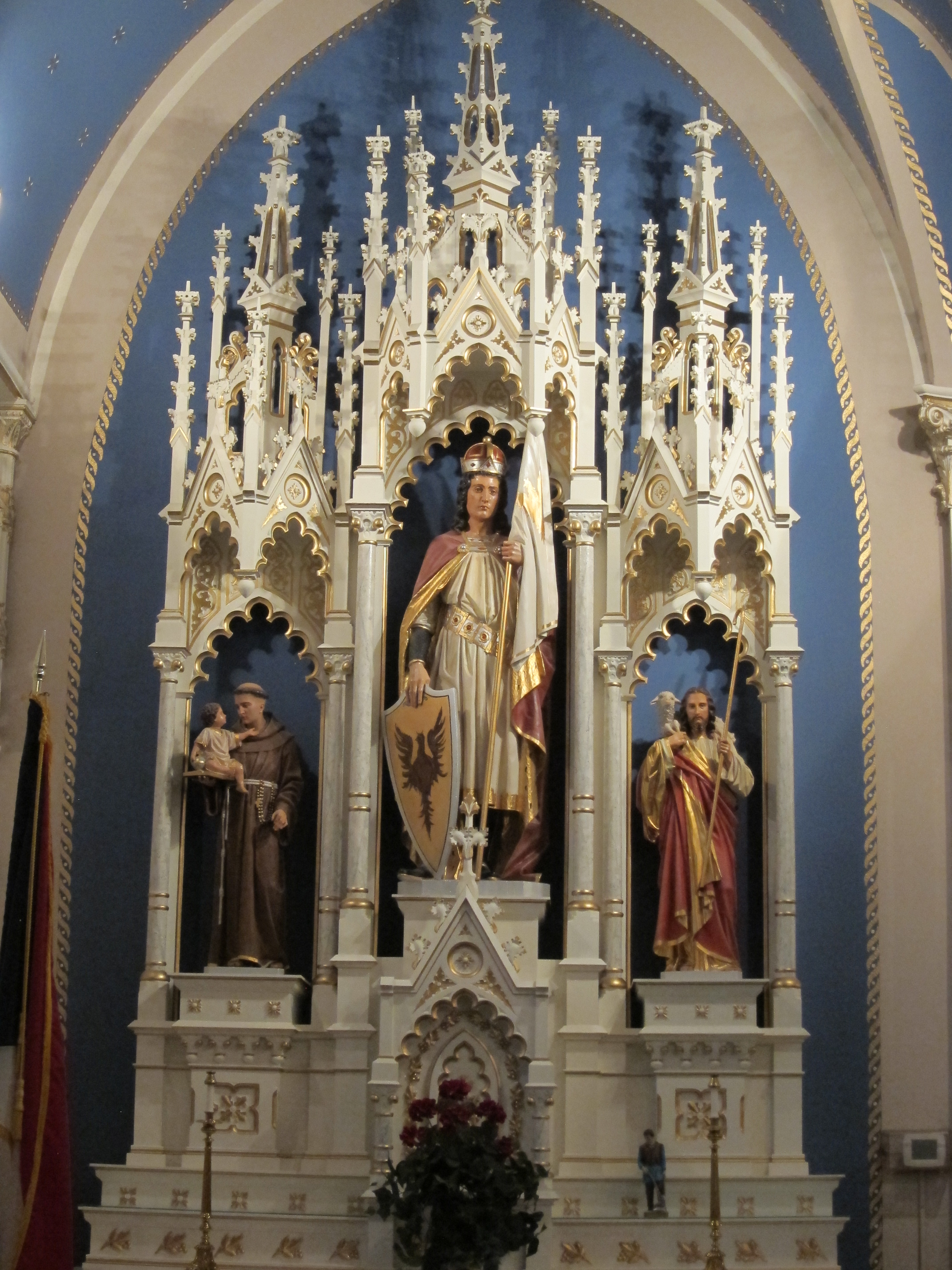
I took the pictures above at St. Joseph's Parish in Andale, Kansas, after it had been restored and renovated after a fire (the first two) and at St. Martin's church in Piqua, Kansas, which has been closed for years as an active parish but is maintained by Catholics in the area to be open for visitors.

And from Servant of God, Chaplain Emil J. Kapaun's home parish in Pilsen, Kansas, honoring the church's patron saint, St. John Nepomucene, which I visited in 2016 on the Solemnity of the Assumption:


And two other side altars in that church:


And finally, here's a picture Mark took during Mass on Christmas Day in 2013 at St. Anthony of Padua Church in Wichita, Kansas (Traditional Latin Mass), depicting the Franciscan saints honored at that parish:


As usual, I'll post my preview of the Son Rise Morning Show discussion this Friday, August 26!

Holy Mary, Mother of God, pray for us!
Saint Joseph, pray for us!
Saint John Nepomucene, pray for us!
Saint Anthony of Padua, pray for us!
Saint Clare of Assisi, pray for us!
Saint Francis of Assisi, pray for us!
Saint John Henry Newman, pray for us!

Image Credit for Shakespeare's Works (public domain): Title page of the First Folio, 1623. Copper engraving of Shakespeare by Martin Droeshout. All other images (c) Stephanie A. Mann (2013-2022).

Saturday, August 20, 2022

St. J.H. Newman on Life and Change, Corruption and Correction

For my final discussion (scheduled for August 29) on the Son Rise Morning Show of Saint John Henry Newman's development in accepting, understanding, and defending the Marian Doctrine of the Catholic Church and the devotion of Catholics to Mary, I've been reading Newman's reply to E. B. Pusey's Eirenicon for the first time ever! I've read excerpts from it, as in Scepter's The Mystical Rose collection, but never the entire work.

Pusey wrote a public letter to John Keble, one of the other great leaders of the Oxford or Tractarian Movement after the proclamation of the Dogma of the Immaculate Conception. In the letter, in which Pusey discussed the obstacles preventing the union of the Catholic Church and Church of England, he mentioned their former colleague in that effort to revive the Apostolic authority of the bishops in the Anglican Church, namely, Newman. 

I have not read Pusey's Eirenicon, but evidently he discussed Father Newman's position in the Catholic Church as a convert; he made comments about statements he mistakenly attributed to Father Newman (shades of Charles Kingsley!); and quoted passages from various Continental Catholic writers in devotional works on the Blessed Virgin Mary.

In January of 1866, Newman replied with his own public letter in five chapters:

1. Introductory Remarks
2. Various Statements introduced into the
Eirenicon
3. The Belief of Catholics concerning the Blessed Virgin, as distinct from their Devotion to her
4. The Belief of Catholics concerning the Blessed Virgin, as coloured by their Devotion to Her
5. Anglican Misconceptions and Catholic Excesses in Devotion to the Blessed Virgin

Fortunately, Gracewing Publishers will be bringing out a new edition of this work, with Newman's Letter to the Duke of Norfolk, as the companion volume to Edward Short's critical edition of Lectures on Difficulties Felt by Anglicans in Submitting to the Catholic Church which I reviewed here and here.

The second chapter this Letter reads like a mini-Apologia pro Vita Sua, as Newman corrects Pusey's errors about things he or didn't say, about what it must be like to accept the Church's authority over one as a convert, and about certain authors and how they wrote about Marian devotions. Thus he states at the end of that chapter:

I write afresh nevertheless, and that for three reasons; first, because I wish to contribute to the accurate statement and the full exposition of the argument in question; next, because I may gain a more patient hearing than has sometimes been granted to better men than myself; lastly, because there just now seems a call on me, under my circumstances, to avow plainly what I do and what I do not hold about the Blessed Virgin, that others may know, did they come to stand where I stand, what they would, and what they would not, be bound to hold concerning her.

In chapter 4, one passage reminded me of one of the most famous quotations taken from Newman's works, "In a higher world it is otherwise, but here below to live is to change, and to be perfect is to have changed often." (from Chapter 1. On the Development of Ideas, Section 1. On the Process of Development in Ideas, paragraph 7 in An Essay on the Development of Christian Doctrine).

In context:

But whatever be the risk of corruption from intercourse with the world around, such a risk must be encountered {40} if a great idea is duly to be understood, and much more if it is to be fully exhibited. It is elicited and expanded by trial, and battles into perfection and supremacy. Nor does it escape the collision of opinion even in its earlier years, nor does it remain truer to itself, and with a better claim to be considered one and the same, though externally protected from vicissitude and change. It is indeed sometimes said that the stream is clearest near the spring. Whatever use may fairly be made of this image, it does not apply to the history of a philosophy or belief, which on the contrary is more equable, and purer, and stronger, when its bed has become deep, and broad, and full. It necessarily rises out of an existing state of things, and for a time savours of the soil. Its vital element needs disengaging from what is foreign and temporary, and is employed in efforts after freedom which become wore vigorous and hopeful as its years increase. Its beginnings are no measure of its capabilities, nor of its scope. At first no one knows what it is, or what it is worth. It remains perhaps for a time quiescent; it tries, as it were, its limbs, and proves the ground under it, and feels its way. From time to time it makes essays which fail, and are in consequence abandoned. It seems in suspense which way to go; it wavers, and at length strikes out in one definite direction. In time it enters upon strange territory; points of controversy alter their bearing; parties rise and around it; dangers and hopes appear in new relations; and old principles reappear under new forms. It changes with them in order to remain the same. In a higher world it is otherwise, but here below to live is to change, and to be perfect is to have changed often.

[Sometimes that quotation is taken out of context and interpreted to mean that change for change sake is perfection and that change means that "a great idea" is not the same. But the notice the sentence before as Newman is speaking of "a great idea" and its development: "It changes with them [challenges, controversy, etc] in order to remain the same."

As Newman wrote to Pusey in his letter's second chapter, you can't "cherry-pick" quotations (accurately stated or not) from his works, make them say what you want them to say, and be true to what he really said.]

In this passage, as Newman begins to describe the "Belief of Catholics concerning the Blessed Virgin, as coloured by their Devotion to her", Newman returns to the theme of "great ideas" and change:

Life in this world is motion, and involves a continual process of change. Living things grow into their perfection, into their decline, into their death. No rule of art will suffice to stop the operation of this natural law, whether in the material world or in the human mind. We can indeed encounter disorders, when they occur, by external antagonism and remedies; but we cannot eradicate the process itself, out of which they arise. Life has the same right to decay, as it has to wax strong. This is specially the case with great ideas. You may stifle them; or you may refuse them elbow-room; or again, you may torment them with your continual meddling; or you may let them have free course and range, and be content, instead of anticipating their excesses, to expose and restrain those excesses after they have occurred. But you have only this alternative; and for myself, I prefer much wherever it is possible, to be first generous and then just; to grant full liberty of thought, and to call it to account when abused.

So even the "great idea" of Marian devotion has a right to change and develop, wax and wane, go wrong for a time and be corrected:

If what I have been saying be true of energetic ideas generally, much more is it the case in matters of religion. Religion acts on the affections; who is to hinder these, when once roused, from gathering in their strength and running wild? . . .  And of all passions love is the most unmanageable; nay more, I would not give much for that love which is never extravagant, which always observes the proprieties, and can move about in perfect good taste, under all emergencies. What mother, what husband or wife, what youth or maiden in love, but says a thousand foolish things, in the way of endearment, which the speaker would be sorry for strangers to hear; yet they are not on that account unwelcome to the parties to whom they are addressed. Sometimes by bad luck they are written down, sometimes they get into the newspapers; and what might be even graceful, when it was fresh from the heart, and interpreted by the voice and the countenance, presents but a melancholy exhibition when served up cold for the public eye. So it is with devotional feelings. Burning thoughts and words are as open to criticism as they are beyond it. What is abstractedly extravagant, may in particular persons be becoming and beautiful, and only fall under blame when it is found in others who imitate them. When it is formalized into meditations or exercises, it is as repulsive as love-letters in a police report. 

I'll stop there with the love-letters in the police report! 

I will post one more passage from this work that really impressed me before I prepare my preview for the August 29 Son Rise Morning Show discussion on Newman's response to Pusey on Marian doctrine and devotion in the Catholic Church.

Holy Mary, Mother of God, pray for us!
Saint John Henry Newman, pray for us!