Showing posts with label Dominic Selwood. Show all posts

Friday, September 30, 2016

"This book will challenge everything you think you know about history."

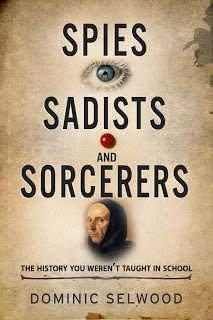
Dominic Selwood is an author and columnist, who has collected a series of columns offering different views of historical events into a book: Spies, Sadists and Sorcerers: The History You Weren't Taught in School (available on Kindle for $.99!).

Nancy Bilyeau interviews him on her blog, highlighting his revisionist view of the English Reformation, which certainly coincides with mine (and hers, too, I think).

Selwood's website provides generous excerpts from the book, including this "unintended Reformation" moment, discussing Walpurgisnacht and the saint it should be honoring:

It is pure coincidence that Walburga was canonized on May Day, thus giving her name to the festivities of the night before. But it is also strangely fitting, as popular belief in the healing properties of saints’ relics (and oils) is inseparable from our historical attachment to magic. 

And here is where something fascinating happens. As the Reformation swept away faith in popular and largely benign Christian miracles, it instead offered belief in a much darker magic —one that would quickly lead to the horror of the witch-craze and fantastical legends like the sabbaths on the Brocken. 

It is deeply ironic that the Protestant reformers, in abolishing what they saw as harmful superstitious claptrap, replaced it with terrifying magical fears that would end with the brutal and pointless murder of tens of thousands of innocent women. 

Before the Reformation there had, of course, been some scattered witch trials. But the same reforming theologians who lambasted what they saw as the crude and irrational magical beliefs underpinning the cult of saints and relics rapidly convinced themselves that hundreds of towns and villages were sheltering the foulest witches and demons, whose unnatural rites jeopardized the health and salvation of Christendom. They saw them flying on diabolical beasts, covering vast distances in the blink of an eye. They found on them folds of skin used for suckling demons in the form of familiars. They accused them of sexually molesting decent folk, invading their beds as lustful incubi and succubi. They were convinced they possessed infernal powers to see the past, the present (at great distance), and the future. But above all, they feared the witches were working ceaselessly to destroy their new, rational churches. 

As the reformers set about ridding the world of these devilish handmaidens, the great burnings began, peaking in the late 1500s and early 1600s, before petering out in the early 1700s. In that time, somewhere between 40,000 and 100,000 people (predominantly, but not exclusively, women) were torched alive on suspicion of practising magic.

Looks like a fascinating, if episodic, review of events in history seen from different angles.

Friday, April 24, 2015

If England Had Remained Catholic

There have been other alternative histories of England if the Spanish Armada succeeded, for example, or if, somehow the English Reformation never happened, but they have usually been negative and based upon flawed historical understanding. One example is Kingsley Amis' The Alteration, as summarized on this website:

Renowned novelist Kingsley Amis entered alternate-history territory in 1976 with his award-winning novel The Alteration. In his imagined history, Henry VIII’s short-lived older brother, Arthur, has a son just before his death. When Henry tries to usurp his nephew’s throne, he is stopped in a papal war. Hence, the Church of England is never founded, the Spanish Armada is never defeated (as Elizabeth I was never born), and Martin Luther reconciles with the Catholic Church, eventually becoming Pope. Naturally, this turns Europe into a vastly different place. By 1976, it is ruled by the Vatican, in the middle of a long-running Christian/Muslim cold war, and technologically regressed, as electricity is banned and scientists are frowned upon.

Of course, that last statement is ridiculously inaccurate, since Catholics, especially Jesuit priests--in the real world--were scientists. Of course, in Amis' world, St. Ignatius of Loyola might never have founded the Jesuits. But then, Benedictines would have fostered the use of electric power, just as they developed water power in their monasteries. Typical anti-Catholic rubbish. (Read or re-read Thomas E. Woods, Jr.'s How the Catholic Church Built Western Civilization in paperback from Ignatius Press for more information on the Catholic Church and science.)

Dominic Selwood writes in The Catholic Herald a more hopeful view of England if the infant Henry the Duke of Cornwall hadn't died:

The 19-year-old King Henry VIII took to the field arrayed in cloth of gold and blue velvet, all spangled with golden hearts and K’s for his 25-year-old wife, Katherine of Aragon, whose honour he defended as “Sir Loyal Heart”. The joust was the most lavish of Henry’s reign, celebrating the birth, 10 days earlier on New Year’s Day, of their son, Prince Henry, Duke of Cornwall.

Henry VIII and Katherine went on to preside over England’s first truly Renaissance court, where the progressive influence of Thomas More and Erasmus brought a gentle but keen appreciation of the classics and humanities. When Henry died an old man, he was mourned as our greatest scholar king.

His son, King Henry IX, acceded to the throne, inaugurating one of England’s most luminous reigns. He sponsored the maritime genius of Drake and Raleigh, oversaw England’s first substantial colonies in the New World, and witnessed the consolidation of England and Spain as Europe’s leading Catholic powers.


Selwood reminds us that's not what happened, of course, but then begins to sketch out some alternative ideas about the past and the present:

But let’s rejoin the story with Henry VIII, and ask what would have happened if Henry and Katherine had never divorced. How might England be different today?

First, the Reformation would almost certainly not have reached England, then known affectionately for the deepness of its Catholic faith as “Mary’s Dowry”. There were few Protestants this side of the Channel, and nothing suggests they would have grown in any significant numbers. So, like most of continental Europe, England would have remained Catholic.


He thinks that Mystery Plays would still be popular or would have influenced current drama, the monasteries would still be helping the needy, sheltering the homeless, and welcoming the stranger, and that English Catholic spirituality, with its colorful, gentle beauty would have greater influence--Selwood also opines that Cardinal Archbishop Edmund Campion would have led "an English scriptural renaissance" by translating the Holy Bible into English (instead of being torn apart at Tyburn Tree). Selwood should have also mentioned the influence of the friaries on social welfare and care for the poor (he may be lumping monasteries and friaries together, but there is a difference.)

Read the rest there.

Tuesday, May 27, 2014

Dominic Selwood on the English Reformation

Writing on his Telegraph blog about how history can be manipulated by the ruling party, Dominic Selwood writes:

So what about England? Has our constitutional monarchy and ancient tradition of parliamentary democracy protected our history from political manipulation? Can we rely on what we are taught and told, or are there myths we, too, have swallowed hook, line, and sinker?

Where better to start than with that most quintessentially English of events ­— the break with Rome that signalled the birth of modern England?

For centuries, the English have been taught that the late medieval Church was superstitious, corrupt, exploitative, and alien. Above all, we were told that King Henry VIII and the people of England despised its popish flummery and primitive rites. England was fed up to the back teeth with the ignorant mumbo-jumbo magicians of the foreign Church, and up and down the country Tudor people preferred plain-speaking, rational men like Wycliffe, Luther, and Calvin. Henry VIII achieved what all sane English and Welsh people had long desired ­– an excuse to break away from an anachronistic subjugation to the ridiculous medieval strictures of the Church.

For many in England, the subject of whether or not this was true was not even up for debate. Even now, the historical English disdain for all things Catholic is often regarded as irrefutable and objective fact. Otherwise why would we have been taught it for four and a half centuries? And anyway, the English are quite clearly not an emotional race like some of our continental cousins. We like our churches bright and clean and practical and full of common sense. For this reason, we are brought up to believe that Catholicism is just fundamentally, well … un-English.

But the last 30 years have seen a revolution in Reformation research. Leading scholars have started looking behind the pronouncements of the religious revolution’s leaders – Henry VIII, Thomas Cromwell, Thomas Cranmer, Hugh Latimer, Nicholas Ridley – and beyond the parliamentary pronouncements and the great sermons. Instead, they have begun focusing on the records left by ordinary English people. This “bottom up” approach to history has undoubtedly been the most exciting development in historical research in the last 50 years. It has taken us away from what the rulers want us to know, and steered us closer towards what actually happened.

Golly, you'd almost think he'd read my book!

I thought this was a particularly well-reasoned analysis of the violence of Henry VIII's imposition of his break from Rome:

The Tudor violence meted out to enforce the break with Rome was extreme, designed to deter by shock. For instance, one of Henry’s earliest victims was Sister Elizabeth Barton, a Benedictine nun. When she criticised Henry’s desire to marry Anne Boleyn, he had her executed, and her head spiked on London Bridge ­— the first and only woman ever to have suffered this posthumous barbarity.

Henry and his inner circle of politicians and radical clerics put to death hundreds of dissenters, pour encourager les autres. None of these people were plotting to kill him or destabilise his rule. Their “treason” was to oppose the destruction of their religion or the despoiling of their property. The brutal strangulation, emasculation, disembowelling, beheading, and quartering they endured as traitors was hideous, as was the total absence of any form of due process or justice.

Henry's use of attainder, meaning that the accused was never tried nor really even knew the charges against them, was brought up in an article by Suzannah Lipscomb in History Today, discussing whether or not Henry VIII was a tyrant:

Yet one of these laws, passed in 1539, ordered that royal proclamations would henceforth have the same status in law as statute. In other words, Henry used Parliament to eradicate the need for it and to make his word – quite literally – law. Similarly he condemned to death, through Parliament, an unprecedented number of people who were available for trial by the use of acts of attainder – acts of Parliament by which the accused was declared guilty and his property and life forfeited without trial or the need to cite precise evidence or name specific crimes. This is how Henry’s fifth wife, Katherine Howard, and first minister, Thomas Cromwell, Earl of Essex, were dispatched.

Blessed Margaret Pole, Blessed Adrian Fortescue, and Blessed Thomas Dingley were also all executed under a Bill of Attainder. They were not plotting to bring down Henry VIII's rule--but all three were wealthy Catholics. Henry was able to seize the treasure of the Knights of Jerusalem and the lands of Countess of Salisbury by bringing them to the block, making up conspiracies out of travels to the Continent and devotion to the Five Wounds of Christ.

But I think Selwood is wrong to ignore the fact that those burned at the stake during the reign of Mary I were not plotting to kill her or "destabilize" her rule either. Cranmer, of course, had been found guilty of treason against the rightful heir, and could have been beheaded. Certainly, the Catholic martyrs of the Elizabethan era who have been beatified and canonized were not plotting against Elizabeth.

Otherwise, Selwood provides an interesting and spirited summary of the revisionist history more or less accepted now about the English Reformation.