Showing posts with label Joseph Pearce. Show all posts

Monday, June 14, 2021

G.K. Chesterton, RIP

So last Friday night, on the Solemnity of the Sacred Heart of Jesus, our Greater Wichita Chesterton Society local chapter (including residents of Derby, St. Mark's, Hutchinson and Newton) met in The Ladder to finish our discussion of Joseph Pearce's biography of G.K. Chesterton. As you might expect, the last event in Chesterton's life to be discussed was his death, 85 years ago today (June 14, 1936).

There were two very beautiful anecdotes about Chesterton's decline and death. One was that he had memorized the Sequence for the Feast of Corpus Christi (having published his great work on St. Thomas Aquinas just three years before in 1933). Pearce quoted the last two stanzas of Lauda Sion, with its prayer to see God face-to-face at the Heavenly Banquet:

Bone pastor, panis vere,
Jesu, nostri miserére:
Tu nos pasce, nos tuére:
Tu nos bona fac vidére
In terra vivéntium.

Tu, qui cuncta scis et vales:
Qui nos pascis hic mortáles:
Tuos ibi commensáles,
Cohærédes et sodáles,
Fac sanctórum cívium.
Amen. Alleluia.

He also cited the last words of Verbum supernum prodiens, reflecting on Heaven as being in patria (our true native land!). For a man who loved England so much, this was remarkable statement.

UPDATE: I think that the feast of Corpus Christi was celebrated on Thursday, June 11 in 1936. (Easter was on April 12; Pentecost on May 31, and Trinity Sunday on June 7.)

The other anecdote was that Pope Pius XI sent telegrams to Frances Chesterton and Cardinal Hinsley, referring to Chesterton as a "Defender of the Catholic Faith". The telegram was read at a memorial Requiem Mass celebrated at Westminster Cathedral on June 27, 1936. The British press would not publish the pope's telegram because it gave Chesterton the title which, in its view, belonged only to the King of England, Edward VIII. (Edward VIII had not been crowned yet and never would be because he abdicated in December of 1936 because he could not reign "without the help and support of the woman" he loved.)

Since he had not been crowned or anointed, or sworn his coronation oath to defend the faith, the future Duke of Kent was not really the Defender of the Faith at that time at all! 

I wonder what Chesterton would have made of all the ironies of Edward VIII's abdication in his column for G.K.'s Weekly.

Pearce reminded us, of course, that King Henry VIII had received the title "Fidei Defensor" from Pope Leo X "shortly before the King had rebelled against the Church". It was actually in 1521, about six years before Henry started seeking an annulment of his marriage to Katherine of Aragon. We could date his rebellion against the Catholic Church and Papal authority to 1532, so perhaps not that "shortly before". Pearce also comments that Chesterton had little in common with the king, "except perhaps the size of their girths."! (p. 485)

You may see a digitized image (showing the damage incurred in a fire) of the Papal Bull of Pope Leo X proclaiming Henry VIII the Defender of the Faith at the British Library's Medieval Manuscripts blog, reminding us why he received that title:

Henry was given the title Defender of the Faith in recognition for his Assertio Septem Sacramentorum (Defence of the Seven Sacraments). Possibly written in consultation with Thomas More (b. 1478, d. 1535) and Cardinal Wolsey (b. c. 1473, d. 1530), Henry’s principal statesmen at this point in his reign, this theological treatise acted as a response to the pronouncements of the German theologian Martin Luther (b. 1483, d. 1546), whose ideas helped to shape the Protestant Reformation movement during the 16th century. . . .

Henry’s positive relationship with the Papacy did not last. Only a decade after Leo X issued the papal bull, Henry decided to break away from the Church of Rome, following Pope Clement VII’s refusal to annul his marriage to his first wife Catherine of Aragon (b. 1485, d. 1536). He also distanced himself from the Assertio, claiming that he had been manoeuvred into writing it by his bishops. His actions ultimately resulted in his own excommunication by Clement’s successor Paul III (b. 1468, d. 1549) in 1538 and he was stripped of the title Defender of the Faith.

However, towards the end of Henry’s reign, in 1543, the English Parliament passed an act that restored the title for him and his successors. Since then, it has continued to be used as part of the styling of British monarchs (including the reigning Elizabeth II) to indicate their role as Head of the Church of England. It even features on coins of the realm, with the Latin Fidei defensor appearing in its abbreviated form F.D beside the Queen’s portrait.

Gilbert Keith Chesterton, Defender of the Catholic Faith, Rest in Peace in Our True Native Land!

Wednesday, April 21, 2021

Book Review: Joseph Pearce's Biography of G.K. Chesterton

It seems like I've been reading this book forever! We started reading it in our local Chesterton Society group late in 2019 I think, three chapters at a time, although we sometimes only got through two chapters during our monthly discussions. Then because of COVID, we had to skip several meetings, both in the spring of 2020 and particularly at the end of the year. My late brother and I were both in the hospital in December; then Steven died on the second day of January and we met on the second Friday of that month to pray a Rosary for the repose of his soul, and then it was bitterly cold in February so we cancelled. A smaller group of us finally met in March this year, and a larger group gathered on the Friday in the Octave of Easter this month. 

We determined then we'd all read the last four chapters, hope to get through two of them in May and finish our discussion of this book in June! Next month we'll decide what to read next: we're leaning toward either Chesterton's study of Charles Dickens or his book about Geoffrey Chaucer. I'm in favor of either, but we'll vote so that Eighth Day Books may obtain the book for us and we'll start discussing it in July!

Wisdom and Innocence: A Life of G.K. Chesterton is an excellent biographical study, combining the narrative of Chesterton's life with a comprehensive review of his works, their reception at the time, and their influence on other writers like C.S. Lewis, Christopher Dawson, Dorothy L. Sayers, and many others. Pearce's vivid description of the Chestertons' (Gilbert and Frances) domestic life is well-matched by his recounting of their travels to the Holy Land, the U.S.A., Ireland, etc.

One theme we did comment on several times, because we had previously (in 2016) read Nancy Carpentier Brown's The Woman Who Was Chesterton, was how Pearce's biography was considerably more favorable toward Chesterton's sister-in-law, Ada Chesterton (his brother Cecil's wife/widow) than Brown's view of her in the context of Frances' life. In Pearce's narration, she seemed more sympathetic to Chesterton and his work, while Brown highlights Frances' negative reaction to Ada's biographical work The Chestertons.

There was one error I spotted: one page 381 in the chapter "Rome and Romance" Pearce mentions that the Chestertons were in Rome for the "Beatification of the Forty Martyrs of England and Wales"--that's incorrect: 136 Martyrs of England and Wales were beatified in 1929 by Pope Pius XI. Twenty-nine of those beatified in that group would be canonized among the 40 Martyrs of England and Wales in 1970 by Pope Paul VI.

It was difficult for me to read the last pages, describing Chesterton's death and Frances' grief--too close to my own feelings; I had to put the book down for a day before I could finish it.

I think this biography is one of Joseph Pearce's greatest achievements. Highly recommended.

Tuesday, July 14, 2020

One Good Book Leads to Another: Chesterton on the Victorians

Our local Chesterton Society is reading Joseph Pearce's biography of Chesterton, Wisdom and Innocence. Next month we're going to conclude our discussion of a chapter  in which Pearce introduces us to one of Chesterton's works of literary criticism, The Victorian Age in Literature.

Dale Ahlquist of the American Chesterton Society offers some background for the book, which is out of print:

In 1913 the Home University Library published Chesterton’s The Victorian Age in Literature. But the editors emphatically declared that the book was not being offered as “an authoritative history of Victorian Literature” but only as Chesterton’s “personal views” on the subject. Apparently someone with personal views cannot write an authoritative history. In other words, an author cannot be an authority.

In spite of this handicap, the book was hugely successful, with multiple reprintings. One reviewer, however, while admiring the book, still expressed his irritation at “Chesterton’s obsession with religion.” (Again, authors should not have opinions, though critics may.) The reviewer’s irritation enabled him to miss the whole point of the book: that we cannot understand the Victorian writers without reference to their traditions and creeds – especially the traditions and creeds that they have rejected. Chesterton says religion “was the key of this age as of every other.” . . .


We cannot really understand the Victorian era unless we go back to the breakup of Catholic society. The multiple heresies that pulverized Catholicism were not merely religious but cultural and political and artistic. The old order was never replaced with a new order, but only with continued reactions against the old order. Chesterton says the later Protestant-types kept the Protestantism but did away with the Christianity. The Victorian Age began under the godless philosophy of Utilitarianism; it ended in the god-defying philosophy of Decadence, where men engaged in vile behavior not because they did not know it was wrong but because they did know it was wrong. “The decadents utterly lost the light and reason of their existence.” . . .

When I began reading the on-line edition of Chesterton's study I was happy to see his mention of St. John Henry Newman as a writer:

A mere conviction that Catholic thought is the clearest as well as the best disciplined, will not make a man a writer like Newman. But without that conviction Newman would not be a writer like Newman; and probably not a writer at all. It is useless for the æsthete (or any other anarchist) to urge the isolated individuality of the artist, apart from his attitude to his age. His attitude to his age is his individuality: men are never individual when alone.

And in the first paragraph of the first chapter Chesterton cites Newman again:

Now in trying to describe how the Victorian writers stood to each other, we must recur to the very real difficulty noted at the beginning: the difficulty of keeping the moral order parallel with the chronological order. For the mind moves by instincts, associations, premonitions and not by fixed dates or completed processes. Action and reaction will occur simultaneously: or the cause actually be found after the effect. Errors will be resisted before they have been properly promulgated: notions will be first defined long after they are dead. It is no good getting the almanac to look up moonshine; and most literature in this sense is moonshine. Thus Wordsworth shrank back into Toryism, as it were, from a Shelleyan extreme of pantheism as yet disembodied. Thus Newman took down the iron sword of dogma to parry a blow not yet delivered, that was coming from the club of Darwin. For this reason no one can understand tradition, or even history, who has not some tenderness for anachronism.

Chesterton identifies the Oxford Movement as one of the three great trends of Victorian thought along with Utilitarianism and Romantic Protestantism, and he summarizes his view of Newman's leadership of the Oxford Movement and his Catholic career after he left it thus:

But the greater part of all this happened before what is properly our period; and in that period Newman, and perhaps Newman alone, is the expression and summary of the whole school. It was certainly in the Victorian Age, and after his passage to Rome, that Newman claimed his complete right to be in any book on modern English literature. This is no place for estimating his theology: but one point about it does clearly emerge. Whatever else is right, the theory that Newman went over to Rome to find peace and an end of argument, is quite unquestionably wrong. He had far more quarrels after he had gone over to Rome. But, though he had far more quarrels, he had far fewer compromises: and he was of that temper which is tortured more by compromise than by quarrel. He was a man at once of abnormal energy and abnormal sensibility: nobody without that combination could have written the Apologia.  In this sense his Apologia is a triumph far beyond the ephemeral charge on which it was founded; in this sense he does indeed (to use his own expression) vanquish not his accuser but his judges. Many men would shrink from recording all their cold fits and hesitations and prolonged inconsistencies: I am sure it was the breath of life to Newman to confess them, now that he had done with them for ever. His Lectures on the Present Position of English Catholics, practically preached against a raging mob, rise not only higher but happier, as his instant unpopularity increases. There is something grander than humour, there is fun, in the very first lecture about the British Constitution as explained to a meeting of Russians. But always his triumphs are the triumphs of a highly sensitive man: a man must feel insults before he can so insultingly and splendidly avenge them. He is a naked man, who carries a naked sword. The quality of his literary style is so successful that it succeeds in escaping definition. The quality of his logic is that of a long but passionate patience, which waits until he has fixed all corners of an iron trap. But the quality of his moral comment on the age remains what I have said: a protest of the rationality of religion as against the increasing irrationality of mere Victorian comfort and compromise. So far as the present purpose is concerned, his protest died with him: he left few imitators and (it may easily be conceived) no successful imitators. The suggestion of him lingers on in the exquisite Elizabethan perversity of Coventry Patmore; and has later flamed out from the shy volcano of Francis Thompson. Otherwise (as we shall see in the parallel case of Ruskin's Socialism) he has no followers in his own age: but very many in ours.

More of Chesterton's appraisal of Newman's style may be found here (also highlighting Newman's Lectures on the Present Position of Catholics in England).

At our last meeting, we ended our discussions in the midst of chapter 12, "Brothers in Arms" as Chesterton has confessed to Father O'Connor (the model for Father Brown) in the spring of 1912 that he wants to become a Catholic but is waiting for his wife Frances. Pearce's description of Chesterton's The Victorian Age in Literature will be part of our reading next month as we finish up chapter 12 and move along to chapters 13 through 15. In the meantime, I'm reading Chesterton's evaluations of the Brontes, Thackeray, Dickens, Meredith, Browning, Barrett Browning, et al.

Sunday, January 13, 2019

Surprise! Hemingway, Greene--and Mann?


I was surprised when I got in the mail the other day because there was a copy of the St. Austin Review in the mailbox. Then my surprise turned to delight because my name was on the cover.

In a collection of essays about Catholicism, conversion, Ernest Hemingway, and Graham Greene, Joseph Pearce had included my analysis of the 1955 film adaptation of The End of the Affair, starring (no pun intended) Deborah Kerr, Van Johnson, and Peter Cushing (in a non vampire hunting role). It's titled "Shabby Second Best": Conversion in 1955's The End of the Affair".

I wrote and submitted this piece years ago and I don't even have a saved .doc anymore!

Thursday, April 12, 2018

Pearce on Belloc and Tolkien (and Chesterton?)

From The National Catholic Register:

Although Belloc and Tolkien had much in common, not least of which was their shared and impassioned Catholicism, it is intriguing that they should differ so profoundly on the importance of the Anglo-Saxons.

Belloc’s view of history, for the most part astute and penetrative, was always skewed by a less-than-balanced Francophilia and an almost shrill Germanophobia. This was evident in his dismissive disregard of the contribution to Christian culture of the Germanic tribes of England prior to the Norman Conquest and his lauding of the Conquest itself as having brought England into the fullness of Christendom which was always, for Belloc, synonymous with the influence of France.

In contrast, Tolkien considered Anglo-Saxon England to have been idyllically Christian. Had he had his “whole case very carefully prepared” to counter Belloc’s attack on the Anglo-Saxons, he might have shown that Anglo-Saxon England was profoundly Catholic, to such a degree that the saintly Englishman, Boniface, had helped to evangelize Pagan Europe, while his contemporary, the truly venerable Bede, had exhibited the high culture that Saxon England enjoyed in abundance.

Whilst the former converted the Germans to Christ, the latter excelled in Latin and Greek, and classical and patristic literature, as well as Hebrew, medicine and astronomy. Bede also wrote homilies, lives of saints, hymns, epigrams, works on chronology and grammar, commentaries on the Old and New Testament, and, most famously, his seminal Historia Ecclesiastica Gentis Anglorum which was translated into Anglo-Saxon by King Alfred the Great. At the time of his death in 735 Bede had just finished translating the Gospel of St. John into Anglo-Saxon. Almost six hundred years later, Dante expressed his own admiration for Bede’s achievement by placing him in the Paradiso of his Divina Commedia.

Pearce doesn't mention it, but Chesterton must have been influenced by Belloc, in spite of his admiration for Alfred the Great. As Chesterton writes in his A Short History of England (from Chapter 5. "St. Edward and the Norman Kings") he presents a mixed view of the Anglo-Saxons, although he does praise them for "christening" England:

As I have indicated, there is some unreality in talking about the Anglo-Saxon at all. The Anglo-Saxon is a mythical and straddling giant, who has presumably left one footprint in England and the other in Saxony. But there was a community, or rather group of communities, living in Britain before the Conquest under what we call Saxon names, and of a blood probably more Germanic and certainly less French than the same communities after the Conquest. And they have a modern reputation which is exactly the reverse of their real one. The value of the Anglo-Saxon is exaggerated, and yet his virtues are ignored. Our Anglo-Saxon blood is supposed to be the practical part of us; but as a fact the Anglo-Saxons were more hopelessly unpractical than any Celt. Their racial influence is supposed to be healthy, or, what many think the same thing, heathen. But as a fact these "Teutons" were the mystics. The Anglo-Saxons did one thing, and one thing only, thoroughly well, as they were fitted to do it thoroughly well. They christened England. Indeed, they christened it before it was born. The one thing the Angles obviously and certainly could not manage to do was to become English. But they did become Christians, and indeed showed a particular disposition to become monks. Moderns who talk vaguely of them as our hardy ancestors never do justice to the real good they did us, by thus opening our history, as it were, with the fable of an age of innocence, and beginning all our chronicles, as so many chronicles began, with the golden initial of a saint. By becoming monks they served us in many very valuable and special capacities, but not notably, perhaps, in the capacity of ancestors.

Chesterton does admire Alfred the Great, of course, having written his great poem The Ballad of the White Horse about this Anglo-Saxon hero (from Chapter 4. "The Defeat of the Barbarians"):

There is, from the first, something humble and even accidental about Alfred. He was a great understudy. The interest of his early life lies in this: that he combined an almost commonplace coolness, and readiness for the ceaseless small bargains and shifting combinations of all that period, with the flaming patience of saints in times of persecution. While he would dare anything for the faith, he would bargain in anything except the faith. He was a conqueror, with no ambition; an author only too glad to be a translator; a simple, concentrated, wary man, watching the fortunes of one thing, which he piloted both boldly and cautiously, and which he saved at last.
He had disappeared after what appeared to be the final heathen triumph and settlement, and is supposed to have lurked like an outlaw in a lonely islet in the impenetrable marshlands of the Parret; towards those wild western lands to which aboriginal races are held to have been driven by fate itself. But Alfred, as he himself wrote in words that are his challenge to the period, held that a Christian man was unconcerned with fate. He began once more to draw to him the bows and spears of the broken levies of the western shires, especially the men of Somerset; and in the spring of 878 he flung them at the lines before the fenced camp of the victorious Danes at Ethandune. His sudden assault was as successful as that at Ashdown, and it was followed by a siege which was successful in a different and very definite sense. Guthrum, the conqueror of England, and all his important supports, were here penned behind their palisades, and when at last they surrendered the Danish conquest had come to an end. Guthrum was baptized, and the Treaty of Wedmore secured the clearance of Wessex. The modern reader will smile at the baptism, and turn with greater interest to the terms of the treaty. In this acute attitude the modern reader will be vitally and hopelessly wrong. He must support the tedium of frequent references to the religious element in this part of English history, for without it there would never have been any English history at all. And nothing could clinch this truth more than the case of the Danes. In all the facts that followed, the baptism of Guthrum is really much more important than the Treaty of Wedmore. The treaty itself was a compromise, and even as such did not endure; a century afterwards a Danish king like Canute was really ruling in England. But though the Dane got the crown, he did not get rid of the cross. It was precisely Alfred's religious exaction that remained unalterable. 

Thursday, December 14, 2017

A Brief Encounter and A New Publication

Last week my husband and I went to the Spiritual Life Center to attend one of the "Dinners with the Doctors" presentations--Erin Doom of the Eighth Day Institute on St. John of Damascus--and enjoyed the evening very much. Toward the end of the Q and A, a lady came in and sat at one of the tables; she looked familiar. At the conclusion of the presentation, she came over and asked, "Don't I know you?"

She was my college French instructor (15 hours of college credit)! Mark and I had also known her and her husband at the Newman Center at WSU and at our home parish at Blessed Sacrament. She lives in France, in the Moselle region, but visits the USA often. She was at the Spiritual Life Center for a retreat before going to visit some friends in Florida for Christmas. It's one of those coincidences: if we hadn't attended and if she hadn't come into the room (helping with some clean up as part of her retreat), we wouldn't have reconnected.

One of the things we mentioned to her was that we had been able to travel to Paris so many times since we had last seen her. Mark talked about how much her French lessons had helped me on those trips. We exchanged business cards and parted. On our way home, Mark and I reminisced about our college years at WSU. Who knows if we'll ever see her again! She commented that she hopes we'll visit France again soon.

There's my segue into mentioning that I've had an article accepted in a brand new publication, Faith & Culture. It's the Journal of The Augustine Institute, edited by Joseph Pearce. He had accepted an article on Paris for the St. Austin Review a few years ago and used it in his new publication instead. It's available here. More about the The Augustine Institute here.

Tuesday, November 21, 2017

Speaking of the Second Spring


Joseph Pearce highlighted Blessed John Henry Newman's 1852 sermon "The Second Spring" in his first lecture at the the Fall Forum last weekend. He cited this passage:

A great change, an awful contrast, between the time-honoured Church of St. Augustine and St. Thomas, and the poor remnant of their children in the beginning of the nineteenth century! It was a miracle, I might say, to have pulled down that lordly power; but there was a greater and a truer one in store. No one could have prophesied its fall, but still less would any one have ventured to prophesy its rise again. The fall was wonderful; still after all it was in the order of nature;—all things come to nought: its rise again would be a different sort of wonder, for it is in the order of grace,—and who can hope for miracles, and such a miracle as this? Has the whole course of history a like to show? I must speak cautiously and according to my knowledge, but I recollect no parallel to it. Augustine, indeed, came to the same island to which the early missionaries had come already; but they came to Britons, and he to Saxons. The Arian Goths and Lombards, too, cast off their heresy in St. Augustine's age, and joined the Church; but they had never fallen away from her. The inspired word seems to imply the almost impossibility of such a grace as the renovation of those who have crucified to themselves again, and trodden under foot, the Son of God. Who then could have dared to hope that, out of so sacrilegious a nation as this is, a people would have been formed again unto their Saviour? What signs did it show that it was to be singled out from among the nations? Had it been prophesied some fifty years ago, would not the very notion have seemed preposterous and wild?

Pearce noted that Newman's conversion in 1845 brought more converts during his lifetime and then that more converts followed in in the 20th century: some great literary converts: Gerard Manley Hopkins, G.K. Chesterton, Robert Hugh Benson, Siegfried Sassoon, etc.

Henry VIII biographer J.J. Scarisbrick (Dr. James Scarisbrick) proposes that England needs a Third Spring of Catholicism in The Catholic World Report--and not just a literary revival, but a moral, spiritual, and cultural revival to fill the gap of religion in England:

The overall collapse of the Anglican Church and the near-disappearance of Methodism and the other non-Conformists from the national religious scene in recent times have left a huge spiritual vacuum at the heart of English society. Ours is indeed a post-Christian one. An increasingly arrogant neo-paganism is engulfing us.

This is lamentable. But is it not also a God-given opportunity for the English Catholic community to come out of its post-Vatican II diffidence, deference, introversion (call it what you like) and resume what our forefathers began again in 1850: that is, to reclaim our beloved country for the true Church?

Famously, in 1852 John Henry Newman, preaching at a celebration of that restoration of our Hierarchy, spoke of a ‘Second Spring’. This yielded a rich harvest. But now we need a third.

How will this come about?

It will be the apostolate of every Catholic priest, deacon, lay woman and man. We all have to take up this challenge.

Above all it will be the responsibility of our bishops. Hitherto unseen and unheard by the outside world, they have to come out from the sidelines – to become the nation’s spiritual leaders, heirs to the likes of Anselm, Becket, and John Fisher.

They must proclaim the good news that God loves us and longs for us to love him; that his Son has re-opened the gates of Heaven for and we can all pass through them if we want to; that the seven sacraments have been given to us to enable us to do so.
The same is true of the USA and every nation where Catholics live. We have Good News to tell and we should tell it!

Image: bust/shrine of Blessed John Henry Newman in New York City, copyright 2011-2017 Stephanie A. Mann.

Monday, November 20, 2017

Meeting Mister Pearce

Things have been hectic lately and I haven't mentioned two events I attended in the past two months: The Eighth Day Institute Inklings Oktoberfest in October and the Spiritual Life Fall Forum just concluded this month. These events had in common the keynote speaker: author and editor Joseph Pearce.

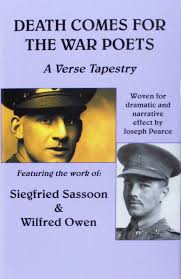
At the Inklings Oktoberfest his lectures were focused on World War I, since we are still remembering the centenary of the War to End All Wars. Pearce offered three lectures: one on the great poets of World War I, including Sassoon and Owen as featured in one of Pearce's most recent books, Death Comes for The War Poets, and one each on the wartime experiences of Tolkien and Lewis. Here's an excerpt from an essay Pearce submitted for the EDI blog:

It would have been very easy for Tolkien and Lewis to have become embittered by their experience of the trenches in the first world war. Both men lost close friends in the war, and both men experienced horrors that would be difficult for most of us to even imagine. And yet they emerged from their world on fire with imaginations that would set the world ablaze with the flame of divine light and love. Tolkien began working in earnest on the invention of his elvish language in 1915 and 1916, only months before the “animal horror” of the Somme, and this would serve as the inspirational launching pad for the creation of Middle-earth in which his world-changing stories are set. Meanwhile, C. S. Lewis discovered the works of G. K. Chesterton in early 1918, while serving in the British Army and recovering from trench fever, an encounter that would set his soul on the road to recovery. Reading Chesterton helped baptize Lewis’s imagination, contributing to his transition from cynical atheism to Christian conversion. And so it was that Lewis and Tolkien received priceless inklings of light amid the darkness of war. From the very ashes of the World on Fire these great writers would enkindle the power and the glory of the Word on Fire!   

Another poet whom Pearce featured in his first lecture was the American Joyce Kilmer, most famous for "Trees". Pearce recited this poem,"Prayer of a Soldier in France":

My shoulders ache beneath my pack
(Lie easier, Cross, upon His back).

I march with feet that burn and smart
(Tread, Holy Feet, upon my heart).

Men shout at me who may not speak
(They scourged Thy back and smote Thy cheek).

I may not lift a hand to clear
My eyes of salty drops that sear.

(Then shall my fickle soul forget
Thy agony of Bloody Sweat?)

My rifle hand is stiff and numb
(From Thy pierced palm red rivers come).

Lord, Thou didst suffer more for me
Than all the hosts of land and sea.

So let me render back again
This millionth of Thy gift. Amen.

The Oktoberfest was combined with the celebration of the 29th anniversary of the opening of Eighth Day Books, and there was a fun reception at the store after the Friday night lecture. Pearce will be returning to Wichita in late January 2018 for the Eighth Institute's Eighth Annual Symposium titled "STRANGERS & SOCIETY: Cultivating Friendship in a Fractured Age".

Mr. Pearce came back to Wichita this past weekend for the Spiritual Life Center's first Fall Forum, focused on Catholic liturgy,  “Memory & Mystery: Perspectives on the Sacred Liturgy”, at which he gave two lectures: “The Liturgy and the Second Spring” and “The Death & Resurrection of the Mass: Modernism versus Tradition”. In the first lecture he addressed the efforts of Joseph Cardinal Ratzinger/Pope Benedict XVI to reform the reform of the liturgy after the Second Vatican Council, restoring reverence, silence, and Latin to the celebration of the Mass. Pearce used Blessed John Henry Newman's great homily from the Westminster Diocesan Synod in 1852, "The Second Spring" as his inspiration and also quoted extensively from Ratzinger's The Spirit of the Liturgy. Eighth Day Books provided a book table at the forum and Mr. Pearce was busy signing copies of his books.

He and I had some opportunities to discuss submissions I've made previously to the St. Austin Review and another journal he is editing, so I'll have more announcements about those publications soon. 

By the way, Joseph Pearce will be back in Kansas early in 2018 for the Third Annual Prairie Troubadour Symposium in February: "Field and Family: Reflections on a Healthy Human Ecology"! That's held in Fort Scott.

Tuesday, September 26, 2017

Reformation Era Biography Collections


On the cusp of the 500th anniversary of Martin Luther posting his 95 Theses, books and articles about the Protestant Reformation have of course been plentiful. One subset of these books are the biographical collections, represented by the examples above.

Ignatius Press has published a new edition of Hilaire Belloc's Characters of the Reformation, with prose portraits of mostly English characters of the Reformation, starting with Henry VIII, but including a few French personages, like Cardinal Richelieu. Belloc believes that the English Reformation was not only distinct from the Protestant Reformation but that the defection of the Church in England--Henry VIII's breaking away from Catholic unity--was decisive in the destruction of Christendom. From his introduction:

The early enthusiasm for change was anarchic and dispersed. It had no form. It was of a violence which was bound to burn itself out, especially as it was resisted by all the organized central authorities of Christendom: the Kings and the Emperor. All that descended directly from the ancient foundation of our culture, the Romanized, civilized core of Europe, held out — save for one province: Britain. England was captured for the Revolutionary side, not by any desire on the part of her people, but by a succession of incidents which marked each of them a step more difficult to retrace. First, on a matter in no way connected with the Faith, the King of England, the most complete autocrat of his day, happened to quarrel with the Pope. The divorce of Henry VIII from his wife Catherine of Aragon, due to his infatuation with Anne Boleyn, began the business. It was conducted by a man of far greater ability than Henry, one Thomas Cromwell, an adventurer of high talent and no scruples (the great-uncle of Oliver and founder of the vast Cromwell fortune of which Oliver was a cadet). This Thomas Cromwell advised and carried out the confiscation of the monastic lands in England; a huge loot which was to be followed by further robbery of clerical endowments of every kind, including schools and colleges as well as the wealth of Sees and Parishes and Chapters. The new fortunes arising from this flood of confiscation determined the issue. . . .

That severance of England from Europe and from Christendom was, I have said, the pivotal matter of the Protestant advance. On it the partial success of the religious revolution everywhere depended. Hence the necessity for beginning by an understanding of the English tragedy, failing which the disruption of Europe and all our modern chaos would never have appeared. 

Belloc certainly takes a "Long Reformation" approach, because he ends his collection of characters with Blaise Pascal, William of Orange, and Louis XIV.

OSV has published Joseph Pearce's Heroes of the Catholic Reformation: Saints Who Renewed the Church, which I previewed and endorsed with a blurb:

The Protestant Reformation began five hundred years ago, accompanied by an age of turmoil and secularism we can recognize even in our own time. Rather than shrinking from the crisis, the Catholic Church responded with even deeper, and more genuine, reform. We can do the same today.

This Catholic Reformation was accomplished by many defenders of the Faith whom we now know as saints. Their holiness, courageous deeds, and sacrifices during this renewal of the Catholic Faith demonstrate the true heroism of saintly action and provide models for defending the faith in the modern world.

Diverse as they are inspiring, these heroes and saints stood up to slay “the dragons of sin” while championing Church teaching. Their sacrifices left the Church — and the world — forever changed.

Bishop John Fisher, Sir Thomas More, and priests Edmund Campion and Robert Southwell refused to submit to England’s secular tyranny and chose martyrdom instead. — Ignatius Loyola, founder of the Jesuits, and Charles Borromeo, the reforming Archbishop of Milan, spearheaded the Catholic Reformation.

Pope Pius V brought a spirit of asceticism to the papacy and ardor to the work of reform.
Teresa of Ávila and John of the Cross, despite enduring terrible suffering, surrendered themselves completely to Christ’s great mission of reform within the Church.

The Heroes of the Catholic Reformation is a scholarly and cultured celebration of the saints who responded to the fierce oppositions of their time with courage and an authentic and lasting Catholic Reformation. Author Joseph Pearce invites us look to these heroes for inspiration as we seek to live the fullness of Faith in our fallen world.

Pearce--who is coming to Wichita in October AND November for presentations--takes the view that the Reformation as a whole is divided into three parts: the Protestant "Reformation"; the English "Reformation", and the Catholic Reformation. Only the latter is a true reformation; the others are rebellions and divisions: the latter worked to restore the Apostolic Teaching and Tradition as Jesus commanded; the others resulted in religious chaos.

The one book I have not read or seen is Phillip Campbell's Heroes and Heretics of the Reformation from TAN:

Not since the birth of Christ has an event shaken the foundations of the Western world like the Reformation. Now, 500 years after Luther nailed his ninety-five theses to the door at Wittenberg—the sound of which served as the thunder presaging the storm to come—Phillip Campbell, author of The Story of Civilization, casts fresh eyes on that tumultuous time and its most influential characters.

It was a tumultuous time, filled with heroes, heretics, and some who were a little bit of both. It was a time of destruction and rebuilding. Some sincerely sought reform while others sought merely to profit by it, and some—perhaps too few—used the events of the time to become saints.

In these pages meet as you’ve never met before:

• Martin Luther: the tortured Augustinian monk whose act at Wittenberg called forth the storm
• Thomas Müntzer: the radical who, inspired by the new way of thinking and his own apocalyptic views, sought to use the sword to usher in the reign of God; he would feel the sting of Luther’s words and the bite of the executioner’s blade.
• The queens: Mary and Elizabeth Tudor, who were at different times bastardized and delegitimized by their father Henry VIII, but who each reigned during this period of upheaval. One is known to history by a derogatory epithet, while the other, “bloodier” still, has an epoch named in her honor.
• The popes: Paul III and Pius V, each of whom sought to save what could be saved of Christendom, one through the calling of the Council of Trent, which codified an authentic Catholic Reform, and the other through the calling of a new crusade to fend off the ever-threatening Turks.
• St. Peter Canisius: who lived a life of sanctity as he tried to reconcile those who had drifted away back to the Church.


Through the lives of those above and others, dramatically unfolded in Campbell’s stirring narrative, learn how the heroes and heretics of the tumultuous sixteenth century shook the world, for better or for worse.


I'm sure that Protestant publishers have produced some of the same kind of collections and I'll try to find some for a future post.

Monday, September 18, 2017

Third Annual Inklings Festival: OOM-PAH OctoberFest!

The Eighth Day Institute has announced the dates, speaker, and location for the Inklings Festival. Registration is open:

Our first two Inklings Festivals were a great success. But Kansas summers are scorchers and we all experienced that crazy heat both years (101 degrees in 2015, 106 degrees in 2016!).

So this year we've decided to make it an Octoberfest. And as a bonus, we've scheduled it in conjunction with the annual anniversary party for Eighth Day Books, which falls on the third weekend of October. So we'll be celebrating the Inklings and the 29th anniversary of Eighth Day Books!

Similar to the first two years, the emphasis is threefold: Inklings, Craftsmanship & Local.

World on Fire: How the Inklings Responded with Hope & Creativity
Plenary Lectures by Joseph Pearce
FRIDAY
7:00 pm    Lecture One at Journey the Way Church: "Tolkien & Lewis among the War Poets"
Tolkien & Lewis both fought in World War One, experiencing what Tolkien called the "animal horror" of trench warfare. The first lecture will place the two writers in the wider context of other writers who fought in the war, comparing their response to the war with that of Siegfried Sassoon and Wilfred Owen in particular.
8:30 pm    Anniversary reception at Eighth Day Books
SATURDAY
8:00 am    Doors open at Journey the Way Church for arrival and registration
9:00 am    Convocation and Introduction
9:30 am    Lecture Two - Beyond the Waste Land: Hope and War in the Work of Lewis
In the wake of World War One a spirit of cynicism prevailed in what became known as the Waste Land Generation. Lewis responded with a hope that transcended the despair of nihilism. The second lecture will focus on the transcendent hope in Lewis' work.
10:30 am  Break
11:00 am  Lecture Three - War & Mordor: Hope and War in the Work of Tolkien
Following on from lecture two, the third lecture will examine Tolkien's response to the experience of war, his horror at the advent of weapons of mass destruction, and his defence of the idea of a just war to defend civilization from the forces of evil.

Saturday, April 23, 2016

Another Catholic Literary Convert

Coincidentally, I had just read George Mackay Brown's name in Father John Vidmar's The Catholic Church Through the Ages (second edition); then I see that Joseph Pearce has written an article in The Catholic Herald about George Mackay Brown, who

was raised in a lukewarm Presbyterian family, where “all the words that clustered about [Catholicism] – rosary, pope, confession, relics, purgatory, monks, penance – had the same sinister connotations”. Yet Brown, a great and underrated Scottish poet who died 20 years ago on April 13, 1996, would be received into the Catholic Church in 1961, shortly before his 40th birthday.

The process by which he overcame these inherited prejudices is recounted in his semi-autobiographical story The Tarn and the Rosary (1974), especially in the letter that Colm Sinclair, a character in the story, sends home to explain to his parents why he took the unthinkable step of becoming a Catholic: “What saves us is ceremony … Ceremony makes everything bearable and beautiful for us. Transfigured by ceremony, the truths we could not otherwise endure come to us … It is this saving ceremony that you call ‘idolatry’ and ‘mumbo-jumbo’.”

This salvific “ceremony” was of course the Mass. Completing the letter, Colm walks to a nearby church to experience the beauty of the liturgy: “The celebrant entered … Once again, for the thousandth time, Colm watched the ancient endless beautiful ceremony, the exchange of gifts between earth and heaven, dust and spirit, man and God. The transfigured Bread shone momentarily in the saffron fingers of the celebrant.”

Having been transformed and transfigured by the sheer beauty of the Mass, it might be said that Brown’s conversion was essentially aesthetic. And yet, as is illustrated in his multifarious works – verse, short stories, novels and essays – he was acutely aware that beauty points towards the good and the true, forming a transcendental trinity which reflects the Trinity itself.

In contrast to the beauty of the Mass, the Reformation casts a gloom-laden shadow over Brown’s poems and stories. In “Master Halcrow, Priest”, one of the stories in A Calendar of Love (1967), religious images are callously and iconoclastically destroyed; and in his play, A Spell for Green Corn (1970), the Reformation is held responsible for the destruction of the old faith of the island folk and its replacement with a barren and lifeless puritanism: “The Word was imprisoned between black boards, and chained and padlocked, in the pulpit of the kirk.”

Read the rest there. More about Brown here at the Scottish Poetry Library.

I'll be at the Catholic Culture Conference all day today at the Spiritual Life Center, trying to decide which sessions to attend when I have a choice and making my own presentation:

Saturday, April 23, 2016

7:30am Holy Mass- Chapel of Mary the First Disciple

8:15am Breakfast and book sales

9am Opening prayer in Main Assembly Room

Plenary Lecture by Anthony Esolen- “Dante and the Glorious Liberty of the Children of God”

10am Break

10:15am Pillar Lecture by Anthony Esolen- “Assaults on Spiritual Liberty”

11am Break

11:15am Breakout Sessions

Bo Bonner- “Purifying the Passions through Wonder: Why Children should read Homer & Virgil” - Marian Room

Dusty Gates- “Imagination and Heroism: The Mystery of St. George the Dragonslayer” St. Joseph Room

Fr. Ken Van Haverbeke- “Touched by the Divine through our Imagination” Main Assembly Room.

12:00pm Lunch (Dining Room)

1:00pm Pillar Lecture by Stephanie Mann “Chesterton, Cobbett, and Merry Old England”

2:00pm Break

2:15pm Breakout Sessions

Matthew Umbarger- "Reading the Bible with an Overactive Imagination: Midrash as a Tonic for Fundamentalism"- Main Assembly Room

Jackie Arnold- “Inspiring a Catholic Imagination in Children”- Marian Room

Bo Bonner- “Chewing on God: Scripture, Prayer, and Lectio Divina”- St. Joseph Room

3:00pm Break

3:15pm Panel Conversation: Questions, Answers, and Comments

4:00pm Closing Prayer and Dismissal

Our Greater Wichita American Chesterton Society local group will have a table with information about our meetings and Chesterton and Eighth Day Books will also be there with tables and tables of books!

Saturday, June 13, 2015

More Bad News about England (and me?)

Father Dwight Longenecker and Joseph Pearce just led a Catholic pilgrimage to England. Father Longenecker writes on his blog:

One of the most impressive things about this pilgrimage to England was the remembrance of a Catholic England that was not only brutally destroyed, but a destruction which, to this day, is covered up by a smokescreen of ignorance, propaganda and lies. Henry VIII is still presented in tourist information boards, cathedral guides and church leaflets as “the charismatic young King who reformed a corrupt church system of the Dark Ages.” His depredations, robbery, iconoclasm and cruelty is totally glossed over. Time and again the pilgrims were astounded to see how Mary Queen of Scots [and] Catherine of Aragon were ignored or sidelined–how Mary Tudor was still presented as “Bloody Mary” and Elizabeth I as “Good Queen Bess”. Happily our guide at the Tower was probably a Catholic and stressed how Elizabeth’s persecution of Catholics was far more severe and long lasting and pervasive than Mary’s persecution of Protestants ever was.

That this misrepresentation still continues with films like the two Elizabeth movies and the recent TV series Wolf Hall is shameful. Revisionist historians like Eamon Duffy, Jack Scarisbrick and Christopher Haigh have done their work and any researcher now has no excuse not to know the true history of the period, but of course that history doesn’t sell. So the blood of the English martyrs is ignored. The true horror of Tyburn Tree, Topcliffe’s torture chambers and 300 years of Catholic persecution in England–the longest and harshest in history–is swept under the carpet. Chief among the culprits, of course, are the Anglicans. They continue to present their laundered view of history–despite knowing full well what happened, and still (to my knowledge) there has been no formal attempt of repentance and sorrow for what happened similar to Pope St John Paul II’s famous Ash Wednesday service of repentance in the year 2000.

Reading this made me sad. I've tried on the popular level with my book, articles, this blog, radio interviews, a 13 week radio show (!), presentations, etc, etc, and so forth, for the past six years to tell this story. Duffy, Scarisbrick, and Haigh all wrote on an academic level to lay the foundation for a more accurate view of the history of the English Reformation, of course, but Father Longenecker is right that history does not sell or at least that historical revisionism doesn't sell. It's so much more easy to accept the common lies, the Black Legend, the party line, either because of prejudice or because it's hard to think about it a different way.

When I taught my class on St. Thomas More in May, I referenced George Weigel's comment from First Things on the commonly accepted view of the English Reformation and how the revisionist view still hasn't replaced the Whig version:

And because Britain’s literary high culture is still in thrall to the Whig view of British history, and seems oblivious to the deep transformation that’s taken place in English Reformation studies since Eamon Duffy’s extraordinary book, The Stripping of the Altars, was first published in 1992. There, Duffy demonstrated beyond cavil what Simon Schama alluded to in his Financial Times article on the BBC version of Wolf Hall: that Henry VIII was a proto-totalitarian who, with his Protestant heirs, imposed his version of Christianity on England against the will of the great majority of plain folk, who stubbornly clung to the old faith until the overwhelming power of the state extinguished most of English Catholic life, and “anti-popery” got set in cultural concrete as modern nation-building went forward in Britain—often funded by expropriated Catholic properties.

As I told the little group of friends cum students (including Rex the dog), reading that made me sad. Of course, I've been doing all this on a part-time basis, but I'm disappointed that the project and the message I think so important has been ignored. Thanks to all of you who follow my blog, have read my book, listened to interviews, liked my facebook page, followed me on twitter, etc. Your comments and encouragement are always welcome. 

Wednesday, April 15, 2015

The Next Issue of The St. Austin Review

Publisher Joseph Pearce announces its topic and its contents. If you are interested in the French Revolution and its effects on the Catholic Church in France, this is the issue for you:

The theme of this issue is “Revolution versus Revelation: France & the Faith”.
Highlights:
Stephanie A. Mann compares “Revolution and Private Revelation”, sketching “Some Notes on Marian Apparitions in France”.
Joseph G. Trabbic writes on “Étienne Gilson on Doing Philosophy in the Light of Revelation”.
Fr. Henri Giroux reveals “What everybody seems to have missed” in Pascal’s Wager.
Matthew Chominksi admires the aesthetic of Chateaubriand and Ratzinger as “A Frenchman and a German Walk the Path of Beauty”.
John Beaumont considers “The Case of Adolf Retté: A Great French Convert and Catholic Apologist”.
Lisa Salinas teaches “A Lesson in Trust at the Feet of Millet”.
Ken Clark offers his impressions of “Monet’s Rouen Cathedrals”.
Susan Treacy scales the heights of the “Requiem Aeternam: Gabriel Fauré’s Vision of Rest”.
James M. Wilson follows Raïssa Maritain into the mystical depths.
Brendan D. King translates Rainer Maria Rilke.
Fr. Dwight Longenecker joins C. S. Lewis in condemning the hideous strength of the “N.I.C.E. New World”.
James Bemis praises the classic movie, The Life and Passion of Our Lord Jesus Christ.
Kevin O’Brien is aghast as “The Germans Invade St. Louis” and recalls when he was Jung at heart!
Fr. Benedict Kiely discusses “The Real Moral Equivalence” with regard to the Islamist slaughter of Christians.

Friday, July 25, 2014

Sadness and Confusion in the Sixties


This is a sad book. Reading about Evelyn Waugh's confusion and sorrow as he witnessed changes in the Mass during and after the Second Vatican Council is heartbreaking. Reading it now, seven years after Pope Benedict XVI issued Summorum Pontificum, is still heartbreaking, because Waugh demonstrates how so many Catholics suffered so much sadness, confusion, anger and pain. With a foreword by Joseph Pearce, an introduction by Alcuin Reed, and an afterword by Clare Asquith, the Countess of Oxford, the one thing the book does not do is clarify the historical context. Waugh died before the promulgation of the Missal of Pope Paul VI--what he endured was the confusing period when the Mass seemed almost a laboratory. Waugh laments, for example, the sudden change when he was no longer to genuflect during the Credo when the Incarnation was proclaimed--he was forbidden, in fact, to genuflect, with no explanation. The translation from Latin to English was in process, but the vernacular was introduced anyway. This review of the edition from The New Oxford Review makes that context more clear:

The first liturgical changes remarked upon by Waugh were the revisions of the Easter vigil in 1951 and the abbreviated new rite of Holy Week in 1955, with its changes, omissions, and “endless blank periods,” which left him “resentful of the new liturgy.” Other changes included the dialogue Masses of the 1950s, which were never made obligatory until the introduction of the vernacular in the 1960s, accompanied by persistent confusion occasioned by conflicting statements from Rome. “Repeatedly standing up and saying ‘And with you’ detracts from [the] intimate association” of uniting oneself to the action of the priest, he complained in 1965. Waugh lived through the Second Vatican Council, which nearly undid him.

One wag suggested that Waugh suffered “Death by Novus Ordo,” though the jest is more clever than accurate. Pope Paul VI’s New Mass was not promulgated until 1969; Waugh died three years earlier, about an hour after attending a private Latin Mass on Easter Sunday celebrated by his friend, Fr. Caraman. Yet, if the liturgy were understood as a “permanent workshop” of innovation — as it was by Fr. Joseph Gelineau, S.J., whom the chief architect of the new Mass, Archbishop Annibale Bugnini, described as “one of the great masters of the international liturgical world” — it would be accurate to say that Waugh’s bitter trial was an effect of the accelerating and seemingly interminable experiments in what he called “the new liturgy,” which he endured in the decade until his death the year after the Council ended.


Waugh certainly appreciated the connection between the Church's worship and the Church's teaching--he predicted that Catholics would become confused about doctrine: the Eucharist, the priesthood, the Incarnation because of the changes and confusion he was experiencing at Mass. He and Cardinal Heenan corresponded about the changes that were occurring and Heenan tried to console Waugh that in the end, it wouldn't be that bad and that surely some provision would be made for the Mass in Latin according to the Tridentine Rite would still be available. Cardinal Heenan did petition Rome for such permission and Paul VI granted it--the so-called "Agatha Christie" Indult, which was limited and restrictive indeed.

Again, it's wonderful that with Summorum Pontificum, what Pope Benedict XVI called the Extraordinary Form of the Latin Liturgy of the Roman Rite is more freely available, when a group of dedicated laity gather and request it, provide for it, prepare for it, and support it. But reading A Bitter Trial--and that title comes from Waugh's comment that attending Mass had become a bitter trial to him, testing his faith, hope, and charity--it's a sorrowful mystery that Catholic laity had to suffer such a trial in the first place.

Tuesday, June 10, 2014

Preview of the July/August Issue of StAR

Joseph Pearce previews the next issue of the St. Austin Review, and you might guess at my interest in the issue by the title (and the list of New poetry at the bottom!):

The next issue of the St. Austin Review will soon be winging its way to the printers. The theme is St. Robert Southwell: Priest, Poet, Martyr.

Highlights include:
   F. W. Brownlow reflects on “A Plaintive Muse: Robert Southwell’s Attack on Elizabethan Terror”.
   Joseph Pearce examines “The Bard and the Jesuit: Robert Southwell’s Influence on William Shakespeare”.
   Joseph Pearce reveals “Shakespeare’s Homage to Robert Southwell” in King Lear.
   Gary M. Bouchard sees “The Enduring Legacy of Robert Southwell” in his influence on a host of other poets from John Donne to Gerard Manley Hopkins.
   Melissa Siik discusses “Robert Southwell and the Formation of English National Identity”.
   Fr. Benedict Kiely rejoices in “The Joyful Witness of the English Martyrs”.
   The full colour art feature focuses on the work of Gwyneth Holston and her perceptions of “The Role of Art and the Vocation of the Artist”.
   Kevin O’Brien sees the use of torture today and in Elizabethan England as “The Destruction of God in Man”.
   Fr. Dwight Longenecker sees the parallels between “Science Fiction and the Metaphysicals”.
   James Bemis’s regular film review focuses on Monsieur Vincent.
   Donald DeMarco vents his justifiable spleen against the blatant bias of the New York Times.
   Regis Martin, Greg Peters, Paula Gallagher, Stephen Mirarchi, Thaddeus Kozinski, Rachel Ronnow, Ken Colston, Mitchell Kalpakgian and Marie Dudzik review eleven new books of fiction, non-fiction and poetry.
 
New poetry by Pavel Chichikov, Donald DeMarco, Stephanie A. Mann and Lisa Salinas.

That's really extraordinarily humbling and delightful--to have a poem I wrote published in a magazine issue dedicated to such a great martyr-poet! (St. Robert Southwell is in the poem.) I look forward to seeing it in print next month.