Showing posts with label The American Chesterton Society. Show all posts

Tuesday, July 14, 2020

One Good Book Leads to Another: Chesterton on the Victorians

Our local Chesterton Society is reading Joseph Pearce's biography of Chesterton, Wisdom and Innocence. Next month we're going to conclude our discussion of a chapter  in which Pearce introduces us to one of Chesterton's works of literary criticism, The Victorian Age in Literature.

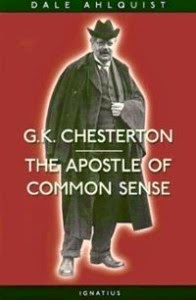
Dale Ahlquist of the American Chesterton Society offers some background for the book, which is out of print:

In 1913 the Home University Library published Chesterton’s The Victorian Age in Literature. But the editors emphatically declared that the book was not being offered as “an authoritative history of Victorian Literature” but only as Chesterton’s “personal views” on the subject. Apparently someone with personal views cannot write an authoritative history. In other words, an author cannot be an authority.

In spite of this handicap, the book was hugely successful, with multiple reprintings. One reviewer, however, while admiring the book, still expressed his irritation at “Chesterton’s obsession with religion.” (Again, authors should not have opinions, though critics may.) The reviewer’s irritation enabled him to miss the whole point of the book: that we cannot understand the Victorian writers without reference to their traditions and creeds – especially the traditions and creeds that they have rejected. Chesterton says religion “was the key of this age as of every other.” . . .


We cannot really understand the Victorian era unless we go back to the breakup of Catholic society. The multiple heresies that pulverized Catholicism were not merely religious but cultural and political and artistic. The old order was never replaced with a new order, but only with continued reactions against the old order. Chesterton says the later Protestant-types kept the Protestantism but did away with the Christianity. The Victorian Age began under the godless philosophy of Utilitarianism; it ended in the god-defying philosophy of Decadence, where men engaged in vile behavior not because they did not know it was wrong but because they did know it was wrong. “The decadents utterly lost the light and reason of their existence.” . . .

When I began reading the on-line edition of Chesterton's study I was happy to see his mention of St. John Henry Newman as a writer:

A mere conviction that Catholic thought is the clearest as well as the best disciplined, will not make a man a writer like Newman. But without that conviction Newman would not be a writer like Newman; and probably not a writer at all. It is useless for the æsthete (or any other anarchist) to urge the isolated individuality of the artist, apart from his attitude to his age. His attitude to his age is his individuality: men are never individual when alone.

And in the first paragraph of the first chapter Chesterton cites Newman again:

Now in trying to describe how the Victorian writers stood to each other, we must recur to the very real difficulty noted at the beginning: the difficulty of keeping the moral order parallel with the chronological order. For the mind moves by instincts, associations, premonitions and not by fixed dates or completed processes. Action and reaction will occur simultaneously: or the cause actually be found after the effect. Errors will be resisted before they have been properly promulgated: notions will be first defined long after they are dead. It is no good getting the almanac to look up moonshine; and most literature in this sense is moonshine. Thus Wordsworth shrank back into Toryism, as it were, from a Shelleyan extreme of pantheism as yet disembodied. Thus Newman took down the iron sword of dogma to parry a blow not yet delivered, that was coming from the club of Darwin. For this reason no one can understand tradition, or even history, who has not some tenderness for anachronism.

Chesterton identifies the Oxford Movement as one of the three great trends of Victorian thought along with Utilitarianism and Romantic Protestantism, and he summarizes his view of Newman's leadership of the Oxford Movement and his Catholic career after he left it thus:

But the greater part of all this happened before what is properly our period; and in that period Newman, and perhaps Newman alone, is the expression and summary of the whole school. It was certainly in the Victorian Age, and after his passage to Rome, that Newman claimed his complete right to be in any book on modern English literature. This is no place for estimating his theology: but one point about it does clearly emerge. Whatever else is right, the theory that Newman went over to Rome to find peace and an end of argument, is quite unquestionably wrong. He had far more quarrels after he had gone over to Rome. But, though he had far more quarrels, he had far fewer compromises: and he was of that temper which is tortured more by compromise than by quarrel. He was a man at once of abnormal energy and abnormal sensibility: nobody without that combination could have written the Apologia.  In this sense his Apologia is a triumph far beyond the ephemeral charge on which it was founded; in this sense he does indeed (to use his own expression) vanquish not his accuser but his judges. Many men would shrink from recording all their cold fits and hesitations and prolonged inconsistencies: I am sure it was the breath of life to Newman to confess them, now that he had done with them for ever. His Lectures on the Present Position of English Catholics, practically preached against a raging mob, rise not only higher but happier, as his instant unpopularity increases. There is something grander than humour, there is fun, in the very first lecture about the British Constitution as explained to a meeting of Russians. But always his triumphs are the triumphs of a highly sensitive man: a man must feel insults before he can so insultingly and splendidly avenge them. He is a naked man, who carries a naked sword. The quality of his literary style is so successful that it succeeds in escaping definition. The quality of his logic is that of a long but passionate patience, which waits until he has fixed all corners of an iron trap. But the quality of his moral comment on the age remains what I have said: a protest of the rationality of religion as against the increasing irrationality of mere Victorian comfort and compromise. So far as the present purpose is concerned, his protest died with him: he left few imitators and (it may easily be conceived) no successful imitators. The suggestion of him lingers on in the exquisite Elizabethan perversity of Coventry Patmore; and has later flamed out from the shy volcano of Francis Thompson. Otherwise (as we shall see in the parallel case of Ruskin's Socialism) he has no followers in his own age: but very many in ours.

More of Chesterton's appraisal of Newman's style may be found here (also highlighting Newman's Lectures on the Present Position of Catholics in England).

At our last meeting, we ended our discussions in the midst of chapter 12, "Brothers in Arms" as Chesterton has confessed to Father O'Connor (the model for Father Brown) in the spring of 1912 that he wants to become a Catholic but is waiting for his wife Frances. Pearce's description of Chesterton's The Victorian Age in Literature will be part of our reading next month as we finish up chapter 12 and move along to chapters 13 through 15. In the meantime, I'm reading Chesterton's evaluations of the Brontes, Thackeray, Dickens, Meredith, Browning, Barrett Browning, et al.

Friday, September 14, 2018

Chesterton on the "Smart Set" and Mr. McCabe

Our Greater Wichita area American Chesterton Society local group will discuss two more chapters from Chesterton's Heretics this evening. One of the ways that I prepare for these meetings is to research some of the authors and works he mentions. For example, in the chapter on "On Smart Novelists and the Smart Set" Chesterton describes the benefits of some fiction that was popular at the time:

In one sense, at any rate, it is more valuable to read bad literature than good literature. Good literature may tell us the mind of one man; but bad literature may tell us the mind of many men. A good novel tells us the truth about its hero; but a bad novel tells us the truth about its author. It does much more than that, it tells us the truth about its readers; and, oddly enough, it tells us this all the more the more cynical and immoral be the motive of its manufacture. The more dishonest a book is as a book the more honest it is as a public document. A sincere novel exhibits the simplicity of one particular man; an insincere novel exhibits the simplicity of mankind. The pedantic decisions and definable readjustments of man may be found in scrolls and statute books and scriptures; but men's basic assumptions and everlasting energies are to be found in penny dreadfuls and halfpenny novelettes. Thus a man, like many men of real culture in our day, might learn from good literature nothing except the power to appreciate good literature. But from bad literature he might learn to govern empires and look over the map of mankind.

Then he names names:

This new aristocratic fiction must have caught the attention of everybody who has read the best fiction for the last fifteen years. It is that genuine or alleged literature of the Smart Set which represents that set as distinguished, not only by smart dresses, but by smart sayings. To the bad baronet, to the good baronet, to the romantic and misunderstood baronet who is supposed to be a bad baronet, but is a good baronet, this school has added a conception undreamed of in the former years—the conception of an amusing baronet. The aristocrat is not merely to be taller than mortal men and stronger and handsomer, he is also to be more witty. He is the long man with the short epigram. Many eminent, and deservedly eminent, modern novelists must accept some responsibility for having supported this worst form of snobbishness—an intellectual snobbishness. The talented author of "Dodo" is responsible for having in some sense created the fashion as a fashion. Mr. Hichens, in the "Green Carnation," reaffirmed the strange idea that young noblemen talk well; though his case had some vague biographical foundation, and in consequence an excuse. Mrs. Craigie is considerably guilty in the matter, although, or rather because, she has combined the aristocratic note with a note of some moral and even religious sincerity. When you are saving a man's soul, even in a novel, it is indecent to mention that he is a gentleman. Nor can blame in this matter be altogether removed from a man of much greater ability, and a man who has proved his possession of the highest of human instinct, the romantic instinct—I mean Mr. Anthony Hope. In a galloping, impossible melodrama like "The Prisoner of Zenda," the blood of kings fanned an excellent fantastic thread or theme. But the blood of kings is not a thing that can be taken seriously. And when, for example, Mr. Hope devotes so much serious and sympathetic study to the man called Tristram of Blent, a man who throughout burning boyhood thought of nothing but a silly old estate, we feel even in Mr. Hope the hint of this excessive concern about the oligarchic idea. It is hard for any ordinary person to feel so much interest in a young man whose whole aim is to own the house of Blent at the time when every other young man is owning the stars.

Mr. Hichens is Robert Smyth Hichens, and the Green Carnation was an anonymously published novel about Oscar Wilde and Lord Alfred Douglas! Hichens also wrote The Garden of Allah and The Paradine Case, both made into movies. Hichens knew Wilde and Douglas; the dialogue in the novel recreated their conversations. 

Mrs. Craigie was Pearl Mary Teresa Craigie who wrote under the nom-de-plume of John Oliver Hobbes. According to the Catholic Encyclopedia, she was an:

English novelist, dramatist, and convert; b. 3 November, 1867; d. 13 August, 1906. She was the eldest daughter of John Morgan Richards, a successful man of business in Boston, Massachusetts, U.S.A., and of Laura Hortense Arnold, a lady of distinguished colonial descent. Her father came of an intensely Calvinistic stock long settled in and about New York and New Jersey; and her grandfather, the Rev. James Richards, D.D., was a preacher and theological writer of some distinction in his time. In February, 1887, before she had completed her twentieth year, Miss Richards was married to Mr. Reginald Walpole Craigie, an English gentleman of good connections. The union, however, proved an uncongenial one, and Mrs. Craigie soon sought and obtained a legal separation with the right to the custody of her child. In 1892, as the result, it would seem, of much private and independent reflection, she was received into the Church. She had begun to turn her thoughts seriously to literature some time before this event; for already in 1891 she had ventured before the public under the pseudonym which she insisted on retaining long after her identity was known, and challenged the puzzled critics by a book to which she gave the unconventional title of "Some Emotions and a Moral". Success waited upon her from the start: "The Sinner's Comedy" (1892); "A Study in Temptations" (1893); "A Bundle of Life" (1894); "The Gods, Some Mortals, and Lord Wickenham" (1895); "The Herb Moon" (1896); "The School for Saints" (1897); "Robert Orange" (1900); "A Serious Wooing" (1901); "Love and the Soul Hunters" (1902); "The Vineyard" (1904); "The Flute of Pan" (1905); "The Dream and the Business" (published after her death of 1906); - these with plays like "Journeys End in Lovers Meeting: Proverb," in one act, written for Miss Ellen Terry (1894); "the Ambassador", produced at the St. James's theatre in London (1898); "Osbern and Ursyne", a tragedy in three acts, published in the "Anglo-Saxon Review" (1899); "A Repentance", a drama in one act, produced at the St. James's Theatre and afterwards at Carisbrooke Castle (1899); "The Wisdom of the Wise", produced at the St. James's theatre (1900); and "The Bishop's Move" (1902), of which she was author only in part, represent the sum of her considered work, the output she preferred to be judged by. As she grew older in the wisdom of her art, the religious quality which seems to lie inevitably behind all her theory of life emerged more and more into prominence. It reached its height in "The School for Saints" and its sequel "Robert Orange". Whether in literary form or in artistic intention she never rose beyond the achievement of these two books. They are intensely serious, intensely human, and almost too religious; yet they are modern and alive. Mrs. Craigie was in the full enjoyment of a well deserved fame, yet hardly at the acme of her powers, when death came to her suddenly from heart disease.

Regarding Anthony Hope's novel Tristram of Blent, this website notes:

Tristram of Blent is a departure from Hope's normal adventure story. Subtitled "An Episode in the Story of an Ancient House," the protagonist is a man who throughout boyhood thinks of nothing but owning the House of Blent. This desire is beset on every side by family entanglements and complications, and provides Hope with the opportunity for a lively character study.

I am glad that Chesterton did enjoy The Prisoner of Zenda, which is an entertaining adventure novel.

Chesterton also mentions a Miss Fowler, who was Eileen Thorneycroft Fowler (1860-1929), the daughter of a Viscount; her novels were about Methodism and high society. One of her most popular novels was Concerning Isabel Carnaby.

In the next chapter, "On Mr. McCabe and a Divine Frivolity", Chesterton describes his conversation in print with Mr. Joseph McCabe (1867-1955), the former Franciscan priest (Father Anthony, 1890-1896) and staunch critic of Catholicism. McCabe wrote on free thought, contributing often to the Little Blue Book and Big Blue Book series published by Emanuel Haldeman-Julius (1889-1951). The Haldeman-Julius Publishing Co. was based in Girard, Kansas (the county seat of Crawford County in southeast Kansas).

Girard, Kansas was a center of Socialist thought in the early twentieth century, with Eugene V. Debs launching one of his four presidential campaigns on the courthouse steps (1908) and carrying Crawford County in 1912 (the only county in the USA he won in 1912--but then he was campaigning from Federal Prison in Atlanta).

The University of Nebraska recently published a book about the Haldeman-Julius Publishing Co. and its name sake:

His admirers called him the “Barnum of Books” and the “Voltaire of Kansas” because of his ability to bring culture and education to the people.

R. Alton Lee brings to life Emanuel Haldeman-Julius (1889–1951), a writer-publisher-entrepreneur who was one of America’s most significant publishers and editorialists of the twentieth century. His company published a record 500,000,000 copies of 2,580 titles and was second only to the U.S. Government Printing Office in the quantity of publications it produced. Lee details Haldeman-Julius’s family origins in Russia and his formative years in Philadelphia, where he learned the book trade. As a writer and editor for the
Social Democrat, Sunday Call, and Western Comrade, Haldeman-Julius was already well known by the time he launched his own publishing company. Haldeman-Julius knew, was nurtured by, and published writers such as Jack London, Upton Sinclair, Jane Addams, Emma Goldman, H. L. Mencken, Carl Sandburg, Eugene V. Debs, Clarence Darrow, Job Harriman, Will Durant, and Bertrand Russell, among others.

Based in Girard, Kansas, his company, Haldeman-Julius Publications, covered socialist politics, the philosophy of free thought, and both new and classic books marketed to ordinary Americans, including the Little Blue Book series of classics in Western thought and literature.

This biography of the enigmatic and energetic Haldeman-Julius opens a window into the fascinating world of early twentieth-century radical politics and publishing.


If you want to come to our meeting, we'll convene about 6:30 p.m. at Eighth Day Books. Refreshments will be served.

Thursday, February 22, 2018

GKC on "The Style of Newman"


G.K. Chesterton seems to have written about almost everything and everyone. I found the text of his book A Handful of Authors online. His secretary and friend Dorothy Collins edited this book in 1953 from among many essays and reviews Chesterton had written and it was published by Sheed & Ward. Here's part of what Chesterton says about the prose style of John Henry Cardinal Newman (Blessed John Newman):

A FINE style is not a narrow or fastidious or aristocratic thing, as many think. On the contrary, style is the truly democratic thing, since it touches all common things with the same fairy wand. A man who loves all men enough to use them rightly is a democrat. A man who loves all words enough to use them rightly is a stylist. Style comes out, as the fraternal human sentiment comes out, pre-eminently and most definitely in dealing with coarse or everyday things. An eloquent outburst from Carlyle about the stars and the heroes is, in its own way, fine style. But a page of Newman's Apologia which merely describes how he left off living at some college and went to live in some settlement is also fine style. The ideal lover of mankind would linger over a postcard to his washerwoman, transposing words and modifying adjectives until it was as perfect as a sonnet.

The one weakness of Newman's temper and attitude as a whole was, I think, that he lacked the democratic warmth. This had nothing to do with his religion; for in Manning, who was a far more rigid and central Catholic than he, democracy roared like a bonfire. It had something to do with his character and something to do with his training. But in this matter of a fine style Newman was not doing anything precious or exclusive; he was doing something entirely human and sociable. Good style treats verbs and particles as good manners treats chairs and tables, easily but in the proper way. There is no such thing as being a gentleman at important moments; it is at unimportant moments that a man is a gentleman. At important moments he ought to be something better. So while we can consent to receive some poignant message or violent and sudden sincerity in any language that the man chooses to use, we feel that the finest instinct of geniality is to speak of common things with some dignity and care. No man has ever done this so well as Newman. A magic that is like a sort of musical accompaniment changes and heightens the most prosaic fragments of personal biography or scholastic explanation. And in this, as I say, he achieves for a time that awful and beautiful thing which is the dream of all democracy, the seeing of all things as wonderful, the thing for which Whitman strove and which he did not perfectly attain. In this respect Carlyle and Walt Whitman (that immeasurably greater man) are even the aristocrats compared to this classical embroiderer. They spoke in a tongue not understanded of the people. They were bold and boisterous and personal, as the better kind of aristocrats are always bold and boisterous and personal.

"The Style of Newman" was first published in The Speaker in 1904.

He demonstrates some knowledge of Newman's works, comparing him to Gladstone in some respects. Anticipating the great Newman biographer Father Ian Ker, Chesterton comments on Newman's use of humor:

The truth was, as I fancy, that it was very fortunate for Newman, considered merely as a temperament and a personality, that he was forced into that insatiably fighting thing, the Catholic Church, and that he was forced into it in a deeply Protestant country. His spirit might have been too much protected by the politeness of our English temper and our modern age, but it was flayed alive by the living spirit of "No Popery". The frigid philosopher was called a liar and turned into a man. We might also dwell upon that one outburst of wild and exuberant satire in which Newman indulged: I mean his comparison (in the first lecture on "The Position of English Catholics")* of the English view of the Catholic Church to the probable Russian view of the British Constitution. It is one of the great pages of fierce English humour. Why he thus once exploded into fantastic derision I do not know. But I suspect that it was because Birmingham was full of "No Popery" rioters and his back was to the wall. This man, when he was in the sweet but too refined atmosphere of the Oxford High Churchmen, had shed many tears. But, like all brave men when he first saw the face of battle, he began to laugh.

*Of course, Chesterton means The Present Position of Catholics in England!

More about A Handful of Authors from Dale Ahlquist and the American Chesterton Society.

Friday, July 8, 2016

Rum and Cheddar at Eighth Day Books

Tonight at Eighth Day Books, our Greater Wichita local society of the American Chesterton society will meet to begin our discussion of G.K. Chesterton's The Flying Inn.

William Kirkpatrick wrote about the book for Crisis Magazine a couple of years ago with one glaring error:

the book has a whimsical, Pickwickian quality. It follows the rambling adventures of two British (sic) stalwarts, Patrick Dalroy and Humphrey Pump, as they try to stay one step ahead of the law, dispensing free liquor as they go in an England where alcohol has been banned. The “Flying Inn” is their motor car which they have furnished with a large keg of rum, a cask of cheese, and a pub sign.

Patrick Dalroy is IRISH!

. . . The reason that alcohol is banned in Chesterton’s tale is because some upper-class elites have become enamored of Islam and everything Islamic—including the prohibition of drink. Chief among these is Lord Ivywood, a Nietzschean diplomat who has enlisted the aid of a mysterious Turk, Misyra Ammon, to spread the new gospel among the jaded upper class who find exotic Islam to be more exciting than their own traditions and religion.

Other than Mr. Quoodle, the dog who leaves Lord Ivywood and joins Dalroy and Pump on their adventures, the most interesting character is Lady Joan Brett, who is too close to Lord Ivywood because of family ties and is in mortal and moral danger. From Chapter 10, "The Character of Quoodle":

Now Lady Joan Brett did appreciate dogs. It was the whole of her type and a great deal of her tragedy that all that was natural in her was still alive under all that was artificial; and she could smell hawthorn or the sea as far off as a dog can smell his dinner. Like most aristocrats she would carry cynicism almost to the suburbs of the city of Satan; she was quite as irreligious as Lord Ivywood, or rather more. She could be quite equally frigid or supercilious when she felt inclined. And in the great social talent of being tired, she could beat him any day of the week. But the difference remained in spite of her sophistries and ambitions; that her elemental communications were not cut, and his were. For her the sunrise was still the rising of a sun, and not the turning on of a light by a convenient cosmic servant. For her the Spring was really the Season in the country, and not merely the Season in town. For her cocks and hens were natural appendages to an English house; and not (as Lord Ivywood had proved to her from an encyclopaedia) animals of Indian origin, recently imported by Alexander the Great. And so for her a dog was a dog, and not one of the higher animals, nor one of the lower animals, nor something that had the sacredness of life, nor something that ought to be muzzled, nor something that ought not to be vivisected. She knew that in every practical sense proper provision would be made for the dog; as, indeed, provision was made for the yellow dogs in Constantinople by Abdul Hamid, whose life Lord Ivywood was writing for the Progressive Potentatesseries. Nor was she in the least sentimental about the dog or anxious to turn him into a pet. It simply came natural to her in passing to rub all his hair the wrong way and call him something which she instantly forgot.

While Dalroy and Pump are on the run and in trouble, Lady Joan is in danger of losing her immortal soul!

In the book of essays we finished discussing in June, The Well and the Shallows, Chesterton often referred to Prohibition in the U.S.A. and he did not like it. For example: in number VII of "My Six Conversions":

I could point, for instance, to the collapse of Prohibition; not so much in the narrow sense of Prohibition as in the general sense of Prohibitionism. For what failed with the American experiment was not merely a particular chemical experiment with some alleged chemical constituent, which they chose to call alcohol. It was a whole attitude towards all the complex uses and abuses of human things. The great outstanding principle of the modern materialistic world has been Prohibition; even Prohibition in the abstract. Where we say that a social element is dangerous or doubtful, that it must be watched, that it may on due occasion be restrained, the thing that was called the Modern Mind always cried aloud with a voice of thunder that it must be forbidden. The Prohibitionist declares that there must be no wine; the Pacifist that there must be no war; the Communist that there must be no private property; the Secularist that there must be no religious worship. The failure of Prohibition in the one country in which it was a favourite, in which it was a popular ideal in so far as anything so inhuman can be popular, was the collapse of the whole conception of wiping out entirely the temptations of man and the trials of mortal life. After that, it is tacitly agreed that there is no such simple way out of moral problems; it is almost admitted that they must be referred to the moral sense. We were actually driven back on the desperate and tragic duty of our fathers, of deciding for ourselves whether we were drinking too much, or whether we were fighting in a just quarrel, or whether we were only defending our own lawful property, or getting other people's property by lawless usury. Such a demand was naturally a great strain on the Modern Mind. For the Modern Mind is not at all accustomed to making up its mind. It finds the task almost as unfamiliar as working its own farm or practising its own craft; or doing a hundred other things, that human beings had done from the foundations of the world. In short, it would not accept the Catholic doctrine that human life is a battle; it only wanted to have it announced, from time to time in the newsapers, that it was a victory.

I can confirm that rum and cheddar cheese will be available without charge and without any violation of Lord Ivywood's pernicious Parliamentary permutations. 

Thursday, December 24, 2015

Chesterton at Kings (Frances, That Is)

Each year I peruse the booklet for the Nine Lessons and Carols at the King's College Chapel in Cambridge to see what carols have been chosen and what the new commissioned carol is. Chesterton would approve of all that alliteration and this year Chesterton contributes to the program. Not G.K. Chesterton, but his wife, Frances Chesterton!

Here is the little door, lift up the latch, oh lift! 
We need not wander more but enter with our gift; 
Our gift of finest gold, 
Gold that was never bought nor sold; 
Myrrh to be strewn about his bed; 
Incense in clouds about his head; 
All for the child that stirs not in his sleep, 
But holy slumber holds with ass and sheep. 

Bend low about his bed, for each he has a gift; 
See how his eyes awake, lift up your hand, O lift! 
For gold, he gives a keen-edged sword 
(Defend with it thy little Lord!) 
For incense, smoke of battle red, 
Myrrh for the honoured happy dead; 
Gifts for his children, terrible and sweet, 
Touched by such tiny hands, and Oh such tiny feet.

The music is by Herbert Howells.

Our Greater Wichita chapter of the American Chesterton Society held a most festive meeting last Friday at Eighth Day Books: we read selections from collection by G.K. Chesterton called The Spirit of Christmas, of which I bought two copies last year (and gave one as a gift): it's as rare as hen's teeth now and the American Chesterton Society should reprint it as the companion volume to Frances Chesterton's collection, edited by Nancy Carpenter Brown, of poems and plays, How Far Is It to Bethlehem. You might say we had lessons without carols, but with many treats and great fun!

When my GKC group friends see this post, it may confirm us all more than ever that we should read The Woman Who Was Chesterton next, once we've finished reading and discussing The Well and the Shallows (and we can just about see the bottom of the well now).

According to the website for King's College Chapel:

A Festival of Nine Lessons and Carols is broadcast live on BBC Radio 4 on 24 December at 3pm (10:00 EST or 07:00 PST). The service is also broadcast at 2pm on Radio 3 on Christmas Day, and at various times on the BBC World Service.

In the United States the service is broadcast by around 300 radio stations, including American Public Media and its affiliates (Minnesota Public Radio and WNYC-New York, for example). Unfortunately there is no list of radio stations that are broadcasting the service, so it's best to contact your local stations or check their online listings.

Friday, January 23, 2015

Chesterton Tonight: Beginning to Wade into "The Well and the Shallows"

Our Greater Wichita local group of the American Chesterton Society meets tonight at Eighth Day Books (6:30 p.m.) to begin our discussions of another book of Chesterton's essays included in volume III of Ignatius Press's Collected Works. These essays/articles were gathered into a book called The Well and the Shallows in 1935.

I have a hardcover copy of the book from Sheed & Ward, printed in Great Britain in 1935--this is one of Chesterton's last books.

We will also start discussing promotion of the next big Chesterton event in Wichita--the Catholic Culture Conference at the Spiritual Life Center on April 17 and 18, 2015. More info here:

Join Dale Ahlquist and many Diocesan speakers for this great conference about being Catholic in the world.

The Catholic Culture Conference is an opportunity for faithful Christians to come together for formation and fellowship. The program intends to promote Catholic values in personal and family life, as well as in society at large.

The Conference will consist of multiple sessions, each geared towards some particular component of Catholic life in our modern age. A combination of large group lectures and smaller breakout sessions will give each participant the opportunity to learn more about how Catholicism relates to–and is intended to positively change-our culture.

Our Catholic Faith is not just a notional idea. It is a concrete reality with the power to open the hearts and minds of all peoples. It can make the societies in which we live flourish in the way God intended. This Conference will give participants knowledge and inspiration to go about doing just that.

Our Keynote speaker is one of th emost respected G.K. Chesterton scholars in the world, Mr. Dale Ahlquist. He will give a keynote lecture entitled "The Glorious Side of Social Decline" and a second lecture on "The Trouble with Catholic Social Teaching."


As for tonight: 6:30 p.m. at Eighth Day Books, 2838 East Douglas Avenue (refreshments will be served!!). If you are interested in Chesterton, drop by!

Saturday, June 14, 2014

G.K. Chesterton, RIP

Yesterday, Dale Ahlquist paid tribute to Gilbert Keith Chesterton, who died 78 years ago today, June 14:

His death was front page news around the world and was met with an outpouring of spontaneous groans and genuine grief. Thousands of people who had never met Chesterton but who had welcomed him into their homes through his newspaper columns felt as though they had lost a friend. But the next few decades passed and he was forgotten. Then something quite contrary happened. Thousands of people suddenly found a friend in Chesterton. His books and essays surged back into print, and people got to know him all over again, embracing the sense of wonder and joy that lives on in his words.

We have witnessed a revival, and it has, of course, been personally gratifying as Chesterton has proved to be my friend, my hero, my mentor, my Virgil, who led me, not through the Inferno but through the comedy which is indeed divine. It is a great joke that he led this Baptist to the Catholic Church.

I certainly feel that I know him very well as I have explored the mountain of his words. Five thousand essays and counting. In the last few years we have found over four hundred previously uncollected essays. Yet I often think about the impenetrable wall that exists between those of us who have known Chesterton only through his writings and those who actually knew him in person. As we approach eight decades since his death, that latter list continues to dwindle.

Read the rest here.

This blog cites the many writers G.K. Chesterton influenced: from contemporaries like G.B. Shaw and H.G. Wells (with whom he graciously disagreed) to current authors like Dean Koontz and J.K. Rowling. A sample:

 -Agatha Christie was a fan of Chesterton's detective Father Brown:

Father Brown has always been one of my favorite sleuths...He is one of the few figures in detective fiction who can be enjoyed for his own sake, whether you are a detective fan or not. [28]
-Dean Koontz is another Chestertonian. In an interview with Gilbert Magazine, he was asked which was the first Chesterton book he had read, stated:

Orthodoxy, and it had a powerful effect. Then I read The Everlasting Man, which I think was the better of the two. Together they were like a one-two punch. [29]
Shortly afterwards, when asked how Chesterton's precision of writing had influenced his writing, Koontz responded:

The precision of his language, the clarity of his thought, his exuberant nature, and his delight in tweaking the humorless who are humorless because of their dour materialism- all of those things influenced my writing.[29]
Indeed, Chesterton quotes feature as epigraphs in at least four of his novels (Relentless, Breathless, and two volumes of his Frankenstein Series: Lost Souls and The Dead Town). Koontz also dedicated The Dead Town to GKC:

To the memory of Gilbert K. Chesterton, who presented wisdom and hard truths in a most appealing package, changing countless lives with kindness and a smile [30]
-Another person on whom Chesterton's influence came was Alfred Hitchcock. According to Hitchcock biographer, Donald Spoto:

The influence of Chesterton must be assessed as well. Much admired and celebrated by the Catholic clergy, and read by Catholic schoolboys, Chesterton's popular essays "A Defence of Penny Dreadfuls" and "A Defence of Detective stories" (published in his 1901 collection The Defendant) entertained the adolescent Hitchcock, and provided him with ideas for the formation of his own style and vision when he was an apprentice filmmaker. It was Chesterton who defended popular literature, Chesterton who pointed out the archetypal, fairy-tale structure of police stories, and Chesterton who defended exploration of criminal behavior.

'One of the strangest examples of the degree to which ordinary life is undervalued is the example of popular literature, the vast mast of which we contentedly describe as vulgar.' Hitchcock read in 'A Defense of Penny Dreadfuls.' [31]
In fact, the title (though not the plot) of one of Hitchcock's movies (and it's remake), The Man Who Knew Too Much, is derived from a book of mysteries by Chesterton's of that name:

Hitchcock made The Man Who Knew Too Much twice, in England in 1934 and in America in 1956. It was based on a story by Charles Bennett and D.B. Wyndham-Lewis, though the title actually comes from a collection of mysteries by G.K. Chesterton, to which Hitchcock owned the rights and which has nothing to do with the story-line of the films he made. [32]
-Chesterton was "one of [President Theodore] Roosevelt's favorite contemporary writers." [33], and Roosevelt expressed a desire to meet Chesterton during a visit to England. [33a]. Such a desire was fulfilled, and Roosevelt, after meeting Chesterton, had this to say about him.

What a supreme genius Chesterton is! I never met a man who could talk so brilliantly and interestingly. [33b]
-J.K. Rowling, a member (at least at one time- I do not know if she is still or not) of the UK Chesterton Society [34], has "paid homage to" Chesterton. [35]

And here's another post, focused on Chesterton's influence on Christians in his own time and ours.

Brandon Vogt has a Chesterton giveaway, including the book pictured above, on his blog. As I mentioned to a facebook friend--"You could enter, but I should win!"

Thursday, May 29, 2014

Happy Birthday to Gilbert Keith Chesterton!

As our Wichita chapter of the American Chesterton Society continues to read Chesterton, we've appreciated how he looks at historical events from a different perspective. This short article from Lunacy and Letters, posted on the American Chesterton Society's website, shows why Chesterton offers those different views--he does not want to read what the historian thinks about history; he just wants to read history:

In my innocent and ardent youth I had a fixed fancy. I held that children in a school ought to be taught history, and ought to be taught nothing else. The story of human society is the only fundamental framework outside of religion in which everything can fall into its place. A boy cannot see the importance of Latin simply by learning Latin. But he might see it by learning the history of the Latins. Nobody can possibly see any sense in learning geography or in learning arithmetic – both studies are obviously nonsense. But on the eager eve of Austerlitz, where Napoleon was fighting a superior force in a foreign country, one might see the need for Napoleon knowing a little geography and a little arithmetic. I have thought that if people would only learn history, they would learn to learn everything else. Algebra might seem ugly, yet the very name of it is connected with something so romantic as the Crusades, for the word is from the Saracens. Greek might be ugly until one knew the Greeks, but surely not afterwards. History is simply humanity. And history will humanise all studies, even anthropology.

Since that age of innocence I have, however, realised that there is a difficulty in this teaching of history. And the difficulty is that there is no history to teach. This is not a scrap of cynicism – it is a genuine and necessary product of the many points of view and the strong mental separations of our society, for in our age every man has a cosmos of his own, and is therefore horribly alone. There is no history; there are only historians. To tell the tale plainly is now much more difficult than to tell it treacherously. It is unnatural to leave the facts alone; it is instinctive to pervert them. The very words involved in the chronicles – “Pagan”, “Puritan”, “Catholic”, “Republican”, “Imperialist” – are words which make us leap out of our armchairs.

No good modern historians are impartial. All modern historians are divided into two classes – those who tell half the truth, like Macaulay and Froude, and those who tell none of the truth, like Hallam and the Impartials. The angry historians see one side of the question. The calm historians see nothing at all, not even the question itself.

But there is another possible attitude towards the records of the past, and I have never been able to understand why it has not been more often adopted. To put it in its curtest form, my proposal is this: That we should not read historians, but history. Let us read the actual text of the times. Let us, for a year, or a month, or a fortnight, refuse to read anything about Oliver Cromwell except what was written while he was alive. There is plenty of material; from my own memory (which is all I have to rely on in the place where I write) I could mention offhand many long and famous efforts of English literature that cover the period. Clarendon’s History, Evelyn’s Diary, the Life of Colonel Hutchinson. Above all let us read all Cromwell’s own letters and speeches, as Carlyle published them. But before we read them let us carefully paste pieces of stamp-paper over every sentence written by Carlyle. Let us blot out in every memoir every critical note and every modern paragraph. For a time let us cease altogether to read the living men on their dead topics. Let us read only the dead men on their living topics.

Read the rest here. Happy birthday, G.K.C.! (May 29, 1874).