Thursday, May 12, 2022

The Solemnity of Corpus Christi and the York Mystery Plays

The Solemnity of Corpus Christi, the patronal feast of our parish, Blessed Sacrament Catholic Church, is on Sunday, June 19 this year. Since the Traditional Latin Mass is celebrated every Thursday at Blessed Sacrament, it will also be celebrated on Thursday, June 16! From the online parish calendar I see that a Corpus Christi Novena is planned with more details to come, and our annual parish festival will be celebrated on the weekend of the feast day. And by the way, our parish is one of the designated pilgrimage sites for our diocesan Year of the Eucharist!

I'm thinking about this feast, not just because it's one of my favorites feasts of the Liturgical Calendar, but because I saw this post from the Adoremus Bulletin in my Facebook feed. The author, Dr. Marcel Antonio Brown, describes the connections between the feast of Corpus Christi and the York Mystery Plays, beyond the fact that they were performed in honor of the feast. For example:

Joseph’s Trouble About Mary, sponsored by a guild which manufactured liturgical items such as thuribles, dramatizes Joseph’s difficulty in comprehending the Virgin-with-Child, the great mystery or sacramentum of Christ’s Body.[3] The wonder of Joseph becomes specifically Eucharistic in The Nativity when Mary welcomes the Christ-child with a litany used by the late-medieval lay faithful during the Elevation of the Host at Mass.[4] At the end of the play, Mary and Joseph lay the Christ-child in the manger while repeating together a vernacular version of the prayer prescribed for the priest’s quiet recitation in Latin (tacita voce) at the end of each Mass in accord with the rubrics of the York Missal.[5] The Nativity subtly shows that the Body of Christ, the Christ-child born in the stables at Bethlehem, is thus made present at every Mass, a miracle celebrated in sacred drama in York on Corpus Christi Day.

If you click on footnote #4, you'll see that Brown directs you to a source published in 1942:

See R. H. Robbins, “Levation Prayers in Middle English Verse” (Modern Philology 40.2, 1942), p. 136, where the early fifteenth-century MS Royal 17.C.xvii provides an analogy for lines 57-63 of the York Nativity.

The verses he highlights, lines 57 to 63, are:

Hayle, my Lord God, hayle prince of pees,
Hayle my Fadir, and hayle my Sone,
Hayle sovereyne sege all synnes to sesse,
Hayle God and man in erth to wonne!
Hayle, thurgh whos myht
All this worlde was first begonne,
Merknes and light.

This University of Rochester website provides some background on Levation Prayers, a devotion practiced by the laity during the Elevation of the Blessed Sacrament during the Canon of the Mass:

Since taking communion (that is, eating a consecrated host and drinking consec­rated wine) was not as common as it is in today’s Christian churches, the moment when the laity saw the host, known as the levation (or elevation), was their primary form of contact with the Eucharist. Ecclesiastical writers strongly emphasized the importance of the levation. A widely-circulated list of the benefits gained from seeing the host daily included promises that the worshipper would not suffer sudden death, a lack of food, or blindness on any day that he or she saw the consecrated host.2 Writers also required the laity to view the host with highly concentrated devotion. The statutes of Coventry suggest that the sacring bell is like “a gentle trumpet announcing the arrival of a judge, indeed of a savior,” and many authorities encouraged the laity to utter heartfelt prayers at the moment of the levation.3

These prayers exist in a variety of vernacular forms; as Russell Hope Robbins has argued, the heightened emotion of this moment required laity to pray in the language they knew best.4 Perhaps for the same reason, writers who offered their own suggestions for levation prayer stressed that it did not matter which version the laity used, so long as they prayed in some form.

These sacramental mystery plays, of course, were suppressed in England during the Reformation era. Brown also comments on the strange absence of the institution of the Eucharist in the 27th play of the cycle:

The bakers’ Last Supper, featuring the apocryphal character Marcellus leading the disciples to the Lamb’s Supper, contains a curious lacuna: at the moment of the institution of the Eucharist, the manuscript is corrupt. Richard Beadle, the world’s leading textual-bibliographical scholar of The York Plays, suspects “deliberate removal” of this section of the play.[8]  

Thus hoping to hide from future generations the devotion of the English people in the past? How ridiculous, since the Catholic Mass was celebrated in secret in Recusant England and in public throughout Catholic Europe!

And the University of Rochester has this comment on that lacuna:

The Bakers were an obvious choice for the Last Supper since bread was an essential requirement for the institution of the Eucharist. No event in biblical history could be of greater significance in relation to the feast of Corpus Christi, which was a celebration of the Sacrament of the Eucharist in liturgical rite and procession as well as, at York, the plays. It is thus all the more unfortunate that, due to the loss of a leaf between lines 89 and 90, the central portion of the narrative with its representation of the blessing of the bread and wine is missing. The actions performed by Jesus at the table very likely were modeled on the gestures of the priest in consecrating the elements at Mass.

Please read the rest of Dr. Brown's article at the Adoremus Bulletin site, and two other articles, here and here, he wrote about York Mystery Plays.

This solemn feast is just a little more than a month away! Perhaps there's still time to read the Oxford World Classics modern language edition!

Thursday, May 5, 2022

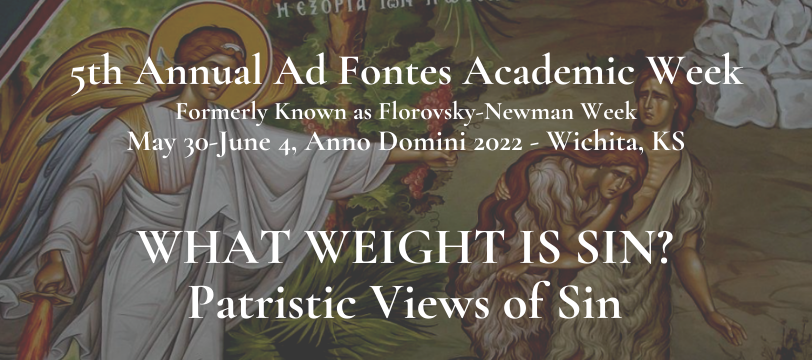
This Year's EDI Academic Week: Now Named "Ad Fontes"


Beginning June 1st with the Festal Banquet at Newman University and continuing with prayers, lectures, academic papers, and Plenary Dialogues at Newman University and St. George Catholic Christian Cathedral on June 2nd, 3rd, and 4th, Eighth Day Institute's annual academic theological event has been announced:

Co-sponsored by St George Orthodox Christian Cathedral and the Gerber Institute for Catholic Studies, the Ad Fontes Academic Week promotes a “return to the sources for Christian unity.” Heeding Fr. Florovsky's advice, rather than simply overlooking differences, this conference seeks to overcome the different views of sin. And we do so by returning to the common Tradition, by learning to read the Fathers as living masters, rather than as historical documents.

In years past, this conference has been known as the Florovsky-Newman Week. This year we have decided to broaden our perspective by honoring Thomas F. Torrance together with our other two patrons. Torrance was a Protestant who, like the Orthodox Fr. Georges Florovsky and Catholic St. John Henry Newman, called for a return to patristic sources as a guide for the modern Church..

Join us for this unique event as we return to the sources—ad fontes—in order to explore, challenge, and encourage one another to better love God and neighbor, and to work towards unity by way of the Fathers.

The topic this year is "What Weight Is Sin? Patristic Views of Sin" and the schedule, still being refined, is posted here.

Also note that there is a pre-Ad Fontes seminar: "Sin in the Bible, the Fathers, the Liturgy, & Literature" with texts still to be announced. I've attended two of those seminars and they are wonderful, as participants discuss the texts.

I'll be presenting the annual Newman Lecture on Thursday, June 2 at 9:00 a.m. at Newman University. My topic is "Newman on Hypocrisy and Holiness in the Life of a Christian":

John Henry Cardinal Newman, before his canonization in 2019, may have been studied mostly for his controversial works like the Essay on the Development of Christian Doctrine, The Letter to the Duke of Norfolk, or classics like the Apologia pro Vita Sua and Idea of a University. Interest in his spiritual influence as an Anglican preacher in the Parochial and Plain Sermons and as the founder of the Oratory of St. Philip Neri in England, has been increasing, however, as his cause for canonization progressed (and succeeded on October 13, 2019).

This annual Newman lecture will focus on his efforts as the Vicar of the University Church of St. Mary the Virgin in Oxford to help his congregation free themselves from the corruptions of what he called the “Religion of the Day” and their comforts as part of the establishment in England to lead true Christian lives, loving God fully and avoiding the besetting sin of hypocrisy.

The continuity of that effort will also be briefly explored through some of his Meditations and Devotions, prepared for the boys of the Oratory School in Birmingham. 

Watch for updates (including the other speakers' abstracts and the list of academic papers to be presented) on the EDI website or Facebook page.

Wednesday, May 4, 2022

"The torments they endured were horrible": The Catholic Martyrs of England and Wales, 1535-1679


From Fr. Christopher George Phillips, the retired founding pastor of Our Lady of the Atonement Church in San Antonio, Texas, a parish of the Personal Ordinariate of the Chair of Saint Peter, comes this reflection on the May 4th feast of Catholic Martyrs of England and Wales:

The English Martyrs include 284 men and women who gave their lives during the 16th and 17th centuries. They were martyred simply because they remained steadfast in their Catholic faith. What had happened?

King Henry VIII had proclaimed himself supreme head of the Church in England, claiming for himself and his successors power over his subjects not only in civil matters, but also in all things spiritual. He took to himself a spiritual power that can belong only to the Pope as the Vicar of Christ and Successor of St. Peter. The Catholics at that time wanted to be loyal subjects of the Crown, but their consciences could not allow them to grant the power of spiritual supremacy. It is as though, in the United States, the president and Congress took upon themselves the power to determine what we as Catholics believe, and how we worship. We could not allow Congress to pass laws that changed the Church’s teaching about the Mass, or what we believe about God. But this was what had happened in England and Wales. This was what led many people to face death courageously rather than act against their consciences and deny their Catholic faith.

Please read the rest there.

This Feast, honoring all the martyrs, canonized and beatified, is celebrated in the Anglican Ordinariate* and in the dioceses of England on May 4th, the date of the execution of the Protomartyrs in 1535 (Saints John Houghton, Augustine Webster, Robert Lawrence, Richard Reynolds, and Blessed John Haile); in the dioceses of Wales, their Feast, known as the Feast of Six Welsh Martyrs and [English] Companions, is celebrated on October 25th, the date that Pope Saint Paul VI canonized the 40 Martyrs of England and Wales in 1979.

*Please note that is celebrated as a Feast in the Anglican Ordinariate of Our Lady of Walsingham, but as a Memorial in the Ordinariates of the Chair of St. Peter in North American and of Our Lady of the Southern Cross in Australia.

According to the Liturgical Calendar of England:

The English Men and Women martyred for the Catholic Faith 1535–1680 and beatified or canonised by the Holy See. On this day in 1535 there died at Tyburn three Carthusian monks, the first of many martyrs, Catholic and Protestant, of the English reformation. Of these martyrs, forty two [including Saints John Fisher and Thomas More, and the six Welsh Martyrs] have been canonised and a further two hundred and forty two declared blessed, but the number of those who died on the scaffold, perished in prison, or suffered harsh persecution for their faith in the course of a century and a half cannot now be reckoned. They came from every walk of life; there are among them rich and poor, married and single, women and men. They are remembered for the example they gave of constancy in their faith, and courage in the face of persecution.

The Six Welsh Martyrs, listed on the website of the Liturgical Calendar of Wales are: Saints John Jones, Philip Evans, John Lloyd, David Lewis, Richard Gwyn, and John Roberts. Saints Evans, Lloyd, Lewis, and Gwyn were executed in the throes of the Popish Plot in 1679.

Holy Catholic Martyrs of England and Wales, pray for us!

Sunday, May 1, 2022

William Byrd and the "Non Nobis" Canon

Thinking of the "Non nobis" reference in the article from The Guild of Our Lady Ransom's The Ransomer, and anticipating the broadcast of Laurence Oliver's Henry V on TCM yesterday, I searched for more information about that canon. I also heard the echo of Patrick Doyle's setting of "Non nobis" in Kenneth Branagh's version of Shakespeare's play.

At one time the music for that canon or round was attributed to William Byrd. But this posting from the Choral Wiki indicates a more complicated history:

This famous canon at the fifth and unison or octave is now generally accepted by musicologists as not having been written by William Byrd (1542/3–1623); the late, eminent Byrd specialist Philip Brett came to the view that most of the canons attributed to Byrd were spurious.

Recent research has shown that the two related figures which form the basis of the Non nobis, Domine canon were extracted from the 5-voice motet Aspice Domine by Philip van Wilder (c. 1500–1554). In the motet both figures are set to the text-phrase Non est qui consoletur (“there is none to console”) which was presumably the text to which the original version of the canon was sung by the Elizabethan recusant community as an expression of nostalgia for the old religious order. 

The words of the motet, taken from the Vulgate Latin of Jeremiah's Lamentations:

Aspice, Domine, quia facta est desolata civitas plena divitiis. 
Sedet in tristitia, non est qui consoletur eam, nisi tu, Deus noster. 

Behold, O Lord, how the city full of riches is become desolate. 
She sits in mourning, there is none to comfort her save only thou, our God.

But the words of the Non nobis version of the motet have a different source, according to the Choral Wiki article:

The Non nobis, Domine text to which the canon is sung today was apparently taken from the first collect from the thanksgiving service added to the Book of Common Prayer to celebrate the thwarting of the Gunpowder Plot on 5 November 1605.

And Wikipedia's entry on Non nobis has this note about its occurrence in Shakespeare's play and in a 1542 report on the Battle of Agincourt:

Shakespeare, in Henry V Act IV Scene 8, has the king proclaim the singing of both the Non nobis and the Te Deum after the victory at Agincourt. The canon is sung in the 1944 film of Henry V (starring Laurence Olivier) and also in the 1989 film of the same title (starring Kenneth Branagh), though we now know that the retexted version was not in existence as early as 1599, when the play was written. There is no stage direction in the play to indicate the singing of Non nobis Domine , but if Shakespeare had a specific setting in mind he was probably thinking anachronistically of a Protestant metrical psalm tune. However, in Hall's Chronicle (1542) Non nobis is sung as part of the complete psalm, presumably to plainsong [plainchant] or faburden.
When the kyng had passed through the felde & saw neither resistence nor apparaunce of any Frenchmen savyng the dead corsses [corpses], he caused the retrayte to be blowen and brought al his armie together about, iiij [4]. of the clocke at after noone. And fyrst to geve thankes to almightie God gever & tributor of this glorious victory, he caused his prelates & chapelaines fyrst to sing this psalme In exitu Israel de Egipto, commaundyng every man to knele doune on the ground at this verse. Non nobis domine, non nobis, sed nomini tuo da gloriam, whiche is to say in Englishe, Not to us lord, not to us, but to thy name let the glory be geven: whiche done he caused Te deum with certeine anthemes to be song gevyng laudes and praisynges to God, and not boastyng nor braggyng of him selfe nor his humane power.

In plainchant, this might have been what the English sang at Agincourt. (And that's the Plainchant Mode we use at the Church of the Blessed Sacrament when we chant Psalm 115 in Sunday Vespers during Advent and Lent!) 

This makes for an interesting juxtaposition of memories, depending on when the play was performed. After 1605, Non nobis reminded audiences of the Gunpowder Plot; before and after 1605, it might have  reminded some Recusant Catholics in the audience of the "old religious order."

Not to us, O Lord, but to Your Name be the Glory! Amen.

Thursday, April 28, 2022

Shakespeare's Catholic Language

When the issue of Shakespeare's Catholicism or crypto-Catholicism, or Church Papism comes up, I always think of the Catholic language and imagery of his plays; the good friars, the true nun, etc. This article from The Guild of Our Lady of Ransom reminds us of how Shakespeare reminded his audiences of their Catholic past:

Shakespeare lived during the worst religious division England has known. It has been remarked that one of the most curious aspects of his writing is the apparent absence of any plays on the main themes of the age – belief, religion, and the church. . .

Nevertheless, he was born when the Catholic religion was effectively in retreat and indeed under accelerating persecution, under forbidding injunctions intending that ‘there remain no memory of the same’.‍ . . .‍

The official hope was that Catholic belief and practice would abate with the dying out of priests, places of worship and the forms of prayer and devotion that legislation now banned. . . .

The author, Edmund Matyjaszek, then cites two examples of Shakespeare recalling very Catholic words, practices, and images, one from Richard II and the other from Henry V:

'I’ll give my jewels for a set of beads,
My gorgeous palace for a hermitage,
My gay apparel for an almsman’s gown,
My figured goblets for a dish of wood,
My sceptre for a palmer’s walking staff,
My subjects for a pair of carved saints,
And my large kingdom for a little grave,
A little, little grave …
(Act 3, scene 2)

and 

‘Do we all holy rites:
Let there be sung Non Nobis and Te Deum,
The dead with charity enclosed with clay:
And then to Callice, and to England then
Where ne’er from France arrived more happy men.’
(Act 4, scene 8)

He could have also cited Henry V's words about how he was trying to make up for his father's sins against Richard II, before the Battle of Agincourt:

Not today, O Lord,
O, not today, think not upon the fault
My father made in compassing the crown.
I Richard’s body have interrèd new
And on it have bestowed more contrite tears
Than from it issued forcèd drops of blood.
Five hundred poor I have in yearly pay
Who twice a day their withered hands hold up
Toward heaven to pardon blood. And I have built
Two chantries where the sad and solemn priests
Sing still for Richard’s soul.
More will I do—
Though all that I can do is nothing worth,
Since that my penitence comes after all,
Imploring pardon. (Act 4, scene 1)

Although those last three lines seem to call the effectiveness of all those efforts of prayers and Masses for Richard's soul and his father's pardon into doubt. Nevertheless, as in Hamlet, Shakespeare has recalled the practice of Prayer for the Dead in Purgatory to the minds of his audience.

As Matyjaszek concludes his article:

How did the works of this possible crypto-Catholic (certainly one steeped in its imagery), spread throughout the whole world carrying this rich, resonant and sacramental imagery? At the core of all this is the “echo chamber of remembrance “ that is, in effect, the English language itself.‍

This continued to appear and inform the language and the culture throughout the 270 years of Catholic suppression, emerging to inform Newman’s ‘Second Spring’ that inspired the foundation of our Guild. This language not only underpins our country and its culture, but is still evident – and potent – in the most unlikely places today.

Tuesday, April 26, 2022

James G. Clark's New History of the Dissolution of the Monasteries


Over on his blog, Matthew Lyon has posted an extended version of his review of The Dissolution of the Monasteries: A New History by James G. Clark. His review was first published in History Today. The review raises some intriguing notes about Clark's analysis of the story of how, in just four years (1536-1540) Henry VIII and Thomas Cromwell destroyed the monastic movement in England after it had been present in England for almost a thousand years. For instance, in medias res:

. . . It has suited both Protestant and Catholic historiography to believe that the dissolution was part of a great struggle, that it was a considered, decisive and strategic blow by the new order against the old. But, as Clark makes clear, there was no grand plan. It may be a dismal thought that a thousand years of history, faith and culture can be swept away so easily by mere carelessness and incompetence, yet, on this reading, that seems to be the case. Certainly the Reformation account of monasticism, which Clark describes as “compelling in its perfect alignment of cause and effect”, is thoroughly picked apart. At no point, even in monasticism’s last months, does there seem to be a crux at which a final decision was made.

In Clark’s hands, then, the dissolution itself dissolves as a single event; instead it becomes a long, complex series of decisions and indecisions, with consequences both intended and unintended, and with individuals from the king down behaving in ways that are inconsistent and irreducible to generalisation. Not only is it not possible to say how monasticism responded to Henry’s reformation, it’s not possible to say how different orders or different houses responded. Just as profession was ultimately an individual choice, so was reaction to change. . . .

And toward the end of the review:

. . . Clark pursues his arguments through the meticulous accumulation of detail, much of it new. Every page is packed with it. But this is not detail for detail’s sake: it supports an argument against the dominant, ideological interpretations of the dissolution, presenting instead a profoundly nuanced portrait of individuals and institutions grappling with complex problems in a time of great turmoil and change. This is messy, granular stuff, and readers hoping for broad brushstrokes and the glories of a grand narrative may find it hard going; but it is glorious nonetheless – thrilling in its mastery of the sources and both provocative and persuasive in the richness and subtlety of its thought. . . .

I do think--even though I haven't read the book, just the available excerpts--that Lyons is correct to have wished that Clark had included more detail about "the spiritual and religious life of English monasticism in what turned out to be its final decades". Yes, the buildings were gone and the monks and nuns (what about the friars?) were pensioned off, but what about the prayers, the Masses, the praise of God seven times a day, and the rhythm of their days of work, charity, and hospitality--all that was lost from English culture and life? 

Perhaps that's the even greater loss that resulted from the dissolution of the monasteries, beyond the reach of a historian.

Thursday, April 21, 2022

Benedictine Anniversaries (Benedict XVI)

We've celebrated a couple of anniversaries for Pope Emeritus Benedict XVI (Joseph Cardinal Ratzinger) the past several days: his 95th birthday on Holy Saturday, April 16 in 1927 (also the day of his baptism), the anniversary of his election as Pope on April 19, 2005--and we will also mark the anniversary of his installation as Pope on April 24. 

(It should also be pointed on that when he was born and baptized on April 16, 1927 it was also Holy Saturday.) 

As his life as a theologian and cleric continues to be evaluated, his influence in doctrine and liturgy come to the forefront, and in my stack of books to read I have his The Spirit of the Liturgy from Ignatius Press in a commemorate edition which includes Romano Guardini's classic work of the same title, which I have read before.

All this--and the recent notice about the new edition of The Stripping of the Altars coming this summer--made the arrival of an e-mail from the Adoremus Bulletin with an article about the Roman Rite in the later Middle Ages even more fascinating. Father Uwe Michael Lang of the Oratory in London has written several books about the liturgy and writes here in objection to the common theme of liturgical decline before the Tridentine reforms, particularly commenting on lay participation:

The prevailing use of Latin as a sacred language certainly removed the liturgy from the vast majority of the lay faithful, but it did not raise an impenetrable barrier to popular participation, as is often assumed. At least in Romance-speaking countries, where the vernacular language developed from Latin, there was a basic understanding at least of the meaning conveyed in liturgical texts.[2] Moreover, the vernacular Prayer of the Faithful at the main Sunday Mass in the parish church offered to the laity a form of involvement that corresponded to their spiritual and temporal needs. The oldest known example of such “bidding prayers” from England precedes the Norman Conquest and has been dated to the early 11th century. In other countries, as well, the Prayer of the Faithful employed local languages, such as Catalan, Basque, and Breton, as well as Occitan and German dialects.[3] This vernacular rite was inserted at some point during the offertory, and commonly after the incensation of the gifts and the altar and before the priest’s washing of hands (lavabo).

And he also argues that comprehension and participation should not be limited to understanding only one text (the written word), but that there were other texts the lay participants "read":

Liturgical participation cannot be reduced to the comprehension of texts, and Frank Senn has proposed a broader conception that includes “other ‘vernaculars’ than language, not least of which were the church buildings themselves and the liturgical art that decorated them.”[4] From a similar perspective, Éric Palazzo has explored the sensory dimensions of the liturgy: the stimulation of seeing, hearing, smelling, touching and tasting made participation in the Mass a synesthetic experience.[5] Lay participation was by its very nature unscripted: it was not regulated by the official liturgical books that gave detailed instructions to the clergy regarding what to say and how to perform the sacred rites. Thus, the faithful were able to engage with the Mass in a variety of ways that are not easy for us to grasp precisely because they were not scripted. Paul S. Barnwell speaks of “the meditative and affective nature of much lay devotion in the period.”[6] The sensory dimensions of the late medieval liturgy offered important stimuli for such meditation.

Please read the rest there--it's one in a series of articles on the history of the Roman Rite of the Mass by the same author. The immediately previous article about Medieval devotion to Jesus in His Real Presence in the Eucharist is also excellent.

Wednesday, April 13, 2022

Eamon Duffy on "The Stripping of the Altars" after 30 Years

In March 22, 2022 issue of The Catholic Herald-UK, historian Eamon Duffy offers some background on the publication of his seminal work, The Stripping of the Altars, especially the influence of Mary Douglas:

. . . I absorbed a brilliant anthropological work, which drew some of its most telling material from the recent upheavals in the English Roman Catholic Church after the Second Vatican Council. Dame Mary Douglas, herself the product of a Catholic convent education, was also one of the most original cultural anthropologists of the mid-20th century. Douglas’s work was much concerned with the relative claims of form versus formlessness as values in the ordering of human society. In Natural Symbols: Explorations in Cosmology, she deployed this analysis to argue for the vital importance of ritual for social life. Written against the background of the sexual revolution, the social and political unrest of the 1960s and the transformation of the Roman Catholic Church in the wake of the Second Vatican Council, Douglas’s book was an attack on what she saw as a disastrous and culturally and socially naïve abandonment of vital symbolic and ritual structures which made for orderly communal life, both secular and religious. . . . 

Please read the rest there. As the Holy Triduum begins tomorrow on Holy Thursday, when "the stripping of the altars" still occurs after Mass (but without much of the symbolism Duffy highlights) when the Blessed Sacrament is processed to an Altar of Repose for the night as we share in prayer the time of Our Lord's Agony in the Garden, this will be my last post until after Easter. 

Duffy indeed mentions the choice of the title in his piece:

The title, borrowed from one of the now-suppressed but most eloquent ceremonies of the old Latin liturgy for Holy Week, was a manifesto in itself, summarising the overall argument of the book. On Maundy Thursday, after the Mass of the Last Supper and procession with the Host to the Altar of Repose, the other altars in the church were ritually stripped of their altar cloths and ornaments in preparation for the stark liturgy of Good Friday, while the ministers and choir recited Psalm 21, “My God, my God, why hast thou forsaken me?”, with its anticipation of the incidents of the Passion. The altar here becomes a surrogate for the stripped and scourged Christ – resonances which would of course not have been lost on religious conservatives during the iconoclastic destruction of altars and imagery in the reign of Edward VI.

Please read the rest there. And if you haven't read The Stripping of the Altars, I highly recommend it. This article is abridged from Duffy's introduction to the 2022 edition of the book. I admit that I'm rather tempted to buy the new edition, partially because my old paperback copy is rather worn and the price of the new edition is most favorable!

Best wishes for a Blessed Holy Triduum and a Happy Easter!

Tuesday, April 12, 2022

The Venerabile 2021 Yearbook

Last week I received the 2021 edition of The Venerabile from the Venerable English College in Rome, shipped to me directly from the publishers, Gangemi Editore International. As you'll see on the sidebar of this blog, I'm a member of the Board of Directors for the North American Friends of the Venerable English College (NAFVEC):

The Venerable English College in Rome has been preparing men for Catholic priestly ministry in England & Wales since 1579. It is the oldest British institution outside the United Kingdom.

North American Friends of the Venerable English College was established in 2020 to promote awareness of the “Venerabile” and the history of the College and its Martyrs. It is committed to fostering material and spiritual support for the VEC as a unique Catholic institution and seminary housing an exceptional archival collection.

As a yearbook for a seminary and an historical foundation, some of the articles are of more interest to those who attend or have attended the Venerable English College and their families and friends, but I also found several articles that coincide with my interests, including:

Saint Thomas of Canterbury: a great College patron
Fr John Flynn

A Reflection for Martyrs' Day
Mgr Mark Langham

A Tudor Quincentenary
 [Henry VIII's Assertio Septem Sacramentorum]
Maurice Whitehead

Hidden Liturgical Books of the English College
Fr Anthony Fyk

News from the College Archives, 2020-21
Maurice Whitehead

Since 2020 was the 800th anniversary year of the infamous Murder in the Cathedral, the cover art is a photograph of the Martyrdom of Saint Thomas of Canterbury in the Martyrs Chapel of the College.

If you are interested in this very well produced and illustrated book, please find more information about it--and past issues--here.

Best wishes for a Blessed Holy Week and Triduum!

Friday, April 8, 2022

Preview: Newman on the Sufferings of Christ in His Passion

On Monday, April 11 (the Monday of Holy Week), I'll continue the Son Rise Morning Show series of reflections on Lenten sermons by Saint John Henry Newman edited and excerpted in The Tears of Christ. We'll be on the air at my usual time, about 6:50 a.m. Central/7:50 a.m. Eastern time. Please listen live on EWTN Radio or on your local EWTN affiliate.

The sermon I've chosen this week is "The Incarnate Son: a Sufferer and Sacrifice" which is divided into two meditations for Palm Sunday and the Monday of Holy Week in The Tears of Christ. According to the Chronology of his sermons, he delivered it on Good Friday,  April 1, 1836 and it is in the sixth volume of his Parochial and Plain Sermons, sermon number 6.

As I've often noted--based on many authorities--one of Newman's great efforts in his Parochial and Plain Sermons was to wake the Christian people of England up to the reality of their faith in God. They were living in a nominally Christian country with an Established Church as part of their governance, yet he saw signs that they did not really know what they believed. Their faith was notional, not real: it did not always affect their lives as English men and women. At the beginning of this sermon, he tells them:

Let us try, what is so very difficult, to put off other thoughts, to clear our minds of things transitory, temporal, and earthly, and to occupy them with the contemplation of the Eternal Priest and His one ever-enduring Sacrifice;—that Sacrifice which, though completed once for all on Calvary, yet ever abideth, and, in its power and its grace, is ever present among us, and is at all times gratefully and awfully to be commemorated, but now especially, when the time of year is come at which it was made. Let us look upon Him who was lifted up that He might draw us to Him; and, by being drawn one and all to Him, let us be drawn to each other, so that we may understand and feel that He has redeemed us one and all, and that, unless we love one another, we cannot really have love to Him who laid down His life for us.

So he's telling them not to think about the Passion of Our Lord like it's something they've heard about dozens of times, with their minds divided between it and what they're going to do after the service, what someone said to them yesterday, what they need to do to get ready for Easter Sunday, etc. Instead: Think about what Jesus has done for us and the effect it should have in our lives, so that we love Him and one another.

Newman hopes to awaken that love by reminding them of the Doctrine of the Incarnation, as they profess in the Nicene Creed!

It would be well if we opened our minds to what is meant by the doctrine of the Son of God dying on the Cross for us. I do not say we shall ever be able to solve the mystery of it, but we may understand in what the Mystery consists; and that is what many men are deficient in. They have no clear views what the truth of the matter is; if they had, it would make them more serious than they are. Let it be understood, then, that the Almighty Son of God, who had been in the bosom of the Father from everlasting, became man; became man as truly as He was always God. He was God from God, as the Creed says; that is, as being the Son of the Father, He had all those infinite perfections from the Father which the Father had. He was of one substance with the Father, and was God, because the Father was God. He was truly God, but He became as truly man. He became man, yet so as not to cease in any respect being what He was before. He added a new nature to Himself, yet so intimately, that it was as if He had actually left His former self, which He did not. "The Word became flesh:" even this would seem mystery and marvel enough, but even this was not all; not only was He "made man," but, as the Creed goes on to state, He "was crucified also for us under Pontius Pilate, He suffered and was buried." . . .

Think of this, all ye light-hearted, and consider whether with this thought you can read the last chapters of the four Gospels without fear and trembling.

And then to bring images of what was done to Jesus on Good Friday to his congregation's mind's eye, Newman cites verses from the Gospels of John, Matthew, and Luke (John 18:22, Matthew 26:67, Luke 22:63-65, Luke 23:11, John 19:1-5, Luke 23:33), recounting how Jesus was struck, mocked, brutalized, scourged, nailed to a cross, exposed, and pierced.

Then he exhorted them to think about that suffering and Who suffered it:

Now I bid you consider that that Face, so ruthlessly smitten, was the Face of God Himself; the Brows bloody with the thorns, the sacred Body exposed to view and lacerated with the scourge, the Hands nailed to the Cross, and, afterwards, the Side pierced with the spear; it was the Blood, and the sacred Flesh, and the Hands, and the Temples, and the Side, and the Feet of God Himself, which the frenzied multitude then gazed upon. This is so fearful a thought, that when the mind first masters it, surely it will be difficult to think of any thing else; so that, while we think of it, we must pray God to temper it to us, and to give us strength to think of it rightly, lest it be too much for us.

But Newman must also remind us that Christ's sufferings, for which we should feel great compassion, also were the means of our salvation, because He endured these agonies in our human nature through His Incarnation and thus redeemed it and us:

We believe, then, that when Christ suffered on the cross, our nature suffered in Him. . . . The Son of God then took our nature on Him, that in Him it might do and suffer what in itself was impossible to it. What it could not effect of itself, it could effect in Him. He carried it about Him through a life of penance. He carried it forward to agony and death. In Him our sinful nature died and rose again. When it died in Him on the cross, that death was its new creation. In Him it satisfied its old and heavy debt; for the presence of His Divinity gave it transcendent merit. . . And thus, when it had been offered up upon the Cross, and was made perfect by suffering, it became the first-fruits of a new man. It became a Divine leaven of holiness for the new birth and spiritual life of as many as should receive it. And thus, as the Apostle says, "If one died for all, then did all die" (2 Cor. 5:14); "our old man is crucified in Him, that the body of sin might be destroyed" (Romans 6:6); and "he made us alive together with Christ . . . and raised us up with Him in the heavenly places with Christ Jesus." (Ephesians 2:5-6)

This is great meditation for Holy Week as we remember the Passion of Our Lord through the Holy Triduum. 

Blood of Christ, shed profusely in the Scourging, save us.
Blood of Christ, flowing forth in the Crowning with Thorns, save us.
Blood of Christ, poured out on the Cross, save us.

Best wishes for a holy and blessed Holy Week!