Showing posts with label Saints John Fisher and Thomas More. Show all posts

Monday, June 22, 2026

English Lawyer Saints in the June "Magnificat"

Every month, the Magnificat prayer book features a sequence of Catholic saints, beatified and canonized, in a certain category (educators, social workers, parents, etc). 

In June the theme is "Saints Who Studied Law." Of course, one saint that could be included in the series (on days that are not Solemnities--and there a quite a few in June that do not occur on Sundays!) is Saint Thomas More. But he's not included because the prayers and readings for Mass are for his optional memorial with Saint John Fisher today, and the meditation for the day is from one of his Tower prayers--and there's another regular column by Anne Burleigh in which he's highlighted. 

(Last year, Magnificat featured Saint Paulinus of Nola's memorial; the year before when featuring the prayers for More and Fisher, Saint John Fisher was emphasized.)

But of those featured in the June series, four of them are English saints: of those four, three are martyrs:

On p. 89, Saint Thomas Becket, Bishop and Martyr +1170 (December 29 feast day)

On p. 143, Saint Thomas de Cantelupe (aka Saint Thomas of Hereford), Bishop +1282 (August 25 feast day)

On p. 183, Blessed John Storey, Layman and Martyr +1571 (June 1 feast day)

On p. 289, Blessed Richard Langhorne, Layman and Popish Plot Martyr +1679 (July 14 feast day)

And a fourth martyr, Blessed Dermot O'Hurley, Irish Bishop tortured and martyred by Elizabethan authorities +1584 (June 20 feast day) is connected with the English effort to extirpate Catholicism from the realm.

Of course, the space for these stories is limited, but I did think--and I sent an email to the editors--that the one on Blessed John Storey should have been clearer about the kind of "important positions" he "was granted" during Mary I's reign. I'm sensitive to this because I've been accused of skipping over this issue myself on this blog, although I've posted these details at least twice:

In August of 1533, Storey and his family returned to England after Edward VI died and Mary, Henry VIII and Katherine of Aragon’s Catholic daughter succeeded to the throne in spite of the attempt to supplant her by the Protestant Lady Jane Grey. Story went back to Oxford as Regius Professor of Law but then took on important duties in the revived Catholic Church, serving as Chancellor for the dioceses of London and Oxford, and Dean of the Arches, the ecclesiastical court of the Archbishop of Canterbury. In his role as Chancellor for the Bishop of London, Edmund Bonner, he took part in heresy trials. He also served as proctor or representative for Queen Mary I at the trial of Thomas Cranmer in Oxford and joined efforts to control the publication of heretical books in several dioceses.

When Mary I and Reginald Pole, Archbishop of Canterbury, died on November 17, 1558, Storey, like other Catholics in England, waited to see what direction Elizabeth I would take in religion. Her first Parliament began to introduce bills leading to the establishment of the Church of England, and John Storey found himself under attack for his opposition and for his work during Mary I’s reign. In May of 1560 he was arrested and imprisoned in the Fleet, from which he escaped briefly, being recaptured and taken to Marshalsea Prison in April or May of 1562. He escaped from Marshalsea before he could be confronted with the taking of Elizabeth I’s Oath of Supremacy and fled again to Louvain, leaving everything he owned behind in England. His family joined him in exile again and the Duke of Alba offered him financial assistance and a position as a customs official. John Storey renounced his allegiance to Elizabeth I and placed himself in the service of Philip II of Spain, ruling in the Spanish Netherlands. He remained there for seven years.

Elizabethan authorities tracked him down, kidnapped him, and brought him back to England to face trial for treason: he argued he was loyal to his sovereign, Philip II, but was condemned anyway. The execution was brutal, especially for a 70-year old man, because it was conducted in angry revenge (not justice). Blessed John Storey, pray for us!

Saturday, June 22, 2024

The 2024 Religious Freedom Week Begins


Once again, the United States Conference of Catholic Bishops have issued prayers for Religious Freedom Week, starting today, on the Optional Memorial--their choice--of Saints John Fisher and Thomas More, as the patrons of the week. June 22 is the anniversary of Saint John Fisher's execution; July 6 of Saint Thomas More's: both in 1535.

The theme for today is the "Respect for Sacred Spaces", and the reflection upon that theme mentions that "In recent years, a wave of vandalism and arson has hit Catholic churches and statues. There have been over 320 attacks so far, and that number steadily continues to grow."

Although Saints Fisher and More did not live to see it, we know that throughout the English Reformation period, during the reigns of Henry VIII, Edward VI, and Elizabeth religious objects, vessels, art, and other devotional representations of the Blessed Virgin Mary and the Saints were vandalized and destroyed. 

Just three years and a few months after their executions, both mercifully commuted to beheadings rather being hanged, drawn, and quartered, the destruction began, as this excerpt from "Chapter 1: 1538 and after: the Virgin Mary in the century of iconoclasm" in The Virgin Mary in Late Medieval and Early Modern English Literature and Popular Culture by Gary Waller (Cambridge University Press, 2022):

In 1538, in the late summer or autumn, in Chelsea or Smithfield or Tyburn, we can surmise – from both casual remarks recorded at the time and various histories and memoirs some years later – that one or more fires was lit and in it (or them) were burned statues, “images,” of the Virgin Mary, most probably those that had been brought from shrines dedicated to her at Doncaster, Ipswich, Penrhys, and Walsingham. Local records suggest that similar images from Caversham, along with roods from Bermondsey, Boxley, Islington, and others were added to this, or similar, fires elsewhere. In 1537, the reformist bishop Hugh Latimer had announced that in his own diocese there reigned “idolatry, and many kinds of superstition,” and during what Helen Parish terms 1538’s “long summer of iconoclasm,” he also named the statue of the Virgin at Worcester a “devil’s instrument.” . . . There are conflicting accounts on the date or dates on which such a “jolly muster” took place, and exactly when and what “idols” were destroyed, whether publicly or privately, but, Latimer pronounced, they were destroyed because they had “been the instrument to bring many (I fear) to eternal fire.” 

Here's a rather ironic line from Latimer's comments: these statues of the Mother of God, "unlike flesh-and-blood heretics, would not “be all day in burning.”" (Since Latimer was present at Blessed John Forest's execution by being burned alive, and he himself would suffer the same fate, those are eerie words to read). Notice that both men were burned alive as heretics!

And, of course, as the Dissolution of the Monasteries proceeded, more religious art and artefacts, books, and buildings were destroyed.

Saint John Fisher, pray for us!

Saint Thomas More, pray for us!

Our Lady of Walsingham, pray for us!

Image Credit (Public Domain): Seal of the Abbey of Our Lady of Walsingham.

Saturday, January 1, 2022

Happy New Year, 2022: Book Review in the NC Register

Happy New Year! Best wishes for a happy, holy, and healthy 2022! 

I ended the year 2021 and have begun the year 2022 with a head cold, but also with the publication of my review of a new book about Saints John Fisher and Thomas More in the National Catholic Register:

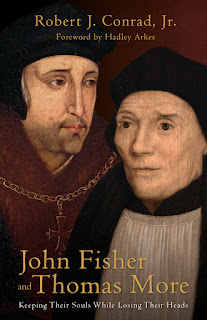
St. Thomas More shares a feast with St. John Fisher on the date of the cardinal-bishop’s death on June 22 (in 1535). Yet, probably because, as author Robert Conrad Jr. says, Fisher’s virtues aren’t celebrated in an award-winning movie like A Man for All Seasons, he has been somewhat eclipsed by More. In John Fisher and Thomas More: Keeping Their Souls While Losing Their Heads, Conrad attempts to redress this injustice in a very personal way, exploring both Fisher’s and More’s responses to Henry VIII’s usurpation of ecclesial authority in England. Throughout the book, Gardner holds both men up as models for us to follow in courage, fidelity, integrity, piety, Christian joy, perseverance and other virtues. Instead of offering a chronological dual biography, he presents a series of 12 vignettes in both men’s lives to demonstrate their practice of these virtues, culminating in their martyrdoms.

In keeping with his effort to highlight St. John Fisher as well St. Thomas More, Conrad begins his series of anecdotes in Chapter 1 on “Conscience” with Bishop John Fisher’s forthright refusal to be coerced into agreeing with the rest of the English bishops in support of Henry VIII’s actions. Conrad highlights the courage of Fisher, not taking the easy way out when the archbishop of Canterbury, William Warham, declared the unanimous agreement of the bishops with Henry VIII at the Legatine Court in 1529: Bishop Fisher denies he signed the document, he denies his signature on the document is authentic, and he denies that he agrees with the document. Neither Warham’s embarrassment nor Henry VIII’s impatience dissuade him. As Conrad concludes, Fisher “spoke with strength to power nonetheless” (p. 16). . . .

Please read the rest there.

Judge Conrad's book demonstrates once again the impact of these saints' lives upon us today. The example of their lives, not just their deaths, inspire us every day. 

Pause to consider that on this day, January 1, 1535 (although they weren't really celebrating the New Year as we are today), 487 years ago, they were imprisoned in the Tower of London, with cold stone walls about them, and yet we know that their thoughts were still about Jesus and the salvation He won for us! Their faith, though tested, was true and they were strong in hope and love.


Merry Christmas and Happy New Year!
(Our outdoor Creche for Christmas 2017/2018)

Tuesday, November 16, 2021

Eleazar the Scribe and Saints John Fisher and Thomas More

Today at Mass, the first reading is from the Second Book of Maccabees, chapter 6:18-31. This passage recounts the martyrdom of Eleazar the Scribe, who refused to eat pork--or even pretend to eat pork--at the command of the Greek ruler:

Those who were in charge of that unlawful sacrifice took the man aside because of their long acquaintance with him, and privately urged him to bring meat of his own providing, proper for him to use, and to pretend that he was eating the flesh of the sacrificial meal that had been commanded by the king, so that by doing this he might be saved from death, and be treated kindly on account of his old friendship with them. But making a high resolve, worthy of his years and the dignity of his old age and the grey hairs that he had reached with distinction and his excellent life even from childhood, and moreover according to the holy God-given law, he declared himself quickly, telling them to send him to Hades.

‘Such pretence is not worthy of our time of life,’ he said, ‘for many of the young might suppose that Eleazar in his ninetieth year had gone over to an alien religion, and through my pretence, for the sake of living a brief moment longer, they would be led astray because of me, while I defile and disgrace my old age. Even if for the present I would avoid the punishment of mortals, yet whether I live or die I will not escape the hands of the Almighty. Therefore, by bravely giving up my life now, I will show myself worthy of my old age and leave to the young a noble example of how to die a good death willingly and nobly for the revered and holy laws.’ (verses 21-28)

In the 1962 Roman Missal, the feast of Saints John Fisher and Thomas More is celebrated in England on July 9th (June 22nd is already the feast of the great protomartyr St. Alban; I'm not sure why July 9th was chosen over July 6th). Remember that Saint John Fisher suffered first on June 22 and Saint Thomas More on July 6 in 1535, beheaded rather than tortured as Eleazar was for the faith.


When I read this passage in July in the Supplement of special Masses for the Dioceses of England and Wales in the Baronius Press version of the 1962 Roman Missal, and when I heard it read on the Bible in A Year podcast last month, I thought how appropriate this selection was for these English martyrs' feast, for both of them were urged to take Henry VIII's Oaths of Succession and Supremacy while withholding their consent in some way, or just going along with the majority for the sake of peace.

Saint John Fisher faced the crisis first at the June 21,1529 Legatine Court hearings at Blackfriars in London  when the Archbishop of Canterbury William Warham had added his name to the bishops' affidavit without his knowledge or consent. Fisher spoke up boldly that he had not consented to the King's wishes at all and would not. He denied that he had signed or sealed the document--that it was against his conscience. He furthermore reminded the embarrassed Warham that he had told the Archbishop that he would never sign or seal such a document. Warham was silent (consent?) but Henry VIII dismissed Fisher's courageous stand with the comment that he was but one man.

Everyone knew, of course, that Fisher had displeased Henry VIII, and that to displease the king was a dangerous, fatal error. The very public venue of the dispute; Fisher's adamantine rejection of Warham's attempts to save face in front of the king, the Papal Legate, the Cardinal Archbishop of York and Lord Chancellor Thomas Wolsey; Fisher's reputation for learning and holiness--all of that, in the face of temporary defeat, Henry VIII ignored by refusing to contend with the Bishop of Rochester and dismissing his opposition as of no matter. He would win and Fisher would lose. And Fisher would endure an attempted poisoning, accusations in the matter of Elizabeth Barton, the Nun of Kent, and finally be imprisoned in the Tower of London, tried for Treason, condemned, and beheaded. It would seem that Henry had won.

Thomas More faced such pressures too, to go along, although in 1529, he was able to remain out of the fray as he was not as involved in the King's Great Matter (he wasn't selected as Lord Chancellor until late in October, 1529) because it was largely an ecclesiastical matter, a dispute between the King and the Convocation of Bishops. As Henry VIII's administration proceeded with the separation from the spiritual and ecclesiastical authority of the Pope, however, More had to present the king's positions and proposals to the House of Lords, etc., while still staying silent--relying upon the supposition of silence implying consent--on the validity of the King's first marriage, the papal annulment that had made it possible, and the even the processes of restricting/reforming the Catholic Church in England. In May 1532 he had to resign after the Bishops presented the Submission of the Clergy. 

After his retirement, in 1534 he was called to swear the Oath of Succession, and as we know was imprisoned in the Tower of London until his trial on July 1, 1535 and again until his execution on Tower Hill on July 6th because he had refused. His daughter Margaret More Roper was allowed to visit him in the Tower--after taking the oath herself--to persuade him to do likewise. They exchanged letters on conscience in response to Thomas Audley's effort to point out More's folly, in which:

More proceeds to tell her about Company, “an honest man from another quarter,” who cannot agree with the questionable verdict rendered by his fellow eleven jurors. Angered that Company is stubbornly getting in the way of their decision, the eleven urge him to be “Good Company” and agree with their verdict. Open to the possibility of correction, Company says that while he already has considered the matter, he would like the eleven “to talk upon the matter and tell him … reasons“ he should change his mind. After the jury declines his offer, Company decides to keep to his own company; otherwise, ”the passage of [his] poor soul would passeth all good company.“ As More reminds Margaret, he himself ”never intended (God being my good lord) to pin my soul to another man’s back … for I know not whether he may hap to carry it.“

He wrote her letters to describe the questioning he received in the Tower to swear the oaths (now of Succession and Supremacy). She finally had to accept that he would not swear those oaths, even to be reunited with the family he loved so much, nor would he dissemble, swear the oaths publicly and withhold consent inwardly. He would be merrily true to the Truth of Christ and His Catholic Church throughout the centuries and not consent to Henry VIII and his Church of England in the Sixteenth Century.

To sum it up, like the Scribe Eleazar, Fisher and More refused to violate their formed consciences, to renounce their integrity, break faith with the Covenant or the Church, or even present a false front to avoid conflict and ultimately execution.

Holy Maccabean Martyrs, pray for us! (honored on some Eastern Orthodox calendars on August 1)
Saint John Fisher, pray for us!
Saint Thomas More, pray for us!

Tuesday, March 23, 2021

On-line Exhibition on the Catholic Martyrs of the English Reformation

I have been limiting my blog posting throughout Lent to a few book reviews and the announcements (previews and reminders) of the Son Rise Morning Show series on St. Thomas More's The Sadness of Christ. As we enter Passiontide, however, it seems appropriate for me to let you know about this on-line exhibition on the Blessed and Canonized Catholic Martyrs of England and Wales:

In commemoration of the 50th anniversary of the canonisation of the Forty Martyrs of England and Wales, this online exhibition will examine the faith stories of these remarkable men and women from the 16th and 17th centuries. It is illustrated with images of their relics and other manuscripts and artefacts in the care of the Jesuits in Britain Archives and Stonyhurst College.

The exhibition has been designed as an immersive visual and audio experience and is best viewed on larger screens. To listen to the exhibition text press the play button under the main image and scroll down to see the accompanying images. You can skip to particular relics or Saints using the index above, but to get the best experience we recommend working your way through from start to finish.

We hope you enjoy discovering these remarkable objects.

You can both read and listen to the text describing the objects and their stories.

The exhibition does include an entry on St. Thomas More, including pictures of his nightcap, crucifix, and hairshirt!

There's also a fascinating account of the Thorn from the Crown of Thorns which Mary, Queen of Scots brought with her to Scotland after the of her husband King Francois, and how Father John Gerard, SJ, came to receive it:

A gift of a one of these precious thorns was made to Mary, Queen of Scots on or after the occasion of her marriage to Francois, the oldest son of the King of France, in 1558. Mary’s later misfortunes after Francois’ death, on her return to Scotland as an eighteen year-old widow, are well known. In 1568, following armed rebellion from her government and defeat in battle, she fled Scotland seeking refuge in England and was taken to Carlisle Castle. She was described as a guest but was in fact a prisoner.

Learning of her arrival in Carlisle, Thomas Percy, the Catholic Earl of Northumberland gained entrance to the castle and demanded, unsuccessfully, that the Catholic Queen of Scots be handed into his custody. During the following twelve months, Percy was active in raising opposition to Elizabeth, with the intention of freeing Mary, placing her at the head of an army, and, ultimately, on Elizabeth’s throne. It seems reasonable to assume that Mary passed this most precious relic of the Passion to Percy at Carlisle, or in the months afterwards, as a pledge of her trust in him.

During my last trip to Paris with my late husband Mark I was able to attend, during Lent, one of the services Venerating the Crown of Thorns in the Cathedral of Notre Dame--seven years ago!

Monday, June 22, 2020

This Morning: Saints Richard Reynolds and Saint John Stone

Just a reminder that I'll be on the Son Rise Morning Show talking with Anna Mitchell about two more of the 40 Martyrs of England and Wales: Saint Richard Reynolds, who suffered with the Carthusian Priors on May 4, 1535, and Saint John Stone, who refused to acknowledge King Henry VIII's supremacy when the Austin Friary in Canterbury was being suppressed in 1539. He was martyred on or about December 27 that year.

Please listen live here; the podcast will be archived here.


But I would be totally remiss if I did not remember St. John Fisher on the anniversary of his beheading on Tower Hill on June 22, 1535 or St. Thomas More, on their shared feast.

Saint John Fisher's last words 485 years ago today:

Christian people, I am come hither to die for the faith of Christ's Catholic Church, and I thank God hitherto my courage hath served me well thereto, so that yet hitherto I have not feared death; wherefore I desire you help me and assist me with your prayers, that at the very point and instant of my death's stroke, and in the very moment of my death, I then faint not in any point of the Catholic Faith for fear; and I pray God save the king and the realm, and hold His holy hand over it, and send the king a good counsel.

More about St. John Fisher here.


Saint John Fisher, pray for us!
Saint Thomas More, pray for us!
Saint Richard Reynolds, pray for us!
Saint John Stone, pray for us!

Saturday, June 20, 2020

Preview: Saints Richard Reynolds and John Stone

I'm particularly pleased that Anna Mitchell and I will talk about St. John Stone on Monday, June 22 in our Son Rise Morning Show series celebrating this year's 50th anniversary of the canonization of the 40 Martyrs of England and Wales. We never have the opportunity to talk about him because he was executed after Christmas in 1539--and the Son Rise Morning Show hosts and producers are off the air celebrating Christmas!

We'll also talk about Saint Richard Reynolds, who was executed on May 4, 1535 with the Carthusian Priors. And we can't forget to honor Saints John Fisher and Thomas More, whose feast we celebrate on June 22, the date of Fisher's beheading, also in 1535.

Since Saint Richard Reynolds, a Bridgettine or Briggitine monk of Syon Abbey, suffered first, here's some background on him:

Like the Carthusians the Bridgettine nuns of Syon Abbey were regarded as exemplary religious in England. Reynolds was also known as a monk of great learning--like the three Carthusians with whom he suffered he had studied at Cambridge University (Corpus Christi College!). Reynolds had joined the Bridgettine Abbey of Syon as Chaplain in 1513 and was called the "Angel of Syon".

The Abbey, founded by King Henry V in 1415 as The Monastery of St Saviour and St Bridget of Syon, of the Order of St Augustine, was rich and shared plentifully with the poor around London. There were separate houses of men and women with the Abbess as the highest authority. The abbess at the time of Reynolds' martyrdom and the dissolution of the abbey in 1539 was Agnes Jordan.

In his Defense of the Unity of the Church, the public letter he wrote to Henry VIII to remonstrate with him and call him to repentance, Reginald Pole highlighted the martyrdom of Reynolds:

One of these martyrs I must not pass over without a special notice, as he was intimately known to myself. Reynolds was his name, and he was one who, for the sanctity of his life, might be compared with the very first of those who profess the more exact rule of conduct, according to the discipline of Christ. . . . To manifest to all future time the praises of his sanctity and doctrine, and to show the height of his piety to Christ and his love of his country, it was ordained that in company with the other heroes he should, in this time of so great need, give testimony to the truth with his own blood. He gave it in truth, and was among the first to give it, and that with such constancy of mind, that as I was told by one who was present at the spectacle and had observed most attentively all that took place, when he put his neck within the murderous halter, he seemed rather to be putting on a regal chain than an instrument of death, such was the alacrity manifested in his countenance. O Blessed man! truly worthy of the fullest confidence of thee, O my country!

It's also important to note that Reynolds was the last to suffer execution and consoled the four men (the Carthusians and Blessed John Haile) as they endured their brutal tortures at Tyburn.

St. John Stone, in contrast, died alone in Canterbury, probably on December 27, 1539. Although the date is not completely certain, we know exactly what his execution cost. We also know nothing about St. John Stone before his arrest, trial, and execution, except that he was a Canon in the Austin (Augustinian) Friary of Canterbury. As British History Online describes the events in Kent:

The bishop of Dover, who came to Canterbury on 13 December, 1538, to negotiate the surrender of the friaries, found the Austin Friars specially in great poverty. (fn. 37) Their debts were £40, and their implements not worth £6, except a little plate weighing 126 oz. He reports to Cromwell that at the Austin Friars on 14 December, 'one friar very rudely and traitorously used himself,' and declared he was ready to die for it that the king might not be the head of the Church, but it must be a spiritual father appointed by God. This was probably Friar Stone. .  .

The Bishop of Dover was a former Dominican friar and prior, Richard Ingworth, who had been rewarded with that see in 1537 because he "had taken great pains in the king's matters" and readily submitted to the Oaths required and the surrender of King's Langley Priory in Hertford (which property he also received). He was then "commissioned by the king in February 1538 to visit all friaries in England, (fn. 68) and in May he was ordered to put their goods into safe custody and take inventories of them, (fn. 69) evidently in preparation for suppression."

The Midwest Augustinians's website offers these details of what happened to Friar Stone:

. . . All the other Augustinian Friars signed the document, but John refused.

John was arrested and thrown into prison in the Tower of London. He remained firm in his refusal to accept the King as head of the Church. While in jail, he spent many hours in prayer. One day, God spoke to him, encouraging him to be of good heart and to remain steadfast in his belief, even if it meant death. From this point on, John felt great strength. 

And British History Online provides the data about the cost of his execution and the labor involved:

and the sequel is thus noted in the City Accounts (1538-9):—Paid for half a ton of timber to make a pair of gallows to hang Friar Stone, 2s. 6d.; to a labourer that digged the holes, 3d.; to four men that helped set up the gallows for drink to them, for carriage of the timber from Stablegate to Dongeon (i.e. Dane John), 1s.; for a hurdle, 6d.; for a load of wood and for a horse to draw him to the Dongeon, 2s. 3d.; paid two men that set the kettle and parboiled him, 1s.; to two men that carried his quarters to the gates and set them up, 1s.; for halters to hang him and Sandwich cord and for straw, 1s.; to a woman that scoured the kettle, 2d.; to him that did the execution, 3s. 8d. (fn. 38)

Another Augustinian history website provides additional detail about the date of his execution:

Usually such a sentence was carried out without delay but in this instance an extraordinary event complicated matters. Anne of Cleves, who was coming to England to be the fourth wife of King Henry VIII, was due to arrive on Sunday, 7th December 1539, and would be stopping at Canterbury overnight on her way to London.

Her arrival, however, was delayed by bad weather. Her visit and John Stone’s execution probably happened on Saturday, 27th December 1539. As bizarre as it sounds, John Stone's execution was timed to be part of the reception festivities arranged for Anne of Cleves, despite the shortness of her stay. This conclusion is deduced from the extraordinary expenses for the execution and from the fact that the paraphernalia needed for it were removed only after her departure. . . .

What a welcome to England for Henry VIII's (briefly) fourth wife! A brutal, bloody execution!

Saint John Fisher, pray for us!
Saint Thomas More, pray for us!
Saint Richard Reynolds, pray for us!
Saint John Stone, pray for us!