Showing posts with label Happy New Year. Show all posts

Saturday, January 1, 2022

Happy New Year, 2022: Book Review in the NC Register

Happy New Year! Best wishes for a happy, holy, and healthy 2022! 

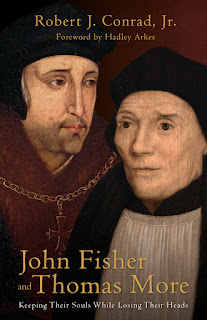
I ended the year 2021 and have begun the year 2022 with a head cold, but also with the publication of my review of a new book about Saints John Fisher and Thomas More in the National Catholic Register:

St. Thomas More shares a feast with St. John Fisher on the date of the cardinal-bishop’s death on June 22 (in 1535). Yet, probably because, as author Robert Conrad Jr. says, Fisher’s virtues aren’t celebrated in an award-winning movie like A Man for All Seasons, he has been somewhat eclipsed by More. In John Fisher and Thomas More: Keeping Their Souls While Losing Their Heads, Conrad attempts to redress this injustice in a very personal way, exploring both Fisher’s and More’s responses to Henry VIII’s usurpation of ecclesial authority in England. Throughout the book, Gardner holds both men up as models for us to follow in courage, fidelity, integrity, piety, Christian joy, perseverance and other virtues. Instead of offering a chronological dual biography, he presents a series of 12 vignettes in both men’s lives to demonstrate their practice of these virtues, culminating in their martyrdoms.

In keeping with his effort to highlight St. John Fisher as well St. Thomas More, Conrad begins his series of anecdotes in Chapter 1 on “Conscience” with Bishop John Fisher’s forthright refusal to be coerced into agreeing with the rest of the English bishops in support of Henry VIII’s actions. Conrad highlights the courage of Fisher, not taking the easy way out when the archbishop of Canterbury, William Warham, declared the unanimous agreement of the bishops with Henry VIII at the Legatine Court in 1529: Bishop Fisher denies he signed the document, he denies his signature on the document is authentic, and he denies that he agrees with the document. Neither Warham’s embarrassment nor Henry VIII’s impatience dissuade him. As Conrad concludes, Fisher “spoke with strength to power nonetheless” (p. 16). . . .

Please read the rest there.

Judge Conrad's book demonstrates once again the impact of these saints' lives upon us today. The example of their lives, not just their deaths, inspire us every day. 

Pause to consider that on this day, January 1, 1535 (although they weren't really celebrating the New Year as we are today), 487 years ago, they were imprisoned in the Tower of London, with cold stone walls about them, and yet we know that their thoughts were still about Jesus and the salvation He won for us! Their faith, though tested, was true and they were strong in hope and love.


Merry Christmas and Happy New Year!
(Our outdoor Creche for Christmas 2017/2018)

Tuesday, January 3, 2017

Chesterton on New Year's Resolutions


From one of his Daily News columns:

The object of a New Year is not that we should have a new year. It is that we should have a new soul and a new nose; new feet, a new backbone, new ears, and new eyes. Unless a particular man made New Year resolutions, he would make no resolutions. Unless a man starts afresh about things, he will certainly do nothing effective. Unless a man starts on the strange assumption that he has never existed before, it is quite certain that he will never exist afterwards. Unless a man be born again, he shall by no means enter into the Kingdom of Heaven.

In that last sentence, Chesterton is alluding to Jesus's statement to Nicodemus in the Gospel of St. John (John 3:3-5). Mark Brumley provides some exegesis on this passage:

The only biblical use of the term "born again" occurs in John 3:3-5--although, as we shall see, similar and related expressions such as "new birth" and "regeneration" occur elsewhere in Scripture (Titus 3:5; 1 Pet 1:3, 23). In John 3:3, Jesus tells Nicodemus, "Truly, truly, I say to you, unless one is born again, he cannot see the kingdom of God." The Greek expression translated "born again" (gennathei anothen) also means "born from above." Jesus, it seems, makes a play on words with Nicodemus, contrasting earthly life, or what theologians would later dub natural life ("what is born of flesh"), with the new life of heaven, or what they would later call supernatural life ("what is born of Spirit").

Nicodemus' reply: "How can a man be born when he is old? Can he enter a second time into his mother's womb and be born?" (John 3:4). Does he simply mistake Jesus to be speaking literally or is Nicodemus himself answering figuratively, meaning, "How can an old man learn new ways as if he were a child again?" We cannot say for sure, but in any case Jesus answers, "Truly, truly, I say to you, unless one is born of water and the Spirit, he cannot enter the kingdom of God. That which is born of the flesh is flesh, and that which is born of the Spirit is spirit. Do not marvel that I said to you, `You must be born again."' (John 3:5-7).

So then the mystery is, how does one start again when one has already been "born again" in Baptism? I can't follow Chesterton's advice to get a new nose, new feet, new backbone, new ears, and new eyes! I'm stuck with the ones I've got, unless I start using them for something different. Smell new things, walk new paths, stand up for what I believe in, hear news things, see new things. 

I'm still thinking about resolutions for 2017. How about you?

In the meantime, I'm preparing for a couple of presentations--coming up fast: Thursday, January 5, I'll be speaking to the Altar Society at All Saints Catholic Church at 7 p.m.. Topic: the Three Women Martyrs of the English Reformation: Saints Margaret Clitherow, Margaret Ward, and Anne Line. Next week: Friday, January 13 at the Eighth Day Institute: "Long Live the Queen: John Henry Newman and the Place of Theology in a Liberal Arts Education"!!

Happy New Year! Merry Christmas!

Saturday, January 2, 2016

Happy New Year!


I am sorry for the lack of blogging in the past few days, but I've been much at the hospital with a family member and focused on the present, not the past.

I do want to let you know that I've had an article published in the January 2016 issue of Tudor Life: The Tudor Society Magazine: "Elizabeth I and Her Catholic Subjects".

And, I'll start the New Year on the broadcast of the Son Rise Morning Show Monday morning, January 4, 2016, talking with Matt Swaim about the "Twelve Days of Christmas" carol as a hidden, coded Catholic catechism during the Recusant period in England. My usual time slot: after the 7:45 a.m. Eastern/6:45 a.m. Central update/break. Listen live here.

In the meantime, Happy New Year--and try to get used to writing 2016!

Tuesday, January 1, 2013

January 1, 2013: Here We Come A-Wassailing!

Here we come a-wassailing
Among the leaves so green;
Here we come a-wand'ring
So fair to be seen.

Love and joy come to you,
And to you your wassail too;
And God bless you and send you
a Happy New Year
And God send you a Happy New Year.

We're not daily beggars
That beg from door to door;
But we are neighbors' children,
Whom you have seen before.

Love and joy come to you,
And to you your wassail too;
And God bless you and send you
a Happy New Year
And God send you a Happy New Year.

Good master and good mistress,
Are sitting by the fire,
Pray think of us poor children
Who wander in the mire.

Love and joy come to you,
And to you your wassail too;
And God bless you and send you
a Happy New Year
And God send you a Happy New Year.

God bless the master of this house
Likewise the mistress too!
And all the little children
that 'round the table go

Love and joy come to you,
And to you your wassail too;
And God bless you and send you
a Happy New Year
And God send you a Happy New Year

More on wassailing at New Year's here.

I look forward to another year of updates and posts on the English Reformation, the Catholic martyrs of England, the ongoing revival of Catholicism in England--and the big announcement I hinted at yesterday! May 2013 bring great blessings to us all! Happy New Year!

Monday, December 31, 2012

"In the Ending of the Year"~~December 31, 2012


John Mason Neale included this translation of the medieval hymn, In hoc anni circuli in his 1853 Carols for Christmas-tide:

In the ending of the year
Life and light to man appear;
And the Holy Babe is here,
De Virgine;
And the Holy Babe is here,
De Virgine Mariâ.

What in ancient days was slain
This day calls to life again;
God is coming, God shall reign,
De Virgine;
God is coming, God shall reign,
De Virgine Mariâ.

From the desert grew the corn,
Sprang the lily from the thorn,
When the Infant King was born
De Virgine;
When the Infant King was born
De Virgine Mariâ.

On the straw He lays His head,
Hath a manger for His bed,
Thirsts and hungers and is fed
De Virgine;
Thirsts and hungers and is fed
De Virgine Mariâ.

Angel hosts His praises sing,
Three Wise men their off'rings bring,
Ox and ass adore the King,
Cum Virgine;
Ox and ass adore the King,
Cum Virgine Mariâ.

Wherefore let us all to-day
Banish sorrow far away,
Singing and exulting aye,
Cum Virgine;
Singing and exulting aye,
Cum Virgine Mariâ.

As 2012 draws to a close, thank you for your attention to and comments on this blog! I look forward to more research and sharing in 2013--including a big announcement I should be making in the next few weeks!