Showing posts with label Bonnie Prince Charlie. Show all posts

Wednesday, September 21, 2022

The Battle of Prestonpans and King Charles III

There was a comment/meme on Facebook when the King of England, etc., after Elizabeth II's death and his immediate succession, announced that he would be known as King Charles III, that there'd already been a King Charles III! 

Of course, the meme was referring to the Young Pretender, Bonnie Prince Charlie, the grandson of King James II and VII, and the son of the Old Pretender, James Frances Edward Stuart!

On September 21, 1745, Bonnie Prince Charlie, fighting for his father's succession to the throne as King James III and VIII thirty years after the first attempt to invade England and claim the throne ("the Fifteen"), won a great battle at Prestonpans. 

This was last, best chance of the Catholic Stuarts to take the throne of Great Britain by force. The Act of Succession denied them the legal right to rule, so it had to be through conquest. 

The Young Pretender's forces won a stunning victory at the Battle of Prestonpans against a larger, better supplied, and supposedly more disciplined Hanoverian Army, defending King George II's occupation of the throne. This website describes the two armies:

In September 1745, an army of British regulars mustered near the village of Prestonpans on the shores of the Firth of Forth.

The commander of the Redcoats was Sir John Cope. He was supremely confident of victory. Although the two sides were equal in number, Cope had more cavalry and artillery, and his infantry was trained to deliver well-aimed volleys. Facing west, moreover – towards Edinburgh, from which his opponents had marched – there were the walls and dykes of two grand houses providing protection for his men.

Cope’s opponents were the Jacobite army raised in rebellion some weeks before by Prince Charles Edward Stuart, the ‘Young Pretender’; he was the son of James Edward Stuart, the ‘Old Pretender’, who was in turn the son of King James II, ousted in the ‘Glorious Revolution’ of 1688. Charles’s shock troops were Scottish Highland clansman, most of whom spoke Gaelic, and were regarded as barbarians by most Lowland Scots and the English.

What was to happen at Prestonpans on 21 September 1745, however, was a signal humiliation for the British Army.

It was the charge of the Jacobite army that took the Hanoverian forces by surprise and routed them. The Young Pretender returned to Edinburgh and entered Holyrood House, as depicted in the painting above (Public Domain), by John Pettie, c. 1892. Sir John Cope and fewer than 500 survivors returned to England; Cope and his commanders faced a Court Martial.

King George II recalled his son Prince William Augustus, Duke of Cumberland and 12,000 troops from the War of Austrian Succession on the Continent to prepare a new army to prevent any further success of the Jacobites. And at the Battle of Culloden, Cumberland defeated the Young Pretender's army decisively on April 16, 1746. Charles Edward Louis John Sylvester Maria Casimir Stuart fled Scotland, protected by many Jacobite Highlanders, including Flora MacDonald, leaving on September 19 and arriving in France on September 29, 1746.

The Young Pretender never returned to Scotland, although he did travel to London in September, 1750. According to The Jacobite Heritage website, "It is commonly believed that on this occasion he apostasized from the Catholic Church and conformed to the Established Church of England." He thought that would strengthen his claim to the throne. He did return to the Catholic Faith before he died on January 30, 1788 (January 30 was the anniversary of his great-grandfather Charles I's beheading). He and his father and brother (Henry Cardinal Stuart) are buried in St. Peter's Basilica in Vatican City, Rome, in a monument to which the future George IV (the Prince Regent) donated funds to complete!

Saturday, June 24, 2017

Bonnie Prince Charlie at Home

The National Museum of Scotland opened an exhibition on Bonnie Prince Charlie and the Jacobites. A review and overview from The Financial Times:

On July 25 1745, Charles Edward Stuart landed on the Scottish mainland at Borrodale. Despite bearing the title Prince of Wales, it was the first time he had been in Britain, having lived all his life in Rome. His mission was to restore his father, James III, to the throne, and in so doing make Scotland an independent kingdom once more. But one of the first people he met, unimpressed with Charles’s invasion force of 12 (one of whom was a priest), said simply, “Go home”.

Charles was undaunted. “Home?” he said. “I am come home.” Charles knew that his chances of reaching and seizing London were low. But a new exhibition at the National Museum of Scotland in Edinburgh, titled Bonnie Prince Charlie and the Jacobites, shows how Charles used his underdog status to his advantage. A central exhibit is the shield, or “targe”, Charles carried on to Borrodale beach. It is flamboyantly decorated with a snarling Medusa’s head; Charles, it tells us, was a modern Perseus, sent to rescue the people of Britain from oppression. Other exhibits, a number of them from private collections, include Charles’s elaborate silver travelling cutlery, swords, portraits, miniatures and the kind of “memorabilia”, such as a wine glass engraved with the prince’s face, beloved of his loyal followers.

The Jacobite cause — as James’s supporters were called — began in 1688, when the Catholic James II was deposed by the Protestant William III. James was a brave soldier (his suit of armour here was the last to be made for a British monarch), but he failed to regain the crown. He left that challenge to his son, James Francis Edward Stuart, or James III.


Please read the rest there.

Sunday, February 23, 2014

Will Ye No Come Again? A Portrait of Bonnie Prince Charlie


A genuine and acceptably bonny portrait of Bonnie Prince Charlie has been rediscovered, by the remorseful art historian who broke hearts in the Scottish souvenir industry by debunking the best-known portrait of the national hero, immortalised on countless tins of shortbread.
 
The long-lost portrait of the pink-cheeked prince was painted in Edinburgh in 1745 by one of Scotland's most renowned artists, Allan Ramsay, in the year the Young Pretender, grandson of the deposed Stuart king James II, launched a doomed invasion of England in an attempt to restore his family to the throne. It is the only known portrait of the prince made in Britain: the butchery of the battle of Culloden ended the Jacobite rebellion, Charles spent the rest of his life in exile, died in 1788 and was buried in Rome.
 
"Such a great image," Bendor Grosvenor said fondly of his discovery, which he tracked down from an old photograph to Gosford House, the family home of the Earls of Wemyss, just outside Edinburgh. "It gets the confidence of a man who wanted to invade England at the age of 24."

You may see the portrait at The Guardian site.

When Bendor Grosvener opined that a famous portrait of Bonnie Prince Charlie (seen at right) was really of his brother Henry Benedict, later Cardinal, Stuart, he really upset the apple cart, as this BBC article demonstrates:

Now a leading expert believes the pastel might be Prince Henry Benedict instead of Charles Edward Stuart.
 
The gallery said it was not uncommon for re-attributions to be made.
 
It follows a two-year row over the identity of the man in the painting since London art dealer Bendor Grosvenor claimed it was not Bonnie Prince Charlie.
 
At first the gallery dismissed the claim citing expert on Jacobite portraiture, Dr Edward Corp of the University of Toulouse, France, in its defence.
 
However, Dr Corp has now changed his opinion in an article in the latest issue of The British Art Journal.
 
He said: "'The weight of evidence, perhaps regrettably, supports Bendor Grosvenor's argument that the pastel in the Scottish National Portrait Gallery shows Prince Henry rather than Prince Charles."

I think when you compare that portrait above to this of the Duke of York as Cardinal York, the resemblance is clear. Part of the reason experts thought it could not be Henry was that he was a Cardinal by 1747--but he had been in command of the naval expedition of the '45, and evidently both he and his elder brother had sat for portraits by Maurice Quentin de La Tour.

As Dr. Corp noted, this re-attribution was a really big deal:

"It is not merely the catalogue of the Scottish National Portrait Gallery which needs to be corrected.
 
"The impression which an entire nation has derived of this important historical figure should also be changed.
 
"The portrait is now reproduced in all biographies of the prince, and has been selected to illustrate the article about him in the Oxford Dictionary of National Biography."
 
Still the real search is for a portrait of Bonnie Prince Charlie by Maurice Quentin de La Tour painted around the same time as this painting of Henry Benedict, the Duke of York.

More on the Scottish National Portrait Gallery here.

Wednesday, January 22, 2014

The Stuarts In Italy

According to Cambridge University Press, the blurb for The Stuarts in Italy, 1719–1766: A Royal Court in Permanent Exile by Edward Corp:

For nearly half of the eighteenth century, the exiled Stuart court provided an important British presence in Rome. It acted as a surrogate embassy for the many Grand Tourists passing through the city – Hanoverian Whigs as well as Tories and Jacobites – and as a significant social and cultural centre. This book presents the first complete study of the court of the exiled Stuart King James III, offering a significant reassessment of its importance and of the lives of the Stuarts and their courtiers, and their relations with the Popes, cardinals and princely families of Rome. Edward Corp's interdisciplinary approach also reveals the Stuarts' patronage of leading portrait painters, their influence on the development of Italian opera, and the impact of their court buildings on relations with their supporters. This book will be essential reading for everyone with an interest in Jacobitism, Italian culture and the eighteenth-century Grand Tour.

~This is the first ever study of the exiled Stuart Court in Italy
~Provides a great deal of new information about the lives of all four members of the Stuart royal family; James III and his Polish wife Queen Clementina, and the upbringing of their two children (Bonnie Prince Charlie and Cardinal York)
~Makes comprehensive use of previously unexploited Italian archives


This is a sequel to Corp's work on the Stuart exiles in France, A Court in Exile: The Stuarts in France, 1689–1718, which I reviewed here.
This study of "a court in exile" covers all aspects of the grandeur of court life. When King James II was deposed during the "Glorious Revolution" of 1688-89, he came with his family to France, where his cousin, Louis XIV allowed him to establish a large court-in-exile in the Château of Saint-Germain near Versailles. The book describes the magnificent setting of the court, the way it was organized, and how the exiled courtiers lived. Particular attention is given to the close relationships between the British and French royal families.

~The first full study of the Stuart court in exile in France, following the 'Glorious Revolution' of 1688/89
~Covers all aspects of the court - social, financial, cultural - and not merely the political background
~Emphasises cultural and patronage issues, breaking new ground in describing the painting, poetry and music of the court


The emphasis in the new book on music and art, with chapters on "The Stuarts and Italian operatic life", and "The Stuarts and Italian music", as well as on the portraits of the court, looks particularly fascinating.

Tuesday, December 31, 2013

King of Angels or King of the English? Adeste Fideles/O Come All Ye Faithful

Because I sent a contribution to the Christian Heritage Centre at Stonyhurst in England, they sent me a Christmas card, signed by Lord and Lady Windsor, Nicholas and Paola. The art for the outside of the Christmas card is one of the manuscript copies of John Francis Wade's "Adeste, Fideles". My husband took the pictures below:


The most familiar translation of this hymn, which was written by Wade in 1750, is by Frederick Oakeley, an Oxford Movement follower of Blessed John Henry Newman, who joined the Catholic Church in 1845.

There is a very common theory that this hymn contains a code referring to Bonnie Prince Charlie--Wade was a Jacobite, and an exile in Europe after the '45. The BBC cites this expert, Bennett Zon of Durham University:

He said "clear references" to the prince were in the lyrics, written by John Francis Wade in the 18th Century. The prince was defeated at the Battle of Culloden in 1746 after raising an army to take the British throne.Born shortly before Christmas in December 1720, Bonnie Prince Charlie was the grandson of England's last Catholic monarch, James II. He was born in exile in Italy and became the focus for Catholic Jacobite rebels intent on restoring the House of Stuart to the British throne.

Prof Zon, said there was "far more" to the carol - also known as Adeste Fideles - than was originally thought.
He said: "Fideles is Faithful Catholic Jacobites. Bethlehem is a common Jacobite cipher for England, and Regem Angelorum is a well-known pun on Angelorum, angels and Anglorum, English.
 
"The meaning of the Christmas carol is clear: 'Come and Behold Him, Born the King of Angels' really means, 'Come and Behold Him, Born the King of the English' - Bonnie Prince Charlie." Professor Zon said the Jacobite meaning of the carol gradually faded as the cause lost its grip on popular consciousness.

This interpretation has been around for a long time, however, according to this site. I can accept the possible code in the first verse, but wonder about the rest of the hymn. Did John Francis Wade really intend his fellow Jacobites to think of Bonnie Prince Charlie as "Deum de Deo" (God from God), "Lumen de Lumine" (Light from Light)? I have my doubts about that! Canon Oakeley's translation:

O come, all ye faithful,
Joyful and triumphant,
O come ye, O come ye to Bethlehem;
Come and behold Him
Born the King of angels;

Chorus:O come, let us adore Him,
O come, let us adore Him,
Christ the Lord.


God of God,
Light of Light;
Lo, He abhors not the Virgin's womb:
Very God,
Begotten, not created; Chorus.


Sing, choirs of angels;
Sking in exultation,
Sing, all ye citizens of heaven above;
Glory to God
In the highest; Chorus.


Yea, Lord, we greet Thee,
Born this happy morning:
Jesus, to Thee be glory given;
Word of the Father,
Late in flesh appearing; Chorus.

Monday, December 16, 2013

Kings Over the Water and their Supporters' "Material Culture"

Coming soon from Cambridge University Press: The Material Culture of the Jacobites by Neil Guthrie:

The Jacobites, adherents of the exiled King James II of England and VII of Scotland and his descendants, continue to command attention long after the end of realistic Jacobite hopes down to the present. Extraordinarily, the promotion of the Jacobite cause and adherence to it were recorded in a rich and highly miscellaneous store of objects, including medals, portraits, pin-cushions, glassware and dice-boxes. Interdisciplinary and highly illustrated, this book combines legal and art history to survey the extensive material culture associated with Jacobites and Jacobitism. Neil Guthrie considers the attractions and the risks of making, distributing and possessing ‘things of danger’; their imagery and inscriptions; and their place in a variety of contexts in the seventeenth and eighteenth centuries. Finally, he explores the many complex reasons underlying the long-lasting fascination with the Jacobites.

The Cambridge University Press website contains several .pdfs of excerpts from the book, including the Table of Contents:

Introduction
1. 'By things themselves': the danger of Jacobite material culture
2. 'Many emblems of sedition and treason': patterns of Jacobite visual symbolism
3. 'Their disloyal and wicked inscriptions': the uses of texts on Jacobite objects
4. 'Tempora mutantur et nos mutamur in illis': phases and varieties of Jacobite material culture
5. 'Those who are fortunate enough to possess pictures and relics': later uses of Jacobite material culture
Bibliography


The National Gallery of Victoria in Melbourne, Australia has an exhibition now of one of the most common Jacobite objects: the glassware used to toast the true Kings of England:

So the Stuart supporters, or Jacobites, instituted, amongst other things, the practice of drinking toasts to their King “over the water” in glasses engraved with cryptic symbols which reflected their Stuart loyalties.

The NGV possesses an extensive and important collection of these rare glasses, many of them generous gifts from the Morgan family of Melbourne.
Kings over the water will explore the fascinating hidden symbolism of these beautiful objects, created as part of a doomed political adventure whose tragic history continues to cast a romantic spell even today. 

The exhibition site includes an essay on the glassware's manufacture and use, detailing the symbols etched in glass to represent the Stuart claimants:

Jacobite glasses were decorated with engraved cryptic symbols and mottos which, to those who understood their coded messages, spoke of the drinker’s loyalty to the Stuart dynasty. By far the most common symbol was the six-petalled white heraldic rose, an ancient emblem of the Stuarts. The white rose also had connotations of strict legitimacy. Its adoption by James III as his personal badge was particularly appropriate as rumours of his illegitimacy had been circulated by political enemies since his birth.

On its own, the white rose is believed to have stood for the exiled king. A rose bud to the right of the rose represented his heir apparent, Prince Charles Edward Stuart. A second rosebud, to the left of the rose, represented Prince Henry Benedict Stuart, Princes Charles’s younger brother. When there are two rosebuds, that representing Prince Charles is often larger and on the verge of opening.

And the Latin mottoes:

  • Audentior Ibo (I shall go more boldly). This motto probably derived from the sixth book of Virgil’s Aeneid, in which Aeneas consults a mystic who warns him of grim fighting to come, but adds ‘sed contra audentior ito’ (‘but go forth against it with great daring’).
  • Radiat (It shines).
  • Redeat (May he return). This motto appears on a medal with a bust of Prince Charles, struck in 1752 for the Oak Society.
  • Rede (Return!).
  • Redi. Perhaps an abbreviation of Redii (I have returned).
  • Reditti (Restore).
  • Revirescit (It revives).
  • Fiat (May it come to pass). This is also a Latin equivalent of ‘Amen’.
  • Turno Tempus Erit (For Turnus there shall be a time). Turnus is a character in Virgil’s Aeneid who struggles against Aeneas for mastery of Italy. Aeneas defeats Turnus in battle and is inclined to spare his life, but notices that Turnus wears the sword of a friend of his whom he has killed. Aeneas slays Turnus in revenge. Turnus may be meant to stand for the Duke of Cumberland, who defeated the Jacobites at Culloden. The glass warns that the Hanoverian victory may be short lived.
  • Hic Vir Hic Est (This, this is the man). This motto derives from the sixth book of Virgil’s Aeneid. After the fall of Troy, Aeneas escapes to Italy where he is permitted to descend into the underworld in order to gain a glimpse of the future. He sees the coming glory of Rome, and the appearance of Augutus Caesar is heralded with the phrase Hic Vir Hic Est.
  • Wednesday, September 11, 2013

    King John III Sobieski and the Battle of Vienna

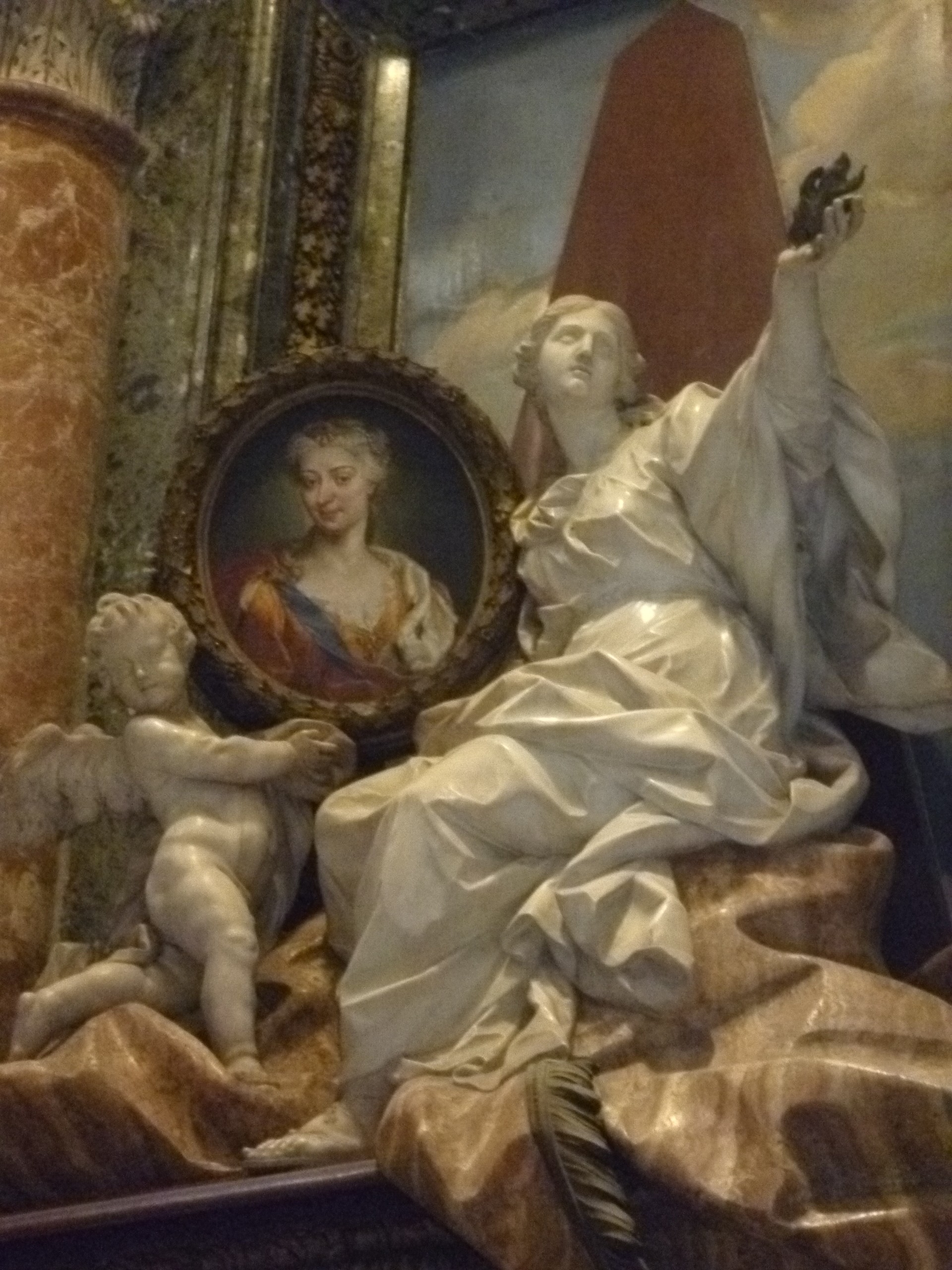
    File:Maria Clementina Sobieski Memorial.JPGIn addition to being the 12th anniversary of the 9/11 attacks in the United States, this is the 330th anniversary of the Battle of Vienna, at which King Jan Sobieski of Poland led the combined imperial and Polish forces to defeat the Ottoman Empire Believe it or not, there's a connection between September 11, 1683 and the long English Reformation: Maria Clementina Sobieska, the granddaughter of King Jan Sobieski married James Francis Edward Stuart:

    Being one of Europe's wealthiest heiresses, she was betrothed to James Francis Edward Stuart. King George I of Great Britain was opposed to the marriage because he feared that the union might produce heirs to James Francis Edward's claim to his thrones. To placate him, the Holy Roman Emperor Charles VI arrested Maria Clementina while on her way to Italy to marry James Francis Edward. She was confined in Innsbruck Castle but eventually the guards were deceived and Maria Clementina escaped to Bologna, Italy, where, for safety from further intrusions, she was married by proxy to James who was in Spain at that time.

    Maria Clementina's father, James Louis Sobieski, approved her escape declaring that, as she became engaged to James Francis Edward she ought to "follow his fortune and his cause".

    Maria Clementina and James Francis Edward were formally married on 3 September 1719 in the Chapel of episcopal palace of Montefiascone, Italy in the Cathedral of Santa Margherita. Following their marriage, James and Maria Clementina were invited to reside in Rome at the special request of Pope Clement XI, who acknowledged them as the King and Queen of England, Scotland and Ireland.

    The Pope provided them with a papal guard of troops, gave them the Palazzo Muti in the Piazza dei Santi Apostoli in Rome to live in, plus a country villa at Albano. The Catholic Church also provided them with an annual allowance of 12,000 crowns out of the papal treasury. The Popes Clement XI and Innocent XIII considered James and Maria Clementina the rightful and, more importantly, Catholic King and Queen of England, Scotland and Ireland: the cousin of Pope Innocent XIII, Francesco Maria Conti, from Siena, was here the Gentiluomo di Camera (the chamberlaine) in the little Roman Jacobite court.

    The married life of James and Maria Clementina proved turbulent and unhappy. Soon after their second child's birth (Henry Benedict), Maria Clementina left him and went to live in Rome in the convent of St. Cecilia. She accused her husband of adultery and he said it was sinful to leave him and her children. (Their first son was Charles Edward, aka Bonnie Prince Charlie.) It was more than two years before they reconciled.

    Maria Clementina died at the early age of 32 on 18 January 1735. She was interred with full royal honors in St. Peter's Basilica in Rome. Pope Clement XII ordered that she have a state burial. Pope Benedict XIV commissioned Pietro Bracci (1700–1773) to sculpt a monument to her memory, which was erected in the Basilica.

    More on the Battle of Vienna, September 11 to 12, 1683, here.

    Saturday, May 12, 2012

    Robert Louis Stevenson and Jacobites

    Requiem

    Under the wide and starry sky,
    Dig the grave and let me die.
    Glad did I live and gladly die,
    And I laid me down with a will.

    This be the verse you grave for me:
    Here he lies where he longed to be;
    Home is the sailor, home from sea,
    And the hunter home from the hill.


    Following up on my post about Robert Louis Stevenson's defense of St. Damian, the Leper Priest, here is some background on Stevenson's great Jacobite novels: Kidnapped and The Master of Ballantrae:

    Masterpiece Theater aired the BBC adaptation of Kidnapped a few years ago. Set in the period after the failure of Bonnie Prince Charlie's 1745 attempt to regain the throne, Kidnapped tells the story of David Balfour:

    In an effort to claim his inheritance -- the House of Shaws, a great landed estate -- Davie finds himself trapped on a ship and headed for slavery in the New World. But thanks to the intervention of a swashbuckling highlander, Alan Breck, Davie eludes his captors and joins Breck on a wild flight through the Scottish highlands, pursued by notoriously ruthless English bounty hunters. . . .

    On a quest for justice, through perilous encounters with friend and foe, Davie gradually learns about the difference between right and wrong. But there are still difficult moral decisions to be made, right up until the story's final, enthralling chapter...

    First published in 1886, Kidnapped -- a gripping adventure story full of drama, poignancy, heroism and danger -- surpasses even Treasure Island as a sophisticated literary work masquerading as a ripping yarn for young readers.

    This site traces the path taken by Balfour and Breck through the Scottish Highlands between 27 June and 24 August 1751.

    The Master of Ballantrae also explores issues of inheritance and loyalty against the backdrop of the Jacobite uprising of 1745 and its affects on Scotland:

    The Master of Ballantrae begins in 1745 and is narrated by Mackellar, the loyal, often meddling steward to the respected Durie of Durisdeer family. The family consists of the old Lord and his two sons, James (the eldest son and Master of Ballantrae) and Lord Henry. Miss Alison Graeme, a relative, and heir to a great fortune, also lives with the family.

    In order to keep her wealth in the family, Alison is pledged to be the Master’s wife. The Master himself is a drinker, a gambler, and a womanizer. Although he is manipulative and insinuating, he is his father’s and Alison’s favorite. Despite Henry’s best attempts, he always falls short in the eyes of his family, his only champions Mackellar and an old servant Macconochie.

    The Jacobite Rising of 1745 proves an anxious time for the Durie family. To be on the safe side they decide to support both parties: one son will go and fight for the Jacobites, while the other will stay home to keep favour with King George.

    As the eldest, the Master should stay at home. He refuses, and finally demands that he and Henry toss a coin for it. The Master wins and rides out, but the family later hear he has been killed at the Battle of Culloden. Tam Macmorland, who fought alongside the Master, now falsely alleges that Henry had betrayed the Master and his men to the King.

    Tuesday, January 31, 2012

    The Death of Bonnie Prince Charlie

    According to Theo Aronson in Kings Over the Water: The Saga of the Stuart Pretenders, the Young Pretender, AKA Bonnie Charlie, born Charles Edward Stuart, actually died on the anniversary of his grandfather's execution on January 30, 1788. His death, however, is dated January 31st of that year.

    After the defeat at Culloden in '45 and the Holy See's recognition of the House of Hanover after Prince Charles' father died in 1766, the Pretender wandered in Europe, sometimes calling himself the Duke of Albany.

    His wife, Princess Louise of Stolberg-Geden, left him in 1780, claiming abuse. He legitimized his daughter Charlotte, born of his mistress Clementine Walkinshaw, in 1783. They stayed together in Rome and Florence until his death in 1788. Prince Charles was first buried in the Cathedral Basilica of St. Peter's in Frascati where his brother was bishop, but then he was moved to St. Peter's Basilica when Henry Cardinal Stuart died in 1807. That's where the Prince Regent, later George IV of the House of Hanover, supported the construction of a monument by Antonio Canova to the three Stuart Pretenders--the threat was gone, after all--commemorating the saga of the Kings over the Water.