Showing posts with label movie reviews. Show all posts

Friday, February 5, 2016

President Garfield on PBS


I watched most of, except for the first 20 minutes or so, the Murder of A President, the biography of James Garfield on PBS's American Experience earlier this week. It was a well-produced documentary with dramatic representations of Garfield as President, his wife, his assassin, and his doctor. Garfield served only four months of his term of office. He was a Republican president who wanted to fight the corruption of elected officials in the Federal Government and to provide "equal opportunity" to all citizens, including the recently freed slaves. The documentary tries to build up Garfield's presidency as a lost chance, although the viewer is given little evidence of exactly what Garfield planned to do to facilitate "equal opportunity" for citizens of the U.S.A. His fight against corruption in office, the constant quid pro quo elected officials demanded for themselves and their unelected followers in the civil service, is much clearer, although again he did not have much chance to effect much change because of the attempted assassination by Charles Guiteau, aided and abetted by the medical ineptitude of Doctor Willard Bliss, who introduced infection into the non-fatal wounds and hindered Garfield's immune system.

Although other authorities are included, much of the program was based upon Candice Millard's Destiny of the Republic: A Tale of Madness, Medicine, and the Murder of a President, which I read a few years ago. Millard tells Garfield's life story--and his assassin's, poor mad and unstable Guiteau, while interweaving the stories of Alexander Graham Bell, Vice President Chester Arthur, Senator Roscoe Conkling, Doctor Joseph Lister, and others, including Garfield's wife Lucretia.

The dramatic scenes are mostly well-done: Shuler Hensley, the actor playing Garfield seems to represent him well. He is confident, open, genial, and resolute. The actress Kathryn Erbe played his wife, displaying great love and heartbroken mourning at his suffering and death. I was sorry that Will Janowitz, who portrayed the mad Guiteau, did not have the opportunity to recite Guiteau's poem "I Am Going to the Lordy" on the gallows.

The wrap-up after Garfield's death was rather rushed and the documentary did not follow up as extensively as the book on the lives of the survivors. It does note that Chester Arthur frees himself of the influence of Conkling to reform the civil service of the federal government, but the program leaves out entirely the mysterious female correspondent who urged Arthur to become a better man.

As the transcript shows, however, it's the platitudes at the end--that try to present Garfield as a great change-agent who just didn't get the chance to make his impact--that weaken the overall effect of the program:

Narrator: With Chester Arthur in the White House, the wheels of government began turning again. Life went on across the country, but many Americans were haunted by a sense of loss. For laborers, field hands, immigrants, settlers, for everyone hoping to rise through hard work, James Garfield had embodied the American dream, a dream that was being obscured by the strife and divisions of the Gilded Age. In an era shot through with cynicism and corruption, he had dared to summon once again the better angels of their natures.

Heather Cox Richardson, Historian: Garfield would come to represent that vision for which the Union had fought. Garfield believed that everybody should have equality of opportunity and that the government should help them get that. And that included black men as well as white men. With the assassination of Garfield, that dream -- the dream for which the Union had fought -- that vision died.

Todd Arrington, Garfield National Historic Site: There's this great sense that Garfield represented lost potential. There's no question that Garfield could have been a great president.

Candice Millard, Author,
Destiny of the Republic: He'd been incredibly kind and just and courageous. Garfield for even a short time raised our sights and made us more tolerant and more open-minded.

The documentary needed another 30 minutes to prove those rather anodyne but far-reaching declarations.

Tuesday, July 7, 2015

1776: The Musical

Turner Classic Movies broadcast 1776 on Independence Day. I missed some of it on Saturday but I have seen it before. Of course I know we should always be careful of taking our history from dramatizations like this and we have to grant that they may or may not be attempting to depict history accurately, but this movie and the musical play on which it is based is very disappointing.

It's disappointing in part because the musical numbers are so dull compared to my favorite musicals. Then all the historical inaccuracies pile up--John Adams was not the irritating man he's depicted to be; Martha Jefferson never came to Philadelphia that summer; James Wilson was certainly not the non-entity his character wants to be, and Caesar Rodney was not an old man when the Continental Congress was meeting etc, etc.

The inaccuracy--through omission not commission at least--that irritated me the most was leaving Charles Carroll of Carrollton out among the signers at the end of the movie/play, which were I know only representative of all the signers. Since he was the only Catholic and the last surviving signer of the Declaration of Independence, passing him over seems dramatically and historically foolish.

Turner Classic Movies did make up for this lackluster musical offering with Meredith Wilson's The Music Man later Saturday night. It has clever, rousing, poignant, and beautiful songs, including counterpoint numbers. Even though it's not about Independence Day, it is about brass bands, small-town America, and love. You know, of course, that Marian's song Goodnight, My Someone" is just "Seventy-six Trombones" in waltz time.

Monday, August 11, 2014

Back to Provence and Pagnol

Many, many years ago my husband and I watched Jean de Florettte and Manon of the Springs, two wonderful movies based on Maurice Pagnol's novels. We also saw My Father's Glory and My Mother's Castle--I know that we watched them in a great movie house in Augusta, Kansas, which was festooned with neon. Last month, we watched The Well-Digger's Daughter, a remake of a Pagnol movie, produced, directed, and starring Daniel Auteuil, who played the role of Ugolin Soubeyran, the carnation grower in the Jean/Manon movies.

Set in Provence just before and during World War I, this is a story about a beautiful young girl who foolishly falls for a young man. She finds herself pregnant and abandoned (she thinks) by him, and his parents will not acknowledge their son's responsibility. Pascal Amoretti, the well digger, considers his perfect, good daughter Patricia's sin a great shame to the family--especially since Jacques Mazel's family will not accept his daughter as their son's wife--and sends her away to his sister's to carry the baby to term without anyone knowing what's happened.

When one of his neighbors and another of his daughters visits the baby and he finds out it's a boy, Pascal, who has no son, goes to his sister and brings Patricia and "Amoretti" as he calls him home. The other family also values the little boy when they hear that Jacques is missing in action and believed dead--they want to have contact with their grandson--and confess their role in Patricia's shame.

I won't go into more detail about how the family honor is restored. Pagnol's very human, almost unbaptized portrayals of Provencal life always seem to be based on ideals of family versus stranger, honor versus shame--when Pascal accuses Patricia of "sin" he is not really thinking of her fall in terms of religion: he does not tell her to go to Confession and repent of her sin. He thinks about the family's honor and the shame her pregnancy will bring upon the family. She did not sin against God; she sinned against him and his ideal of her. He sends her away with a kiss that he tells her is only for the benefit of her sisters, not out of any affection. When Jacques Mazel's father and mother reject the pregnant Patricia and add the accusations of entrapment and blackmail, they are again concerned about their own standing in the community.

The production values of the movie are beautiful--Auteuil made the movie with film, not digitally--and the score by Alexandre Desplat is evocative. These movies always inspire me to buy some good dry red wine, some crusty French bread, have some olives, and a delicious soup.

Saturday, August 9, 2014

Mozart's Sister, the Dauphin and the Abbess

My husband and I rented this French language film from Amazon.com and watched it Thursday night. It is a fictionalized account of the early life of Wolfgang Amadeus Mozart's sister, Maria Anna, nicknamed Nannerl. The movie depicts the Mozart family on tour, enduring disappointment, delays, and other misfortunes along the way. Both Wolfgang and Nannerl tire of their father's lying about their ages to make their musical prodigality appear more amazing, and forcing them to practice, practice, practice!

The film is beautifully made, with scenes filmed at Versailles and in Paris (I recognized the Chapelle de la Vierge with its musical angels at St. Germain L'Auxerrois, next to the Louvre). The plot is entirely imaginary, of course, as Nannerl, dressed as a boy, visits the Dauphin of France, writes a violin concerto for him, and is devastated by his ultimate response.

She also meets the Dauphin's three sisters in their convent retreat (when the axle breaks on their coach as the Mozart family travels to Paris). Louise, the youngest of Louis XV's children, and Nannerl become friends, as Nannerl is her messenger to the man Louise plans to marry. But Louise instead decides to join the Carmel at St. Denis, praying in reparation for her father's sins. As Sr. Therese of Saint Augustine, she eventually becomes Abbess at St. Denis. According to this Wikipedia article, her last words were: Au paradis! Vite! Au grand galop!" ("To paradise! Fast! At the great gallop!). She was declared Venerable by Pope Pius IX.

After the movie it was fun to try to explain all the Dauphins and the succession of the House of Bourbon to my husband. The Dauphin in this movie was the son of Louis XV and father of Louis XVI, Louis XVIII, and Charles X. He was also named Louis and died in 1765, before his father died, and thus never reigned. Mozart's Sister depicts him as mentally unstable, morbid, and even sexually ambivalent. The "trouser role" Nannerl plays creates the same tension and uncertainty as Cherubino in Le Nozze di Figaro. There was one musical detail I wondered about--the Dauphin asks the trousered Nannerl if she can sing Gregorio Allegri's Miserere; I thought that the music for the Miserere wasn't widely available until Wolfgang Amadeus Mozart transcribed it in 1771, and the action in this movie predates his visit to the Sistine Chapel. The Dauphin wants to know if he/she can sing the beautiful high notes of that setting of Psalm 51--and she/he can!

Sunday, June 15, 2014

Movie Review: The Monuments Men (2014)

 
You might have noticed on this blog that I am fascinated by the history of art stolen by the Nazis during World War II from various museums and also the private collectors (often Jewish). The Rape of Europa is the great documentary about Hitler's great plan for a Linz art museum in his name honoring all the great art he desired, the Nazi disgust for certain art they considered degenerate because non-Aryan, efforts to protect and preserve the art in the midst of war, and efforts to return art stolen from individuals to their heirs, etc.
 
So I bought a DVD of The Monuments Men: a mistake. Whatever good intentions George Clooney, director, writer, and producer and his co-writer and co-producer Grant Heslov had, they made a terrible movie, episodic and sentimental, illogical and historically inaccurate.
 
What they did with the character of Claire Simon, based on the real-life Rose Valland, was most disappointing. At first resistant to helping the American museum curator sent to contact her, she then tries to seduce him even as she gives him the detailed notes she made about works stolen from private collections (The Rothschilds, etc). It is the most cynical, cold, calculated attempt of seduction, coming in the context of her mockery of the unfaithfulness of American soldiers to their wives. Matt Damon's character has no trouble rejecting it, although he tries to let her down easy in some trite way.
 
It's too bad that Clooney thought he had to make The Monuments Men into "Ocean's Fourteen"--with buddy movie jokes about mines and tooth decay in the midst of war, death, atrocities, and mayhem. It was horribly disappointing: I'd recommend the documentary and the books about the real "Monument Men" instead. If seeing the movie does lead viewers to those resources, it will have accomplished something good.

Friday, May 2, 2014

Walter Pidgeon, Action Hero!

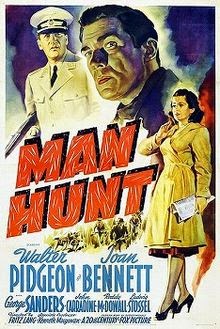
I stayed up past my bedtime Wednesday night to watch Man Hunt through to its conclusion. I had never thought of Walter Pidgeon as an action hero, but he is tall enough and physical enough for sure, as Captain Alan Thorndike, famous big game hunter. Joan Bennett plays the Vivien Leigh role as a "streetwalker" as in Waterloo Bridge. George Sanders plays Major Quive-Smith, the SS Officer who has Thorndike tortured, tries to murder him in Germany, and then tracks him down to London and Lyme Regis.

The movie was issued in 1941, in an age of neutrality toward Germany and the National Socialist Party. Throughout the film, the issue of neutrality and even appeasement is important, as Thorndike was caught while seeming to attempt Hitler's assassination. He insists that he was just testing to see if he COULD kill Hitler, something that Quive-Smith does not believe. He wants Thorndike to sign a confession implicating the British government in the assassination attempt. Thorndike refuses and the plot goes on from there, with our hero in constant danger, and our heroine, Jerry Stokes, shares that danger after she saves him and falls in love with him.

The director of the movie is Fritz Lang of Metropolis fame, who had left Nazi Germany--Hitler both admired and hated Lang's talents, destroying some of his movies and then offering him an official role in Germany's film industry. Lang was Jewish (but his estranged wife was a Nazi party member) so he was probably right not to accept the office.

The New York Times liked the movie in its 2009 DVD release:

As propaganda “Man Hunt” is a movie of undisguised practical aims. During a confrontation in Quive-Smith’s office the German contemptuously tells his captive, “You’re symbolic of the English race.” Thorndike answers, “I’m beginning to think that you’re symbolic of yours!” — one of the lines that apparently roused the fury of Hollywood’s self-censorship board, the Production Code Administration, which objected to the picture’s lack of “balance.” (The administration also insisted that a sewing machine be placed in Bennett’s apartment to suggest that this young woman of suspiciously independent means was in fact a seamstress.) As agitprop the film could not be more effective: during its climax Thorndike finds a way to continue his stalking under more official circumstances, and the audience yearns to go along with him.

And yet, seen again in this excellent restoration from 20th Century Fox Home Entertainment, “Man Hunt” has the timeless quality of a work of pure imagination. Each image contains what the German critic Frieda Grafe called “the hidden geometry” of Lang’s work: that mysterious tendency of shots to resolve themselves into intersecting planes (the banked floors that seem to be rising to meet lowered ceilings), the crisscrossing lines of force traced by streets and the angles of buildings, the circles and squares and triangles that emerge from the décor and seem to dominate the tiny human figures. One of the film’s most prominent characters is an inanimate object, a brooch in the shape of an arrow that passes from Pidgeon to Bennett to Sanders and back to Pidgeon again.

I have to admit I did not notice all the angles and geometry noted above--I did think the pace of the story was excellent and the touches of humor welcome. As far as the propaganda goes, if the Production Code Administration had trouble with Man Hunt, how it must have struggled letting The Mortal Storm be produced and distributed!

Peter O'Toole played the role of Captain Thornton in 1976's Rogue Male for the BBC (with Alistair Sim--Scrooge--as his brother). O'Toole's character was named Captain Robert HUNTER.

Thursday, April 24, 2014

"Gravity", the Octave of Easter, and Mystagogy


My husband bought me the DVD set of Gravity for me as an Easter present and we watched it together Easter Monday evening. I readily admit that my viewing of movie, beyond appreciating the plot, excellent acting, and special effects is influenced by this week of Easter celebration. But from the special features on the second DVD in this package, I know that the creators meant for this to be a story about rebirth and redemption; it's a space adventure that helps even the viewer overcome her fears. Warned by George Clooney's character Matt Kowalski (as he jokes) that he has a bad feeling about this mission, at first I did not think I could watch the disaster that was about to occur.

At the end of the movie, Ryan Stone, the neophyte, stumbles to her feet after her rebirth and baptism, experiencing gravity after being weightless, and murmurs, "Thank you". Who is she thanking? She has emerged from the womb of a tiny capsule and plunged into death before rising to a new life. How will she live from now on? At the beginning of the movie, while she feared being in space as a scientist-cum-astronaut, she enjoyed the silence and isolation. Facing her fears and overcoming one danger after another, she has to accept both letting go and deciding to go on. When she thinks she is going to die and prepares to give up and die, she regrets that there is really no one to mourn for her, no one to pray for her--and that she does not know how to pray, because nobody ever taught her how. Once she decides to try to survive, she does pray: she talks to a person she believes is in some happy afterlife so that he can give a message to someone she loves. And then she says her prayer of gratitude once back on earth.

In the early Church, this Octave week of Easter, each day celebrating the Solemnity of Solemnities, Easter Sunday, was dedicated to the neophytes, those who had been brought into the Church at the Easter Vigil. As they attended Mass during the week they wore their baptismal white robes until Low or Quasimodo* Sunday (From the Introit: Quasi modo geniti infantes, rationabile, sine dolo lac concupiscite ut in eo crescatis in salutem si gustastis quoniam dulcis Dominus--I Peter 2:2)After that Mass, they put aside their white albs and joined the community without distinction--but they continue their mystagogic catechesis, learning more about the mysteries they had only heard about during their long catechumenate.

The movie, of course, ends with Ryan Stone on the beach, waiting for her rescuers. The movie is over, but the story hasn't ended. If she is to continue to grow in her new life, she will need some mystagogy: perhaps someone to teach her more about prayer; a community to give and receive help and support; some way to live out the change (the conversion) she's just experienced. She may have escaped the dangers of carbon dioxide, space debris, fire, freezing, and hopelessness by herself, but she wasn't alone. Kowalski was somehow there with her even after he sacrificed his life for her, and the simple Inuit fisherman Aningaaq, with his barking dogs and crying baby, comforts her. Those who trained her had prepared her; Houston awaited her and would track her once her capsule entered the atmosphere of Earth, sending someone to bring her home. Perhaps now home will be something more than going to work and driving aimlessly.

Even if you don't make connections like I have, Gravity is an exciting movie about resilience and survival. Sandra Bullock should have won the award for best actress of the year for this performance!

*Quasimodo, the bell-ringer from Victor Hugo's novel Notre Dame de Paris, is found as an infant at the cathedral on Low Sunday and is thus given his name from the Introit. More about Low Sunday here.

Wednesday, January 15, 2014

Travel Via Roku Movie Nights

My husband and I went to France twice this week: to an undisclosed village in My Afternoons with Margueritte (yes, two t's--her father could not spell very well, she tells us) and to Senlis, north of Paris, in Seraphine.

Roger Ebert liked the former (and we did too):

Germain is a handyman in a sloppy flannel shirt and overalls, overweight and hulking. Margueritte is a little (85 pounds) old (95 years) lady. They meet on a park bench, where both know that exactly 14 pigeons hang out there, and both recognize them by sight. . . .

This happens in an improbably sweet film that will strike many as too upbeat. Germain is cuddled by his adorable bus-driver girlfriend Annette (Sophie Guillemin), and pals around with his buddies at a local cafe. He suffers through flashbacks to his unhappy childhood, but seems on the whole serene. He loves Annette but he declares himself "in love" with Margueritte.

So are we, a little. She is bright-eyed and high-spirited, and never overplays the heart-tugging. The director, Jean Becker, is the son of the great French noir director Jacques Becker, who was 8 when Gisele Casadesus was born. There's history here. The happy ending lays it on too thick, but what the hell: In for a dime, in for a dollar. Besides, the movie started me re-reading
The Plague.

We enjoyed the upbeat ending and were happy to think about Margueritte, Annette, and Germain being happy. We did not start re-reading The Plague.

Instead, we started watching Seraphine, a 2009 movie based on the life and art of Seraphine Louis, usually called Seraphine de Senlis. We have visited Senlis before, driving there from Roissy to see the Cathedral (of the former diocese of Senlis) and eat dinner at Le Gril des Barbares. I would like to go back to Senlis our next trip to visit the museum that displays her work.

Seraphine does not have a happy ending, except that the title character may have received the care and peace she needed. When she created her beautiful artworks, the artist sang the Veni, Creator Spiritus, and she offers prayers to the Blessed Virgin Mary, painting at the inspiration of her Guardian Angel. Roger Ebert liked it, too, but he did not recognize the Veni, Creator Spiritus!

We might watch The Well Digger's Daughter the next time we have a Roku movie night. We've enjoyed the movies based on Pagnol's works before: Jean de Florette and Manon des Sources; My Mother's Castle and My Father's Glory, so we look forward to it.

Monday, November 12, 2012

Random Harvest, Book and Film


I read James Hilton's novel Random Harvest on my Kindle Fire while flying to Paris last month. I have often watched the Mervyn LeRoy production of the movie Random Harvest starring Ronald Colman and Greer Garson. The plot can be found here on the TCM.com website--it all turns on Charles Rainier's amnesia after being wounded in World War I. The protagonist (Ronald Colman)suffers amnesia twice--once after the war, when he struggles to remember who he really is, and once after he has made a new life, when he remembers who he really is, but cannot remember who he was for two years. He had actually married a young woman (Greer Garson) who in his new life is serving as his secretary and whom he weds in a marriage of convenience as his social and political hostess. Colman and Garson make a wonderful romantic couple.

The novel, unlike the movie, hides the identity of Rainier's social secretary and political wife as Rainier's latest secretary, a young man named Harrison, narrates his story. The novel is divided into four sections and traces Rainier's life story as he tries to put the hidden past of his life together. Hilton introduces a great character, a Church of England pastor named Blampied, who marries Smith, as Rainier is then known, and Paula, the young woman who helped nurse him through influenza after he escaped from the asylum where he'd been treated for his injuries and loss of memory. The novel begins with a moment of silence on a train--for Remembrance Day, November 11--so the timing of this review is propitious, I think!

Rainier returns to his family once he remembers who he is, and finds them none too pleased to find him alive. Each family member, however reluctantly, donates some portion of their inheritance from Charles's father, who dies without knowing that his son, presumed dead in WWI, has returned alive. Rainier goes off to continue his education at Cambridge, but then has to take over and rescue the family business--all the while wondering what happened to those two years he was missing. Harrison begins to work for him and meets his wife, Helen, whom he thinks a gracious hostess while wondering what his boss's relationship really is with Helen.

In the movie, there are a few scenes that show Paula's (Greer Garson's) work in vaudeville, including a wild scene in which she dances in a very short kilt--and vaudeville plays a role in Rainier's strange, fleeting memories. Rainier and Harrison don't know it, but when they attend a vaudeville performance, they are seeing a shtick that "Smith" accidently developed and has now become part of the repertoire! Finally, of course, Rainier finds himself back in the village where he as Smith and Paula met, and he goes to a place only he and Paula would know--another one of those vague memories he tried to remember--and Harrison witnesses the reunion of true husband and wife.

James Hilton was a very successful novelist of the thirties and forties: Lost Horizon; Goodbye, Mr. Chips; Random Harvest; So Well Remembered, etc, and his novels were well adapted to the screen. Ronald Colman starred in the film version of Lost Horizon and Greer Garson in Goodbye, Mr. Chips.

If you've seen the movie, the novel is such a different experience, one that I also highly recommend.