Showing posts with label Faith and Prejudice. Show all posts

Thursday, February 17, 2022

Newman and Quinquagesima Sunday on the Son Rise Morning Show

On Monday, February 21--which just happens to be the 221st anniversary of Saint John Henry Newman's birth in the City of London--Matt Swaim and I will discuss the third of Newman's pre-Lenten sermons on the Son Rise Morning Show. We'll be on the air at my usual time, about 6:50 a.m. Central/7:50 a.m. Eastern time. Please listen live on EWTN Radio or on your local EWTN affiliate.

Newman preached on "Prejudice and Faith" on Quinquagesima Sunday, March 5, 1848, reflecting on the Gospel of Saint Luke, chapter 18, verses 31-43, in which Jesus announces His fate. Newman focuses on that third prophecy of His Passion and the Apostles' (His Twelve closest followers) confusion:

And taking the twelve, he said to them, “Behold, we are going up to Jerusalem, and everything that is written of the Son of man by the prophets will be accomplished. For he will be delivered to the Gentiles, and will be mocked and shamefully treated and spit upon; they will scourge him and kill him, and on the third day he will rise.” But they understood none of these things; this saying was hid from them, and they did not grasp what was said. (Luke 18: 31-34)

Exploring the Apostles' lack of understanding, Newman begins his sermon with other examples of their failures:

We have in the Gospel for this day what, I suppose, has raised the wonder of most readers of the New Testament. I mean the slowness of the disciples to take in the notion that our Lord was to suffer on the Cross. It can only be accounted for by the circumstance that a contrary opinion had strong possession of their minds—what we call a strong prejudice against the truth, in their cases an honest religious prejudice, the prejudice of honest religious minds, but still a deep and violent prejudice. When our Lord first declared it, St. Peter said, "Be it far from thee, Lord, this shall not happen to Thee." He spoke so strongly that the holy Evangelist says that he "took our Lord and began to rebuke Him." [Matthew 21:22-23] He did it out of reverence and love, as the occasion of it shows, but still that he spoke with warmth, with vehemence, is evident from the expression. Think then how deep his prejudice must have been.

This same prejudice accounts for what we find in today's gospel. . . . Could words be plainer? Yet what effect had they on the disciples? "They understood none of these things, and this was hid from them, and they understood not the things that were said." Why hid? Because they had not eyes to see.

And so again after the resurrection, when they found the sepulchre empty, it is said, "They knew not the Scripture, that He must rise again from the dead." [John 20:9] And when St. Mary Magdalen and the other women told them, "their words seemed to them as an idle tale, and they did not believe them" [Luke 24:10-11]; and accordingly when our Lord appeared to them, "He upbraided them with their incredulity and hardness of heart, because they did not believe them who had seen Him after He was risen again." [Mark 16:14]

This is certainly a very remarkable state of mind, and the record of it in the gospels may serve to explain much which goes on among us, and to put us on our guard against ourselves, and to suggest to us the question, Are we in any respect in the same state of imperfection as these holy, but at that time prejudiced, disciples of our Lord and Saviour?

Before he addresses the issue of his hearers' imperfection, Newman identifies the source of the Apostles' prejudice, their expectation of the Messiah's mission:

It was the opinion of numbers at that day that the promised Messiah or Christ, who was coming, would be a great temporal Prince, like Solomon, only greater; that he was to have an earthly court, earthly wealth, earthly palaces, lands and armies and servants and the glory of a temporal kingdom. This was their idea—they looked for a deliverer, but thought he would come like Gideon, David, or Judas Maccabaeus, with sword and spear and loud trumpet, inflicting wounds and shedding blood, and throwing his captives into dungeons.

And they fancied Scripture taught this doctrine. They took parts of Scripture which pleased their fancy, in the first place, and utterly put out of their minds such as went contrary to these.

And, putting off again his congregation's examination of conscience, Newman speaks about how some people ignore certain verses in the Holy Bible (and there we see how Newman echoes St. Joan of Arc, quoted in paragraph 795 in the Catechism of the Catholic Church "About Jesus Christ and the Church, I simply know they're just one thing, and we shouldn't complicate the matter."):

Far be it from me to be severe with such, but is it not so, that in this educated and intelligent and great people, there are multitudes,—nay more, the great majority is such, as to have put a false sense on Scripture, and to be violently opposed to the truth on account of this false interpretation? The Church of Christ walks the earth now, as Christ did in the days of His flesh, and as our Lord fulfilled the Scriptures in what was and what He did then, so the Church fulfils the Scriptures in what she is and what she does now; as Christ was promised, predicted, in the Scriptures as He was then, so is the Church promised, predicted, in the Scriptures in what she is now. Yet the people of this day, though they read the Scriptures and think they understand them, like the Jews then, who read the Scriptures and thought they understood them, do not understand them. Why? Because like the Jews then, they have been taught badly; they have received false traditions, as the Jews had received the traditions of the Pharisees, and are blind when they think they see, and are prejudiced against the truth, and shocked and offended when they are told it.

And, as the Jews then passed over passages in Scripture, which ought to have set them right, so do Christians now pass over passages, which would, if dwelt on, extricate them from their error.

When I read this sermon and came to this point, I thought this is a perfect sermon to discuss with Matt Swaim, who in addition to being the co-host of the Son Rise Morning Show, works at the Coming Home Network as Outreach Manager. Marcus Grodi, the President and Founder, used to host a radio program/podcast called "Verses I Never Saw" and that issue still comes up when converts tell their stories--how they started reading certain verses in the Bible differently on their journey home to the Catholic Church.

Newman cites a few of those verses and then starts to comment on what Catholics should do when faced with this situation of how some misread the Holy Bible. In other words, he instructs his congregation on a method of evangelization:
. . . how are we Catholics to behave ourselves to such prejudiced and erring persons? We should imitate our Lord and Master. He was most patient with them; He abounded in long-suffering. "A bruised reed did He not break, and smoking flax did He not quench." He did not argue, but He quietly led them on. He displayed His wonders to them. He gradually influenced them by His words and by His grace, and then enlightened them, till they believed all things. Till that Apostle [Thomas], who doubted most stoutly of His resurrection, cried out, overcome, "My Lord and My God." So must we do now—so does the Church do now. Argument is well in its place, but it is not the chief thing. The chief thing is to win the mind, to melt the heart, to influence the will. This the Church does. After the pattern of her Divine Lord she draws us with cords of a man, with cords of love, with divine charity; "she hopeth all things, endureth all things," she opens the gates of her temple, she lights up her altars, she displays the Most Holy under the sacramental veil, she bursts forth into singing, till the wayward soul, overcome and subdued, says with the Patriarch, "It is enough—let me now die, for I have seen Thy Face; Nunc Dimittis, Lord now lettest Thou Thy servant depart in peace, for mine eyes have seen Thy salvation. I have heard of Thee with the hearing of the ear, but now mine eye seeth Thee." And, as our Lord after His resurrection opened the understanding of the disciples to understand the Scripture, so now are the hearts of men softened and enlightened, and they see that the Church fulfils all the prophecies about herself, all that is written in the Law, the Prophets, and the Psalms; and thus they fall down and worship, and confess that God is here of a truth.

Finally, Newman concludes with some counsel for our own spiritual lives and progress, before the beginning of Lent on Ash Wednesday:

Be sure, my Brethren, that this must be our way too. Never does God give faith, but He tries it, and none without faith can enter the kingdom of heaven. Therefore all ye who come to serve God, all ye who wish to save your souls, begin with making up your minds that you cannot do so, without a generous faith, a generous self-surrender; without putting yourselves into God's hands, making no bargain with Him, not stipulating conditions, but saying "O Lord here I am—I will be whatever Thou wilt ask me—I will go whithersoever Thou sendest me—I will bear whatever Thou puttest upon me. Not in my own might or my own strength. My strength is very weakness—if I trust in myself more or less, I shall fail—but I trust in Thee—I trust and I know that Thou wilt aid me to do, what Thou callest on me to do—I trust and I know that Thou wilt never leave me nor forsake me. Never wilt Thou bring me into any trial, which Thou wilt not bring me through. Never will there be a failing on Thy part, never will there be a lack of grace. I shall have all and abound. I shall be tried: my reason will be tried, for I shall have to believe; my affections will be tried, for I shall have to obey Thee instead of pleasing myself; my flesh will be tried, for I shall have to bring it into subjection. But Thou art more to me than all other things put together. Thou canst make up to me all Thou takest from me and Thou wilt, for Thou wilt give to me Thyself. Thou wilt guide me."

Saint John Henry Newman, pray for us!

Friday, February 11, 2022

Newman and Sexagesima Sunday on the Son Rise Morning Show


On Monday, February 14, Anna Mitchell and I will continue our series of segments on seasonal sermons by St. John Henry Newman on the Son Rise Morning Show. We'll be on the air at my usual time, about 6:50 a.m. Central/7:50 a.m. Eastern time. Please listen live on EWTN Radio or on your local EWTN affiliate.

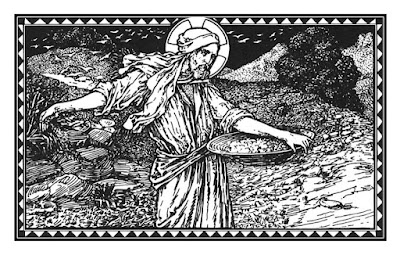
Our next sermon is for Sexagesima Sunday, "The Calls of Grace", which Newman delivered on Sunday, February 27, 1848. In this sermon, Newman considers the Parable of the Sower (Luke 8:4-15), providing a quick summary of the imagery and meaning of the parable:

In the parable of the Sower, which has formed the Gospel for this day, we have set before us four descriptions of men, all of whom receive the word of God. The sower sows first on the hard ground or road, then on the shallow earth or rock, then on a ground where other seeds were sown, and lastly on really good, rich, well-prepared soil. By the sower is meant the preacher; and by the seed the word preached; and by the rock, the road, the preoccupied ground, and the good soil, are meant four different states of mind of those who hear the word. Now here we have a picture laid out before us, which will, through God's mercy, provide us with a fitting subject of thought . . .

While the title highlights the calls of grace, what Newman really considers is how those calls of grace, the love God wants to share with us, are often answered with hardness of heart and rejection, as in the case of the Seed of the Word of God scattered on the side of the road: "some fell by the road and was trodden down and the birds of the heaven ate it up." (verse 12)

The word goeth forth, as the prophet Isaias says, and does not return unto Him void, but prospers in the thing whereto He sends it. Nothing can stop it, but a closed heart. Nothing can resist it, but a deliberately worldly, carnal and godless will—and such a will can. But where the heart is ever so little softened, the divine word enters it; where it is not softened, it lies on the surface. It lies on the surface and we learn from the parable the immediate consequence: "the birds of the air stole it away." It did not lie there long. There was but the alternative—it was admitted within, or the wind or the birds or the foot of the passer-by, as it might be, destroyed it.

Newman doesn't emphasis this, but he's alluding to the great mystery that God does not make us love Him, obey Him, worship Him: we have free will. We can reject His love and His Commandments. We are free to love Him and we are free to reject Him!

Instead, Newman provides the gentle warning to his congregation that they shouldn't think this hardness of heart exists only in others:

Now I can fancy some of those who hear me thinking that this is an extreme case—when perhaps it is their own. When they read or hear this picture of the seed falling on the hard wayside, they may hear it in an unconcerned way, as if they had not interest in it, when they may have a great concern in the description.

Then he provides us with examples of this hardness of heart, even on a person's deathbed:

But you see the difference between one whose heart is hard, and one whose heart is softened. One man has often thought about religion, another never. The latter will be interested enough if you speak to him of things connected with this world, if you talk only of how to raise crops or how to make money in any way, or of any worldly amusement or pleasure, his attention is arrested at once. But if you speak to him about the four last things, about heaven or hell, death or judgement, he stares or laughs out. If you speak good and holy words to him, he hears and forgets. This is the dreadful case with many at death; religious persons say what they can to touch the dying man and the poor patient hears indeed, but hears without emotion, without thought of any kind. The words fall off, and have no effect—and so he dies.

His second example hearkens back to the description of the parable:

You will observe that, in the parable, not only did the fowls carry off the word of life, but the foot of the passer-by trampled it. I have hitherto spoken of those who were ignorant, careless and heartless, and from whom the devil stole the divine treasure, while they let it lie on the surface of their minds. But there are others who are worse than this; who, as it were, trample on the divine words. Such are those who feel a disdain and hatred of the truth. It is an awful thing to say, but we see it before our eyes how many people there are who hate the doctrine which Christ revealed and the Church teaches. Of course many do so in mere ignorance, and would feel and act otherwise, if they had the opportunity. But there are those, and not a few, who scorn and are irritated at the preaching of the word of life, and spurn it from them.

And his third:

But I will now go on to mention a third case of hardness of heart, which not infrequently occurs, and that is, the case of those who get familiar with the word of life and then are not moved by it. When persons who are living in sin hear for the first time the sound of Catholic truth, they are affected by it; it is something new and the novelty of the doctrine is God's instrument. It is blest by God, to make an effect upon them. It moves and draws them. And then the worship of the Catholic Church is so overcoming—the holy forms, the sacred actions, the awful functions (Benediction, for instance), subdue them. They, as it were, give up, they surrender themselves to God, they feel themselves in the hands of their Saviour. They are led to cry out: "Take me, make what Thou wilt of me." This lasts for some time, and in a number of cases, praised be God, it ends happily; this excitement and transport of mind leads on to a lasting conversion. But in other cases it does not. A person is moved for a while, and then the excitement goes off. I have seen cases of this kind—many people may know them. A man is on the point of making a real conversion; he is on the point of taking up religion seriously. He is on the point of putting one and one object alone before him as the end of his being and the aim of his life, to please God and save his soul. But all of a sudden a change comes over him. Almost while we turn our head and look another way, it has taken place. We look back to him and he is quite another man—or rather he is the same, the same as he was. He has lapsed into his old forgetfulness of religion, and when he has once relaxed, it is impossible to move him. There he is for ever.

I don't think that Newman is denying that there is hope for these people, these images of the kind of thoughts and actions he has seen during his life as a pastor of souls (remember that he had been an Anglican minister for almost 20 years), serving people from womb to tomb, encouraging conversion, watching over them, seeing progress and improvement, and sometimes being very disappointed when he saw those efforts fail. Newman has witnessed even the ultimate hardness of heart when a person says that religion is a matter for children and that he or she is too adult to believe in what should be considered mere fairy tales--and that person seems to be unreachable.

Finally, Newman addresses his congregation, some of whom may now be wondering about their own hardness of heart. He urges them to ask God for the grace of conversion, to persevere in such prayers, and to observe traditional Catholic devotion, to the Blessed Sacrament, to daily Mass, to simple acts of faith, hope and love:

And if you are conscious that your hearts are hard, and are desirous that they should be softened, do not despair. All things are possible to you, through God's grace. Come to Him for the will and the power to do that to which He calls you. He never forsakes anyone who calls upon him. He never puts any trial on a man but He gives Him grace to overcome it. Do not despair then; nay do not despond, even though you do come to Him, yet are not at once exalted to overcome yourselves. He gives grace by little and little. It is by coming daily into His presence, that by degrees we find ourselves awed by that presence and able to believe and obey Him. Therefore if any one desires illumination to know God's will as well as strength to do it, let him come to Mass daily, if he possibly can. At least let him present himself daily before the Blessed Sacrament, and, as it were, offer his heart to His Incarnate Saviour, presenting it as a reasonable offering to be influenced, changed and sanctified under the eye and by the grace of the Eternal Son. And let him every now and then through the day make some short prayer or ejaculation, to the Lord and Saviour, and again to His Blessed Mother, the immaculate most Blessed Virgin Mary, or again to his guardian Angel, or to his Patron Saint. Let him now and then collect his mind and place himself, as if in heaven, in the presence of God; as if before God's throne; let him fancy he sees the All-Holy Lamb of God, which taketh away the sin of the world. 

And he ends with this beautiful reminder that this is the way to become a saint:

These are the means by which, with God's grace, he will be able in course of time to soften his heart—not all at once, but by degrees; not by his own power or wisdom, but by the grace of God blessing his endeavour. Thus it is that Saints have begun. They have begun by these little things, and so become at length Saints. They were not saints all at once, but by little and little. And so we, who are not saints, must still proceed by the same road; by lowliness, patience, trust in God, recollection that we are in His presence, and thankfulness for His mercies.

Saint John Henry Newman, pray for us!

Friday, February 4, 2022

Newman and Septuagesima on the Son Rise Morning Show


Starting on Monday, February 7, Anna Mitchell, Matt Swaim, and I will begin a series of segments on seasonal sermons by St. John Henry Newman on the Son Rise Morning Show. We'll be on the air at my usual time, about 6:50 a.m. Central/7:50 a.m. Eastern time. Please listen live on EWTN Radio or on your local EWTN affiliate.

We are going to start with three sermons he gave at St. Chad's (the Cathedral since 1852) in Birmingham, England after he returned from Rome. He had studied for the Catholic priesthood there at the College of Propaganda, been ordained, joined the Oratory of St. Philip Neri, and then returned to England to establish the Oratory there.

The first three sermons we'll consider are for the Sundays of the Septuagesima period before Lent: Septuagesima (Sunday, February 13), Sexagesima (February 20), and Quinquagesima (February 27). These Sundays are still celebrated in parishes and communities where the Traditional Latin Mass is still allowed, in Anglican parishes, and in the Anglican Ordinariate--and they correspond to the Pre-Lent preparation Orthodox Christians and Eastern Rite Catholics observe with their Meatfare (eliminating meat from their diets) and Cheesefare (eliminating dairy from their diets) Sundays. Even some Lutheran communities observe Septuagesima. 

It's a good way to prepare for Lent: to think about fasting, almsgiving, and prayer before Ash Wednesday arrives.

The Gospel for Septuagesima Sunday is from Matthew: the Parable of the Workers in the Vineyard (20:1-16). Newman delivered this sermon on February 20, 1848.

Newman jumps right into his focus in this sermon ("Preparation for Judgment"): the last verse of the Gospel reading:

"The last shall be first and the first last, for many are called, but few are chosen." Such are the words with which the Gospel of this day ends, which is the Parable of the Labourers in the Vineyard. In that parable, you know well, my Brethren, the Master of the Vineyard calls into his Vineyard all the labourers he can get together. He calls them in at different times, some in the morning, some at noon, some shortly before the evening. When the evening is come, he bids his paymaster call them together and give them their wages for the day past. It is very plain what this means. The Master of the Vineyard is our Lord and Saviour. We are the labourers. The evening is the hour of death, when we shall each receive the reward of our labour, if we have laboured well.

There is more in the parable than this, but I shall not go into the details of it. I shall here content myself with the general sketch I have taken of it, and with the words with which it concludes, "The last shall be first and the first last, for," etc.

When C. Stephen Dessain of the Oratory edited these early Catholic sermons for publication in the 1950's he noted that we can see Newman's transition from how he gave sermons as an Anglican and how he gave them as a Catholic: "The old mastery is there, the style, the concrete illustrations, the psychological insight, the use of Holy Scripture, the stress on the moral preparation needed for receiving the truth;—it is authentic Newman, and entirely Catholic."

And indeed, there is a lovely passage in which Newman relates evening and rest with death, which you can read online (or in the Assumption Press re-issue of these sermons, pp. 32-34). He distinguishes the particular judgement each of us must prepare for at the hour of our deaths from the general judgement at the Second Coming of Christ and concludes with this statement, emphasizing his focus on the Parable:

But the parable in the Gospel speaks of the time of evening, and by the evening is meant, not the end of the world, but the time of death. . . . It will be most terrible certainly, and it comes first, to find ourselves by ourselves, one by one, in His presence, and to have brought before us most vividly all the thoughts, words and deeds of this past life. Who will be able to bear the sight of himself? And yet we shall be obliged steadily to confront ourselves and to see ourselves. In this life we shrink from knowing our real selves. We do not like to know how sinful we are. We love those who prophesy smooth things to us, and we are angry with those who tell us of our faults. But then, not one fault only, but all the secret, as well as evident, defects of our character will be clearly brought out. We shall see what we feared to see here, and much more. And then, when the full sight of ourselves comes to us, who will not wish that he had known more of himself here, rather than leaving it for the inevitable day to reveal it all to him!

Then he brings us to a full stop: "I am speaking, not only of the bad, but of the good."

He warns that even those Catholics who are trying to cooperate with God's grace, to obey the Commandments, develop the virtues in their lives, practice their faith, pray, fast, and give alms--all will find out how they've failed and how horrible that failure was:

But I speak of holy souls, souls that will be saved, and I say that to these the sight of themselves will be intolerable, and it will be a torment to them to see what they really are and the sins which lie against them. And hence some writers have said that their horror will be such that of their own will, and from a holy indignation against themselves, they will be ready to plunge into Purgatory in order to satisfy divine justice, and to be clear of what is to their own clear sense and spiritual judgement so abominable. We do not know how great an evil sin is. We do not know how subtle and penetrating an evil it is. It circles round us and enters in every seam, or rather at every pore. It is like dust covering everything, defiling every part of us, and requiring constant attention, constant cleansing. Our very duties cover us with this miserable dust and dirt. As we labour in God's vineyard and do His will, the while from the infirmity of our nature we sin in lesser matters even when we do good in greater, so that when the evening comes, with all our care, in spite of the sacraments of the Church, in spite of our prayers and our penance, we are covered with the heat and defilement of the day.

Newman would later become one of those writers who describe the willingness of the saved Soul to enter Purgatory in the Dream of Gerontius (1865) as the Soul of Gerontius sings after seeing Jesus at his particular judgement:

Take me away, and in the lowest deep
There let me be,
And there in hope the lone night-watches keep,
Told out for me.
There, motionless and happy in my pain,
Lone, not forlorn,—
There will I sing my sad perpetual strain,
Until the morn.
There will I sing, and soothe my stricken breast,
Which ne'er can cease
To throb, and pine, and languish, till possest
Of its Sole Peace.
There will I sing my absent Lord and Love:—
Take me away,
That sooner I may rise, and go above,
And see Him in the truth of everlasting day.

Newman concludes this sermon with the thought that we'll be asked basically two things at our own particular judgement (not about how successful or reputable we were in business, academics, etc):

When we come into God's presence, we shall be asked two things, whether we were in the Church, and whether we worked in the Church. Everything else is worthless. Whether we have been rich or poor, whether we have been learned or unlearned, whether we have been prosperous or afflicted, whether we have been sick or well, whether we have had a good name or a bad one, all this will be far from the work of that day. The single question will be, are we Catholics and are we good Catholics? If we have not been, it will avail nothing that we have been ever so honoured here, ever so successful, have had ever so good a name. And if we have been, it will matter nothing though we have been ever so despised, ever so poor, ever so hardly pressed, ever so troubled, ever so unfriended. Christ will make up everything to us, if we have been faithful to Him; and He will take everything away from us, if we have lived to the world.

Then will be fulfilled the awful words of the parable. Many that are last shall be first, for many are called but few are chosen.

As Dessain said, we see the same concern for the Salvation of Souls in this early Catholic sermon from Newman as we saw in his Parochial and Plain Sermons.

Saint John Henry Newman, pray for us!