Monday, July 27, 2015

The Crutched Friars

While researching a list of orders and their houses suppressed by Henry VIII between 1536 and 1540, I found an order I hadn't read about before: the Crutched Friars. According to the Catholic Encyclopedia, the Crutched Friars, or Crossed Friars were:

An order of mendicant friars who went to England in the thirteenth century from Italy, where they existed for some time, and where they were called "Fratres Cruciferi". There (sic) first appearance in England was at a synod of the Diocese of Rochester in 1244, when they presented documents from the pope and asked to be allowed to settle in the country (Matthew Paris). Each friar carried in his hand a wooden staff surmounted by a cross and also had a cross of red cloth upon his habit, from which circumstances originated the name by which they became commonly known. Their rule was that of St. Augustine and their habit originally brown or black, was later on changed to blue by Pope Pius II. They established eight or nine houses in England, the first being at either Colchester (according to Dugdale), or at Reigate (according to Reyner), founded in 1245. They settled in London in 1249, where they gave their name to the locality, near Tower Hill, still called "Crutched Friars". Other houses were at Oxford (1348), York, Great Weltham (Suffolk), Barham (a cell to Gt. Weltham), Wotten-under-Edge (Gloucestershire), Brackley (Northants) and Kildale (Yorkshire).

They were never a very large order, but they have been lost to history except for that area of London named for them and a pub in the area. More about them here.

The photo above is from Wikipedia commons, with the permission of the photographer. More about the sculpture here. It's too bad that the sculptor did not include the Crutched Friar cross on the staff held by one of the friars, since that's the identifying mark of the order! According to this site, the figures represent the title characters of a Hermann Hesse novel, Narcissus and Goldmund, but then the sculpture would have nothing to do with the Crutched Friars, since that novel is set in Germany and is about two German monks! 

Sunday, July 26, 2015

YET Another Martyrdom in July: Blessed George Swallowell, Layman

Today's final late July martyr is connected to St. John Boste from just a couple of days ago: Blessed George Swallowell was executed on July 26, 1594 in Darlington. He was a layman and former Anglican minister and was condemned to death for the crime of becoming a Catholic, which was not just a felony punishable by hanging, but an act of treason--according to Parlimentary statute--punishable by drawing, hanging, and quartering.

This story provides some excellent background to the situation of Catholics in Durham, especially after the Northern Rebellion, when many showed themselves most ready and willing to return to the Catholic faith. About today's martyr, the author, Chris Lloyd notes:

George Swalwell - his name is often spelled Swallowell - was born in Darlington in 1564. He became a clerk at Trimdon in 1575 and, after he was ordained in 1577, became a curate there. A few years later he moved on to work and teach in the parish of Houghton-le-Spring.

In 1590, his work caused him to visit a Catholic languishing in Durham Jail because of his faith. They fell into argument during which George saw the light and converted to Catholicism. Rather than keep it hidden, he rushed to the pulpit in Houghton and announced that he had hitherto been in error, that there was "no true mission" in Protestantism and so he quit the church on the spot. He was arrested and thrown in Durham Jail.


He came to trial a year later and was reprieved. However, the authorities decided to have another go at him in 1594. They had lost the only witness, known as Willie, who had heard George's pulpit pronouncement, but a fellow called Finch testified that he had once heard Willie tell the story, and this was enough. On Tuesday, July 23, George was sentenced to death for treason. He stood in the dock with two other accused Catholics, Father John Ingram, of Warwickshire, and Father John Boste, of Penrith. Poor Mr Boste had already done time in the Tower of London, where he had been stretched on the rack at least four times "in a manner that rendered him a permanent cripple".

When the death sentence was announced, George immediately reconverted to Protestantism and promised to do whatever the judge said if he could keep his life. But Mr Boste fixed him with a steely stare and asked: "George Swalwell, what hast thou done?" George immediately converted back once more to Catholicism, and the judge ordered that he be hanged, drawn and quartered at Darlington.

On July 24, Mr Boste was executed at Durham; on July 25, Mr Ingram was executed at Gateshead; on July 26, it was George Swalwell's turn.

Here are some details of Blessed George Swallowell or Swalwell's execution, from the same article:

"Upon the day designed for execution, he was brought two miles off the place on foot, and then was put into a cart, where he lay on his back with his hands and eyes up to heaven, and so he was drawn to the gallows," records Bishop Richard Challoner in his 1741 book, Memoirs of the Missionary Priests.

The gallows had been erected on Bakehouse Hill, between the Market Square and Tubwell Row. "To terrify him the more, they led him by two great fires, the one made for burning his bowels, the other for boiling his quarters," says Challoner.

Four priests accompanied him on the walk across the Market Square to the gallows, beseeching him to reconvert yet again to the Protestant faith. He would not listen, and they became so fed up with him that they beat him with a rod to make him climb the ladder to his death more quickly.

The rope was put around his neck and "Mr Swalwell desired if there were any Catholics there they would say three paters, three aves and the creed for him, and so making the sign of the cross, he was turned off the ladder". He was cut down before he lost consciousness "and the hangman, who was but a boy, drew him along by the rope yet alive, and there dismembered and bowelled him, and cast his bowels into the fire". "Then the hangman cut off his head and held it up saying: 'Behold the head of a traitor!' His quarters, after they were boiled in the cauldron, were buried in the baker's dunghill."

Although Elizabeth I had not wanted to make windows into men's souls, an Act of Parliament that made conversion, re-version, or influencing another to join the Catholic Church a treasonous crime was going beyond requiring or controlling the outward conformity of attending Church of England services.

Pater Noster; Ave Maria; Credo: Blessed George Swallowell, pray for us!

Another Martyr in July: Blessed William Ward (William Webster)

Blessed William Ward was born William Webster in Thornby, Westmorland around 1560 and was raised as an Anglican. Although there isn't any record in the sources I found of his educational career, he became a teacher and then traveled to Spain with a Catholic friend. Something happened while he was in Spain--perhaps the expressions of faith, attending Mass with his friend, the art and culture influenced him--and William Webster became a Catholic.

Back home, he converted his mother--under laws passed by Elizabeth I's government, both his efforts and her conversion were treasonous felonies. Webster was repeatedly imprisoned for professing his faith--paying fines for his recusancy and refusal to attend Church of England services. When he was over 40 years old he went to Belgium to study for the priesthood; he arrived there on 18 September, 1604; received the minor orders on 16 December, 1605; the subdiaconate on 26 October, 1607; the diaconate on 31 May, 1608; and the priesthood on the following day, taking the name Father William Ward. On 14 October he started for England, but was driven on to the shores of Scotland, arrested, and imprisoned for three years.

Upon being released, he worked the next 30 years in and around London, secretly ministering to the Catholic population and the poor in general. According to Bishop Challoner, "he was zealous [with a] fiery temperament, severe with himself and others, and especially devoted to hearing confessions. Though he had the reputation of being a very exacting director his earnestness drew to him many penitents. So mortified was his personal life and so secret his numerous charities that he was even accused of avarice." Father Ward was frequently jailed or banished during the reigns of both James I and Charles I, as those periods of relative tolerance ebbed and flowed. He was in London when Parliament issued the proclamation of 7 April, 1641, banishing all priests under pain of death, but refused to retire, and on 15 July was arrested in the house of his nephew. (Charles I had to accept this proclamation because he needed funds from Parliament to fight the rebels in Ireland.) Six days later he was brought to trial at the Old Bailey and was condemned on 23 July. Martyred at age 81 on July 26, 1641, he died uttering the words: “Jesus, Jesus, Jesus, receive my soul!” 

He was among the 162 English Martyrs Pope Pius XI beatified in 1929.

More Martyrs in July: Blessed Edward Thwing and Blessed Robert Nutter

These two martyrs, executed on July 26 in 1600, each had a relative (nephew and brother, respectively) who also suffered martyrdom for their priesthood in recusant England. They were beatified by Pope John Paul II in 1982 as two of the 85 Martyrs of England and Wales:

Edward Thwing was born in Yorkshire. He went to Reims, France in the summer of 1583 to study for the priesthood and then went to the Jesuit community at Pont-a-Mousson, evidently intending to enter the order. But within two years, he was back at the English College. After completing his studies with a stay in Rome, he returned to France for his ordination in Laon on December 20, 1590. His return to England was delayed by health problems. In 1597, he was finally able to go to England but was captured by the Elizabethan authorities as soon as he arrived. He and a fellow priest, (Blessed) Robert Nutter, managed to escape from their prison, and eluded arrest for the next three years. In May of 1600, they were re-captured. On July 26, 1600, Father Thwing was executed at Lancaster by drawing and quartering, together with Father Nutter. His nephew was also martyred, during the Popish Plot craziness: Blessed Thomas Thwing.

Blessed Robert Nutter was born at Burnley, Lancashire, c. 1550; executed at Lancaster, 26 July, 1600. He entered Brasenose College, Oxford in 1564 or 1565, and, with his brother John, also a martyr (executed at Tyburn on February 12, 1584 with four other priests and beatified by Pope Pius XI in 1929) became a student of the English College, Reims. Having been ordained priest, 21 Dec., 1581, he returned to England. On 2 Feb., 1583-4 he was committed to the Tower, where he remained in the pit forty-seven days, wearing irons for forty-three days, and twice subjected to the tortures of "the scavenger's daughter". On 10 November, 1584, he was again consigned to the pit, where he remained until, on 21 Jan., 1584-5, he, with twenty other priests and one layman, was shipped aboard the "Mary Martin" of Colchester, at Tower Wharf. Landing at Boulogne, 2 Feb., he revisited Rome in July, but, on 30 November, was again committed to prison in London, this time to Newgate, under the alias of Rowley. In 1587 he was removed to the Marshalsea, and thence, in 1589-90, was sent to Wisbech Castle, Cambridgeshire. There, in 1597, he signed a petition to Father Garnet in favour of having a Jesuit superior, but, on 8 Nov., 1598, he and his fellow martyr, Edward Thwing, with others, besought the pope to institute an archpriest.

This site offers more detail on each martyr:

Blessed John Nutter: He was a man of strong body but of a stronger soul, who rather despised than conquered death; and went before his companion to the gallows with as much cheerfulness and joy as if he had been going to a feast, to the astonishment of the spectators.

Blessed Edward Thwing: Thwing was of a Yorkshire family, a man of admirable meekness and patience, suffering long with a painful infirmity.

Blesseds Thwing and Nutter are among the Lancaster Martyrs, listed here.

Another Martyr in July: Blessed John Ingram

The Catholic Diocese of Hexham and Newcastle posts this prayer for the canonization of Blessed John Ingram on their site:

O God, you gave us Blessed John Ingram to inspire and encourage us. Grant that we may know the benefit of his prayers so that we, your Church, can give witness to his sanctity. We make our Prayer through our Lord Jesus. Christ your Son, who lives and reigns with You and the Holy Spirit, one God for ever and ever. Amen.

The site also tells the story of his trial and execution:

From Berwick he was sent to Newcastle, then to York and eventually to the Tower of London for examination by Richard Topcliffe. He suffered grievous torture while in the Tower, yet steadfastly refused to betray his friends and associates.

From London he was sent to Durham to stand trial with two other Martyrs, St. John Boste and Blessed George Swallowell.

All three were convicted and condemned to be hanged, drawn and quartered. St. John Boste was executed that same day (July 24th) in Durham, Blessed George Swallowell in Darlington on Monday 29th July.

Blessed John Ingram was executed at Gateshead on Friday 26th July 1594, at a gallows near where is now the church of the Holy Trinity. He was only 29 years of age.

His last words to the people assembled to see him suffer were "I take God and His Holy Angels to the record that I die only for the Holy Catholic Faith and Religion, and do rejoice and thank God with all my heart that He made me worthy to testify my faith therein by the spending of my blood in this manner."

These last days of July offer us a great testimony of how these martyrs consoled and supported each other. St. John Boste had strengthened Blessed George Swallowell (about whom more soon), and their trial and executions demonstrated the endurance of recusancy in northern England.

Blessed John Ingram - Pray for us.

Saturday, July 25, 2015

One Drowning Victim Among Many: Robert Parsons


The BBC History Magazine posts an extra: why did so many people drown in Tudor England?:

Travel across and beside water was as risky as travel on it. Rickety bridges, slippery banks, panicky horses, and fords where the depth of the water or the speed of the current were hard to judge all posed threats.

Everyone was at risk, from a labourer like John Hayward, walking the six miles from Broadway to market in Evesham across the brook at Childswickham on a dark December morning, to a yeoman like Richard Mongombery, riding the eight miles from Uppingham to Kirby late on a February afternoon beside the flooded river Welland.

Animals and water were a dangerous combination. The easiest way to wash a horse was to ride it into deep water, but falling off could be fatal, as Griffin Home found when he rode a black horse into the ‘horse pool’ at Bishop’s Castle and it stumbled. Even taking excitable horses to drink was risky. William Hill, aged 17, took two colts to the river Soar at Burton on the Wolds on 15 June 1558, but they ran into the river and pulled him in after them.

Sheep needed washing before they were sheared and that too could have tragic consequences. One June morning in 1560 Alice and Katherine Bonde were washing sheep in the river Hodder at Slaidburn. A wether (castrated ram) jumped up and knocked Alice head over heels into a whirlpool. Seeing her sister in trouble, Katherine went after her, while John Swinglehirst jumped in from the bank to help. All three died.

Children’s curiosity could get them into trouble with anything that moved. John Choppinge, a Hertford toddler, followed a gosling into a pond in the yard of his family home in April 1560 with fatal results.

One drowning in every ten involved women fetching water for cooking or washing. They died this way three times as often as men, as we might expect from their predominant role in domestic work. Wells, slippery-sided streams and rivers like the Tyne at Newcastle, where Elizabeth Garret fell in on 26 June 1560, all posed problems.

Washing linen in rivers could also prove fatal for women. And in the devastating epidemics of the late 1550s, men and women alike drowned in the attempt to slake their fevered thirst. Some were described as losing their reason in the heat of the fever, like Dorothy Cawthorn of Belton in Lincolnshire, who got out of bed between 4 and 5am on 19 October 1559 and smashed a hole in the kitchen wall so she could get out into her mistress’s hop-garden, where she drowned in a pit five-feet deep. . . .

Read the rest there. Robert Parsons, the great Tudor composer, died of drowning. Naxos posts this biographical note:

Little is known about the life of Robert Parsons. Much of his music has survived to the modern day, however, often in incomplete editions. Born in England around 1535, Parsons was appointed as a Gentleman of the Chapel Royal in 1563, a post he held until his death in 1572, when he was succeeded by William Byrd.

Parsons’ output of music was varied, and although the majority of his surviving scores are for choir, he is believed to have written a large amount of instrumental music for the Chapel Royal as well. It is the story surrounding the death of Robert Parsons that arouses great intrigue. On a cold and wet January day, Parsons fell into a swollen River Trent and drowned. Such was the upset and suspicion surrounding his death that much of his music ceased to be performed in the Chapel Royal, as musicians tried to move on and forget this tragic incident. These unfortunate circumstances may also have led to the poor maintenance of Parsons’ music over the years. The consequence of the lack of performance of Parsons’ works after his death has, in the course of time, led to this English polyphonic master being largely unrecognised and even forgotten. His vocal writing is very gifted, and he must have been well versed in composition to have access to the skills of writing music for seven part viols.

His Ave Maria, here sung by the Choir of St. John's College, Cambridge, is one of his best known works. The Cardinall's Musicke performed several of his works on their 2011 release, pictured above:

Gramophone award-winning ensemble The Cardinall’s Musick return to another master of the Renaissance, Robert Parsons. Very few records remain of the composer’s short life, and his musical output is often overlooked, perhaps in the shadow of the prolific William Byrd, his successor as a Gentleman of the Chapel Royal. However, his vocal writing is some of the most opulent of the period.

The Cardinall’s Musick give sublime performances of some of the composer’s most sumptuous choral works, from the remarkably sophisticated Magnificat to the dramatic O bone Jesu. As demonstrated in their previous recordings, their resonant, pure-toned singing is the perfect advocate for such exquisite polyphony. The ensemble’s seemingly effortless and magical performance of the glorious Ave Maria is the perfect conclusion to an enlightening recording.

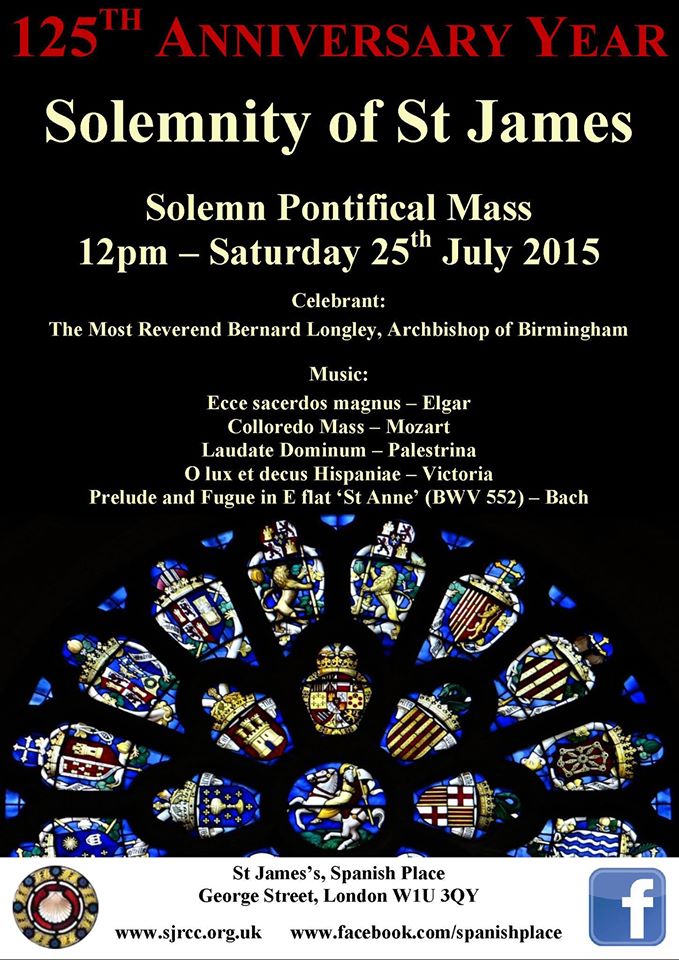
The Feast of St. James at Spanish Place

Today is the Feast of St. James the Greater. Every year on this feast day I think of the quip of my mother regarding my late father when deciding which was his patron saint, St. James the Greater or St. James the Lesser? She said immediately: "St. James THE Great". I certainly hope and pray that my father is a saint in heaven today.

In London, the parish of St. James Spanish Place is celebrating not only the patronal feast day but its 125th anniversary! From the parish's history page:

The visitor to St James's Church is often puzzled to know why a church which stands in George Street, W1, should have derived a kind of secondary title from a street called Spanish Place which can be found opposite the Presbytery door. The explanation is that St James's, Spanish Place, like so many of the older parishes in the Westminster diocese, can trace its origin to the penal times and to the benefactions of a friendly Catholic embassy. And this is perhaps the reason why, despite the magnificence of the church, there is within an atmosphere that breathes our Catholic past.

In the reign of Elizabeth I the Bishops of Ely let their palace and chapel in Ely Place to the Spanish Ambassador, and until the reign of Charles I it was occupied by the representative of the Court of Spain. During this period the chapel was freely used by English Catholics and became a place of sanctuary for them.

After the restoration of Charles II the Spanish Embassy was re-established in London, first on Ormond Street and then at Hartford house, Manchester Square, where the Wallace Collection is now housed. Here, in 1791, shortly after the first repeal of some of the laws affecting Catholic worship, a chapel was built on the corner of Spanish Place and Charles Street (now George Street), largely through the efforts of DOctor Thomas Hussey who had been a chaplain at the Embassy since his ordination in 1769. Most of the objects of piety in the present church are legacies from this older building which was famous enough in its day to be mentioned by Thackeray in
Vanity Fair as the church attended by the Marchioness of Steyne. . . .

In the year 1827 the official Spanish connection with the chapel ceased and it was handed over to the London Vicariate. However, there is much in the present church to remind us of our Spanish heritage including Alfonso XIII's personal standard which is in a frame over the sacristy door, and the parishioners of Spanish Place have never forgotten their debt to Spain for having established and maintained the mission in the dark days. An unofficial connection with the Embassy of Spain has continued and is still cherished by the Church of St James today. . . .

The site was purchased and the design for a new church was made an open competition. Edward Goldie, great grandson of the architect of the old chapel, Signor Joseph Bonomi, won the competition and the present edifice, partially completed, was opened on Michaelmas Day, 1890.

Happy Feast of St. James! St. James, pray for us!

Friday, July 24, 2015

More Martyrs in July: Blessed Joseph Lambton and St. John Boste

The Catholic Encyclopedia cites a horrible detail in the execution of Blessed Joseph Lambton, most likely on July 24, 1592 at Newcastle-on-Tyne:

English martyr, b. 1569; d. at Newcastle-on-Tyne. The day of his death is variously given as 23 June, 23 July, and 27 July, and the year as 1592 and 1593; but from a letter of Lord Huntingdon it is clear he died before 31 July, 1592, and Father Holtby's Stonyhurst manuscript says he died on a Monday, so that the probable date is 24 July, 1592. He was the second son of Thomas Lambton of Malton-in-Rydall, Yorks, and Katharine, daughter of Robert Birkhead of West Brandon, Durham. He arrived at the English College, Reims, in 1584, and at the English College, Rome, in 1589. Being allowed to curtail his theological course, he was ordained priest when only twenty-three, and sent on the mission on 22 April 1592. He was arrested at Newcastle on landing with [Blessed] Edward Waterson, and condemned at the next assizes under 27 Eliz., c. 2. He was cut down alive, and the reprieved felon who acted as hangman refused to complete the sentence, which was at last carried out by a Frenchman practicing as a surgeon at Kenton.

So half-strangled he had to wait on another executioner--perhaps the surgeon was able to complete the process more humanely than the felon would have!

On the same date, two years later, another martyr, St. John Boste, suffered in Durham:

Priest and martyr, b. of good Catholic family at Dufton, in Westmoreland, about 1544; d. at Durham, 24 July, 1594. He studied at Queen's College, Oxford, 1569-72, became a Fellow, and was received into the Church at Brome, in Suffolk, in 1576. Resigning his Fellowship in 1580, he went to Reims, where he was ordained priest, 4 March, 1581, and in April was sent to England. He landed at Hartlepool and became a most zealous missioner, so that the persecutors made extraordinary efforts to capture him. At last, after many narrow escapes, he was taken to Waterhouses, the house of William Claxton, near Durham, betrayed by one Eglesfield [or Ecclesfield], 5 July, 1593. The place is still visited by Catholics. From Durham he was conveyed to London, showing himself throughout "resolute, bold, joyful, and pleasant", although terribly racked in the Tower. Sent back to Durham for the July Assizes, 1594, he behaved with undaunted courage and resolution, and induced his fellow-martyr, Bl. George Swalwell [or Swallowell], a convert minister, who had recanted through fear, to repent of his cowardice, absolving him publicly in court. He suffered at Dryburn, outside Durham. He recited the Angelus while mounting the ladder, and was executed with extraordinary brutality; for he was scarcely turned off the ladder when he was cut down, so that he stood on his feet, and in that posture was cruelly butchered alive. An account of his trial and execution was written by an eye-witness, [Blessed] Christopher Robinson, who suffered martyrdom shortly afterwards at Carlisle.

Blessed Joseph Lambton was among the 85 Martyrs of England and Wales beatified by Blessed John Paul II, while St. John Boste was canonized by Pope Paul VI. Blessed George Swalwell, Blessed Christopher Robinson, and Blessed Edward Waterson are also among those beatified in 1987.

More Martyrs in July: Blessed Nicholas Garlick, Blessed Robert Ludlam, and Blessed Richard Simpson

Blessed Nicholas Garlick, Blessed Robert Ludlam, and Blessed Richard Simpson, three priests, suffered martyrdom on July 24, 1588 in Derby. They were beatified by Pope St. John Paul II among the 85 Martyrs of England and Wales in 1987. Bishop Challoner quotes this poem in his 1741 Memoirs of Missionary Priests:

When Garlick did the ladder kiss,
And Sympson after hie,
Methought that there St. Andrew was
Desirous for to die.

When Ludlam lookèd smilingly,
And joyful did remain,
It seemed St. Stephen was standing by,
For to be stoned again.

And what if Sympson seemed to yield,
For doubt and dread to die;
He rose again, and won the field
And died most constantly.

His watching, fasting, shirt of hair;
His speech, his death, and all,
Do record give, do witness bear,
He wailed his former fall.

It's neat when one can find a parish website commemorating the English martyrs, Blessed Nicholas Garlick and Blessed Robert Ludlam are featured on this site from the Catholic Church at Glossop in Derbyshire:

Who is Blessed Nicholas? None other than one of the martyrs of what is called the English Reformation. Nicholas was a local boy, from Dinting, about a half hour’s walk west from Old Glossop. The Catholic Encyclopaedia tells us that Nicholas was born in about 1555 and met his end at Derby in 1588, following his capture with his brother priest Robert Ludlum at Padley, also in the Peak District and to the south-east of Glossop.

A charismatic man, Nicholas seems to have had great influence, for example, during his time as school-master at Tideswell in the Peak, enough indeed that some of his pupils followed him to the seminary at Rheims in France, where men were being prepared for the missionary priesthood in protestant England, men who expected to meet a grisly end if they were arrested by the authorities (at a time when being a priest was considered in England to be an act of treason). Nicholas went there in 1581, was ordained and returned to England in 1583. He was arrested soon afterwards and exiled in 1585 with a warning.


The Catholic Encyclopedia tells more about the second and third priests who suffered that day:

With Garlick was arrested another priest, Robert Ludlam, or Ludham, who had, like Garlick, been at Oxford and had engaged in teaching before his ordination in May, 1581. In Derby Gaol, a small and pestiferous prison, they found a third priest, Robert Sympson, who was of Garlick's college at Oxford. There he had taken Protestant orders, but was soon after reconciled to the Church, for which he suffered long imprisonment in York Castle. In this trial his faith had grown stronger, but having been ordained and passed through many labours, including exile, he was again in durance and in danger of his life, and this time he was wavering. Garlick and Ludlam cheered, reconciled, and comforted their fellow-captive, and all three were tried and suffered together.

These martyrs are remembered annually with a pilgrimage and Mass at Padley Chapel; it was at Padley, the home of John Fitzherbert, that Fathers Garlick and Ludlam were captured. The Catholic Fitzherberts suffered much for their faith, including the invasion of their home on July 12, 1588 when these priests were captured, according to this site:

The special events which led up to the execution, and subsequent martyrdom of the two Catholic priests who were captured at Padley have been recorded many times, but briefly the main protagonists in the saga were:-

Sir Thomas FITZHERBERT, who married Anne, daughter of Sir Arthur EYRE. Inherited Padley through his marriage to Anne. Lived at Norbury, having handed over the tenancy of Padley to John, his younger brother. A staunch Catholic, he had been imprisoned in 1559 at Derby for his recusancy. Although he was later released, he was ultimately denounced by his nephew, imprisoned again and died in the Tower of London on 2nd October 1591.

John FITZHERBERT, Thomas's brother. Captured by George, Earl of Shrewsbury at Padley on 12th July 1588, with his son Anthony, three of his daughters, Matilda, Jane and Mary (married respectively to - Thomas BARLOW, Thomas EYRE and - DRAYCOTT), and ten serving men from the estate. Jane and Mary were placed in the custody of the Anglican Rectors of Aston, and Weston upon Trent. The others were taken to the county Gaol at Derby. John was reprieved of the death sentence, by an alleged payment of £10,000 in bribes; kept 2 years in Derby Gaol and then sent to Fleet Prison in London where he died on 8th November 1590.

Thomas FITZHERBERT, John's traitorous son, who betrayed his uncle Thomas. Had Norbury estate after his uncle died, but was refused Padley by arch-villain Richard TOPCLIFFE.

Richard TOPCLIFFE, a spy for the Privy Council, who persuaded Thomas to betray his uncle. Sir Thomas made a will whilst he was in the Tower, disinheriting his nephew, but Topcliffe managed to get hold of it, and destroyed it. He obtained Padley for himself after Sir Thomas and John's deaths, but lost it again after 1603 (when Elizabeth I died) to Anthony FITZHERBERT, Thomas's brother (who although captured in 1588 apparently survived!).

Wednesday, July 22, 2015

First in a Series: English Catholic Martyrs at the End of July

We're entering another period with a cluster of martyrs, starting today with two Popish Plot victims, canonized in 1970 among the Forty Martyrs of England and Wales.

Father Philip Evans, SJ and Father John Lloyd suffered martyrdom on July 22, 1679 in Cardiff, Wales. Although they were tried for supposed involvement in the Popish Plot, they were found guilty of their priesthood and their presence in Wales. This blog provides some detail about their background and contains this great understatement: "1678 was a bad year to be a Roman Catholic priest on the island of Great Britain. (There were many such years in in the 1600s.) But, in 1678, there was a fictional plot by Roman Catholic to assassinate King Charles II. (This was ironic, given the Roman Catholic sympathies of the House of Stuart.) Anyway, a wave of anti-Roman Catholic hysteria swept the land,where authorities political and religious had planted, watered, and nurtured anti-Roman Catholicism for a long time. And hysterical people did not check facts, to confirm or refute them. So the two priest-martyrs became prisoners. They became casualties of hysteria and religious bigotry. Their crime was to be priests, a charge considered on par with committing treason." That's because, of course, of the Elizabethan statute which declared the mere presence of an English Catholic priest in his own native land to be an act of treason.

As the site summarizes their careers: St. Philip Evans, educated at St. Omer Monastery in France, became a Jesuit in 1665, at age 20. Ten years later, at Liege, he entered the priesthood then embarked for his Welsh mission. For three years Evans ministered there.

St. John Lloyd, educated at Ghent (now in Belgium, but a Hapsburg domain) and at Valladolid, Spain (also a Hapsburg domain at the the time). Ordained at Valladolid in 1653, he began this twenty-four-year long Welsh mission the following year.


Among the priests who suffered during the Popish Plot hysteria, St. John Lloyd's long tenure as a missionary priest is not unusual: St. John Kemble served his flock in Monmouthshire for more than 50--fifty--years! and St. David Lewis, SJ served in Wales for 30 years. Pope Paul VI canonized today's martyrs (and John Kemble and David Lewis) among the Forty Martyrs of England and Wales in 1970. Since today is the feast of St. Mary Magdalen, their feast is usually observed--in parishes named for them, for instance, and in the dioceses of Wales, on July 23. They are also honored on October 25, the Feast of the Welsh Martyrs, and May 4, the Feast of ALL the Martyrs of England and Wales.

St. John Lloyd and St. Philip Evans, pray for us!