Friday, September 21, 2012

Spying in Elizabethan England

Appropriately enough after yesterday's post on the Babington Plot and Sir Francis Walsingham's spy network against Mary, Queen of Scots, here is a review from the U.K. Guardian newspaper of a book about spying in Elizabethan England:

The age of Elizabeth I, so often celebrated as a period of glorious national achievement, was one of intense insecurity. Beset by enemies at home and abroad, the Queen knew that her hold on the crown was always precarious. The Catholic powers of Europe regarded her as a heretic and a bastard. Pope Pius V tried to depose her. Philip II of Spain attempted armed invasion. The loyalty of English Catholics, unreconciled to her Protestant church settlement, was always in doubt.

Elizabeth created further anxiety by persistently refusing to nominate her successor. The stability of the regime thus depended entirely on her own personal survival. As one MP put it in 1567: "If God should take her Majestie, the succession being not established, I know not what shall become of myself, my wife, my children, lands, goods, friends or country."

Feelings of anxiety and distrust were intensified by an unending series of conspiracies and assassination plots. The Rising of the Northern Earls in 1569, the Ridolfi Plot of 1569-71, the Throckmorton Plot of 1583 and the Babington Plot of 1585-6 were only the best publicised of repeated attempts to dethrone the Queen by insurrection, foreign invasion or simple assassination. There were three such plots in 1596 alone. Many of these conspiracies sought to replace Elizabeth with the Catholic Mary Stuart, the ex-Queen of the Scots who had taken refuge in England after her forced abdication in 1568, and whose strong hereditary claim to the succession was terminated only by her execution in 1587. . . .

Confronted by these threats, the Elizabethan government embarked on a draconian policy of counter-terrorism. The laws of treason were extended to catch not just those who questioned Elizabeth's right to rule, but all missionary priests and those who sheltered them. Torture was not permitted by the common law, but special powers were invoked to justify its regular use to extract information from Catholic suspects. The procedure in treason trials gave the accused no chance of offering an adequate defence, and unsafe convictions were common. The standard penalty for traitors was to be hanged, cut down when still alive, castrated, disembowelled and dismembered. Over 100 Catholic priests suffered this fate. This was not enough for Elizabeth, who wanted her Privy Councillors to devise an even more terrible death for the Babington conspirators, who had planned to murder her.

In my book collection I have this interesting title, Tudor Underground, by Denis Meadows. Kirkus Reviews wasn't that thrilled in 1950, but perhaps I'll read it again some day:

Personalities, hangings and quarterings, spies and Elizabethan religious turmoil provide a tempestuous background for a relatively pallid story of religious conversion. Hugh Rampling, young Catholic heir of an aquiline-nosed (and therefore, of course, loyal) English family attempts to align his hereditary Catholicism with a neutralized religious position which his career with the Protestant Principal Secretary, of Queen Elizabeth, Sir Francis Walsingham, demands. Aiding in the Secretary's spy ring formed to root out Catholic infiltration into England, Hugh, in successful adventures with a female demon aiding the purge, pursuers in Rome and in other narrow squeaks, is on the way up. However, in the midst of this uneasy neutrality, Hugh meets one of the most coveted prizes of the State -- Father Persons, a Jesuit priest. Not only does the priest induce Hugh to allow him and other followers to escape, but brings Hugh back into the fold, and positive action for the Catholic mission. Some elements of a good story here, but Hugh as the hero is the usual blank cartridge bright boy not peculiarly adaptive to heavenly meditation. A sprawling, uneven historical.

Thursday, September 20, 2012

Traitors and A Poet: The Babington Plot

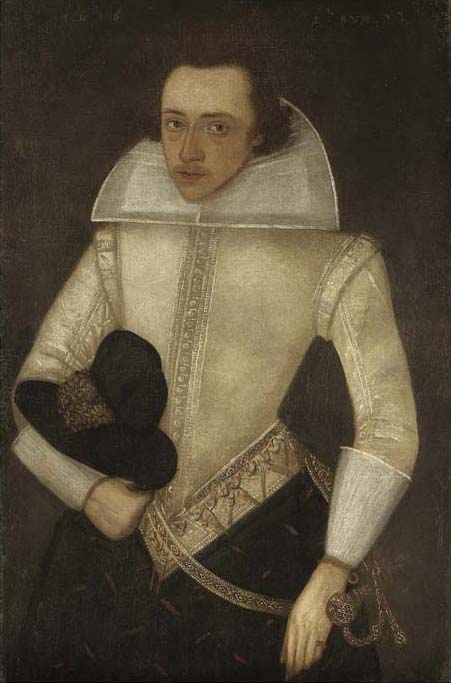
File:Portrait of young gentleman said to be Anthony Babington.jpg Anthony Babington (the portrait is from Wikipedia commons) was executed at St. Gile's Field on September 20, 1586, along with a Jesuit priest, John Ballard and several other conspirators--Chidiock Tichborne, Thomas Salisbury, Henry Donn among them. As traitors, of course, they were hung, drawn and quartered, but their executions and sufferings were so extreme--especially considering their relative youth--that the onlookers began to have sympathy for them. Queen Elizabeth ordered that the rest of the traitors to be executed were to be hung until dead (then cut up per the standard operating procedure).

Babington involved the imprisoned Mary, Queen of Scots in his plot to assassinate Elizabeth and bring Mary to the throne of England and this led to her execution within months. Beyond the plot's murderous intent, the disturbing aspect of this conspiracy is that Elizabeth's spymaster, Sir Francis Walsingham, knew about the plot because he had a double agent in place who also served as an agent provocateur. There is an element of entrapment--especially regarding Mary's replies to correspondence--in Walsingham's handling of the matter. As the BBC History site notes:

Walsingham loathed Mary and everything she stood for, and vowed to bring her down. It was to take him almost 20 years. But when he discovered in 1586 that she was corresponding with a group of Catholics led by the young Anthony Babington, he seized his chance.

For the first stage of his plan, Walsingham used a spy named Gifford to act as a double agent. Gifford persuaded the local brewer to encourage Mary to use him as a secret means of communicating with the outside world. By establishing a system whereby Mary's personal letters were carried in and out of Chartley (her current residence) hidden in a beer barrel, Walsingham was able to intercept and decode her correspondence. The relatively simple code used by Mary was quickly deciphered, and translations were provided for Elizabeth. These letters were then resealed and sent on to their destination or delivered to Mary in prison. And so the plot progressed.

Walsingham, meanwhile, was biding his time. Luckily for him, Babington and his friends were enthusiastic but inexperienced plotters and were happy to discuss their plans in public. It was therefore not difficult for the authorities to keep track of their movements. Having outlined his plans to Mary, Babington now tried to secure her participation in the plot. This was the moment Walsingham had been waiting for. When the vital letter from Mary asking for details was intercepted, a postscript was forged in her hand asking for the identities of the plotters. The names were duly supplied, and their fate was sealed. Mary's involvement in the plot had been proven, and a gallows was drawn on the page by the decoding expert. Walsingham could now move in for the kill.

Young Chidiock Tichborne wrote an elegy while in the Tower which gained some fame with its haunting contrasts (note that all but one of the words is but one syllable and "fallen" could be pronounced as one by elision):

Tichborne’s Elegy
Written with His Own Hand in the Tower Before His Execution

My prime of youth is but a frost of cares,
My feast of joy is but a dish of pain,
My crop of corn is but a field of tares,
And all my good is but vain hope of gain;
The day is past, and yet I saw no sun,
And now I live, and now my life is done.

My tale was heard and yet it was not told,
My fruit is fallen and yet my leaves are green,
My youth is spent and yet I am not old,
I saw the world and yet I was not seen;
My thread is cut and yet it is not spun,
And now I live, and now my life is done.

I sought my death and found it in my womb,
I looked for life and saw it was a shade,
I trod the earth and knew it was my tomb,
And now I die, and now I was but made;
My glass is full, and now my glass is run,
And now I live, and now my life is done.

The Tichborne family was solidly, adamantly, recusantly Catholic: Chideock's cousins Father Thomas Tichborne and his brother Nicholas were executed (because Thomas was a Catholic priest and his brother helped him to escape, in 1602 and 1601, respectively).

Wednesday, September 19, 2012

Catholic Revival in English Literature


The Catholic Revival In English Literature,1845-1961: Newman, Hopkins, Belloc, Chesterton, Greene, WaughSeveral years ago, I read Father Ian Ker's The Catholic Revival in English Literature, 1845-1961: Newman, Hopkins, Belloc, Chesterton, Greene, Waugh from the University of Notre Dame Press:

The Catholic Revival in English Literature, 1845–1961 presents a thorough discussion of the six principal writers of the Catholic revival in English literature—Newman, Hopkins, Belloc, Chesterton, Greene, and Waugh. Beginning with Newman’s conversion in 1845 and ending with Waugh’s completion of the triology The Sword of Honor in 1961, this book explores how Catholicism shaped the work of these six prominent writers.

John Henry Newman claimed in The Idea of a University that post-Reformation English literature was overwhelmingly Protestant and that there was no prospect of a Catholic body of literature. Describing this claim as “happily lacking in prescience,” Ian Ker persuasively argues that Newman, Hopkins, Belloc, Chesterton, Greene, and Waugh succeeded in producing a substantial body of literature written by Catholics who wrote as Catholics. These revivalists were not so much influenced by traditional themes of guilt, sin, and ceremony, as they were attracted to unexpected facets of Catholicism. The idea of a Catholic priest as a craftsman is a recurring motif, as is the celebration of the ordinariness and objectivity of Catholicism.

Ker’s compelling and intelligent reading of these six major writers will appeal to anyone with an interest in nineteenth- and twentieth-century English literature, or the relation between literature and theology.

Now I have, but have not yet commenced to read, Adam Schwartz's The Third Spring: G.K. Chesterton, Graham Greene, Christopher Dawson, and David Jones from Catholic University of America Press:
 
For most of modern history, Roman Catholics in Britain were a "rejected minority," facing hostility and estrangement from a culture increasingly at odds with traditional Christianity. Yet British Catholicism underwent a remarkable intellectual and literary renewal, especially in the twentieth century, drawing a disproportionate number of the age's leading minds into its ranks. The Third Spring unravels this paradox of a renascent Catholic culture within a post-Christian society. It does so through detailed profiles of the spiritual journeys and religious and cultural beliefs of four seminal members of that twentieth-century revival: G. K. Chesterton, Graham Greene, Christopher Dawson, and David Jones.

Although these four authors came from different backgrounds and wrote primarily in different genres, each converted to Roman Catholicism as an adult and made his new faith the foundation of his intellectual and artistic work. All of them judged the Church to be the last corporate voice of orthodox Christianity in a hitherto unmatched irreligious climate of opinion; and they concluded that the Roman Catholic vision of human nature, thought, history, and art was truer and richer than proposed by prevailing secularism. They thus built on the nineteenth-century "Second Spring" of British Catholicism proclaimed by John Henry Newman to create a fresh assertion of Roman Catholicism, one suited to an era of unprecedented unbelief: a Third Spring.

This book is the first detailed examination of these four authors as part of a Roman Catholic, counter-modern community of discourse. It is informed by extensive research in the writers' works, scholarship on them, and their personal papers. This study is also distinguished by its careful attention to the authors' cultural and religious contexts, and to the psychology and theology of conversion. It will therefore deepen understanding, and correct some misconceptions, of each man's spiritual development and his thought, while revealing the twentieth-century Catholic literary revival to be a distinct movement in both British and Roman Catholic thought.

And the author of The Third Spring here reviews yet another book on Catholics and English Literature: The Pen and the Cross: Catholicism and English Literature, 1850 to 2000 by Richard Griffiths from Continuum (2010):

Although The Pen and the Cross provides some insight into British Catholic imaginative writing and its historical context, its sympathies for favored literary critical models and for modernist and progressive theology preclude it from presenting a comprehensive portrait of the Catholic renascence or from appreciating what made it distinctive. . . .

As accurate as Griffiths’s descriptions of the nature and history of British Catholic intellectual life are, his analysis of them is marred by his interpretive frameworks. Griffiths shows a marked preference for writers whose work reveals “acceptance of modern trends in literature,” regarding them as a “refreshing departure.” His treatments of novels therefore privilege realistic fiction, which twentieth-century critics typically considered the foremost arena of forward-looking artistry. But this emphasis presents a grave problem for a synthetic investigation of Catholic literature. Although Griffiths claims correctly that realistic fiction has been the “dominant strain” in British Catholic narrative prose, he admits and discusses the substantial Catholic presence in other such genres, including historical fiction, detective stories, and fantasy. Yet his examination excludes utterly the finest Catholic fabulist, J. R. R. Tolkien.

Tuesday, September 18, 2012

Father John Gerard's Autobiography

Ignatius Press has reissued this translation of Father John Gerard, SJ's autobiography made by Father Philip Caraman, SJ , unexpurgated, with an introduction by Father James V. Schall, SJ:

Truth is stranger than fiction. And nowhere in literature is it so apparent as in this classic work, the Autobiography of a Hunted Priest. This autobiography of a Jesuit priest in Elizabethan England is a most remarkable document and John Gerard, its author, a most remarkable priest in a time when to be a Catholic in England courted imprisonment and torture; to be a priest was treason by act of Parliament.
Smuggled into England after his ordination and dumped on a Norfolk beach at night, Fr. Gerard disguised himself as a country gentleman and traveled about the country saying Mass, preaching and ministering to the faithful in secret - always in constant danger. The houses in which he found shelter were frequently raided by "priest hunters"; priest-holes, hide-outs and hair-breadth escapes were part of his daily life. He was finally caught and imprisoned, and later removed to the infamous Tower of London where he was brutally tortured.
The stirring account of his escape, by means of a rope thrown across the moat, is a daring and magnificent climax to a true story which, for sheer narrative power and interest, far exceeds any fiction. Here is an accurate and compelling picture of England when Catholics were denied their freedom to worship and endured vicious persecution and often martyrdom.
But more than the story of a single priest, the Autobiography of a Hunted Priest epitomizes the constant struggle of all human beings through the ages to maintain their freedom. It is a book of courage and of conviction whose message is most timely for our age.

This edition is unexpurgated because it includes Father Gerard's comments about the disagreements between the Jesuits and other missionary priests, including Father William Watson.

One of the most famous excerpts from this story is Gerard's account of his torture, as he was hung by his wrists (as St. Robert Southwell was) in the Tower of London:

My arms were then lifted up and an iron bar was passed through the rings of one gauntlet, then through the staple and rings to the second gauntlet. This done, they fastened the bar with a pin to prevent it from slipping, and then, removing the wicker steps one by one from under my feet, they left me hanging by my hands and arms fastened above my head. The tips of my toes, however, still touched the ground, and they had to dig the earth away from under them. They had hung me up from the highest staple in the pillar and could not raise me any higher, without driving in another staple. Hanging like this I began to pray. The gentlemen standing around me asked me whether I was willing to confess now. 'I cannot and I will not,' I answered. But I could hardly utter the words, such a gripping pain came over me. It was worst in my chest and belly, my hands and arms. All the blood in my body seemed to rush up into my arms and hands and I thought that blood was oozing from the ends of my fingers and the pores of my skin. But it was only a sensation caused by my flesh swelling above the irons holding them.
The pain was so intense that I thought I could not possibly endure it, and added to it, I had an interior temptation. Yet I did not feel any inclination or wish to give them the information they wanted. The Lord saw my weakness with the eyes of His mercy, and did not permit me to be tempted beyond my strength. With the temptation He sent me relief. Seeing my agony and the struggle going on in my mind, He gave me this most merciful thought: the utmost and worst they can do is to kill you, and you have often wanted to give your life for your Lord God. The Lord God sees all you are enduring - He can do all things. You are in God's keeping.
With these thoughts, God in His infinite goodness and mercy gave me the grace of resignation, and with a desire to die and a hope (I admit) that I would, I offered Him myself to do with me as He wished. From that moment the conflict in my soul ceased, and even the physical pain seemed much more bearable than before, though it must, in fact, I am sure, have been greater with the growing strain and weariness of my body... Sometime after one o'clock, I think, I fell into a faint. How long I was unconscious I don't know, but I think it was long, for the men held my body up or put the wicker steps under my feet until I came to. Then they heard me pray and immediately let me down again. And they did this every time I fainted - eight or nine times that day - before it struck five...


Sunday, September 16, 2012

The Long Reformation, redux

This might be an interesting new release: The Long European Reformation, second edition, by Peter G. Wallace, from Palgrave Macmillan:

Peter G. Wallace adeptly interweaves the influential events of the early modern religious reformation with the transformations of political institutions, socio-economic structures, gender relations, and cultural values throughout Europe. In this established study, Wallace:
* examines the European Reformation as a long-term process
* reconnects the classic sixteenth-century religious struggles with the political and religious pressures confronting late medieval Christianity
* argues that the resolutions proposed by reformers, such as Luther, were not fully realised for most Christians until the early eighteenth century.

Incorporating the latest research, the second edition of this essential text now features a new chapter on the Reformation and Islam, expanded discussion of gender issues, and a helpful glossary.

Table of Contents:

List of Maps
Abbreviations
Acknowledgements
Preface to the Second Edition
Introduction
PART I: THE WARP: THREADS OF REFORMATION HISTORIES, 1350-1650
The Late Medieval Crisis, 1347-1517
Resistance, Renewal, and Reform, 1414-1521
Evangelical Movements and Confessions, 1521-59
Reformation and Religious War, 1550-1650
PART II: THE WEFT: MAKING SENSE OF THE LONG EUROPEAN REFORMATION
Settlements, 1600-1750: Church Building, State Building, and Social Discipline
Rereading the Reformation through Gender Analysis
The Reformation and Islam: From Menace to Coexistence
Conclusions
Notes
Glossary
Select Bibliography
Index

I don't know if I'm that excited about "Gender Analysis" but much of the other content looks fascinating. I must admit that when I wrote Supremacy and Survival: How Catholics Endured the English Reformation, I did not know about this academic theory of the "Long Reformation". As I studied the English Reformation, however, it was clear to me that England endured religious change/reformation for hundreds of years, primarily because of the monarchy's authority over the church in England--whenever there was a change in monarchy, there was some change in religion. This pattern endures through the Tudor dynasty with Henry VIII's heirs, and manifests itself in the longer Stuart dynasty: James I to Charles I, Cromwell to Charles II; James II to William and Mary; Anne to George I: every change in the authority of the monarch or protector meant a change in religious settlement. Turns out that this is an ongoing theme of research, even in the English Reformation. See this course description from Sewanee, for example:

This course examines the role of ritual and worship in the religious history of England, ca. 1530 to ca. 1700. It studies the transformation of a traditional religion based on rituals into a religious system based as much on word as on rite. The course draws connections between these religious changes and the larger political, social, and cultural contexts in which they occurred.

Palgrave Macmillan provides a sample on their website (55 pages of material!) and some other interesting resources for this volume in their European History in Perspective series.

Saturday, September 15, 2012

Episode Seven of The English Reformation Today

In this episode, I'll discuss two major crises in the reign of Elizabeth I and their impact on Catholics in England: First: Mary, Queen of Scots' presence on the island and as Elizabeth's prisoner and Second: the Spanish Armada.

The English response to the failure of the Spanish Armada is fascinating and horrifying, as a series of executions in London and southeast England demonstrated how dangerous Catholic priests and laity were to the country--while Catholic nobles had offered their help to defeat the Armada. The sad story of Mary, Queen Scots meant that some Catholics did form conspiracies to dethrone Elizabeth and replace her with Mary--but Elizabeth's own spymaster, Sir Francis Walsingham encouraged the plots so much that it's not always clear how much entrapment led the conspirators on.

As fascinating as these historical events are, I really want to dedicate as much time as possible to the martyrs who died during this last half of Elizabeth's long reign: St. Margaret Ward. St. Robert Southwell, St. Philip Howard, St. Henry Walpole, and St. Anne Line.

Then I'll make the transition from Elizabeth I to James VI of Scotland as her heir, with some final remarks on the Tudor dynasty and a review of the status of Catholics in 1603, as James (Mary, Queen of Scots' son) headed south to London to be crowned King James I of England and start a new dynasty: the Stuarts.

I welcome all listeners of Radio Maria US to my blog, whether you're listening on one of their radio stations or on line or through one of their apps. I invite you to call in with questions and comments toll-free at 866-333-MARY(6279). Just a reminder, too, that podcasts of previous episodes of The English Reformation Today are available on the Radio Maria US website.

Friday, September 14, 2012

Anne Boleyn's Jailer Dies

Illustration: Anne Boleyn in the Tower, speaking with William Kingston, the Constable of the Tower. c1855Sir William Kingston, Constable of the Tower, died on September 15, 1540. On 28 May 1524 he became constable of the Tower at a salary of £100 and when Anne Boleyn and those accused of adultery with her were brought to the Tower, he was in charge.

He met Anne when she was conveyed to the Tower and he reported on her to Thomas Cromwell, for example, when he had to tell her of a delay in her execution:

"This morning she sent for me, that I might be with her at such time as she received the good Lord, to the intent I should hear her speak as touching her innocency alway to be clear. And in the writing of this she sent for me, and at my coming she said, "Mr. Kingston, I hear I shall not die afore noon, and I am very sorry therefore, for I thought to be dead by this time and past my pain." I told her it should be no pain, it was so little. And then she said, "I heard say the executioner was very good, and I have a little neck", and then put her hands about it, laughing heartily. I have seen many men and also women executed, and that they have been in great sorrow, and to my knowledge this lady has much joy in death. Sir, her almoner is continually with her, and had been since two o'clock after midnight."

The Tudors (show) wiki has more detail about him here, including his letters to Cromwell about her behavior and her requests--for example, for the Blessed Sacrament and her confessor.

The Triumph of the Cross and Mary's Sorrows


Last year I posted on Rood Screens in English churches before the Reformation: see that post here.

My latest article, exploring the Feast of the Triumph of the Holy Cross and the memorial of Our Lady of Sorrows, on the Pray the Mass blog will be posted early this morning here. Here's a preview:

The Feast of the Triumph of the Cross was observed in Rome in the late seventh century to commemorate the recovery of the Holy Cross by the Byzantine Emperor Heraclius in 629. St. Helena, Constantine’s mother, had found the True Cross in Jerusalem in the fourth century but the Persians had captured it and returned it after Heraclius defeated the Persian king Khosrau. The emperor returned it to Jerusalem, and this feast recalls that event.
 
But on a deeper level, of course, the Feast recalls Jesus’ triumph over death and the fulfillment of His great statement, “When I am lifted up from the earth, I will draw everyone to myself." (John 12:32, which serves as the Communion Antiphon). The liturgy of the Mass for this Feast includes both triumph and sorrow in the readings and prayers, since Jesus both suffers His Passion and defeats sin and death. From the Book of Numbers, the First Reading recalls the story of Moses and the bronze Seraph, raised on a pole—when the people Israel who had been grumbling against God for their sufferings, looked up to the serpent, they were healed of the serpent bites God had sent to afflict them. . . .

Earlier this month, Pray the Mass ran this article I wrote on Pope St. Pius X and Holy Communion--in it I demonstrate how I can find a link between my studies of the English Reformation and almost anything!:

As I’ve studied the English Reformation, I’ve read often about the state of religious practice before Henry VIII broke away from the Pope and established himself as Supreme Head and Governor of the Church of England. As Eric Ives points out in his recent study, The Reformation Experience, 16th century Catholics in England demonstrated great devotion to the Blessed Sacrament. At Sunday Mass, they were most attentive at the moment of consecration, worshipping the Body and the Blood of Jesus as the priest elevated the Host and the Chalice. At great shrines and cathedrals, the faithful wanted to see the Precious Body and Blood as each Mass was celebrated in separate chapels. The Feast of Corpus Christi was instantly popular in England with its processions and special liturgies as written by the Dominican friar, Thomas Aquinas. Holy Week, with its special vigil protecting the consecrated Host from Good Friday to Easter, also demonstrates their devotion to the Real Presence. The one thing they did not do is receive Holy Communion often. They were obligated to receive during the Easter Season (Easter Duty), but the practice of frequent Communion had fallen off during the Middle Ages. . . .

On this Feast of the Triumph of the Cross, the sad connection to the English Reformation is the destruction of the Rood Screens, the statutes or figure of the Mother of God and the Beloved Disciple standing on either of the crucified Christ, and the widespread iconoclasm repeated over and over again in England during the long period of religious change--even to the English Civil War when Parliamentary forces destroyed so much of the beauty restored by Archbishop of Canterbury William Laud. No wonder some call it the "English Deformation"!

Thursday, September 13, 2012

Sir John Cheke, Classical Scholar

John Cheke.jpgSir John Cheke died on September 13, 1557. He had been a great scholar at University of Cambridge, reformer of the mode of pronouncing Greek, and the tutor to Prince Edward, later Edward VI.

According to this site, he also took part in the change in succession from Princess Mary to Lady Jane Grey, and that clearly got him into some trouble when Mary I came to the throne:

His zeal for the protestant religion induced him to concur, on the death of Edward VI, in the settlement of the crown on the Lady Jane Grey, and he acted as secretary of state during her brief reign. Immediately after Queen Mary's accession he was committed to the Tower on an accusation of treason, 27 July 1553. He was discharged from custody on 13 Sept. 1554, and about the same time obtained a pardon and the royal license to travel abroad. After residing for some time at Basle he went to Italy, and at Padua he met some of his countrymen, to whom he read and interpreted some of the orations of Demosthenes. Subsequently he settled at Strasburg, where he read a Greek lecture for his subsistence.

At the beginning of 1556 he resolved to go to Brussels, where his wife was, chiefly in consequence of a treacherous invitation from Lord Paget and Sir John Mason. As, however, he was a firm believer in astrology, he first consulted the stars to ascertain whether he might safely undertake the journey, and fell into a fatal snare on his return between Brussels and Antwerp, for, by order of Philip II, he and Sir Peter Carew, with whom he was travelling, were suddenly seized by the provost-marshal on 15 May, unhorsed, blindfolded, bound, thrown into a wagon, conveyed to the nearest harbour, put on board a ship, under hatches, and brought to the Tower of London, where they were placed in close confinement. The alleged ground of his committal was, that having obtained license to travel, he had not returned to England by the time specified in his license.

In the Tower he was visited by two of the queen's chaplains, who tried in vain to induce him to alter his religious opinions. The desire of gaining over so eminent a man caused the queen to send to him Dr. Feckenham, dean of St. Paul's, a divine of moderate and obliging temper. Cheke had been acquainted with him in the late king's reign, and had tried to convert him to protestantism when he was a prisoner in the Tower. Cheke's courage began to fail at the prospect of the stake, and he was at his own request carried before Cardinal Pole, who gravely advised him to return to the unity of the church. Cheke dared hold out no longer, and Feckenham had the credit of effecting his conversion. He made in writing a profession of his belief in the real presence, and sent the paper by the dean of St. Paul's to the cardinal, with a letter dated from the Tower on 15 July, praying that he might be spared the shame of making an open recantation.

This request being refused, he addressed to the queen on the same day a letter in which he declared his readiness to obey all laws and orders concerning religion. After this, in order to declare his repentance for his rejection of the pope, he made a formal submission before the cardinal, as the pope's legate, and after being absolved he was received back into the Roman church. He was kept in prison for upwards of two months before he was allowed to make his public recantation. This was done on 4 Oct. in the most public manner before the queen, and for the sake of greater formality the reading of the palinode was preceded by an oration addressed to her majesty by Feckenham. Cheke was also obliged to read a longer form of recantation in presence of the whole court, and to promise to perform whatever penances might be enjoined upon him by the legate. After having submitted to all these humiliations he was released from the Tower, and regained his lands, which, however, he was forced to exchange with the queen for others.

Pining away with shame and regret for his abjuration of protestantism, he died on 13 Sept. 1557 in Wood Street, London, in the house of his friend Peter Osborne, remembrancer of the exchequer.

"The English Reformation Today" Podcasts


After the live Saturday broadcast of "The English Reformation Today", Radio Maria US repeats the show on Wednesday morning, and then the most recent podcast is uploaded to this page on their website.

Saturday, September 8's episode was the first part of a two part discussion of the reign of Elizabeth I and what it meant for Catholics in the 16th century:

Describe the legislation that established the Church of England as a via media compromise between Calvinism and Catholicism (The Book of Common Prayer and the Thirty-Nine Articles). Catholic Reaction: The Northern Rebellion.The controversial excommunication of Elizabeth I by Pope St. Pius V--casting suspicion on all Catholics in England and leading to recusancy and martyrdom. Stories of early martyrs like St. Edmund Campion and St. Margaret Clitherow.

The most relevant issue today of the episode is the issue of divided loyalty and obedience to authority. To whom did English Catholics owe their homage? Their queen or the pope? For some reason--and this would be an interesting research project--the sixteenth century political order could not apply Jesus's Gospel admonition to render unto Caesar what was Caesar's and to God what is God's to the vision of a united polity. In the sixteenth century there was little or no notion of diversity or certainly plurality. Throughout Europe the motto cuius regno, eius religio (the religion of the ruler was the religion of the ruled) prevailed. The pope's position as a temporal ruler of the Papal States also confused the issue: were Catholics being loyal to their own nation or to a foreign power? The English government was convinced that Catholics could not be loyal to England even temporally if they were loyal to Rome even spiritually.

Now, our situation in the United States has parallels but some important distinctions too: The United States Conference of Catholic Bishops has been pointing out since January this year, through the Fortnight for Freedom and even into the current political season, that religous liberty has been endangered by the U. S. Government through the HHS Contraceptive, Abortafacient, and Sterilization Mandate--especially because of the limited definition of a religious organization AND the lack of an opt-out conscience clause. Like the English Catholics of the sixteenth century, Catholic business owners, for example, have to choose between two loyalties, between their Church doctrine and the US Government law--if they wish to be faithful to God and His Church's teachings, they cannot comply with the state's new demands for loyalty. They will not suffer blood martyrdom, but they will be fined; they can fight the law in the Courts, but their risk is great. The most important distinction is that Catholics in the U.S.A. as citizens have opportunities/rights to campaign for change through legislation, the justice system, and the electoral system: Elizabeth I's Catholic subjects did not have these opportunities.

English Catholics pressed for a view that they were temporally loyal to Elizabeth I but spiritually loyal to Pope Pius V, and their respective successors. Elizabeth I, because of her instability on the throne, could not accept that view, although it was expressed by many of the Catholic martyrs even as they faced death--they could accept her as monarch but not as governor of the church in England. And then there came the "bloody question": when it came to armed conflict or invasion, with whom would they side, England or attacking Catholic power. That's the crucial question coming up in the next episode when we look at the Spanish Armada or the plots against Elizabeth I to replace her on the throne with Mary, the former Queen of Scots.

This Saturday, Sepember 15's episode will conclude the discussion of Elizabeth and introduce the new dynasty, the Stuarts of Scotland. By focusing on the two dangers to Elizabeth's throne, we'll also see the result of this divided loyality--even when Catholics DID support their country when facing invasion, they were punished by the state and when Catholics despaired of receiving any tolerance for their Faith in their own country, they turned to desparate measures, hoping for a change in leadership as the only means of relief:

Explain the two great dangers to Elizabeth and how they affected Catholics: her rivalry with Mary, Queen of Scots and the Spanish Armada (plots led by Catholics to depose Elizabeth and replace her with Mary on England's throne and the Catholic position on the Spanish Armada). Describe the wave of martyrdoms of Catholic priests and laity after the Armada: why are they martyrs?  Describe the end of the Tudor dynasty and the transition to the Stuart dynasty--the status of Catholics in 1603.

Once the Elizabethan government designated all Catholic priests as traitors and most Catholic laymen as potential traitors, a long-lived anti-Catholicism developed in England: a prejudice that certainly emigrated from England to New England in the 17th century.