Showing posts with label Lancelot Andrewes. Show all posts

Wednesday, September 25, 2019

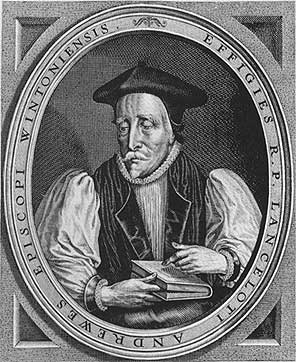
Bishop Lancelot Andrewes, RIP

Lancelot Andrewes, the Anglican minister and bishop, died on September 25, 1626 as the incumbent Bishop of Winchester. He's commonly thought of as a High Church Anglican. This blogger describes his career with an emphasis on his Eucharistic Theology:

Lancelot Andrewes, Laudian divine, early High Churchman, and one of the great preachers of his age, left a sizable impression on Anglican Eucharistic theology despite the paucity of his written works on the topic. Andrewes was a great advocate of frequent reception of the Eucharist and his sermons, including those before the courts of Elizabeth I and James I & VI, frequently expounded upon the great value of Communion. His Eucharistic theology, communicated principally in his published sermons and private devotions, emphasised the immense grace of the gift of the sacrament of Communion and the great benefits for unworthy humanity to be found in receiving it. Andrewes lived his life during a period of relative calm in the life of the Kingdom and Church of England. Born after the Elizabethan Religious Settlement and preaching for much of his career before her tolerant and theologically-learned Presbyterian successor, James, Andrewes enjoyed the luxury of an ecclesial environment where the most heated debates were generally academic in character, even when they were polemical. The great issues facing the Church of England in Andrewes’ day were the rise of Puritanism and the problems of recusancy and religious toleration. Of these Andrewes engaged mostly with the former, including in an early, oft overstatedly labelled ‘Puritan’ phase, the evidence for which is entirely in sets of unreliable notes taken by hearers of some of his earlier sermons. By the time Andrewes reached the greater heights of his career his Puritanism, if ever that had been an accurate label, had passed, and he faced the problem of working his Roman Catholic leanings into his written work and preaching in an age when ‘popery’ was a serious, career-ending accusation. Andrewes navigated this minefield of conscience and politik deftly and his sermons reflect far more of Calvinistic orthodoxy than do his private prayer and devotions.[1] However, all differences in emphases aside, the sources of Eucharistic theology which Andrewes has left to present a coherent picture of a clear theology with strong spiritual and ascetic leanings.

More on his life in the old Dictionary of National Biography here.

John Henry Newman translated Andrewes's private devotions from Greek into English and published them in Tract 88 of the Tracts for the Times (his next contribution would be Tract 90!). One can see how Andrewes would be a model for Newman's Via Media, as summarized from the (archived) blog post above:

Andrewes’ thought reflects his walking the line between Calvinistic and Roman Catholic theologies of the Eucharist. Andrewes rejected both the Calvinist theology of ‘virtual presence’ in the Eucharist and the doctrine of transubstantiation. His own teaching does not make clear any explicit theology of the presence or absence thereof of Christ in the Eucharist, though he did accept some form of real presence.

One can also see how Newman could not stop there: is Holy Communion the Real Presence of Jesus, Body, Blood, Soul, and Divinity or not? what does the one, holy, catholic and apostolic Church believe? what has it always believed? Newman couldn't find answers to those questions in Andrewes as he learned while studying the Fathers of the Church. 

Here is Newman's translation of Andrewes prayer before receiving Holy Communion:

O LORD,
I am not worthy, I am not fit,
that thou shouldest come under the roof
of my soul;
for it is all desolate and ruined;
nor hast Thou in me fitting place
to lay Thy head.
But, as Thou didst vouchsafe
to lie in the cavern and manger of brute cattle,
as Thou didst not disdain
to be entertained in the house of Simon the leper,
as Thou didst not disdain
that harlot, like me, who was a sinner,
coming to Thee and touching Thee;
as Thou abhorredst not
her polluted and loathsome mouth;
nor the thief upon the cross
confessing Thee:
So me too the ruined, wretched,
and excessive sinner,
deign to receive to the touch and partaking
of the immaculate, supernatural, lifegiving,
and saving mysteries
of Thy all-holy Body
and Thy precious Blood.
Listen, O LORD, our GOD,
from Thy holy habitation,
and from the glorious throne of Thy kingdom,
and come to sanctify us.
O Thou who sittest on high with the FATHER,
and art present with us here invisibly;
come Thou to sanctify the gifts which lie before Thee,
and those in whose behalf, and by whom,
and the things for which,
they are brought near Thee.
And grant to us communion,
unto faith without shame,
love without dissimulation,
fulfilment of Thy commandments,
alacrity for every spiritual fruit:
hindrance of all adversity,
healing of soul and body,
that we too, with all Saints,
who have been well-pleasing to Thee from the beginning,
may become partakers
of Thy incorrupt and everlasting goods,
which Thou hast prepared, O LORD, for them that love Thee;
in whom Thou art glorified
for ever and ever.
Lamb of GOD,
that takest away the sin of the world,
take away the sin of me,
the utter sinner. . . 

The hymnist and translator John Mason Neale matched Newman's translation of Andrewes' Greek devotions with his own translation of Andrewes' Latin devotions, and compiled, that results in the volume pictured above.

Sunday, September 25, 2011

Lancelot Andrewes, September 25, 1626--His Cathedrals and His Influences

The great Anglican divine, Lancelot Andrewes, Bishop of Chicheser, Ely and finally Winchester, overseer of the Authorized Translation of the Holy Bible (the King James version) died on September 25, 1626.

James I liked Andrewes' sermon style and he became Lord High Almoner, in charge of charity. Andrewes also preached the commemorative sermon after the discovery of the Gunpowder Plot, argued with Robert Bellarmine over the Divine Right of Kings, and tried to assist James I in convincing the Scots to give up the Kirk for the Church of England.

He is commonly thought of as an Anglo-Catholic, and his theology of the Eucharist was quite high for he believed in the Real Presence--although he did not quite accept transubstantiation as an explanation. Andrewes celebrated Holy Communion with candles, incense, and beautiful altar furnishings (in private). His Private Devotions were translated from the Greek by Blessed John Henry Newman and from the Latin by John Mason Neale in this edition. This article describes Newman's interest in the Caroline divines of the 17th century. Remember also that T.S. Eliot admired Archbishop Andrewes.

Ely Cathedral, one of the cathedrals he would have known, is a Norman style cathedral. Before the English Reformation, it would have been the site of many pilgrimages to the shrine of St. Etheldreda. According to the cathedral web site today:

She was the daughter of Anna, king of East Anglia, and was born, probably, at Exning, near Newmarket in Suffolk. At an early age she was married (c.652) to Tondberht, ealdorman of the South Gyrwas, but she remained a virgin. On his death, c.655, she retired to the Isle of Ely, her dowry. In 660, for political reasons, she was married to Egfrith, the young king of Northumbria who was then only 15 years old, and several years younger than her. He agreed that she should remain a virgin, as in her previous marriage, but 12 years later he wished their marital relationship to be normal. Etheldreda, advised and aided by Wilfred, bishop of Northumbria, refused. Egfrith offered bribes in vain. Etheldreda left him and became a nun at Coldingham under her aunt Ebbe (672) and founded a double monastery at Ely in 673. (from FARMER, David: The Oxford Dictionary of Saints, 3rd ed. OUP, 1992.) . . .

For centuries, Etheldreda's shrine was the focus for vast numbers of medieval pilgrims.

It was destroyed in 1541, but a slate in the Cathedral marks the spot where it stood, and the 23 June and 17 October are still kept as major festivals in the Cathedral. Some relics are alleged to be in St Etheldreda's Church, Ely Place, London (where the bishops of Ely formerly had their London residence). Her hand, which was discovered in a recusant hiding place near Arundel in 1811, is claimed by St Etheldreda's Roman Catholic church at Ely. . . .
Work on the present Cathedral began in the 11th century under the leadership of Abbot Simeon, and the monastic church became a cathedral in 1109 with the Diocese of Ely being carved out of the Diocese of Lincoln. The monastery at Ely was dissolved by Henry VIII in 1539. Ely suffered less than many other monasteries, but even so, statues were destroyed together with carvings and stained glass. St Etheldreda's Shrine was destroyed.

The Cathedral was refounded with a Chapter of eight canons in 1541 as was the Kings School. Robert Steward, the last Prior of the monastery, became the first Dean.

I like that choice of words: "is claimed by"! That the former Prior became the first Dean was a pretty common event in the "transition" from the dissolution of the monasteries to the establishment of new cathedral chapters.

Another of Andrewes' cathedrals was Chichester: St. Richard of Chichester was the main draw before the Reformation:

Richard of Wych, bishop of Chichester from 1245 - 1253, was canonized in 1262 when plans were made to move his body from its first burial place in the Nave to the Retroquire. The ceremony of translation took place on 16 June 1276, in the presence of King Edward I. From that day until the shrine was destroyed in 1538, the Shrine of St Richard attracted pilgrims from all over England and beyond. In 1930 an alter (sic) was restored to the site of the shrine.

Finally, Winchester, which I have noted before in the Sunday Shrine Series.

Saturday, September 17, 2011

St. Robert Bellarmine and the English Reformation

Today's saint has connections to England and the aftermath of the English Reformation. First, his book addressing Protestant teaching and doctrine, The Controversies, based on lectures he gave at the Roman College, proved so effective that Queen Elizabeth I banned its publication and distribution in England.

Robert Bellarmine conducted disputations with James I of England and one of the king's favorite Anglican bishops, Lancelot Andrewes. Bellarmine did not support James I's doctrine of the Divine Right of Kings, arguing that the true source of political power was indeed from God, but that the power of the king or magistrate depended on the consent of the people and that, indeed, the people may withdraw their consent and change the form of government. This scholar even argues that Bellarmine's disputations with King James I provided Thomas Jefferson with some of the terminology of the Declaration of Independence.

For example:

Equality of man

Declaration of Independence: “All men are created equal; they are endowed by their Creator with certain inalienable rights.”

Bellarmine: “All men are equal, not in wisdom or grace, but in the essence and nature of mankind” (“De Laicis,” c.7) “There is no reason why among equals one should rule rather than another” (ibid.). “Let rulers remember that they preside over men who are of the same nature as they themselves.” (“De Officus Princ.” c. 22). “Political right is immediately from God and necessarily inherent in the nature of man” (“De Laicis,” c. 6, note 1).

The source of power

Declaration of Independence: “Governments are instituted among men, deriving their just powers from the consent of the governed.”

Bellarmine: “It depends upon the consent of the multitude to constitute over itself a king, consul, or other magistrate. This power is, indeed, from God, but vested in a particular ruler by the counsel and election of men” (“De Laicis, c. 6, notes 4 and 5). “The people themselves immediately and directly hold the political power” (“De Clericis,” c. 7).

The late great Fr. Hardon provides this overview of Bellarmine's life and works. He died on September 17, 1621 and was proclaimed a Doctor of the Church on the same date in 1931. The Art of Dying Well is certainly one of those works that contributed to his being named a Doctor of the Church.