Showing posts with label Titus Oates. Show all posts

Tuesday, August 20, 2019

The Popish Plot: William Bedloe, RIP

William Bedloe who assisted Titus Oates in perjury and false accusations against Jesuit priests and other Catholics in the Popish Plot during the reign of King Charles II died on August 20, 1680. His entry in the Dictionary of National Biography, written by Joseph Woodfall Ebsworth, denounces him as a "dishonest adventurer and 'evidence' in the Popish plot". Bedloe was complicit with the conviction of at least one innocent man, Blessed Edward Coleman or Colman.

His biographical entry describes his duplicity with dizzying detail:

He claimed for himself the attainment of proficiency in Latin, heraldry, and mathematics. David Lewis, the Jesuit, who was afterwards executed at Monmouth, took notice of the boy when he was twelve years old, and taught him much, with intent of converting him. When aged twenty, in 1670, he travelled to London with one hundred pounds in his pocket, and lived near two Jesuits, Father Harman and Father Johnson. They dined at Locket's ordinary, and were said to adjourn to Mother Cresswell's. Bedloe certainly lived a sharping life in London before he went to Dunkirk, where he was recommended by the lady abbess to Sir John Warner, who sent him to Father Harcourt, the Jesuit, afterwards executed on the evidence of Oates. By his own account, William Bedloe went to Rome, Flanders, Spain, &c., carrying letters; but opened them and made forged copies, which he delivered, retaining the originals. He bore an alias of Captain Williams, under which he cheated the Prince of Orange, and from him, by fraud, obtained a captain's commission. But this captaincy was as apocryphal as the 'invisible degree' of doctor won by Titus Oates at Salamanca. Five years of varied service, intrigues, frauds, and broils, prepared him, with occasional employment by the Jesuits, for emerging into notice as a betrayer and forsworn spy. He declared that Titus Oates had anticipated and outstripped him in making revelations of the popish plot. At the beginning of August 1678, he confessed that he 'had once been an ill man, but desired to be so no more.' He wrote from Bristol, offering to make startling declarations. The Earl of Danby gave little credit to him; and in revenge for this, Bedloe asserted that a bribe was offered to him by Danby, who promised that he should be supported in whatever country he chose to retire into, if he would suppress his threatened revelations. The commons accepted his account of the murder of Sir E. B. Godfrey, and gave him 500l. The extant portrait of Bedloe, prefixed to his 'Narrative' of the fire of London having been caused by the papists, shows a villainous countenance, harsh and forbidding, full of malice and revenge. With beetle brows, hard mouth, and savage eyes, we see the man, unscrupulous, unrelenting, as he in later life became. Dressed in finery beyond his station, his arrogance is as self-evident as his malice. He declared that Counsellor Reading had tried to tamper with him for suppression of his testimony, and Reading was condemned to a year's imprisonment, with exposure for an hour in the pillory, and to pay a fine of 1,000l. Bedloe made many accusations and found willing associates. The king's chemist, Dr. James, deposed that one Dr. Smith, a papist, tried to make him poison Bedloe with a pill on 20 March 1679. By this time he was almost as popular as Oates. He received ten pounds weekly allowance from the royal funds, and lived at the rate of two thousand a year. Rich dupes were plentiful. The citizens feasted him. His folio pamphlets, with copperplate portrait prefixed, had a large sale. He attributed the most extensive plots and execrable crimes, falsely, to the Romanists.

Bedloe went too far, however, and was facing distrust and waning influence when he died:

Then he was recalled to London in the middle of July 1680. He was now, with Oates, experiencing the fickleness of fortune and the waning of popularity. Sir George Jeffreys [left], on the bench, told him sharp truths, and he felt his power deserting him. He retreated back to Bristol, where he had left his wife Anna, who, in her illness, summoned him, at beginning of August. He fell ill after his hurried journey, having 'broken his gall' by violent riding. He was said to be past cure. At the commencement of the assizes on 16 Aug., Sir Francis North, chief justice of the common pleas, attended Bedloe, and took his dying deposition. There had been a promise of fresh revelations, but none of importance were forthcoming. He reiterated old statements as really true, his wife being beside him. James Bedloe [his brother] made immediate application for money from King Charles, through North, next day. This application, 'that his sickness was very changeable, and that money was required for his subsistence,' explains the persistence of the family in the accusation of the Jesuits. William's death took place on Friday, 20 Aug. 1680.

When Sir George Jeffreys, later of the Bloody Assizes (as featured in the Errol Flynn movie Captain Blood) turns against you, you're in trouble. Although Jeffreys would later serve James II as Lord Chancellor, he was no friend of Catholics and was certainly ready to find them guilty of treason--as was Sir William Scroggs, Lord Chief Justice at the time of the Popish Plot--and it was not until the end, nearly, of all the trials and executions, that these judges began to see the perjury of Oates, Bedloe, and others.

Although Ebsworth denounces Bedloe, he's no friend of Catholics either, using the terms Romanists and Papist, and Romanism (in his biography of Edward Coleman, Bedloe's chief victim).

Wednesday, February 15, 2017

Another Victim of Titus Oates' Perjury

Today is the feast of St. Claude de la Colombiere, SJ who died on February 15, 1682. In a way, he is a victim of the Popish Plot, according to this biography published on the Jesuits in Britain website:

Claude found himself sent to England, to London where, seventy years after the Gunpowder Plot, there was still hostility to Catholics. Claude was sent to be Chaplain to the Duke and Duchess of York, both Catholics. The Duke was the younger brother and heir-presumptive of the reigning King Charles II; the Duchess, Mary of Modena, was a devout Catholic. As King James II & VIIth, he would become the last Catholic monarch of England, Scotland and Ireland until deposed in the “Glorious Revolution” of 1688. Charles II had granted the couple special permission to maintain a chapel in St. James’s Palace. English Jesuits were still, in those days, in considerable disarray and English Catholic priests would not have been permitted to occupy such a prominent posting. Fr Claude was given a modest apartment in the Palace and moved in on October 13th, 1676.

Fr Claude found it difficult from the beginning. That first London winter seems to have been severe. Perhaps imprudently, he would not hear of any extra heating in his sparse apartment. He admits to finding London cuisine inedible. Physical hardship was not the worst of his unhappiness. The morals of the Restoration era (broadly 1660 – 1710) were lax and louche, as the contemporary literary evidence shows. Claude was distressed by what he saw but he refused to harangue; instead, he returned again and again, in his preaching, to the Eucharistic love of Christ’s heart. Another biographer notes that “he breathed good will” and that there was “nothing of Savonarola about de la Colombiere”. Fr Claude’s spiritual diary of that time records an increasing devotion to St Francis de Sales; in Claude’s preaching we find a similar emphasis on the tenderness of God’s mercy, and an amazement at the contrast between God’s unlimited love and the boundless ingratitude that people show in return. This would surely have recalled, for Claude, those spiritual conversations and discernments in the Pray-le-Monial days.

Trouble lay ahead. Seventeenth-century London was an ambiguous place and not safe for Catholics, especially Jesuits. An entirely fictitious conspiracy, dreamt up by one Titus Oates, gripped both the English and Scottish kingdoms between 1678 and 1681. Catholics, it alleged, were plotting against the life of Charles II. The Jesuits in England were to carry out the “Popish Plot” (there had been a popular, hysterical assumption that the Great Fire of London in 1666 had been ignited by the Jesuits). Oates claimed to have attended a meeting, in a pub on The Strand, which discussed the Jesuits’ tactics. Caught up in this wave of frenzy, Claude was denounced by someone whom he thought he could trust. Imprisoned in November 1678 in an unheated filthy dungeon, he suffered a rapid deterioration in his health. Claude was charged with traitorous speech against the King and parliament. He was deported back to France and, seriously ill, slowly made his way back to Paray. There, his health broken and after one final meeting with St Margaret Mary, he died, 41 years old, on February 15th 1682.

Pope St. John Paul II canonized St. Claude in 1992.

Thursday, July 14, 2016

Blessed Richard Langhorne

Blessed Richard Langhorne (c. 1624 – 14 July 1679) was a barrister executed as part of the Popish Plot. He was admitted to the Inner Temple in May 1647 and called to the bar in November 1654. He provided legal and financial advice for the Jesuits.

His wife, Dorothy, was a Protestant from Havering in Essex. His sons Charles and Francis were both priests. When, in October 1677, Titus Oates was expelled from the English College at St Omer "for serious moral lapses", Charles Langhorne entrusted Oates with a letter to his father. Oates returned to St Omer with a letter from Richard thanking the Jesuits for all they had done for his sons.

When Oates and Israel Tonge unleashed their Popish Plot in September 1678, three Jesuits and a Benedictine were arrested. Langhorne was arrested a week later, imprisoned at Newgate and charged with Treason. Oates claimed, corroborated by William Bedloe, that Langhorne's earlier correspondence dealt with treason.

He was found guilty of High Treason. As the result of a petition by his wife, a ‘true Protestant’, he received a month's reprieve to tidy the affairs of his clients. He was executed at Tyburn, London, on 14 July 1679. According to the Benedictines at Tyburn Convent, "He declared on the scaffold at Tyburn, that not only a pardon, but many preferments and estates had been offered to him if he would for sake his religion. As the hangman was placing the rope round his neck, he took it into his hands and kissed it."

This notice from The Tablet archives has this additional detail about his execution from a contemporary account:

"He then said, 'Pray God bless his Majesty and this kingdom, and defend him from all his enemies '; and then prayed that there might be no more blood shed, and that God would forgive them that designed or rejoyced in his death, and suddenly added, 'I shall say no more in publick.' And presently applyed himself to his private devotions, and by some words which he spake lowder than ordinary it appeared that some of his prayers were in Latin and some in English. One near him saying, the Lord have mercy on his soul,' he, turning to him, said, I thank you for your charity.' Having continued about a quarter of an hour in his private ejaculations (though the sheriff told him he might take half an hour if he pleased), he asked whether the rope were right. A while after he said, You need stay no longer for me.' Upon which the cart was immediately drawn away, and the hangman, having struck him on the breast and pull'd his legs to dispatch him, he was stripp'd, and being quite dead, was cut down and the sentence executed upon him. . . .

"After his bowels were burnt and his body quartered according to his sentence, his corps was, by his Majesty's most gracious order, delivered to his friends, who put it into a hearse, with escutcheons about it, and was afterwards interred in the Temple church, in which place he was once a student of the laws."


On 15 December 1929, he was beatified by Pope Pius XI.


As I've noted before on this blog when discussing the Popish Plot, England's justice system benefited the accuser and gave little leeway to a defendant trying to prove a negative: Langhorne could not prove their interpretation of his letters was wrong. Samuel Pepys and other defendants finally received some measure of justice because Judge Scrogg figured out Oates' and his confreres' perjury. Samuel Pepys was accused that same year of giving naval secrets to the French and of being a Catholic, just because of his loyalty to James, the Duke of York. He spent six months in the Tower of London and eventually established, not his innocence per se, but his accuser's guilt. Pepys was cleared of charges and reinstated as Secretary to the Admirality--in 1684!

Blessed Richard Langhorne, pray for us!

Tuesday, December 29, 2015

The Popish Plot and The Howard Family

The Howard family boasts two martyrs: St. Philip Howard who died in the Tower of London during Queen Elizabeth I's reign (denied the opportunity to see his son before he died unless he denied his Catholicism and professed to be a Protestant!) and his grandson, Blessed William Howard, who was beheaded on December 29, 1680 on Tower Hill.

William Howard was born on November 30, 1614, the son of Thomas Howard, who had conformed to the Church of England. William married Mary Stafford in a Catholic ceremony in 1637 and they had nine children. The Howard family, being Royalists, fled to the Netherlands during the English Civil War and returned to England with the Restoration of Charles II, being restored to his lands. Three of their daughters became nuns on the Continent and his wife died in 1692; James II had provided her with a pension.

He was accused by Titus Oates of being part of the non-existent Popish Plot and was tried by his peers in the House of Lords in Westminster Hall. One of his witnesses was arrested and died in jail. Howard was, of course, found guilty, attainted and his lands forfeit. The British Museum has a print that depicts his trial and execution.

He protested his innocence throughout the trial and on the scaffold:

Next he lift up his hands, standing up, and said. "I beseech Thee, God, not to avenge my innocent blood upon any man in the Whole kingdom ; no, not against those who by their perjuries have brought me here. For I profess before Almighty God that I never combined against the King's life, nor any body else, but whatever I did was only to procure liberty for the Romish religion. And, as for the Duke of York, I do here declare, upon my Salvation, I know of no design that he ever had against the King, but hath ever behaved himself, for ought I know, as a loving, loyal brother ought to do.
So now, upon my Salvation, I have said true all that I have said. And I pray God to have mercy upon my soul." . . .

After which he went round the scaffold and spake to the multitude thus, "I pray God, bless the King, and bless you all, especially the King's loyal subjects (such as I am myself) for I know you have a good and gracious King as ever reigned. God forgive me my sins, I forgive all the world, even those fellows that brought me here, and pray God to send them no worse punishment than to repent and tell the truth. And so, God bless you all."

And some replyed, "God have mercy upon your soul." Then a minister applyed himself, and said, "Sir; you did disown the indulgences of the Romish Church."

To which he answered, with a great passion.

"Sir ; what have you to do with my religion? Pray do not trouble me. However, I do say that the Church of Rome allows no indulgences for murder, lying, &c., and whatever I have said is true. What need you trouble yourself?"

Min. "Have you received no absolution?"

Answ. "I have received none at all. Sir, trouble not yourself, nor me."

Min. "You said that you never saw those witnesses."

Answ. "I never saw any of them but Dugdale, and that was at a time when I spoke to him about a footboy, or a foot match."

Then his man took off his periwig and upper coat, and with a pair of sizers (sic) cut off the collar of his masters shirt, after which, W.S. lyes down in a white satin waistcoat, a quilted sky-coloured silk cap, with lace turn 'd up, &c.

He gave his watch to a gentleman, crucifix to his page, his staff and paper to another.

Having fitted his neck to the block, rise up upon his knees and prayed to himself, then takes the block and embraced it, then 'his servants cut off more of the linen, in all which time he sent up short prayers, that Christ would receive his spirit. Then lying down and praying upon the block, the sheriff Cornish askt' of the headsman, in kindness to W.S., if he had given him any sign. He answered "No."
 
Whereupon W.S. rose up in a consternation and asked what they wanted. To which it was answered, "What sign will you give, Sir?"

Answ. "No sign at all. Take your own time. God's will be done."

Whereupon the executioner said, "I hope you forgive me?"

He made answer, "I do." Then lying down again, two of his servants came with a piece of black silk to receive the head. Then the headsman took the Axe in 'his hand, and after some pause gave the blow, Which was cleverly done, save the cutting off a little skin, which was cut off immediately with a knife. 

In 1824 his great-great-great grandson George William Jerningham requested Parliament to reverse the attainder against William Howard and restore the title Viscount Stafford, which he then inherited.

Pope Pius XI beatified William Howard in 1929.

Thursday, December 3, 2015

The First Popish Plot Victim


Blessed Edward Coleman was the first victim of the Popish Plot (except for truth and justice):

A controversialist, politician, and secretary of the Duchess of York, date of birth unknown; executed at Tyburn, 3 December, 1678. He was the son of a Suffolk clergyman and, after a distinguished career at Cambridge, became a Catholic and was employed by the Duchess of York. As her secretary he became acquainted with continental statesmen from whom he sought pecuniary help when in difficulties. In 1675 he offered his services in favour of Catholicism to Père La Chaise, the confessor of Louis XIV; again in 1676 he was in communication with Father Saint-Germain, offering his assistance to prevent a rupture between England and France. These attempts to procure money failed, but he succeeded later in obtaining £3500 from three successive French ambassadors whom he supplied with daily information regarding the proceedings of Parliament. He became a suspected character, and on the discovery of the Titus Oates Plot, conceived in 1678 for the ruin of the Duke of York whose Catholicity was suspected Coleman was named as one of the conspirators. Conscious of his innocence he took no steps to protect himself, allowed his papers to be seized, and gave himself up for examination. He was tried 28 Nov., 1678, being accused of corresponding with foreign powers for the subversion of the Protestant religion, and of consenting to a resolution to murder the king. His defense was that he had only endeavoured to procure liberty of conscience for Catholics constitutionally through Parliament, and had sought money abroad to further this object. He denied absolutely any complicity with the plot against the king's life. His foreign correspondence of 1675 and 1676, when examined, proved him to be an intriguer, but contained nothing that could connect him in any way with designs on the king's life. However, in spite of the flagrantly false testimony of Oates and Bedloe, he was found guilty, drawn to Tyburn, and there executed. He was a good linguist, writer, and controversialist. His controversy with Drs. Stillingfleet and Burnet resulted in the conversion of Lady Tyrwhit to the Catholic religion. His writings were: "Reasons for Dissolving Parliament", "Two Letters to M. La Chaise, the French King's Confessor" (London 1678, reprinted in Cobbett's "Parliamentary History"; "The Tryal of Edward Coleman" etc. (London, 1678); "Legacies; a Poem", etc. (London, 1679).

He was beatified on 15 December 1929 by Pope Pius XI. Wikipedia gives more detail, from the Dictionary of National Biography in its entry for this martyred victim of Titus Oates' Popish Plot.

Saturday, June 20, 2015

Five Jesuit Victims of the Popish Plot

The Jesuits in Britain website gives some background to the Popish Plot, specifically how intra-Catholic conflict contributed to the anti-Jesuit, anti-Catholic conspiracy dreamed up by Titus Oates:

There were two separate forces behind the Popish Plot (known to some Catholics as the Presbyterian Plot). One was political. For many years the old Cromwellian Lord Shaftesbury and the puritan (Whig) faction had been stoking the fires of religious hatred against Catholics and France, in a long game to end absolute monarchy and once again to depose a king. Charles II openly favoured religious toleration of Catholics. This meant a significant minority in parliament always voted with the king. The Whigs therefore wanted to eliminate the Catholics in parliament. The Plot was constructed against the Catholics at court – the Queen, the Duke and Duchess of York, and their clergy, many of whom were Jesuits. The ultimate target, the King, exerted his energy to defend his Queen and his brother. He could not defend all the accused despite the clearly absurd nature of the accusations.

Non Jesuit Catholics were seeking an oath of allegiance to the King which could be accepted by Rome and allow them constitutional rights. Jesuits always blocked this, being unable to compromise their obedience to the pope. In this way they made an enemy of Dr. Sergeant, a secular Catholic priest – the secondary force which caught so many Jesuits in the plot. Early in the onset of hysteria Dr. Sergeant made false denunciations of Jesuits to the Privy Council which lent credence to the plotters. . . .


More on Father John Sergeant here, who seems to have been a contentious figure. This page on the Jesuits in Britain website includes his portrait.

On June 20, 1679, Fathers John Gavan, William Harcourt, Anthony Turner, Thomas Whitbread, and John Fenwick all suffered execution at Tyburn, but not without added drama:

Some of the first to be arrested were the Jesuits who had spurned Oates at St. Omer – William Ireland and Bl Thomas Whitbread who was English provincial. Fr Whitbread was tried in June 1679 alongside fellow Jesuits John Fenwick, John Gavan, William Harcourt and Anthony Turner. Fr Gavan, who was the spokesman, presented an eloquent defence. A brave group of Jesuit novices travelled from St. Omer to give evidence that Oates had been at St Omer's on crucial dates when he claimed to be in London witnessing Jesuit plotting. But the judges argued that as Catholic witnesses could receive a papal dispensation to lie on oath, they were not credible.

The five were hanged at Tyburn where the crowd stood in silence for an hour while each made a speech maintaining his innocence. On the scaffold they were offered the King’s pardon on condition they admit their guilt, but all refused.

Pope Pius XI beatified these five martyrs in 1929; St. Giles-in-the-Fields would be well-worth a visit on a pilgrimage to London, as they, and six other Popish Plot martyrs, are buried there. Perhaps they should be exhumed, however, and reburied at Stonyhurst, where they could receive more appropriate honors and devotion?

Saturday, May 30, 2015

Samuel Pepys and the Popish Plot


Accusations of treason against Samuel Pepys were a side product of the Popish Plot: he was accused of being a Catholic (treason enough in England then) and of providing naval secrets to France. The two authors provide tremendous detail about Pepys' accuser, John Scott, the English justice system, the conspiracy against Pepys, and the defense Pepys is able to muster through his contacts and connections. The main connection against him, however, was that his mentor was Charles II's Catholic brother and heir, James, the Duke of York. The main thrust of the Popish Plot was to arrest, try, and execute Jesuit and other Catholic priests, primarily to harm the Jesuits, and Titus Oates took the lead as witness in that project.

The conspiracy against Samuel Pepys was led by John Scott, whose back story almost hijacks this book, as Long and Long trace his history, enumerate his crimes and scams, and detail his difficulties as a witness: he began to get confused about which lies he had told the Court. His animus against Pepys is part of the wider conspiracy against the Duke of York, as Parliament debated the Exclusion Act to keep the Catholic heir from the throne.

Long and Long dedicate a chapter to a Catholic layman who tried to mount the same kind of defense as Pepys, Richard Langhorne, who did have strong links to the Jesuit mission in England since he was their attorney, managing practical matters. Langhorne did not have the same connections Pepys had, however, and he was manifestly a Catholic, but he attempted throughout his trial to show that Titus Oates and William Bedloe were not reliable witnesses and could not have witnessed events as they said, for example, because they were somewhere else on certain dates. Langhorne tried to point out inconsistencies in their testimony but according to Long and Long, the court prevented many of those attempts. His witnesses were also roughed up and threatened.

This untold story has been thoroughly told but since the authors focus so much on the details of Pepys' efforts to make contacts to build his defense, including all the difficulties of conflicting interests, mail service, and diplomatic entanglements, when the case against him falls apart, the resolution is anti-climactic. Traitor to the Crown needed a summing up to identify the consequences of the Popish Plot, the inadequacies of the English judicial system, and what it means for a country and people when fear of the stranger (in this case, Catholics) overwhelms both the legislature and the judiciary--and how it can lead to accusations against the innocent and the unlikely. In a 2007 review in The Telegraph for example, Nicholas Shakespeare made the connections I wanted to see in the book:

For five impossibly happy years, I lived in Wiltshire in a converted Catholic chapel that Italian masons built in 1695 to house temporarily the relics of two early Christian martyrs, the curiously named saints, Primus and Secundus. Recent excavations have exposed a passage 150 yards long that possibly served as an escape route for harried priests who worshipped in what was my bedroom. As the father and son authors of this intriguing book remind us: "To be converted to Catholicism, to attend mass or to possess Catholic apparatus was illegal. Catholic priests were forbidden entry into England; any found within England could be executed."

We're always inventing dragons. In the 1960s, the Reds were under the bed. In the late 17th century, Papists were feared to be in the bed. "If the Pope gets his great toe in England," believed one MP, "all his body would follow." Catholics formed just five per cent of the population, but their hysterical persecution by a Protestant Whig Parliament has unsettling echoes of the Mexican witch-hunt depicted in Graham Greene's novel
The Power and the Glory.

In the summer of 1679, there unfolded "the great Holocaust of the Plot", in J P Kenyon's phrase. The invention by Titus Oates - a braying, dish-faced homosexual ex-Jesuit - of a plan to kill Charles II and replace him with his Catholic brother the Duke of York, ignited "a powder-keg of suspicion and anxiety".

Priests were rumoured to be seen tossing fire-bombs through windows to start another Fire of London. Tracts warned of "troops of papists ravishing your wives and daughters, dashing your little children's brains out against the walls". No one proved more adept at whipping up the London mob than the sour, thin-lipped Earl of Shaftesbury. In one parade, a wax pope attended by devils and nuns was set on fire. "For added realism the effigy was filled with cats, which screeched as the flames took hold."


A survey of several Pepys related websites reveals that this untold story now told has not had much influence on summaries of his biography. This episode is usually dismissed as a brief imprisonment in the Tower of London on charges of giving naval secrets to the French--without any connection to the Popish Plot or anti-Catholicism in English history.

Friday, May 15, 2015

The Greater Wichita G.K. Chesterton Society Meets Tonight!

Although Dale Ahlquist won't be at Eighth Day Books tonight at 6:30 p.m. (and he surely would wish he could be here!) our core group is hoping to see some new Chesterton fans at our meeting tonight. We made some connections at the Catholic Culture Conference in April.

We are going to discuss two more chapters in The Well and the Shallows: "The Return to Religion" and "The Reaction of the Intellectuals". In the first essay, Chesterton discusses the destruction of Marriage in his own time:

To take one example out of many; the whole question of Marriage has been turned into a question of Mood. The enemies of marriage did not have the patience to remain in their relatively strong position; that marriage could not be proved to be sacramental, and that some exceptions must be treated as exceptions, so long as it was merely social. They could not be content to say that it is not a sacrament but a contract, and that exceptional legal action might break a contract. They brought objections against it that would be quite as facile and quite as futile, if brought against any other contract. They said that a man is never in the same mood for ten minutes together; that he must not be asked to admire in a red daybreak what he admired in a yellow sunset; that no man can say he will even be the same man by the next month or the next minute; that new and nameless tortures may afflict him if his wife wears a different hat; or that he may plunge her into hell by putting on a pair of socks that does not harmonise with somebody else's carpet. It is quite obvious that this sort of sensitive insanity applies as much to any other human relation as to this relation. A man cannot choose a profession; because, long before he has qualified as an architect, he may have mystically changed into an aviator, or been convulsed in rapid succession by the emotions of a ticket-collector, a trombone-player and a professional harpooner of whales. A man dare not buy a house for fear a fatal stranger with the wrong sort of socks should come into it; or for fear his own mind should be utterly changed in the matter of carpets or cornices. A man may suddenly decline to do any business with his own business partner; because he also, like the cruel husband, wears the wrong necktie. And I saw a serious printed appeal for sympathy for a wife, who deserted her family because her psychology was incompatible with an orange necktie. This is only one application, as I say; but it exactly illustrates how the sceptical principle is now applied; and how scepticism has recently changed from apparent sense to quite self-evident nonsense. The heresies not only decay but destroy themselves; in any case they perish without a blow.

In the second essay, Chesterton discusses the Sitwells, Edith, Sacheverell, and Osbert:

I will take one particular case which is rather a parable. Some time ago all the fine old English critics, Constant Readers and Conservative people generally, were in a ferment of fury and mockery against the impudent innovations of "the Sitwells"; that is, the three poets of that family. They were a proof that being modern means going mad. They were the very latest and loudest anarchists, destroying both rhyme and reason. I will not discuss their merits here. When Miss Sitwell accused the Dawn of "creaking," there were discussions as to her meaning. Her foes said it was random nonsense, like describing the sun as sneezing or the grass as blowing its nose. Her friends said it was a bold and novel way of suggesting something harsh and reluctant about the cold morning light. But everybody agreed that it was the very latest and newest experiment, whether in liberty or in lunacy. The Sitwells were accused of beating the big drum, or blowing their own trumpet; but it was agreed that their drums and trumpets were the newest musical instruments of the queerest shape; and that they used the newest methods of shrieking for what they wanted. But what did they want?

Now, what the Sitwells want is Victorianism. What they do definitely desire, demand and incessantly describe, is a reaction to Victorian habits; to Victorian manners; and even to Victorian morals. As certainly as Shelley wanted a lot of wind and light and the rise of the pure pagan republic, as surely as Walt Whitman wanted democratic breadth and a sort of bodily brotherhood among men out-of-doors, so certainly what the Sitwells want is Victorian flower-beds and hot-houses, Victorian coloured patchwork and curios under glass; and, in no small degree, Victorian etiquette, distance and dignity. This may be a fad but it is a fact; and it is a fact that vividly illustrates the real revolt against recent moral, or immoral, tendencies. The Victorian revolt is not a revolt of Victorians. It is a revolt of Post-Victorians or rather of Post-Post-Victorians. They are going back to something remote, as much as the Pre-Raphaelites in going back to the Middle Ages. In both cases the reason is the same; because the modern ages have become too unbearably stupid for intelligent people. But the more modern case is the more acute case of this revolt against modernity among the moderns. To understand it, we must take a more general view of the singular situation in the world to-day.

I first learned about the Sitwells when studying seventeenth century English history because their ancestor, William Sacheverell was one of the great Whig politicians opposing Charles II's more Catholic efforts and alliances and the succession of James, the Duke of York, because he was Catholic. Sacheverell was also one of most active prosecutors of supposed conspirators of the supposed Popish Plot including Blessed Edward Coleman (Mary of Modena's Catholic Secretary), according to Sacheverell's Parliamentary biography:

Sacheverell was appointed to most of the important committees in the last session of the Cavalier Parliament, including the inquiry into the Popish plot, acting as chairman for the examinations of Coleman and Samuel Atkins. He helped to draw up reasons for a conference on the plot on 31 Oct. and the articles of impeachment of Lord Arundell of Wardour, while taking part during November in drafting eight addresses. On the address for the withdrawal of the Duke of York from the King’s presence, he said:

I have read a little in the law, but I would have the gentlemen of the long robe tell me whether any degree or quality whatsoever of any subject can patronize any correspondence with the King’s enemies? Or whether the King and Parliament may not dispose of the succession of the Crown, and whether it be not praemunire to say the contrary?

On 6 Nov. he moved for the printing of Coleman’s letters, and three days later he alone had the courage explicitly to demand exclusion, and expose the hollowness of the King’s promises of limitations on a Popish successor. Sacheverell’s biggest coup was due to William Williams, who enabled him to produce a list of commissions to Roman Catholic officers countersigned by Williamson. The House ordered the secretary to the Tower, but he was released by the King next day, much to his indignation. He protested at the Lords’ amendment exempting the Duke of York from the bill to hinder Papists from sitting in Parliament:

I wonder they should offer such arguments. The heir apparent was never excepted from taking oaths for preservation of the King’s person. Show me that ever he was. I wonder why, when the preservation of the King’s person is the case, the Duke should be excepted.

With Thomas Bennett he acted as teller against the amendment On 21 Nov. He was one of the five Members given special responsibility for the impeachment of the other four Popish lords on 5 Dec. Two days later at his suggestion the Elizabethan Act of Association was read to the House, and he moved that it should be felony for foreigners, as well as Papists, to appear in arms. He took an active part in conferences with the Lords about disbandment. On 14 Dec. he was appointed to the committee of secrecy, and, after speaking in favour of Danby’s impeachment, he was among the Members ordered to prepare it. Altogether he was named to 207 committees in this Parliament, most of them for public bills or affairs of state, acted as teller in ten divisions, and made over 170 speeches.7

Saturday, January 24, 2015

The Popish Plot Begins to Take Its Toll

Blessed William Ireland, SJ (picture) and Blessed John Grove, a Jesuit lay brother, were executed on 24 January 1679, found guilty in Titus Oates' perjured plot: 

William Ireland (1636-1679) worked for 10 years in Flanders, waiting to return to his native England. When he was finally able to do so, he served as procurator (responsible for finances) for only one year before he became the first victim of the infamous Titus Oates plot. Ireland studied at the English College at Saint-Omer, Flanders, and entered the Jesuit novitiate at age 19. After studying theology at Liège, he was ordained in 1667. For the next decade he taught at his alma mater and was confessor to the Poor Clares at Gravelines. Finally, he was able to return to England in June 1677 and settled in London where he used the alias "Ironmonger" while he cared for the financial affairs of the Jesuit mission. 

Titus Oates was a renegade Anglican minister who hated the Society of Jesus. Along with another minister, Israel Tonge, he invented a story that the English Jesuits planned to assassinate King Charles II, overthrow the government and its established religion and reinstate Catholicism. This fabricated tale raised an angry furor and led to a renewed persecution of Catholics. Among the first to suffer was Father Ireland who was arrested along with Father John Fenwick and their lay assistant, Mr. John Grove. They were imprisoned in the Newgate and burdened with heavy chains that rubbed the flesh on their legs raw. After three months, Ireland and his companions came to trial on Dec. 17, 1678; along with them were Fr. Thomas Whitbread and Thomas Pickering, a Benedictine brother. 

At the trial Titus Oates testified that he had been present at a meeting of Jesuits in April that year and listened to plans being made to murder the king. He claimed that Ireland, Fenwick and Grove were present at the meeting, while Whitbread and Pickering had been assigned to carry out the murder. According to Oates, Ireland had been seen loitering about the royal residence during August; an attempt would have already been made but Pickering's pistol failed three times to fire. A second witness agreed with most of the testimony. Ireland had witnesses to prove that he was in the Midlands and North Wales at the time he was alleged to have loitered about the royal palace. To contradict him, Oates bribed a maid to say she had seen him in London at that time. On the basis of the false testimony, Ireland, Grove and Pickering were found guilty of high treason and condemned to be hanged, drawn and quartered. The execution was postponed for a month by royal order because Charles II never believed that the Jesuits were involved in a plot against him. Oates produced more unreliable witnesses and the king allowed the executions to take place out of fear for popular anger. 

Ireland and Grove were taken to Tyburn on Jan. 24, 1679. The people of London pelted them with stones and insults as they were dragged to the gallows. They were hanged until dead, and then cut down so their bodies could be drawn and quartered. 

They were beatified in 1929 by Pope Pius XI.

Sunday, December 29, 2013

The Second Howard Martyr on the Block

Blessed William Howard, who was St. Philip Howard's grandson, was beheaded on December 29, 1680 on Tower Hill as a result of the Popish Plot; he had been tried in the House of Lords and found guilty. He protested his innocence throughout the trial and on the scaffold:
Next he lift up his hands, standing up, and said. "I beseech Thee, God, not to avenge my innocent blood upon any man in the Whole kingdom ; no, not against those who by their perjuries have brought me here. For I profess before Almighty God that I never combined against the King's life, nor any body else, but whatever I did was only to procure liberty for the Romish religion. And, as for the Duke of York, I do here declare, upon my Salvation, I know of no design that he ever had against the King, but hath ever behaved himself, for ought I know, as a loving, loyal brother ought to do.
So now, upon my Salvation, I have said true all that I have said. And I pray God to have mercy upon my soul." . . .
After which he went round the scaffold and spake to the multitude thus, "I pray God, bless the King, and bless you all, especially the King's loyal subjects (such as I am myself) for I know you have a good and gracious King as ever reigned. God forgive me my sins, I forgive all the world, even those fellows that brought me here, and pray God to send them no worse punishment than to repent and tell the truth. And so, God bless you all."
And some replyed, "God have mercy upon your soul." Then a minister applyed himself, and said, "Sir; you did disown the indulgences of the Romish Church."
To which he answered, with a great passion.
" Sir ; what have you to do with my religion? Pray do not trouble me. However, I do say that the Church of Rome allows no indulgences for murder, lying, &c., and whatever I have said is true. What need you trouble yourself? "
Min. "Have you received no absolution?"
Answ. "I have received none at all. Sir, trouble not yourself, nor me."
Min. "You said that you never saw those witnesses."
Answ. "I never saw any of them but Dugdale, and that was at a time when I spoke to him about a footboy, or a foot match."
Then his man took off his periwig and upper coat, and with a pair of sizers (sic) cut off the collar of his masters shirt, after which, W.S. lyes down in a white satin waistcoat, a quilted sky-coloured silk cap, with lace turn 'd up, &c.
He gave his watch to a gentleman, crucifix to his page, his staff and paper to another.
Having fitted his neck to the block, rise up upon his knees and prayed to himself, then takes the block and embraced it, then 'his servants cut off more of the linen, in all which time he sent up short prayers, that Christ would receive his spirit. Then lying down and praying upon the block, the sheriff Cornish askt' of the headsman, in kindness to W.S., if he had given him any sign. He answered "No." Whereupon W.S. rose up in a consternation and asked what they wanted. To which it was answered, "What sign will you give, Sir?"
Answ. "No sign at all. Take your own time. God's will be done."
Whereupon the executioner said, " I hope you forgive me?"
He made answer, "I do." Then lying down again, two of his servants came with a piece of black silk to receive the head. Then the headsman took the Axe in 'his hand, and after some pause gave the blow, Which was cleverly done, save the cutting off a little skin, which was cut off immediately with a knife. 
Pope Pius XI beatified William Howard in 1929.

Saturday, July 13, 2013

Titus Oates, RIP, July 13, 1705


Titus Oates died in 1705 on July 13, after marrying and becoming a Baptist minister (and then being defrocked); relatively obscure and with his fame forgotten--but still receiving a pension from the British government. BBC History Magazine selected Titus Oates as the Worst Briton of the 17th century and the third worst Briton in last one thousand years in 2006.

With the so-called Popish Plot, Oates implicated and caused the deaths of 15 Catholic priests and laity who were certainly not guilty of any plot to kill King Charles II--since there was no plot. Before the horror of those three years, however, Titus Oates also indicated an inability to decide which Church he belonged to, a propensity to immorality, and a previous charge of perjury. Although he failed at two colleges at the University of Cambridge, he was ordained in the Church of England and served in a parish and as chaplain on a ship, during which service he was accused of sodomy.

After joining the household of the Catholic Duke of Norfolk as a chaplain to the Anglicans in that household, he became a Catholic in 1677. At the same time, however, he was writing anti-Catholic pamphlets.

He studied for a time with the Jesuits in the seminary at Valladolid in Spain, later claiming just to have been there as a spy--he was indeed kicked out in 1678. By September of that same year, Oates was testifying to the King's Council about the Jesuit's plot to murder the Anglican Charles so that Charles' brother James, the Catholic Duke of York could succeed him.

Charles soon figured out that Oates was making some things up, at least, when he caught him in several lies and inaccuracies. He had Oates arrested, but Parliament forced his release. Oates was soon in posh apartments with a nice annual stipend. After a time, however, Judge William Scroggs, who had been subjecting the Catholic defendants to horrible verbal abuse in addition to sentencing them to death, began to turn his scorn upon those testifying against them, and declared the midwife Elizabeth Cellier and Lord Castlemaine, the husband of one of Charles II's mistresses, Barbara, innocent in their trials. In Cellier's trial, he sentenced her accuser to prison for perjury.

Finally, in 1681, Oates was disgraced--kicked out of his nice pad, charged and convicted of sedition, and put in prison. When the Duke of York did succeed his brother, James II had Oates retried, convicted of perjury and sentenced to annual pillory, as pictured above.

During the reign of William and Mary Oates was pardoned and granted another pension.

Thursday, May 9, 2013

A Benedictine Popish Plot Victim: Blessed Thomas Pickering

Blessed Thomas Pickering was a Benedictine lay brother and martyr caught up in Titus Oates' duplicitous plot; a member of an old Westmoreland family, b. c. 1621; executed at Tyburn, 9 May, 1679. He was sent to the Benedictine monastery of St. Gregory at Douai, where he took vows as a lay brother in 1660. In 1665 he was sent to London, where, as steward or procurator to the little community of Benedictines who served Queen Catherine of Braganza's chapel royal, he became known personally to the queen and Charles II; and when in 1675, urged by the parliament, Charles issued a proclamation ordering the Benedictines to leave England within a fixed time, Pickering was allowed to remain, probably on the ground that he was not a priest.

In 1678 came the pretended revelations of Titus Oates, and Pickering was accused of conspiring to murder the king. No evidence except Oates's word was produced and Pickering's innocence was so obvious that the queen publicly announced her belief in him, but the jury found him guilty, and with two others he was condemned to be hanged, drawn, and quartered. The king was divided between the wish to save the innocent men and fear of the popular clamour, which loudly demanded the death of Oates's victims, and twice within a month the three prisoners were ordered for execution and then reprieved. At length Charles remitted the execution of the other two, hoping that this would satisfy the people and save Pickering from his fate. The contrary took place, however, and 26 April, 1679, the House of Commons petitioned for Pickering's execution. Charles yielded and the long-deferred sentence was carried out on the ninth of May. A small piece of cloth stained with his blood is preserved among the relics at Downside Abbey.

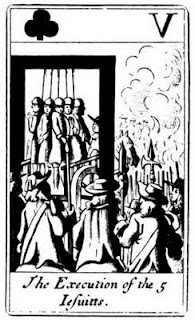
The British Museum has a page dedicated to the deck of the Popish/Oates Plot playing cards, one of which depicted Brother Thomas Pickering's fictitious attempt on Charles II's life--and so does the V&A, providing this background:

Object Type
These playing cards are engravings. The images were made by cutting lines into the surface of a flat piece of metal, inking the plate and then transferring the ink held in the lines onto a sheet of paper. Francis Barlow's original drawings for the engravings are in the British Museum, London.

Subject
The Popish Plot was a fictitious Catholic conspiracy to kill Charles II that the Reverend Titus Oates claimed to have uncovered in 1678.The pictures on these cards tell the story of the plot and show the dire penalties meted out to alleged Roman Catholic enemies of the state. Sets of playing cards depicting historical events were very popular in the last quarter of the 17th century. There are other political packs from the time of the Popish Plot depicting 'All the Popish Plots' and the Rye House Plot, a conspiracy to assassinate Charles II and his brother, James, Duke of York.

Historical Context
There was great fear in Britain at the time of Catholic intrigue and a very real apprehension that on the death of Charles his Roman Catholic brother, James, would be placed on the throne. Prints were used to fuel public anxiety, and playing cards were another ideal means of spreading political propaganda at a low cost. Many packs were designed and engraved by leading artists of the day.

Monday, December 3, 2012

One of the Lay Victims of the Titus Oates' Plot

Blessed Edward Coleman:

A controversialist, politician, and secretary of the Duchess of York, date of birth unknown; executed at Tyburn, 3 December, 1678. He was the son of a Suffolk clergyman and, after a distinguished career at Cambridge, became a Catholic and was employed by the Duchess of York. As her secretary he became acquainted with continental statesmen from whom he sought pecuniary help when in difficulties. In 1675 he offered his services in favour of Catholicism to Père La Chaise, the confessor of Louis XIV; again in 1676 he was in communication with Father Saint-Germain, offering his assistance to prevent a rupture between England and France. These attempts to procure money failed, but he succeeded later in obtaining £3500 from three successive French ambassadors whom he supplied with daily information regarding the proceedings of Parliament. He became a suspected character, and on the discovery of the Titus Oates Plot, conceived in 1678 for the ruin of the Duke of York whose Catholicity was suspected Coleman was named as one of the conspirators. Conscious of his innocence he took no steps to protect himself, allowed his papers to be seized, and gave himself up for examination. He was tried 28 Nov., 1678, being accused of corresponding with foreign powers for the subversion of the Protestant religion, and of consenting to a resolution to murder the king. His defense was that he had only endeavoured to procure liberty of conscience for Catholics constitutionally through Parliament, and had sought money abroad to further this object. He denied absolutely any complicity with the plot against the king's life. His foreign correspondence of 1675 and 1676, when examined, proved him to be an intriguer, but contained nothing that could connect him in any way with designs on the king's life. However, in spite of the flagrantly false testimony of Oates and Bedloe, he was found guilty, drawn to Tyburn, and there executed. He was a good linguist, writer, and controversialist. His controversy with Drs. Stillingfleet and Burnet resulted in the conversion of Lady Tyrwhit to the Catholic religion. His writings were: "Reasons for Dissolving Parliament", "Two Letters to M. La Chaise, the French King's Confessor" (London 1678, reprinted in Cobbett's "Parliamentary History"; "The Tryal of Edward Coleman" etc. (London, 1678); "Legacies; a Poem", etc. (London, 1679).

He was beatified on 15 December 1929 by Pope Pius XI. Wikipedia gives more detail, from the Dictionary of National Biography in its entry for this martyred victim of Titus Oates' Popish Plot.

Friday, October 12, 2012

Edmund Berry Godfrey, RIP

Titus Oates and Israel Tonge were telling their story about the vast Jesuit wing conspiracy to kill Charles II. They swore a desposition to Edmund Berry Godfrey, a magistrate and then on October 12, 1678, he disappeared. His body was found on October 17, in a ditch on Primrose Hill. It was his mysterious death, impaled by his own sword that really gave impetus to Oates and Tonge's Popish Plot, as authorities assumed it was his knowledge of the Plot that led to his death. Catholics had murdered him to keep him from telling about the Plot, it was alleged--although there were indications that Godfrey had already warned Edward Colman, the Duchess of York's secretary (who would suffer hanging and quartering on December 3, 1678) that there was a plot to ensnare the royal family and its servants.

There is memorial to the magistrate in Westminster Abbey:


"Edmund Berry Godfrey, raised, for his services to King and Country, to the rank of Knight, having filled the office of Justice with a singular faithfulness and diligence, was snatched at last from the sight of his kinsfolk on 12th Oct. 1678, and found on the fifth day following, having suffered an abominable and hideous death. The rest let History tell. This monument, ravaged by age, was restored, and the epitaph to his brother Edmund added, by Benjamin, youngest son and now the sole survivor of the sons of Thomas Godfrey, 2nd April 1696".
 Edmund Berry Godfrey was born 23 December 1621, a son of Thomas, a Member of Parliament, and his second wife Sarah (Iles or Isles). His second name was taken from his godfather Captain John Berrie. He attended Westminster School, like his brother Edward, and Christ Church college Oxford. Ill health and deafness prevented him from completing his law studies. In 1650 he went into trade as a wood and coal merchant in London. He had a house in Westminster and became a local magistrate and was called the "best justice of the peace in England". In 1666 he was knighted for services in helping "to suppress the late fire in the City". In 1678 he became involved in the Popish Plot scandal. His body was found on Primrose Hill near Hampstead on 17 October with a sword wound and it was popularly said that he was murdered by Catholics. He was buried at St Martin in the Fields church, Westminster. Three men were executed for the murder but later many other theories were put forward.

Wednesday, August 22, 2012

A Kemble Cup; A Kemble Pipe: A Catholic Martyr in Monmouthshire

As The Catholic Herald noted two years ago:

John Kemble (1599-1679) was a much-loved Catholic priest martyred during the madness of the “Popish Plot”.

In normal times, despite harsh anti-Catholic laws, the extent of persecution depended upon the sympathies of local landowners and JPs. Around Hereford and Monmouth, for example, where the Catholic Earls (from 1642 Marquesses) of Worcester held sway at Raglan Castle, the old religion was for long periods practised with impunity. From 1622 there was even a Jesuit College at Cwm, near Welsh Newton. At nearby Dingestow 20-odd worshippers at the parish church would see some 60 Catholics trooping past on their way to Mass.

In 1678 the farrago of lies concocted by Titus Oates, that there was a Jesuit conspiracy to murder the King, gave disgruntled Protestants and ambitious chancers their opportunity. A Monmouthshire rogue called William Bedloe laid false information against the leading Catholics of the area.

One of those who suffered in the prevailing hysteria was John Kemble. Born into a Catholic family at St Weonards, some five miles north of Welsh Newton, he had studied for the priesthood at the English College in Douai.

Ordained in 1625, he returned to Monmouthshire and served more than 50 years as an itinerant priest, winning admirers even among Protestants. Based at Pembridge Castle, which his brother had leased in 1630, he had seemed immune from prosecution.

Moreover in 1651 his nephew Richard Kemble saved Charles II’s life at the battle of Worcester. The King, however, was not a man to remember past services when his own preservation was at stake.

As the anti-Catholic furore boiled over in 1678 John Kemble rejected all warnings, declaring that he could do no better than to die for Christ. . . .

Because he responded with the news of his impending execution with the requests to finish his pipe and enjoy a last drink, the terms a "Kemble Pipe" and a "Kemble Cup" became part of popular culture. He even had to encourage this hangman to do his job!

There is an annual pilgrimage to the site of his grave in an Anglican churchyard, held this year on August 19:

The Annual Pilgrimage to the grave of St John Kemble at Welsh Newton will take place on Sunday 19th August 2012. His Grace Archbishop George Stack will be in attendance. The programme is as follows:

10 a m: MONMOUTH
The walk begins from St Mary’s Church, Monmouth. Pilgrims are advised to bring a packed lunch.

3 p m: WELSH NEWTON
Rosary, Readings and prayers at the grave of St John Kemble in the churchyard of St Mary the Virgin, Welsh Newton, Herefordshire.

4:15 p m: MONMOUTH
Benediction at St Mary's Church, Monmouth. Following Benediction, tea will be served in the garden.

Here is a Kyrie from a Mass in his honor. St. John Kemble, pray for us!

A Popish Plot Franciscan Martyr: St. John Wall

The Francisan Province of Great Britain celebrates all their martyrs on July 12 (the date of St. John Jones' martyrdom), but St. John Wall was martyred on August 22, 1679--at the center of the "Popish Plot" even though he was not a Jesuit, Oates' main targets:
John Wall was born in 1620, probably at Chingle Hall, near Preston in Lancashire. As a young man he entered the English College in Douai where he was taught by the famous Dr. Kellison. In 1641 he transferred to the English College in Rome, where he was ordained a priest in 1645. After a brief spell as a missionary in England he returned to Douai and asked to enter the Franciscan College of St. Bonaventure which John Gennings had erected there in his restoration of the Franciscan Province of England. In January 1651 he was accepted into the Order and took the name Joachim of St. Anne. Five friars from that friary had already been martyred.

John Joachim, although only 6 months professed was appointed Guardian of the college and later Master of Novices. In 1656 he assumed the false name Francis Webb and re-entered England as a missionary in Worcestershire. He remained there for 22 years ministering to the Catholics of the area. In 1678 he went to London to meet the Jesuit Claude de la Colombière, and the two spoke together of their desire for martyrdom. The context of this meeting was the renewed persecution that was unleashed in the wake of the murderous lies of Titus Oates and his invented Catholic plot against King Charles II.

Returning from this encounter, John was staying with a friend in Rushock Court. There he was mistaken for one of the so-called plotters, Francis Johnson, and arrested. When he refused to swear to the religious supremacy of the King, he was imprisoned for five months of dreadful suffering. At the end of this time, on 25th April 1679, he was condemned to death for high treason, since he was a priest who had been ordained abroad and returned to exercise his ministry in contravention to the Elizabethan anti-Catholic laws. He argued in vain that Charles II's amnesty of 1660 should have covered him, as indeed it should. Instead he was sent to London to be interrogated by Oates, Bedloe, Dugdale and Pranse. He was found innocent of the accusation of complicity in the “Papist Plot” but because of his priestly ordination and ministry, his death sentence was nevertheless confirmed and he was sent back to Worcester, where he was hanged on 22nd August 1679.

His fellow friar William Leveson, whose own brother Francis Leveson would himself be martyred at the age of 34 in 1680, looked after John Wall in his last days in prison. He recounted the condemnation and death of the martyr in a letter. John Wall's body was buried in the cemetery of the church of St. Oswald in Worcester, and his head returned to Douai, where it was venerated as a holy relic.

Along with John Jones and 38 other English martyrs John Wall was beatified by Pius XI on 15th December 1929 and canonised by Paul VI on 25th October 1970.

According to this website, St. John Wall used Harvington Hall as a base of operations.The Hall, parts of which are open to the public (owned by the Archdiocese of Birmingham), is well known for the "priest hides" built there by Saint Nicholas Owen, Jesuit lay brother and martyr.

Tuesday, August 7, 2012

Blessed Nicholas Postgate and the Popish Plot

Here is a link to a new book about Blessed Nicholas Postgate, who was arrested and executed for his supposed involvement in the supposed Popish Plot during the reign of the Merry Monarch, Charles II:

Father Nicholas Postgate is one of our best-loved martyrs whose lonely mission in the wilds of the North York Moors has captured the imagination of people of all faiths. Known as 'The Good Samaritan of the Moors' due to his generosity to all, regardless of their status or religion, he walked around his huge 'parish' of Blackamoor, always declining the offer of a horse. He shared his food and clothes and visited people in remote areas to offer both spiritual and practical help, wanting to understand the plight of the poor and to empathise with them in every way.

Most remarkably he began this work when he was more than sixty years old, and continued almost into his eighties. Although born in those moors, he attended the English College at Douai where he earned the degree of Doctor of Divinity, and then returned to England to work as a chaplain for wealthy families in great houses. That secret work took him to places far away from his beloved Blackamoor. Returning to the moors in the early 1660s, he embarked on a completely new role that was to earn him everlasting admiration. This work nourishing the Catholic faith came to the notice of Parliament just when the fabricated 'Popish Plot' of Titus Oates brought a return of the persecution of Catholics. A highly experienced Government agent, whose employer was alleged to have been murdered by Catholics, was ordered to hunt down, capture and prosecute Father Postgate.

Blessed Nicholas Postgate is the patron of this Catholic History society and he is honored annually with the Postgate Rally in Ugthorpe. In 2011, a new stained glass window depicting the priest and martyr hiking on the moors was dedicated at St. Hedda's Catholic Church in Egton Bridge. He was executed on August 7, 1679 in York and beatified by Blessed John Paul II among the Eighty-five Martyrs of England and Wales in 1987. Like several other Popish Plot martyrs, he had been able to serve Catholics for years with little interference until the anti-Catholic hysteria whipped up by Titus Oates and the Whigs in Parliament led to his arrest and capture.

Saturday, July 14, 2012

A Lay Victim of The Popish Plot

Blessed Richard Langhorne (c. 1624 – 14 July 1679) was a barrister executed as part of the Popish Plot. He was admitted to the Inner Temple in May 1647 and called to the bar in November 1654. He provided legal and financial advice for the Jesuits.

His wife, Dorothy, was a Protestant from Havering in Essex. His sons Charles and Francis were both priests. When, in October 1677, Titus Oates was expelled from the English College at St Omer "for serious moral lapses", Charles Langhorne entrusted Oates with a letter to his father. Oates returned to St Omer with a letter from Richard thanking the Jesuits for all they had done for his sons.

When Oates and Israel Tonge unleashed their Popish Plot in September 1678, three Jesuits and a Benedictine were arrested. Langhorne was arrested a week later, imprisoned at Newgate and charged with Treason. Oates claimed, corroborated by William Bedloe, that Langhorne's earlier correspondence dealt with treason.

He was found guilty of High Treason. As the result of a petition by his wife, a ‘true Protestant’, he received a month's reprieve to tidy the affairs of his clients. He was executed at Tyburn, London, on 14 July 1679. According to the Benedictines at Tyburn Convent, "He declared on the scaffold at Tyburn, that not only a pardon, but many preferments and estates had been offered to him if he would for sake his religion.As the hangman was placing the rope round his neck, he took it into his hands and kissed it."

On 15 December 1929, he was beatified by Pope Pius XI.

As I've noted before on this blog when discussing the Popish Plot, England's justice system benefitted the accuser and gave little leeway to a defendant trying to prove a negative: Langhorne could not prove their interpretation of his letters was wrong. Samuel Pepys and other defendants finally received some measure of justice because Judge Scrogg figured out Oates' and his confreres' perjury. Samuel Pepys was accused that same year of giving naval secrets to the French and of being a Catholic, just because of his loyalty to James, the Duke of York. He spent six months in the Tower of London and eventually established, not his innocence per se, but his accuser's guilt. Pepys was cleared of charges and reinstated as Secretary to the Admirality--in 1684!

Wednesday, June 20, 2012

With Ropes Around Their Necks, An Offer of a Pardon

Today is the anniversary of the martyrdoms of five Jesuit Popish Plot Martyrs on June 20, 1679, who died as a result of the false, perjurous claims there was a vast, Jesuit, Catholic-wing conspiracy to assassinate Charles II and bring the Catholic Duke of York, James, his brother to the throne. Oates convinced the Whigs in Parliament that he knew who was in on this plot and he was given the authority to round up the suspects. At the trials for his accused, any witnesses they brought forward would be discounted by the Prosecution and the Judge, because, of course, they were also Catholics and if not in on the plot were probably in favor of the plot! After one of these manifestly unfair trials, five Jesuits were martyred on June 20, 1679 at Tyburn Tree in London:

John Gavan
William Harcourt
Anthony Turner
Thomas Whitbread
John Fenwick

Fathers John Fenwick and William Ireland were arrested in September of 1678 and held in prison. Then Oates captured Fathers Thomas Whitbread and Edward Mico, who were ill with the plague and living in the household of the Spanish ambassador. By December that year Father Whitbread was well enough to join Fathers Fenwick and Ireland in Newgate Prison; Father Mico died in custody. Father William Ireland was executed in January of 1679 with the Jesuit laybrother John Grove, but Fenwick and Whitbread awaited their fate and another trial. They had given evidence that refuted Oates', so Oates needed more time to gather more evidence! Fathers John Gavan, William Harcourt, and Anthony Turner in the meantime had been arrested and they were brought together with Father Fenwick and Whitbread (tried for the second time--no double jeopardy in Charles II's courts for Catholics!)

At the trial, the defense produced plenty of  witnesses from Saint-Omer to testify that Oates hadn't even been in England the day he was supposed to have heard the Jesuits plotting to assassinate King Charles II--he was at the college in St. Omer's that day. But the Court told the jury to trust Oates' evidence over the Catholic witnesses. The jury returned a verdict of guilty, condemning the five Jesuits to die for treason.

The circumstances of their execution were quite dramatic. All five were standing in a cart under the scaffold, with their hands bound and the nooses around their necks. They had each spoken, each prepared themselves for death, when suddenly, a rider galloped up, crying "A Pardon, A Pardon!"

Charles II issued them a conditional pardon to spare their lives--all they had to was admit their guilt and tell him all they knew about the plot. Trouble was that they weren't guilty of any plot and they couldn't tell him what they knew because there wasn't any plot in the first place! They declined the pardon, protesting that they could not lie to save their lives--they could not risk their immortal souls to save their physical bodies.

Therefore, they prepared themselves again for death--the rider returned to Charles II with the news--the cart pulled away and they were hung until dead before their bodies were quartered and their heads cut off. They were buried in the churchyard of St. Giles in the Fields. According to the church's website, there are actually eleven of twelve martyrs originally buried there in the churchyard:

The testimony of Titus Oates, led during 1678-81, to the burial in St Giles Churchyard of twelve Roman Catholic martyrs who were later beatified - Whitebread, Harcourt, Fenwick, Gavan, Turner, Coleman, Langhorne, Mico, Ireland, Grove, Pickering and Oliver Plunket, Archbishop of Armagh. All were priests except Coleman, who was secretary to the Duchess of York, Langhorne, who was a barrister, Grove, and Pickering, who was a laybrother; and all except Mico, who died after his arrest, had been executed at Tyburn (then close to where Marble Arch now stands). The first five are the Jesuit fathers with whom Plunket asked to be buried in the churchyard of St. Giles. The burial place is said to be near the north wall of the church. Though the body of Oliver Plunket, who was canonised in 1975, was later exhumed and taken to Lamspringe in Germany (the head being now at Drogheda and the body at Downside), there is in the St. Giles Burial Register for 1 July, 1681 a most legible entry of the burial.