Showing posts with label St. Giles in the Fields. Show all posts

Tuesday, June 20, 2017

Five Jesuit Martyrs; Victims of the Popish Plot

The Jesuits in Britain website gives some background to the Popish Plot, specifically how intra-Catholic conflict contributed to the anti-Jesuit, anti-Catholic conspiracy dreamed up by Titus Oates:

There were two separate forces behind the Popish Plot (known to some Catholics as the Presbyterian Plot). One was political. For many years the old Cromwellian Lord Shaftesbury and the puritan (Whig) faction had been stoking the fires of religious hatred against Catholics and France, in a long game to end absolute monarchy and once again to depose a king. Charles II openly favoured religious toleration of Catholics. This meant a significant minority in parliament always voted with the king. The Whigs therefore wanted to eliminate the Catholics in parliament. The Plot was constructed against the Catholics at court – the Queen, the Duke and Duchess of York, and their clergy, many of whom were Jesuits. The ultimate target, the King, exerted his energy to defend his Queen and his brother. He could not defend all the accused despite the clearly absurd nature of the accusations.

Non Jesuit Catholics were seeking an oath of allegiance to the King which could be accepted by Rome and allow them constitutional rights. Jesuits always blocked this, being unable to compromise their obedience to the pope. In this way they made an enemy of Dr. Sergeant, a secular Catholic priest – the secondary force which caught so many Jesuits in the plot. Early in the onset of hysteria Dr. Sergeant made false denunciations of Jesuits to the Privy Council which lent credence to the plotters. . . .


More on Father John Sergeant here, who seems to have been a contentious figure. This page on the Jesuits in Britain website includes his portrait.

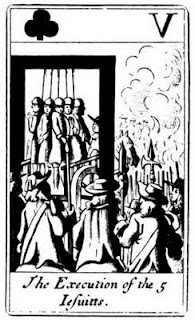
On June 20, 1679, Fathers John Gavan, William Harcourt (aka William Barrow), Anthony Turner, Thomas Whitbread, and John Fenwick all suffered execution at Tyburn, but not without added drama:

Some of the first to be arrested were the Jesuits who had spurned Oates at St. Omer – William Ireland and Bl Thomas Whitbread who was English provincial. Fr Whitbread was tried in June 1679 alongside fellow Jesuits John Fenwick, John Gavan, William Harcourt and Anthony Turner. Fr Gavan, who was the spokesman, presented an eloquent defence. A brave group of Jesuit novices travelled from St. Omer to give evidence that Oates had been at St Omer's on crucial dates when he claimed to be in London witnessing Jesuit plotting. But the judges argued that as Catholic witnesses could receive a papal dispensation to lie on oath, they were not credible.

The five were hanged at Tyburn where the crowd stood in silence for an hour while each made a speech maintaining his innocence. On the scaffold they were offered the King’s pardon on condition they admit their guilt, but all refused.

Pope Pius XI beatified these five martyrs in 1929; St. Giles-in-the-Fields would be well-worth a visit on a pilgrimage to London, as they, and six other Popish Plot martyrs, are buried there. St. Oliver Plunkett was buried there but his remains have been moved:

Eleven Roman Catholics who were implicated in an alleged plot to kill Charles II were executed for treason at Tyburn and buried here in 1679 – William Ireland SJ and John Grove on 24 January, Lawrence Hill and Robert Greene on 21 February, Thomas Pickering, OSB on 21 May, Fr Thomas Whitebread SJ, Fr William Barrow (alias Harcourt) SJ, Fr John Fenwick, SJ, Fr John Gavan, SJ, Fr Anthony Turner, SJ on 20 June, and Richard Langhorne on 14 July. They were beatified by Pope Pius XI in 1929.

On 1 July 1681 Oliver Plunkett, the Roman Catholic Archbishop of Armagh, who was implicated in an alleged plot for a French invasion of Ireland, was hanged drawn and quartered at Tyburn and buried here. His body was later removed to Lamspring Abbey in Germany and is now at Downside Abbey in Somerset. His head was taken to Rome, and then given to the Archbishop of Armagh, and is now displayed at St Peter’s Church in Drogheda, County Louth. He was canonised by Pope Paul VI in 1975.

Thursday, April 14, 2016

A First at St. Giles-in-the-Fields

From the Jesuits in Britain site, this good news:

On Saturday April 9th Fr Dominic Robinson SJ led a Mount Street Jesuit Community excursion to St Giles-in-the-Fields to celebrate a Mass in honour of the five Jesuit martyrs of the so-called ‘Titus Oates’ or ‘Popish’ plot of 1679, the last major executions of Catholics in England.  The five Jesuits are all buried in unmarked graves on the north side of the church, a mark of some respect compared to the quartering and piking of the bodies of those martyrs hung at Tyburn in the previous century. 

Fr Dominic said "I think this may be the first time a Mass honouring these later martyrs has been celebrated and we were very grateful for the permission of St Giles-in-the-Fields Rector The Revd Alan Carr, his Parish Council, and the Bishop of London The Rt Revd Richard Chartres; and a graced opportunity to learn from our Jesuit ancestors who struggled to live lives of courage and authenticity in more dangerous times in the history of the city in which we minister."

The five buried are: Blesseds Thomas Whitbread, William Harcourt, John Fenwick, John Gavan, Anthony Turner. 


Their executions took place on June 20, 1679. Read more about their executions on that day--when the promise of a pardon seemed an opportunity to save their lives--here.

Photo: St. Giles-in-the-Fields (used by permission).

Wednesday, June 20, 2012

With Ropes Around Their Necks, An Offer of a Pardon

Today is the anniversary of the martyrdoms of five Jesuit Popish Plot Martyrs on June 20, 1679, who died as a result of the false, perjurous claims there was a vast, Jesuit, Catholic-wing conspiracy to assassinate Charles II and bring the Catholic Duke of York, James, his brother to the throne. Oates convinced the Whigs in Parliament that he knew who was in on this plot and he was given the authority to round up the suspects. At the trials for his accused, any witnesses they brought forward would be discounted by the Prosecution and the Judge, because, of course, they were also Catholics and if not in on the plot were probably in favor of the plot! After one of these manifestly unfair trials, five Jesuits were martyred on June 20, 1679 at Tyburn Tree in London:

John Gavan
William Harcourt
Anthony Turner
Thomas Whitbread
John Fenwick

Fathers John Fenwick and William Ireland were arrested in September of 1678 and held in prison. Then Oates captured Fathers Thomas Whitbread and Edward Mico, who were ill with the plague and living in the household of the Spanish ambassador. By December that year Father Whitbread was well enough to join Fathers Fenwick and Ireland in Newgate Prison; Father Mico died in custody. Father William Ireland was executed in January of 1679 with the Jesuit laybrother John Grove, but Fenwick and Whitbread awaited their fate and another trial. They had given evidence that refuted Oates', so Oates needed more time to gather more evidence! Fathers John Gavan, William Harcourt, and Anthony Turner in the meantime had been arrested and they were brought together with Father Fenwick and Whitbread (tried for the second time--no double jeopardy in Charles II's courts for Catholics!)

At the trial, the defense produced plenty of  witnesses from Saint-Omer to testify that Oates hadn't even been in England the day he was supposed to have heard the Jesuits plotting to assassinate King Charles II--he was at the college in St. Omer's that day. But the Court told the jury to trust Oates' evidence over the Catholic witnesses. The jury returned a verdict of guilty, condemning the five Jesuits to die for treason.

The circumstances of their execution were quite dramatic. All five were standing in a cart under the scaffold, with their hands bound and the nooses around their necks. They had each spoken, each prepared themselves for death, when suddenly, a rider galloped up, crying "A Pardon, A Pardon!"

Charles II issued them a conditional pardon to spare their lives--all they had to was admit their guilt and tell him all they knew about the plot. Trouble was that they weren't guilty of any plot and they couldn't tell him what they knew because there wasn't any plot in the first place! They declined the pardon, protesting that they could not lie to save their lives--they could not risk their immortal souls to save their physical bodies.

Therefore, they prepared themselves again for death--the rider returned to Charles II with the news--the cart pulled away and they were hung until dead before their bodies were quartered and their heads cut off. They were buried in the churchyard of St. Giles in the Fields. According to the church's website, there are actually eleven of twelve martyrs originally buried there in the churchyard:

The testimony of Titus Oates, led during 1678-81, to the burial in St Giles Churchyard of twelve Roman Catholic martyrs who were later beatified - Whitebread, Harcourt, Fenwick, Gavan, Turner, Coleman, Langhorne, Mico, Ireland, Grove, Pickering and Oliver Plunket, Archbishop of Armagh. All were priests except Coleman, who was secretary to the Duchess of York, Langhorne, who was a barrister, Grove, and Pickering, who was a laybrother; and all except Mico, who died after his arrest, had been executed at Tyburn (then close to where Marble Arch now stands). The first five are the Jesuit fathers with whom Plunket asked to be buried in the churchyard of St. Giles. The burial place is said to be near the north wall of the church. Though the body of Oliver Plunket, who was canonised in 1975, was later exhumed and taken to Lamspringe in Germany (the head being now at Drogheda and the body at Downside), there is in the St. Giles Burial Register for 1 July, 1681 a most legible entry of the burial.