Showing posts sorted by relevance for query spanish embassy. Sort by date Show all posts

Saturday, July 25, 2015

The Feast of St. James at Spanish Place

Today is the Feast of St. James the Greater. Every year on this feast day I think of the quip of my mother regarding my late father when deciding which was his patron saint, St. James the Greater or St. James the Lesser? She said immediately: "St. James THE Great". I certainly hope and pray that my father is a saint in heaven today.

In London, the parish of St. James Spanish Place is celebrating not only the patronal feast day but its 125th anniversary! From the parish's history page:

The visitor to St James's Church is often puzzled to know why a church which stands in George Street, W1, should have derived a kind of secondary title from a street called Spanish Place which can be found opposite the Presbytery door. The explanation is that St James's, Spanish Place, like so many of the older parishes in the Westminster diocese, can trace its origin to the penal times and to the benefactions of a friendly Catholic embassy. And this is perhaps the reason why, despite the magnificence of the church, there is within an atmosphere that breathes our Catholic past.

In the reign of Elizabeth I the Bishops of Ely let their palace and chapel in Ely Place to the Spanish Ambassador, and until the reign of Charles I it was occupied by the representative of the Court of Spain. During this period the chapel was freely used by English Catholics and became a place of sanctuary for them.

After the restoration of Charles II the Spanish Embassy was re-established in London, first on Ormond Street and then at Hartford house, Manchester Square, where the Wallace Collection is now housed. Here, in 1791, shortly after the first repeal of some of the laws affecting Catholic worship, a chapel was built on the corner of Spanish Place and Charles Street (now George Street), largely through the efforts of DOctor Thomas Hussey who had been a chaplain at the Embassy since his ordination in 1769. Most of the objects of piety in the present church are legacies from this older building which was famous enough in its day to be mentioned by Thackeray in
Vanity Fair as the church attended by the Marchioness of Steyne. . . .

In the year 1827 the official Spanish connection with the chapel ceased and it was handed over to the London Vicariate. However, there is much in the present church to remind us of our Spanish heritage including Alfonso XIII's personal standard which is in a frame over the sacristy door, and the parishioners of Spanish Place have never forgotten their debt to Spain for having established and maintained the mission in the dark days. An unofficial connection with the Embassy of Spain has continued and is still cherished by the Church of St James today. . . .

The site was purchased and the design for a new church was made an open competition. Edward Goldie, great grandson of the architect of the old chapel, Signor Joseph Bonomi, won the competition and the present edifice, partially completed, was opened on Michaelmas Day, 1890.

Happy Feast of St. James! St. James, pray for us!

Sunday, May 18, 2014

Embassy Chapels in London and the Mass

Here's some more interesting news from the Personal Ordinariate of Our Lady of Walsingham: a special Mass at Our Lady of the Assumption and St. Gregory, the Ordinariate parish in that part of London to honor the Portuguese Ambassador to the Court of St. James:

The Portuguese ambassador to the United Kingdom is to attend Mass at the Personal Ordinariate of Our Lady of Walsingham's central church in Warwick Street, Soho, next month as part of efforts to restore historic links between that church and the Portuguese Embassy. His Excellency João de Vallera, along with other representatives from the Portuguese community in London, will be at the 10.30 a.m. Solemn Mass on Sunday 15 June, Trinity Sunday, which falls at the end of a week of celebrations to mark Portugal's National Day on 10 June.

The Warwick Street church, Our Lady of the Assumption and St. Gregory - which Cardinal Vincent Nichols dedicated to the life of the Ordinariate in 2013 - was built on the site of a Catholic chapel which had served the Portuguese embassy in London in the early eighteenth century, when the embassy was located in Golden Square, Soho. That original chapel, built during the Marques de Pombal's term as ambassador from 1724 to 1747 (and subsequently leased to the Bavarian Embassy), was badly damaged during the anti-Catholic Gordon Riots of 1780. It was rebuilt in 1789-90.

Beginning in the reign of King James I, from my reading, the embassy chapels of Catholic nations in London became sites of worship and the sacraments for Catholic English men and women. The ambassadors of the Court of Spain opened the chapel of St. James, Spanish Place (which for awhile hosted several Ordinariate events) to Catholics and the ambassadors often pleaded for the life (and exile) of Catholic priests arrested and condemned to death or, failing that, would make sure the martyred priest was supported during his execution with prayers. See for example the execution of Blessed Thomas Maxfield. Obviously, the Portuguese Embassy chapel served the same purpose for Catholics in London.

According to the announcement of this event:

The Mass will combine a flavour of the Anglican patrimony which the Ordinariate brings to the Catholic Church, with a Portuguese feel. Music by the Portuguese composer, Manuel Cardoso, will feature, alongside pieces by English composers including Herbert Howells and John Stainer. The Mass will be celebrated according to the Ordinariate Use, which integrates centuries' old Anglican prayers into the Roman Rite.

It's almost too bad they could not have included some of the music of Samuel Webbe, the English Catholic composer who served as organist in both the Sardinian and Portuguese embassy chapels in the 18th century.

Refreshments will be served! Portuguese wine and finger-foods (aka petiscos e doces?)!

Thursday, July 25, 2019

St. James the Greater and the English Reformation

Today is the Feast of St. James, the son of Zebedee, also called the Greater, one of the Twelve Apostles, not to be confused with St. James the Lesser or St. James the Just, the bishop of Jerusalem. He is renowned today because of the popularity of the Camino de Santiago and his shrine church in Compostela, Spain. Pilgrims walk the Camino to visit his shrine and gain the Indulgences of the pilgrimage.

There was an English route to the shrine which began in either A Coruña (Corunna) or Ferrol on the coast. After crossing the seas from England, Ireland, or Northern Europe, the pilgrims walked at least 75 kilometers or 46 miles. This was also a major trade route during the late Middle Ages.

Of course, once pilgrimages and other devotions to the saints, including the saints previously honored in England like Our Lady of Walsingham and St. Thomas of Canterbury, were discouraged, this pilgrimage to Spain from England was curtailed. William Farina, in his Saint James the Greater in History, Art and Culture, further suggests that there was a great animosity in England toward this traditional devotion to St. James the Greater because it was in Spain. He notes that Henry VIII named St. James Palace in the City of Westminster for St. James the Lesser "in direct opposition to the popular Spanish cult"--even though the Palace was built on the site of a former leper hostel named for St. James the Lesser, so perhaps it wasn't such direct opposition but continuity with the past. Farina also interprets several passages from Shakespeare plays, especially naming one of his greater villains, Iago in Othello, after the (Spanish) saint, as displaying not only national English animosity, but Shakespeare's personal animosity to Saint James the Greater because of his shrine in Spain, even though there were many churches in England dedicated to this saint. Finally, Farina states that more churches were built in England after the Break from Rome dedicated to St. James the Lesser than to St. James the Greater, although he does not provide any evidence of that assertion. Usually, St. James the Lesser is combined with St. Philip as in their shared feast Saints Philip and James in May.

We do know, however, that Sir Francis Drake's excursions into Spain provoked fear that English forces would desecrate the shrine of Santiago de Compostela, as this website explains:

In May 1589, faced with the fear of an attack on Compostela by the English troops of Francis Drake, whose ships were attacking Corunna, Archbishop Juan de Sanclemente ordered the concealment of the body of the apostle in the presbytery of the Cathedral. Its exact location was unknown for several centuries until 1879, the year of the second discovery of the apostolic remains.

So the conflict between England and Spain during the reigns of Elizabeth I and Philip II indirectly impacted the shrine of Saint James the Greater at Compostela, even though the Spanish forces at Corunna was prepared to thwart his attack.

In England, however, there was a Spanish presence and embassy chapel in London throughout the reigns of Elizabeth I and James I as the parish church now called St. James-Spanish Place explains:

In the reign of Elizabeth I the Bishops of Ely let their palace and chapel in Ely Place to the Spanish Ambassador, and until the reign of Charles I it was occupied by the representative of the Court of Spain. During this period the chapel was freely used by English Catholics and became a place of sanctuary for them.

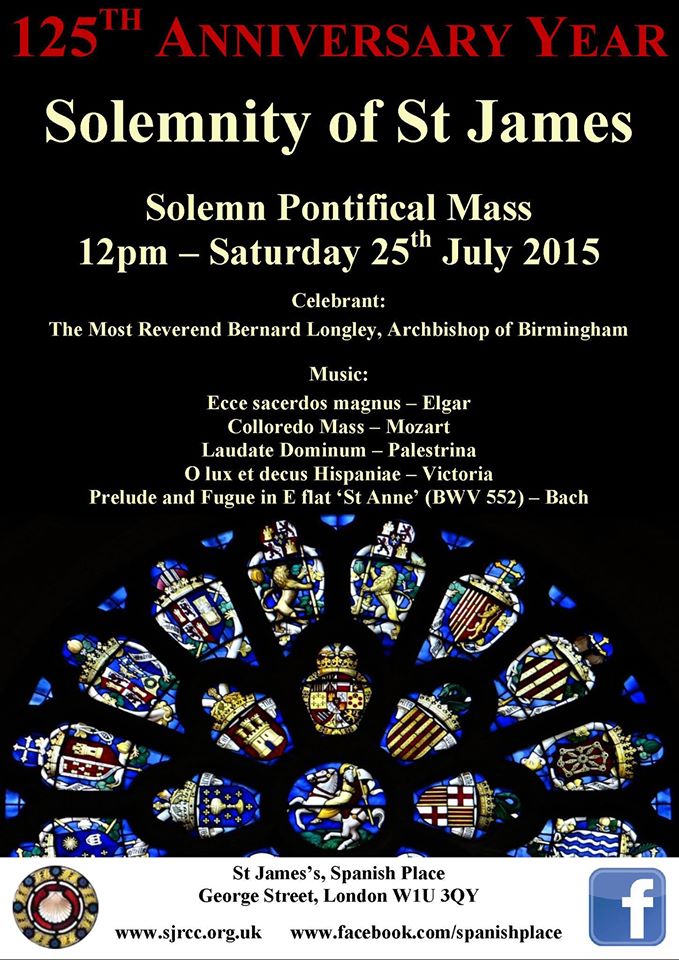
St. James-Spanish Place celebrates its patronal feast today with a Solemn Pontifical Mass and glorious music, its choir accompanied by His Majestys Sagbutts and Cornetts:

Mass Andrea Gabrieli 
Plaudite omnis terra Giovanni Gabrieli 
Iubilate Deo a 15 Giovanni Gabrieli 
O quam suavis est Giovanni Gabrieli 
O lux et decus Hispaniae Victoria (O light and grace of Spain,
most holy James, you who were the first among the apostles, were the first of them to wear a martyr’s crown. Alleluia.)
Canzon a 13 Pietro Lappi

St. James the Greater, pray for us!

Sunday, January 15, 2012

January 15, 1559 and Today

On January 15, 1559 Elizabeth Tudor was crowned and anointed Queen of England and Ireland in Westminster Abbey with a ceremony based on that developed for her half-sister Mary Tudor five years or so earlier. There are reports that she left the sanctuary area when the Bishop of Carlisle elevated the Sacred Host and that she did not receive Holy Communion. She was only 25 years old--after the succession of a boy king, too young (legally) to reign, and of a middle aged woman, perhaps too old to reign, her youth must have been very refreshing. Her subjects anticipated her marriage.

Her first Parliament would establish the Via Media of the Church of England while the Convocation of Bishops as constituted by the late Reginald Cardinal Pole, Archbishop of Canterbury, almost to the man, refused to swear the Oaths of Supremacy and Uniformity demanded by it. Elizabeth appointed Matthew Parker, who had been one of her mother's chaplains, as her Archbishop of Canterbury--she was, after all, Supreme Governor of the Church, as determined by Parliament. The bishops, priests and officials at the universities of Oxford and Cambridge who refused to take her oaths and follow his leadership would be deposed from their positions, exiled or imprisoned.

Today, on January 15, 2012, the Ordinariate of Our Lady of Walsingham will celebrate its first year: "Monsignor Newton will preside at this commemoration celebration, which has been organised by Fr Christopher Pearson and the Marylebone Ordinariate Group, and to which all are invited.The music for the event has been chosen to reflect some of the familiar repertoire of the Anglican Choral Tradition and will include works by Sir Charles Hubert Hastings Parry, Sir Charles Villiers Stanford, Henry Balfour Gardiner and Sir Edward Elgar." Last year on this date, the Vatican announced the formation of this Ordinariate for groups of Anglicans in England, including entire congregations.

The very church hosting this Evensong & Benediction has a fascinating history: St. James, Spanish Place. The parish website explains the descriptive addition "Spanish Place" to the saint's name:

The visitor to St James's Church is often puzzled to know why a church which stands in George Street, W1, should have derived a kind of secondary title from a street called Spanish Place which can be found opposite the Presbytery door. The explanation is that St James's, Spanish Place, like so many of the older parishes in the Westminster diocese, can trace its origin to the penal times and to the benefactions of a friendly Catholic embassy. And this is perhaps the reason why, despite the magnificence of the church, there is within an atmosphere that breathes our Catholic past.

In the reign of Elizabeth I the Bishops of Ely let their palace and chapel in Ely Place to the Spanish Ambassador, and until the reign of Charles I it was occupied by the representative of the Court of Spain. During this period the chapel was freely used by English Catholics and became a place of sanctuary for them.

A rather fascinating juxtaposition of events--and even location, eh?

Wednesday, March 6, 2019

Juan Luis Vives and Thomas More

Juan Luis Vives was born on March 6, 1492/1493 in Valencia, Spain. He was a great humanist scholar, friend of Erasmus, educational adviser to Katherine of Aragon to prepare her daughter (also Henry VIII's daughter) to be Queen of England. His family had suffered during the Spanish Inquisition under Katherine's parents, Ferdinand and Isabella, but he was willing to serve as her daughter's tutor and to disagree with Henry VIII on the grounds of the annulment Henry eventually sought from Katherine (he had to leave England).

He was also a friend of Sir Thomas More. As this UNESCO publication describes his career in England, More had a real influence on him:

His commentary on Saint Augustine’s City of God (Comentaria ad libros De Civitate Dei D. Aurelii Agustini) (Louvain-Bruges, 1521-22), a work commissioned by Erasmus and dedicated to King Henry VIII, is a brilliant critical, historical and philological interpretation surpassing anything he had previously published. He had close contacts with the Court. Cardinal Wolsey honoured him with his friendship; it was he who dubbed Vives as ‘doctor melifluo’ because his prose flowed like honey. Although he had established a worldwide reputation and was in receipt of a royal pension, Vives lived in strained circumstances. 

An outstanding member of the brilliant humanist cultural group at the English Court with which Vives communicated was Thomas More, the most famous of the English humanists and the most admired and respected by Henry VIII. More would eventually send Henry to the block for opposing his divorce from Queen Catherine. Vives also opposed this divorce and was obliged on that account to return to Louvain in 1528. His friendship with the powerful never caused him to waver in his convictions. 

Thomas More, whom he met as early as 1520, had a profound influence on Vives. Until then, his works had been basically humanist in character, with a religious dimension that he never failed to cultivate. The bulk of his writings consisted of commentaries on a wide variety of classical authors through whom he sought to introduce his pupils to the Graeco-Latin world. But from that time onwards, he emerged as a thinker dedicated to the writing of voluminous works on philosophy, morals, social policy and education—from the time of his retirement to Bruges until his death in 1540. The impact of Thomas More is particularly significant because of his deep social commitment, clearly expressed in Utopia. Utopia is the name of an island discovered by a Portuguese navigator, who begins a new wholesome life there, based on natural morals and religion in opposition to the corrupt, debased, bellicose environment around him. 

De subventione pauperam [Help for the Poor] (Bruges, 1526) by Vives and a large number of letters on the virtues of peace reveal the political, social and ethical influence of Thomas More. The title of Chapter IX, Book I, of this book reflects the thinking of both: ‘What God gives to each person is not given for each person alone.’

In 2015, an exhibition in Valencia and a conference at the Institute of Historical Research, Senate House in London, supported by the Spanish Embassy explored the friendship between More and Vives.

Wednesday, February 26, 2014

Cardinal Merry del Val, RIP


O Jesus! meek and humble of heart, hear me.
From the desire of being esteemed, deliver me, O Jesus.
From the desire of being loved,
From the desire of being extolled,
From the desire of being honored,
From the desire of being praised,
From the desire of being preferred to others,
From the desire of being consulted,
From the desire of being approved,

From the fear of being humiliated, deliver me, O Jesus.
From the fear of being despised,
From the fear of suffering rebukes,
From the fear of being calumniated,
From the fear of being forgotten,
From the fear of being ridiculed,
From the fear of being wronged,
From the fear of being suspected,

That others may be loved more than I, O Jesus, grant me the grace to desire it.
That others may be esteemed more than I,
That, in the opinion of the world, others may, increase and I may decrease,
That others may be chosen and I set aside,
That others may be praised and I unnoticed,
That others may be preferred to me in everything,
That others may become holier than I, provided that I may become as holy as I should, O Jesus, grant me the grace to desire it.

Amen.

Cardinal Rafael Merry de Val, Secretary of State for Pope St. Pius X, died on Feburary 26, 1930. He composed the Litany of Humility, above. He was born in England at the Spanish Embassy in London on October 10, 1865 and was educated at Catholic schools in England and then in Rome.

According to this article, he maintained those early links with England, including his investigation of the validity of Anglican Orders in the Catholic Church:

After graduating from the Pontifical Gregorian University, he became one of the most influential and consulted figures of pontifical Rome, especially when it came to problems regarding Anglicanism. His perfect knowledge of the environment and of the language, his frequent trips across the English Channel, and the esteem of Cardinal Vaughan gave him great authority.

Entrusted by Leo XIII with the thorny question of the validity of Anglican orders – at the uncertain, hesitant beginning of the ecumenical journey – he led the Holy See to the negative response, made official in September of 1896 with the bull "Apostolicae Curae," of which he was the main architect. On the basis of practice that had stood for three hundred years, and of an exhaustive historical investigation, Leo XIII confirmed the "nullity" of the "ordinations carried out with the Anglican rite," thereby denying the apostolic succession of those bishops. The reconciliation of Anglicans and Catholics, which had been proceeding for some time, came to an abrupt halt, while the young prelate established himself as the spokesman of a stance of doctrinal austerity that was different from, if not incompatible with, the policy of Rampolla, who was secretary of state at the time.

He was well known for his facility with languages, his piety and devotion (evidenced by the prayer above), and his great personal support of Pope St. Pius X, whose cause for canonization he introduced and supported. Cardinal Merry del Val died on February 26, 1930 during an operation for appendicitus. His cause for canonization has been introduced and he is a Servant of God.

Image source: Wikipedia commons.

Sunday, May 25, 2014

Samuel Webbe and English Catholics in the Eighteenth Century

I mentioned Samuel Webbe in my post last Sunday about the Mass at Our Lady and St. Gregory, Warwick Street to honor the Portuguese ambassador. He died on May 29 in 1816--25 years after the Catholic Relief Act of 1791 and 13 years before Catholic Emancipation. The Friends of the Ordinariate of Our Lady of Walsingham highlights him on their Music tab:

English composer, born in England in 1742; died in London, 29 May, 1816. He studied under Barbaudt. In 1766 he was given a prize medal by the Catch Club for his O that I had wings, and in all he obtained twenty-seven medals for as many canons, catches, and glees, including Discord, dire sister, Glory be to the Father, Swiftly from the mountain’s brow, and To thee all angels. Other glees like When winds breathe soft, Thy voice, O Harmony, and Would you know my Celia’s charms are even better known. In 1776 he succeeded George Paxton as organist of the chapel of the Sardinian embassy, a position which he held until 1795: he was also organist of the Portuguese chapel. His Collection of Motetts (1792) and A Collection of Masses for Small Choirs were extensively used in Catholic churches throughout Great Britain from 1795 to the middle of the last century. If not of a very high order, they are at least devotional, and some are still sung. He also published nine books of glees, between the years 1764 and 1798, and some songs. His glees are his best claim on posterity.

Lest you are confused, Webbe did not write for the TV show Glee; he wrote English a cappella part songs, scored for three to four voices, although Glee clubs did sing them:

Discord!Dire sister of the slaughtering power,
Small at her birth, but rising every hour,
While scarce the skies her horrid head can bound,
She stalks on earth, and shakes the world around.
But lovely Peace in angel form
Descending quells the rising storm.
Soft ease and sweet content shall reign
And Discord never rise again.

The same site that highlighted Webbe notes that "The penal laws and the persecution of Catholics during the 220 years from 1558 to 1778 prevented any development of music by and for Catholics." 

This intrigues me. William Byrd's great output of liturgical music for all the propers of the Roman Missal dates from the 17th century, and I know that composers like Peter Phillips fled to the Continent to both practice their faith and compose music. Since Catholics were only able to attend Mass secretly in hidden chapels in recusant safe houses, Low Mass, silent and somber, was the rule. According to this presentation by an Oratorian priest, there was little congregational singing, and even when rarely celebrated, Benediction was accompanied by recitation of the great Eucharistic hymns of St. Thomas Aquinas. In the Embassy chapels, the liturgical music, if it represented more modern compositions than Gregorian chant and Renaissance polyphony, was by German, Italian, Portuguese, or Spanish composers, so English Catholics attending those Masses heard international music, not by their own.

Ashgate publishes Roman Catholic Church Music in England, 1791–1914: A Handmaid of the Liturgy? by T.E. Muir that addresses developments after the 1791 Catholic Relief Act until World War I:

Roman Catholic church music in England served the needs of a vigorous, vibrant and multi-faceted community that grew from about 70,000 to 1.7 million people during the long nineteenth century. Contemporary literature of all kinds abounds, along with numerous collections of sheet music, some running to hundreds, occasionally even thousands, of separate pieces, many of which have since been forgotten. Apart from compositions in the latest Classical Viennese styles and their successors, much of the music performed constituted a revival or imitation of older musical genres, especially plainchant and Renaissance Polyphony. Furthermore, many pieces that had originally been intended to be performed by professional musicians for the benefit of privileged royal, aristocratic or high ecclesiastical elites were repackaged for rendition by amateurs before largely working or lower middle class congregations, many of them Irish.

However, outside Catholic circles, little attention has been paid to this subject. Consequently, the achievements and widespread popularity of many composers (such as Joseph Egbert Turner, Henry George Nixon or John Richardson) within the English Catholic community have passed largely unnoticed. Worse still, much of the evidence is rapidly disappearing, partly because it no longer seems relevant to the needs of the modern Catholic Church in England.

This book provides a framework of the main aspects of Catholic church music in this period, showing how and why it developed in the way it did. Dr Muir sets the music in its historical, liturgical and legal context, pointing to the ways in which the music itself can be used as evidence to throw light on the changing character of English Catholicism. As a result the book will appeal not only to scholars and students working in the field, but also to church musicians, liturgists, historians, ecclesiastics and other interested Catholic and non-Catholic parties.

The article I cited from Newman's foundation, the Oratory of St. Philip Neri in England, points out that there were exceptions to the rule of secret and silent Masses, looking again at the Embassies in London and the outlet they offered to some Catholic composers, like Samuel Webbe, George Paxton--and Thomas Arne, arranger of "God Save the King/Queen" and composer of "Rule, Britannia". There is definitely more to this story.

Wednesday, October 21, 2020

One of Elizabeth I's Diplomats, Sir William Waad, RIP

Sir William Wade or Waad or Wadd died on October 21, 1623.

He was born in 1546 and by the age of 30 was serving his monarch as an ambassador on the Continent, according to the Dictionary of National Biography:

In July 1576 he was residing at Paris, and frequently supplied political information to Burghley, whose ‘servant’ he is described as being (cf. Lansd. MS. 23, art. 75). He claimed ‘familiar acquaintance’ with the celebrated French publicist, Jean Bodin, from whom he seems to have derived some of the news he forwarded to Burghley. In the autumn of 1576 Sir Amias Paulet [q. v.] took Wade to Blois (Cal. State Papers, For. 1575-7 passim). During the winter of 1578-9 he was in Italy, whence he forwarded to Burghley reports on its political condition. From Venice in April 1579 he sent the lord-treasurer fifty of the rarest kinds of seeds in Italy (Cal. Hatfield MSS. ii. 254). In May he was at Florence, and in February 1579-1580 he was residing at Strasbourg. 

In the following April he was employed on some delicate mission in Paris by Sir Henry Cobham. The suggestion in the Cal. State Papers, Venetian, that he was ambassador to Spain and Portugal in 1579 is misdated. In 1580 he received instructions as ambassador to Portugal (Sloane MS. 1442, f. 114). In 1581 he seems to have returned to England, and entered the service of Sir Francis Walsingham as secretary, and in 1583 he became one of the clerks to the privy council (Cal. State Papers, Dom., 1611-18, p.198). In April of that year he was sent to Vienna to discuss the differences between the Hanse Towns and English merchants abroad, and in July he accompanied Lord Willoughby on his embassy to Denmark to invest the king with the insignia of the Garter, and to negotiate an agreement on mercantile affairs (Birch, Memoirs of the Reign of Elizabeth, i. 24, 31). 

He undertook a couple of delicate and dangerous missions, to Spain and France:

In January 1583-4 he was sent to Madrid to explain the expulsion from England of the Spanish ambassador, Mendoza. He arrived in March, but Philip II refused all his requests for an interview, and ordered him out of Spain, with an intimation that he was fortunate to escape free (Cotton. MS. Vesp. C. vii. f.392; Cal. State Papers, Simancas, 1580-6, pp. 516, 520-1; Birch, i. 45, 48; Froude, xi. 414, 422). . . .

In March [1584-5] Waad was despatched to Paris to demand the surrender of the conspirator Thomas Morgan [accused in the Throckmorton Plot] (1543-1606?) [q. v.] Henry III was willing to consider the request but the catholic league [sic] and the Guises were violently opposed to it, and even instructed the Duc d’Aumale to waylay Waad and rescue Morgan on their way to the coast. Waad, however, convinced that he could not secure Morgan, contented himself with obtaining a promise that he should be detained in prison in France, but Aumale nevertheless attacked the envoy near Amiens, and inflicted on him a severe beating as an answer to his demand for the extradition of a catholic from France.

Waad also became involved in the ongoing issue of Mary, the former Queen of Scotland, being in England as a focus of Catholic plots:

He was back in England on 12 April, and with his return diplomatic relations between England and Spain ceased. In the same month Waad was sent to Mary Stuart to induce her to come to terns with Elizabeth, and his account of the interview is printed by Froude (Hist. xi. 448-51). In February 1584-5 he was appointed to accompany Nau to the court of James VI, but was stopped at the last minute (Cal. State Papers, Simancas, 1580-6, p. 533). . . .

In August 1585 Waad accompanied William Davison [q. v.] to the Low Countries to negotiate an alliance with the States-General. A year later he took a prominent part in arranging the seizure of Mary Stuart’s papers which implicated her in the Babington plot. He himself went down to Chartley in August 1586, and, while Mary was decoyed away on a hunting expedition, arrested her secretaries Nau and Curle, and having ransacked her cabinent [sic] , carried back a valuable collection of papers to London (ib. 1580-6, pp. 625-6; Amyas Poulet, Letter-Books, pp. 288 sqq.; Froude, xii. 160 sqq.) For this important service he was paid thirty pounds (Acts P. C. 1586-7, p. 211). In the following February he was again sent to France to explain the execution of Mary Stuart, to demand the recall of De l’Aubespine, the French ambassador, on the ground of his dependence on the league and complicity in Stafford’s plot [see Stafford, William, 1554-1612], and to justify Elizabeth’s detention of French shipping. For some time he was denied audience, the recall of the French ambassador was refused, but more success attended his endeavour to arrange the dispute about detention of French shipping in England and English shipping in France (Cal. State Papers, Venetian, 1581-91, pp. 475, 477, 483, 492, 517, 527, 533). He returned to England in June.

That was the end of Waad's diplomatic career. He became a member of Parliament but:

He was, however, mainly occupied with his duties as clerk of the privy council, and especially in tracking treasonable practices and examining jesuits [sic] and recusants. His zeal in these pursuits gained him the reputation of being the chief persecutor of the catholics [sic] (ib. Dom. 1601-1603, p. 199; cf. Lansd, MSS. 63, 66, 145, 148, 153; Law, The Archpriest Controversy, i. 84, 85, 155, 208, 212, 215, 226; Foley, Records, vol. iv. passim). As early as September 1584 he had, when Walsingham’s secretary, gained great credit by piecing together and deciphering the fragments of the treasonable document which Father William Crichton [q. v.] had torn up on his capture; a portrait of Waad thus engaged is given in Bishop Carleton’s ‘Thankfull Remembrance,’ 1624 (the story, sometimes described as ridiculous, is undoubtedly true; see Mr. T. G. Law in English Hist. Review, viii. 698). From this time Waad was frequently engaged in bringing to light plots against the queen’s life among them being that of Dr. Roderigo Lopez [q. v.] in 1594, of which Waad drew up a narrative, extant at the record office (State Papers, Dom. Vol. ccxlviii. art. 7), and Essex’s rebellion in 1601 (see Carleton, Thankfull Remembrance; Cal. State Papers, Dom. 1591-1603, passim).

Waad continued in royal service during the reign of James I and was appointed Lieutenant of the Tower of London at least by 1605 because he questioned those accused in the Gunpowder Plot, including Guy Fawkes and Thomas Wintour. He was also involved in the trial of Sir Walter Raleigh and supervised the imprisonment of Lady Arbella Stuart.

Waad was removed from his post at the Tower in 1613, evidently through the efforts of Frances Howard, the Countess of Somerset, so she could arrange the murder of Sir Thomas Overbury, who had been arrested through the efforts of Robert Carr, the Earl of Somerset (King James I's favorite). Waad was too good a Lieutenant to let poisoned tarts pass into Overbury's cell. The Lieutenant of the Tower who replaced him, Sir Gervase Helwys, would be found guilty of being an accessory to Overbury's murder and was executed on Tower Hill on November 20, 1615. Frances Howard pled guilty to the murder and was sentenced to death, but King James commuted her sentence--and Robert Carr's--to imprisonment in the Tower and exile from Court. 

Waad had retired from public life and died in his bed at home, Battles Hall in Manuden, Essex on October 21, 1623 and is buried in the churchyard of St. Mary's the Virgin in Manuden, with a memorial in the church.
Sunday, August 28, 2011

St. Edmund Arrowsmith

Last year, The Catholic Herald featured St. Edmund Arrowsmith, a Lancashire priest executed on August 28, 1628 after being denounced and betrayed by a man named Holden whose marital irregularities Father Arrowsmith had commented on. According to the article, St. Edmund "was one of the 15 Catholics martyred in Lancashire between 1584 and 1646, although there were several other Lancastrians who died for the old faith outside the county." More details:

Edmund – he was actually christened Bryan – Arrowsmith was born at Haydock, near Warrington, into the very heart of recusancy.

His mother belonged to the fervently Catholic Gerard family; his father Robert, a farmer, and his eldest brother Peter had served in Sir William Stanley’s regiment which fought for Spain in the Low Countries. Peter, in fact, died of his wounds in Brussels.

Bryan Arrowsmith also had an uncle called Edmund who helped train English priests in France. When Bryan went to Douai in 1605 he adopted his uncle’s christian name. Despite periods of ill-health Arrowsmith was ordained in 1612, after which he undertook a fearless and forthright ministry in Lancashire, denouncing heretics with unguarded zeal.


Arrested in 1622, he was released because James I eschewed persecution when trying to arrange a Spanish marriage for his son Prince Charles.

A devotee of St Ignatius’s spiritual exercises, Arrowsmith was enrolled in 1623 as a Jesuit novice in London, probably in the French embassy at Blackfriars. It is not clear, though, whether he spent much time there.

Certainly in 1628 he was acting with his accustomed rigour in Lancashire. A man called Holden, whom he had reprobated for some matrimonial irregularity, denounced him to the authorities.

Indicted at Lancaster Assizes as a seminary priest and Jesuit, Arrowsmith was hanged, drawn and quartered in that town on August 28 1628. The authorities set his head upon a pinnacle of Lancaster Castle, and distributed his quarters elsewhere upon the building. His severed hand is preserved in St Oswald’s Church, Ashton-in-Makerfield, near Wigan.


Throughout the Elizabethan era Catholics in Lanchasire were able to practice their Faith with some security--the Earls of Derby protected them. The Justices of the Peace in that area were Church Papists and had many recusants in their families. Church Papists wanted to remain true to the Catholic Church but would attend Church of England services to maintain their offices. It was not uncommon for the husband to practice this outward conformity while paying his wife's fines. You can see the difficulty with this practice, of course--when would your outward conformity become an inward habit and disposition?

We might see a contrast between between the Church Papist's behavior and Father Arrowsmith's--the Catholic Herald article refers to the martyr's zeal. Because he remained true to his vocation, which included pointing out and correcting sinful behavior, he was betrayed. He demonstrated integrity. Catholic priests in England in that era might have to hide, wear disguises and travel incognito, but they also had to be true to the whole of their vocation, to preach the Gospel in season and out of season.

St. Edmund Arrowsmith, pray for us!

Monday, January 21, 2013

BBC Magazine Reviews Thomas Wyatt Bio

Thomas Wyatt: The Heart's Forest
The current BBC History magazine contains this review of Susan Brigden's new biography of Thomas Wyatt the elder, written by another Tudor scholar, George Bernard:

George Bernard considers an emotive attempt to understand the trials and tribulations faced by a poet in the court of Henry VIII

Gentleman, courtier, diplomat and, most remarkably, poet, Thomas Wyatt died of a fever at the age of 39 but had also come perilously close to losing his life on two earlier occasions. He was briefly held in the Tower in May 1536 on suspicion of having been among Anne Boleyn’s lovers, and again in January 1541 on suspicion of being less than fully loyal to Henry VIII when on embassy to Charles V, Holy Roman emperor.

Wyatt’s verses are hauntingly allusive, often making reference to deep but unrequited love, fears of betrayal by supposed friends, and the challenges of serving, and advising, Henry, a monarch who demanded total allegiance.

Susan Brigden’s biography is an attempt to bring together what we know about Thomas Wyatt from letters, and especially diplomatic correspondence, and what his poems can be taken to reveal. As with her earlier books she proceeds by evocation, building up, quotation by quotation, a vivid impression of how Wyatt felt, whether unhappy in love or frustrated at the impossible demands of his master, who expected his diplomats to persuade European rulers of the justice of his divorce and of his royal supremacy over the church.

Brigden’s is a distinctive voice that holds the attention throughout. It is easy to imagine her reading her book out loud by candlelight in the atmospheric setting of Hampton Court Palace. Her labours in the archives have been prodigious, and her endnotes show her to be well-read in the current literature. Acknowledgments to the “powerful vision” of one scholar and the “persuasive” interpretation of another are readily made. But Brigden’s evocative approach makes it harder for her to deal in her main text with different interpretations. She gives, for example, an account of Anne Boleyn’s fall, and the endnotes fairly cite the books and articles by historians who have engaged in what Steven Gunn has called “trench warfare” over the matter. However, she does not attempt to give reasons why she takes the view she does and rejects others.

Read the rest here.

I enjoyed and benefitted much from reading Susan Brigden's New Worlds, Lost Worlds: The Rule of the Tudors, 1485 to 1603, part of the Penguin History of Britain series, because of her interest in the Reformation and religion:

No period in British history today retains more resonance and mystery than the sixteenth century. The leading figures of the time have become almost mythical, and the terrors and grandeurs of Tudor Britain have resonance with even the least historically minded readers.

Above all Brigden sees the key to the Tudor world as religion - the new world of Protestantism and its battle with the the old world of uniform Catholicism. This great religious rent in the fabric of English society underlies the savage violence and turbulence of the period - from Henry VIII's break with Rome to the overwhelming threat of the Spanish Armada.

New Worlds, Lost Worlds is a startlingly atmospheric tour de force.

Monday, September 14, 2015

Robert Devereux, Third Earl of Essex, RIP (With Notes about his Mother!)

After failing as a general for Parliament in the English Civil War, Robert Devereux, the son of the Earl of Essex referenced in the title Elizabeth and Essex, died on September 14, 1646. His first wife was Frances Howard, who left him for Robert Carr, one of James I's favorites. When Robert and Frances were charged and convicted in the Overbury Murder, Devereux urged the king to have Frances Howard executed, but James spared her for the sake of his favorite. Devereux second marriage was also a failure and he died without an heir. As this site describes his fall from leadership in Parliament's Army:

Essex opposed the formation of the Committee for Both Kingdoms in February 1644 because he realised that it threatened his authority. His political influence was further undermined by the failure of his military campaigning that year when, after arguing with Waller, he disobeyed orders from Parliament, split his forces and marched into the West. Although he relieved the siege of Lyme, his subsequent invasion of Cornwall resulted in a crushing defeat at Lostwithiel in September 1644 after which Essex left his troops to their fate and made an ignominious escape in a fishing boat.

Although he was not officialy censured by Parliament, the disaster of Lostwithiel ended Essex's military career. Returning to the House of Lords, he supported the Earl of Manchester against Oliver Cromwell's criticisms of Manchester's leadership of the Eastern Association, and in December 1644 he joined an unsuccessful attempt to have Cromwell impeached for sedition. Essex led the opposition in the House of Lords to the measures proposed in the Commons for the re-organisation of Parliament's army, but he was finally obliged to resign his commission, which he did with a dignified speech on 2 April 1645, the day before the Self-Denying Ordinance was passed.

Thereafter, Essex lived in semi-retirement, a revered and respected figure once he had laid down his military commissions. He suffered a stroke after stag hunting at Windsor and died on 14 September 1646. He was buried in Westminster Abbey with great pomp and ceremony, and an effigy was erected to his memory. A month after the funeral, however, his grave was vandalised and his effigy beheaded by a former Royalist soldier. The effigy was refurbished but was finally destroyed on the orders of Charles II after the Restoration, though Essex's body was left undisturbed.


His mother was Frances Walsingham, daughter of Sir Francis Walsingham, widow of the great poet and courtier, Philip Sidney. She married for the third time in 1603, to an Irish Catholic, Richard de Burgh, and became a Catholic herself. Their son and Richard's heir, Ulick Burke, fought for Charles I in Ireland during the same civil war. So she had two sons fighting in the war between King and Parliament--on opposite sides.

Her daughter Honora de Burgh married a Catholic, John Paulet, 5th Marquess of Winchester, who also fought for Charles I (in England) and they were held in the Tower of London after Cromwell broke through the besieged Basing House in 1645--he finally recovered his land and title after the Restoration and married a third time: Isabel Howard, the daughter of Blessed William Howard (the grandson of St. Philip Howard).

Frances Walsingham Spenser Devereux de Burgh died in 1633. According to this author's work, she is another fascinating figure of the Elizabethan/Jacobean era:

Much has been written on Sir Francis Walsingham, Elizabeth the First's Secretary of State and Spymaster, but very little on his daughter, Frances, who is comparatively unknown but closely connected with the greatest of that era.

As a child, she survived the massacre of St.Bartholomew's Eve, together with Sir Philip Sidney, in Walsingham's embassy in Paris. At thirteen, she contracted herself in marriage to one of her Father's employees and, when this was forbidden, she was married to Sidney. She followed him on campaign in the Netherlands and was with him when he died of wounds following the battle of Zutphen. She then married the Queen's favourite, the Earl of Essex. Sidney had died with chivalric perfection, Essex, after a treasonable uprising, died with his head on a block eleven years later.

Within two years, Frances married the Irish Earl of Clanricarde, who had been brought up in the Essex household, and had accompanied Essex on several campaigns. She converted to Catholicism and together they built and left to posterity two outstanding houses. The book covers the last half of the reign, including the defeat of the Armada, Dutch, Spanish and Irish campaigns.

Frances was a survivor, but must have had, besides intelligence, rare charm or beauty to have married, in succession, three of the most charismatic men of the age. Seven of her twelve children survived.