Showing posts with label Spanish Embassy. Show all posts

Saturday, July 25, 2015

The Feast of St. James at Spanish Place

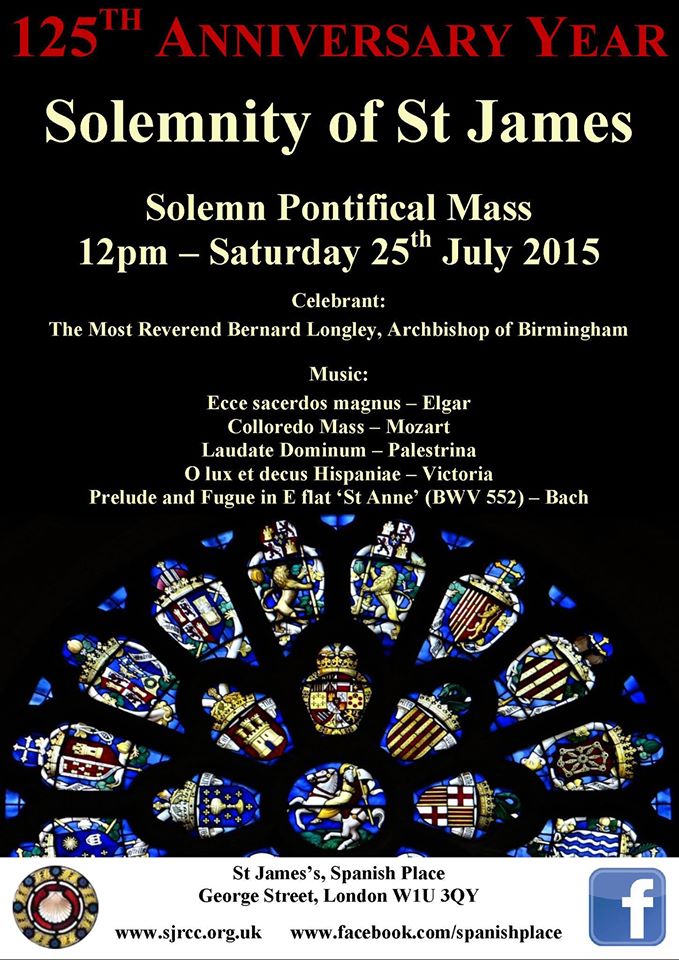
Today is the Feast of St. James the Greater. Every year on this feast day I think of the quip of my mother regarding my late father when deciding which was his patron saint, St. James the Greater or St. James the Lesser? She said immediately: "St. James THE Great". I certainly hope and pray that my father is a saint in heaven today.

In London, the parish of St. James Spanish Place is celebrating not only the patronal feast day but its 125th anniversary! From the parish's history page:

The visitor to St James's Church is often puzzled to know why a church which stands in George Street, W1, should have derived a kind of secondary title from a street called Spanish Place which can be found opposite the Presbytery door. The explanation is that St James's, Spanish Place, like so many of the older parishes in the Westminster diocese, can trace its origin to the penal times and to the benefactions of a friendly Catholic embassy. And this is perhaps the reason why, despite the magnificence of the church, there is within an atmosphere that breathes our Catholic past.

In the reign of Elizabeth I the Bishops of Ely let their palace and chapel in Ely Place to the Spanish Ambassador, and until the reign of Charles I it was occupied by the representative of the Court of Spain. During this period the chapel was freely used by English Catholics and became a place of sanctuary for them.

After the restoration of Charles II the Spanish Embassy was re-established in London, first on Ormond Street and then at Hartford house, Manchester Square, where the Wallace Collection is now housed. Here, in 1791, shortly after the first repeal of some of the laws affecting Catholic worship, a chapel was built on the corner of Spanish Place and Charles Street (now George Street), largely through the efforts of DOctor Thomas Hussey who had been a chaplain at the Embassy since his ordination in 1769. Most of the objects of piety in the present church are legacies from this older building which was famous enough in its day to be mentioned by Thackeray in
Vanity Fair as the church attended by the Marchioness of Steyne. . . .

In the year 1827 the official Spanish connection with the chapel ceased and it was handed over to the London Vicariate. However, there is much in the present church to remind us of our Spanish heritage including Alfonso XIII's personal standard which is in a frame over the sacristy door, and the parishioners of Spanish Place have never forgotten their debt to Spain for having established and maintained the mission in the dark days. An unofficial connection with the Embassy of Spain has continued and is still cherished by the Church of St James today. . . .

The site was purchased and the design for a new church was made an open competition. Edward Goldie, great grandson of the architect of the old chapel, Signor Joseph Bonomi, won the competition and the present edifice, partially completed, was opened on Michaelmas Day, 1890.

Happy Feast of St. James! St. James, pray for us!

Sunday, May 18, 2014

Embassy Chapels in London and the Mass

Here's some more interesting news from the Personal Ordinariate of Our Lady of Walsingham: a special Mass at Our Lady of the Assumption and St. Gregory, the Ordinariate parish in that part of London to honor the Portuguese Ambassador to the Court of St. James:

The Portuguese ambassador to the United Kingdom is to attend Mass at the Personal Ordinariate of Our Lady of Walsingham's central church in Warwick Street, Soho, next month as part of efforts to restore historic links between that church and the Portuguese Embassy. His Excellency João de Vallera, along with other representatives from the Portuguese community in London, will be at the 10.30 a.m. Solemn Mass on Sunday 15 June, Trinity Sunday, which falls at the end of a week of celebrations to mark Portugal's National Day on 10 June.

The Warwick Street church, Our Lady of the Assumption and St. Gregory - which Cardinal Vincent Nichols dedicated to the life of the Ordinariate in 2013 - was built on the site of a Catholic chapel which had served the Portuguese embassy in London in the early eighteenth century, when the embassy was located in Golden Square, Soho. That original chapel, built during the Marques de Pombal's term as ambassador from 1724 to 1747 (and subsequently leased to the Bavarian Embassy), was badly damaged during the anti-Catholic Gordon Riots of 1780. It was rebuilt in 1789-90.

Beginning in the reign of King James I, from my reading, the embassy chapels of Catholic nations in London became sites of worship and the sacraments for Catholic English men and women. The ambassadors of the Court of Spain opened the chapel of St. James, Spanish Place (which for awhile hosted several Ordinariate events) to Catholics and the ambassadors often pleaded for the life (and exile) of Catholic priests arrested and condemned to death or, failing that, would make sure the martyred priest was supported during his execution with prayers. See for example the execution of Blessed Thomas Maxfield. Obviously, the Portuguese Embassy chapel served the same purpose for Catholics in London.

According to the announcement of this event:

The Mass will combine a flavour of the Anglican patrimony which the Ordinariate brings to the Catholic Church, with a Portuguese feel. Music by the Portuguese composer, Manuel Cardoso, will feature, alongside pieces by English composers including Herbert Howells and John Stainer. The Mass will be celebrated according to the Ordinariate Use, which integrates centuries' old Anglican prayers into the Roman Rite.

It's almost too bad they could not have included some of the music of Samuel Webbe, the English Catholic composer who served as organist in both the Sardinian and Portuguese embassy chapels in the 18th century.

Refreshments will be served! Portuguese wine and finger-foods (aka petiscos e doces?)!

Wednesday, February 26, 2014

Cardinal Merry del Val, RIP


O Jesus! meek and humble of heart, hear me.
From the desire of being esteemed, deliver me, O Jesus.
From the desire of being loved,
From the desire of being extolled,
From the desire of being honored,
From the desire of being praised,
From the desire of being preferred to others,
From the desire of being consulted,
From the desire of being approved,

From the fear of being humiliated, deliver me, O Jesus.
From the fear of being despised,
From the fear of suffering rebukes,
From the fear of being calumniated,
From the fear of being forgotten,
From the fear of being ridiculed,
From the fear of being wronged,
From the fear of being suspected,

That others may be loved more than I, O Jesus, grant me the grace to desire it.
That others may be esteemed more than I,
That, in the opinion of the world, others may, increase and I may decrease,
That others may be chosen and I set aside,
That others may be praised and I unnoticed,
That others may be preferred to me in everything,
That others may become holier than I, provided that I may become as holy as I should, O Jesus, grant me the grace to desire it.

Amen.

Cardinal Rafael Merry de Val, Secretary of State for Pope St. Pius X, died on Feburary 26, 1930. He composed the Litany of Humility, above. He was born in England at the Spanish Embassy in London on October 10, 1865 and was educated at Catholic schools in England and then in Rome.

According to this article, he maintained those early links with England, including his investigation of the validity of Anglican Orders in the Catholic Church:

After graduating from the Pontifical Gregorian University, he became one of the most influential and consulted figures of pontifical Rome, especially when it came to problems regarding Anglicanism. His perfect knowledge of the environment and of the language, his frequent trips across the English Channel, and the esteem of Cardinal Vaughan gave him great authority.

Entrusted by Leo XIII with the thorny question of the validity of Anglican orders – at the uncertain, hesitant beginning of the ecumenical journey – he led the Holy See to the negative response, made official in September of 1896 with the bull "Apostolicae Curae," of which he was the main architect. On the basis of practice that had stood for three hundred years, and of an exhaustive historical investigation, Leo XIII confirmed the "nullity" of the "ordinations carried out with the Anglican rite," thereby denying the apostolic succession of those bishops. The reconciliation of Anglicans and Catholics, which had been proceeding for some time, came to an abrupt halt, while the young prelate established himself as the spokesman of a stance of doctrinal austerity that was different from, if not incompatible with, the policy of Rampolla, who was secretary of state at the time.

He was well known for his facility with languages, his piety and devotion (evidenced by the prayer above), and his great personal support of Pope St. Pius X, whose cause for canonization he introduced and supported. Cardinal Merry del Val died on February 26, 1930 during an operation for appendicitus. His cause for canonization has been introduced and he is a Servant of God.

Image source: Wikipedia commons.