Showing posts with label Embassy Chapels. Show all posts

Saturday, July 25, 2015

The Feast of St. James at Spanish Place

Today is the Feast of St. James the Greater. Every year on this feast day I think of the quip of my mother regarding my late father when deciding which was his patron saint, St. James the Greater or St. James the Lesser? She said immediately: "St. James THE Great". I certainly hope and pray that my father is a saint in heaven today.

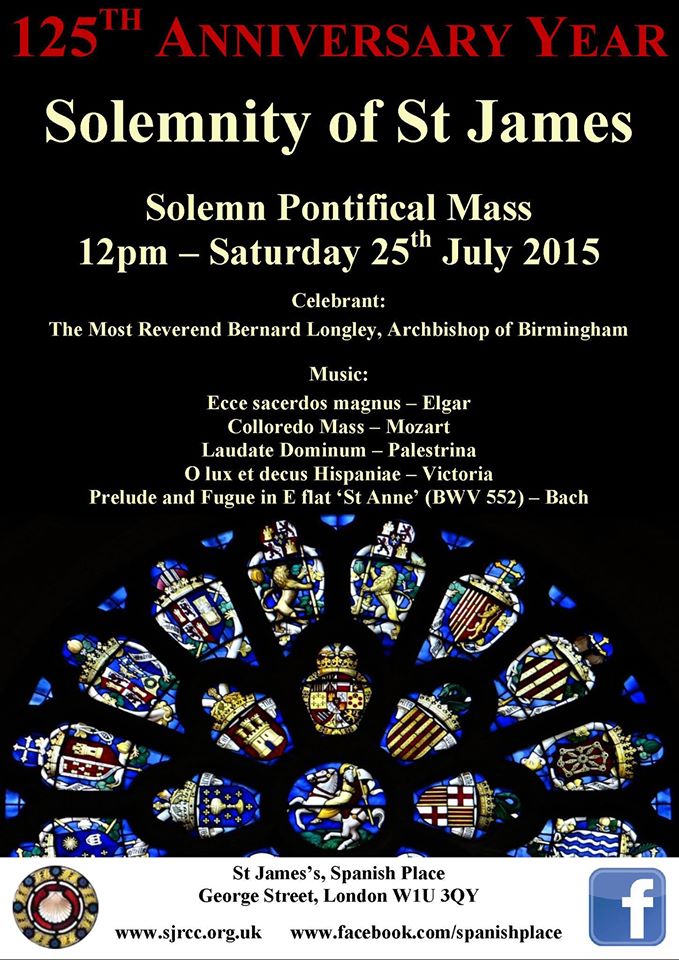
In London, the parish of St. James Spanish Place is celebrating not only the patronal feast day but its 125th anniversary! From the parish's history page:

The visitor to St James's Church is often puzzled to know why a church which stands in George Street, W1, should have derived a kind of secondary title from a street called Spanish Place which can be found opposite the Presbytery door. The explanation is that St James's, Spanish Place, like so many of the older parishes in the Westminster diocese, can trace its origin to the penal times and to the benefactions of a friendly Catholic embassy. And this is perhaps the reason why, despite the magnificence of the church, there is within an atmosphere that breathes our Catholic past.

In the reign of Elizabeth I the Bishops of Ely let their palace and chapel in Ely Place to the Spanish Ambassador, and until the reign of Charles I it was occupied by the representative of the Court of Spain. During this period the chapel was freely used by English Catholics and became a place of sanctuary for them.

After the restoration of Charles II the Spanish Embassy was re-established in London, first on Ormond Street and then at Hartford house, Manchester Square, where the Wallace Collection is now housed. Here, in 1791, shortly after the first repeal of some of the laws affecting Catholic worship, a chapel was built on the corner of Spanish Place and Charles Street (now George Street), largely through the efforts of DOctor Thomas Hussey who had been a chaplain at the Embassy since his ordination in 1769. Most of the objects of piety in the present church are legacies from this older building which was famous enough in its day to be mentioned by Thackeray in
Vanity Fair as the church attended by the Marchioness of Steyne. . . .

In the year 1827 the official Spanish connection with the chapel ceased and it was handed over to the London Vicariate. However, there is much in the present church to remind us of our Spanish heritage including Alfonso XIII's personal standard which is in a frame over the sacristy door, and the parishioners of Spanish Place have never forgotten their debt to Spain for having established and maintained the mission in the dark days. An unofficial connection with the Embassy of Spain has continued and is still cherished by the Church of St James today. . . .

The site was purchased and the design for a new church was made an open competition. Edward Goldie, great grandson of the architect of the old chapel, Signor Joseph Bonomi, won the competition and the present edifice, partially completed, was opened on Michaelmas Day, 1890.

Happy Feast of St. James! St. James, pray for us!

Sunday, May 25, 2014

Samuel Webbe and English Catholics in the Eighteenth Century

I mentioned Samuel Webbe in my post last Sunday about the Mass at Our Lady and St. Gregory, Warwick Street to honor the Portuguese ambassador. He died on May 29 in 1816--25 years after the Catholic Relief Act of 1791 and 13 years before Catholic Emancipation. The Friends of the Ordinariate of Our Lady of Walsingham highlights him on their Music tab:

English composer, born in England in 1742; died in London, 29 May, 1816. He studied under Barbaudt. In 1766 he was given a prize medal by the Catch Club for his O that I had wings, and in all he obtained twenty-seven medals for as many canons, catches, and glees, including Discord, dire sister, Glory be to the Father, Swiftly from the mountain’s brow, and To thee all angels. Other glees like When winds breathe soft, Thy voice, O Harmony, and Would you know my Celia’s charms are even better known. In 1776 he succeeded George Paxton as organist of the chapel of the Sardinian embassy, a position which he held until 1795: he was also organist of the Portuguese chapel. His Collection of Motetts (1792) and A Collection of Masses for Small Choirs were extensively used in Catholic churches throughout Great Britain from 1795 to the middle of the last century. If not of a very high order, they are at least devotional, and some are still sung. He also published nine books of glees, between the years 1764 and 1798, and some songs. His glees are his best claim on posterity.

Lest you are confused, Webbe did not write for the TV show Glee; he wrote English a cappella part songs, scored for three to four voices, although Glee clubs did sing them:

Discord!Dire sister of the slaughtering power,
Small at her birth, but rising every hour,
While scarce the skies her horrid head can bound,
She stalks on earth, and shakes the world around.
But lovely Peace in angel form
Descending quells the rising storm.
Soft ease and sweet content shall reign
And Discord never rise again.

The same site that highlighted Webbe notes that "The penal laws and the persecution of Catholics during the 220 years from 1558 to 1778 prevented any development of music by and for Catholics." 

This intrigues me. William Byrd's great output of liturgical music for all the propers of the Roman Missal dates from the 17th century, and I know that composers like Peter Phillips fled to the Continent to both practice their faith and compose music. Since Catholics were only able to attend Mass secretly in hidden chapels in recusant safe houses, Low Mass, silent and somber, was the rule. According to this presentation by an Oratorian priest, there was little congregational singing, and even when rarely celebrated, Benediction was accompanied by recitation of the great Eucharistic hymns of St. Thomas Aquinas. In the Embassy chapels, the liturgical music, if it represented more modern compositions than Gregorian chant and Renaissance polyphony, was by German, Italian, Portuguese, or Spanish composers, so English Catholics attending those Masses heard international music, not by their own.

Ashgate publishes Roman Catholic Church Music in England, 1791–1914: A Handmaid of the Liturgy? by T.E. Muir that addresses developments after the 1791 Catholic Relief Act until World War I:

Roman Catholic church music in England served the needs of a vigorous, vibrant and multi-faceted community that grew from about 70,000 to 1.7 million people during the long nineteenth century. Contemporary literature of all kinds abounds, along with numerous collections of sheet music, some running to hundreds, occasionally even thousands, of separate pieces, many of which have since been forgotten. Apart from compositions in the latest Classical Viennese styles and their successors, much of the music performed constituted a revival or imitation of older musical genres, especially plainchant and Renaissance Polyphony. Furthermore, many pieces that had originally been intended to be performed by professional musicians for the benefit of privileged royal, aristocratic or high ecclesiastical elites were repackaged for rendition by amateurs before largely working or lower middle class congregations, many of them Irish.

However, outside Catholic circles, little attention has been paid to this subject. Consequently, the achievements and widespread popularity of many composers (such as Joseph Egbert Turner, Henry George Nixon or John Richardson) within the English Catholic community have passed largely unnoticed. Worse still, much of the evidence is rapidly disappearing, partly because it no longer seems relevant to the needs of the modern Catholic Church in England.

This book provides a framework of the main aspects of Catholic church music in this period, showing how and why it developed in the way it did. Dr Muir sets the music in its historical, liturgical and legal context, pointing to the ways in which the music itself can be used as evidence to throw light on the changing character of English Catholicism. As a result the book will appeal not only to scholars and students working in the field, but also to church musicians, liturgists, historians, ecclesiastics and other interested Catholic and non-Catholic parties.

The article I cited from Newman's foundation, the Oratory of St. Philip Neri in England, points out that there were exceptions to the rule of secret and silent Masses, looking again at the Embassies in London and the outlet they offered to some Catholic composers, like Samuel Webbe, George Paxton--and Thomas Arne, arranger of "God Save the King/Queen" and composer of "Rule, Britannia". There is definitely more to this story.
Sunday, May 18, 2014

Embassy Chapels in London and the Mass

Here's some more interesting news from the Personal Ordinariate of Our Lady of Walsingham: a special Mass at Our Lady of the Assumption and St. Gregory, the Ordinariate parish in that part of London to honor the Portuguese Ambassador to the Court of St. James:

The Portuguese ambassador to the United Kingdom is to attend Mass at the Personal Ordinariate of Our Lady of Walsingham's central church in Warwick Street, Soho, next month as part of efforts to restore historic links between that church and the Portuguese Embassy. His Excellency João de Vallera, along with other representatives from the Portuguese community in London, will be at the 10.30 a.m. Solemn Mass on Sunday 15 June, Trinity Sunday, which falls at the end of a week of celebrations to mark Portugal's National Day on 10 June.

The Warwick Street church, Our Lady of the Assumption and St. Gregory - which Cardinal Vincent Nichols dedicated to the life of the Ordinariate in 2013 - was built on the site of a Catholic chapel which had served the Portuguese embassy in London in the early eighteenth century, when the embassy was located in Golden Square, Soho. That original chapel, built during the Marques de Pombal's term as ambassador from 1724 to 1747 (and subsequently leased to the Bavarian Embassy), was badly damaged during the anti-Catholic Gordon Riots of 1780. It was rebuilt in 1789-90.

Beginning in the reign of King James I, from my reading, the embassy chapels of Catholic nations in London became sites of worship and the sacraments for Catholic English men and women. The ambassadors of the Court of Spain opened the chapel of St. James, Spanish Place (which for awhile hosted several Ordinariate events) to Catholics and the ambassadors often pleaded for the life (and exile) of Catholic priests arrested and condemned to death or, failing that, would make sure the martyred priest was supported during his execution with prayers. See for example the execution of Blessed Thomas Maxfield. Obviously, the Portuguese Embassy chapel served the same purpose for Catholics in London.

According to the announcement of this event:

The Mass will combine a flavour of the Anglican patrimony which the Ordinariate brings to the Catholic Church, with a Portuguese feel. Music by the Portuguese composer, Manuel Cardoso, will feature, alongside pieces by English composers including Herbert Howells and John Stainer. The Mass will be celebrated according to the Ordinariate Use, which integrates centuries' old Anglican prayers into the Roman Rite.

It's almost too bad they could not have included some of the music of Samuel Webbe, the English Catholic composer who served as organist in both the Sardinian and Portuguese embassy chapels in the 18th century.

Refreshments will be served! Portuguese wine and finger-foods (aka petiscos e doces?)!

Saturday, January 5, 2013

Good news from the Ordinariate in England!

The Ordinariate now has a parish in London: Our Lady of the Assumption and Saint Gregory, Warwick Street, according to this news release:

The Archbishop of Westminster, the Most Reverend Vincent Nichols, has today announced that the church of Our Lady of the Assumption and Saint Gregory, Warwick Street, is being dedicated to the life of the Personal Ordinariate of Our Lady of Walsingham.

The historic church, which is situated in Soho, previously served as the chapel of the Portuguese, and later Bavarian, embassies. In the nineteenth century the sanctuary was rebuilt by the architect, J. F. Bentley, who designed Westminster Cathedral. In his ‘Apologia’ Blessed John Henry Newman mentions a visit to the church as a young boy with his father. He converted from Anglicanism to the Catholic faith in 1845and is the patron of the Personal Ordinariate.

Speaking of the news, Monsignor Keith Newton, the Ordinary of the Personal Ordinariate, said, “We are very grateful to Archbishop Vincent Nichols for this gesture of goodwill and support for the Ordinariate. The church is a beautiful example of ecclesiastical architecture in a very central part of London. We will be challenged to provide a strong Christian witness to those who frequent the surrounding area of Soho. It will also provide a fitting place for the liturgical and spiritual traditions of the Anglican tradition to flourish, in complete union with the Catholic Church. These demonstrate our fervent hope for the realisation of the ultimate goal of all ecumenical work, the restoration of full ecclesial communion”.

"The missionary work of the slum clergy of our Anglican forebears to the marginalised of our society must be at the heart of our mission. We relish the opportunity to engage in this important pastoral ministry, faithfully presenting the teaching of the Catholic Church as the means by which light of Jesus Christ can shine on the dark places of our world. Together with the recent formation of a religious community of former Anglican religious within the Ordinariate this is really good news as we begin 2013".

Read the rest here.

This site includes more detail about the church and its history, including the damage it suffered during the Gordon Riots :

Roman Catholic Church of Our Lady of the Assumption and St. Gregory, Warwick Street

This church, which was built in 1789–90, is the sole survivor of the few Roman Catholic chapels which existed in London during the eighteenth century. Its erection was one of the earliest manifestations of the Roman Catholic resurgence which accompanied the gradual relaxation of the penal laws. A smaller chapel, belonging successively to the Portuguese and Bavarian envoys who lived in Golden Square, had stood on part of the site of the present church, probably since 1724, and this long tradition of faith gives the Warwick Street church its unique cachet.

In 1724 the Portuguese envoy moved into the adjoining Nos. 23 and 24 Golden Square and it may reasonably be assumed that a Catholic chapel, to which his diplomatic privileges entitled him, was established there at about that time. Despite the penal laws against the celebration of Mass, his English co-religionists were evidently allowed to worship there unmolested.

The chapel must have been a small building. It was probably adapted from the existing outbuildings between the two houses in Golden Square and the legation stables fronting on to the east side of Warwick Street. A deed of 1700 which refers to the buildings behind No. 23 Golden Square mentions 'the room next the Garden' and an adjoining room containing 'a stove set with dutch tiles and wainscot over it'. It may therefore have been these, or similar buildings behind No. 24, that were subsequently converted into the envoy's chapel. He and his family and staff probably had a private entrance from the houses in Golden Square but the public entry was through a narrow passage from Warwick Street.

The Portuguese legation remained in Golden Square until 1747. Its most famous occupant was Don Sebastian Joseph de Carvalho, later Marquis of Pombal and dictator of Portugal who, soon after his arrival in London in 1739, issued a series of minute regulations governing the conduct of the services in his chapel.

In 1747 the Portuguese legation moved to South Street, Mayfair. The two houses in Golden Square, with the chapel and other outbuildings in Warwick Street, were then taken by Count Haslang, the Bavarian minister, who remained there until his death in 1783;  the danger of the chapel being closed by the withdrawal of diplomatic patronage and immunity was thus averted. The priests who served the chapel were technically the minister's chaplains, but in practice they were evidently charged mainly with ministering to the English Catholics in the neighbourhood, of whom in 1780 there were nearly a thousand living in St. James's parish, as well as many more in St. Anne's, Soho. Of the forty-four priests who are known to have served the chapel during its years under Bavarian protection, only three had foreign names.

The statutory relaxation of the penal laws began in 1778 with the passing of Sir George Savile's Catholic Relief Act. This occasioned the formation of the Protestant Association to procure its repeal and eventually culminated in the acts of mob violence which took place between 2 and 13 June 1780 and which have since been known as the Gordon Riots.

Count Haslang's chapel was amongst the first to suffer. On the night of 2–3 June, while another mob was destroying the Sardinian envoy's chapel in Lincoln's Inn Fields, a large party of rioters arrived in Warwick Street from Palace Yard, where the Protestant Association had gathered under Lord George Gordon. The rioters forced an entry and set about the despoilment of the chapel, most of the furniture and fittings being taken out into the street and burnt.

In the Diocese of Southwark, another parish has been established for the Ordinariate at the Church of the Most Precious Blood (from the same Ordinariate website):

Ordinariate priest appointed to South London parish
24 December 2012

An announcement was made yesterday (Sunday) that the Parish of the Most Precious Blood, Borough, is to be cared for by the Personal Ordinariate of Our Lady of Walsingham.
By the kind invitation of the Archbishop of Southwark, the Most Reverend Peter Smith, the diocesan parish of the Precious Blood near London Bridge station will be cared for by Fr Christopher Pearson - a priest of the Personal Ordinariate - with the permission of the Ordinary of the Personal Ordinariate, Mgr Keith Newton.
Replacing the Religious Community of the Society of the Divine Saviour (Salvatorians), who currently care for the parish, Fr Pearson will undertake the pastoral care of the diocesan faithful alongside the London (South) Ordinariate Group, who have worshipped in the parish in recent months. Fr Pearson's appointment begins in January 2013.
Mgr Keith Newton said, "We are very grateful to Archbishop Peter Smith and the diocesan authorities for making this possible. It represents a positive moment in the life of the Ordinariate, as we grow towards the establishment of our own parishes and communities".
The parish of the Precious Blood was founded in 1891.