Showing posts with label presentations. Show all posts

Thursday, May 5, 2022

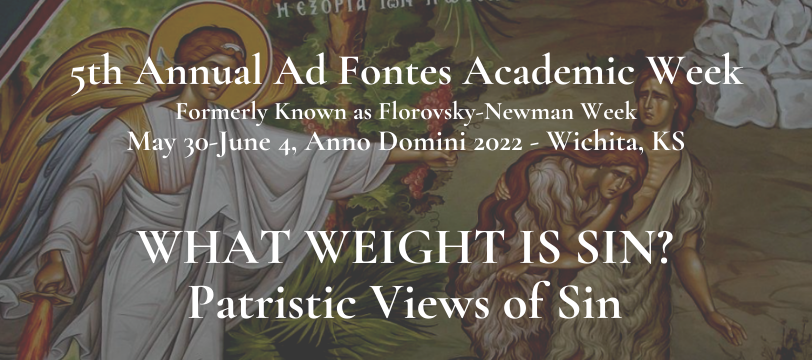
This Year's EDI Academic Week: Now Named "Ad Fontes"


Beginning June 1st with the Festal Banquet at Newman University and continuing with prayers, lectures, academic papers, and Plenary Dialogues at Newman University and St. George Catholic Christian Cathedral on June 2nd, 3rd, and 4th, Eighth Day Institute's annual academic theological event has been announced:

Co-sponsored by St George Orthodox Christian Cathedral and the Gerber Institute for Catholic Studies, the Ad Fontes Academic Week promotes a “return to the sources for Christian unity.” Heeding Fr. Florovsky's advice, rather than simply overlooking differences, this conference seeks to overcome the different views of sin. And we do so by returning to the common Tradition, by learning to read the Fathers as living masters, rather than as historical documents.

In years past, this conference has been known as the Florovsky-Newman Week. This year we have decided to broaden our perspective by honoring Thomas F. Torrance together with our other two patrons. Torrance was a Protestant who, like the Orthodox Fr. Georges Florovsky and Catholic St. John Henry Newman, called for a return to patristic sources as a guide for the modern Church..

Join us for this unique event as we return to the sources—ad fontes—in order to explore, challenge, and encourage one another to better love God and neighbor, and to work towards unity by way of the Fathers.

The topic this year is "What Weight Is Sin? Patristic Views of Sin" and the schedule, still being refined, is posted here.

Also note that there is a pre-Ad Fontes seminar: "Sin in the Bible, the Fathers, the Liturgy, & Literature" with texts still to be announced. I've attended two of those seminars and they are wonderful, as participants discuss the texts.

I'll be presenting the annual Newman Lecture on Thursday, June 2 at 9:00 a.m. at Newman University. My topic is "Newman on Hypocrisy and Holiness in the Life of a Christian":

John Henry Cardinal Newman, before his canonization in 2019, may have been studied mostly for his controversial works like the Essay on the Development of Christian Doctrine, The Letter to the Duke of Norfolk, or classics like the Apologia pro Vita Sua and Idea of a University. Interest in his spiritual influence as an Anglican preacher in the Parochial and Plain Sermons and as the founder of the Oratory of St. Philip Neri in England, has been increasing, however, as his cause for canonization progressed (and succeeded on October 13, 2019).

This annual Newman lecture will focus on his efforts as the Vicar of the University Church of St. Mary the Virgin in Oxford to help his congregation free themselves from the corruptions of what he called the “Religion of the Day” and their comforts as part of the establishment in England to lead true Christian lives, loving God fully and avoiding the besetting sin of hypocrisy.

The continuity of that effort will also be briefly explored through some of his Meditations and Devotions, prepared for the boys of the Oratory School in Birmingham. 

Watch for updates (including the other speakers' abstracts and the list of academic papers to be presented) on the EDI website or Facebook page.

Tuesday, February 22, 2022

My "Newman Week"


Last week was really a Newman week for me--but one event had to be postponed because of icy and snowy weather. It seems like our weeks here in Wichita have a certain pattern: mild weekends, lovely Mondays and Tuesdays, and then stormy weather coming Wednesday overnight into Thursday. Cancellations and school closings Thursday, warm up Friday, and then warmer weekends! At least, it's happened three times so far this year.

I'd been preparing for two presentations last week at Newman University during their Heritage Month which honors both Saint Maria de Mattias, the founder of the Adorers of the Blood of Christ and Saint John Henry Newman, the university's patron since 1993 (first as Kansas Newman College and then as Newman University). Both saints were born in February (she on February 4, 1805; he on February 21, 1801.) I gave one of the presentations Wednesday, February 16 at Noon (see flyer above) but was warned that the second presentation I was scheduled to make, at the Beata Banquet for benefactors Thursday evening, might need to be postponed if the winter storm occurred as forecast. And it was! I certainly hope it will be rescheduled after spending so much time preparing for it!

I'd also been preparing for our monthly Lovers of Newman meeting at the convent of the Sisters of the Immaculate Heart of Mary in Colwich, Kansas, which I attended Sunday, February 20. We celebrated Saint John Henry Newman's birthday with a red velvet cake (appropriate for a Cardinal!) as we read and discussed one of his Parochial and Plain Sermons, "Love the One Thing Needful".

And of course, I'd been reading and preparing for my segment on the Son Rise Morning Show yesterday (Monday) morning, discussing the third of Newman's pre-Lenten sermons, "Prejudice and Faith", which will be repeated Friday morning February 25, during the first EWTN hour (from 5:00 to 6:00 a.m. Central or 6:00 to 7:00 a.m. Eastern). We'll continue that series throughout Lent, using the sermons included in The Tears of Christ: Meditations for Lent edited and complied by Christopher O. Blum of the Augustine Institute. We'll select one sermon, excerpted by Blum, each week from among the daily meditations and discuss it on Monday mornings at my usual time.

And finally, following a pattern of preparation I developed in college, I read Michael Ffinch's Newman: Towards the Second Spring before my presentations just as a review of Newman's life and times. I commented on that book last week too.

And today I plan to attend the High Tea at Newman University this afternoon. This event has been held to honor the Englishman Saint John Henry Newman since the mid-1980's as this 2019 story explains!

Saint John Henry Newman, pray for us!

Monday, July 12, 2021

John Finnis and Shakespeare and Catholicism

After posting about Dr. Neil Younger's article about Catholics and crypto-Catholics in Elizabeth I's regime, I found several presentations by Professor John Finnis about Shakespeare's connection to one of those Catholics in both Elizabeth's and James I's reign: Edward Somerset, the 4th Earl of Worcester, whom Elizabeth said had "reconciled what she believed impossible, a stiff papist to a good subject." Finnis and his frequent collaborator in these Shakespeare and Catholicism researches, Patrick H. Martin, identifies Worcester, and Worcester's secretary William Sterrell, as important figures in the Appellant controversy, an attempt to procure some leniency for Catholics in exchange for a vow against certain powers of the pope to depose monarchs, and Worcester specifically as a patron of two plays, A Midsummer Night's Dream and As You Like It.

In October of 2010, he presented three lectures on "Shakespeare's Patriotic Resistance" at Princeton University in the Charles E. Test Distinguished Lecture Series and you may find those lectures here, with the general thesis that we may find Shakespeare's arguments for the overthrow of the Tudor or Stuart regime because they are not fit to rule--in spite of their claims to rule based on their legitimate succession--and should be replaced that rulers who are fit to rule, as Richmond (Henry VII) replaced Richard III and Bolingbroke (Henry IV) replaced Richard II. Both usurpations were dramatized by Shakespeare.

In 2012, he spoke on Australian ABC's "Philosopher's Zone" on "Shakespeare, Identity, and Religion": Listen to that conversation with David Rutledge here.

In 2014, he spoke in the Catholic Culture Series at the University of Notre Dame on "Shakespeare and the Four Last Things":

The series began with an illuminating lecture by renowned professor of law and Center research fellow John Finnis on “Shakespeare and the Four Last Things,” where he examined Catholic themes in Richard III, Henry VIII, and the poem “The Phoenix and the Turtle.” While English Catholics of Shakespeare’s day were persecuted for their faith, Finnis argued that Shakespeare still managed to raise several theological and ethical questions in his work that were unique to Catholics at the time. In Richard III, for example, Shakespeare presents a world where one’s personal judgment corresponds to the divine judgment after death—an idea contrary to the Calvinistic view of predestination. “Conscience is massively a part of the Catholic self-understanding of the world,” Finnis argued. Meanwhile, in “The Phoenix and the Turtle,” Shakespeare calls for prayer for the dead birds of the title—figures that represented prominent Catholic martyrs of the time. Finnis concluded that, viewed through the lens of Shakespeare’s contemporary Catholic audience, one can see these Catholic values clearly at work in his writing.

You may find that presentation here.

Professor John Finnis has had a remarkable academic career, as noted at the website for Princeton presentations

John M. Finnis is Professor of Law and Legal Philosophy at the University of Oxford, Biolchini Family Professor of Law at the University of Notre Dame, and adjunct Professor in the Department of Philosophy at the University of Notre Dame. Known for his work in moral, political and legal theory, as well as constitutional law, Professor Finnis teaches courses in Jurisprudence, in the Social, Political, and Legal Theory of Thomas Aquinas, and in the Social, Political and Legal Theory of Shakespeare. He joined the Notre Dame Law School faculty in 1995. He has served as associate in law at the University of California at Berkeley (1965-66), as professor of law at the University of Malawi (Africa) (1976-78), and as the Huber Distinguished Visiting Professor of Law at the Boston College Law School (1993-94). He is admitted to the English Bar (Gray’s Inn). His service has included the Linacre Centre for Health Care Ethics (governor since 1981), the Catholic Bishops’ Joint Committee on Bioethical Issues (1981-88), the International Theological Commission (1986-92), the Pontifical Council for Justice and Peace (1990-95), and the Pontifical Academy Pro Vita (2001- present). He has published widely in law, legal theory, moral and political philosophy, moral theology, and the history of the late Elizabethan era. His published works include Fundamentals of Ethics, Moral Absolutes: Tradition, Revision and Truth, and Aquinas: Moral, Political, and Legal Theory. A five-volume edition of The Collected Essays of John Finnis will be published by Oxford University Press in March 2011. At that time, the second edition of his widely heralded book Natural Law and Natural Rights will be released, also by Oxford University Press. He earned his LL.B. from Adelaide University in 1961 and his doctorate from Oxford University as a Rhodes Scholar in 1965.

Fascinating, if complicated and rather repetitive (the same tropes of the "Phoenix and the Turtle", William Sterrill's activity, etc come up in nearly each set of presentations) material, offered for your consideration.

Image Credit (Public Domain): Portrait of Edward Somerset, 4th Earl of Worcester signed "Gilbertus Jackson" and dated 1621.
Saturday, January 4, 2020

2019: The Year of Reading Newman


I just can't let my reading year in review go without commenting on how much I read in and about St. John Henry Newman last year.

With Matt Swaim and Anna Mitchell on the Son Rise Morning Show I completed a long series of discussions of Newman's life and works starting in January and ending in October the day after his canonization. We covered many aspects of his life and works so I re-read many of his great books, dipping into them, and consulting works about Newman.

I presented a paper on Newman and Papal Infallibility at the Eighth Day Institute Florovsky-Newman Week in June last year.

The Theology Institute at the Spiritual Life Center has included works by and about Newman in recent monthly discussions, using Bishop Robert Barron's Exploring Catholic Theology: Essays on God, Liturgy, and Evangelization. Two chapters highlight Newman: "A Tale of Two Cardinals: Avery Dulles's Creative Engagement with the Thought of John Henry Newman" and "John Henry Newman among the Postmoderns". Three of the priest guest speakers have talked about Newman in their presentations during our once-a-month meetings: on Newman and the Fathers, on Newman's Personalism, and on Newman as a Doctor of the Church. We'll continue our exploration of Newman with lectures on his Essay on the Development of Christian Doctrine today.

Two of the books on my best of the year list highlighted Newman: Vatican I and Mary's Bodily Assumption.

And, finally, I made two presentations at the Spiritual Life Center's Newman Retreat in November on "Newman in Wichita" and "Newman and the Laity".

So 2019 was a Newman Reading Year indeed, even though I did not read one book totally dedicated to Newman!

Among the works consulted:

Parochial and Plain Sermons
University Sermons
Apologia Pro Vita Sua
The Dream of Gerontius
Meditations and Devotions
Loss and Gain
A Letter to the Duke of Norfolk
Consulting the Faithful in Matters of Doctrine
The Grammar of Consent
An Essay on the Development of Christian Doctrine
The Idea of A University

Father Ian Ker's Biography of Newman
Newman on Vatican II by Father Ian Ker
Newman and History by Edward Short
John Henry Newman: Spiritual Director by Peter Wilcox

Thursday, November 7, 2019

Newman Memories on the Ides of November

“My theme is memory, that winged host that soared about me one grey morning of war-time. These memories, which are my life—for we possess nothing certainly except the past—were always with me."--from Brideshead Revisited by Evelyn Waugh.

November is a month for memories: we remember the faithfully departed; we remember the 11th hour of the 11th day of the 11th month at the end of the war that was to end all wars; we remember all the blessings we have received and give thanks for them. My brother and sister and I remember our father's birthday on November 6 and our parents' wedding anniversary on November 25--they are both dead, but those events, not just the celebration of their memory are always with us. Without them, we are not. They are our life. And I do mean "our life" as well as our lives--they are our life as a family.

So I've been preparing for my presentations next week at the Spiritual Life Center for a Newman Retreat Friday, November 15 and Saturday, November 16:

Newman’s writings have long been esteemed by scholars. Now, with his canonization, his influence is being lifted up for all to see; not just for theologians, but for the whole Church. Among many other things, Newman is famous for his explanations of the way doctrine develops, the way God saves us through his Church, and the way people come to know and accept truth. Retreatants will walk through his teachings under the direction of Stephanie Mann and Fr. Tom Hoisington, both of the Wichita Diocese. Stephanie Mann will give two presentations: one focusing on the impact Newman has had in our diocese, and the other on the importance of Newman for the laity in light of his being raised to the altars. Fr. Hoisington will present on Newman’s personalism- his explanation of how an individual subject makes response to objective truth in a way that is both personal and universal- an essential area of Newman’s thought that is often misunderstood and underappreciated. New this retreat, participants will enjoy a Friday evening social time with music, appetizers and drinks as they enjoy each other’s company and build a Catholic Culture. Musician Jack Korbel will provide entertainment. For those who cannot attend the entire retreat, please consider joining us for Friday evening's celebrations for this new Saint!

The Friday evening presentation is made up of memories of all the different programs I've attended since 1979. And for the month of November, especially while we are remembering all the faithful departed, I'm using the word "late" often in my presentation.

The late Bishop David Maloney
The late Father Joseph Gorentz
The late Father Richard Stuchlik
The late Father Charles Taylor
The late H. Lyman Stebbins
The late James Mesa
The late Ralph McInerny
etc,
etc,
etc.

The schedule for Friday night, November 15, includes my presentation "focusing on the impact Newman has had in our diocese" and then we'll have a social hour with a musical performance by Jack Korbel!

On Saturday, November 16, we'll begin the day with Morning Prayer at 9:00 a.m.; then I'll make a presentation on St. John Henry Newman and The Laity: Notes for 21st Century Catholic Faithful; Mass follows, then lunch, and Father Hoisington will then present on Newman's Personalism.

Registration is open at the Spiritual Life Center through November 14!

Thursday, July 5, 2018

Next Week: The First Annual Florovsky Week


Eighth Day Institute will host its first annual Florovsky Week:

Please join us for the inaugural Florovsky Week
Honoring Fr. Georges Florovsky with a week of prayer, papers, iconography workshop, fellowship, 
a festal banquet with inaugural Florovsky Lecture & plenary dialogues on
THE PATRISTIC VIEW OF SALVATION
​Justification by Faith Alone?

Fr. Georges Florovsky, a 20th century Russian Orthodox priest, tirelessly insisted on a return to the common heritage of all Christians in the first 1000 years of the Church's history as a path to recovering a common language for progress toward overcoming the divisions of Christendom. In his honor, this week is organized to promote such a return to the sources for Christian unity.


The three main speakers, each representing a different branch of Christianity, are:

HANS BOERSMA - Protestant
J. I. Packer Professor of Theology at Regent College
Author of many books, including Violence, Hospitality and the Cross: Reappropriating the Atonement Tradition 

KENNETH HOWELL - Catholic
Academic Director of the Eucharist Project
President of the Pontifical Studies Foundation

BRADLEY NASSIF - Orthodox
Professor of Biblical and Theological Studies at North Park University
"Leading academic expert on Evangelical-Orthodox dialogue."
~New York Times

The schedule is here. From Tuesday evening through Friday, the event will be held at Newman University. On Saturday, the presentations will be held at St. George's Orthodox Cathedral.

I'll be making a presentation the first afternoon:

3:30 p.m. Wednesday, July 11, 2018
Group 1-Eck 124 (on the campus of Newman University)
~Malcolm Harris- Good Pope John’s (Not So) Secret Agenda to Reunite Christianity
~Stephanie Mann-Reformation and Counter-Reformation: The Catholic Mission in England and Why it Failed
~Angie Gumm-Unwitting Ecumenicalism: Annum Sacrum and Pope Leo XIII's Consecration of the World to the Sacred Heart of Jesus

Reformation and Counter-Reformation: The Catholic Mission in England and Why it Failed

After the theological ideas of Martin Luther, John Calvin, and other Protestant Reformers spread on the Continent and in the British Isles, the Latin Rite Catholic Church mounted a Counter-Reformation campaign. Religious orders like the Society of Jesus (the Jesuits) and the Capuchins (a Franciscan order) succeeded—as even James R. Payton, Jr, recognized in Getting the Reformation Wrong: Correcting Some Misunderstandings (IVP Academic: 2010)—in taking back some territory and bringing back some Protestant converts to the Catholic Church. In one country, however, all the efforts and sacrifices of clerical and lay martyrs seemed to have failed. I propose to discuss why Catholics, in spite of (and sometimes because of) tremendous plans, sacrifices and heroism, failed in their mission even to obtain freedom of worship in their native land throughout the sixteenth and seventeenth centuries. The presentation will include stories of those martyred saints who died in that failed mission and analysis of the tangle of religion and politics during the long Reformation era.

Saturday, July 29, 2017

Apologetics: Tradition at the Spiritual Life Center

At the Spiritual Life Center of the Diocese of Wichita on Tuesday, August 22 at 7:00 p.m.: 

Apologia: The Merit of Tradition
Defending the Faith in the 21st Century
Stephanie A. Mann

Apologizing isn’t saying “I’m Sorry.”

apologia or ἀπολογία (Greek): a speech in defense

An apology, in the classical sense, is a reasoned defense of the faith.

Join Dusty Gates, M.A., and guest presenters for these sessions of apologetic dialogue. Each session will address a different topic, pertinent to 21st century Catholics, which we have the need and obligation to be able to defend and explain: firstly for ourselves, secondly to our families and religious brethren, and thirdly to the greater public who may inquire of us; either as seekers of the faith, or as its attackers.

Protestants and Catholics alike often ask, "Where is that Catholic Church teaching in the Bible?" Thus, even Catholics are influenced by one of the basic tenets of the Protestant Reformation: sola scriptura, citing the Holy Bible as the only source of authority in Christianity. The Catholic Church has consistently taught that there are two sources of authority in the Church: the Tradition of the Church and the Holy Bible, formed and canonized by that Tradition. This month's Apologia at the Spiritual Life Center, presented by Stephanie A. Mann, will explore this teaching and look at how even Protestants have Tradition in their communities' authority for being a Christian.

$10 admission: online, by phone, or at the door. 7pm-8:30pm.

Each session features a one hour presentation on one topic, followed by 15-30 minutes for Q/A and discussion of this topic, and/or any topic pertaining to apologetics.

Seems natural that someone interested in Church History would be interested in Tradition! In preparation for this presentation next month, I've been reading Yves Congar's The Meaning of Tradition. Congar, a Dominican and periti at the Second Vatican Council, wrote two longer works on Tradition: La Tradition et les traditions: essai historique and La Tradition et les traditions: essai théologique, combined in the English translation as Tradition and Traditions: An historical and a theological essay. Ignatius Press provides an excerpt from The Meaning of Tradition, the introduction, here.

Sunday, July 2, 2017

Conscience and Conversion at the Spiritual Life Center


If my blogging lately has been pretty light, I have an excuse: I've been working on three presentations for next month. One is on the depiction of conscience in a Pre-Raphaelite painting; another on St. Thomas More and Conscience, and third on Blessed John Henry Newman and Conscience. More information, including registration, here:

The Spiritual Life Center will host a three-day Symposium on Conversion and Conscience July 13-15 for adult faith formation, prayer, celebration, and intellectual exchange. The theme is “Conversion and Conscience: Freedom, Will, and Truth in the Human Quest for Meaning.”

The faculty for the 2017 symposium consists of Dr. James Madden, professor of philosophy at Benedictine College; Fr. Thomas Hoisington, priest in residence at St. Mary’s Parish in Garden Plain; Fr. Joshua Lollar, priest at St. Nicholas Orthodox Church in Lawrence; and Stephanie Mann, local author of “Supremacy and Survival: How Catholics Endured the English Reformation.”

The symposium begins with a keynote banquet Thursday evening, July 13, and continues all day Friday and Saturday with a schedule consisting of morning prayer, Mass, and lectures in four pillar content areas.

The symposium will discuss how the life of Christ provides us with a model for obedience. In the person of Jesus, human will was perfectly aligned with divine will. But with lives filled with distraction and cross-pressures, and minds filled with confusion and doubt, how are we to follow in his example? How can we overcome the dissenting voices around us, and the sinful impulses within us, which tempt us to follow the example of the world, rather than the example of our Lord?

Utilizing Christological, philosophical, and historical perspectives, the symposium will provide insights into ways our forebears have pursued authentic human liberty by focusing on the transcendent, even in the midst of persecution.

The painting chosen for the program is the Call of St. Matthew by Caravaggio. Whom to you think Jesus is pointing to when He gestures to the future St. Matthew? The man with the beard or the young man counting coins? Do you think that Caravaggio wanted us to wonder?

Thursday, March 2, 2017

Blessed John Henry Newman and Lent: Affliction and Love


Two years ago, I presented a lecture on Ash Wednesday at Newman University for Cardinal Newman Day. I was asked to highlight the season of Lent and what Blessed John Henry Newman had said about it. I started with a discussion of Newman and the Liturgy both as an Anglican minister and a Catholic priest, and then I cited examples from his Parochial and Plain Sermons and from his homilies at the Oratory. The lecture was included in the third volume of Archaeopteryx: The Newman Journal of Ideas, published late last year. An excerpt:

When Newman speaks of Lent, as both an Anglican minister and later as a Catholic priest, he speaks of it not only as the season for preparation for Easter, but as a season for affliction in the service of love for God and neighbor. In PPS “Life the Season of Repentance” he told his congregation:
From the earliest times down to this day, these weeks before Easter have been set apart every year, for the particular remembrance and confession of our sins. From the first age downward, not a year has passed but Christians have been exhorted to reflect how far they have let go their birthright, as a preparation for their claiming the blessing.
(his sermon was based on the story from Genesis of Esau selling his birthright for a mess of potage): Newman cites the Apostolic tradition of Lent and continues to highlight the essence of the liturgical year, reminding us of Christ’s life, from the virgin’s womb to the empty tomb:
At Christmas we are born again with Christ; at Easter we keep the Eucharistic Feast. In Lent, by penance, we join the two great sacraments together. . . . See, then, the Church offers you this season for the purpose. "Now is the accepted time, now the day of salvation." Now it is that, God being your helper, you are to attempt to throw off from you the heavy burden of past transgression, to reconcile yourselves to Him who has once already imparted to you His atoning merits, and you have profaned them.
Then Newman introduces his great theme for Lenten observance, the connection between affliction and love. The journey from acknowledgement of sin to reconciliation with God our Father passes through trials. What we think of as something to hate is the only way to love—God uses things we want to avoid to bring us closer to him and to our neighbor.
And be sure of this: that if He has any love for you, if He sees aught of good in your soul, He will afflict you, if you will not afflict yourselves. He will not let you escape.
To separate us from sin and lead to repentance, the Lord may afflict us, Newman says, with

~disease
~misfortunes
~loss of friends and family
~darkness of mind
~lack of strength to bear a great burden
~lingering and painful death

Or we can actively choose our mortification ourselves. Therefore he urges his congregation:
Let us judge ourselves, that we be not judged. Let us afflict ourselves, that God may not afflict us. Let us come before Him with our best offerings, that He may forgive us.
Newman warns them however that this is definitely going against the spirit of the age (the Victorian age?) which values comfort and ease, luxury and wealth above everything because the focus of the day is to make life pleasant: “We aim at having all things at our will.” Newman therefore exhorted them:
Let not the year go round and round, without a break and interruption in its circle of pleasures. Give back some of God's gifts to God, that you may safely enjoy the rest.
He cites the traditional forms of penance and Lenten preparation—and more:
Fast, or watch, or abound in alms, or be instant in prayer, or deny yourselves society, or pleasant books, or easy clothing, or take on you some irksome task or employment; do one or other, or some, or all of these . . .
In another Lenten PPS sermon, “Apostolic Abstinence a Pattern for Christians” Newman used the example of St. Timothy, whom St. Paul urged to “drink no longer water, but use a little wine for your stomach” to demonstrate how strictly the Apostles and the early Christians denied themselves:
Such were holy men of old time. How far are we below them! Alas for our easy sensual life, our cowardice, our sloth! is this the way by which the kingdom of heaven is won? is this the way that St. Paul fought a good fight, and finished his course? or was it by putting behind his back all things on earth, and looking steadfastly towards Him who is invisible?
He describes again the link between love of God and affliction, even more strongly, saying that we cannot have one without the other:
But thus much we are able to see, that the great duty of the Gospel is love to God and man; and that this love is quenched and extinguished by self-indulgence, and cherished by self-denial. They who enjoy this life freely, make it or self their idol; they are gross-hearted, and have no eyes to see God withal. . . . Now, observe, I do not mean that abstinence produces this effect as a matter of course in any given person,—else all the poor ought to be patterns of Christian love . . . I should really be disposed to say,—You must make your choice, you must in some way or another deny the flesh, or you cannot possess Christian love.
Newman furthermore warns his listeners not to relapse after the self-denial of Lent and “indulge ourselves the more freely in this world's goods, for having renounced them for a while.” Instead he counseled them to make some sort of abstinence a habit so that “Self-denial will become natural to us.” . . .

If you wish to read the rest, it is available for purchase here.

Tuesday, January 3, 2017

Chesterton on New Year's Resolutions


From one of his Daily News columns:

The object of a New Year is not that we should have a new year. It is that we should have a new soul and a new nose; new feet, a new backbone, new ears, and new eyes. Unless a particular man made New Year resolutions, he would make no resolutions. Unless a man starts afresh about things, he will certainly do nothing effective. Unless a man starts on the strange assumption that he has never existed before, it is quite certain that he will never exist afterwards. Unless a man be born again, he shall by no means enter into the Kingdom of Heaven.

In that last sentence, Chesterton is alluding to Jesus's statement to Nicodemus in the Gospel of St. John (John 3:3-5). Mark Brumley provides some exegesis on this passage:

The only biblical use of the term "born again" occurs in John 3:3-5--although, as we shall see, similar and related expressions such as "new birth" and "regeneration" occur elsewhere in Scripture (Titus 3:5; 1 Pet 1:3, 23). In John 3:3, Jesus tells Nicodemus, "Truly, truly, I say to you, unless one is born again, he cannot see the kingdom of God." The Greek expression translated "born again" (gennathei anothen) also means "born from above." Jesus, it seems, makes a play on words with Nicodemus, contrasting earthly life, or what theologians would later dub natural life ("what is born of flesh"), with the new life of heaven, or what they would later call supernatural life ("what is born of Spirit").

Nicodemus' reply: "How can a man be born when he is old? Can he enter a second time into his mother's womb and be born?" (John 3:4). Does he simply mistake Jesus to be speaking literally or is Nicodemus himself answering figuratively, meaning, "How can an old man learn new ways as if he were a child again?" We cannot say for sure, but in any case Jesus answers, "Truly, truly, I say to you, unless one is born of water and the Spirit, he cannot enter the kingdom of God. That which is born of the flesh is flesh, and that which is born of the Spirit is spirit. Do not marvel that I said to you, `You must be born again."' (John 3:5-7).

So then the mystery is, how does one start again when one has already been "born again" in Baptism? I can't follow Chesterton's advice to get a new nose, new feet, new backbone, new ears, and new eyes! I'm stuck with the ones I've got, unless I start using them for something different. Smell new things, walk new paths, stand up for what I believe in, hear news things, see new things. 

I'm still thinking about resolutions for 2017. How about you?

In the meantime, I'm preparing for a couple of presentations--coming up fast: Thursday, January 5, I'll be speaking to the Altar Society at All Saints Catholic Church at 7 p.m.. Topic: the Three Women Martyrs of the English Reformation: Saints Margaret Clitherow, Margaret Ward, and Anne Line. Next week: Friday, January 13 at the Eighth Day Institute: "Long Live the Queen: John Henry Newman and the Place of Theology in a Liberal Arts Education"!!

Happy New Year! Merry Christmas!

Sunday, August 21, 2016

Updates and Deadlines


I apologize for the lack of blogging: I'm working on a project with a fast approaching deadline! I'm writing an article for the Tudor Life magazine about The Pilgrimage of Grace, exploring the meaning of that title and the banner of that pilgrimage depicting the Five Wounds of Jesus.

In the meantime, I've updated my "Presentations and Interviews" and by "Other Publications" tabs. The former includes a teaser from the Spiritual Life Center of my presentation on Blessed John Henry Newman on Faith, Family, and Friends, which I think went well. The latter includes the announcement that my article on Papal Bulls and other official documents will be in the September/October issue of OSV's The Catholic Answer Magazine.

Have a wonderful Sunday!

Friday, August 5, 2016

Newman: Docentium at the Spiritual Life Center

Our diocesan newspaper, The Catholic Advance, features a story (page 11) about my presentation on Thursday, August 18 as part of the Spiritual Life Center's monthly Docentium series. The title is: "Blessed John Henry Newman: Faith, Family, and Friends":

When Pope Emeritus Benedict XVI beatified John Henry Newman in September 2010, local author Stephanie A. Mann says, “Something changed about the way Catholics should view this great nineteenth century writer and intellectual. Blessed John Henry Newman is an intercessor and a heavenly patron now, not just an academic interest and research project.”

In the decades after his death in the late nineteenth, his Cause for Canonization moved slowly, Mann notes, but one reason some Catholics believed Newman should be canonized was his influence on others to become Catholic , both in his lifetime and for more than a century after his death. “Some even thought those conversions should be considered the miracles needed for his canonization,” Mann commented.

While Newman has had tremendous influence among converts, his own family rejected Catholicism entirely, and his brothers might even be said to have rejected orthodox, Trinitarian Christianity, in spite of his efforts. His equals in the Oxford Movement, E.B. Pusey and John Keble, didn’t follow his example but remained Anglicans.

Why did someone so persuasive fail within his own close family and friends? What does Newman’s failure mean for those of us whose family and friends have fallen away from Jesus and His Church?

Stephanie A. Mann will explore this aspect of Newman’s life and legacy as part of the Docentium series at the Spiritual Life Center on Thursday, August 18. “Blessed John Henry Newman is a model for us of how to follow Jesus and to reach out to others to follow Him too, despite the cost, difficulty, or failure,” Mann concluded.


Contact the Spiritual Life Center at 316.744.0167 or register online to attend. The Docentium format includes a brief social gathering, buffet dinner, and presentation.

Wednesday, July 13, 2016

The Inklings Festival, July 23, 2016

Early bird registration for the Second Annual Eighth Day Inklings Festival ends this Friday, July 15--and includes a free C.S. Lewis tote bag! The entire event is held inside and on the grounds of St. George Orthodox Cathedral here in Wichita, Kansas!

Here's the poster: (Note the need for CASH)


Here's the schedule:


Most of the presentations at this year's Inkling Festival are dedicated to C.S. Lewis (The Chronicles of Narnia and Till We Have Faces are featured), but my presentation is about Dorothy L. Sayers, the Oxford graduate (BA and MA), Christian apologist, translator of Dante and The Song of Roland, advertising copywriter, mystery writer, and playwright! My presentation is also distinguished by having the shortest abstract!

While not an active member of the Inkling group, mystery writer and Anglo-Catholic theologian Dorothy L. Sayers was known to Lewis, Tolkien, et al. This presentation will serve as an introduction to Sayers’ life and work - particularly her examination of the role of women in society and the Church. Her dedication to essential Christian doctrines as the guides to creating great drama and framing true morality will also demonstrate her support of the Inklings’ literary and religious revivals.

Tuesday, June 14, 2016

For Ladies Only: Sisters of Sophia

For seven years, the Eighth Day Institute hosted meetings of the Hall of Men, a male-only enclave of fellowship and formation, with presentations on various heroes (and some heroines) of Christianity. The Eighth Day Institute brings Orthodox, Catholic, and Protestant clergy and laity together for the renewal of culture. Just last September, EDI organized the Sisters of Sophia, a female-only enclave of fellowship and formation, held almost every month on the  third Tuesday. We gather for a meal and a presentation about a Christian heroine. So far we have heard about heroines like St. Cecilia, St. Elizabeth the New Martyr, Christina Rossetti, and St. Therese of Lisieux.

Next Tuesday, June 21, is the third Tuesday of the month, and I am presenting on my heroine: Margaret More Roper, St. Thomas More's "dearest Meg". The schedule is:

6:15 Doors Open
6:30 Food and Fellowship
7:30 Eighth Day Convocation and
Lecture on Margaret More Roper; daughter of Sir Thomas More by Stephanie Mann
8:15 Q&A and Closing Prayer

If you are in the Wichita area and if you are female, here's more information about the event, including an opportunity to RSVP. This is such an opportune date to discuss Margaret More Roper: the eve of her father's Sanctoral Memorial, the beginning of the annual Fortnight for Freedom, the Tuesday after Father's Day--many beautiful connections! 

Saturday, May 7, 2016

The Narrow Gate and the Cause of Martyrdom

John Andra writes about St. Thomas More's martyrdom for Crisis Magazine:

Martyrdom is in practice narrow. When St. Thomas More died on a scaffold in Henry VIII’s kingdom, it was for a narrow matter. Henry said he was the head of the Catholic Church in that realm, and Thomas disagreed. Thomas believed only a bishop could head the Church, specifically the bishop who had succeeded St. Peter on the chair in Rome.

It is a strange thing, though, that Henry would kill for narrowness. It was so important that he, with the backing of Parliament, considered it treason to disagree. Henry and Thomas agreed on nearly everything else in Catholic teaching, and Henry died still an enemy of Protestantism. For his own need to control the Church, however, Henry repeatedly killed.

Few resisted him, perhaps because the matter was so narrow. Would it really matter if Henry were called the head of the Church? It would not change the reality, after all. The sacraments also continued, the bishops and priests still taught, and none but the religious orders, possessors of great wealth, were entirely despoiled. Many probably thought Thomas, and the sole bishop to lose his life resisting, St. John Fisher, were unreasonable.

He makes a connection to Catholics and other Christians resisting State coercion today:

But we should always remember our Lord’s warning to enter by the narrow gate. “For wide is the gate and broad is the way that leads to destruction, and many there are who enter that way. How narrow the gate and close the way that leads to life! And few there are who find it” (Matt. 7:13-14). St. Thomas More and St. John Fisher with the grace of God found the narrow gate. We must likewise prepare to resist any claim by an earthly power to jurisdiction over a matter of faith and morals. St. Peter, the first Bishop of Rome, gave us the fundamental rule: “ ‘We must obey God rather than men’ ” (Acts 5:29).

I've drafted an article for the Feast of Saints John Fisher and Thomas More--focusing on the Bishop of Rochester this time--in connection with the annual Fortnight for Freedom, which this year focuses on witnesses/martyrs from the early Church until today (including the Coptic martyrs beheaded on the beach in Libya last year by ISIL/ISIS). And, I'm working on a presentation for the Eighth Day Institute's Sisters of Sophia group on Margaret More Roper, St. Thomas More's daughter, to be given on June 21, the beginning of the Fortnight and the vigil of her father's feast! 

After those two projects are completed, I'll be keeping company with Dorothy L. Sayers, preparing a presentation for the EDI Inklings Festival in July and then with Blessed John Henry Newman, preparing a presentation for the Spiritual Life Center in August!

Saturday, April 16, 2016

An Idea for Book Clubs and Authors

I am on the Speakers Bureau list for the Catholic Diocese of Wichita and I participated recently in a parish's reading group because they had chosen Supremacy and Survival: How Catholics Endured the English Reformation as their book for the spring semester.

I first met with the group before they started to read and discuss the book at their meetings, presenting an overview of my book and my purposes of writing it.

Then, in the past week, I met with them after they had finished reading it and answered their questions about the history of the English Reformation. Our discussion ranged far beyond the English Reformation in fact as we talked about the Protestant Reformation on the Continent, Catholics in United States history, and even our own diocese.

With the technology of free on-line long distance and video conferencing, an author would not even have to be on-site to participate in such reading groups!

If you are in a book group and want to read Supremacy and Survival, please let me know if you'd like my participation. In the Wichita Diocese, please contact the Speakers Bureau and then we'll coordinate the schedule, etc. Outside of the Wichita Diocese--or even outside of Wichita and its immediate environs--we could set that up too!

Tuesday, April 5, 2016

My "Expert Talk" at The Tudor Society


You have to be a subscriber, but I still wanted to let you know that I worked with Tim Ridgway of the Tudor Society to create a talk on St. Thomas More, based upon presentations I've made recently. With software available on my laptop, I recorded my comments and narrative. I sent him a deck of slides to sync up with my commentary, promising in my recording not to read the slides to people who can read--of course, if they don't want to watch, they might miss out on that part of the information that I don't read! But what a remarkable process: I didn't need a separate piece of equipment (a tape recorder or reel-to-reel machine) or any other extraordinary arrangements. I just sat at my laptop and made my presentation. Tim put it together and voila, I can provide insights to people all over the world!

Later in the month I'll participate in an on-line chat with members of the Tudor Society.

My thesis is that for all his fame and notoriety, Thomas More is relatively unknown. He is immediately recognized but not that well understood. He is controversial and yet we can rely too much on popular presentations of his life and times and even on biographies or books about him. Like many other historical figures, if we really want to understand him, we need to read what he wrote, not just what others wrote about him or about what he wrote, so I encourage those viewing the "expert talk" to investigate More's works, including those that Scepter Publishers has been printing that update the text of even More's English compositions, so they are more accessible.

The video is introduced with this comment:

This month's amazing Expert Talk is by Stephanie Mann, author of "Supremacy and Survival". Her topic, one which is clearly close to her heart, is Thomas More, a fascinating man who it turns out we really don't know as much about as we should.

Prepare to learn about St. Thomas More ...


Also, please note that I've updated my presentations tab here.

Monday, February 22, 2016

First Printed Notice: The Annual Catholic Culture Conference

We are just two months away from the annual Catholic Culture Conference at the Spiritual Life Center. From the Wichita diocesan newspaper, The Catholic Advance:

. . . A Catholic culture is an environment which fosters our authentic development in mind, body, and spirit. John Senior described this culture as “the natural environment of truth, assisted by art, ordered intrinsically, that is, from within – to the praise, reverence, and service of God our Lord. To restore it, we must learn its language.”

This is the motivation, and hope, for the 2nd Annual Catholic Culture Conference April 22-23 at the Spiritual Life Center. The theme of this year’s conference is “Reviving the Catholic Imagination.”


Our keynote speaker is Dr. Anthony Esolen. Professor Esolen currently serves as professor of English at Providence College, and is perhaps best known for his widely acclaimed translation of Dante’s
Divine Comedy. He has also authored several original works, including The Politically Incorrect Guide to Western Civilization and the satirically titled Ten Ways to Destroy the Imagination of Your Child. He regularly writes for publications including The Catholic Thing and Crisis Magazine.

Dr. Esolen will give three presentations at the conference. A keynote presentation entitled “The Smallest of the Seeds: The Union of All Things in Christ” on Friday, April 22, followed “Dante and the Glorious Liberty of the Children of God” and “Assaults on Spiritual Liberty” on Saturday, April 23. The conference will also feature other presentations by regional and local speakers including Bo Bonner, Stephanie Mann, Jackie Arnold, Matthew Umbarger, and Fr. Ken Van Haverbeke.
Gates is assistant program director at the center.


Want to hear Esolen?


Space is limited to the first 150 registrants. Sign up early by calling the Spiritual Life Center at (316) 744-0167 or online at SLCWichita.org. Registration includes a wine and appetizer social Friday evening, and breakfast and lunch on Saturday. Early bird rates, by April 11, are commuter $55, single occupancy $85, double occupancy $75.


I'm preparing my presentation now: "Cobbett, Chesterton, and Merry Old England."

Wednesday, February 10, 2016

John Farrow, St. Damien the Leper and St. Thomas More

Today is, of course, Ash Wednesday.

February 10 is also the birthday, in 1904, of John Farrow, the Australian screenwriter, director, and author. He wrote a great biography of Damien the Leper priest of Molokai, now Saint Damien de Veuster--and also a biography of St. Thomas More. EWTN has it in their library.

As I'm preparing for my presentation this Saturday, February 13 on "St. Thomas More and the Defense of Christendom" at the First Annual History and Heretics Symposium in Fort Scott, Kansas, hosted by The Prairie Troubadour, I scrolled down to see what Farrow said about More's apologetic works against the Lutheran reformers:

In the long literary controversy, four men led the lists against More: William Tyndale, John Frith, Simon Fish, and Christopher Saint-German. The first two were priests, influenced by the new heresy; the second two were lawyers. All four were able men and put their cases well, but their opponent was abler still. After completing the Dialogue, More answered Fish's Supplication of Beggars with Supplication of Souls. Again he showed his characteristic wit in the story of "a lewd gallant and a good friar. Whom, when the gallant saw going barefoot in a great frost and snow, he asked him why he did take such pain. And he answered that it was very little pain if a man would remember hell. 'Yea, Friar,' quod the gallant, 'but what and there be no hell? Then art thou a great fool?' 'Yea, Master,' quod the friar, 'but what and there be hell? Then is your mastership a much more fool.'"

Even when he became Lord Chancellor, More somehow found time to wield his pen in defence of the Church, nor after his fall from the high office was the labour diminished. The pen continued to move; book after book answered the arguments and charges of the enemy. He deemed the great task he had undertaken to be both a duty and a work of love, and to keep his moral independence he avoided subsidy. (Chapter 10).

After his resignation from the Chancellorship, Farrow notes how much Thomas More wrote to defend Catholic teaching:

The speed with which he moved his pen was amazing. Unhampered by public duties, he completed his Confutation of Tyndale's Answer, a letter against Frith, the Apology, a work in defence of the clergy, The Debellation of Salem and Bizance, and his Answer to the book which a nameless heretic hath named The Supper of the Lord.

These works, nearly a half million words, constituted a bulwark of orthodoxy, and the clergy, recognizing More as their champion, thought to reward him. They collected a great sum of money, which he refused, giving as his reason that if he were in their pay, he would no longer be a disinterested and unbiased defender. Some of his friends pointed out that he was now a poor man and that it would be well for him to accept so that his wife and children would profit. But he was obdurate. When they offered him the purse he said: "I had liefer see it all cast into the Thames, than I, or any of mine, should have thereof the worth of one penny. For though your offer, my Lords, be indeed very friendly and honourable, yet set I so much by my pleasure and so little by my profit, that I would not, in good faith, for so much, and much more too, have lost the rest of so many nights sleep that was spent upon the same. And yet wish would I, for all that, upon condition that all heresies were suppressed, that all my books were burned and my labour utterly lost." (Chapter 15).

As Farrow notes in his foreword, he is not writing a critical biography, but he does write with a filmmaker's eye, noting the great drama of the events at Henry VIII's court:

The reader will soon discover that my aim was not to write an exhaustive biography in the conventional sense, but to tell a story in general terms of a man and his friends and his enemies; his time and circumstance; a story of tenderness and violence and tragedy, and, above all, a story of courage and example. I am indebted to Fr. Joseph Donovan, S.J., Dean of Law at Loyola University in Los Angeles, who encouraged me to write the book and who, at the planning stage, took me to the Huntington Library. There, thanks to the graciousness of the Library officials, my appetite was stimulated by the famous Holbein collection and the treasure of papers and books of the period. The Assistant to the Librarian, Miss Gertrude Ruhnka, consented to aid me in the compilation of the considerable research. This she did most ably and I thank her deeply. Upon completion of the writing, I sent the manuscript to a More scholar and fellow devotee then in London, Dr. Frank Sullivan. He interrupted his busy literary labours at the British Museum to make valuable suggestions and criticism. I thank him also.

Friday, January 29, 2016

Next Month, in Fort Scott, Kansas

On Saturday, February 13, I'll be one of the speakers, along with Dale Ahlquist, Christopher Check, and Kevin O'Brien at the First Annual History and Heretics Symposium in Fort Scott, Kansas, hosted by The Prairie Troubadour. From their website:

Faithful to Holy Mother Church, The Prairie Troubadour is a group of friends inspired by the likes of Cardinal Newman, ChesterBelloc, John Senior, and other stalwarts of the Faith, to live and share the Joy of Christ through stories, song and good red wine.

By our History and Heretics Symposium, we intend to create an authentic Catholic experience where the Good, the True and the Beautiful are glimpsed through lively discourse punctuated by earnest prayer, toothsome food, strong drink and the real mirth found in friendship.

Catholicism needn't be stodgy and narrow. Quite the contrary! As G.K. Chesterton reminds us, the walls built by the Church through doctrine and discipline are not the walls of a prison, but the "walls of a playground." And as Belloc wrote, "Wherever the Catholic Sun doth shine, there's always laughter and good red wine. At least I've always found it so. Benedicamus Domino."

Indeed it is so. Let us bless the Lord!


The topic for this first day-long symposium is Christendom and Islam and I am going to discuss St. Thomas More's contribution to the defense of Christendom:

For nearly 1,500 years Christianity and Islam have clashed. On February 13th, we’ll examine the history and ideology of this clash and consider what an authentically Christian response to the Islamic threat looks like. This will be a frank discussion void of sentimentality and political correctness but, Lord willing, abiding in charity, hope and good cheer.

More info on the website, including the schedule, venue, lodging, and costs!