Showing posts with label Dale Ahlquist. Show all posts

Thursday, June 14, 2018

G.K. Chesterton, RIP

From the Archbishop of Westminster, Arthur Hinsley, writing of G.K. Chesterton after his death on June 14, 1936:

We have lost a man, a big man of unique strength, a man of courage and conviction. G.K., as he was everywhere known, was an ardent Catholic, a lover of liberty, a sound philosopher, an apologist of highest value, a keen, clean humourist. He will be sadly missed in days when men in the mould of St. Thomas More are rare. Those who share our heritage of English speech may well owe a great debt to G.K. Chesterton for his work as a master artist. Some will certainly repay him with the meed of so many words. But his friends and comrades in the rank of the Church militant will remember chiefly that he staunchly fought the good fight and upheld the faith. To them words without prayers will seem a scant and empty requital of his unswerving loyalty.

Father Vincent McNabb, O.P. wrote that the shock of the words CHESTERTON IS DEAD made him moan almost with despair because of what he and the world had lost:

Londoner of Londoners. English of the English. Gilbert Chesterton towered shoulder high about his contemporaries. His massive body, crowned with a massive head, struck me as being only the well-proportioned outward visible sign of the massive intellectual, spiritual reality within. And this inward reality was in the sphere of memory, mind and heart. His memory was not just beyond the average, but far beyond the average. Had it not been balanced by equal powers of mind it would have been, as in lesser minds, a danger or even a disease. But Gilbert Chesterton's memory was a storehouse of such ordered facts that from it, almost at will and always at need, he could bring forth things old and new. In control of this vast, densely filled memory was a mind of more than average power. It was not just a power of reason - though few could reason better - it was an unusual power of instant intuition; which, the philosophers say, is to be found only in a few men; and, as the theologians say, is found in all the angels.

One of his books he called
An Outline of Sanity. The title was the man. His was the same healthy mind that recognizes in the outline the first necessary line of thought received or thought expressed. His thought about things was always the deep philosophical recognition not of resemblance but of differences. Unconsciously he acted on the principle that "a philosopher is one who knows how to divide." His rapidly moving intelligence recognised in one principle a hundred conclusions; and in one phenomenon of nature or one fact of history recognised a hundred principles. This made him the best of listeners. But whilst he listened even to something he had already heard and perhaps knew better than the speaker knew, his giant mind was tracing within the accurate outline of the subject an elaborate diaper of thought. The myriad epigrams of his style were not carefully designed effects. But they were the irrepressible and spontaneous results of a clear mind always set with philosophic instinct on discerning differences.

Dale Ahlquist, President of the American Chesterton Society, was born on June 14, 1958. He wrote about Chesterton's death in 2014 for Crisis Magazine:

His death was front page news around the world and was met with an outpouring of spontaneous groans and genuine grief. Thousands of people who had never met Chesterton but who had welcomed him into their homes through his newspaper columns felt as though they had lost a friend. But the next few decades passed and he was forgotten. Then something quite contrary happened. Thousands of people suddenly found a friend in Chesterton. His books and essays surged back into print, and people got to know him all over again, embracing the sense of wonder and joy that lives on in his words.

We have witnessed a revival, and it has, of course, been personally gratifying as Chesterton has proved to be my friend, my hero, my mentor, my Virgil, who led me, not through the Inferno but through the comedy which is indeed divine. It is a great joke that he led this Baptist to the Catholic Church.


Chesterton's Eternities:

I cannot count the pebbles in the brook.
Well hath He spoken: "Swear not by thy head.
Thou knowest not the hairs," though He, we read,
Writes that wild number in His own strange book.

I cannot count the sands or search the seas,
Death cometh, and I leave so much untrod.
Grant my immortal aureole, O my God,
And I will name the leaves upon the trees,

In heaven I shall stand on gold and glass,
Still brooding earth's arithmetic to spell;
Or see the fading of the fires of hell
Ere I have thanked my God for all the grass.

Image: Self-portrait of Chesterton based on the Distributist slogan "Three acres and a cow"

Thursday, March 8, 2018

Starting Chesterton's "Heretics"

Tomorrow night our Wichita area Chesterton group will start another book by Chesterton: the work that led to his great masterpiece, Orthodoxy: Heretics! On the American Chesterton Society website, Dale Ahlquist comments on this 1905 work:

This book is not an attack but a defense, a defense of the ancient truths that are under attack by modern heretics. Chesterton claims to have gained a deeper appreciation of the Christian Faith through the simple exercise of defending it. He says he never realized the great philosophic common sense of Christianity until the anti-Christian writers pointed it to him.

Heresy, it turns out, is usually a distinct lack of common sense. A heresy is at best a half-truth, but usually even less than that. A heresy is a fragment of the truth that is exaggerated at the expense of the rest of the truth. The modern world praises science and hygiene and progress. These are all very well and good, but they have been elevated at the expense of larger truths, such as faith and tradition and permanent ideals.

In this book, Chesterton takes on George Bernard Shaw, H.G. Wells, and other “heretics” whose names may not be familiar, even if their “heresies” are still exceedingly familiar. The original objection to Heretics, which in fact compelled Chesterton to write Orthodoxy, is that his own criticisms of others were not to be taken seriously unless Chesterton himself declared what he stood for. This is perhaps why Heretics is considered the negative for which Orthodoxy is the positive. But any reasonable reader can see that Chesterton’s criticisms are a defense of a well-defined position. By criticizing moral and artistic relativism, he is defending identifiable and absolute standards. By criticizing egoism and the cult of success, he is defending humility. By criticizing skepticism, morbidity and muddle-headedness, he is defending faith, hope, and clarity.

Clarity. The truth which Chesterton is defending should be obvious. But because Chesterton has to defend it, it obviously isn’t obvious. The heretics have obscured the truth, they have distracted us, they have won us over with lies. The first lie is that truth doesn’t matter.

Chesterton begins his study of modern heresies and those who defend them by noting that heretics "nowadays" are different than those of the past: they want to be known as heretics!--they don't want their teaching to be considered orthodox at all. After all, Arius thought that he was right about the Person of Jesus Christ; he thought he was orthodox--had the right teaching--and that St. Athanasius was wrong. That's why St. Athanasius was forced into exile over and over again. To Arius and his followers, St. Athanasius was the heretic!

Now, no one wants to be orthodox:

Nothing more strangely indicates an enormous and silent evil of modern society than the extraordinary use which is made nowadays of the word "orthodox." In former days the heretic was proud of not being a heretic. It was the kingdoms of the world and the police and the judges who were heretics. He was orthodox. He had no pride in having rebelled against them; they had rebelled against him. The armies with their cruel security, the kings with their cold faces, the decorous processes of State, the reasonable processes of law—all these like sheep had gone astray. The man was proud of being orthodox, was proud of being right. If he stood alone in a howling wilderness he was more than a man; he was a church. He was the centre of the universe; it was round him that the stars swung. All the tortures torn out of forgotten hells could not make him admit that he was heretical. But a few modern phrases have made him boast of it. He says, with a conscious laugh, "I suppose I am very heretical," and looks round for applause. The word "heresy" not only means no longer being wrong; it practically means being clear-headed and courageous. The word "orthodoxy" not only no longer means being right; it practically means being wrong. All this can mean one thing, and one thing only. It means that people care less for whether they are philosophically right. For obviously a man ought to confess himself crazy before he confesses himself heretical. The Bohemian, with a red tie, ought to pique himself on his orthodoxy. The dynamiter, laying a bomb, ought to feel that, whatever else he is, at least he is orthodox.

It is foolish, generally speaking, for a philosopher to set fire to another philosopher in Smithfield Market because they do not agree in their theory of the universe. That was done very frequently in the last decadence of the Middle Ages, and it failed altogether in its object. But there is one thing that is infinitely more absurd and unpractical than burning a man for his philosophy. This is the habit of saying that his philosophy does not matter, and this is done universally in the twentieth century, in the decadence of the great revolutionary period. General theories are everywhere contemned; the doctrine of the Rights of Man is dismissed with the doctrine of the Fall of Man. Atheism itself is too theological for us to-day. Revolution itself is too much of a system; liberty itself is too much of a restraint. We will have no generalizations. Mr. Bernard Shaw has put the view in a perfect epigram: "The golden rule is that there is no golden rule." We are more and more to discuss details in art, politics, literature. A man's opinion on tramcars matters; his opinion on Botticelli matters; his opinion on all things does not matter. He may turn over and explore a million objects, but he must not find that strange object, the universe; for if he does he will have a religion, and be lost. Everything matters—except everything.

I have heard people say, "heretical though it might be to say" and then espouse something as a truth. Plato would say that they are modern sophists; they have taken nominalism to such an extreme that their statements mean nothing--nothing but power. Chesterton is pointing out, throughout this book in some way, the abuse of language in modern culture, language abused because it does not serve truth but only power and control.

When Chesterton "takes on" George Bernard Shaw he points out some problems with Shaw's vision:

For the truth is that Mr. Shaw has never seen things as they really are. If he had he would have fallen on his knees before them. He has always had a secret ideal that has withered all the things of this world. He has all the time been silently comparing humanity with something that was not human, with a monster from Mars, with the Wise Man of the Stoics, with the Economic Man of the Fabians, with Julius Caesar, with Siegfried, with the Superman. Now, to have this inner and merciless standard may be a very good thing, or a very bad one, it may be excellent or unfortunate, but it is not seeing things as they are. It is not seeing things as they are to think first of a Briareus with a hundred hands, and then call every man a cripple for only having two. It is not seeing things as they are to start with a vision of Argus with his hundred eyes, and then jeer at every man with two eyes as if he had only one. And it is not seeing things as they are to imagine a demigod of infinite mental clarity, who may or may not appear in the latter days of the earth, and then to see all men as idiots. And this is what Mr. Shaw has always in some degree done. When we really see men as they are, we do not criticise, but worship; and very rightly. For a monster with mysterious eyes and miraculous thumbs, with strange dreams in his skull, and a queer tenderness for this place or that baby, is truly a wonderful and unnerving matter. It is only the quite arbitrary and priggish habit of comparison with something else which makes it possible to be at our ease in front of him. A sentiment of superiority keeps us cool and practical; the mere facts would make, our knees knock under as with religious fear. It is the fact that every instant of conscious life is an unimaginable prodigy. It is the fact that every face in the street has the incredible unexpectedness of a fairy-tale. The thing which prevents a man from realizing this is not any clear-sightedness or experience, it is simply a habit of pedantic and fastidious comparisons between one thing and another. Mr. Shaw, on the practical side perhaps the most humane man alive, is in this sense inhumane. He has even been infected to some extent with the primary intellectual weakness of his new master, Nietzsche, the strange notion that the greater and stronger a man was the more he would despise other things. The greater and stronger a man is the more he would be inclined to prostrate himself before a periwinkle. That Mr. Shaw keeps a lifted head and a contemptuous face before the colossal panorama of empires and civilizations, this does not in itself convince one that he sees things as they are. I should be most effectively convinced that he did if I found him staring with religious astonishment at his own feet. "What are those two beautiful and industrious beings," I can imagine him murmuring to himself, "whom I see everywhere, serving me I know not why? What fairy godmother bade them come trotting out of elfland when I was born? What god of the borderland, what barbaric god of legs, must I propitiate with fire and wine, lest they run away with me?"

The truth is, that all genuine appreciation rests on a certain mystery of humility and almost of darkness. The man who said, "Blessed is he that expecteth nothing, for he shall not be disappointed," put the eulogy quite inadequately and even falsely. The truth "Blessed is he that expecteth nothing, for he shall be gloriously surprised." The man who expects nothing sees redder roses than common men can see, and greener grass, and a more startling sun. Blessed is he that expecteth nothing, for he shall possess the cities and the mountains; blessed is the meek, for he shall inherit the earth. Until we realize that things might not be we cannot realize that things are. Until we see the background of darkness we cannot admire the light as a single and created thing. As soon as we have seen that darkness, all light is lightening, sudden, blinding, and divine. Until we picture nonentity we underrate the victory of God, and can realize none of the trophies of His ancient war. It is one of the million wild jests of truth that we know nothing until we know nothing.

Now this is, I say deliberately, the only defect in the greatness of Mr. Shaw, the only answer to his claim to be a great man, that he is not easily pleased. He is an almost solitary exception to the general and essential maxim, that little things please great minds. And from this absence of that most uproarious of all things, humility, comes incidentally the peculiar insistence on the Superman. After belabouring a great many people for a great many years for being unprogressive, Mr. Shaw has discovered, with characteristic sense, that it is very doubtful whether any existing human being with two legs can be progressive at all. Having come to doubt whether humanity can be combined with progress, most people, easily pleased, would have elected to abandon progress and remain with humanity. Mr. Shaw, not being easily pleased, decides to throw over humanity with all its limitations and go in for progress for its own sake. If man, as we know him, is incapable of the philosophy of progress, Mr. Shaw asks, not for a new kind of philosophy, but for a new kind of man. It is rather as if a nurse had tried a rather bitter food for some years on a baby, and on discovering that it was not suitable, should not throw away the food and ask for a new food, but throw the baby out of window, and ask for a new baby. Mr. Shaw cannot understand that the thing which is valuable and lovable in our eyes is man—the old beer-drinking, creed-making, fighting, failing, sensual, respectable man. And the things that have been founded on this creature immortally remain; the things that have been founded on the fancy of the Superman have died with the dying civilizations which alone have given them birth. When Christ at a symbolic moment was establishing His great society, He chose for its corner-stone neither the brilliant Paul nor the mystic John, but a shuffler, a snob a coward—in a word, a man. And upon this rock He has built His Church, and the gates of Hell have not prevailed against it. All the empires and the kingdoms have failed, because of this inherent and continual weakness, that they were founded by strong men and upon strong men. But this one thing, the historic Christian Church, was founded on a weak man, and for that reason it is indestructible. For no chain is stronger than its weakest link.

Our Chesterton group will gather on the second floor of Eighth Day Books around 6:30 p.m. and discuss the first several chapters. Lenten appropriate refreshments will be served; that means: no cake!

Saturday, May 27, 2017

The Chesterton Option?

Dale Ahlquist suggests an alternative to "The Benedict Option" and the Catholic World Report posted it:

What is the Chesterton Option? It starts with being faithful to the Faith. St. Benedict did not set out to save culture. He was seeking God. The Incarnation is the center of reality. It is the truth that affects all other truths. We have to not be afraid of telling that truth. It's worth dying for. But more importantly, it's worth living for.

From that start, we have to start taking control of our own lives. Not waiting around for the government to fix things, or for the new technological breakthrough, the new cure, the new device. Chesterton says it is a sign of decadence when we pay others to fight for us, others to dance for us, and others to rule us. Doing things for ourselves would be revolutionary. Chesterton says it is cheap to own a slave. It is cheaper to be a slave. We have to be free from all the things that would enslave us. Whether they are electronic, chemical, or cultural. Free means being as free not to use a thing as to use it.

What else can we do to change the world from the ground up?

Work to become your own employer rather than someone else's employee. Whenever you can, buy local. Start your own school with like-minded parents who understand that there is nothing more important than the souls of our children. Join a health care cost-sharing cooperative rather giving your money to a health insurance conglomerate that is officed in a glass skyscraper. Join a local credit union instead of a bank. Give part of your money to the poor and give them the dignity of spending it themselves rather than spending it for them.

Create your own entertainment rather than paying for the paltry product pedaled by the entertainment industry. Make your own art. Write poems. Poems that rhyme. Read books. Read old books. Read Chesterton.

Grow things. If you cannot grow vegetables or flowers, at least grow children.

Every day should include a family meal where we linger long at the table. Every day should include a time of family prayer. Every day you should make a time of silence for yourself. Remember the Sabbath and keep it holy. Keep yourself holy. Break the conventions, keep the commandments.

Look at everything as if you are seeing it for the first time. Always be thankful. Always think about God. And if you are always thankful, you always will think about God. And you will be happy.

Chesterton says, "The aim of human polity is human happiness . . . There is no obligation on us to be richer, or busier, or more efficient, or more productive, or progressive, or in any way worldlier or wealthier if it does not make us happier."

And as I said before: Read Chesterton.

Please read the rest there!

Monday, November 14, 2016

February 2017 in Fort Scott, Kansas

The Prairie Troubadour has announced the theme and speakers for the February 2017 symposium: "The Restoration of the Imagination" with Anthony Esolen, Dale Ahlquist, Christopher Check, Alan Hicks, Lisa Bergman.

The issue for the 2nd Annual symposium is "In an age aglow with screens, the battle for the imagination, particularly of our youth, is a battle we are almost universally losing. Why does it matter and what is at stake?"

I'm sure that Professor Esolen, who was here in Wichita earlier this year for the annual Catholic Culture Conference, will refer to his book on children and imagination published by ISI Books:

Play dates, soccer practice, day care, political correctness, drudgery without facts, television, video games, constant supervision, endless distractions: these and other insidious trends in child rearing and education are now the hallmarks of childhood. As author Anthony Esolen demonstrates in this elegantly written, often wickedly funny book, almost everything we are doing to children now constricts their imaginations, usually to serve the ulterior motives of the constrictors.

Ten Ways to Destroy the Imagination of Your Child takes square aim at these accelerating trends, in a bitingly witty style reminiscent of C. S. Lewis, while offering parents—and children—hopeful alternatives. Esolen shows how imagination is snuffed out at practically every turn:
--in the rearing of children almost exclusively indoors
--in the flattening of love to sex education, and sex education to prurience and hygiene
--in the loss of traditional childhood games
--in the refusal to allow children to organize themselves into teams
--in the effacing of the glorious differences between the sexes
--in the dismissal of the power of memory, which creates the worst of all possible worlds in school—drudgery without even the merit of imparting facts
--in the strict separation of the child’s world from the adult’s
--in the denial of the transcendent, which places a low ceiling on the child’s developing spirit and mind

But Esolen doesn’t stop at pointing out the problem; he offers clear solutions as well. With charming stories from his own boyhood and an assist from the master authors and thinkers of the Western tradition,
Ten Ways to Destroy the Imagination of Your Child is a welcome respite from the overwhelming banality of contemporary culture. Interwoven throughout this indispensable guide to child rearing is a rich tapestry of the literature, music, art, and thought that once enriched the lives of American children.

Ten Ways to Destroy the Imagination of Your Child confronts contemporary trends in parenting and schooling by reclaiming lost traditions. This practical, insightful book is essential reading for any parent who cares about the paltry thing that childhood has become, and who wants to give a child something beyond the dull drone of today’s culture.

The dates have not been announced but the proposed schedule and other information is available.

I spoke at this year's conference and recommend the program highly. The new hotel in Fort Scott, a Sleep Inn & Suites, was excellent, the people hosting and attending the symposium were great!

Friday, September 9, 2016

Tonight at Eighth Day Books: Chesterton! Aquinas! Cake!


Our G.K. Chesterton reading group reconvenes tonight at Eighth Day Books to begin our discussion of Chesterton's Saint Thomas Aquinas. We will discuss the Introduction and the first three chapters. Dale Ahlquist offers an overview in his Chesterton 101 series at the American Chesterton Society:

Evelyn Waugh claimed that G.K. Chesterton never actually read the Summa Theologica. He simply ran his fingers over the binding and absorbed its content. It is certainly as good a legend as Dorothy Collins’ account of Chesterton dictating half the book of St. Thomas Aquinas to her, stopping, asking her to get some books (“What books?” “I don’t know”), her returning from London with a stack of books, him paging rapidly through one of them, taking a walk in his garden, entering his study and saying “Shall we do a little Tommy?” The journalist then proceeded to dictate the rest of the book that put all Thomistic scholars to shame. Etienne Gilson praised it as the best book ever written on St. Thomas Aquinas.

Chesterton begins by comparing Aquinas with St. Francis of Assisi. In spite of their obvious contrasts, he says, “they were really doing the same thing. One of them was doing it in the world of the mind, the other was doing it in the world of the worldly… They were doing the same great work; one in the study, the other in the street.” Neither of them brought anything new to Christianity. Rather, they brought Christianity closer to the kingdom of God. In the process, each of them “reaffirmed the Incarnation, by bringing God back to earth.”

St. Thomas was not only intent on upholding the reality of the Incarnation. He also wanted to show what were the implications of the Incarnation. Bringing heaven and earth together means bringing body and soul together. It means Man is to be studied in his whole Manhood. A man is not a man without his body, just as a man is not a man without his soul: “A corpse is not a man; but also a ghost is not a man.” St. Thomas thereby affirms the dogma that Modernism rejects: the Resurrection of the body.

The American Chesterton Society also provides this article by Chesterton, published in The Spectator (1932), in which he sums up Saint Thomas Aquinas's importance:

To understand his importance, we must pit him against the two or three alternative cosmic creeds: he is the whole Christian intellect speaking to Paganism or to Pessimism. He is arguing across the ages with Plato or with Buddha; and he has the best of the argument. His mind was so broad, and its balance so beautiful, that to suggest it would be to discuss a million things. But perhaps the best simplification is this. St. Thomas confronts other creeds of good and evil, without at all denying evil, with a theory of two levels of good. The supernatural order is the supreme good, as for any Eastern mystic; but the natural order is good; as solidly good as it is for any man in the street. That is what”settles the Manichees.” Faith is higher than reason; but reason is higher than anything else, and has supreme rights in its own domain. That is where it anticipates and answers the anti-rational cry of Luther and the rest; as a highly Pagan poet said to me: “The Reformation happened because people hadn’t the brains to understand Aquinas.” The Church is more immortally important than the State; but the State has its rights, for all that. This Christian duality had always been implicit, as in Christ’s distinction between God and Caesar, or the dogmatic distinction between the natures of Christ. But St. Thomas has the glory of having seized this double thread as the clue to a thousand things; and thereby created the only creed in which the saints can be sane. It presents itself chiefly, perhaps, to the modern world as the only creed in which the poets can be sane. For there is nobody now to settle the Manichees; and all culture is infected with a faint unclean sense that Nature and all things behind us and below us are bad; that there is only praise to the highbrow in the height. St. Thomas exalted God without lowering Man; he exalted Man without lowering Nature. Therefore, he made a cosmos of common sense; terra vientium; a land of the living. His philosophy, like his theology, is that of common sense. He does not torture the brain with desperate attempts to explain existence by explaining it away. The first steps of his mind are the first steps of any honest mind; just as the first virtues of his creed could be those of any honest peasant. For he, who combined so many things, combined also intellectual subtlety and spiritual simplicity; and the priest who attended the deathbed of this Titan of intellectual energy, whose brain had torn up the roots of the world and pierced every star and split every straw in the whole universe of thought and even of scepticism, said that in listening to the dying man’s confession, he fancied suddenly that he was listening to the first confession of a child of five.

We meet at 6:30 p.m. and refreshments will be served!! If you are in Wichita, Kansas or its environs, come join the Greater Wichita local branch of the American Chesterton Society, settling the Manichees and rejoicing in the Resurrection!

Friday, January 29, 2016

Next Month, in Fort Scott, Kansas

On Saturday, February 13, I'll be one of the speakers, along with Dale Ahlquist, Christopher Check, and Kevin O'Brien at the First Annual History and Heretics Symposium in Fort Scott, Kansas, hosted by The Prairie Troubadour. From their website:

Faithful to Holy Mother Church, The Prairie Troubadour is a group of friends inspired by the likes of Cardinal Newman, ChesterBelloc, John Senior, and other stalwarts of the Faith, to live and share the Joy of Christ through stories, song and good red wine.

By our History and Heretics Symposium, we intend to create an authentic Catholic experience where the Good, the True and the Beautiful are glimpsed through lively discourse punctuated by earnest prayer, toothsome food, strong drink and the real mirth found in friendship.

Catholicism needn't be stodgy and narrow. Quite the contrary! As G.K. Chesterton reminds us, the walls built by the Church through doctrine and discipline are not the walls of a prison, but the "walls of a playground." And as Belloc wrote, "Wherever the Catholic Sun doth shine, there's always laughter and good red wine. At least I've always found it so. Benedicamus Domino."

Indeed it is so. Let us bless the Lord!


The topic for this first day-long symposium is Christendom and Islam and I am going to discuss St. Thomas More's contribution to the defense of Christendom:

For nearly 1,500 years Christianity and Islam have clashed. On February 13th, we’ll examine the history and ideology of this clash and consider what an authentically Christian response to the Islamic threat looks like. This will be a frank discussion void of sentimentality and political correctness but, Lord willing, abiding in charity, hope and good cheer.

More info on the website, including the schedule, venue, lodging, and costs!

Sunday, April 19, 2015

Report on the Catholic Culture Conference

The Catholic Culture Conference was a great success in my view, with excellent presenters, a great venue, and wonderful fellowship during the lunch and breaks. Our local chapter of the American Chesterton Society made some good contacts and we hope to gain new members and/or guests at our monthly meetings.

Dale Ahlquist is a remarkably approachable key note speaker--highly recommended. He mingled with the attendees immediately when we started gathering Friday night. His presentations were filled with Chestertonian wisdom and winsomeness. All the local speakers--I could not bilocate today so only saw four of the six--acquitted themselves well (I can never bilocate of course).

Next year's event is already scheduled and Anthony Esolen will be the keynote speaker. My husband and I took these pictures today:


Also, I feel rather hopeful about attendance at the St. Thomas More presentation I'm making on Saturday, May 2nd, as several attending spoke to me about it and Dusty highlighted it during one of his announcements. One friend is going to drive from Frontenac, Kansas--and then we are going to go to lunch!

As ever with such events, the camaraderie and connections are as wonderful as the learning experience. Not even the fact that the power steering belt on our truck broke on the way home could mar the day!

Saturday, April 18, 2015

Walk-Ins Welcome at the Catholic Culture Conference

We enjoyed Dale Ahlquist's first presentation last night--he commented that he looks forward to the day when the Spiritual Life Center unveils the portrait of St. Gilbert K. Chesterton among the Doctors of the Church in the main conference room.

The program begins this morning with Holy Mass at 7:30 a.m. and breakfast before Dale Ahlquist's next talk at 9:00 a.m.: “The Trouble with Catholic Social Teaching”. Then the local speakers take the stage and after lunch and more local speakers, there's a panel discussion.

My husband took this picture of Mr. Ahlquist: he threatened us a few times with a two or three hour lecture, but his hour long talk about G.K. Chesterton, the Dark Ages, King Arthur, and today just flew by. More info here. Eighth Day Books has a table; Dale Ahlquist has a table, and our local American Chesterton Society has a table (there are lots of books available for purchase!).

Wednesday, April 15, 2015

Beware the Ides of April: Taxes and the Catholic Culture Conference

Midnight tonight is the deadline for your taxes to be postmarked. Registration for the Catholic Culture Conference at the Spiritual Life Center here in Wichita has the same deadline: midnight tonight:

Join Dale Ahlquist and many Diocesan speakers for this great conference about being Catholic in the world.

The Catholic Culture Conference is an opportunity for faithful Christians to come together for formation and fellowship. The program intends to promote Catholic values in personal and family life, as well as in society at large.

The Conference will consist of multiple sessions, each geared towards some particular component of Catholic life in our modern age. A combination of large group lectures and smaller breakout sessions will give each participant the opportunity to learn more about how Catholicism relates to–and is intended to positively change-our culture.

Our Catholic Faith is not just a notional idea. It is a concrete reality with the power to open the hearts and minds of all peoples. It can make the societies in which we live flourish in the way God intended. This Conference will give participants knowledge and inspiration to go about doing just that.

Our Keynote speaker is one of the most respected G.K. Chesterton scholars in the world, Mr. Dale Ahlquist. He will give a keynote lecture entitled "The Glorious Side of Social Decline" and a second lecture on "The Trouble with Catholic Social Teaching."

The Conference will also feature the following Diocesan speakers: Jackie Arnold, Bo Bonner, Dusty Gates, James Lewis III and Laurie Robinson.

And while you're hobnobbing with other cultured Catholics, you could find out more about my St. Thomas More presentation on Saturday, May 2. Also, our local chapter of the American Chesterton Society will have a table with info about our group and what we've read so far.

Saturday, June 14, 2014

G.K. Chesterton, RIP

Yesterday, Dale Ahlquist paid tribute to Gilbert Keith Chesterton, who died 78 years ago today, June 14:

His death was front page news around the world and was met with an outpouring of spontaneous groans and genuine grief. Thousands of people who had never met Chesterton but who had welcomed him into their homes through his newspaper columns felt as though they had lost a friend. But the next few decades passed and he was forgotten. Then something quite contrary happened. Thousands of people suddenly found a friend in Chesterton. His books and essays surged back into print, and people got to know him all over again, embracing the sense of wonder and joy that lives on in his words.

We have witnessed a revival, and it has, of course, been personally gratifying as Chesterton has proved to be my friend, my hero, my mentor, my Virgil, who led me, not through the Inferno but through the comedy which is indeed divine. It is a great joke that he led this Baptist to the Catholic Church.

I certainly feel that I know him very well as I have explored the mountain of his words. Five thousand essays and counting. In the last few years we have found over four hundred previously uncollected essays. Yet I often think about the impenetrable wall that exists between those of us who have known Chesterton only through his writings and those who actually knew him in person. As we approach eight decades since his death, that latter list continues to dwindle.

Read the rest here.

This blog cites the many writers G.K. Chesterton influenced: from contemporaries like G.B. Shaw and H.G. Wells (with whom he graciously disagreed) to current authors like Dean Koontz and J.K. Rowling. A sample:

 -Agatha Christie was a fan of Chesterton's detective Father Brown:

Father Brown has always been one of my favorite sleuths...He is one of the few figures in detective fiction who can be enjoyed for his own sake, whether you are a detective fan or not. [28]
-Dean Koontz is another Chestertonian. In an interview with Gilbert Magazine, he was asked which was the first Chesterton book he had read, stated:

Orthodoxy, and it had a powerful effect. Then I read The Everlasting Man, which I think was the better of the two. Together they were like a one-two punch. [29]
Shortly afterwards, when asked how Chesterton's precision of writing had influenced his writing, Koontz responded:

The precision of his language, the clarity of his thought, his exuberant nature, and his delight in tweaking the humorless who are humorless because of their dour materialism- all of those things influenced my writing.[29]
Indeed, Chesterton quotes feature as epigraphs in at least four of his novels (Relentless, Breathless, and two volumes of his Frankenstein Series: Lost Souls and The Dead Town). Koontz also dedicated The Dead Town to GKC:

To the memory of Gilbert K. Chesterton, who presented wisdom and hard truths in a most appealing package, changing countless lives with kindness and a smile [30]
-Another person on whom Chesterton's influence came was Alfred Hitchcock. According to Hitchcock biographer, Donald Spoto:

The influence of Chesterton must be assessed as well. Much admired and celebrated by the Catholic clergy, and read by Catholic schoolboys, Chesterton's popular essays "A Defence of Penny Dreadfuls" and "A Defence of Detective stories" (published in his 1901 collection The Defendant) entertained the adolescent Hitchcock, and provided him with ideas for the formation of his own style and vision when he was an apprentice filmmaker. It was Chesterton who defended popular literature, Chesterton who pointed out the archetypal, fairy-tale structure of police stories, and Chesterton who defended exploration of criminal behavior.

'One of the strangest examples of the degree to which ordinary life is undervalued is the example of popular literature, the vast mast of which we contentedly describe as vulgar.' Hitchcock read in 'A Defense of Penny Dreadfuls.' [31]
In fact, the title (though not the plot) of one of Hitchcock's movies (and it's remake), The Man Who Knew Too Much, is derived from a book of mysteries by Chesterton's of that name:

Hitchcock made The Man Who Knew Too Much twice, in England in 1934 and in America in 1956. It was based on a story by Charles Bennett and D.B. Wyndham-Lewis, though the title actually comes from a collection of mysteries by G.K. Chesterton, to which Hitchcock owned the rights and which has nothing to do with the story-line of the films he made. [32]
-Chesterton was "one of [President Theodore] Roosevelt's favorite contemporary writers." [33], and Roosevelt expressed a desire to meet Chesterton during a visit to England. [33a]. Such a desire was fulfilled, and Roosevelt, after meeting Chesterton, had this to say about him.

What a supreme genius Chesterton is! I never met a man who could talk so brilliantly and interestingly. [33b]
-J.K. Rowling, a member (at least at one time- I do not know if she is still or not) of the UK Chesterton Society [34], has "paid homage to" Chesterton. [35]

And here's another post, focused on Chesterton's influence on Christians in his own time and ours.

Brandon Vogt has a Chesterton giveaway, including the book pictured above, on his blog. As I mentioned to a facebook friend--"You could enter, but I should win!"

Wednesday, February 5, 2014

Next for Our GKC Reading Group: The Thing

In a couple of weeks our Wichita branch of the American Chesterton Society will start our reading of G.K. Chesterton's The Thing: Why I am a Catholic. We are reading it from the Ignatius Press edition of the Collected Works: Volume III.

It seems to me that this Chesterton work might be excellent reading for the New Evangelization, which both Blessed Pope John Paul II and Emeritus Pope Benedict have proclaimed. As Dale Ahlquist notes in his Chesterton 101 lesson for this book:

The essays in this collection were originally written for Catholic publications and are somewhat different from his other journalism because here Chesterton is writing for a specifically Catholic audience. And yet his vigorous defense of the Catholic faith seems to invite all comers. But as for addressing Catholics, there is one passage that is strikingly relevant to modern Catholics who seem intent on “reforming” things in the Church, whether it be the liturgy, the moral teachings, or the fundamental doctrines of the faith: “In the matter of reforming things, as distinct from deforming them,” says Chesterton, there are two kinds of reformers. “Let us say, for the sake of simplicity, a fence or gate erected across a road. The more modern type of reformer goes gaily up to it and says, ‘I don’t see the use of this; let us clear it away.’ To which the more intelligent type of reformer will do well to answer: ‘If you don’t see the use of it, I certainly won’t let you clear it away. Go away and think. Then, when you can come back and tell me that you do see the use of it, I may allow you to destroy it.’”

I watched Raymond Arroyo interview Al Kresta about his new book, Dangers to the Faith: Recognizing Catholicism’s 21st Century Opponents on EWTN's The World Over. Arroyo quoted Kresta from the book saying that Catholics, including the laity, in the 21st Century still aren't prepared to defend the Faith, still aren't prepared to account for our joy in Jesus Christ and His Church. Even after the great teaching pontificates of Blessed John Paul II and Pope Emeritus Benedict XVI, as Kresta said, the hay is still in the lofts of the barns and hasn't reached the horses below. But so many lay evangelists have labored to get their messages out--the entire "Theology of the Body" effort for example. George Weigel has written and spoken about Blessed John Paul II in books, articles, interviews, and speeches. Father Charles Connor presented a season of exploring "The Thought of Pope Benedict XVI" on EWTN. Ignatius Press has published dozens of Pope Benedict/Joseph Ratzinger's books before and during his papacy. I don't think it's for lack of effort on the part of teachers. Many of them have been in the loft, preparing the hay for our consumption.

Perhaps it's us, the students--switching metaphors from the farm to the classroom--who aren't attentive and don't take the time to listen and learn. (We have met the enemy--the danger to the Faith--and he is us!) Or to quote G.K. Chesterton's response to the question "What's wrong with the world?"--"I am." "What's wrong  with the Church?" "I am."

So, if you are in Wichita, Kansas on February 21 and want to read Chesterton on Catholicism, you're welcome to come to Eighth Day Books (2838 East Douglas) at 6:30 p.m. We'll enjoy some pre-Lenten snacks and discuss the first ten essays in The Thing. Eighth Day Books should have Volume III of Chesterton's Collected Works in stock. Warren, the proprietor, has C. S. Lewis, G.K. Chesterton, Dorothy L. Sayers, George MacDonald, Charles Williams, et al, in a special section on the first floor. 

As a sample, here's an excerpt from the essay titled "Why I am a Catholic," in which Chesterton discusses the Dissolution of the Monasteries:

It Is perfectly true that we can find real wrongs, provoking rebellion, in the Roman Church just before the Reformation.  What we cannot find is one of those real wrongs that the Reformation reformed. For instance, it was an abominable abuse that the corruption of the monasteries sometimes permitted a rich noble to play the patron and even play at being the Abbot, or draw on the revenues supposed to belong to a brotherhood of poverty and charity.  But all that the Reformation did was to allow the same rich noble to take over ALL the revenue, to seize the whole house and turn it into a palace or a pig-sty, and utterly stamp out the last legend of the poor brotherhood.

Wednesday, August 14, 2013

St. Maximilian Kolbe and the Militia of the Immaculata

Today is the feast of St. Maximilian Kolbe, the Auschwitz martyr: more about him and his martyrdom here and here.

My true reason for posting about him is a conference I plan to attend next month associated with his Militia of the Immaculata, at which Dale Ahlquist of the American Chesterton Society will be the featured speaker. I don't know what his topic will be, but surely he'll find some unity between the two journalists: St. Maximilian and G.K. Chesterton:

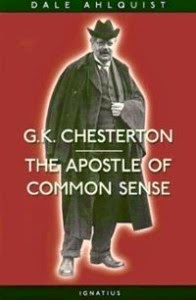
Dale Ahlquist, host of EWTN’s “G.K. Chesterton: The Apostle of Common Sense,” will be the featured speaker at the Militia Immaculata Midwest Conference, Sept 6-7, at the Savior Pastoral Center in Kansas City, Kan. Also speaking will be Fr. Stephen McKinley, rector of the National Shrine of St. Maximilian Kolbe. The weekend includes concerts, Mass, benediction, and the Divine Mercy Chaplet. For information about registration, accommodations, and meals, email Christine Rossi at immaculata8@kc.rr.com.

St. Maximilian Kolbe is the patron saint of media communications!

Here's a link to the flyer and more info on the conference location.

Wednesday, August 7, 2013

Saint Gilbert Keith Chesterton?

You might recall that I highlighted William Oddie's suggestion that G.K. Chesterton be the next Englishman proposed for beatification and canonization in the Catholic Church. At last weekend's annual American Chesterton Conference in Worcester, MA, Dale Ahlquist announced that he had permission from Peter John Haworth Doyle of Northampton in the UK to announce that he wants to open a cause for Chesterton's canonization. So it's not an announcement that the cause is open, but that the bishop wants to find a priest of his diocese to lead the cause.

Nevertheless, the American Chesterton Society has posted this prayer card--FOR PRIVATE DEVOTION ONLY.

UPDATE: Something interesting about this prayer card, according to a friend of mine who listened to a recent ACS "virtual meeting" online: the Cardinal Archbishop of Buenos Aires had approved the prayer. That Cardinal Archbishop is, of course, Pope Francis!

First Things magazine has posted this information on their blog, and the American Chesterton Society has also issued a news release--but nothing is posted on the website of the Northampton diocese.