Showing posts with label Observant Franciscans. Show all posts

Friday, July 16, 2021

Preview: One of 29 Venerable English Martyrs on the Son Rise Morning Show


In 1886, Pope Leo XIII beatified 54 martyrs, including Thomas More and Bishop John Fisher, later canonized in 1935, and 11 others who were canonized in 1970 by Pope Paul VI; he also declared 29 English Catholic martyrs to be Venerable (several of these martyrs had died in chains, that is, is prison or because of their treatment in prison). These Venerable Martyrs were not included among those beatified in 1895, 1929, or 1987. 

The stages of a Cause for Canonization in the Catholic Church are indicated by the title granted the proposed saint along the way: 1) Servant of God; 2) Venerable; 3) Blessed; and 4) Saint. For example, Archbishop Sheen is still at the Venerable, although the miracle needed for his Beatification was approved a couple of years ago; Chaplain Emil Kapaun of my home diocese is a Servant of God.

On Monday, July 19, I'll tell the story of one of these martyrs, the Observant Franciscan, Venerable Anthony Brookby, on the Son Rise Morning Show--at my usual time, 6:50 a.m. Central/7:50 a.m. Eastern. Please listen live here on EWTN Radio's website or on your local EWTN radio affiliate.

Venerable Anthony Brookby was strangled to death, secretly in prison, 484 years ago on July 19, 1537 after enduring horrible torture in Newgate Prison. He had been Professor of Divinity at Magdalen College, Oxford, teaching theology and well-versed in Latin, Greek and Hebrew (signs that he was a Christian humanist in the mold of Bishop John Fisher, Erasmus, More and others). So how did he end up a martyr? Because he, like others in his house, opposed Henry VIII's actions in the King's Great Matter--and he remonstrated with Henry publicly in his sermons.

The Observant Franciscans had one of their friaries next door to the Tudor palace on the Thames, the Palace of Placentia, also known as Greenwich Palace (pictured above), now the location of the Royal Navy College and the Greenwich Observatory (up the hill!) Their chapel served almost as the Royal parish although there was a chapel in the palace, some ruins of which were discovered in 2005:

The friars' church was used for royal baptisms and marriages. Henry VIII was christened probably in this church (1491), and certainly his brother Edmund (1498). The marriage of Henry and Catherine took place at Greenwich, probably in the friars' church (1509). The Princess Mary was christened here 20 February, 1515-16, and the Princess Elizabeth 8 September, 1533.

Henry VIII admired the Observant Friars at Greenwich as much as he admired Bishop John Fisher (which we know didn't mean much once Henry had a certain goal in mind!):

Henry VIII, in 1513, wrote from his palace of Greenwich to Leo X that he could not sufficiently commend the Observant Friars' strict adherence to poverty, their sincerity, charity and devotion. No Order battled more assiduously against vice, and none were more active in keeping Christ's fold.

Remember that it was Pope Leo X who named Henry VIII "Defender of the Faith" in 1521 after the king wrote his book defending the Seven Sacraments of the Catholic Church against Martin Luther's teachings.

When the validity of Henry VIII's marriage to Catherine of Aragon first became an issue, the Observant Franciscans were all on her side, that is, convinced that their Sacramental Marriage was valid and the papal dispensation issued by Pope Julius II in 1503 proved it. One of the friars even preached against the king's desire to have that marriage declared null in Henry's--and Anne Boleyn's--presence at Greenwich in 1532 (on Easter Sunday)!

Therefore, Henry VIII really wanted to force the Observant Friars to accept his new queen and title as Supreme Head and Governor of the Church in England in 1534:

On 15 June the visitors tried to induce the Greenwich friars to adopt the same procedure [to entrust the decision for all the friars to the decision of a few friars], 'specially to the intent that if the discreets should refuse to consent, it were better after our minds to strain a few than a multitude.' The friars, however, 'stiffly affirmed that where the matter concerned particularly every one of their souls, they would answer particularly every man for himself.' After further discussion, the visitors were compelled to examine each friar separately, and each refused to accept the articles, especially that which denied the papal authority. In answer to all the arguments of the visitors they declared that 'they had professed St. Francis' religion, and in the observance thereof they would live and die.'

Reaction was swift to that refusal:

On 17 June two cart-loads of friars drove through London to the Tower, (fn. 52) and it is possible that some of the Greenwich Observants were among them. On or before 11 August the friars were expelled from their convent (fn. 53) (though they seem to have made some kind of submission (fn. 54) ) and distributed in different places, generally in houses of the Grey Friars, where, wrote Chapuys to Charles V, 'they were locked up in chains and treated worse than they could be in prison.' (fn. 55) Some, such as John Forest, were actually in prison in London. (fn. 56) Two of them, inclosed in a poor lodging at the Grey Friars, Stamford, and treated as prisoners, were ' in meetly good case as the world at this time requireth,' and sent to London for their little belongings, including a new Psalter, a pair of socks, a penner and inkhorn. (fn. 57) But the severity of their treatment is shown by the fact that out of 140 Observant Friars thirty-one soon died, (fn. 58) and this does not account for all the deaths. Thomas Bourchier, who was a member of the Greenwich friary in the reign of Mary, gives details of several martyrdoms which probably belong to this time, though the writer assigns them to 1537. (fn. 59) On 19 July Anthony Brdrbe [Brookby], formerly of Magdalen College, Oxford, a distinguished scholar, who had been imprisoned and tortured to such an extent that ' for twenty-five days he could not turn in bed or lift his hands to his mouth,' was strangled with his own cord. (fn. 60) On 27 July Thomas Cortt, who had been imprisoned for a sermon against the king in the church of St. Lawrence, London, died in Newgate. (fn. 61) On 3 August Thomas Belchiam, a young priest, who had composed a book against the king, one copy of which he left in the hands of his brethren at Greenwich, died of starvation in Newgate. (fn. 62) No mention of these three friars occurs in extant contemporary authorities, but Bourchier's account representing the tradition of the Order is probably substantially correct, though the names may be misspelt.

The secrecy of their imprisonment, torture, and deaths reminds me of the sufferings several of the Carthusians endured, harassed for a time and then imprisoned and left to die of dehydration and starvation. 

Venerable Anthony Brookby and others among the Observant Franciscans suffered and died because, as Henry VIII himself had said, they were "active in keeping Christ's fold", urging him not to divide the Church and set himself up as the Caesar-Pope of England and calling on him to repent and return to the Church and his marriage to Catherine of Aragon. They were bold and brave!

Venerable Anthony Brookby, pray for us!

Image Credit (public domain): A sketch of Greenwich Palace, published in The Gentleman's Magazine in 1840 (earlier published by W. Bristow in 1797)

Friday, August 10, 2018

Suppression of the Observant Friars, 1534

The Observant Friars of Greenwich were the parish priests for Henry VIII's family: their church was the site of his baptism (perhaps), his wedding to Catherine of Aragon in 1509, and both Mary and Elizabeth were baptized there. Before his Great Matter dominated their relationship, Henry VIII admired the Observant Franciscans of Greenwich. According to British History Online:

Henry VIII, in 1513, wrote from his palace of Greenwich to Leo X that he could not sufficiently commend the Observant Friars' strict adherence to poverty, their sincerity, charity and devotion. No Order battled more assiduously against vice, and none were more active in keeping Christ's fold.

From the beginning, however, the Friars sided with Catherine of Aragon in opposing Henry VIII's attempts to have his marriage to her declared null. They were vocal in their opposition, using the pulpit at Sunday Mass, even, to descry Henry's marital ambitions to replace their queen (who might have been a third order Franciscan) with Anne Boleyn. In 1534, things came to a head:

Henry probably hoped to bend the friars to his will at this time. He gave them an alms of 10 marks; (fn. 47) the Princess Elizabeth was christened in the church with great pomp 10 September, (fn. 48) and the minister, warden, and friars of Greenwich begged for the king's pardon 21 December. [1533](fn. 49) But on 13 April, 1534, a royal commission was issued to the provincial priors of the Austin and Black Friars to visit all the friars' houses and bind every friar by oath to acknowledge the king as supreme head of the church and repudiate the pope's authority. (fn. 50) On 14 June Roland Lee and Thomas Bedyll, acting on instructions from the commissioners, visited Richmond, and induced the friars there to entrust their case to four ' discreets' or representatives, who should attend the visitors the next day at Greenwich. On 15 June the visitors tried to induce the Greenwich friars to adopt the same procedure, 'specially to the intent that if the discreets should refuse to consent, it were better after our minds to strain a few than a multitude.' The friars, however, 'stiffly affirmed that where the matter concerned particularly every one of their souls, they would answer particularly every man for himself.' After further discussion, the visitors were compelled to examine each friar separately, and each refused to accept the articles, especially that which denied the papal authority. In answer to all the arguments of the visitors they declared that 'they had professed St. Francis' religion, and in the observance thereof they would live and die.' (fn. 51)

On 17 June two cart-loads of friars drove through London to the Tower, (fn. 52) and it is possible that some of the Greenwich Observants were among them. On or before 11 August the friars were expelled from their convent (fn. 53) (though they seem to have made some kind of submission (fn. 54) ) and distributed in different places, generally in houses of the Grey Friars, where, wrote Chapuys to Charles V, 'they were locked up in chains and treated worse than they could be in prison.' (fn. 55) Some, such as John Forest, were actually in prison in London. (fn. 56) Two of them, inclosed in a poor lodging at the Grey Friars, Stamford, and treated as prisoners, were 'in meetly good case as the world at this time requireth,' and sent to London for their little belongings, including a new Psalter, a pair of socks, a penner and inkhorn. (fn. 57) But the severity of their treatment is shown by the fact that out of 140 Observant Friars thirty-one soon died, (fn. 58) and this does not account for all the deaths. Thomas Bourchier, who was a member of the Greenwich friary in the reign of Mary, gives details of several martyrdoms which probably belong to this time, though the writer assigns them to 1537. (fn. 59) On 19 July Anthony Brookby, formerly of Magdalen College, Oxford, a distinguished scholar, who had been imprisoned and tortured to such an extent that ' for twenty-five days he could not turn in bed or lift his hands to his mouth,' was strangled with his own cord. (fn. 60) On 27 July Thomas Cortt, who had been imprisoned for a sermon against the king in the church of St. Lawrence, London, died in Newgate. (fn. 61) On 3 August Thomas Belchiam, a young priest, who had composed a book against the king, one copy of which he left in the hands of his brethren at Greenwich, died of starvation in Newgate. (fn. 62) No mention of these three friars occurs in extant contemporary authorities, but Bourchier's account representing the tradition of the Order is probably substantially correct, though the names may be misspelt.

It's always sad to read about the religious orders acting against each other--those who were willing to take the oaths and conform to Henry VIII's demands were willing to do his bidding against those were ready to stand against him.--and then it's ironic when you recognize that their compliance did nothing to save their orders in England after 1536. More about the Franciscans in England here.

Tuesday, October 4, 2016

St. Francis of Assisi and the English Franciscans: 1224 to 2016

On this feast of St. Francis of Assisi, who is probably one of the most popular saints inside and outside of the Catholic Church, some background on the Franciscans in England. According to this site:

In 1224 Francis decided to send some friars to England and appointed Agnellus of Pisa to lead a small expedition. On Tuesday, 10 September of the same year, a small boat landed near Dover and nine roughly-dressed figures disembarked, and so the Franciscan Order was implanted in England. The nine friars were led by an Italian, Agnellus of Pisa, who had previously been Custos in Paris. It included three Englishmen who had joined the Order, probably in Paris where many Englishmen of the time went to study, five Italians and one Frenchman. Within seven weeks of arrival they had established friaries in Canterbury, London and Oxford, the ecclesiastical, political and intellectual capitals of England.

The order grew and grew in England, Wales and Scotland, and its members contributed greatly to intellectual developments:

Of all the activities of the Friars in England perhaps it is the Intellectual Tradition which most stands out in the Order. One German historian, Hilarin Felder, said that, apart from St. Bonaventure, all the major contributors to the Franciscan Intellectual Tradition were from the Province of England. The friary at Oxford was founded in 1224 and the friary at Cambridge in 1226. Agnellus of Pisa arranged for Robert Grosseteste (1168-1253), Bishop of Lincoln, to be the first teacher of theology to the Friars. Grosseteste was one of the leading thinkers of his day. The Franciscan involvement at Oxford would change the intellectual face of Europe. The Franciscan Oxford tradition is a veritable Who’s Who of intellectual giants, not just in the Order, but in the history of Western Thought: Adam Marsh (d. 1259), Thomas of York (d. 1260), first Franciscan lecturer at Cambridge, Richard Rufus of Cornwall, (d. c.1260-61), Roger Marston (1235-1303), William of Ware (who may have taught Duns Scotus) (f. 1270-1300), Roger Bacon (1214-1294), John Duns Scotus (1266-1308), William of Ockham (1285-1349), John of Peckham (1240-1292), who would later become Archbishop of Canterbury and is entombed within the magnificent splendour of Canterbury Cathedral. 

Then, of course, came the English Reformation:

The Observants were staunch defenders of Henry's marriage to Catherine and of the Supremacy of the Pope over the entire Church. One of the friars, Elstow, even preached against Henry's divorce in the presence of the King, showing great courage and gaining a spell in prison for his pains. Consequently the Observants were the first religious to be attacked by Henry and, when they refused to be cowed, the first to be suppressed in 1534. Some were imprisoned, Bl. John Forest was martyred and many Observants went into exile to Pontoise, Paris. In 1555-1559, the friary at Greenwich was restored under Queen Mary, who remembered the friars' loyalty to her mother, but this friary was suppressed again only four years later in 1559 by Elizabeth I. In 1559 the Observants scattered to Scotland, Pontoise and the Low Countries, although there were always those who remained in hiding in England to minister to the Catholic faithful in the years of persecution.

And the other Franciscan martyrs:

This missionary spirit was watered by the blood of the Province's martyrs. There has never been any period since 1224 when there have not been Franciscans in Britain, even throughout the times of persecution. The Province has given martyrs to the Church and many confessors who were imprisoned and persecuted for their faith. Bl. John Forest was martyred under Henry VIII, St. John Jones (1559-1598) died at St. Thomas’ Waterings, South London, on July 12th 1598 during the reign of Elizabeth I. In the time of the Commonwealth between 1642 and 1646 Bl. Thomas Bullaker, Henry Heath, Francis Bell and John Woodcock were hanged, drawn and quartered. St. John Wall was martyred in 1679 during the hysteria occasioned by the perjuries of Titus Oates. Several other friars died in prison and many more suffered periods of imprisonment in serving the Catholic population of England during the penal years. 

The order expanded in the nineteenth century after 1850, but then had to retrench so as to make sure "that there are always enough Friars in a house to live an optimal fraternal life": 

At present there are friaries in: Canterbury, Clevedon, Edinburgh (Craigmillar), Glasgow, Stratford and Woodford. Most of these friaries minister to parish communities and reach out from there to the wider Church in collaboration with the lay people of the parishes as well as the members of the wider Franciscan family. At Canterbury the Friars run a Study Centre with an international reputation that continues the intellectual tradition of the Custody.


St. Francis of Assisi, pray for us.
St. Clare of Assisi, pray for us.
St. John Jones, pray for us.
St. John Wall, pray for us.
Blessed John Forest, pray for us.
Blessed Thomas Bullaker, pray for us.
Blessed Henry Heath, pray for us.
Blessed Francis Bell, pray for us.
Blessed John Woodcock, pray for us.

Image: The Ecstasy of St. Francis, Stefano di Giovanni (1392–1450)

Sunday, May 22, 2016

Blessed John Forest, Observant Friar and Martyr


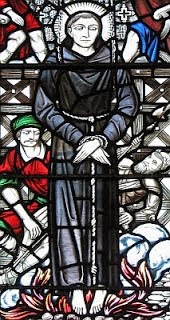
Blessed John Forest was executed by being burned to death, suspended over the flames from a gibbet in chains on May 22, 1538 because he opposed Henry VIII's marriage to Anne Boleyn, the annulment of Henry's marriage to Catherine of Aragon, and Henry's claim to supremacy and religious and ecclesiastical matters in England, which was heresy to Henry VIII. He was one of the Observant Franciscans. According to the Franciscans in the Province of Great Britain website: 

John was born into the noble Forest family, probably in Oxford, in 1471. At seventeen years of age he joined the Observant Friars Minor in Greenwich. He completed his studies at Oxford at the age of 26 and was ordained priest in Greenwich. Cardinal Wolsey gave him the task of preaching in St. Paul's Cross Church and Queen Catherine of Aragon chose him as her chaplain and then confessor. (The Greenwich friary was attached to the Royal Palace of Greenwich). In this role he opposed the divorce that King Henry VIII wanted to obtain from the Queen. In 1532, Guardian of the Greenwich friary, he spoke to the friars of the plans the King had to suppress the Order in England and denounced from the pulpit at St. Paul's Cross Henry's plans for a divorce. In 1533 he was imprisoned in Newgate prison and condemned to death. In 1534 Henry did indeed suppress the Observant friars and ordered them dispersed to other friaries. John was released from prison and by 1538 was in confinement in a Conventual Franciscan friary, his death sentence having been neither commuted nor carried out. From this confinement he could correspond with the Queen and he also wrote a tract against Henry entitled: De auctoritate Ecclesiae et Pontificis maximi (On the Authority of the Church and the Supreme Pontiff), defending the papal primacy in the Church. He was denounced to the King for this tract and also for refusing to swear the oath of loyalty demanded by Cromwell. When he refused to admit that his resistance to the King was an error John was burned over a slow fire on 22nd May 1538 in Smithfield Market. He died praying for his enemies.

Dom Bede Camm wrote an extended narrative of Blessed John Forest's stand against Henry VIII, his correspondence with Queen Katherine of Aragon, Latimer's long sermon before Forest was burned alive, and the martyr's last words: "Domine, miserere mei".

The Catholic Encyclopedia has this further detail about his execution and information about his beatification:

The statue of "Darvell Gatheren" which had been brought from the church of Llanderfel in Wales, was thrown on the pile of firewood; and thus, according to popular belief, was fulfilled an old prophecy, that this holy image would set a forest on fire. The holy man's martyrdom lasted two hours, at the end of which the executioners threw him, together with the gibbet on which he hung, into the fire. Father Forest, together with fifty-three other English martyrs, was declared Blessed by Pope Leo XIII, on 9 December, 1886, and his feast is kept by the Friars Minor on 22 May.

Image credit: Wikipedia commons, under license. It depicts his statue in St. Etheldreda's, Ely Place in London.

Blessed John Forest, pray for us.

Thursday, March 31, 2016

Some Fiery Preaching on Easter Sunday--and a Fiery Result

From the Anne Boleyn Files blog:

On Easter Sunday 1532, 31st March, Princess Mary’s confessor, Friar William Peto, preached a rather controversial sermon in the King’s presence at Greenwich’s Franciscan chapel.

Instead of focusing on the Easter story and Christ’s resurrection, Peto, who supported Catherine of Aragon, spoke on 1 Kings 22, in which Micaiah shares his prophecies with King Ahab, but Ahab ignores them and imprisons Micaiah. Ahab then died from wounds inflicted during the battle:

“So the King died and was brought to Samaria, and they buried him there. They washed the chariot at a pool in Samaria (where the prostitutes bathed), and the dogs licked up his blood, as the word of the Lord had declared.”

Peto compared Henry VIII to Ahab, drawing comparisons between Anne Boleyn and Jezebel, Ahab’s wife, who had replaced God’s prophets with pagan priests, as Anne was promoting men of the New Religion. Peto concluded by warning the King that if he carried on the way he was, he would end up like Ahab, and dogs would lick up his blood, too. Peto wanted to set Henry VIII on the right path. He wanted him to abandon Anne Boleyn, with her heretical views, and return to Catherine of Aragon. Henry, however, believed his marriage to Catherine to be invalid, and tried to persuade Peto of that.


Father Peto was an Observant Franciscan and served as the provincial of the Greenwich Franciscans. There was a backlash, of course, as British History Online reports:

The king dissembled his ill-will, but on the provincial's departure for a chapter, he caused one of his chaplains, Dr. Curwen, to preach in the friars' church, contrary to the custom of the convent and the will of the warden. The chaplain's sermon roused the warden, Henry Elston, to expostulate; in the king's presence he gave the chaplain the lie. Henry was very angry, and bade the provincial on his return depose the warden. This he refused to do, and the king had them both arrested (fn. 32) Elston was confined at the Grey Friars of Bedford, (fn. 33) but some months later he and Peto were at Antwerp carrying on the campaign against the king. (fn. 34) . . .

And then Henry VIII and Cromwell pressed the Observant Franciscans to swear an oath "to acknowledge the king as supreme head of the church and repudiate the pope's authority" and they refused:

On 15 June the visitors tried to induce the Greenwich friars to adopt the same procedure, ' specially to the intent that if the discreets should refuse to consent, it were better after our minds to strain a few than a multitude.' The friars, however, ' stiffly affirmed that where the matter concerned particularly every one of their souls, they would answer particularly every man for himself.' After further discussion, the visitors were compelled to examine each friar separately, and each refused to accept the articles, especially that which denied the papal authority. In answer to all the arguments of the visitors they declared that ' they had professed St. Francis' religion, and in the observance thereof they would live and die.' (fn. 51)

On 17 June two cart-loads of friars drove through London to the Tower, (fn. 52) and it is possible that some of the Greenwich Observants were among them. On or before 11 August the friars were expelled from their convent (fn. 53)(though they seem to have made some kind of submission (fn. 54) ) and distributed in different places, generally in houses of the Grey Friars, where, wrote Chapuys to Charles V, 'they were locked up in chains and treated worse than they could be in prison.' (fn. 55) Some, such as John Forest, were actually in prison in London. (fn. 56) Two of them, inclosed in a poor lodging at the Grey Friars, Stamford, and treated as prisoners, were ' in meetly good case as the world at this time requireth,' and sent to London for their little belongings, including a new Psalter, a pair of socks, a penner and inkhorn. (fn. 57) But the severity of their treatment is shown by the fact that out of 140 Observant Friars thirty-one soon died, (fn. 58) and this does not account for all the deaths. Thomas Bourchier, who was a member of the Greenwich friary in the reign of Mary, gives details of several martyrdoms which probably belong to this time, though the writer assigns them to 1537. (fn. 59) On 19 July Anthony Brdrbe, formerly of Magdalen College, Oxford, a distinguished scholar, who had been imprisoned and tortured to such an extent that ' for twenty-five days he could not turn in bed or lift his hands to his mouth,' was strangled with his own cord. (fn. 60) On 27 July Thomas Cortt, who had been imprisoned for a sermon against the king in the church of St. Lawrence, London, died in Newgate. (fn. 61) On 3 August Thomas Belchiam, a young priest, who had composed a book against the king, one copy of which he left in the hands of his brethren at Greenwich, died of starvation in Newgate. (fn. 62) No mention of these three friars occurs in extant contemporary authorities, but Bourchier's account representing the tradition of the Order is probably substantially correct, though the names may be misspelt.


Of course, the ultimate response to the Observant Franciscans' refusal to accept the King's Supremacy was the execution of Blessed John Forest. He was burned alive on gibbet for heresy. You may find more about Father William Peto in the Catholic Encyclopedia.

Thursday, May 22, 2014

Blessed John Forest, Unique Among the Catholic Martyrs

Blessed John Forest is unique among the Catholic martyrs of the English Reformation. He is what I would call a Supremacy Martyr, suffering for his refusal to recognize Henry VIII's supremacy over the Church of England, but he was found guilty, not of treason but of heresy--and thus burned alive in chains by the order of Thomas Cranmer, the Archbishop of Canterbury.

As one of the Observant Franciscans and as one of Queen Katherine of Aragon's chaplains and confessors, Blessed John Forest (beatified by Pope Leo XIII), was always opposed to what Henry VIII planned to do to resolve his "Great Matter", manipulating the Catholic Faith in England and attempting to do so in Rome to achieve his goal of marrying Anne Boleyn. The Thomas Abel mentioned below was another one of Katherine of Aragon's chaplains, executed along with two others (and three Zwinglians) two years later. Father Peto's sermon at Greenwich compared Henry VIII to Ahab and Anne Boleyn to Jezebel and occasioned threats from Thomas Cromwell that Peto and his defender Friar Elstow mocked as ineffective to those who did not fear death. Blessed John Forest endured imprisonment and a torturous death to defend the sanctity of marriage and unity of the one, holy, catholic and apostolic Church.

From the Catholic Encyclopedia, details about the blessed martyr's life and death:

Born in 1471, presumably at Oxford, where his surname was then not unknown; suffered 22 May, 1538. At the age of twenty he received the habit of St. Francis at Greenwich, in the church of the Friars Minor of the Regular Observance, called for brevity's sake "Observants". Nine years later we find him at Oxford, studying theology. He is commonly styled "Doctor" though, beyond the steps which he took to qualify as bachelor of divinity, no positive proof of his further progress has been found. Afterwards he became one of Queen Catherine's chaplains, and was appointed her confessor. In 1525 he appears to have been provincial, which seems certain from the fact that he threatened with excommunication the brethren who opposed Cardinal Wolsey's legatine powers. Already in 1531 the Observants had incurred the king's displeasure by their determined opposition to the divorce; and no wonder that Father Forest was soon singled out as an object of wrath. In November, 1532, we find the holy man discoursing at Paul's Cross on the decay of the realm and pulling down of churches. At the beginning of February, 1533 an attempt at reconciliation was made between him and Henry: but a couple of months later he left the neighbourhood of London, where he was no longer safe. He was probably already in Newgate prison 1534, when Father Peto [gave] his famous sermon before the king at Greenwich. In his confinement Father Forest corresponded with the queen and Blessed Thomas Abel and wrote a book or treatise against Henry, which began with the text: "Neither doth any man take the honour to himself, but he that is called by God as Aaron was.

On 8 April, 1538, the holy friar was taken to Lambeth, where, before Cranmer, he was required to make an act of abjuration. This, however, he firmly refused to do; and it was then decided that the sentence of death should be carried out. On 22 May following he was taken to Smithfield to be burned. The statue of "Darvell Gatheren" which had been brought from the church of Llanderfel in Wales, was thrown on the pile of firewood; and thus, according to popular belief, was fulfilled an old prophecy, that this holy image would set a forest on fire. The holy man's martyrdom lasted two hours, at the end of which the executioners threw him, together with the gibbet on which he hung, into the fire. Father Forest, together with fifty-three other English martyrs, was declared Blessed by Pope Leo XIII, on 9 December, 1886, and his feast is kept by the Friars Minor on 22 May.


The Guild of Blessed Titus Brandsma blog posted this information about the friar's correspondence with Katherine of Aragon:

“Most Serene Lady and Queen, my daughter most dear in the bowels of Christ, - When I read your letter I was filled with incredible joy, because I saw how great is your constancy in the Faith.

In this, if you persevere, without doubt you will attain salvation.

Doubt not of me that by any inconstancy I should disgrace my grey hairs.

Meanwhile I earnestly beg your steadfast prayers to God, for whose spouse we suffer torments, to receive me into His glory.

For it have I striven these four and forty years in the Order of St Francis.

Meanwhile do you keep free from the pestilent doctrine of the heretics, so that even if an angel should come down from Heaven and bring you another doctrine from that which I have taught you, give no credit to his words, but reject him; for that other doctrine does not come from God.

These few words you must take in lieu of consolation; but that you will receive from our Lord Jesus Christ, to whom I specially commend you, to my father Francis, to St Catherine; and when you hear of my execution, I heartily beg of you to pray for me to her.

I send you my rosary as I have but three days to live.”


Blessed John Forest, pray for us!

Tuesday, April 8, 2014

St. John Fisher, Defender of Marriage (And a Few Colleagues)

From Crisis Magazine, this article by Samuel Gregg, Research Director at the Acton Institute:

In his October 2013 article on the question of communion for divorced and civilly remarried Catholics, Cardinal Gerhard Müller underscored that the Catholic Church had risked much to uphold Christ’s teaching regarding true marriage’s indissolubility. The Prefect of the Congregation for the Doctrine of the Faith singled out the fact that Catholicism had suffered the schism of “a Church in England” “because the Pope, out of obedience to the sayings of Jesus, could not accommodate the demands of King Henry VIII for the dissolution of his marriage.”

In this context, most people immediately think of Saint Thomas More. In at least two accounts of his trial, More stated that the real core of Henry VIII’s animus against him was that More did not believe Anne Boleyn to be Henry’s wife. After all, one reason for More’s imprisonment was his refusal to affirm, on oath, the marriage’s validity.

In truth, however, More had tried to say as little as possible about the King’s Great Matter before and after his resignation as Lord Chancellor. In public at least, the real water on the marriage issue was carried by another Saint: Cardinal John Fisher of Rochester.

Fisher was by far the most formidable defender of the validity of Henry and Catherine of Aragon’s marriage, penning at least 7 tracts on the subject. Widely regarded as one of the greatest bishop-scholars of his time and a successful Chancellor of Cambridge University, Fisher’s writings underscore his deep familiarity with the Scriptures, church fathers, and scholastic and renaissance thought. Not many people learn Greek in their forties. Yet Fisher somehow managed to do so.


Concerns about what his scholarly peers might think, however, didn't prevent Fisher from confronting doctrinal and moral error. He also actively combated corruption and lax morality among clergy and laity alike. Nor was Fisher ever distracted from his pastoral responsibilities. Testimonies abound to Fisher personally serving the poor, spending long hours in the confessional, regularly visiting the sick and dying, penning devotional writings for ordinary folk, and leading an abstentious life. Eligible for any number of more famous sees, Fisher chose to remain in the very poor, insignificant diocese of Rochester.

Other great defenders of the validity of Henry and Catherine's marriage met the same fate as good Bishop Fisher: Fathers Thomas Abel, Richard Fetherston, and Edward Powell (except that they endured the full sentence of the execution of traitors, being hung, drawn, and quartered). The Observant Franciscans, formerly Henry VIII's favorite mendicants, openly opposed Henry's marital machinations and defended the validity of his marriage to Queen Catherine. Friars Peto and Elstow publicly stated their opposition and defense during sermons in the Greenwich chapel. Perhaps on this date, April 8, in 1533, the friars appeared before Henry's Council. According to this website:

Again the friars repeated their strong condemnation of Henry's course of action. The Earl of Essex (sic) [Henry did not name Thomas Cromwell Earl of Essex until 1540, less than two months before his arrest and attainder] told them that they deserved to be put in a sack and cast into the Thames. Elstow's response deserves recording: "Threaten these things to rich and dainty folk who are clothed in purple, fare delicately, and have their chiefest hope in this world, for we esteem them not, but are joyful that for the discharge of our duties we are driven hence. With thanks to God we know the way to Heaven to be as ready by water as by land, and therefore we care not which way we go." 

Astonishingly the two friars were not flung into the Thames or even into prison (Henry was still flexing his proto-totalitarian muscles) and were instead banished from the country. Friar Peto was eventually to be raised in Rome to the purple
[during the reign of Mary I].