Showing posts with label Blessed John Forest. Show all posts

Friday, May 5, 2023

Preview: A Royal Confessor and an Observant Martyr

We'll continue our series on Father Henry Sebastian Bowden's book, Mementoes of the English Martyrs and Confessors for Every Day in the Year on the Son Rise Morning Show next Monday, May 8 at a little after 6:45 a.m. Central/7:45 a.m. Eastern. Please listen live here or find the podcast later that day here.

This time we'll feature an exchange of letters between one whom Father Henry Sebastian Bowden terms a Confessor, one who suffered for the faith during the English Reformation but was neither martyred nor considered for canonization, and a martyr, both from the reign of Henry VIII.

The Confessor, who writes to her priestly confessor, is Catherine of Aragon, and the Martyr is Blessed John Forest, her "venerated Father" who would suffer a unique martyrdom. On page 159, in "A Royal Penitent", Queen Catherine writes to the Observant Franciscan Father John Forest because she thinks he will be executed soon for his early and lasting opposition to Henry VIII's plans to have the marriage between himself and Catherine dissolved so he may marry Anne Boleyn. (You might recall that the Observant Franciscans at Greenwich, so associated with the royal family, supported the validity of that marriage from the very beginning of the King's Great Matter. The couple was married at the Observant's chapel at the Royal Palace on June 22, 1509, after all.) 

Queen Catherine had been exiled from Court since 1531 and after Thomas Cranmer, the Archbishop of Canterbury had declared her marriage to Henry VIII null and void in May 1533, the king would not allow her any other title than Dowager Princess of Wales, although she continued to refer to herself as the Queen (she had been anointed and crowned Queen of England and Wales on June 24, 1509)! Cranmer also had to declare Henry VIII's marriage to Anne Boleyn, which had been celebrated before that annulment, was valid.

The dates of this correspondence, which Bowden might have accessed through Don Bede Camm's The Lives of the English Martyrs, are not certain. Bowden does include Camm's work as one of his sources in his Introduction (p. 7). Father John Morris, SJ, who wrote Forest's entry in Camm's book, dates it to sometime in 1534 when Forest was in prison because of his opposition to Henry's actions.

So, perhaps in 1534, by then in Cambridgeshire at either Buckton Towers* or Kimbolton Castle, Queen Catherine of England and Wales wrote her confessor, lamenting that he will die before her, leaving her without his counsel for he was "the man who had taught me the most in divine things." She says she would be willing to suffer "a thousand torments than follow you after a time." She asks for his prayers, for him to "commend me always to God, now and from your place in heaven" and call herself his "most sorrowful daughter." The verse for her entry is Ruth 1:16: "whither thou goest . . ."

Father John Forest answers her from prison that he "was filled with incredible joy" because he "saw how great is your constancy in the faith." He begs her prayers and commends her to Saint Francis of Assisi and especially Saint Catherine of Siena (whose feast we just celebrated at the end of April); especially "when you hear of my execution, I heartily beg of you to pray for me to her. I send to you my rosary, as I have but three days to live." Father Bowden gives his memento the title "One Only Gospel" with the verse from Galatians 1:18 as Forest reminds her to reject any doctrine of "heretics" and remain true to the Church's teaching.

What Bowden does not tell us is that Queen Catherine of England and Wales died before Blessed John Forest after a long illness and much distress that she could not see her daughter Mary before she died (unless she accepted her Dowager title and Mary's illegitimacy), on January 7, 1536 at age 50. She was buried in Peterborough Cathedral on January 29. Her tomb bears the title "Katharine Queen of England", courtesy of Queen Mary of Teck, King George V's consort. The Cathedral holds a festival every January in her honor, with a Catholic Mass celebrated.

According to Camm's book, Forest was released from prison for a time to the Grey Friar Franciscan house near Smithfield until he was finally brought to trial for heresy and burned at the stake on May 22, 1538 at Smithfield. On page 171, on the anniversary of his martyrdom, Bowden remembers him with the title "A Living Holocaust". According to the 1913 Catholic Encyclopedia:

On 22 May following he was taken to Smithfield to be burned. The statue of Saint Derfel which had been brought from the church of Llanderfel in Wales, was thrown on the pile of firewood; and thus, according to popular belief, was fulfilled an old prophecy, that this holy image would set a forest on fire. The holy man's martyrdom lasted two hours, at the end of which the executioners threw him, together with the gibbet on which he hung, into the fire. 

He was beatified by Pope Leo XIII in 1886.

Blessed John Forest, pray for us! and may the Soul of Queen Catherine of England, rest in peace.

*I think of Catherine of Aragon would be pleased that Buckton Towers is now The Claret Centre, a retreat and conference center, run by the Claretians, with the Church of Saint Hugh of Lincoln on the grounds, and two chapels, one dedicated to Our Lady and the other to Saint Anthony Claret! (She might not be thrilled with the plainness of the church and chapels, however--not quite what she was used to in her era!)

Sunday, May 22, 2016

Blessed John Forest, Observant Friar and Martyr


Blessed John Forest was executed by being burned to death, suspended over the flames from a gibbet in chains on May 22, 1538 because he opposed Henry VIII's marriage to Anne Boleyn, the annulment of Henry's marriage to Catherine of Aragon, and Henry's claim to supremacy and religious and ecclesiastical matters in England, which was heresy to Henry VIII. He was one of the Observant Franciscans. According to the Franciscans in the Province of Great Britain website: 

John was born into the noble Forest family, probably in Oxford, in 1471. At seventeen years of age he joined the Observant Friars Minor in Greenwich. He completed his studies at Oxford at the age of 26 and was ordained priest in Greenwich. Cardinal Wolsey gave him the task of preaching in St. Paul's Cross Church and Queen Catherine of Aragon chose him as her chaplain and then confessor. (The Greenwich friary was attached to the Royal Palace of Greenwich). In this role he opposed the divorce that King Henry VIII wanted to obtain from the Queen. In 1532, Guardian of the Greenwich friary, he spoke to the friars of the plans the King had to suppress the Order in England and denounced from the pulpit at St. Paul's Cross Henry's plans for a divorce. In 1533 he was imprisoned in Newgate prison and condemned to death. In 1534 Henry did indeed suppress the Observant friars and ordered them dispersed to other friaries. John was released from prison and by 1538 was in confinement in a Conventual Franciscan friary, his death sentence having been neither commuted nor carried out. From this confinement he could correspond with the Queen and he also wrote a tract against Henry entitled: De auctoritate Ecclesiae et Pontificis maximi (On the Authority of the Church and the Supreme Pontiff), defending the papal primacy in the Church. He was denounced to the King for this tract and also for refusing to swear the oath of loyalty demanded by Cromwell. When he refused to admit that his resistance to the King was an error John was burned over a slow fire on 22nd May 1538 in Smithfield Market. He died praying for his enemies.

Dom Bede Camm wrote an extended narrative of Blessed John Forest's stand against Henry VIII, his correspondence with Queen Katherine of Aragon, Latimer's long sermon before Forest was burned alive, and the martyr's last words: "Domine, miserere mei".

The Catholic Encyclopedia has this further detail about his execution and information about his beatification:

The statue of "Darvell Gatheren" which had been brought from the church of Llanderfel in Wales, was thrown on the pile of firewood; and thus, according to popular belief, was fulfilled an old prophecy, that this holy image would set a forest on fire. The holy man's martyrdom lasted two hours, at the end of which the executioners threw him, together with the gibbet on which he hung, into the fire. Father Forest, together with fifty-three other English martyrs, was declared Blessed by Pope Leo XIII, on 9 December, 1886, and his feast is kept by the Friars Minor on 22 May.

Image credit: Wikipedia commons, under license. It depicts his statue in St. Etheldreda's, Ely Place in London.

Blessed John Forest, pray for us.

Friday, May 22, 2015

Heresy or Treason? Blessed John Forest

Blessed John Forest is the only Supremacy Martyr to be executed by being burned alive, sentenced by Archbishop Thomas Cranmer, with the penalty of death carried out by the state. He was found guilty of the same offenses as the Carthusians and John Fisher, but he was not beheaded or hung, drawn and quartered.

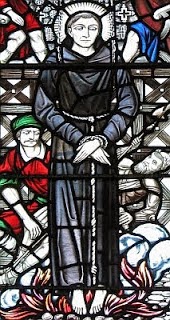
Blessed John Forest was executed by being burned to death by being suspended over the flames from a gibbet --those are chains under his arms in the stained glass--on May 22, 1538 because he opposed Henry VIII's marriage to Anne Boleyn, the annulment of Henry's marriage to Catherine of Aragon, and Henry's claim to supremacy and religious and ecclesiastical matters in England, which was heresy to Henry VIII. According to the 1913 Catholic Encyclopedia

Born in 1471, presumably at Oxford, where his surname was then not unknown; suffered 22 May, 1538. At the age of twenty he received the habit of St. Francis at Greenwich, in the church of the Friars Minor of the Regular Observance, called for brevity's sake "Observants". Nine years later we find him at Oxford, studying theology. He is commonly styled "Doctor" though, beyond the steps which he took to qualify as bachelor of divinity, no positive proof of his further progress has been found. Afterwards he became one of Queen Catherine's chaplains, and was appointed her confessor. In 1525 he appears to have been provincial, which seems certain from the fact that he threatened with excommunication the brethren who opposed Cardinal Wolsey's legatine powers. Already in 1531 the Observants had incurred the king's displeasure by their determined opposition to the divorce; and no wonder that Father Forest was soon singled out as an object of wrath In November, 1532, we find the holy man discoursing at Paul's Cross on the decay of the realm and pulling down of churches. At the beginning of February, 1533 an attempt at reconciliation was made between him and Henry: but a couple of months later he left the neighborhood of London, where he was no longer safe. He was probably already in Newgate prison 1534, when Father Peto his famous sermon before the king at Greenwich. In his confinement Father Forest corresponded with the queen and Blessed Thomas Abel and wrote a book or treatise against Henry, which began with the text: "Neither doth any man take the honour to himself, but he that is called by God as Aaron was." On 8 April, 1538, the holy friar was taken to Lambeth, where, before Cranmer, he was required to make an act of abjuration. This, however, he firmly refused to do; and it was then decided that the sentence of death should be carried out. On 22 May following he was taken to Smithfield to be burned. The statue of Saint Derfel which had been brought from the church of Llanderfel in Wales, was thrown on the pile of firewood; and thus, according to popular belief, was fulfilled an old prophecy, that this holy image would set a forest on fire. The holy man's martyrdom lasted two hours, at the end of which the executioners threw him, together with the gibbet on which he hung, into the fire. 

Hugh Latimer preached a sermon at Smithfield urging Forest to recant his defense of truths that Henry VIII had believed and affirmed several years before, as he had praised the Observant Friars as holy and devout religious.

He was beatified by Pope Leo XIII in 1886.

Thursday, May 22, 2014

Blessed John Forest, Unique Among the Catholic Martyrs

Blessed John Forest is unique among the Catholic martyrs of the English Reformation. He is what I would call a Supremacy Martyr, suffering for his refusal to recognize Henry VIII's supremacy over the Church of England, but he was found guilty, not of treason but of heresy--and thus burned alive in chains by the order of Thomas Cranmer, the Archbishop of Canterbury.

As one of the Observant Franciscans and as one of Queen Katherine of Aragon's chaplains and confessors, Blessed John Forest (beatified by Pope Leo XIII), was always opposed to what Henry VIII planned to do to resolve his "Great Matter", manipulating the Catholic Faith in England and attempting to do so in Rome to achieve his goal of marrying Anne Boleyn. The Thomas Abel mentioned below was another one of Katherine of Aragon's chaplains, executed along with two others (and three Zwinglians) two years later. Father Peto's sermon at Greenwich compared Henry VIII to Ahab and Anne Boleyn to Jezebel and occasioned threats from Thomas Cromwell that Peto and his defender Friar Elstow mocked as ineffective to those who did not fear death. Blessed John Forest endured imprisonment and a torturous death to defend the sanctity of marriage and unity of the one, holy, catholic and apostolic Church.

From the Catholic Encyclopedia, details about the blessed martyr's life and death:

Born in 1471, presumably at Oxford, where his surname was then not unknown; suffered 22 May, 1538. At the age of twenty he received the habit of St. Francis at Greenwich, in the church of the Friars Minor of the Regular Observance, called for brevity's sake "Observants". Nine years later we find him at Oxford, studying theology. He is commonly styled "Doctor" though, beyond the steps which he took to qualify as bachelor of divinity, no positive proof of his further progress has been found. Afterwards he became one of Queen Catherine's chaplains, and was appointed her confessor. In 1525 he appears to have been provincial, which seems certain from the fact that he threatened with excommunication the brethren who opposed Cardinal Wolsey's legatine powers. Already in 1531 the Observants had incurred the king's displeasure by their determined opposition to the divorce; and no wonder that Father Forest was soon singled out as an object of wrath. In November, 1532, we find the holy man discoursing at Paul's Cross on the decay of the realm and pulling down of churches. At the beginning of February, 1533 an attempt at reconciliation was made between him and Henry: but a couple of months later he left the neighbourhood of London, where he was no longer safe. He was probably already in Newgate prison 1534, when Father Peto [gave] his famous sermon before the king at Greenwich. In his confinement Father Forest corresponded with the queen and Blessed Thomas Abel and wrote a book or treatise against Henry, which began with the text: "Neither doth any man take the honour to himself, but he that is called by God as Aaron was.

On 8 April, 1538, the holy friar was taken to Lambeth, where, before Cranmer, he was required to make an act of abjuration. This, however, he firmly refused to do; and it was then decided that the sentence of death should be carried out. On 22 May following he was taken to Smithfield to be burned. The statue of "Darvell Gatheren" which had been brought from the church of Llanderfel in Wales, was thrown on the pile of firewood; and thus, according to popular belief, was fulfilled an old prophecy, that this holy image would set a forest on fire. The holy man's martyrdom lasted two hours, at the end of which the executioners threw him, together with the gibbet on which he hung, into the fire. Father Forest, together with fifty-three other English martyrs, was declared Blessed by Pope Leo XIII, on 9 December, 1886, and his feast is kept by the Friars Minor on 22 May.


The Guild of Blessed Titus Brandsma blog posted this information about the friar's correspondence with Katherine of Aragon:

“Most Serene Lady and Queen, my daughter most dear in the bowels of Christ, - When I read your letter I was filled with incredible joy, because I saw how great is your constancy in the Faith.

In this, if you persevere, without doubt you will attain salvation.

Doubt not of me that by any inconstancy I should disgrace my grey hairs.

Meanwhile I earnestly beg your steadfast prayers to God, for whose spouse we suffer torments, to receive me into His glory.

For it have I striven these four and forty years in the Order of St Francis.

Meanwhile do you keep free from the pestilent doctrine of the heretics, so that even if an angel should come down from Heaven and bring you another doctrine from that which I have taught you, give no credit to his words, but reject him; for that other doctrine does not come from God.

These few words you must take in lieu of consolation; but that you will receive from our Lord Jesus Christ, to whom I specially commend you, to my father Francis, to St Catherine; and when you hear of my execution, I heartily beg of you to pray for me to her.

I send you my rosary as I have but three days to live.”


Blessed John Forest, pray for us!

Wednesday, May 22, 2013

A Supremacy Martyr Burned Alive as a Heretic!


A heretic, that is, against the new orthodoxy that Henry VIII was the Supreme Head and Governor of the Church of England! Blessed John Forest is the only Supremacy Martyr to be executed by being burned alive, sentenced by Archbishop Thomas Cranmer, with the penalty of death carried out by the state.

Blessed John Forest was executed by being burned to death by being suspended over the flames from a gibbet --those are chains under his arms in the stained glass--on May 22, 1538 because he opposed Henry VIII's marriage to Anne Boleyn, the annulment of Henry's marriage to Catherine of Aragon, and Henry's claim to supremacy and religious and ecclesiastical matters in England, which was heresy to Henry VIII. According to the 1913 Catholic Encyclopedia:

Born in 1471, presumably at Oxford, where his surname was then not unknown; suffered 22 May, 1538. At the age of twenty he received the habit of St. Francis at Greenwich, in the church of the Friars Minor of the Regular Observance, called for brevity's sake "Observants". Nine years later we find him at Oxford, studying theology. He is commonly styled "Doctor" though, beyond the steps which he took to qualify as bachelor of divinity, no positive proof of his further progress has been found. Afterwards he became one of Queen Catherine's chaplains, and was appointed her confessor. In 1525 he appears to have been provincial, which seems certain from the fact that he threatened with excommunication the brethren who opposed Cardinal Wolsey's legatine powers. Already in 1531 the Observants had incurred the king's displeasure by their determined opposition to the divorce; and no wonder that Father Forest was soon singled out as an object of wrath In November, 1532, we find the holy man discoursing at Paul's Cross on the decay of the realm and pulling down of churches. At the beginning of February, 1533 an attempt at reconciliation was made between him and Henry: but a couple of months later he left the neighborhood of London, where he was no longer safe. He was probably already in Newgate prison 1534, when Father Peto his famous sermon before the king at Greenwich. In his confinement Father Forest corresponded with the queen and Blessed Thomas Abel and wrote a book or treatise against Henry, which began with the text: "Neither doth any man take the honour to himself, but he that is called by God as Aaron was." On 8 April, 1538, the holy friar was taken to Lambeth, where, before Cranmer, he was required to make an act of abjuration. This, however, he firmly refused to do; and it was then decided that the sentence of death should be carried out. On 22 May following he was taken to Smithfield to be burned. The statue of Saint Derfel which had been brought from the church of Llanderfel in Wales, was thrown on the pile of firewood; and thus, according to popular belief, was fulfilled an old prophecy, that this holy image would set a forest on fire. The holy man's martyrdom lasted two hours, at the end of which the executioners threw him, together with the gibbet on which he hung, into the fire.

The Observant Franciscan Friars of Greenwich were among those who most adamantly defended the marriage of Catherine of Aragon and Henry VIII and protested against Henry's "coup d'eglise". Here is a sermon telling the story not only of John Forest but of the Greenwich Franciscans and here is another survey of these events.

Tuesday, May 22, 2012

Blessed John Forest and the Observant Friars of England

Blessed John Forest was executed by being burned to death by being suspended over the flames from a gibbet --those are chains under his arms in the stained glass--on May 22, 1538 because he opposed Henry VIII's marriage to Anne Boleyn, the annulment of Henry's marriage to Catherine of Aragon, and Henry's claim to supremacy and religious and ecclesiastical matters in England, which was heresy to Henry VIII. According to the 1913 Catholic Encyclopedia:

Born in 1471, presumably at Oxford, where his surname was then not unknown; suffered 22 May, 1538. At the age of twenty he received the habit of St. Francis at Greenwich, in the church of the Friars Minor of the Regular Observance, called for brevity's sake "Observants". Nine years later we find him at Oxford, studying theology. He is commonly styled "Doctor" though, beyond the steps which he took to qualify as bachelor of divinity, no positive proof of his further progress has been found. Afterwards he became one of Queen Catherine's chaplains, and was appointed her confessor. In 1525 he appears to have been provincial, which seems certain from the fact that he threatened with excommunication the brethren who opposed Cardinal Wolsey's legatine powers. Already in 1531 the Observants had incurred the king's displeasure by their determined opposition to the divorce; and no wonder that Father Forest was soon singled out as an object of wrath In November, 1532, we find the holy man discoursing at Paul's Cross on the decay of the realm and pulling down of churches. At the beginning of February, 1533 an attempt at reconciliation was made between him and Henry: but a couple of months later he left the neighborhood of London, where he was no longer safe. He was probably already in Newgate prison 1534, when Father Peto his famous sermon before the king at Greenwich. In his confinement Father Forest corresponded with the queen and Blessed Thomas Abel and wrote a book or treatise against Henry, which began with the text: "Neither doth any man take the honour to himself, but he that is called by God as Aaron was." On 8 April, 1538, the holy friar was taken to Lambeth, where, before Cranmer, he was required to make an act of abjuration. This, however, he firmly refused to do; and it was then decided that the sentence of death should be carried out. On 22 May following he was taken to Smithfield to be burned. The statue of Saint Derfel which had been brought from the church of Llanderfel in Wales, was thrown on the pile of firewood; and thus, according to popular belief, was fulfilled an old prophecy, that this holy image would set a forest on fire. The holy man's martyrdom lasted two hours, at the end of which the executioners threw him, together with the gibbet on which he hung, into the fire.

The Observant Franciscan Friars of Greenwich were among those who most adamantly defended the marriage of Catherine of Aragon and Henry VIII and protested against Henry's "coup d'eglise". Here is a sermon telling the story not only of John Forest but of the Greenwich Franciscans and here is another survey of these events.

I will be on the Son Rise Morning Show to discuss Blessed John Forest this morning at 7:45 a.m. Eastern/6:45 a.m. Central. Please listen live here!