Showing posts with label Heresy. Show all posts

Friday, May 22, 2020

May 22, 1377: Pope Gregory XI's Bulls to England


On May 22, 1377, Pope Gregory XI, an Avignon-era pope who would finally return to Rome later that year (November 7) at Saint Catherine of Siena's insistence, sent a series of Papal Bulls to England condemning the teachings of John Wycliffe, an ordained priest of the Catholic Church. As Christian History magazine summarized the pope's efforts in a 1983 issue:

ON MAY 22, 1377, Pope Gregory XI issued five bulls condemning the work of John Wycliffe. Three of the bulls were sent jointly to the Archbishop of Canterbury, Simon Sudbury, who held the ecclesiastical power in England, and to the Bishop of London, William Courtenay, who was eager to carry out the Pope’s wishes. Needing political support, the Pope issued a similar bull to King Edward III, who died before he received it. Wishing to put pressure on Oxford, Gregory sent the final bull to the university’s chancellor.

Since Father John Wycliffe's doctrines are usually thought to be precursors of the sixteenth century Reformers' thoughts and a legacy of dissent from Papal authority before the English Reformation, it seems appropriate to remember this date. According to Fordham University's Medieval Sourcebook, these are Wycliffe's teachings that Pope Gregory XI condemned as not conforming to the teaching of the Catholic Church (there were 24 in total; these are the first 12):

1. That the material substance of bread and of wine remains, after the consecration, in the sacrament of the altar.
2. That the accidents do not remain without the subject, after the consecration, in the same sacrament.
3. That Christ is not in the sacrament of the altar identically, truly and really in his proper corporeal presence.
4. That if a bishop or priest lives in mortal sin he does not ordain, or consecrate, or baptize.
5. That if a man has been truly repentant, all external confession is superfluous to him or useless.
6. That it is not founded in the gospel that Christ instituted the mass.
7. That God ought to be obedient to the devil.
8. That if the pope is fore-ordained to destruction and a wicked man, and therefore a member of the devil, no power has been given to him over the faithful of Christ by any one, unless perhaps by the Emperor.
9. That since Urban VI, no one is to be acknowledged as pope; but all are to live, in the way of the Greeks, under their own laws.
10. To assert that it is against sacred scripture that men of the Church should have temporal possessions.
11. That no prelate ought to excommunicate any one unless he first knows that the man is excommunicated by God.
12. That a prelate thus excommunicating is thereby a heretic or excommunicate. . . .


Note that the first three condemned Wycliffe's erroneous teachings about the Sacrifice of the Mass and the Sacrament of Holy Communion.

In the Papal Bull dispatched to the chancellor of the University of Oxford, Adam de Toneworth, Pope Gregory chastised him for his neglect and inaction:

Gregory, bishop, servus servorum dei, to his beloved sons the Chancellor and University of Oxford, in the diocese of Lincoln, grace and apostolic benediction.

We are compelled to wonder and grieve that you, who, in consideration of the favors and privileges conceded to your University of Oxford by the apostolic see, and on account of your familiarity with the Scriptures, in whose sea you navigate, by the gift of God, with auspicious oar, you, who ought to be, as it were, warriors and champions of the orthodox faith, without which there is no salvation of souls, ---that you through a certain sloth and neglect allow tares to spring up amidst the pure wheat in the fields of your glorious University aforesaid; and what is still more pernicious, even continue to grow to maturity. And you are quite careless, as has been lately reported to us, as to the extirpation of these tares; with no little clouding of a bright name, danger to your souls, contempt of the Roman Church, and injury to the faith above mentioned. And what pains us the more, is that this increase of the tares aforesaid is known in Rome before the remedy of extirpation has been applied in England where they sprang up. By the insinuation of many, if they are indeed worthy of belief, deploring it deeply, it has come to our ears that John de Wycliffe, rector of the church of Lutterworth, in the diocese of Lincoln, Professor of the Sacred Scriptures (would that he were not also Master of Errors), has fallen into such a detestable madness that he does not hesitate to dogmatize and publicly preach, or rather vomit forth from the recesses of his breast, certain propositions and conclusions which are erroneous and false. . . .


Please read the rest there.

Pope Gregory XI may have dispatched these five Papal Bulls on May 22 but, according to the British Library page on John Wycliffe, they took some time to arrive:

These decrees did not arrive in England until Christmas 1377, whereupon Wycliffe was arrested. He was subsequently released and then summoned to a meeting with Archbishop Sudbury and Bishop Courtney. In the spring of 1378 Wycliffe appeared before the authorities in Lambeth, but the investigation was interrupted by Sir Lewis Clifford who was sent by Joan of Kent, the mother of the king.

The king mentioned above was the young Richard II, son of Edward, the Black Prince, who had predeceased his father (Richard's grandfather) King Edward III. The young king was 10 years old ruled with a council of advisors not including his uncle, John of Gaunt, but also without a regent. Nonetheless, his mother, who protected some of Wycliffe's followers, the Lollards, had some influence and power at Court, and thus was able to protect Wycliffe in this case.

As the British Library concludes, however, the association between Wycliffe and the Peasant's Revolt of 1381 led to further trouble for Wycliffe, even though he died in relative obscurity in 1384:

Despite this royal protection, in May 1382 Wycliffe was condemned at the Blackfriars Council. In June of the previous year there had been a rebellion in England, known as the Peasants’ Revolt: a group of rebels had marched on London, where they burnt buildings (including the Savoy Palace, the palace of John of Gaunt) and murdered anyone they encountered who was thought to be associated with the government. It’s unclear what influence Wycliffe’s works had on the rebels, but his ideas became associated with them.

In Henry IV's reign (who had supplanted Richard II), heresy laws were passed against Wycliffe's teachings and his Lollard followers were targeted, as the UK Parliament's website details:

In 1401 Parliament took action against believers known by the abusive term of Lollards or mumblers. The Lollards included some MPs – who from the 1380s began to speak out against important aspects of the Church and its thinking.

Inspired by the writings of the Oxford academic John Wyclif, they objected to the meanings attached to certain rituals used in church worship. They also felt that more attention should be given to God’s own words as revealed in the Bible, than on interpretations made by the Church.

Before the fifteenth century the English Church had been largely free of this kind of heresy or deviation from its teachings. But in 1401 Parliament enacted a law called
De Heretico Comburendo - On the burning of heretics - by which Lollard leaders were liable for imprisonment, trial and execution. It is thought that about 100 people were burned for heresy under this Act.

This act and two others of Richard II and Henry V were revived by the 1554 Parliament of Mary I, thus leading to renewed prosecution of heresy during her reign. These laws had been repealed by Henry VIII and Edward VI, but had been in force during Henry VIII's reign for some time (and his father's reign too) while Thomas More was Chancellor, investigating and prosecuting laws against heresy.

Image Credit (public domain): "Louis I, Duke of Anjou leading Pope Gregory XI to the palace at Avignon, while cardinals follow", from Chroniques de France ou de St. Denis (end 14th C) - BL Royal MS 20 C VII by Virgil Master and his atelier

Thursday, September 5, 2019

Bishop of London, Edmund Bonner, RIP

Edmund Bonner, the former bishop of London (deposed by the authority of Elizabeth I), died in Marshalsea Prison on September 5, 1569. There is some argument that he should be considered a "martyr in chains" because he refused the Elizabethan Oaths of Supremacy and Uniformity over and over again. Eamon Duffy in his Fires of Faith: Catholic England under Mary Tudor endeavors to bring some balance to our understanding of Bonner's actions during the reign of Mary I to clear away some of the bias left by Bale and Foxe, but his actions during Henry VIII's reign bear some scrutiny too, as the Catholic Encyclopedia explains his promotion to Bishop of London after good service to the king:

Elected in November, 1539, he returned, and was consecrated 4th April, 1540. Almost his first duty was to try heretics under Henry's Act of the Six Articles, and though his action seems to have been only official, accusations of excessive cruelty and bias against the accused were spread broadcast by his enemies, and from the first he seems to have been unpopular in London. During the years 1542-43 he was again abroad in Spain and Germany as ambassador to the emperor, at the end of which time he returned to London. The death of the king on 28th January 1547, proved the turning point in his career Hitherto he had shown himself entirely subservient to the sovereign, supporting him in the matter of the divorce, approving of the suppression of the religious houses, taking the oath of Supremacy which Fisher and More refused at the cost of life itself, and accepting schismatical consecration and institution. But while acting in this way, he had always resisted the innovations of the Reformers, and held to the doctrines of the old religion. Therefore from the first he put himself in opposition to the religious changes introduced by Protector Somerset and Archbishop Cranmer.

Therefore, Bonner spent some time in prison, both in the Fleet and in Marshalsea. When Mary I came to the throne, he was restored to his diocese and began the work to restore Catholicism in England, including the composition of a book of sermons, a catechism, and a guide for educating school children in the true faith. He also began the investigation of charges of heresy, including the degradation of Thomas Cranmer from his see and office, and that of course raised the ire of Bale and Foxe. Long before Eamon Duffy's book, Edwin Burton in the Catholic Encyclopedia examined his role in the heresy trials and executions, citing Lingard, Maitland, and Acton:

The end came on 5th September, 1569, when he died in the Marshalsea. The Anglican Bishop of London wrote to Cecil to say that he had been buried in St. George's churchyard, Southwark, but if this was so the coffin was soon secretly removed to Copford, near Colchester, where it was buried under the north side of the altar. Sander, Bridgewater, and other contemporary writers attributed to Bonner and the other bishops who died in prison the honor of martyrdom: in vinculis obierunt martyres. On the walls of the English College, Rome, an inscription recording the death of the eleven bishops, but without naming them, found a place among the paintings of the martyrs. In a work quoted below the Catholic tradition with regard to these bishops has been ably set forth by Rev. George Phillips, avowedly for the purpose of promoting their beatification. 

Bishop Bonner differs from the others in this respect, that owing to the prominent part circumstances compelled him to play in the persecution, he was attacked during life with a hatred which has followed him even after death, so that in English history few names have been so execrated and vilified as his. Tardy justice is now being done to his memory by historians, Catholic and Protestant alike, yet there remains immense prejudice against his memory in the popular mind. Nor could this be otherwise in face of the calumnies that have been. repeated by tradition. The reckless charges of Bale and Foxe were repeated by Burnet, Hume, and others, who join in representing him as an inhuman persecutor, "a man of profligate manners and of a brutal character, who seemed to rejoice in the torments of the unhappy sufferers" (Hume c. xxxvii). 

The first historian of note to challenge this verdict was the Catholic, Lingard, though even he wrote in a very tentative way and it was by an Anglican historian, S.R. Maitland, that anything like justice was first done to Bonner. This writer's analysis remains the most discriminating summary of the bishop's character. "Setting aside declamation and looking at the details of facts left by those who may be called, if people please, Bonner's victims, and their friends, we find, very consistently maintained, the character of a man, straightforward and hearty, familiar and humorous, sometimes rough, perhaps coarse, naturally hot tempered, but obviously (by the testimony of his enemies) placable and easily intreated, capable of bearing most patiently much intemperate and insolent language, much reviling and low abuse directed against himself personally, against his order, and against those peculiar doctrines and practices of his church for maintaining which he had himself suffered the loss of all things, and borne long imprisonment. At the same time not incapable of being provoked into saying harsh and passionate things, but much more frequently meaning nothing by the threatenings and slaughter which he breathed out, than to intimidate those on whose ignorance and simplicity argument seemed to be thrown away-in short, we can scarcely read with attention any one of the cases detailed by those who were no friends of Bonner, without seeing in him a judge who (even if we grant that he was dispensing bad laws badly) was obviously desirous to save the prisoner's life." 

This verdict has been generally followed by later historians, and the last word has been added, for the present, in. the recently published volume on the Reformation, in the "Cambridge Modern History" planned by Lord Acton (1903) where the statement is expressly made: "It is now generally admitted that the part played by Bonner was not that attributed to him by Foxe, of a cruel bigot who exulted in sending his victims to the stake. The number of those put to death in his diocese of London was undoubtedly disproportionately large, but this would seem to have been more the result of the strength of the reforming element in the capital and in Essex than of the employment of exceptional rigor; while the evidence also shows that he himself patiently dealt with many of the Protestants, and did his best to induce them to renounce what he conscientiously believed to be their errors."

(I added the paragraph breaks to make this a little easier to read.) Duffy recounts some of Bonner's efforts to make every accommodation to a heretic to renounce his or her errors in Fires of Faith.

Thursday, April 11, 2019

April 11: A Decollation, A Burning, and A Coronation

On April 11, 1554, Thomas Wyatt the Younger was executed on Tower Hill for leading his eponymous rebellion against Mary I. I have to post on this event for three reasons: using the words "eponymous" and "decollation" and using this great profile portrait.

The Wyatt Rebellion, as this site notes, failed completely:

The plan itself involved too many ‘ifs’ and ‘buts’ if it was to succeed. The noble conspirators planned to remove Mary, instate Elizabeth as Queen and arrange for her to marry Edward Courtenay – a man Mary had already rejected as a husband. [It sounds like the Gunpowder Plot!]

The plan was for three rebellions to take place in separate parts of the country. They would occur at the same time – in the Midlands, the West Country and Kent. The plan was that the government would not know which one to put down first and each would blossom as a result of their localised success and attract more and more supporters among the common people.

The French Navy would blockade the English Channel with eighty ships so that the Habsburgs would not be able to help Mary.

The plan failed miserably. The Imperial Ambassador, Simon Renard, had heard rumours that such a plot existed and informed the Lord Chancellor, Stephen Gardner [sic], of his concerns. Gardner brought in Courtenay for questioning as Renard had mentioned his name. The records stated that Gardner’s questioning was ‘robust’ and Courtenay was not a man who could stand up to this. Edward Courtenay told Gardner all that he knew about the plot so that the government knew about the plot even before it had begun – even if Courtenay would not have known about the details.

The ‘uprisings’ in the Midlands and the West Country were a failure as few of the people there gave Carew and the Duke of Suffolk the support they needed for success. It seems that though there was concern about Mary marrying a foreigner, loyalty to the Queen took precedence. Those in the Midlands did not want to commit treason (Suffolk raised a force of just 140 men) while many in the West were Catholic. . . .

Only two of the leaders were executed for their treason – Wyatt and the Duke of Suffolk. Other minor nobles were also executed but some – guilty of treason – were spared. In total about 90 rebels were executed but many of the common people who had joined Wyatt and survived were spared. Two other casualties were Lady Jane Grey and her husband Guildford Dudley. Both had been in prison since the failed attempt to put Lady Jane on the throne and had nothing to do with Wyatt’s rebellion. However Mary felt that she could no longer risk anyone rallying to Lady Jane’s cause – hence her execution – especially as her father, the Duke of Suffolk, had been involved in this plot and had been executed for treason.

I find it interesting that the website does not mention that Queen Mary had rallied her people to defend her and their city. Even John Foxe, who had no reason to present Mary in a good light, recounted her bravery, her devotion, and her resolve in her speech at Guildhall:
I am your Queen, to whom at my coronation, when I was wedded to the realm and laws of the same (the spousal ring whereof I have on my finger, which never hitherto was, not hereafter shall be, left off), you promised your allegiance and obedience to me…. And I say to you, on the word of a Prince, I cannot tell how naturally the mother loveth the child, for I was never the mother of any; but certainly, if a Prince and Governor may as naturally and earnestly love her subjects as the mother doth love the child, then assure yourselves that I, being your lady and mistress, do as earnestly and tenderly love and favour you. And I, thus loving you, cannot but think that ye as heartily and faithfully love me; and then I doubt not but we shall give these rebels a short and speedy overthrow.
Some details about Wyatt's execution for treason; although he was beheaded and therefore did not endure the full agony of being hanged, drawn, and quartered, his remains were eviscerated and quartered as a the body of a traitor would be:

After he was beheaded, his body was subjected to all the barbarities that formed part of punishment for treason. Next day his head was hung to a gallows on ‘Hay Hill beside Hyde Park,’ and subsequently his limbs were distributed among gibbets in various quarters of the town (Machyn, Diary, p. 60). His head was stolen on 17 April.

On April 11, 1612 the last execution for heresy took place in England, during the reign of James I. Edward Wightman was actually burned at the stake twice:

Wightman seems to have denied the doctrine of the Trinity, denied that Jesus Christ was God, denied the Resurrection and the legitimacy of Holy Communion and maintained that he himself was both the Holy Spirit and, though not himself divine, the Messiah appointed by God as the saviour of the world. From a modern perspective it seems clear that he had gone completely insane.

Wightman was eventually put on trial in the diocesan court in Lichfield, which in December pronounced him guilty of blasphemy and of promoting the heresies of figures ranging from Simon Magus to the Arians, the Manicheans and the Anabaptists. He was sent to the stake in the square in Lichfield in March 1612. When the flames began to scorch him he cried out in pain and it was thought he wanted to recant. Some of the crowd of spectators rushed to rescue him, though getting burned themselves. He was taken back to prison to recover, but when he was brought before the court again he refused to sign a formal recantation and on Easter Saturday in April he was sent back to the stake and was this time burned to death.


Finally, on April 11, 1689, William of Orange and Mary his wife and the daughter of the overthrown and deposed James II were crowned together in Westminster Abbey. A few notes from this blog, which indicate that we don't have all the details about the regalia used at this double coronation:

As we know, Mary and William were crowned as joint-monarchs in a ceremony at Westminster Abbey on 11 April 1689. An interesting note, the Archbishop of Canterbury, who typically presides over the coronation, refused to do so because he continued to support James II. So for this coronation, the bishop of London crowned the new queen and king (things like this happened several times in the Middle Ages, but there would often be a second coronation done with the AB of Canterbury for sake of continuity and because of fears over the illegitimacy of the ceremony).  . . 

King Edward’s Chair (or St. Edward’s Chair or the Coronation Chair) has been used for the coronation of English (and British later on) since Edward II, with the exceptions of Edward V and Edward VIII, both of whom were not crowned. Oddly enough, Mary II was not crowned in the chair as well. A second chair was constructed before the coronation for Mary to sit in. . . .

For the coronation of Mary and William there is no mention of the use of St. Edward’s Crown. Instead, some of the sources state that they wore their pair of imperial state crowns. A second crown, then, was either used from a previous queen (perhaps the consort of James II?) or a new crown imperial state crown was made for one or both of the new monarchs. 

Wednesday, September 5, 2018

Bishop Edmund Bonner, RIP

Bishop Edmund Bonner, who at first accepted Henry VIII's supremacy and takeover of the Church in England, died on September 5, 1569 in Marshalsea Prison. As the 1911 Encyclopedia Britannica describes his career during the latter part of Henry's reign and Edward VI's more radical Reformation:

Hitherto Bonner had been known as a somewhat coarse and unscrupulous tool of Cromwell, a sort of ecclesiastical Wriothesley, He is not known to have protested against any of the changes effected by his masters; he professed to be no theologian, and was wont, when asked theological questions, to refer his interrogators to the divines. He had graduated in law, and not in theology. There was nothing in the Reformation to appeal to him, except the repudiation of papal control; and he was one of those numerous Englishmen whose views were faithfully reflected in the Six Articles. He became a staunch Conservative, and, apart from his embassy to the emperor in 1524–1543, was mainly occupied during the last years of Henry's reign in brandishing the “whip with six strings.”

The accession of Edward VI opened a fresh and more creditable chapter in Bonner's career. Like Gardiner, he could hardly repudiate that royal supremacy, in the establishment of which he had been so active an agent; but he began to doubt that supremacy when he saw to what uses it could be put by a Protestant council, and either he or Gardiner evolved the theory that the royal supremacy was in abeyance during a royal minority. The ground was skilfully chosen, but it was not legally nor constitutionally tenable. Both he and Gardiner had in fact sought fresh licences to exercise their ecclesiastical jurisdiction from the young king; and, if he was supreme enough to confer jurisdiction, he was supreme enough to issue the injunctions and order the visitation to which Bonner objected. Moreover, if a minority involved an abeyance of the royal supremacy in the ecclesiastical sphere, it must do the same in the temporal sphere, and there could be nothing but anarchy. It was on this question that Bonner came into conflict with Edward's government. He resisted the visitation of August 1547, and was committed to the Fleet; but he withdrew his opposition, and was released in time to take an active part against the government in the parliament of November 1547. In the next session, November 1548-March 1549, he was a leading opponent of the first Act of Uniformity and Book of Common Prayer. When these became law, he neglected to enforce them, and on the 1st of September 1549 he was required by the council to maintain at St Paul's Cross that the royal authority was as great as if the king were forty years of age. He failed to comply, and after a seven days' trial he was deprived of his bishopric by an ecclesiastical court over which Cranmer presided, and was sent to the Marshalsea. The fall of Somerset in the following month raised Bonner's hopes, and he appealed from Cranmer to the council. After a struggle the Protestant faction gained the upper hand, and on the 7th of February 1550 Bonner's deprivation was confirmed by the council sitting in the Star Chamber, and he was further condemned to perpetual imprisonment.

Because Edward VI died in 1553, that perpetual imprisonment did not last that long. He participated in the ecclesiastical investigations of heresy, but the Catholic Encyclopedia notes that the image of him as "Bloody Bonner", presented by Foxe and Bale, had been corrected in later centuries:

Tardy justice is now being done to his memory by historians, Catholic and Protestant alike, yet there remains immense prejudice against his memory in the popular mind. Nor could this be otherwise in face of the calumnies that have been. repeated by tradition. The reckless charges of Bale and Foxe were repeated by Burnet Hume, and others, who join in representing him as an inhuman persecutor, "a man of profligate manners and of a brutal character, who seemed to rejoice in the torments of the unhappy sufferers" (Hume c. xxxvii). The first historian of note to challenge this verdict was the Catholic, Lingard, though even he wrote in a very tentative way and it was by an Anglican historian, S.R. Maitland, that anything like justice was first done to Bonner. This writer's analysis remains the most discriminating summary of the bishop's character. "Setting aside declamation and looking at the details of facts left by those who may be called, if people please, Bonner's victims, and their friends, we find, very consistently maintained, the character of a man, straightforward and hearty, familiar and humorous, sometimes rough, perhaps coarse, naturally hot tempered, but obviously (by the testimony of his enemies) placable and easily intreated, capable of bearing most patiently much intemperate and insolent language, much reviling and low abuse directed against himself personally, against his order, and against those peculiar doctrines and practices of his church for maintaining which he had himself suffered the loss of all things, and borne long imprisonment. At the same time not incapable of being provoked into saying harsh and passionate things, but much more frequently meaning nothing by the threatenings and slaughter which he breathed out, than to intimidate those on whose ignorance and simplicity argument seemed to be thrown away-in short, we can scarcely read with attention any one of the cases detailed by those who were no friends of Bonner, without seeing in him a judge who (even if we grant that he was dispensing bad laws badly) was obviously desirous to save the prisoner's life." This verdict has been generally followed by later historians, and the last word has been added, for the present, in. the recently published volume on the Reformation, in the "Cambridge Modern History" planned by Lord Acton (1903) where the statement is expressly made: "It is now generally admitted that the part played by Bonner was not that attributed to him by Foxe, of a cruel bigot who exulted in sending his victims to the stake. The number of those put to death in his diocese of London was undoubtedly disproportionately large, but this would seem to have been more the result of the strength of the reforming element in the capital and in Essex than of the employment of exceptional rigor; while the evidence also shows that he himself patiently dealt with many of the Protestants, and did his best to induce them to renounce what he conscientiously believed to be their errors."

Even A.F. Pollard, a definite Whig historian, in the Encyclopedia Britannica tries to be more balanced in his view of Bishop Bonner:

On the other hand, Bonner did not go out of his way to persecute; many of his victims were forced upon him by the council, which sometimes thought that he had not been severe enough (see Acts of the P.C. 1554–1556, pp. 115, 139; 1556–1558, pp. 18, 19, 216, 276). So completely had the state dominated the church that religious persecutions had become state persecutions, and Bonner was acting as an ecclesiastical sheriff in the most refractory district of the realm. Even Foxe records instances in which Bonner failed to persecute. But he had no mercy for a fallen foe; and he is seen at his worst in his brutal jeers at Cranmer, when he was entrusted with the duty of degrading his former chief. It is a more remarkable fact that, in spite of his prominence, neither Henry VIII. nor Mary should ever have admitted him to the privy council. He seems to have been regarded by his own party as a useful instrument, especially in disagreeable work, rather than as a desirable colleague.

Pollard describes Bonner's last years:

On her accession Elizabeth refused to allow him to kiss her hand; but he sat and voted in the parliament and convocation of 1559. In May he refused to take the oath of supremacy, acquiring like his colleagues consistency with old age. He was sent to the Marshalsea, and a few years later was indicted on a charge of praemunire on refusing the oath when tendered him by his diocesan, Bishop Horne of Winchester. He challenged the legality of Horne's consecration, and a special act of parliament was passed to meet the point, while the charge against Bonner was withdrawn. He died in the Marshalsea on the 5th of September 1569, and was buried in St George's, Southwark, at midnight to avoid the risk of a hostile demonstration.

Friday, June 9, 2017

The Fires of Smithfield


Simon Caldwell reviews an upcoming book about the Protestant (and one Catholic) martyrs of Smithfield for The Catholic Herald:

Although it is possible to detect that the author’s own sympathies tend to lie with the Protestants, it is generally even-handed. St Thomas More does not come across marvellously for his persecution of heretics, for instance, knowing what their fate was likely to be, but Rounding does not accept the slur that he tortured them.

Nor does she uncritically accept Protestant martyrologist John Foxe’s sneering interpretation of the death of Blessed John Forest, the Franciscan friar burned as a heretic in 1538 because of his fidelity to Rome. Forest was the only Catholic to suffer this fate at Smithfield, yet nearly a full chapter is dedicated to his execution, with a description of how he was suspended by chains for slow-roasting over a fire fuelled in a large part by a huge wooden statue of Derfel, a Welsh saint, while either Thomas Cromwell or Hugh Latimer (a Reformer who was to suffer immolation under Mary I) reportedly yelled: “Burn him! Burn him!”

To Rounding, Forest, like the other Smithfield martyrs, was an example of the rare type of person willing to die for his or her convictions. She reflects on what could have possibly motivated them to endure such agonies and also examines the evolution of the social and cultural contexts in which violent executions were considered the norm. Again, the Catholic Church does not come off too well in this respect, given that burning for heresy was given papal approval in the 13th century.

Yet in this balanced account, Rounding rightly points out that Protestants were not only burned by Henry VIII and his pyromaniac
[sic] daughter but were also burned by Protestants for being the wrong kind of Protestant, with Anabaptists sent to the stake under both Elizabeth I and James I, even in the 17th century.

Please read the rest there

I object to the term "pyromaniac" being applied to Mary I. A pyromaniac is one who cannot resist impulses to deliberately start fires because of the emotional or psychological release and satisfaction. She did not start fires; Mary did not witness these executions and enjoy them. Her Parliament revived the Heresy Laws (previously aimed at suppressing Lollardy). Church tribunals and secular courts dealt with those who were found to hold heretical views, and we know that some of those burned alive for heresy would have been heretics according to either Lutheran or Reformed doctrine (denying the divinity of Jesus, for example). 

From the publisher, St. Martin's Press:

Smithfield, settled on the fringes of Roman London, was once a place of revelry. Jesters and crowds flocked for the medieval St Bartholomew's Day celebrations, tournaments were plentiful and it became the location of London's most famous meat market. Yet in Tudor England, Smithfield had another, more sinister use: the public execution of heretics.

The Burning Time is a vivid insight into an era in which what was orthodoxy one year might be dangerous heresy the next. The first martyrs were Catholics, who cleaved to Rome in defiance of Henry VIII's break with the papacy. But with the accession of Henry's daughter Mary - soon to be nicknamed 'Bloody Mary' - the charge of heresy was leveled against devout Protestants, who chose to burn rather than recant.

At the center of Virginia Rounding's vivid account of this extraordinary period are two very different characters. The first is Richard Rich, Thomas Cromwell's protégé, who, almost uniquely, remained in a position of great power, influence and wealth under three Tudor monarchs, and who helped send many devout men and women to their deaths. The second is John Deane, Rector of St Bartholomew's, who was able, somehow, to navigate the treacherous waters of changing dogma and help others to survive.


The Burning Time is their story, but it is also the story of the hundreds of men and women who were put to the fire for their faith.

Due out in the UK: 10/31/2017

Sunday, May 22, 2016

Blessed John Forest, Observant Friar and Martyr


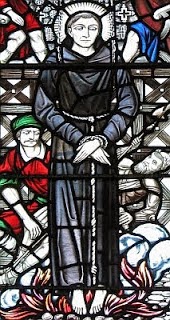
Blessed John Forest was executed by being burned to death, suspended over the flames from a gibbet in chains on May 22, 1538 because he opposed Henry VIII's marriage to Anne Boleyn, the annulment of Henry's marriage to Catherine of Aragon, and Henry's claim to supremacy and religious and ecclesiastical matters in England, which was heresy to Henry VIII. He was one of the Observant Franciscans. According to the Franciscans in the Province of Great Britain website: 

John was born into the noble Forest family, probably in Oxford, in 1471. At seventeen years of age he joined the Observant Friars Minor in Greenwich. He completed his studies at Oxford at the age of 26 and was ordained priest in Greenwich. Cardinal Wolsey gave him the task of preaching in St. Paul's Cross Church and Queen Catherine of Aragon chose him as her chaplain and then confessor. (The Greenwich friary was attached to the Royal Palace of Greenwich). In this role he opposed the divorce that King Henry VIII wanted to obtain from the Queen. In 1532, Guardian of the Greenwich friary, he spoke to the friars of the plans the King had to suppress the Order in England and denounced from the pulpit at St. Paul's Cross Henry's plans for a divorce. In 1533 he was imprisoned in Newgate prison and condemned to death. In 1534 Henry did indeed suppress the Observant friars and ordered them dispersed to other friaries. John was released from prison and by 1538 was in confinement in a Conventual Franciscan friary, his death sentence having been neither commuted nor carried out. From this confinement he could correspond with the Queen and he also wrote a tract against Henry entitled: De auctoritate Ecclesiae et Pontificis maximi (On the Authority of the Church and the Supreme Pontiff), defending the papal primacy in the Church. He was denounced to the King for this tract and also for refusing to swear the oath of loyalty demanded by Cromwell. When he refused to admit that his resistance to the King was an error John was burned over a slow fire on 22nd May 1538 in Smithfield Market. He died praying for his enemies.

Dom Bede Camm wrote an extended narrative of Blessed John Forest's stand against Henry VIII, his correspondence with Queen Katherine of Aragon, Latimer's long sermon before Forest was burned alive, and the martyr's last words: "Domine, miserere mei".

The Catholic Encyclopedia has this further detail about his execution and information about his beatification:

The statue of "Darvell Gatheren" which had been brought from the church of Llanderfel in Wales, was thrown on the pile of firewood; and thus, according to popular belief, was fulfilled an old prophecy, that this holy image would set a forest on fire. The holy man's martyrdom lasted two hours, at the end of which the executioners threw him, together with the gibbet on which he hung, into the fire. Father Forest, together with fifty-three other English martyrs, was declared Blessed by Pope Leo XIII, on 9 December, 1886, and his feast is kept by the Friars Minor on 22 May.

Image credit: Wikipedia commons, under license. It depicts his statue in St. Etheldreda's, Ely Place in London.

Blessed John Forest, pray for us.

Monday, April 11, 2016

A Rebel (Beheaded) and A Heretic (Burned)

On April 11, 1554, Thomas Wyatt the Younger was executed on Tower Hill for leading his eponymous rebellion against Mary I. I have to post on this event for two reasons: using the word eponymous and using this great profile portrait.

The Wyatt Rebellion, as this site notes, failed completely:

The plan itself involved too many ‘ifs’ and ‘buts’ if it was to succeed. The noble conspirators planned to remove Mary, instate Elizabeth as Queen and arrange for her to marry Edward Courtenay – a man Mary had already rejected as a husband. [It sounds like the Gunpowder Plot!]

The plan was for three rebellions to take place in separate parts of the country. They would occur at the same time – in the Midlands, the West Country and Kent. The plan was that the government would not know which one to put down first and each would blossom as a result of their localised success and attract more and more supporters among the common people.

The French Navy would blockade the English Channel with eighty ships so that the Habsburgs would not be able to help Mary.

The plan failed miserably. The Imperial Ambassador, Simon Renard, had heard rumours that such a plot existed and informed the Lord Chancellor, Stephen Gardner [sic], of his concerns. Gardner brought in Courtenay for questioning as Renard had mentioned his name. The records stated that Gardner’s questioning was ‘robust’ and Courtenay was not a man who could stand up to this. Edward Courtenay told Gardner all that he knew about the plot so that the government knew about the plot even before it had begun – even if Courtenay would not have known about the details.

The ‘uprisings’ in the Midlands and the West Country were a failure as few of the people there gave Carew and the Duke of Suffolk the support they needed for success. It seems that though there was concern about Mary marrying a foreigner, loyalty to the Queen took precedence. Those in the Midlands did not want to commit treason (Suffolk raised a force of just 140 men) while many in the West were Catholic. . . .

Only two of the leaders were executed for their treason – Wyatt and the Duke of Suffolk. Other minor nobles were also executed but some – guilty of treason – were spared. In total about 90 rebels were executed but many of the common people who had joined Wyatt and survived were spared. Two other casualties were Lady Jane Grey and her husband Guildford Dudley. Both had been in prison since the failed attempt to put Lady Jane on the throne and had nothing to do with Wyatt’s rebellion. However Mary felt that she could no longer risk anyone rallying to Lady Jane’s cause – hence her execution – especially as her father, the Duke of Suffolk, had been involved in this plot and had been executed for treason.

I find it interesting that the website does not mention that Queen Mary had rallied her people to defend her and their city. Even John Foxe, who had no reason to present Mary in a good light, recounted her bravery, her devotion, and her resolve in her speech at Guildhall:
I am your Queen, to whom at my coronation, when I was wedded to the realm and laws of the same (the spousal ring whereof I have on my finger, which never hitherto was, not hereafter shall be, left off), you promised your allegiance and obedience to me…. And I say to you, on the word of a Prince, I cannot tell how naturally the mother loveth the child, for I was never the mother of any; but certainly, if a Prince and Governor may as naturally and earnestly love her subjects as the mother doth love the child, then assure yourselves that I, being your lady and mistress, do as earnestly and tenderly love and favour you. And I, thus loving you, cannot but think that ye as heartily and faithfully love me; and then I doubt not but we shall give these rebels a short and speedy overthrow.
The other execution on April 11, 1612. It was the last execution for heresy in England, during the reign of James I. Edward Wightman was actually burned at the stake twice:

Wightman seems to have denied the doctrine of the Trinity, denied that Jesus Christ was God, denied the Resurrection and the legitimacy of Holy Communion and maintained that he himself was both the Holy Spirit and, though not himself divine, the Messiah appointed by God as the saviour of the world. From a modern perspective it seems clear that he had gone completely insane.

Wightman was eventually put on trial in the diocesan court in Lichfield, which in December pronounced him guilty of blasphemy and of promoting the heresies of figures ranging from Simon Magus to the Arians, the Manicheans and the Anabaptists. He was sent to the stake in the square in Lichfield in March 1612. When the flames began to scorch him he cried out in pain and it was thought he wanted to recant. Some of the crowd of spectators rushed to rescue him, though getting burned themselves. He was taken back to prison to recover, but when he was brought before the court again he refused to sign a formal recantation and on Easter Saturday in April he was sent back to the stake and was this time burned to death.

I believe the author of that post is incorrect about the date of Easter Sunday in 1612 on the Julian Calendar. It was not April 11 but April 12 (at least according to this site and this one too).

Wednesday, July 8, 2015

St. Thomas More and Conscience (Again)

In a letter to History Today, Hilary Mantel states that Thomas More's "conscience [was] captive to tradition and authority"--as though that were a bad thing. Thomas More's understanding of conscience, its formation, and its decision-making process was that the individual conscience must be responding to God's authority and the traditional teaching of the Catholic Church. I'm presuming now, but Mantel might think of conscience as being captive only to the individual's interpretation of events and actions and being consistent with oneself--what Blessed John Henry Newman in the nineteenth century would call conscience's counterfeit.

More offered Cromwell an explanation of the true meaning of conscience in his June 3, 1535 letter to his daughter Meg about his recent interrogation in the Tower of London. Cromwell was accusing him of a double standard, claiming his conscience was better than a heretic's conscience. More explained that the heretic was not appealing to conscience, which should have led him to follow the Church Jesus founded, but to his own ego, which had led him to reject the truth and develop individual ideas about the Church and salvation:

Whereunto I answered I would not dispute the King's authority, what his Highness might do in such case, but I said that verily under correction it seemed to me somewhat hard. For if it so were that my conscience gave me against the statutes (wherein how my mind giveth me I make no dec­laration), then I nothing doing nor nothing saying against the statute, it were a very hard thing to compel me to say either precisely with it against my conscience to the loss of my soul, or precisely against it to the destruc­tion of my body.

To this Master Secretary said that I had before this when I was Chan­cellor examined heretics and thieves and other malefactors and gave me a great praise above my deserving in that behalf. And he said that I then, as he thought and at the leastwise Bishops did use to examine heretics, whether they believed the Pope to be the head of the Church and used to compel them to make a precise answer thereto. And why should not then the King, since it is a law made here that his Grace is Head of the Church, here compel men to answer precisely to the law here as they did then concerning the Pope.

I answered and said that I protested that I intended not to defend any part or stand in contention; but I said there was a difference between those two cases because at that time, as well here as elsewhere through the corps of Christendom, the Pope's power was recognized for an undoubted thing which seems not like a thing agreed in this realm and the contrary taken for truth in other realms. Whereunto Master Secretary answered that they were as well burned for the denying of that as they be beheaded for deny­ing of this, and therefore as good reason to compel them to make precise answer to the one as to the other.

Whereto I answered that since in this case a man is not by a law of one realm so bound in his conscience, where there is a law of the whole corps of Christendom to the contrary in matter touching belief, as he is by a law of the whole corps though there hap to be made in some place a local law to the contrary, the reasonableness or the unreasonableness in binding a man to precise answer, standeth not in the respect or difference between beheading and burning, but because of the difference in charge of con­science, the difference standeth between beheading and hell.

In his chapter on St. Thomas More in The Cambridge Companion to Thomas More ("More and the Heretics"), Richard Rex notes that More--and in this he certainly was a man of his time--was certain that he knew the truth. Catholic Christianity was the truth and no one had the right to deny or ignore the truth. Rex notes that we post-modernists can hardly imagine this certainty (our only certainty would be perhaps that we cannot be certain!). In his role as Henry VIII's Chancellor, he was sworn to assist the Church in finding heresy and he fulfilled that role. More regarded the obdurate heretic as a danger to society, an egoist deciding his own interpretation of God's revelation, and a person in certain danger of damnation. Thus, when More made his appeal to his right to follow his conscience, he asserted that his conscience was responding not to his own interpretation but to the teaching of the universal Church, an authority high above Henry VIII, even if the monarch did take over the Church in England.

On the Acton Institute website, writer Marc D. Guerra sums up More's understanding of conscience well; he was indeed guided by tradition and authority:

Whereas modern doctrines of conscience characteristically emphasize the self-sufficiency of the individual’s judgment, More stresses its communal nature. More, to be sure, recognized the uniqueness of the individual conscience. More was, after all, imprisoned precisely because he could not, in good conscience, swear allegiance to Henry VIII’s oath. But in contrast to the modern claim that the individual can create his own moral values, More saw the “formation of conscience” as “the fruit” of an education “in the truth.” Far from being the arbitrator and creator of its own moral order, the human conscience is in need of conforming to the truth. For More, the formation of conscience is the result of a long process in which one discovers a preexisting created moral order. This was, in some sense, the issue in More’s dispute with Henry. Henry sought to substitute his own law for the “higher law of God and Christ’s Church.” Nothing underscores the profound differences between More’s and the modernist’s understanding of conscience more than this fact: Whereas modern thought views the individual’s conscience as being above all other authorities, More’s conscience testifies to the superiority of the church’s authority to his king’s. More’s refusal to take Henry’s oath was not an act of civil disobedience but, rather, of obedience to truth and thus, in his view, an act of “genuine liberty.”

Friday, April 17, 2015

St. Thomas More in the Tower

On April 13, 1534, Thomas More was presented with the Act of Succession and the oath it required at Lambeth Palace in the presence of three other Thomases and one William: Audley, Cranmer, Cromwell, and Benson (The last Abbot and first Dean of Westminster Abbey). Then More was held in the custody of Benson for a few days. By April 17 he was in the Tower of London and wrote to his daughter Meg about his questioning earlier that week. He left the Tower again for trial on July 1, 1535 and then for the last time on July 6, 1535 for his beheading.

The Latin Mass magazine published an article I wrote titled "The Long Lent of St. Thomas More" in its Winter/Spring 2015 issue (print or on-line subscription only). In it I demonstrated that More was preparing either for death from natural causes or by execution throughout those long months in the Tower of London:

From April 17, 1534, through the trial and execution of the three Carthusian priors (John Houghton, Augustine Webster, and Robert Lawrence) with Father John Haile and the Angel of Syon, Father Richard Reynolds on May 4, 1535; the trial and execution of John Cardinal Fisher in June of that year, and his own trial on July 1, 1535, Thomas More prepared for his death in the Tower of London. For more than 14 months in the Tower, More observed a Long Lent of repentance and devotion. He meditated on the Passion of Christ, particularly on His Agony in the Garden of Gethsemane. He prayed to repent of all past sins and to wean himself away from all worldly concerns and seems to have marked his progress toward preparing to die. The purpose of this article is to examine those methods of preparation and thereby trace signs of More’s progress and final acceptance of death.

I examine two of his Tower works: The Sadness of Christ and his "Godly Meditation" prayer and then look at More's progress toward death and martyrdom through his letters to his daughter Margaret Roper and of course his trial and execution.

On Wolf Hall this coming Sunday night (April 19), the episode in which Thomas More is depicted torturing a suspected heretic on the rack is scheduled to air. This is the biggest lie that Hilary Mantel and the BBC are presenting so dramatically in defiance even of G.R. Elton, who acknowledged that More never tortured anyone during the three (3) heresy investigations he was involved in as Chancellor. I hope to be booked on Kresta in the Afternoon next week to discuss.

I was perusing a book by Louis L. Martz on Thomas More: The Search for the Inner Man. Martz was one of the editors of the Yale Edition of The Complete Works of Thomas More and chaired the project between 1963 and 1997 (he died in 2001). Martz demolishes the charges both of torture and of fanatical prosecution of heretics. He was arguing in fact against one of the editors on his project, Richard Marius, whose 1984 biography depicted More as hysterical and savage in his pursuit of heresy. Martz notes that the pursuit of heresy continued after More's death, as Cromwell oversaw the execution of monks, friars, and many others, including an elderly princess (the last of the Plantagenets) and two Knights of the Order of St. John--Cromwell called it treason, not heresy. Blessed John Forest was certainly executed for heresy, burned at the stake. His heresy was exactly what Cromwell called treason: he would not acknowledge Henry's supremacy over the Church in England.

Martz concludes:

It is difficult therefore to argue that Thomas More's prosecution of those he suspected of heresy was any more severe than Thomas Cromwell's prosecution of those he suspected of treason. For both it was a grim matter of quelling what they, for different reasons, saw as sedition. Let us lay aside, then, this ancient and unfounded charge against More.

Martz's book was published in 1992.

Please note that Matt Swaim and I will discuss St. Thomas More and Wolf Hall on the Son Rise Morning Show Monday morning, April 20, during the last segment of the EWTN broadcast, after the 7:45 a.m. Eastern/6:45 a.m. Central news break.

Thursday, May 22, 2014

Blessed John Forest, Unique Among the Catholic Martyrs

Blessed John Forest is unique among the Catholic martyrs of the English Reformation. He is what I would call a Supremacy Martyr, suffering for his refusal to recognize Henry VIII's supremacy over the Church of England, but he was found guilty, not of treason but of heresy--and thus burned alive in chains by the order of Thomas Cranmer, the Archbishop of Canterbury.

As one of the Observant Franciscans and as one of Queen Katherine of Aragon's chaplains and confessors, Blessed John Forest (beatified by Pope Leo XIII), was always opposed to what Henry VIII planned to do to resolve his "Great Matter", manipulating the Catholic Faith in England and attempting to do so in Rome to achieve his goal of marrying Anne Boleyn. The Thomas Abel mentioned below was another one of Katherine of Aragon's chaplains, executed along with two others (and three Zwinglians) two years later. Father Peto's sermon at Greenwich compared Henry VIII to Ahab and Anne Boleyn to Jezebel and occasioned threats from Thomas Cromwell that Peto and his defender Friar Elstow mocked as ineffective to those who did not fear death. Blessed John Forest endured imprisonment and a torturous death to defend the sanctity of marriage and unity of the one, holy, catholic and apostolic Church.

From the Catholic Encyclopedia, details about the blessed martyr's life and death:

Born in 1471, presumably at Oxford, where his surname was then not unknown; suffered 22 May, 1538. At the age of twenty he received the habit of St. Francis at Greenwich, in the church of the Friars Minor of the Regular Observance, called for brevity's sake "Observants". Nine years later we find him at Oxford, studying theology. He is commonly styled "Doctor" though, beyond the steps which he took to qualify as bachelor of divinity, no positive proof of his further progress has been found. Afterwards he became one of Queen Catherine's chaplains, and was appointed her confessor. In 1525 he appears to have been provincial, which seems certain from the fact that he threatened with excommunication the brethren who opposed Cardinal Wolsey's legatine powers. Already in 1531 the Observants had incurred the king's displeasure by their determined opposition to the divorce; and no wonder that Father Forest was soon singled out as an object of wrath. In November, 1532, we find the holy man discoursing at Paul's Cross on the decay of the realm and pulling down of churches. At the beginning of February, 1533 an attempt at reconciliation was made between him and Henry: but a couple of months later he left the neighbourhood of London, where he was no longer safe. He was probably already in Newgate prison 1534, when Father Peto [gave] his famous sermon before the king at Greenwich. In his confinement Father Forest corresponded with the queen and Blessed Thomas Abel and wrote a book or treatise against Henry, which began with the text: "Neither doth any man take the honour to himself, but he that is called by God as Aaron was.

On 8 April, 1538, the holy friar was taken to Lambeth, where, before Cranmer, he was required to make an act of abjuration. This, however, he firmly refused to do; and it was then decided that the sentence of death should be carried out. On 22 May following he was taken to Smithfield to be burned. The statue of "Darvell Gatheren" which had been brought from the church of Llanderfel in Wales, was thrown on the pile of firewood; and thus, according to popular belief, was fulfilled an old prophecy, that this holy image would set a forest on fire. The holy man's martyrdom lasted two hours, at the end of which the executioners threw him, together with the gibbet on which he hung, into the fire. Father Forest, together with fifty-three other English martyrs, was declared Blessed by Pope Leo XIII, on 9 December, 1886, and his feast is kept by the Friars Minor on 22 May.


The Guild of Blessed Titus Brandsma blog posted this information about the friar's correspondence with Katherine of Aragon:

“Most Serene Lady and Queen, my daughter most dear in the bowels of Christ, - When I read your letter I was filled with incredible joy, because I saw how great is your constancy in the Faith.

In this, if you persevere, without doubt you will attain salvation.

Doubt not of me that by any inconstancy I should disgrace my grey hairs.

Meanwhile I earnestly beg your steadfast prayers to God, for whose spouse we suffer torments, to receive me into His glory.

For it have I striven these four and forty years in the Order of St Francis.

Meanwhile do you keep free from the pestilent doctrine of the heretics, so that even if an angel should come down from Heaven and bring you another doctrine from that which I have taught you, give no credit to his words, but reject him; for that other doctrine does not come from God.

These few words you must take in lieu of consolation; but that you will receive from our Lord Jesus Christ, to whom I specially commend you, to my father Francis, to St Catherine; and when you hear of my execution, I heartily beg of you to pray for me to her.

I send you my rosary as I have but three days to live.”


Blessed John Forest, pray for us!

Wednesday, March 12, 2014

"Bad Religion" and "Dangers to the Faith": Book Review, Part Two


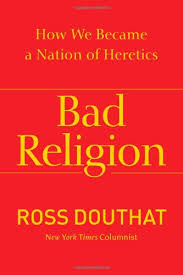
I read Ross Douthat's Bad Religion: How We Became a Nation of Heretics last month and then followed it up by reading Al Kresta's Dangers to the Faith: Recognizing Catholicism's 21st-Century Opponents. The two books are related, as both authors examine the Church's competition for what to believe, how to pray, how to live, and how to think. Douthat tells a story, tracing a history of change and secularization and focusing on a handful of heresies--teachings about Christianity that over-emphasize one doctrine or another and thus distort Christian orthodoxy (using a Mere Christianity view). Kresta writes about 14 opponents of the Catholic Church divided into four groups: Abusers of Spirituality and Revelation; Abusers of Science and Reason; Abusers of the Past and Future, and Abusers of Wealth and Power. Douthat's book is a narrative to be absorbed and analyzed, with a conclusion that emphasizes personal action; Kresta's is is a compendium of information to be consulted and used as a reference for refutation and argument. As I reviewed Bad Religion yesterday, today I focus on Dangers to the Faith.

To begin, I think I should note that Al Kresta has interviewed me a few times on his radio program; he and Nick Thomm even reached out to me to set up an interview on site at the Catholic Writers Guild Conference. Nevertheless, neither he nor OSV sent me a review copy or asked for my opinion. I bought my copies of both Bad Religion and Dangers to the Faith at Eighth Day Books. I have also listened to Al Kresta's program often and was more familiar with his way of reasoning and presenting his arguments than I was with Douthat's--in fact, although I've heard of Douthat and seen and heard interviews on broadcast media, this was the first work of his I'd read. Reading Dangers to the Faith is like listening to Al Kresta: his story-telling method; his way of presenting his side of the argument and deflating the other side's argument--they come through clearly here. His voice is unmistakable on the printed page.

As Kresta presents the 14 dangers to the Faith, he quotes extensively from the sources of the dangers' founders and exponents. Each chapter is dedicated to a specific danger, outlining its tenets and contradiction of Catholic Truth, and then describing arguments against it. The book does not have an index, but it does have pages of notes so you have the sources and resources for further reading. I saw Mr. Kresta on Raymond Arroyo's The World Over program and he commented that these 14 dangers are all abusers of goods. They take something good, like understanding nature through the scientific method, and twist it so that the scientific method becomes the only way to understand life. In that way, these abusers of goods resemble Christian heretics, who take some aspect of the truth, for example, Christian teaching on Who Jesus is and over emphasize it like the Arians or the Monophysites. In a way, both Kresta's "abusers of goods" and Douthat's "heretics" are narrow minded and limited: they cannot see the complexity of reality and so try to manage it by bringing reality down to their level. It may be difficult to understand the relationship between Faith and Reason or how Jesus could be True God and True Man, but it's better to try and fail than to adopt an unrealistic minimalization of the truth so you can handle either truth.

In addition to commenting on the voice so evident in these chapters, I'd like to mention the tone: Kresta is always charitable, sometimes a little exasperated, but never demeaning or disparaging. He speaks of these "enemies" with love, because he wishes they knew the truth. Using the example of Oprah Winfrey's encounter with the Dominican Sisters of Mary, Kresta demonstrates how much she knew something great and good was there--she just didn't recognize Who was there. 

Kresta achieves his goals in helping his readers "know and love the faith" and "love the mission field" (from the Introduction). I did find the subheads, used not just for sections but for paragraphs, rather distracting, and I do wish the book had an index. Dangers to the Faith is an excellent resource and reference. Kresta ends his book just as Douthat did: with a call to sanctity for all Catholics as the best apologetic argument we can make.

Monday, February 17, 2014

Heresy Without Orthodoxy: Ross Douthat's "Bad Religion"

 
My husband and I visited our friendly neighborhood Eighth Day Books on Saturday and I purchased this book: Bad Religion: How We Became a Nation of Heretics. I am finding it fascinating reading. Heresies are essential topics in my study of Church History: the history of the Early Church can almost be seen as a struggle against heresy. As each heresy proposed a simple, logical way of understanding, for example, how Jesus was both God and Man, the bishops met at the councils and restated true Church teaching. The Arian heresy, particularly, divided the Church as St. Athanasius stood up against the world to defend the truth about Jesus. Sometimes we forget how cruel heresy can be (C. Fitzsimmons Allison wrote a book titled The Cruelty of Heresy: An Affirmation of Christian Orthodoxy that explored the more existential aspects of that cruelty), as the supporters of the heresy cast out the defenders of orthodoxy. I think we often view the orthodox as having all the power--but it isn't always so.
 
I'll post a review in the next couple of days, but for now, here's a couple of notes: Douthat's thesis is that the problem is not that religion is on decline in the U.S.A., but that we have almost too much religion, and most of it is unorthodox. While so much of the popular religion is unorthodox, the orthodox religion--let's use C.S. Lewis' term, "Mere Christianity"--is not strong enough, persuasive enough or perhaps even confident enough to call people back to historical, doctrinal, sacramental, and moral orthodoxy.  Douthat starts his review of these issues with the post-World War II situation, examines the era when Reinhold Niebuhr, Billy Graham, Archbishop Fulton Sheen, and Martin Luther King, Jr. demonstrated the strengths of Mainline Protestantism, Evangelical Protestantism, Catholicism, and the African-American Church. He then looks at the period of accommodation, including the sad story of the decline of the Catholic Church in America after the Second Vatican Council--his narrative seems accurate enough to me. Philip Jenkins, Russell Shaw, and Al Kresta (I want to read his new book and Eighth Day should have it in stock by our G.K. Chesterton reading group meeting this Friday) have covered some of the same ground in different works, but Douthat is both persuasive and compelling in his view of the past almost 60 years.