Showing posts with label Nancy Bilyeau. Show all posts

Friday, September 30, 2016

"This book will challenge everything you think you know about history."

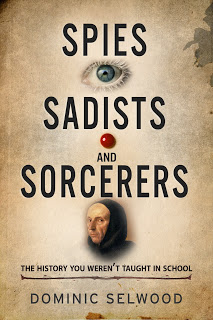
Dominic Selwood is an author and columnist, who has collected a series of columns offering different views of historical events into a book: Spies, Sadists and Sorcerers: The History You Weren't Taught in School (available on Kindle for $.99!).

Nancy Bilyeau interviews him on her blog, highlighting his revisionist view of the English Reformation, which certainly coincides with mine (and hers, too, I think).

Selwood's website provides generous excerpts from the book, including this "unintended Reformation" moment, discussing Walpurgisnacht and the saint it should be honoring:

It is pure coincidence that Walburga was canonized on May Day, thus giving her name to the festivities of the night before. But it is also strangely fitting, as popular belief in the healing properties of saints’ relics (and oils) is inseparable from our historical attachment to magic. 

And here is where something fascinating happens. As the Reformation swept away faith in popular and largely benign Christian miracles, it instead offered belief in a much darker magic —one that would quickly lead to the horror of the witch-craze and fantastical legends like the sabbaths on the Brocken. 

It is deeply ironic that the Protestant reformers, in abolishing what they saw as harmful superstitious claptrap, replaced it with terrifying magical fears that would end with the brutal and pointless murder of tens of thousands of innocent women. 

Before the Reformation there had, of course, been some scattered witch trials. But the same reforming theologians who lambasted what they saw as the crude and irrational magical beliefs underpinning the cult of saints and relics rapidly convinced themselves that hundreds of towns and villages were sheltering the foulest witches and demons, whose unnatural rites jeopardized the health and salvation of Christendom. They saw them flying on diabolical beasts, covering vast distances in the blink of an eye. They found on them folds of skin used for suckling demons in the form of familiars. They accused them of sexually molesting decent folk, invading their beds as lustful incubi and succubi. They were convinced they possessed infernal powers to see the past, the present (at great distance), and the future. But above all, they feared the witches were working ceaselessly to destroy their new, rational churches. 

As the reformers set about ridding the world of these devilish handmaidens, the great burnings began, peaking in the late 1500s and early 1600s, before petering out in the early 1700s. In that time, somewhere between 40,000 and 100,000 people (predominantly, but not exclusively, women) were torched alive on suspicion of practising magic.

Looks like a fascinating, if episodic, review of events in history seen from different angles.

Sunday, April 10, 2016

Another Subscriber-Only Project

On Monday, the Feast of the Annunciation, I participated in my first Skype interview with Simon Rafe of Church Militant on the subject of the English Reformation (Deformation). I was in good company, as Nancy Bilyeau and Father John Vidmar, OP are also interviewed on the show. It's live now on the Church Militant website.

Nancy Bilyeau talks about the Dissolution of the Monasteries; Father Vidmar about the choices facing Catholics in England; I discuss the Whig tradition of English history and highlight the revisionist authors like Duffy, Haigh, Scarisbrick, etc--and of course, how I summarize and survey their input into the history of the English Reformation in my book.

When Simon and I talked, I did not see his face live in the studio. The producer I talked to before the show and with whom I tested our Skype connection instructed me on how to tilt my laptop screen and where to look so I would be framed up on the "tv" screen. Learning something new all the time!

Tuesday, March 22, 2016

The Joanna Stafford Trilogy: All in Paperback


As of today, all three of Nancy Bilyeau's Joanna Stafford series novels are in paperback: The Crown, The Chalice, and The Tapestry. Joanna Stafford is a Dominican nun who is cast out of her priory because of the Dissolution of the Monasteries (and the Friaries, and the Convents) perpetrated by Henry VIII and Thomas Cromwell.


As you know if you read this blog with any regularity, I post often about the Dissolution of the Monasteries: It was the greatest cultural calamity ever inflicted upon England. It meant the loss of great art and architecture, books and music, order and rule, hospitality, education, and the spiritual, religious life. It left a gaping hole in English life: the prayer and penitence of good monks and nuns and the preaching and poverty of good friars.

It's easy to say that not all monks, nuns, and friars were good, but many, even the vast majority were faithful to their Rule and their vows. If the English Reformation was supposed to improve and revive the Church in England, it failed entirely in this case because all it did was destroy, pillage, and plunder the religious heart of England.


Although Bilyeau does not focus on these losses directly, since she is telling stories of intrigue, danger, and conspiracy, her choice of Joanna Stafford as a heroine means that calamity is part of the desperation at the heart of each plot. When we first meet Joanna Stafford at the beginning of The Crown she is on her way to offer some sort of comfort to her cousin, Margaret Bulmer, who is being burned at the stake for her role in the Pilgrimage of Grace, the northern uprising of commons, nobles, and monks against the suppression of monasteries and other changes in religion being enforced by the monarch and his minions. One of the last times we see her in The Tapestry, she is trying to comfort Catherine Howard as Henry VIII's fifth wife awaits her fate.

At the heart of each plot, each symbol (the crown, the chalice, the tapestry) is indeed the desperation of those English men and women who saw how destructive Henry VIII's Supremacy and tyranny were. Joanna Stafford witnesses and gets involved with these plots to thwart Henry VIII or even remove him from the throne through murder (The Chalice).

As I wrote in my review of The Tapestry last year:

In this novel, however, Henry has unraveled his own kingdom, setting factions against each other like colors in the pattern of Joanna's tapestries. Men and women are willing to do almost anything to remove him from power or keep him in power--the former was clear in The Chalice when Joanna almost participated in the murder of Henry VIII when he drank wine from a poisoned chalice--and the conspirators in this volume will even seek help from the occult to remove Thomas Cromwell from his position of influence on Henry VIII.

While Joanna is still in danger after Cromwell's fall and execution, Joanna recognizes that England is in even greater danger because nothing will stop Henry VIII. She realizes this when she sees Thomas Abel, Richard Featherston, and Edward Powell, three former chaplains and defenders of Queen Catherine of Aragon and Robert Barnes, Thomas Garrett, and William Jerome, three Lutheran supporters of Cromwell drawn on sledges to Smithfield. The Catholics would be hung and quartered, while the Lutherans would be burned alive. According to Henry VIII, the first three are traitors, the second, heretics:

So King Henry VIII showed his true heart. He did not favor the Catholics, nor did he follow the Lutherans. It was impossible to understand him, to live safely in his kingdom. The removal of Cromwell had not made him a better man. There was something twisted--even diseased--in a mind that would command that the condemned be paired as opposites on the hurdles. How foolish Bishop Gardiner and the Howards were to think they could predict what King Henry would do--or control his actions.

When it is impossible to live safely in a kingdom, the King has failed because he is a tyrant.


I recommend all three books as good historical fiction! More about the books from the publisher and more about Nancy on her website. Nancy Bilyeau discusses her books and the research she did with Christine Niles here.

Sunday, January 10, 2016

Best Books Read in 2015, Part Two

A few more non-fiction works:

From Dom Bede Jarrett, a study of a Dominican saint and economics (S. Antonino and Medieval Economics):

Although the book refers to the saint and Medieval Economics in the title, Jarrett dedicates one chapter out of ten to "His Social Ideals". Jarrett provides a summary of St. Antonino's Summa Moralis on economic themes: Production, Distribution, and Consumption. The saint, who was Archbishop of Florence when Cosimo de Medici was resident in the Dominican convent of San Marco (which contains the great frescoes of Fra Angelico as referenced and illustrated above), writes about the moral aspects of commerce. He begins with the statement that riches are good and poverty is bad; riches are good because they allow a man to care for his family in relative security and comfort, provide for the common good, and give alms to the poor to alleviate their want. No one in a just state should be destitute of food, shelter, and clothing, but everyone must work according to their ability to support themselves and their families. Wealth also provides for the opportunity for prayer and meditation: riches are a means to good things, not an end. While good may be obtained through voluntary poverty (like that practiced by religious), poverty is not a good in and of itself.

St. Antonino did not expect or even suggest the even distribution of wealth, noting that inequality is part of Nature and while he joined in the universal condemnation of usury and was opposed to monopolies or cartels, he acknowledged that businessmen could and should make a profit, even on their invested capital, as it represents their industry and effort, not as money making money on itself. He condemns extravagance or conspicuous consumption: "For it is a sad thing to see, side by side, extravagance and penury, to see horses and mules gaily caparisoned while the poor perish from hunger; or in a plague-stricken city when the sick lie naked, cold, and foodless to find men and women dressed with vain and gaudy ornaments (II. 4, 4, vi. p. 581; II. 4, 5, ii. p. 591)" (p. 76). St. Antonino discusses the principles of just prices, just reward for labour, and just production and distribution of goods.

Our Greater Wichita chapter of the American Chesterton Society has been reading and discussing The Well and the Shallows two, three or four essays at a time for our monthly meetings at Eighth Day Books. Perhaps one of the best sections of this book was "My Six Conversions" in which Chesterton described some of the reasons he would become a Catholic if he wasn't one already:

I. THE RELIGION OF FOSSILS
II. WHEN THE WORLD TURNED BACK
III. THE SURRENDER UPON SEX
IV. THE PRAYER-BOOK PROBLEM
V. THE COLLAPSE OF MATERIALISM
VI. THE CASE OF SPAIN 
VII. THE WELL AND THE SHALLOWS

AT least six times during the last few years, I have found myself in a situation in which I should certainly have become a Catholic, if I had not been restrained from that rash step by the fortunate accident that I was one already. The point is not merely personal but has some representative interest, because our critics constantly expect the convert to suffer some sort of reaction, ending in disappointment and perhaps desertion. As a rule, the most that they will concede to us is that we have found peace by the surrender of reason; which generally means in practice that we pass the rest of our lives in interminable controversies with a perpetual appeal to logic. But, as a fact, it is in a rather peculiar sense, the other way about. The strongest sort of confirmation often comes to the convert after he has received enough to establish conviction. In these articles I propose to discuss some examples of this singular sort of post-conversion conversion. I mean that things have happened, since I was received into the Church, which would in any case have rendered impossible any intellectual position outside the Church, and especially the position in which I originally found myself.

I did read some fiction in 2015. My husband and I read a Dean Koontz book, Lightning, out loud to each other. He had read it before but restrained himself from revealing the plot. The best thing about this book was how Koontz held off the explanation of the strange appearances of a sort of "guardian angel" in the protagonist's life.

Nancy Bilyeau sent me a review copy of The Tapestry, the third volume in her Tudor suspense trilogy:

In this novel, however, Henry has unraveled his own kingdom, setting factions against each other like colors in the pattern of Joanna's tapestries. Men and women are willing to do almost anything to remove him from power or keep him in power--the former was clear in The Chalice when Joanna almost participated in the murder of Henry VIII when he drank wine from a poisoned chalice--and the conspirators in this volume will even seek help from the occult to remove Thomas Cromwell from his position of influence on Henry VIII.

While Joanna is still in danger after Cromwell's fall and execution, Joanna recognizes that England is in even greater danger because nothing will stop Henry VIII. She realizes this when she sees Thomas Abel, Richard Featherston, and Edward Powell, three former chaplains and defenders of Queen Catherine of Aragon and Robert Barnes, Thomas Garrett, and William Jerome, three Lutheran supporters of Cromwell, drawn on sledges to Smithfield. The Catholics would be hung and quartered, while the Lutherans would be burned alive. According to Henry VIII, the first three are traitors, the second, heretics:

So King Henry VIII showed his true heart. He did not favor the Catholics, nor did he follow the Lutherans. It was impossible to understand him, to live safely in his kingdom. The removal of Cromwell had not made him a better man. There was something twisted--even diseased--in a mind that would command that the condemned be paired as opposites on the hurdles. How foolish Bishop Gardiner and the Howards were to think they could predict what King Henry would do--or control his actions.

When it is impossible to live safely in a kingdom, the King has failed because he is a tyrant.

I went back to read The Chalice, which I already had on Kindle, to understand the danger posed to Joanna throughout this novel. I found it an even more compelling read as Joanna was drawn into the so-called Exeter Conspiracy, the legacies of Elizabeth Barton, the Nun of Kent, and even the turmoil between Catholics and Protestants in the Holy Roman Empire. Nevertheless, as this book weaves the past and present dangers together, it is a compelling read.

Joanna is always loyal to her family, even though she is sensitive to the slights she receives and the horrors she witnesses. In this novel, she does all she can for Catherine Howard as she fears for how she is being used by the Howards and by Henry VIII. She nearly always does what someone tells her what not do (or does not do what someone tells her to do) especially when Geoffrey Scovill tells her what not to do or what to do. If she should stay, she leaves; if she should go, she stays--but that's what drives the story forward.

Catherine Howard and Thomas Culpepper's story in The Tapestry matches in a way the story of the Courtenays and the Poles in The Chalice, although Bilyeau does omit the involvement and execution of Francis Dereham, in a way I think to build up Catherine's innocence--especially because Dereham experienced the full agony of being partially hung, eviscerated, and quartered.

Throughout this trilogy, Bilyeau provides excellent character studies of the historical figures from Henry VIII, so sad at the end, through the Princess Mary, and of course Stephen Gardiner, the Bishop of Winchester and Thomas Howard, the Duke of Norfolk. She also demonstrates the effects the English Reformation was having on the common people, with whom Joanna lives in Dartford. They are experiencing--and will continue to experience--the changes in religion after the break from Rome. Bilyeau shows how the same unraveling that is taking place at the very top of English culture is also occurring among the common folk: the same hatred, opposition of Protestant vs. Papist (which everyone had been before in England), and the same spying and conspiring against one another. As Joanna knows, it is impossible to live safely in Henry VIII's kingdom. How she and the man she chooses (no other revelations here) will live without interference from Henry VIII and his successors remains either to to seen or is up to the readers' imagination.
  
The other great fiction read of 2015 was The Awakening of Miss Prim by Natalia Sanmartin Fenollera:

It was cold and snowy on the First Sunday of Lent in Wichita, Kansas. We went to Mass at the Cathedral of the Immaculate Conception and then stopped for lunch. Once back in the house we were in for the day and I read The Awakening of Miss Prim by Natalia Sanmartin Fenollera. I read it right through the WSU basketball game, two loads of laundry, and letting the dogs out (and in). At least two friends had recommended the book, one lent us his copy, and my husband had already read it.

Although the novel has many delights for any reader, I think that a reader who accepts the worldview of Benedictine monasticism, Thomist philosophy, and Chestertonian paradoxes will fit right in the village of San Ireneo de Arnois and appreciate the awakening that Miss Prudencia Prim needs. While it seems like a love story,
The Awakening of Miss Prim is really a conversion story (which would really be the same thing, right?) All of the people living and working in the village of San Ireneo de Arnois have converted, turned away from the modern world of acquisition and pressure to live in a community where leisure and education for children is the center of their activity. Miss Prim discovers that everyone plans their days and their work around the children and their well-being. Each shop is open only about six hours a day during the week and the proprietors, many of them women, manage their businesses to supply the needs of others the village, which is built next door to the Benedictine monastery. . . .

Catholicism and tradition are in the background throughout the story, but Fenollera does not catechize the reader. Miss Prim receives the catechesis slowly and organically, but the surprise of the novel is that she has to leave the village to understand what she's learned and how to live with it--and at the end she's ready to return and . . . --the author leaves it to us to imagine what Miss Prim does when she goes back to San Ireneo de Arnois to teach school.

I do think she should have named "the Man in the Wing Chair" but then other authors have played games with a main character's identity--Daphne Du Maurier never tells us the second Mrs. DeWinter's first name in
Rebecca, and Rose Macaulay famously teases the reader all through The Towers of Trebizond whether the protagonist/narrator is a woman or a man. Perhaps that's not such a flaw, after all.

Wednesday, August 12, 2015

The Throckmortons: Catholic Recusants (and one exception)

Author Nancy Bilyeau writes about the Throckmorton family and conspiracies against Elizabeth I and James I on her blog:

This was not the last time the name “Throckmorton” surfaced in a plot against a Protestant English ruler. In 1605, a servant to Robert Catesby, a key conspirator in the Gunpowder Plot and the son of Anne Throckmorton, rode directly to the Throckmorton estate, Coughton Court, to tell a group of Catholics, including two Jesuit priests, of Guy Fawkes’ arrest in the plan to blow up King James I and his Parliament. He said those Fawkes plotted with were now running for their lives.

These failed English conspiracies in support of Mary Queen of Scots (ranging from the fourth Duke of Norfolk’s efforts to marry the Scottish queen to Anthony Babington’s plot to murder Elizabeth and rescue Mary) along with the infamous Gunpowder Plot formed a strong impression in some minds that Catholics were conspiratorial and dangerous, controlled by France, Spain and, of course, the Pope. These fears hardened into bigotry throughout the 17th century. The despicable Titus Oates, who fabricated the “Popish plot” against Charles II and brought about at least 15 executions, wouldn’t have been possible without the Gunpowder Plot. Moreover, the Glorious Revolution and the arrival of the Hanovers—the direction the country took that leads us to today—were born, in large part, from fear of what James II, a Catholic king, would do. Those fears originated in the 16th century.

Before Sir Francis Throckmorton plunged into violent plotting, his family had made a far different sort of impact in England, one of service to the crown and country. To best understand the Throckmortons, who’ve popped up in so many interesting times and places in the reigns of the Tudors and Stuarts, we must take a closer look at the patriarch, Sir George Throckmorton, Sir Francis’s grandfather, a strong-minded man who had a blunt conversation with Henry VIII and Thomas Cromwell that is well known even today.


She comments on how Sir George Throckmorton responded to Henry VIII's religious changes and notes one reason he would have certainly been opposed to the Dissolution of the Monasteries:

Another possible factor in George Throckmorton’s traditional stance was sympathy for the fate of his aunt, Elizabeth. She was the abbess of a house of Poor Clares in Cambridgeshire. A woman of intellect, she exchanged letters with the famous humanist, Erasmus. After her abbey was destroyed, Elizabeth, more than 60 years old, went to live at Coughton, perhaps bringing one or two nuns with her who had nowhere else to go. She also brought a “dole-gate,” through which help was given to the local poor, and upon which her name was carved.

The practice of the Throckmortons’ “staunch” Catholic faith went in and out of fashion, depending on the Tudor ruler. After Cromwell was executed, religious traditionalists felt a little safer in England. The reign of Edward VI was so difficult that some left the country to live in exile. Mary’s reign was a brief respite. George’s seventh son, Sir John, was active in her Parliament and a witness to the queen’s will. During the reign of her successor, Elizabeth I, they fell into a defensive position again and a “priest hole” was built in Coughton Court, where priests could hide during inspections. The family became “recusants,” those who refused to attend Anglican services and paid heavy fines for it. People who could not pay the fines were imprisoned. With their money, the Throckmortons avoided that humiliation. Some became Protestants, most famously Sir Nicholas Throckmorton, a skilled courtier.

Read the rest there.

Sir Nicholas Throckmorton was not just a skilled courtier and Protestant: he was able to obtain a verdict of "not guilty" in his treason trial during the reign of Mary I, a most unusual achievement, according to this book, published by the Centre for Reformation and Renaissance Studies (Victoria University in the University of Toronto):

In the autumn of 1553, a new queen reigned in England. The Roman Catholic Mary Tudor had succeeded her sickly young brother Edward VI, and Protestant Englishmen — among them Sir Thomas Wyatt the younger — were trying desperately to engineer her fall. Wyatt’s rebellion was unsuccessful, and in the wake of his execution one of those put on trial for treason was Sir Nicholas Throckmorton: courtier, parliamentarian, and member of the Warwickshire gentry. According to the custom of the time, he was not permitted counsel and had to defend himself. The Trial of Nicholas Throckmorton records, virtually in dramatic form, Throckmorton’s spirited and skillful resistance to his accusers. So learned and quick-witted was his defence that he was acquitted by the jury, an almost unheard-of occurrence in Tudor treason trials. The record of Throckmorton’s trial ― “expressed in a dialogue for the better understanding of every man’s part” ― would become a canonical text in the legal history of England, and particularly important in Whig and liberal history and thought.

Annabel Patterson has edited this important political trial from the version in Raphael Holinshed’s The Chronicles of England, Scotland, and Ireland (London, 1587), a revision and expansion of the first edition of 1577. Her introduction sets the political scene, provides a biography of Throckmorton, analyzes the trial’s place in the fabric of the Tudor law of treason, and considers its aftermath in the experiences of the jury who acquitted Throckmorton, and of later figures such as William Walwyn, John Lilburne, and Algernon Sidney. Two appendices provide Tudor writings relating to the trial, and there is a bibliography of related studies.


Note that Throckmorton served as Elizabeth I's emissary to Mary, Queen of Scotland and was also suspected in the Duke of Norfolk's conspiracy to marry the deposed Queen of Scotland and supplant Elizabeth. Thomas Howard, the Duke of Norfolk lost his head; Sir Nicholas Throckmorton spent some time in the Tower of London but survived, never to regain his queen's favor.

Tuesday, July 28, 2015

Nancy Bilyeau on Cromwell's Execution--and Sir Walter Hungerford

For the English Historical Fiction Authors blog, author Nancy Bilyeau writes about the former Earl of Essex, Thomas Cromwell's execution--and the other man who suffered beheading on July 28, 1540:

Cromwell was arrested on June 10, 1540, in a way meant to cause as much humiliation as possible. The Duke of Norfolk ripped the Order of St. George from around Cromwell's neck while the Earl of Southampton tore the Order of the Garter insignia from his gown."Traitors must not wear the garter," shouted Norfolk. Cromwell was then hustled directly to the Tower of London; within two hours, the treasurer of the royal household had emptied Cromwell's house of valuables while others ransacked his papers.

There was no trial. Cromwell was condemned of treason and "abominable heresies" and executed on July 28, 1540.

But Cromwell did not die alone.

Following Thomas Cromwell to the scaffold erected on Tower Hill (not Tyburn, as some historians have written) was Sir Walter Hungerford. The decision to behead two men that day was unusual, though not unprecedented. Two noblemen that Cromwell had targeted for destruction--Henry Pole, Lord Montague, and Henry Courtenay, Marquess of Exeter--died together in late 1538. But those two men, condemned without trial for treason, were lifelong friends, distantly related, and requested a joint execution.

Why was Sir Walter Hungerford chosen for this ghastly honour? Cromwell was the author of the Reformation, a brilliant and ruthless statesman. His enemies sent Hungerford on the same path, from Tower of London cell to scaffold. It's a mystery that still swirls around that hot, pitiless day. In this post, I examine the myths, the theories and evidence. . . .

Cromwell was the first to die, in a bungled beheading infamous for its ghastliness. Hungerford followed. Both bodies were carted to the nearby Church of St. Peter ad Vincula, within the Tower walls. Their graves are a few feet from Anne Boleyn's. As Macaulay wrote, "In truth there is no sadder spot on earth than that little cemetery."

Because he was a traitor, Hungerford's estates and homes were claimed by the crown. Henry VIII gave Farleigh Hungerford Castle to his brother-in-law, Sir Thomas Seymour. It was not a small acquisition. Which is perhaps as good a reason as any for the destruction of Sir Walter Hungerford.

Nancy depicts these executions, and the atmosphere of such public events, most immediately in the third novel of her Joanna Stafford trilogy, The Tapestry, which I reviewed here. Two days hence and we will see some of the fallout of Cromwell's demise as three Zwinglians suffer at Smithfield.

Monday, May 11, 2015

Cutting off Cromwell's Story at the End of "Wolf Hall"

Wolf Hall, the BBC adaptation of Hilary Mantel's Wolf Hall and Bring Up the Bodies, ended last night on PBS's Masterpiece Theatre with Thomas Cromwell in Henry VIII's arms after the execution of Anne Boleyn. Henry is very happy; Cromwell looks stunned.

Nancy Bilyeau provides her as usual excellent review and analysis here. I agree with this comment from The New York Times review by Louis Bayard:

Mantel is currently writing the last volume of the “Wolf Hall” trilogy, and I can’t help but wish this superb production had waited to incorporate that final strand. The story, as it stands, is “complete” enough, but it lacks the full arc that Cromwell demands. We need to see him go to his end, not for the sake of retribution but for the sake of reckoning.

Bayard also emphasizes that, whatever modern heroism Hilary Mantel wants to impute to Thomas Cromwell, her protagonist has committed great acts of injustice and violence in this final episode. He may be doing it because the mockery of his former master Chancellor/Archbishop Thomas Wolsey at Court after Wolsey's death, or because his current master Henry VIII wants rid of Anne Boleyn. Cromwell has gone too far, as Bayard contends:

Until Sunday night’s episode, I think, a Cromwell apologist could have written off his actions — even his prosecution of Thomas More — as a kind of hard-edged Realpolitik, anchored to an innate sense of justice. No longer. As we watch Cromwell fasten his web around the lovesick musician Mark Smeaton (Max Fowler), we see an inner rot take hold. “I need guilty men,” he says to Norris. “So I found men who are guilty. Though not necessarily as charged.”

Cromwell knows he is perverting the system of justice in England in the service of the King. Remember the scene in A Man for All Seasons when Thomas More would give even the Devil the benefit of English Law? While Cromwell is approaching the heights of his power in Mantel's narrative, he will soon discover the results of destroying English justice and laws: without evidence of guilt, he will be attainted a traitor and sentenced to death--and Bayard is correct: as the BBC's Wolf Hall stands now it is incomplete, like Henry VIII's own play mentioned last night. He says he's written his own story in a tragedy. Henry has forgotten what happens to the hero of classical tragedy: he dies.

Tuesday, May 5, 2015

Like Mother, Like Daughter? Joanne Whalley in "Wolf Hall" and "The Virgin Queen"

Historical novelist Nancy Bilyeau is providing historically informed reviews of each episode of Wolf Hall at medievalists.net. In this week's review she provides some analysis of scenes concerning Catherine of Aragon and the Dissolution of the Monasteries. Although Cromwell did not really visit Catherine of Aragon in exile, Bilyeau comments on both Catherine's stubbornness and her kindness when Wolf Hall imagines such a scene:

Cromwell then moves from Henry VIII’s future woman [Jane Seymour] to his past woman: Catherine of Aragon. The first wife, after 20 years of marriage, fought hard to preserve her rights, and is still refusing to answer to anyone who will not address her as queen—despite the fact that Henry VIII has married Anne Boleyn and had a child with her. “That’s why he sent you, to see if I am really dying,” she says, weak and fighting spasms of pain. She pleads with Cromwell to allow her to see Mary, the daughter whom Henry keeps isolated and away from Catherine. Finally she says she heard “Boleyn’s daughter” had a miscarriage. “I know how that is,” she says, showing a humanity Anne never for an instance extends her way.

Catherine is also shrewd and picks up on the fact that Cromwell doesn't know if Anne is pregnant again. “I thought she always confided in you—I do hope there is no rift,” she says, allowing herself a moment of malice.

Later in the episode, some other historical inaccuracies are depicted:

In the next scene, an important character, Eustace Chapuys, ambassador to the Emperor Charles V, emerges from the dark shadows of Cromwell’s sitting room at home. They drink wine together, in Cromwell’s increasingly luxurious home, hung with a large tapestry the king personally gifted to him.

“I hear you’re going to put all the monks and nuns out on the road,” says Chapuys sternly, referring to the Dissolution of the Monasteries, one of Thomas Cromwell’s main achievements. Thousands of monks, friars and nuns were in reality ejected from their abbeys as Cromwell oversaw their destruction, the buildings stripped of value and given to the king’s friends. In this scene, Cromwell assures Chapuys that most of the nuns and monks wanted to leave when his commissioners visited their abbeys, which were places of corruption and vice. This is where
Wolf Hall falls back into the distortion and propagandizing which marred the previous episode, “Devil’s Spit.” The massive corruption that Cromwell keeps referring to throughout Wolf Hall is exaggerated. It was a pretext to convince Parliament to make legal the seizure of the buildings and land, which poured thousands of pounds into Henry VIII’s treasury.

In a bizarre fiction, Chapuys says, “I see famine before the spring. You’re buying corn from the territories of the Emperor. This trade could be stopped.” When Cromwell asks quietly what Emperor Charles V would gain from starving England, Chapuys says it would prove how badly governed the kingdom of England is.

In the 16th century, the country was in no way reliant on importing food from the land controlled by the Holy Roman Emperor, which included Spain, Portugal and Austria, the German lands, the Netherlands, and part of the Americas. There was trade between England and the Netherlands, mostly of wool. The threat of starving a country to make a point of politics belongs to some more modern age. Also, the show must mean “wheat” when Chapuys says “corn,” a common description of the time, because in the reign of Henry VIII the English did not eat maize, which was discovered by Spanish explorers in Mexico.


Wolf Hall is back on solid ground when Chapuys tearfully begs to be able to see Catherine of Aragon so that she will not die “all alone.” When Cromwell asks the king and queen on Chapuys’ behalf, Anne mocks Catherine. It seems that permission is refused, but in reality Henry VIII relented and Chapuys did visit her in exile the week before she died.

Joanne Whalley plays Catherine of Aragon in Wolf Hall and she played Catherine and Henry's daughter Mary I in a previously aired BBC series on the Tudors, The Virgin Queen. Playing Mary I in the 2005 series, Whalley found some sympathy for the queen usually called "Bloody Mary":

Actress Joanne Whalley is keen to clear up exactly who Queen Mary was, "No one really knows about her. You say I'm playing Queen Mary and they go, 'Oh, Mary Queen of Scots?' and you go 'No! Mary Tudor!' - and they don't know who she is. She is completely overshadowed by Elizabeth - as she was in their time."

"She has a terrible reputation as Bloody Mary but she didn't have an easy time of it. She had a terribly unhappy childhood; she has an unhappy marriage, a nightmare half-sister and religious trouble, so she has a full plate!"

"Elizabeth's mother (Anne Boleyn) replaced Mary's mother in the favour of the King; Mary's mother was sent away to live in exile and Mary wasn't allowed to see her, and she was forced to wait upon Elizabeth's mother," explains Joanne. "So there's a lot of history in their relationship and her paranoia, her fears, are all based in reality. She could have had Elizabeth killed really, but didn't - she was not an unkind person. There are various reports of her showing this much more kind, benign side of her personality, but given the times that she was in that bit wasn't allowed to shine through very often."

"She had a miserable and difficult journey to becoming Queen and it turns out very differently than she had imagined," says Joanne. "One of the keys to that is her relationship with her husband, Philip of Spain. She was hoping for a real marriage, she thinks how wonderful to have a companion - and there was nothing. They had no relationship at all really which is a huge disappointment to her."

All they really seemed to share was their Catholic religion and the desire to overturn the years of Protestant rule instigated by Mary's father, Henry VIII, which led to the religious persecution that earned Mary her gruesome nickname.

"She was very devout and she believed absolutely that she was putting things to rights with the country and in the eyes of God," says Joanne. "Crazy as it is, there is some sympathy to be drawn - she was completely devoted; in her life and her work, everything, she believed she was doing the right thing. Her only moments of joy and pleasure were in her more devout, communing-with-God moments because day-to-day life was pretty tough on her. She was very alone and very conflicted about how to deal with things. I feel sorry for her."

About Catherine of Aragon in Wolf Hall, Whalley commented in Harper's Bazaar:

"We don’t often think of the women around him when we think of Henry VIII. But we should because they were amazing and they operated within such restraints. I didn't expect to like Catherine of Aragon as much as I did. But she was an extraordinary woman. She was well educated and very much into education for women. Women at the time were not generally allowed to run things. But she grew up with her mother as an example - Queen Isabella of Castile - so she wasn't bound, at least in her own mind, by the restrictions of the time. It’s interesting how Elizabethan costume affects everything you do: how you sit, how you stand, how you carry yourself. You don’t have the same physical freedom. And the locations too: I remember shooting at Broughton Hall on the hottest day of the year. The walls were so thick but it was cool inside. You could feel the history in the walls."

On the one hand, it's great to have Nancy Bilyeau correct some of the historical inaccuracies in Wolf Hall; on the other, it's great to see an actress have some sympathy with the historical characters she plays. While she's appearing as the sixteenth century Catherine of Aragon on PBS, Whalley's portrayal of Claudia, Pontius Pilate's wife is on NBC, in A.D. The Bible Continues.

Tuesday, April 28, 2015

The Real Saint Thomas More on Saturday, May 2nd

The latest episode of Wolf Hall was the best one so far with its focus on Cromwell's efforts to suppress dissension from Henry VIII's new role as Supreme Head and Governor of the Church of England and the breakaway from the Catholic Church. Watching this episode was homework for my presentation this Saturday at the Spiritual Life Center on The Real Saint Thomas More from 9:30 to 11:00 a.m. this Saturday (May 2). If you're in the Wichita area, register here or call 316-744-0167.

While this was the best of the episodes so far, it also contained some historical inaccuracies, as Nancy Bilyeau notes in her review for Medievalists.net:

A tough and wily Cromwell questions Barton, who comes across as vindictive and unbalanced, and then interviews each of the important people who've been conspiring with the nun. Not one of them comes within a country mile of Cromwell’s abilities and intelligence. The true motive of the last remaining Plantagenets’ unhappiness with Henry VIII during this period is not explored in Wolf Hall—their respect and affection for Henry’s first wife, Catherine of Aragon; their (justifiable) fear for what will happen to her daughter Mary; and their fear of the country’s religious future in this fast-moving Reformation. Instead, the Poles and Courtenays and Bishop Fisher, one of the most respected scholars in all of Europe in the early 16th century, are shown as stupid, easily duped, and ungrateful for Henry VIII’s supposed years of kindness.

Wolf Hall strains to connect the followers of Sister Elizabeth Barton to an international conspiracy bent on destroying England and taking orders from Rome. At one point, Cromwell tells Margaret Pole, the niece of Edward IV, that through his spies in the kitchen he knows that her sons, Henry and Geoffrey Pole, had dinner with the Lady Mary twice and “talked about the Emperor, the invasion, and the best way to bring it about.” The Emperor Charles V was Mary Tudor’s first cousin through her Mother, and according to Wolf Hall, England was terrified of Spanish invasion in the mid-1530s.

There are two problems with this scene. One is that as Anne Boleyn made clear at the beginning of the episode, Lady Mary is a virtual prisoner in the household of her half-sister Princess Elizabeth. She was in reality subjected to emotional and even physical abuse during this time and watched like a hawk for receiving any letters from sympathizers. The possibility that she could escape her jailers to have dinner with her Yorkist relations and drink toasts to Spanish invasion is nothing short of ludicrous. Second, if such dinners had taken place it would fit the definition of treason to a “T.” All parties would have been carted to the Tower of London immediately. Several years later, when a religious rebellion in the North of England left Henry VIII even more paranoid, Cromwell would orchestrate the destruction of Henry Pole and Edward Courtenay on evidence much flimsier than the content of these alleged dinners. But the deaths of those found guilty in the “Exeter Conspiracy” lies years ahead of this episode, between Wife No. 3 and Wife No. 4. 


[Note that Bilyeau includes a magnificent sequence on the parties involved in the "Exeter Conspiracy" in her second Joanna Stafford novel, The Chalice.]

and

The marriage of Henry and Anne endures another blow when the queen miscarries. Afterward, the queen is even more vengeful and vindictive. “I’ll have no peace until Fisher is dead,” she says. “I’ll have no peace until More is dead.”

Anne tells Cromwell she wants him to “make” More talk, to say why he won’t sign the oath. When Cromwell replies, “No, Madam, we don’t do that,” she runs from the room.

This is one of the most dishonest moments of Wolf Hall. It is no secret that the real Thomas Cromwell, during this same period, presided over the arrest, questioning and executions of a group of friars and monks who also refused to sign the oath. The Carthusian monks of the Charterhouse were starved, hanged, cut down while still alive, castrated and dismembered. This is one of the most well known aspects of England under Thomas Cromwell: the swift arrests, the torture, the convictions without trial, the harrowing executions. No matter how many kittens that Wolf Hall’s Cromwell cuddles or women he flirts with, the historical record is inescapable. Yet at one point in this series, a fair and tolerant Cromwell tells More to “repent your cruelties.”

Bilyeau is referring to Blesseds Humphrey Middlemore, William Exmew and Sebastian Newdigate, who were executed on June 19, 1535, after being arrested on May 25 and kept bound to pillars with iron rings around their necks, hands, and feet, without any relief for 14 days before trial--the rest of the Carthusians who refused to support Henry VIII's supremacy were imprisoned and left to starve to death without even an attainder. The Observant Franciscans were similarly treated.

Mantel and the BBC deceive viewers when they present such a merciful Cromwell in contrast with such a vindictive More.

Richard Rex analyses the controversy about Thomas More's prosecution of heretics and the rather rough language he used in his apologetics in The Cambridge Companion to Thomas More:

Thomas More’s dealings with heresy and heretics have been the most bitterly contested aspects of his career. Even within his lifetime they aroused controversy, as his own Apology demonstrates. John Foxe’s famous ‘Book of Martyrs’ cast More, along with the Tudor bishops, among the deepest-dyed villains, and the stories it told, true and false alike, have been handed down and continue to be supplemented and embellished to this day. Thus Brian Moynahan has bizarrely proposed that More, from his confinement in the Tower of London, masterminded the taking of William Tyndale in Antwerp; while the numbers of heretics executed during More’s chancellorship were recently inflated from half a dozen to ‘a few hundred’ by one of England’s leading journalists; and in 2009 a novelist won the Man Booker Prize for Fiction (appropriately enough) with a story in which she has More admit in conversation the allegations of torture he denied in print. Which all goes to show that, while there have always been admirers for whom Thomas More was a ‘man for all seasons’, there have always been critics for whom he was a fanatical persecutor.

More’s Tudor critics mostly censured him not for persecution as such but for persecuting the wrong people, namely Protestants. Today’s critics censure him rather for the fact of the persecution, and for his emotional intensity in going about it, than for his particular choice of victims. The contrast that mattered for John Foxe was between papist and Protestant; the contrast that matters more today is between the apostle of tolerance some detect in the author of
Utopia and the inquisitorial magistrate who became Henry VIII’s lord chancellor.

Saturday, March 21, 2015

Elena Maria Vidal Interviews Nancy Bilyeau


From the Tea at Trianon blog, this interview with Nancy Bilyeau (above) has these last questions, and if you'll scroll down you'll see why the last one in particular piqued my interest:

5.) Thomas Cromwell, whom many regard as Henry's evil genius in the pillaging of the monasteries, has experienced some good press lately via Hilary Mantel's Wolf Hall. Why do you think Henry gave Cromwell such a free hand in despoiling Catholic religious houses and shrines, etc. in England?

NB: There were two reasons. Money and vindictiveness. Henry VIII was emptying his treasury. He spent a great deal of the money that his frugal father, Henry VII, left him on trying to wage war on France and on luxurious living. Cromwell opened up an enormous new source of cash: the land and buildings and valuables owned by the Catholic abbeys, priories and shrines. It was a land grab. Henry VIII would not have to beg Parliament for money or be forced to listen to his nobles if he had his own source of money. And by handing out properties to the “new men,” he bound them closer to him alone.

The vindictiveness comes from the king’s anger over the Pope not granting him the annulment he wanted. He had to wait for years, being frustrated and sometimes outmaneuvered by the opposition: his first wife, Catherine of Aragon, her nephew, the Emperor Charles V, and those loyal to them. By the time Henry VIII married Anne Boleyn and had himself declared head of the Church of England, he was seething. He seemed like he had won a victory, but by pulling away from the great Catholic powers he isolated himself. And then he had to defeat a very serious rebellion, the Pilgrimage of Grace, that broke out in the North of England, among people who feared and hated Cromwell’s religious reforms. Henry VIII blamed the monastic orders for stirring up dissent and also he distrusted them because he thought their loyalty was to their orders and to Rome, rather than to him. He took out his vengeance. His cruelty to some, such as the Observant Franciscans, the Carthusian Martyrs and the abbot of Glastonbury, is stomach turning. You don’t see any of this in Wolf Hall.


6.) Joanna is a devout but spirited heroine and anything but dull. Thank you for challenging the stereotypes that exist about pious people, namely that they are dull, bigoted and cannot think for themselves. Joanna is bursting with life, love and determination and actually reminds me of some nuns that I have known. Where do you think people get such dreary stereotypes of devout people?

NB: I think that some people who don’t know anything about nuns and monks believe they are strange, joyless creatures. They don’t see any happiness in devotion to a spiritual life. I met a sister at a real Dominican Order in the United States who was friendly and upbeat and told jokes. A nice “normal” person. She read my second and third books for accuracy. And in my books I tried to show the spirited intellectual life of the time, particularly in The Crown. Having a meal with Bishop Stephen Gardiner would be many things, I’m sure, but it would not be dull! I received two emails from friars after The Crown was published that said they felt I had captured what it was like to live in a religious community.

7.) For those who are inspired by your novels to explore Tudor England through their own research, what non-fiction books would you recommend?

NB: There are so many wonderful books! Here is a sampling:

The Stripping of the Altars and Saints, Sacrilege and Sedition, by Eamon Duffy

Henry VIII, by Jasper Ridley

Inside the Tudor Court: Henry VIII and His Six Wives Through the Writings of His Spanish Ambassador, by Lauren Mackay

Winter King: Henry VII and the Dawn of Tudor England, by Thomas Penn

Henry VIII: The King and His Court and The Lady in the Tower, by Alison Weir

Elizabeth: The Struggle for the Throne, by David Starkey

The Creation of Anne Boleyn, by Susan Bordo

Supremacy and Survival, by Stephanie Mann

Read the rest there. Nancy also mentions my review on her blog!

Wednesday, March 18, 2015

Weaving Up Loose Ends: Nancy Bilyeau's THE TAPESTRY

Nancy Bilyeau, the author of the Joanna Stafford trilogy, kindly sent me a copy of the third volume in her trilogy--which also led me to look back on the first volume (The Crown) and read the second volume (The Chalice) this weekend. I am wrapped up in the reign of Henry VIII right now while the end of The Tapestry indicates Joanna Stafford, former Dominican novice, daughter of a second tier noble, tapestry weaver, and conspirator may not be back to involve herself in other Court intrigues. (The Tapestry originally had the alliterative title, The Covenant to go with the first two novels.)

I can't help thinking that Joanna's story should have another reason to go to Court so we can see her view of the end of Henry VIII's reign. She should be the witness of the last days of Henry VIII: the Prebendaries Plot, Katherine Parr bringing the three Tudor children together, the final Howard family fall, etc. Joanna Stafford is not just a fascinating character and actor in Bilyeau's fictional conspiracies, but she is a lens through which to view the Tudor Court and England after Henry VIII broke away from the Catholic Church, dissolved the monasteries and the friaries,. and changed his subject's religious lives.

This interview gives me some hope as Nancy Bilyeau states: "But I do have other ideas for Joanna Stafford, and it’s possible that I will write a second trilogy of Joanna novels. I really want to bring Joanna forward to the reigns of the children of Henry VIII, and particularly the Marian Counter-Reformation!"

In this novel, however, Henry has unraveled his own kingdom, setting factions against each other like colors in the pattern of Joanna's tapestries. Men and women are willing to do almost anything to remove him from power or keep him in power--the former was clear in The Chalice when Joanna almost participated in the murder of Henry VIII when he drank wine from a poisoned chalice--and the conspirators in this volume will even seek help from the occult to remove Thomas Cromwell from his position of influence on Henry VIII

While Joanna is still in danger after Cromwell's fall and execution, Joanna recognizes that England is in even greater danger because nothing will stop Henry VIII. She realizes this when she sees Thomas Abel, Richard Featherston, and Edward Powell, three former chaplains and defenders of Queen Catherine of Aragon and Robert Barnes, Thomas Garrett, and William Jerome, three Lutheran supporters of Cromwell drawn on sledges to Smithfield. The Catholics would be hung and quartered, while the Lutherans would be burned alive. According to Henry VIII, the first three are traitors, the second, heretics:

So King Henry VIII showed his true heart. He did not favor the Catholics, nor did he follow the Lutherans. It was impossible to understand him, to live safely in his kingdom. The removal of Cromwell had not made him a better man. There was something twisted--even diseased--in a mind that would command that the condemned be paired as opposites on the hurdles. How foolish Bishop Gardiner and the Howards were to think they could predict what King Henry would do--or control his actions.

When it is impossible to live safely in a kingdom, the King has failed because he is a tyrant.

I went back to read The Chalice, which I already had on Kindle, to understand the danger posed to Joanna throughout this novel. I found it an even more compelling read as Joanna was drawn into the so-called Exeter Conspiracy, the legacies of Elizabeth Barton, the Nun of Kent, and even the turmoil between Catholics and Protestants in the Holy Roman Empire. Nevertheless, as this book weaves the past and present dangers together, it is a compelling read.

Joanna is always loyal to her family, even though she is sensitive to the slights she receives and the horrors she witnesses. In this novel, she does all she can for Catherine Howard as she fears for how she is being used by the Howards and by Henry VIII. She nearly always does what someone tells her what not do (or does not do what someone tells her to do) especially when Geoffrey Scovill tells her what not to do or what to do. If she should stay, she leaves; if she should go, she stays--but that's what drives the story forward.

Catherine Howard and Thomas Culpepper's story in The Tapestry matches in a way the story of the Courtenays and the Poles in The Chalice, although Bilyeau does omit the involvement and execution of Francis Dereham, in a way I think to build up Catherine's innocence--especially because Dereham experienced the full agony of being partially hung, eviscerated, and quartered.

Throughout this trilogy, Bilyeau provides excellent character studies of the historical figures from Henry VIII, so sad at the end, through the Princess Mary, and of course Stephen Gardiner, the Bishop of Winchester and Thomas Howard,  the Duke of Norfolk. She also demonstrates the effects the English Reformation was having on the common people, with whom Joanna lives in Dartford. They are experiencing--and will continue to experience--the changes in religion after the break from Rome. Bilyeau shows how the same unraveling that is taking place at the very top of English culture is also occurring among the common folk: the same hatred, opposition of Protestant vs. Papist (which everyone had been before in England), and the same spying and conspiring against one another. As Joanna knows, it is impossible to live safely in Henry VIII's kingdom. How she and the man she chooses (no other revelations here) will live without interference from Henry VIII and his successors remains either to to seen or is up to the readers' imagination.

The Tapestry is available for pre-order at Amazon here and at Barnes & Noble here.

Saturday, December 20, 2014

Book Covers and History

When I see this cover my first thought is that the novel is set in the 18th century and the protagonist is a Jane Austen character:


But it's actually the third volume in Nancy Bilyeau's Tudor suspense trilogy:

Welcome to the world of Joanna Stafford, heroine of THE CROWN, THE CHALICE, and the upcoming THE TAPESTRY. The award-winning series takes place in Tudor England, with Joanna, a Dominican novice, struggling to survive the turbulent reign of King Henry VIII.

The trilogy made its debut in 2012 when THE CROWN earned rave reviews and went to No. 1 on Amazon.com. Oprah magazine said, "Bilyeau deftly weaves extensive historical detail throughout, but the real draw of this suspenseful novel is its juicy blend of lust, murder, conspiracy and betrayal."

In 2013 appeared THE CHALICE, revolving around a prophecy-fueled conspiracy against Henry VIII. Parade magazine said "English history buffs and mystery fans alike will revel in this richly detailed sequel." The book won Best Historical Mystery of 2013 from RT Reviewers.

On March 24, 2015, the final book in the historical trilogy will appear. In THE TAPESTRY, Joanna is drawn into the court of the king, becoming closer than ever to her friend Catherine Howard, tangling with Thomas Cromwell and the Duke of Norfolk--and trying to stay one step ahead of a plot against her own life.

Nun or wife, spy or subject, rebel or courtier, Joanna Stafford must finally choose her fate...


When I think of tapestry decoration in the sixteenth century, I think of mille-fleurs in the background:


The cover above looks more like a jacquard style pattern. I am certainly no expert in sixteenth century tapestries, but the cover does not seem to fit the era to me. According to the book description above, Joanna Stafford is deep into Henry VIII's reign and I rather presume that the slender neck of the silhouette above is meant to be Catherine Howard's!

Wednesday, October 22, 2014

Tudor Romance: Charles Brandon and Mary Tudor


Nancy Bilyeau writes about the most romantic of all Tudor marriages, between Henry VIII's beautiful sister the Princess Mary and Charles Brandon, for the English Historical Fiction Authors blog:

Erasmus said of Mary Tudor, "nature never formed anything more beautiful." The pampered and adored younger sister of Henry VIII was married at 19 to Louis XII, king of France. After the princess arrived in Paris with her dowry of 400,000 crowns and hundreds of attendants, the French, disposed to find her a disappointment, admitted that she was, indeed, a "nymph from heaven."

King Louis, 52, crippled with gout, died less than three months after the wedding but not before showering his teenage wife with jewels, including "the Mirror of Naples," a diamond pendant with a pearl "the size of a pigeon's egg." Everyone expected the widow of the French king to make another spectacular royal marriage.

Instead, while still in France, she secretly took as her second husband a 31-year-old Englishman, Charles Brandon, the newly elevated Duke of Suffolk, celebrated for his good looks, military valor and jousting skill. Before she sailed for France, Mary had told her brother she would only agree to wed the old French king if she could choose her second husband herself. Desperate for the diplomatic alliance, Henry VIII had agreed. But Mary feared that if she returned to England, her brother would force her into another arranged marriage. She persuaded Brandon, whom she had known for years and had probably fallen in love with in England before her marriage, to marry her. They had no permission to do so and were in disgrace, with Brandon facing arrest, until Henry VIII forgave them. Charles Brandon was, after all, his best friend.

It was a highly romantic episode, inspiring a stream of novels over the centuries, most significantly
When Knighthood Was in Flower in 1898, which sold so many copies it inspired a burst of similar historical novels and no less than three films, including one in 1922 financed by William Randolph Hearst and starring Hearst's mistress, Marion Davies.

While this might be a most romantic story, Bilyeau focuses on how Charles Brandon used marriage to advance his career and build his wealth. In most Tudor histories I've read, it's clear that the Princess Mary was always opposed to Henry VIII's attempts to have his marriage to Queen Katherine of Aragon annulled and to his attacks on the Catholic Church hierarchy in England. Charles Brandon seems to have served and supported Henry VIII in these endeavors and decisions completely--so as Bilyeau concludes her post, the real question is:

Did Mary Tudor find happiness with the husband she chose for herself, who she risked her brother's wrath to marry? Was this a man who, despite his irresistible good looks and athletic prowess, could be a good husband, even in the 16th century? Perhaps. That is another question entirely, fit for another blog post.

Of course, Mary, the former Queen of France, died before the break, in 1533. She was buried first in the great abbey church of Bury St. Edmonds and then her remains were re-interred after the abbey was suppressed in 1539 in one of the abbey's parish churches, St. Mary's. And Charles Brandon married again after she died (Catherine Willoughby was his last wife).

Tuesday, July 29, 2014

The Poisonous Cook Gets Cooked (Boiled Alive)

Author Nancy Bilyeau writes at the English Historical Fiction Authors blog about the execution of the cook who attempted to poison Bishop John Fisher. Richard Roose confessed to the crime of poisoning the Bishop's soup but said that it was just supposed to make him or anyone who ate it sick, and that it was just a joke. Such jokes were not funny at that time. Although there's some irony in a cook being boiled to death, the way the punishment fit the crime wasn't funny either:

On April 5, 1531, hardened spectators of public punishment gathered at Smithfield, joined, perhaps, by others who were too ghoulish or genuinely curious to stay away. For an execution had been announced of a type that none had witnessed in their lifetimes, nor ever heard of.

The condemned man, Richard Roose, was not of the magnitude of criminal expected to meet his end at Smithfield. . . .

Roose, the victim of 1531, had not sought to harm King Henry VIII nor Queen Catherine nor any royal councilor. He had not tried to overthrow the nation's government nor change its religious policies. The charge was murder. Roose, a cook in the service of Bishop John Fisher, was accused of murder by poison, his victims an obscure gentleman in the bishop's household and a destitute widow. He is believed to have admitted to the poisoning but claimed it has a joke gone wrong, an accident. There is no testimony to examine because Roose had no trial, by command of Henry VIII. . . .

The murder motive and the question of a larger plot were soon obscured by Henry VIII's drastic actions. He decided that Roose should be condemned by attainder without a trial--a measure usually used for criminals who were at large. Roose was in prison. And a bill was passed in Parliament making boiling a form of legal capital punishment for poisoning. This crime was especially heinous, the king's representatives said.

Chapuys questioned the King's actions in his letter to Emperor Charles. Regardless of the "demonstrations of sorrow he makes he will not be able to divert suspicion."

But no accusations were made, of course. And in April the crowds of Smithfield witnessed Roose's death, to their horror. According to an eyewitness:

"He roared mighty loud, and divers women who were big with child did feel sick at the sight of what they saw, and were carried away half dead; and other men and women did not seem frightened by the boiling alive, but would prefer to see the headsman at his work."

Anne Boleyn was implicated by rumor in the attempt on Bishop Fisher's life--and there is record of another attempt at assassination when a shot was fired at his house at Lambeth. Was Henry VIII covering something up? As Bilyeau demonstrates, Henry had admired and valued Fisher, but once the latter opposed him on the matter of the divorce, that regard dissipated. The Oxford Dictionary of National Biography describes the acts of attainder used against Bishop Fisher before his trial for treason:

That the regime might well by this stage have entertained the most profound suspicions about Fisher's loyalty is shown in the way that he was implicated in the proceedings now being taken against the Holy Maid of Kent. After she had been induced to confess publicly to fraud, proceedings were expedited by act of attainder, and Fisher was by the same act convicted of ‘misprision of treason’ and sentenced to confiscation of goods and imprisonment at the king's pleasure for having concealed the predictions she shared with him (these were all of course, as Fisher vainly pleaded in his own defence, public knowledge). Even now the regime had not abandoned all hope of—if not winning Fisher over—at least cowing him into submission. Had he been willing to take the ‘oath to the succession’ (an oath required in 1534 of all adult males, recognizing Henry's divorce and second marriage, and implicitly repudiating papal authority), he would doubtless have been restored to full honours. But he was not, and in April he was therefore confined in the Tower of London. About the end of the year a further act of attainder deprived him of his preferments, including the see of Rochester. In the course of 1535 pressure was put on him to affirm or deny Henry's status as ‘Supreme Head of the Church of England’ (which had been recognized by act of parliament late in 1534). Eventually, he seems to have uttered a denial of this title (possibly elicited by chicanery), which left him liable to the penalties of high treason under a new treason act passed that year. And so in June 1535 he was indicted, tried, convicted, sentenced, and, on Tuesday 22 June, decapitated on Tower Hill. His death, which Catholic Europe unanimously interpreted as martyrdom, was of no small importance in perpetuating after his death the reputation as a theologian which he had acquired earlier in his life. Now his witness against the innovations of his time was sealed in the blood of martyrdom—and death for the truth was no longer the exclusive preserve of the protestant reformers.

Tuesday, July 2, 2013

Henry VIII: Psychopath?


From novelist Nancy Bilyeau, via the English Historical Fiction Authors blog:

This theory about Henry's mental wiring comes from Oxford researcher Kevin Dutton, who wrote The Wisdom of Psychopaths: Lessons in Life from Saints, Spies and Serial Killers, coming out in paperback later this year. That's correct--this is, among other things, a self-help book. "Psychopaths have a lot of good things going for them," declares the book's website. "They are fearless, confident, charismatic, ruthless and focused--qualities tailor-made for success in twenty-first century society." And for the mid-16th century too? Instead of feeling repulsed by Henry's psychopathic side, should I be proud of him? When he consigned devoted ministers Thomas More and Thomas Cromwell to the Tower, he wasn't cold, he was charismatic. Way to be the boss!

Still, I wanted to know how Professor Dutton diagnosed Henry Tudor. It seems that there is a list of criteria ranging from emotional detachment to feelings of alienation, and 10 people considered "Britain's greatest" were put to the test. Only Henry VIII scored high enough: 174 on a spectrum that required a minimum score of 168 to make it to the Big P. The nine who did not make it: Charles Darwin, Isaac Newton, Elizabeth I, Charles Dickens, Freddie Mercury, Lord Byron, William Shakespeare, Winston Churchill and Oscar Wilde. (I love Queen, but Freddie Mercury?)

If you'd like to know more about the job requirements for being a psychopath, Professor Dutton has a quiz--or rather a "Challenge." Typical of the questions: "Cheating on your partner is OK so long as you don't get caught." Hmmmm. When I think of Henry's marital history, it seems that cheating on his partners was OK even if he was caught. Didn't the Tudor king inform his outraged second wife, "Close your eyes, as your betters have done before you"?

Perhaps Professor Dutton is on to something. But before I agree to lump Henry VIII with Ted Bundy, I thought I'd refresh my memory on what other psychologists and historians have said about Henry's psychological state. His outrageous reign has led to all sorts of speculation.


Read the rest here. Among the theories that Bilyeau discusses is the view that in 1536, Henry VIII suffered terrible injuries in the joust. He was left with that horrible leg wound that would not heal.

I reviewed Suzannah Lipscomb's book, 1536: The Year That Changed Henry VIII a couple of years ago, and I doubted her thesis that he changed so greatly. As Bilyeau notes, he was cruel and capricious toward his courtiers before 1536, too! This was my conclusion:

It's tempting to look at 1536 and the events of those twelve months (the fall at the tournament; the written attack by Reginald Pole; Anne Boleyn's miscarriage, arrest, trial, and execution; the death of Henry Fitzroy, and the Pilgrimage of Grace) as a source for a radical change in behavior. I think rather that there was a development of Henry's characteristic behavior dating from 1534, the beginning of his "reign of terror" against anyone who opposed him. That's when the Act of Supremacy and the Act of Succession, crucial to determining who was for and who was against Henry, were passed. Elizabeth Barton was attainted and executed in 1534. Bishop Fisher and Thomas More were imprisoned in 1534. The Treasons Act was passed in 1534. If any year changed Henry VIII, it was 1534--or rather, Henry VIII changed most radically that year and the behaviors he'd developed continued to determine his reaction to opposition and difficulty.

Saturday, June 22, 2013

St. John Fisher's Tower Works

St. Thomas More's devotional writings while in the Tower of London are well-known: A Dialogue of Comfort Against Tribulation; Treatise Upon the Passion; Treatise on the Blessed Body; Instructions and Prayers; De Tristitia Christi. What is not as well known is that St. John Fisher wrote devotional works while in the Tower of London:

Saint John’s sister, Elizabeth White, was a saintly Dominican nun. While imprisoned in the Tower, he wrote two devotional works for her. One, titled The Ways to Perfect Religion, concluded with seven sentences, each a short prayer intended to be used on successive days of the week. In our consideration of these prayers, we should bear in mind: first, Saint John’s deep reverence for the Holy Name of Jesus, to whom each prayer is addressed; and second, his great devotion to the Daily Office, the official prayer of the Church, which takes into account the liturgical character of each day of the week.

Sunday: O blessed Jesu, make me to love Thee entirely.
Monday: O blessed Jesu, I would fain, but without Thy help I cannot.
Tuesday: O blessed Jesu, let me deeply consider the greatness of Thy love towards me.
Wednesday: O blessed Jesu, give unto me grace heartily to thank Thee for Thy benefits.
Thursday: O blessed Jesu, give me good will to serve Thee and to suffer.
Friday: O sweet Jesu, give me a natural remembrance of Thy Passion.
Saturday: O sweet Jesu, possess my heart, hold and keep it only to Thee.

The other work was titled A Spiritual Consolation. Oxford University Press (not Cambridge?) published an edited volume of his works in 2002:

Bishop John Fisher was a scholar and theologian of European reputation, famous as a preacher and author of the first sermon-sequence to be printed in English. He was beheaded for his opposition to Henry VIII's divorce from Catherine of Aragon and pursued after his death by the enmity of the king, who suppressed his books and sought to blacken his name. John Fisher's English writings are distinctive for their structured elegance and clarity. This new edition contains sermons written during the last fifteen years of Fisher's life, including a previously unpublished eyewitness account of the Field of Cloth of Gold celebrations, and devotional works composed while he was a prisoner in the Tower of London.

It was edited by Cecilia A. Hatt and promises that it is/accomplishes three goals:

~The first annotated edition of the English works of John Fisher.
~Sets the theology of this distinguished churchman in its historical context.
~A unique look at the history of the Church during one of its most important stages of development

In the chapter on the Tower Works, Hatt puts them in perspective:

A spiritual consolation and The ways to perfect religion were written while John Fisher was imprisoned in the Tower of London. He composed them for the use of his half‐sister Elizabeth White, who was a nun in the Dominican house at Dartford. The introduction explains the literary and religious background, of the ars moriendi and the meditatio mortis, and the commentary points out resemblances with the work of Henry Suso.

Readers of Nancy Bilyeau's novels The Crown and The Chalice, might remember that the protagonist, Joanna Stafford, was a novice at Dartford Priory, the only house of Dominican nuns in England, suppressed in the Dissolution of the Monasteries!

Tuesday, June 18, 2013

The Ruins of Netley Abbey by George Keate


Nancy Bilyeau is posting a series on the monastic ruins of England at a site called A Bloody Good Read and uses the evocative line, "In Lone Magnificence, a Ruin Stands" for the posts. It's from a poem by George Keate:

Hence all the trivial Pleasures of the Crowd,
Folly's vain Revel, and that treach'rous Art
Which captivates the Gay, or sooths the Proud,
And steals each better Purpose from the Heart.

More welcome far the Shades of this wild Wood
Skirting with cheerful Green the seabeat Sands,
Where NETLEY, near the Margin of the Flood
In lone Magnificence a Ruin stands.

How chang'd alas! from that rever'd Abode
Which spread in ancient Days so wide a Fame,
When votive Monks these sacred Pavements trod,
And swell'd each Echo with JEHOVAH'S Name!

Now sunk, deserted, and with Weeds o'ergrown,
Yon aged Walls their better Years bewail;
Low on the Ground their loftiest Spires are thrown,
And ev'ry Stone points out a moral Tale.

Mark how the Ivy with Luxuriance bends
Its winding Foliage through the cloister'd Space,
O'er the green Window's mould'ring Height ascends,
And seems to clasp it with a fond Embrace.—

With musing Step I pace the silent Isle,
Each moss-grown Nook, each tangled Path explore,
While the Breeze whistles through the shatter'd Pile,
Or wave light-dashing murmurs on the Shore.

No other Noise in this calm Scene is heard,
No other Sounds these tranquil Vaults molest,
Save the Complainings of some mournful Bird
That ever loves in Solitude to rest.

Haunts such as these delight, and o'er the Soul
Awhile their grateful Melancholy cast,
Since through all Periods she can boundless roll,
Enjoy the Present, and recall the Past!—

Here, pious Hermits from the World retir'd
In Contemplation wing'd their Thoughts to Heav'n;
Here, with Religion's heart-felt Raptures fir'd,
Wept o'er their erring Days, and were forgiv'n.

Race after Race succeeding, in these Cells,
Learn'd how to value Life, learn'd how to die;
Lost are their Names, and no Memorial tells
In what lone Spot their mould'ring Ashes lie!

Mute is the matin Bell which us'd to call
The wakeful Fathers from their humble Beds;
No midnight Taper glimmers on the Wall,
Or o'er the Floor its trembling Radiance sheds!

No sainted Shrine now pours its Blaze of Light
Bidding the zealous Bigot hither roam;
No holy Relick glads the Pilgrim's Sight,
Or lures his Foot-steps from a distant Home!—

Now fainter to the View each Object grows,
In the clear West the Day's last Gleams are seen,
On Night's dim Front the Star of Ev'ning glows,
And dusky Twilight aids the solemn Scene.

Again quick Fancy peoples all the Gloom,
Calls from the Dust the venerable Dead,
Who ages since lay shrouded in the Tomb,
And bids them these accustom'd Limits tread.

Swift as her Wish the shadowy Forms appear,
O'er each chang'd Path with doubtful Step they walk,
From their keen Eyes she sees Amazement stare,
And hears, or thinks she hears, the Spectres talk.

E'en now they pass, and fading like a Dream
Back to their hallow'd Graves again they go;
But first bequeath one pitying Sigh, and seem
To mourn with me the Fate of all below!—

Disparted Roofs that threaten from above,
The tott'ring Battlement, the rifted Tow'r,
With many a scatter'd Fragment loudly prove,
All conqu'ring TIME, the Triumphs of thy Pow'r.

These speaking Stones one sacred Truth maintain,
That Dust to Dust is Man's predestin'd Lot;
He plans, and labours, — Yet how much in vain!—
Himself, his Monuments, how soon forgot!—

Forgot on Earth, — but one there sits on high
Who bids our Virtues to his Throne ascend,
Pleas'd he beholds them with Parent's Eye,
To give our Hope new Wings, and crown our End!—

And you, YE FAIR, of gayer Scenes the Grace,
If Chance should lead you from the jocund Train,
Curious to visit this sequester'd Place,
Amidst its Ruins wander not in vain.

Whence do they still our silent Wonder claim
E'en in this low, this desolated State?
'Tis from Remembrance of their former Fame:—
They once were beautiful, they once were great!

'Tis Goodness best adorns the female Heart;
Asks a Respect which must with Years increase,
Lives, when the Roses from the Cheek depart,
And all the Joys of Adulation cease!

Forgive the Muse, if with an anxious Love
She wooes you to attend her friendly Lay;
Warns you, lest faithless to yourselves ye prove,
And in false Pleasures trifle Life away.

Know, in your Breasts is lodg'd a Spark divine
For ever prompting to each great Desire;—
Th' inconstant World must change, that still shall shine,
Nor Death's cold Hand e'er quench th' immortal Fire.

Ne'er may Dishonour's Blast an Entrance find,
O keep it sacred with a Vestal's Care,
Feed it with all the Graces of the Mind,
Nor fail to pour the social Duties there.

So o'er your Forms when TIME his Veil shall cast,
And ev'ry Charm by Age shall be decay'd,
Your fair Renown shall triumph to the last,
And Virtue guard the Conquests Beauty made.

According to Wikipedia, "Netley Abbey is a ruined late medieval monastery in the village of Netley near Southampton in Hampshire, England. The abbey was founded in 1239 as a house for Roman Catholic monks of the austere Cistercian order. Despite being a royal abbey, Netley was never rich, produced no influential scholars nor churchmen, and its nearly 300-year history was quiet. The monks were best known to their neighbours for the generous hospitality they offered to travelers on land and sea." (photo also from Wikipedia) Netley Abbey is on the English Heritage list.