Showing posts with label French Revolution. Show all posts

Thursday, October 29, 2020

The Martyrs of Douai

In the Diocese of Westminster, England, today is the feast of the Douai Martyrs--that is, martyrs who studied at the English College/seminary in Douai during the sixteenth and seventeenth centuries--who have been beatified and canonized. According to the website of the Diocese of Westminster:

The Martyrs of Douai were a group of men who trained for the priesthood at Douai College during the English Reformation and were executed on their return to England for preaching the Catholic faith. Operating as a Roman Catholic priest during the Protestant Reformation was considered high treason, with a punishment of being hanged, drawn and quartered. In total, 158 members of Douai College were martyred between the years 1577 and 1680, including St Robert Southwell and St Edmund Campion.

These men provided essential pastoral and spiritual guidance for Catholics throughout the country and administration of the sacraments. They willingly took on this mission knowing that, as soon as they stepped onto English soil, their lives would be in imminent danger. Many people risked their lives during this period to support these men by sheltering them or allowing them to celebrate Mass in their homes.

In recognition of the work of these men and the sacrifice they made, 80 alumni of Douai College were beatified by Pope Pius XI in 1929, their feast day is celebrated on the 29th October.

Nineteen of the 158 martyrs were canonized in 1970:

Cuthbert Mayne
Ralph Sherwin
Edmund Campion, SJ
Alexander Briant, SJ
John Payne
Luke Kirby
Eustace White
Edmund Gennings
John Boste
Robert Southwell, SJ
Henry Walpole, SJ
John Almond
Edmund Arrowsmith, SJ
Ambrose Barlow, OSB
Alban Roe, OSB
Henry Morse, SJ
John Southworth
John Wall
John Kemble

(We'll talk about Saint John Kemble, a Popish Plot martyr, on Monday, November 2 in the last installment of our series on the Son Rise Morning Show!)

St. Cuthbert Mayne was the first Englishman prepared for the priesthood at Douai and he is the protomartyr of the English seminaries established on the Continent. Born in Devonshire, he was ordained an Anglican minister but became Catholic in the early 1570's while at Oxford. He returned to England in 1575, serving in Cornwall, and was arrested a year later. One of the charges against him was that he had an Agnus Dei, an image of Jesus as the Lamb of God, blessed by the pope. He was hung, drawn and quartered in Cornwall on November 29, 1577.

Blessed Thomas Thwing, the last Douai martyr, suffered during the Popish Plot hysteria in 1680. From 1664 to 1679 he served as a missionary priest in England. He and other members of Sir Thomas Gasciogne's household, including the master, were accused of a conspiracy to kill King Charles II and brought to London for trial. The others were acquitted but he was found guilty and condemned; the King pardoned him but the House of Commons demanded his execution. Of course he was innocent of any charges of conspiracy; he was guilty of being a Catholic priest. Blessed Thomas Thwing was hanged, drawn, and quartered on October 23, 1680.

The Catholic Encyclopedia provides information about Catholic activities in Douai:

To English Catholics, the name Douai will always be bound up with the college founded by Cardinal Allen during the reign of Queen Elizabeth, where the majority of the clergy were educated in penal times, and to which the preservation of the Catholic religion in England was largely due. Several other British establishments were founded there — colleges for the Scots and the Irish, and Benedictine and Franciscan monasteries — and Douai became the chief centre for those who were exiled for the Faith. The University of Douai may be said to date from 31 July, 1559, when Philip II of Spain (in whose dominions it was then situated) obtained a Bull from Pope Paul IV, authorizing its establishment the avowed object being the preservation of the purity of the Catholic Faith from the errors of the Reformation. Paul IV died before he had promulgated the Bull, which was, however, confirmed by his successor, Pius IV, 6 January, 1560. The letters patent of Philip II, dated 19 January, 1561, authorized the establishment of a university with five faculties; theology, canon law, civil law, medicine, and arts. The formal inauguration took place 5 October, 1562, when there was a public procession of the Blessed Sacrament, and a sermon was preached in the market-place by the Bishop of Arras.

There were already a considerable number of English Catholics living at Douai, and their influence made itself felt in the new university. In its early years, several of the chief posts were held by Englishmen, mostly from Oxford. The first chancellor of the university was Dr. Richard Smith, formerly Fellow of Merton and regius professor of divinity at Oxford; the regius professor of canon law at Douai for many years was Dr. Owen Lewis, Fellow of New College, who had held the corresponding post at Oxford; the first principal of Marchiennes College was Richard White, formerly Fellow of New College; while Allen himself, after taking his licentiate at Douai in 1560, became regius professor of divinity. It is reasonable to suppose that many of the traditions of Catholic Oxford were perpetuated at Douai. The university was, however, far from being even predominantly English; it was founded on the model of that of Louvain, from which seat of learning the majority of the first professors were drawn. The two features already mentioned — that the university was founded during the progress of the Reformation, to combat the errors of Protestantism, and that it was to a considerable extent under English influences — explain the fact that William Allen, when seeking a home for a projected English college abroad, turned his eyes towards Douai. . . . His object was to gather some of the numerous body of English Catholics who, having been forced to leave England, were scattered in different countries on the Continent, and to give them facilities for continuing their studies, so that when the time came for the re-establishment of Catholicism, which Allen was always confident could not be far distant, there might be a body of learned clergy ready to return to their country. This was of course a very different thing from sending missionaries over in defiance of the law while England still remained in the hands of the Protestants. This latter plan was an afterthought and a gradual growth from the circumstances in which the college found itself, though eventually it became its chief work. . . .

Please read the rest of the article to see how the French Revolution and the Reign of Terror meant the return of the Catholic scholars, seminarians, and monks to England. The article does not mention the Carthusian house that was also dissolved during the Reign of Terror (perhaps it had few English connections since the English Carthusian exiles were first located in Bruges and finally suppressed in Nieuwpoort by Emperor Joseph II), but the Chartreuse Saints-Joseph-et-Morand is now an art museum.

Martyrs of Douai, pray for us!

Image Credit: the Colleges at Douai (the English College is on the top), Adrien de Montigny (?–1615)[2] - From Les Collèges à Douai of the Album of Duke Charles of Croy. (Public Domain)

Tuesday, July 28, 2020

Book Review: "America on Trial" by Robert Reilly (Part Two)


I published part one of my review on Saturday; it covered most of the book from the Introduction through chapter 8 on John Locke and how the Founders read him (see below for an outline of the book's contents, including the subheads in each chapter).

So, having offered his review of the intellectual background to the Founders' understanding of the issues of governance (Natural Law, Reason, happiness, tyranny, consent of the governed, Divine Right of Kings, rights to overthrow tyrants, etc), Reilly summarizes how they applied that knowledge to the situation the British American colonists faced in the 1760's and 1770's as Parliament (not really King George III) had violated their right of consent through taxation without representation. I found it remarkable that after all this discussion of the battle of ideas between Reason and Will, Reilly states that half of the signers of the Declaration of Independence were college graduates who had received classical Scholastic educations in the trivium (grammar, logic, and rhetoric) and quadrivium (arithmetic, astronomy, music, and geometry) and had studied Latin, another vestige of medieval Catholic culture. Whatever the contemporary debate about rights and rulers--Hobbes vs. Locke et al--half of the signers had a grounding in the liberal arts. In that day, a university education was conservative of classical knowledge of the past.


Next, Reilly compares and contrasts the thoughts of some of the leaders of the French Revolution with those of the Founders, citing Abbé Sieyès, Marquis de Condorcet, Marquis de Sade, and Louis Saint-Just (who wasn't). He explains Jefferson's initial support of the French Revolution, before the Reign of Terror (a reign without a monarch!), and his disappointment with its progress after he left Paris, but then demonstrates how much John Adams and Alexander Hamilton inveighed against the philosophy and ideology of these French thinkers from the start. Reilly highlights Adam's arguments against Condorcet's The Progress of the Human Mind, carried out in the margins of a copy of the book, to demonstrate how completely he rejected Condorcet's view of the human person and society. Reilly's pithy statement in the section on the French Revolution's attack on the Catholic Church, Christianity, and Catholics sums up the dichotomy: The revolutionaries in France "attempted a total break with the past by destroying it"; the Founders of the United States of America "sought a fulfillment of the past by preserving and improving it" (p. 280). Tories, who had wanted to remain loyal to England's rule, may not have been "treated with kid gloves" (p. 288), but there was no genocide as in the Vendee, no rejection of Sunday as a day of rest and worship, no martyrdoms, September massacres, or new religion in the American Revolution.

Having built his case over ten chapters, Reilly now takes on the critics of the Founders and their intellectual background. Perhaps I am at a disadvantage here because I have not read the works of Deneen and Hanby. He devotes at least five pages to debunking Deneen's misquotation of a passage by James Madison in Federalist Papers Number Ten, noting that Deneen uses that misquotation several times in his analysis of the Founding. (The complete quotation is: "The diversity in the faculties of men, from which the rights of property originate, is not less an insuperable obstacle to a uniformity of interests. The protection of these faculties is the first object of government.") Deneen proposes that Madison argues for the protection of the "diversity in the faculties of men" while Reilly argues that Madison wanted government to protect the "faculties" but acknowledged that the natural diversity in those faculties was an obstacle to unity that had to be dealt with because of dangers factionalism pose. A reading of that paper makes it clear to me that Madison was trying to find the better way of "controlling the effects of faction" while enabling and protecting liberty. Madison thought that the federalist structure helped balance those efforts: "The federal Constitution forms a happy combination in this respect; the great and aggregate interests being referred to the national, the local and particular to the State legislatures."

In his Epilogue, Reilly cites passages from Samuel Adams, John Adams, and Charles Carroll of Carrollton--whom he incorrectly identifies as a signer of both the Declaration and the Constitution (p. 314)--to demonstrate that the Founders believed the form of representative government they were establishing required Christian virtues to succeed and perdure. They predicted the decline of the Republic if Christian virtues were rejected and diminished among the Republic's citizens.

Reilly identifies German historicism as the cause of our current decline as we've been taught that progress in itself perfects. Our truths are superior to truths of the past--there is no objective, natural, real truth; it's relative to time and place; it's subjective for each person. "That may be your truth, but it's not mine. Don't impose your truth on me." (I overheard that in a pub outside Canterbury Cathedral many years ago when one woman opined that it's good to be married before you have children--and it was spoken in anger, not comity. The discussion was closed.) Therefore, who ever has the most power to impose their subjective truth--BLM, the NBA, NFL, MSM, Corporations, etc--will triumph; there will be no discussion or debate on a reasonable basis. Wilson, Dewey, and Obama agree: Social reform and political control; schools as great factories to create properly formed citizens; Truth as the object of will because there is no absolute truth. Except for the truth that there is no absolute truth.

In the final paragraphs of the Epilogue, Reilly calls for a ressourcement of the Founding--a return "to reality, to reason, to 'the laws of Nature's God'"--and avers that it will come as the "modern project" destroys itself, cancels itself, devours itself as the Soviet Empire "imploded from its own hollowness." (p. 331)

But as the history of the Soviet Empire demonstrates, there will be great suffering before the end of the modern project: viz Portland, Seattle, and Chicago, et al.

Contents:
Foreword by Larry P. Arnn, PhD
Preface
Introduction: Do We Hold These Truths?
--Whose Fault Is It?
--Sources of the Founding

Chapter 1. The Legacies of Athens, Jerusalem, and Rome
--The Prephilosophical World
--Magic Time: The Problem with Pantheism
--The Problem with an Eternal Universe
--The Philosophical World: Athens
--Natural Law: "What Is"
--The End of Man and Morality
--The Order of the City and the Order of the Soul
--The Problem of Happiness
--Jerusalem: Transcendent Monotheism
--The Goodness of Creation and the "Imago Dei"
--The Origin of Evil
--Rome: Christianity--The Nuptials of Jerusalem and Athens
--Logos Incarnate
--The Solution to Happiness
--Limiting the Political to Itself
--Dedivinization of the World
--Man's Freedom
--The Spiritual Genealogy: Equality

Chapter 2. The Medieval Roots of Civilization
--Dual Sovereignties
--Wielding the Two Swords
--The Investiture Conflict
--The Struggle in England
--Magna Carta
--The Struggle in the Holy Roman Empire
--The Contribution of Canon Law to Constitutional Thinking
--What Touches All Must Be Approved by All
--The Development of Consent

Chapter 3. The Loss of Reason and Nature
--The Realist Metaphysics of Reality
--Nominalism and the End of Essences
--Voluntarism and the Primacy of Will
--Parallels with Islamic Voluntarism
--Loss of Cause and Effect
--Consequences for Law

Chapter 4. Enter: Martin Luther--Exit: Christendom
--Luther and Nominalism
--The Hidden God--Deus Absconditas
--Complete Corruption of Original Sin
--Faith Alone
--Contra Aristotle and Philosophy
--Freedom from Free Will
--The Political Consequences
--The End of Dual Sovereignty
--Legal Positivism--Law as Will

Chapter 5. Richard Hooker: Restoring Natural Law
--Recovery of Reason
--The Requirement of Consent
--Hooker's Influence

Chapter 6. Thomas Hobbes and the Rise of Secular Absolutism
--Hobbes versus Hooker
--Denial of the Highest Good
--Mutable Men
--Primacy of Passion and Power
--The War of All against All
--All-Powerful Leviathan
--Dispositive Despotism
--The Reaction

Chapter 7. The Divine Right of Kings and Its Enemies
--Bellarmine and Suarez
--James I's Divine Right
--Filmer's Defense of Divine Right
--Sovereignty of the People
--Principle of Equality
--Francisco Suarez
--A Catholic Founding? (parallel passages from Bellarmine, Suarez, the Virginia Declaration of Rights and the Declaration of Independence)
--Algernon Sidney

8. John Locke: Problem or Solution?
--Equality and Consent
--The Right to Revolution
--Locke and the Founders
--A Two-Faced Janus?
--The State of Nature
--Happiness or Hedonism?
--Locke vs. Hobbes

9. A Restorative Founding on Reason
--War of Ideas
--Parliament's Violation of the Right of Consent
--Violating the "Laws of Nature" and "Natural Right"
--James Wilson and Natural Law
--The Revolution Arrives
--Declaration of Independence
--The Theology of the Founding
--"All Men Are Created Equal"
--The Relationship between Liberty and Happiness
--The Constitution

10. The Antipodes: The American Revolution versus the French Revolution
--French Enlightenment Ideologies
--The Assault on Christianity
--Adams and Hamilton React

11. Critiquing the Critics: Why They Go Wrong about What Was Right
--Scorning America
--The Abolitionism
--Misquoting Madison
--America Devoted to Diversity?
--Misunderstanding the Declaration
--Misunderstanding Massachusetts
--Retrofitting the American Founding
--Cogs in the Machine
--Suicidal Blunder

Epilogue

Selected Bibliography
Index

Friday, July 17, 2020

Blessed Carmelite Martyrs of Compiegne


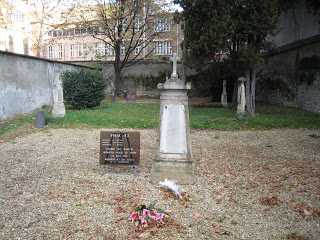
Ten years ago this November, I visited the graves of the Blessed Carmelite Martyrs of Compiegne--the mass graves behind a gate and wall in Picpus Cemetery (more than one thousand victims of the Reign of Terror were dumped into those graves between June 14 and July 18, 1794 after being beheaded at Place du Trone-Renverse, today Place de la Nation, which I also visited that day):


Just outside that wall was the grave marker for Lafayette and his wife:


And also nearby was the gate through which their decapitated bodies were brought in a wagon to be dumped without prayers or ceremony:


I also visited the Chapel of Our Lady of Peace, Notre-Dame-de-la-Paix, before entering the cemetery park grounds:


And there, I tried to take a picture of the massive memorial to all those executed that summer:


Among the names:

Mother Teresa of St. Augustine, prioress
Mother St. Louis, sub-prioress
Mother Henriette of Jesus, ex-prioress
Sister Mary of Jesus Crucified
Sister Charlotte of the Resurrection, ex-sub-prioress and sacristan
Sister Euphrasia of the Immaculate Conception
Sister Teresa of the Sacred Heart of Mary
Sister Julie Louise of Jesus, widow
Sister Teresa of St. Ignatius
Sister Mary-Henrietta of Providence
Sister Constance, novice
Sister St. Martha
Sister Mary of the Holy Spirit
Sister St. Francis Xavier
Catherine Soiron
Thérèse Soiron

The date of their feast is so historically and liturgically appropriate: yesterday was the feast of Our Lady of Mount Carmel, so they were able to celebrate the Carmelite Order's devotion to Our Lady; three days before was the anniversary of the fall of the Bastille, which is now celebrated as the Fête nationale of France. and ten days later the Reign of Terror ended.

Blessed Carmelite Martyrs of Compiegne, pray for us!

Saturday, May 2, 2020

Book Review: The Catholic Church, Modernity, and Modern History

From Basic Books:

A powerful new interpretation of Catholicism’s dramatic encounter with modernity, by one of America’s leading intellectuals

Throughout much of the nineteenth century, both secular and Catholic leaders assumed that the Church and the modern world were locked in a battle to the death. The triumph of modernity would not only finish the Church as a consequential player in world history; it would also lead to the death of religious conviction. But today, the Catholic Church is far more vital and consequential than it was 150 years ago. Ironically, in confronting modernity, the Catholic Church rediscovered its evangelical essence. In the process, Catholicism developed intellectual tools capable of rescuing the imperiled modern project.

A richly rendered, deeply learned, and powerfully argued account of two centuries of profound change in the church and the world, The Irony of Modern Catholic History reveals how Catholicism offers twenty-first century essential truths for our survival and flourishing.


This is a fascinating but ultimately frustrating overview of the history of the Catholic Church from 1789 to 2018. It's fascinating because Weigel interprets Church History from the French Revolution to the McCarrick Scandal to help his readers understand how the Catholic Church has been reacting to the loss of Christian faith in modern society since the late eighteenth century, largely through the projects and efforts of our Popes. From Popes Pius VI and VII's wranglings with the French Revolution and Napoleon, Weigel takes us through the pontificates of Gregory XVI, Pius IX, Pius X, Pius XI, and Pius XII; then to Pope John XXIII and the Second Vatican Council, Pope Paul VI and the confusion after the Council, Pope John Paul II and Pope Benedict XVI and the project to revive the implementation of the Second Vatican Council in transition to the New Evangelization and the pontificate of  Pope Francis. Its frustrating because of how it seems the Church may be stalled in our efforts to help the modern world--our world--love Jesus and love each other.

Weigel organizes this history as a drama with five Acts and four Entr'Actes. The Acts drive the narrative history forward on stage while the Entr'Actes consider important events and personalities off stage. He provides both narrative drive and cogent analysis with attention to biographical detail.

Act One describes the pontificates of Gregory XVI and Pius IX, including a discussion of the First Vatican Council and Papal Infallibility, as these popes were opposed to many of the hallmarks of modernity and its rejection of Catholic teaching authority, while the first Entr'Acte highlights the contributions of Mohler, Rosmini, Scheeben, Ketteler, and Newman to different responses to the revolutions of the nineteenth century--and the distinctive position of the Catholic Church in the United States of America.

Act Two places Pope Leo XIII at center stage with his efforts to "gingerly" reach out to the modern world, reviving Catholic philosophy and theology through his emphasis on St. Thomas Aquinas and biblical interpretation and proposing some Catholic wisdom for the industrial age and the treatment of workers with dignity (Rerum Novarum); then Pius X comes on stage with his efforts at sacramental renewal and battles with Catholic modernists; World War I and Benedict XV follow, reviving Pope Leo XIII's projects; then Pope Pius XI; and finally Pope Pius XII. Weigel shows great appreciation of three of the latter's encyclicals, Mystici Corporus Christi, Divino Afflante Spiritu, and Mediator Dei, but deprecates Humani Generis.

The second Entr'Acte includes a large cast of theological renewal characters including Guardini, various Thomists (Garrigou-Lagrange, Maritain, Gilson,), the ressourcement school (Congar, de Lubac), the Catholic personalists (von Hildebrand, Scheler, Mounier), Hans Urs von Balthasar, and John Courtney Murray.

Act Three brings us to Pope John XXIII and what he hoped to achieve with the Second Vatican Council to "embrace modernity", examining Gaudet Mater Ecclesia, and then various documents of the Council, including Lumen Gentium, Dei Verbum, and Dignitatis Humanae. Weigel offers a substantial critique of Gaudium et Spes, pointing out particularly how dated some of its optimism of how well modern democracy and the Catholic Church would be able to get along seems now. So the Entr'Acte, not surprisingly, examines the aftermath of the Council: Pope Paul VI's efforts to implement it, highlighting Evangelii Nuntiandi; Karol Wojtyla's vade mecum Sources of Renewal and his curial retreat Signs of Contradiction; and the theological rivalry between Communio and Concilium.


With Act Four Weigel brings two of his favorite dramatis personae to the stage: the protagonist Karol Wojtyla (Pope John Paul II), and in the supporting role, Joseph Ratzinger (Pope Benedict XVI). If you are familiar with Weigel's great biography of Pope John Paul II you'll find much that you've read about before with a overview of his papacy and his encyclicals. Weigel also offers an analysis of Pope Benedict XVI's four "September Lectures": Regensberg (9/12/2006); Bernardins (9/12/2008); Westminster (9/17/2010); Bundestag (9/22/2011)--all Weigel's commentary is focused on how these two "distinctively modern men" offered modernism some critiques of unresolved issues of reason, freedom, conscience, morality, economy, and society.

The Entr'Acte reviews the problem of implementing the reforms of the Second Vatican Council since it was "the Council without Keys" and the solution to this problem: the Extraordinary Synod of 1985. Weigel sets the stage for the last Act with the Great Millennium of 2000 and New Evangelization. 

So in Act Five, after explaining John Paul II's vision in Novo Millennio Ineunte, Weigel inserts a flashback to Redemptoris Missio, his 1990 encyclical on the Church's permanent missionary mandate. Weigel also examines John Paul's efforts to influence the EU Constitution, which was poised to skip all of its history from 180 to 1596 by avoiding any mention of Christianity. His 2003 General Audiences and the post-synodal apostolic exhortation Ecclesia in Europa attempted to remind Europeans of the work of the Church to proclaim the Gospel of Hope in Jesus Christ.

Then Weigel comes to the unsatisfactory denouement: "The Franciscan Stall". He has to end his review of Pope Francis' pontificate with the McCarrick revelations of 2018, but he starts with Evangelli Gaudium, the 2013 apostolic exhortation setting out the Franciscan program of evangelization and the continued spread of the Joy of the Gospel. Then Weigel describes the confusion of the 2014/2015 Synods on the Family and the 2018 Synod on Young People, which both resulted in contradictions of the teaching of the Second Vatican Council (Dei Verbum) on the deposit of faith; Jesus Christ on marriage, and St. Paul on the worthy reception of the Body and Blood of Jesus in Holy Communion with implications of historicism (Church moral and sacramental teaching can change with and adapt to the mores and trends of the world) and a new Gallicanism (what's true in Poland about Catholic teaching might not be true in Germany). Weigel asks how this helps fulfill the efforts of the New Evangelization to spread the Joy of the Gospel to everyone, those who believe, those who've fallen away, and those who've never heard of Jesus.

Then the McCarrick Crisis, with the Vatican displaying the same old modes of "institutional-maintenance and status-quo thinking" with slow responses (not to mention Pope Francis' intransigence regarding the Chilean bishop) demonstrated that Pope Francis, blaming a culture of clericalism, still didn't want to take action in certain cases or be transparent: we've been promised a report for almost two years on how a serial abuser of boys and seminarians became a Cardinal and continued to have influence even after he was supposed to retire from official duties and it hasn't been issued yet. 

So we have to wait for the continuation of Act Five or for Act Six.

In the meantime, Weigel summarizes his argument that the Church has rediscovered itself through contending with the issues of modernism and can offer the modern world some guidelines for reform of its own issues: doubt, the naked will to power, emptiness. Jesus Christ is the answer to every human question, he concludes, and the Catholic Church has, from the Apostles, through the Popes, Bishops, clerics and laity, been offering that answer throughout the ages. We may be stalled as Weigel believes, but we still have a message to share and solutions to propose: "liberating truths about salvation and the ultimate destiny of human beings" through the Person of Jesus Christ.

Except for some glimpses in the Entr'Actes, Weigel's spotlight is on the top of the Church's hierarchy: the Popes, but that makes sense since he is describing the Church's official responses to modernity. He provides a good list of sources. Fascinating but frustrating.

Wednesday, July 17, 2013

The Carmelite Martyrs of Compiegne on the Son Rise Morning Show


Today I'll be on the Son Rise Morning Show at 6:45 a.m. Central/7:45 a.m. Eastern because this is the memorial (in France) of the Carmelite martyrs of Compiegne, victims of the Committee for Public Safety and French Revolution, executed in Paris in 1794. Brian Patrick and I will discuss the sacrificial martyrdom of these Carmelites, who swore to offer their deaths for the peace of France. The Catholic martyrs of the French Revolution are probably as little known as the martyrs of the English Reformation have been, although I hope I've made a dent in that ignorance. Many priests and nuns suffered torture, execution--and exile during the Reign of Terror.

The Carmelites' story also has a great connection to the English Reformation and the Dissolution of the Monasteries. The exiled French priests and nuns who fled the Civil Constitution of the Clergy and the dangers of the Terror provoked feelings of sympathy in England. The fact that they were allowed to practice their faith while English Catholics were not contributed to the Catholic Relief movement in Parliament. Among those exiles were actually English Benedictine nuns from Cambrai--they were English nuns in exile on the Continent who then founded a new monastery at Stanbrook Abbey. The foundress of the Cambrai house was none other than Helen More, the great-great-granddaughter of St. Thomas More. Her name in religion became Dame Gertrude More. The Benedictines of Our Lady of Comfort in Cambrai wore the secular clothing of the Carmelites on their journey "home". Stanbrook Abbey was the inspiration for Rumer Godden's novel, In This House of Brede, one of my favorite books. According to her New York Time's obituary:

To do research on ''In This House of Brede,'' Ms. Godden lived for three years near Stanbrook Abbey. Her experience with the nuns there contributed to her decision to convert to Roman Catholicism in 1968. In many of her stories and novels, Ms. Godden would write about the rewards and perils of the contemplative life.

A couple of years ago, I went on a mini-pilgrimage in Paris to the site of the Blessed Carmelites' execution and then to the cemetery behind which their remains were dumped into mass graves: here are links to those posts: the site of execution and the chapel at Picpus, the cemetery grounds at Picpus, and the mass graves.

There were sixteen martyrs in all on July 17, 1794:

Choir Nuns
Mother Teresa of St. Augustine, prioress (Madeleine-Claudine Ledoine) b. 1752
Mother St. Louis, sub-prioress (Marie-Anne [or Antoinett] Brideau) b. 1752
Mother Henriette of Jesus, ex-prioress (Marie-Françoise Gabrielle de Croissy) b. 1745
Sister Mary of Jesus Crucified (Marie-Anne Piedcourt) b. 1715
Sister Charlotte of the Resurrection, ex-sub-prioress and sacristan (Anne-Marie-Madeleine Thouret) b. 1715
Sister Euphrasia of the Immaculate Conception (Marie-Claude Cyprienne) b. 1736
Sister Teresa of the Sacred Heart of Mary (Marie-Antoniette Hanisset) b. 1740
Sister Julie Louise of Jesus, widow (Rose-Chrétien de la Neuville) b. 1741
Sister Teresa of St. Ignatius (Marie-Gabrielle Trézel) b. 1743
Sister Mary-Henrietta of Providence (Anne Petras) b. 1760
Sister Constance, novice (Marie-Geneviève Meunier) b. 1765

Lay Sisters
Sister St. Martha (Marie Dufour) b. 1742
Sister Mary of the Holy Spirit (Angélique Roussel) b. 1742
Sister St. Francis Xavier (Julie Vérolot) b. 1764

Externs:
Catherine Soiron b. 1742
Thérèse Soiron b. 1748

[Image Source: wikipedia commons--from the Carmel in Quidenham, Norfolk!]

Tuesday, March 12, 2013

The Jacobite Pretender and the Venetian Conclave of 1799-1800

Yesterday, March 11 (NS) was the birthday of the last direct-line Stuart Pretender, Henry Benedict Stuart. Since the Papal Conclave of 2013 began today, however, and Henry Cardinal Stuart was among the Cardinal electors in Venice during the extraordinary Conclave of 1799-1800, I thought I would highlight his career again today.

Henry Benedict Stuart was the second son of the Old Pretender, James Francis Edward Stuart, who was recognized by his supporters as James III and VIII, King of England, Ireland and Scotland, and James III's wife Princess Maria Klementyna Sobieska. Henry was born on March 11, 1725 at the Palazzo Muti in Rome and baptized by Pope Benedict XIII the same day. Henry supported his brother Charles Edward Stuart, aka the Young Pretender, aka "Bonnie Prince Charlie" during this attempt to recover the throne of England, Ireland and Scotland from George I in 1745, but afterwards became a priest, bishop, and cardinal in the Church.

The French Revolution of 1789 hurt Cardinal Stuart financially, as did his support of Pope Pius VI, who was captured and deposed by Napoleon Bonaparte's forces in 1798 and died in Valence, France in 1799. Along with several other cardinals, Henry Stuart fled first to Naples and then to Venice, where the Conclave finally met and took quite some time to elect the next pope. According to this site, which gives many details of these events, "The Conclave had lasted three months and fourteen days, the vacancy six months and sixteen days."

The Conclave met in the Benedictine monastery of San Giorgio, located on the island of San Giorgio Maggiore--the monastery would be suppressed in 1806, and is now the headquarters of the Cini Foundation, which has restored it. Barnaba Niccolò Maria Luigi Chiaramonti, who had been a Benedictine monk (named Gregory) was finally elected on March 14, 1800 and crowned, wearing a papier mache tiara decorated with jewel stones donated by the other cardinals, in the monastery church. He took the name Pius, becoming the VIIth pope with that name.

In the meantime, Cardinal Stuart's financial difficulties were addressed with a 4,000 pound annuity from King George III and he eventually returned to his diocese in Frascati. He later became Dean of the College of Cardinals in 1803 and died in Frascati in 1807.

Friday, October 5, 2012

Revolutionary England, Almost

 
Frank McLynn writes about seven times when England could have experienced a complete revolution--somehow passing over the Civil War and the Glorious Revolution of 1688. He includes the Pilgrimage of Grace and the Jacobite uprising (the '45) among the seven. As Nigel Jones comments in this review, the premise is a little weak, and the selection might be questionable:
 
It is axiomatic in British history that this country – unlike many European neighbours – does not ‘do’ revolutions. This assumption is at least arguable. If the Civil War of the 1640s, resulting in the quasi-legal killing of a king, and his replacement by a military dictatorship with millennial overtones, was not a revolution, then the term has no meaning. Ditto the 1688 ‘Glorious Revolution’. Yet according to Frank McLynn, neither of these upheavals constituted a true revolution, which, he argues, Britain has never experienced.

His book focuses on seven moments when he claims Britain came closest to “the possibility for overthrow of a regime and a drastic change of direction politically, economically, socially”: the Peasants’ Revolt, Jack Cade’s 1450 rebellion, the Pilgrimage of Grace in 1536, the Civil War, the 1745/6 Jacobite uprising; the Chartists of the 1840s, and the 1926 General Strike. . . .

The examples McLynn lumps into his revolutionary sack are questionable: if the Pilgrimage, why not the Prayer Book or Kett’s rebellion? And if Chartism, why not the era of Peterloo and the Cato Street conspiracy? This is also very old-fashioned history, with heroes and villains praised – or more frequently damned – featuring Henry VIII, Cromwell and (bizarrely) Stanley Baldwin in a rogues’ gallery of tyranny.

As to why Britain avoided revolution, McLynn discounts such theories as its insular isolation, its small professional army, the popularity of its modern monarchy, or the myth that its people were less violent than their continental counterparts (before the 18th century the reverse was the case). He identifies a few factors as crucial: Britain’s early industrialisation; its acquisition of an empire to export its surplus workforce; and finally the preference for gradualist reformism to revolutionary activism, exemplified by the popularity of Methodism over Marxism.

Whenever I think of book about revolutions, I think of Susan Dunn's Sister Revolutions: French Lightning, American Light, published in 2000:

The American and French revolutions presented the world with two very different visions of democracy. Although both professed similar Enlightenment ideals of freedom, equality, and justice and set similar political agendas, there were also fundamental differences. The French sought a complete break with a thousand years of history; the Americans were content to preserve many aspects of their English heritage. Why did the two revolutions follow such different trajectories? And what lessons do they offer us about democracy today? In lucid narrative style, Dunn captures the personalities and lives of the great figures of both revolutions, and shows how their stories added up to make two very different events.

I completely agree with the assessment of this reviewer: "Everybody should read this book. It offers a lively education in a small package. Then, if there's time, reread Federalist 10 and 51, as well as Simon Schama's book Citizens. What the French took from the Americans, Lord Acton once wrote, "was their theory of revolution not their theory of government — their cutting but not their sewing.""


Saturday, March 3, 2012

English Nuns in Exile

Preparing for a trip to our one and only local Barnes & Noble to buy my sister a couple of Downton Abbey-themed gifts for her birthday last week, I checked out the website for the BBC History Magazine, to see if I wanted to look at it while shopping there. Then I saw that next month's issue (March) has this preview:

James Kelly shows how a large number of Catholic women fled Protestant England to join European convents in the 17th and 18th centuries.

Looking up James Kelly led me to this website: Who Were the Nuns:

Since September 2008, the Arts and Humanities Research Council funded project team at Queen Mary has been making a comprehensive study of the membership of the English convents in exile. That is, the period between the opening of the first English convent in Brussels to the nuns' return to England as a result of the French Revolution and associated violence. Most were enclosed convents, in theory cut off from the outside world. However in practice the nuns were not isolated and their contacts and networks spread widely.

As well as studying the members and their families the project is collecting data on sponsors and patrons on both sides of the Channel.

This website will provide a range of materials for the history of the convents, including edited texts as they are finished and ultimately a fully searchable database of members.

We plan to develop the section inviting contributions from researchers with data they are willing to share with us.


And that site led to this article previously published by James Kelly:

Whereas people have a passing knowledge of the activities of Catholic male religious following the Reformation — such as the Jesuit Edmund Campion, dubbed the flower of England by Elizabeth I before his conversion to Catholicism and subsequent execution — little attention has been paid to the activities of Catholic women religious at this time. Men could head to the likes of the English College in Rome, the oldest English institution abroad, but what about women who wished to lead a religious life denied to them in England? What if families desired that, as well as their sons, their daughters too should be educated within the Catholic faith?

In 1598, the first English convent was established in Brussels and was to be followed by a further 21 establishments across Flanders and France with more than 4,000 women entering them over 200 years. Most were enclosed convents, in theory cut off from the outside world. However, in practice the nuns were not isolated and their contacts and networks spread widely. Here, these substantial communities of women found outlets for female expression often unavailable to their secular counterparts, until the French Revolution and its associated violence forced the convents back to England.


The published results of this study will be very expensive: $495.00 per three volume set!