Showing posts with label Henry Benedict Stuart. Show all posts

Tuesday, August 14, 2018

The Future Pope Pius VII

Barnaba Niccolò Maria Luigi Chiaramonti, the future Pope Pius VII, was born on August 14, 1742. He joined the Benedictine order when he was 14 years old and made his final vows on August 20, 1758taking the name Gregory or Gregorio. He was ordained a priest on September 21, 1765. The Catholic Encyclopedia describes the circumstances of his papal election:

According to an ordinance issued by Pius VI, 13 Nov., 1798, the city where the largest number of cardinals was to be found at the time of his death was to be the scene of the subsequent election. In conformity with these instructions the cardinals met in conclave, after his death (29 Aug., 1799), in the Benedictine monastery of San Giorgio at Venice. The place was agreeable to the emperor, who bore the expense of the election. Thirty-four cardinals were in attendance on the opening day, 30 Nov., 1799; to these was added a few days later Cardinal Herzan, who acted simultaneously as imperial commissioner. It was not long before the election of Cardinal Bellisomi seemed assured. He was, however, unacceptable to the Austrian party, who favoured Cardinal Mattei. As neither candidate could secure a sufficient number of votes, a third name, that of Cardinal Gerdil, was proposed, but his election was vetoed by Austria. At last, after the conclave had lasted three months, some of the neutral cardinals, including Maury, suggested Chiaramonti as a suitable candidate and, with the tactful support of the secretary of the conclave, Ercole Consalvi, he was elected. The new pope was crowned as Pius VII on 21 March, 1800, at Venice. He then left this city in an Austrian vessel for Rome, where he made his solemn entry on 3 July, amid the universal joy of the populace. Of all-important consequence for his reign was the elevation on 11 Aug., 1800, of Ercole Consalvi, one of the greatest statesmen of the nineteenth century, to the college of cardinals and to the office of secretary of state. Consalvi retained to the end the confidence of the pope, although the conflict with Napoleon forced him out of office for several years.

One of the Cardinals at this election was Henry Benedict Cardinal Stuart, Bonnie Prince Charlie's brother.

Like his predecessor, Pope Pius VI, Pius VII endured exile from Rome during Napoleon I's reign. Consalvi successfully negotiated the Concordat of 1801 with Napoleon, re-establishing some of the Catholic Church's rights in France. Pope Pius VII was present at Napoleon and Josephine's coronations in the Cathedral of Notre Dame in Paris in 1804. When France occupied and annexed Rome, Pius was sent to Savona on the coast of Italy.

From Pope Benedict XVI's homily during a visit to Savona, Italy in 2008:

It is a pilgrimage that is also a memory and a tribute to my Venerable Predecessor Pius VII, whose dramatic experience is indissolubly linked to this City and its Marian Shrine. Two centuries later, I come to renew the expression of gratitude of the Holy See and of the entire Church for the faith, love and courage with which your fellow citizens supported the Pope under house arrest in this City, imposed upon him by Napoleon Bonaparte. Many testimonies of the manifestations of solidarity for the Pontiff, sometimes even at personal risk, have been preserved. They are events that the people of Savona can well be proud to commemorate today. As your Bishop rightly observed, through the power of the Holy Spirit, that dark page of Europe's history has become rich in graces and teachings for our day too. It teaches us courage in facing the challenges of the world: materialism, relativism, secularism without ever yielding to compromises, ready to pay in person while remaining faithful to the Lord and his Church. The example of serene firmness set by Pope Pius VII invites us to keep our trust in God unaltered in trials, aware that although he permits the Church to experience difficult moments he never abandons us. The episode the Great Pontiff went through in your land invites us always to trust in the intercession and motherly assistance of Mary Most Holy.

From 1809 to 1814, Pope Pius VII was held prisoner at Fontainebleau. When Napoleon fell, he returned to Rome. Pius began the process of restoring the Jesuits; he established several new dioceses in the United States; and he worked to restore Rome after the French occupation. He died on August 20, 1823 after a fall, breaking his hip. He died on the 65th anniversary of his profession as a Benedictine monk.

Pope Benedict XVI named him a Servant of God in 2007.

Sunday, February 23, 2014

Will Ye No Come Again? A Portrait of Bonnie Prince Charlie


A genuine and acceptably bonny portrait of Bonnie Prince Charlie has been rediscovered, by the remorseful art historian who broke hearts in the Scottish souvenir industry by debunking the best-known portrait of the national hero, immortalised on countless tins of shortbread.
 
The long-lost portrait of the pink-cheeked prince was painted in Edinburgh in 1745 by one of Scotland's most renowned artists, Allan Ramsay, in the year the Young Pretender, grandson of the deposed Stuart king James II, launched a doomed invasion of England in an attempt to restore his family to the throne. It is the only known portrait of the prince made in Britain: the butchery of the battle of Culloden ended the Jacobite rebellion, Charles spent the rest of his life in exile, died in 1788 and was buried in Rome.
 
"Such a great image," Bendor Grosvenor said fondly of his discovery, which he tracked down from an old photograph to Gosford House, the family home of the Earls of Wemyss, just outside Edinburgh. "It gets the confidence of a man who wanted to invade England at the age of 24."

You may see the portrait at The Guardian site.

When Bendor Grosvener opined that a famous portrait of Bonnie Prince Charlie (seen at right) was really of his brother Henry Benedict, later Cardinal, Stuart, he really upset the apple cart, as this BBC article demonstrates:

Now a leading expert believes the pastel might be Prince Henry Benedict instead of Charles Edward Stuart.
 
The gallery said it was not uncommon for re-attributions to be made.
 
It follows a two-year row over the identity of the man in the painting since London art dealer Bendor Grosvenor claimed it was not Bonnie Prince Charlie.
 
At first the gallery dismissed the claim citing expert on Jacobite portraiture, Dr Edward Corp of the University of Toulouse, France, in its defence.
 
However, Dr Corp has now changed his opinion in an article in the latest issue of The British Art Journal.
 
He said: "'The weight of evidence, perhaps regrettably, supports Bendor Grosvenor's argument that the pastel in the Scottish National Portrait Gallery shows Prince Henry rather than Prince Charles."

I think when you compare that portrait above to this of the Duke of York as Cardinal York, the resemblance is clear. Part of the reason experts thought it could not be Henry was that he was a Cardinal by 1747--but he had been in command of the naval expedition of the '45, and evidently both he and his elder brother had sat for portraits by Maurice Quentin de La Tour.

As Dr. Corp noted, this re-attribution was a really big deal:

"It is not merely the catalogue of the Scottish National Portrait Gallery which needs to be corrected.
 
"The impression which an entire nation has derived of this important historical figure should also be changed.
 
"The portrait is now reproduced in all biographies of the prince, and has been selected to illustrate the article about him in the Oxford Dictionary of National Biography."
 
Still the real search is for a portrait of Bonnie Prince Charlie by Maurice Quentin de La Tour painted around the same time as this painting of Henry Benedict, the Duke of York.

More on the Scottish National Portrait Gallery here.

Wednesday, September 11, 2013

King John III Sobieski and the Battle of Vienna

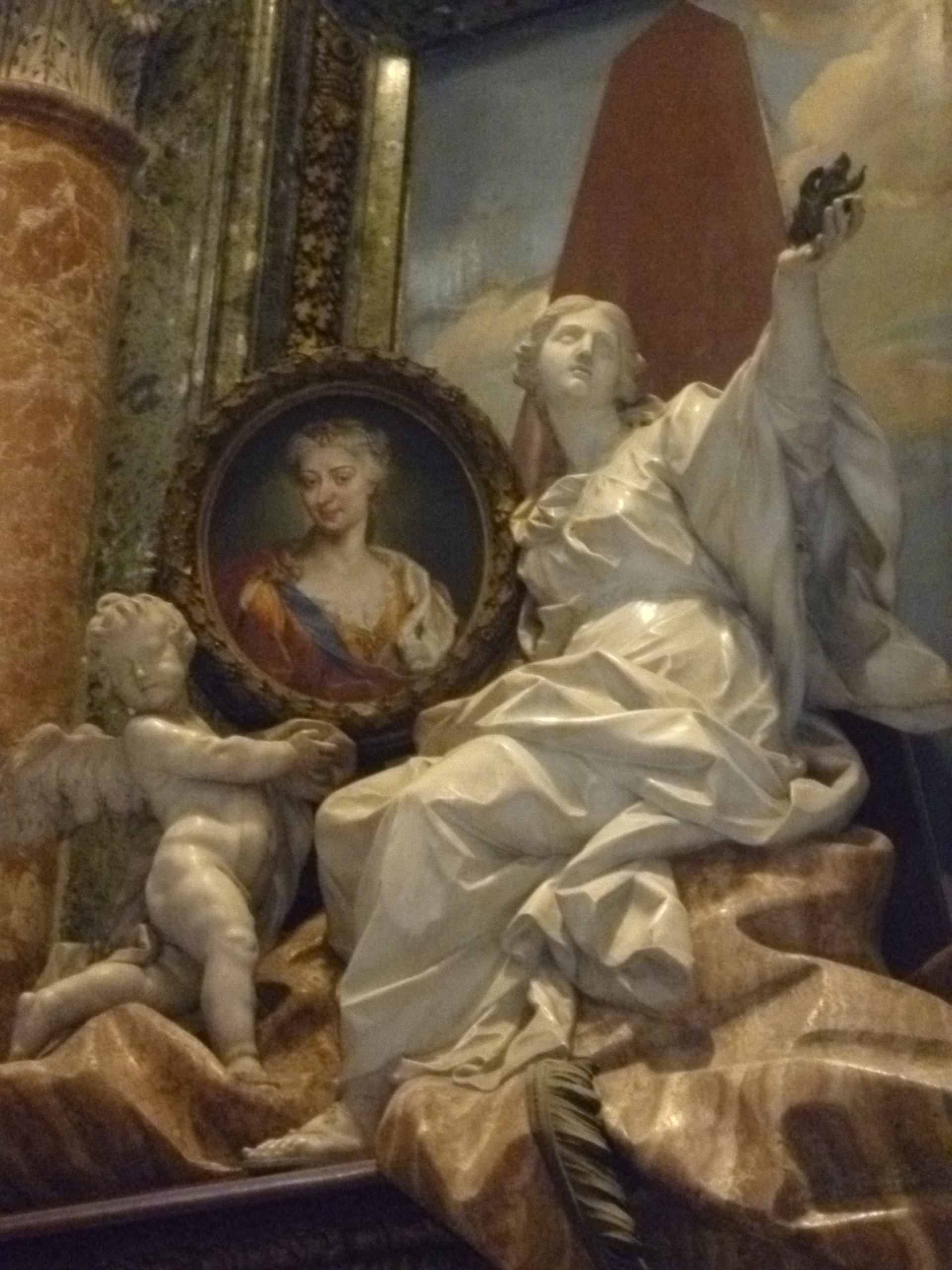
File:Maria Clementina Sobieski Memorial.JPGIn addition to being the 12th anniversary of the 9/11 attacks in the United States, this is the 330th anniversary of the Battle of Vienna, at which King Jan Sobieski of Poland led the combined imperial and Polish forces to defeat the Ottoman Empire Believe it or not, there's a connection between September 11, 1683 and the long English Reformation: Maria Clementina Sobieska, the granddaughter of King Jan Sobieski married James Francis Edward Stuart:

Being one of Europe's wealthiest heiresses, she was betrothed to James Francis Edward Stuart. King George I of Great Britain was opposed to the marriage because he feared that the union might produce heirs to James Francis Edward's claim to his thrones. To placate him, the Holy Roman Emperor Charles VI arrested Maria Clementina while on her way to Italy to marry James Francis Edward. She was confined in Innsbruck Castle but eventually the guards were deceived and Maria Clementina escaped to Bologna, Italy, where, for safety from further intrusions, she was married by proxy to James who was in Spain at that time.

Maria Clementina's father, James Louis Sobieski, approved her escape declaring that, as she became engaged to James Francis Edward she ought to "follow his fortune and his cause".

Maria Clementina and James Francis Edward were formally married on 3 September 1719 in the Chapel of episcopal palace of Montefiascone, Italy in the Cathedral of Santa Margherita. Following their marriage, James and Maria Clementina were invited to reside in Rome at the special request of Pope Clement XI, who acknowledged them as the King and Queen of England, Scotland and Ireland.

The Pope provided them with a papal guard of troops, gave them the Palazzo Muti in the Piazza dei Santi Apostoli in Rome to live in, plus a country villa at Albano. The Catholic Church also provided them with an annual allowance of 12,000 crowns out of the papal treasury. The Popes Clement XI and Innocent XIII considered James and Maria Clementina the rightful and, more importantly, Catholic King and Queen of England, Scotland and Ireland: the cousin of Pope Innocent XIII, Francesco Maria Conti, from Siena, was here the Gentiluomo di Camera (the chamberlaine) in the little Roman Jacobite court.

The married life of James and Maria Clementina proved turbulent and unhappy. Soon after their second child's birth (Henry Benedict), Maria Clementina left him and went to live in Rome in the convent of St. Cecilia. She accused her husband of adultery and he said it was sinful to leave him and her children. (Their first son was Charles Edward, aka Bonnie Prince Charlie.) It was more than two years before they reconciled.

Maria Clementina died at the early age of 32 on 18 January 1735. She was interred with full royal honors in St. Peter's Basilica in Rome. Pope Clement XII ordered that she have a state burial. Pope Benedict XIV commissioned Pietro Bracci (1700–1773) to sculpt a monument to her memory, which was erected in the Basilica.

More on the Battle of Vienna, September 11 to 12, 1683, here.

Tuesday, March 12, 2013

The Jacobite Pretender and the Venetian Conclave of 1799-1800

Yesterday, March 11 (NS) was the birthday of the last direct-line Stuart Pretender, Henry Benedict Stuart. Since the Papal Conclave of 2013 began today, however, and Henry Cardinal Stuart was among the Cardinal electors in Venice during the extraordinary Conclave of 1799-1800, I thought I would highlight his career again today.

Henry Benedict Stuart was the second son of the Old Pretender, James Francis Edward Stuart, who was recognized by his supporters as James III and VIII, King of England, Ireland and Scotland, and James III's wife Princess Maria Klementyna Sobieska. Henry was born on March 11, 1725 at the Palazzo Muti in Rome and baptized by Pope Benedict XIII the same day. Henry supported his brother Charles Edward Stuart, aka the Young Pretender, aka "Bonnie Prince Charlie" during this attempt to recover the throne of England, Ireland and Scotland from George I in 1745, but afterwards became a priest, bishop, and cardinal in the Church.

The French Revolution of 1789 hurt Cardinal Stuart financially, as did his support of Pope Pius VI, who was captured and deposed by Napoleon Bonaparte's forces in 1798 and died in Valence, France in 1799. Along with several other cardinals, Henry Stuart fled first to Naples and then to Venice, where the Conclave finally met and took quite some time to elect the next pope. According to this site, which gives many details of these events, "The Conclave had lasted three months and fourteen days, the vacancy six months and sixteen days."

The Conclave met in the Benedictine monastery of San Giorgio, located on the island of San Giorgio Maggiore--the monastery would be suppressed in 1806, and is now the headquarters of the Cini Foundation, which has restored it. Barnaba Niccolò Maria Luigi Chiaramonti, who had been a Benedictine monk (named Gregory) was finally elected on March 14, 1800 and crowned, wearing a papier mache tiara decorated with jewel stones donated by the other cardinals, in the monastery church. He took the name Pius, becoming the VIIth pope with that name.

In the meantime, Cardinal Stuart's financial difficulties were addressed with a 4,000 pound annuity from King George III and he eventually returned to his diocese in Frascati. He later became Dean of the College of Cardinals in 1803 and died in Frascati in 1807.

Wednesday, July 13, 2011

The Last Stuart Pretender Dies

Henry Benedict Stuart, second son of the Old Pretender, James III (James Francis Edward Stuart) and Maria Klementyna Sobieska, died on July 13, 1807. He was born on March 11, 1725 (NS) in Rome, where the Pretender lived after the failure of the Jacobite plots of 1715. The French Court of King Louis XV had not welcomed him as King Louis XIV had.

His mother left his father soon after Henry's birth, accusing him of infidelity and residing in a convent. They reconciled two years later, but Maria Klementyna died in 1735, ten years before her sons made the great attempt to retake the throne in 1745.

When that attempt failed, Henry returned to Rome and began his ecclesiastical career during the reign of Pope Benedict XIV, progressing through the minor orders while a Cardinal-Deacon in 1747 and the sub-deaconate in 1748 and then being ordained deacon and priest in 1748. He became the Cardinal-Bishop of Frascati, a diocese near Rome in 1761. He was quite wealthy with many properties and benefices, but he lost it all during the French Revolution and in support of Pope Pius VI, who was imprisoned by Napoleon and died in August of 1799. The College of Cardinals, with Cardinal Henry Stuart met in exile in Venice to elect Pope Pius VII in the contentious papal election of 1800.

In the meantime, when his brother Bonnie Prince Charlie died in 1788, the Cardinal had become the de facto Pretender, but he did not seek the throne and was not recognized by the Papacy, being called the Cardinal Duke of York. His priesthood and cardinalate really made it impossible for him to seriously be considered a candidate, anyway. While his brother had been roaming throughout Europe, even visiting England and renouncing his Catholicism (briefly) for any advantages in his attempt to regain the throne, Henry Cardinal York's path probably disappointed the Young Pretender, especially as he had no legitimate heirs.

In 1803, the Cardinal Duke of York returned to Frascati and became Dean of the College of Cardinals. He died on July 13, 1807 when he was 82 years old. The line of the Pretenders was taken up by Charles Emmanuel IV of Sardinia who was the grandson of Charles II's favorite sister, Henrietta Anne, wife of Louis XIV's brother Philippe of France, Monsieur. Charles Emmanuel IV never actively sought the throne of England. The Cardinal, his mother, his father, and his brother are all buried in the crypt of St. Peter's Basilica in Rome. (There is a separate memorial for Maria Klementyna Sobieska.) The inscription reads:

IACOBO·III
IACOBI·II·MAGNAE·BRIT·REGIS·FILIO
KAROLO·EDVARDO
ET·HENRICO·DECANO·PATRUM·CARDINALIVM
IACOBI·III·FILIIS
REGIAE·STIRPIS·STVARDIAE·POSTREMIS
ANNO·M·DCCC·XIX

(To James III, son of King James II of Great Britain, to Charles Edward and to Henry, Dean of the Cardinal Fathers, sons of James III, the last of the Royal House of Stuart. 1819). More about the monument here.