Showing posts with label torture. Show all posts

Wednesday, March 22, 2017

The Silence of St. Nicholas Owen


St. Nicholas Owen, SJ, the Jesuit lay brother and carpenter extraordinaire, died under torture on March 22, 1606. The Jesuits in Britain website notes this about him:

Many of the martyrs of England died very public deaths on the scaffold of Tyburn, but Nicholas died as he had lived; in secret. We have no memorable saying of his to meditate on – his priest holes, which are his wordless prayers, are all that remain. Nicholas in his agonised, furtive death had finished with all concealment and disguises and was welcomed by Campion and all the martyrs into a fellowship where there is no use for human language.

We do, however, have the record of what he said under torture in 1606:

He confesses that he has known and sometimes attended Henry Garnett, the Provincial of the Jesuits for around four years.

He confesses that he was at the house of Thomas Throgmorton called Coughton at the beginning of November last year, when the Lady Digby was there and by the watch that was in town they knew that Robert Catesby, Thomas Percy, and the rest of the gun powder plotters were up in arms.

That on All Saints Day last year, Garnett said Mass at Coughton House, and that at that Mass there were around half a dozen people.

That Henry Garnett was at Henlipp, the house of Thomas Abington some six weeks before he was apprehended and Hall the Jesuit was there about three days before the house of Mr Abington was searched.

That while he was staying with Garnett, he made his fire and served him and that both he and Garnett hid in a secret room below the dining room.


As the Jesuit website notes:

There was no new information in these confessions and the authorities lost patience. The tortures became more violent and on the next day, despite a plate they had fitted around Nicholas to prevent the torture further damaging his pre-existing injuries, Nicholas died, quite literally broken apart by the torture.

The authorities were now in an awkward position. Not only had they been torturing illegally an already injured man, but they had murdered him before extracting a confession. A cover up was swiftly arranged with an inquest returning a verdict of suicide.


The cover up was as bad as the crime.

There is no portrait of St. Nicolas Owen, but on this other page at the Jesuits in Britain website there is a depiction of him, the other Jesuit brother captured, tortured, and martyred, Blessed Ralph Ashley, and Father Henry Garnet, who was also captured tortured and martyred along with Blessed Edward Oldcorne, but has never been beatified or canonized because of concern about his involvement with the Gunpowder Plot. All four of them were arrested at Hindlip Hall on January 23, 1606. They were all hiding in the priest holes St. Nicholas Owen had created, but were without food and water and had to surrender--the pursuivants had not found the hiding places Owen had built!

St. Nicholas Owen, pray for us!

Image credit: the original Hindlip Hall.

Saturday, November 26, 2016

"Silence" and Apostasy

The trailer for Martin Scorsese's film adaptation of Shusaku Endo's Silence is available here. Silence tells the story of Jesuit missionaries in Japan facing, with the Catholics whom St. Francis Xavier and other Jesuits have brought to conversion, torture and martyrdom when Japanese authorities ban Christianity--and expel the Jesuits with an edict in 1587. Remember that Elizabeth I's government passed the "Act against Jesuits, Seminary priests and other such like disobedient persons" (27 Eliz. c. 2) in 1585!

On February 5, 1597, Jesuit Paul Miki and 25 others were crucified in Nagasaki. They are remembered on the Church's calendar on February 6 (since St. Agatha's feast day was already on February 5). The story told in Endo's Silence occurs in the next century, starting about 1639, when Fathers Rodrigues and Garrpe go to Japan to find out what has happened to Father Ferreira, who may have apostatized.

The Jesuits, the other missionary priests, and the Catholic laity in England faced the "Bloody Question", the Oath of Supremacy, Topcliffe's tortures, and many other dangers. The Catholics in Japan faced the temptation of stomping on the image of Jesus or the Blessed Virgin Mary (a fumie) as an act of denying Jesus. Father Rodrigues undergoes the trial of the fumie while the laity are being tortured--he can save them if he denies Jesus. 

I'm sure that Scorsese's film will fully depict the brutality of the tortures suffered by the Catholics, as the trailer hints. I read Endo's novel years ago and I definitely found it troubling and reading Scorsese's foreword to the latest Picador edition, I think I would find his interpretation of the movie just as troubling. To say that we need "the figure of Judas" just as much as "the figure of Christ" so that Christianity may live and "adapt itself to other cultures and historical moments" is ridiculous. Jesus is not a "figure"; He is Our Savior and Redeemer. The Church lives because He lives. Scorsese seems to treat Faith like concept not a Theological virtue and Christianity like a system not the Body of Christ.

The Scottish composer James Macmillan wrote his Symphony No. 3 as a meditation on Endo's Silence.

Tuesday, January 5, 2016

Relics of English Martyrs: Torture and Hope

Thanks to Ian Stubbs on The Catholic English Martyrs Facebook page, I found this story about the Stonyhurst Christian Heritage Centre (I received their Christmas card last week) being featured in a BBC documentary about relics:
The Collections of Stonyhurst College featured prominently in a documentary broadcast on BBC Four at the weekend. In the programme, Treasures of Heaven, [Note that if you are not in the U.K. you can't watch the video] Andrew Graham-Dixon explored the ancient Christian practice of preserving Christian relics and the largely forgotten art form that went with it - the reliquary. His research took him from the Crown of Thorns venerated at Notre Dame Cathedral in Paris to the martyrdom of St Thomas Becket – and even to more recent events in El Salvador with the cause of Blessed Oscar Romero. But it was in Stonyhurst that he was confronted with some of the most gruesome relics.
“The Reformation ushered in a bleak and bitter period for those adhering to the old Catholic traditions of worship,” he said, approaching the college. “If you want to understand that (largely concealed) history, there’s no better place to come than this.”
The most revealing treasure in the Stonyhurst Collection, according to Graham-Dixon, is also the most unassuming: found in the 19th century, behind a wall in a nearby Catholic home, it had lain undiscovered for more than 200 years. But it is the only one of its kind in the world. The chest, disguised as a travelling salesman’s trunk, contained everything needed for a Jesuit to say Mass. Beneath a ladies bonnet was concealed the altar stone, a chalice, corporal and an early 17th century chasuble. Jan Graffius, Curator at Stonyhurst, went on to explain how ministry had to be carried out clandestinely at this time, since anyone caught celebrating Mass would be tried for treason, for which the sentence would be death.
There are indeed more gruesome relics of torture and suffering associated with the missionary priests who returned to England to serve Catholics:
Moving on to the rope that tied St Edmund Campion SJ onto the hurdle prior to his execution at Tyburn, Jan described in the programme the process of being hung, drawn and quartered - in gory detail, before revealing another of the relics held at Stonyhurst: the right eye of Blessed Edward Oldcorne SJ. Graham-Dixon describes it as “one of the most disconcerting body parts to have been passed down to the museum”. Kept in a small silver reliquary, the eye . . . was collected by a local Catholic after Oldcorne’s execution in Worcester in 1606. “I have never seen anyone look at this,” said Jan, “without being moved, shocked: there is always a human reaction” to this relic of torture.
But according to Jan Graffius, the relics are more than just grisly mementos of past events. “I think that the real comfort that Catholics derived from holding, looking at, being near these objects, is a sense of affinity with the sacrifice of the priests who were trying to bring their faith to them, and hope for the future: keep these safe until such a time when this cruelty and persecution is no longer in England. So it’s a pledge for the future, as much as a contact with the past.”
I think I have found the programme on youtube here. How great to see Canterbury, and Paris, and Stonyhurst! There are some great images of Pugin's architecture at St. Edmund's College Chapel near Ware. (The documentary must have broadcast originally several years ago.)

Sunday, July 26, 2015

Another Martyr in July: Blessed John Ingram

The Catholic Diocese of Hexham and Newcastle posts this prayer for the canonization of Blessed John Ingram on their site:

O God, you gave us Blessed John Ingram to inspire and encourage us. Grant that we may know the benefit of his prayers so that we, your Church, can give witness to his sanctity. We make our Prayer through our Lord Jesus. Christ your Son, who lives and reigns with You and the Holy Spirit, one God for ever and ever. Amen.

The site also tells the story of his trial and execution:

From Berwick he was sent to Newcastle, then to York and eventually to the Tower of London for examination by Richard Topcliffe. He suffered grievous torture while in the Tower, yet steadfastly refused to betray his friends and associates.

From London he was sent to Durham to stand trial with two other Martyrs, St. John Boste and Blessed George Swallowell.

All three were convicted and condemned to be hanged, drawn and quartered. St. John Boste was executed that same day (July 24th) in Durham, Blessed George Swallowell in Darlington on Monday 29th July.

Blessed John Ingram was executed at Gateshead on Friday 26th July 1594, at a gallows near where is now the church of the Holy Trinity. He was only 29 years of age.

His last words to the people assembled to see him suffer were "I take God and His Holy Angels to the record that I die only for the Holy Catholic Faith and Religion, and do rejoice and thank God with all my heart that He made me worthy to testify my faith therein by the spending of my blood in this manner."

These last days of July offer us a great testimony of how these martyrs consoled and supported each other. St. John Boste had strengthened Blessed George Swallowell (about whom more soon), and their trial and executions demonstrated the endurance of recusancy in northern England.

Blessed John Ingram - Pray for us.

Friday, July 3, 2015

The Fortnight for Freedom: Recusants Yesterday and Today

In the midst of The Fortnight for [Religious] Freedom (which ends tomorrow) came the Supreme Court's decision on so-called "same sex marriage" which has raised more concerns for religious freedom than even the ACA and its contraception mandate. The dissenting judges and the deciding judges both addressed the issue. Justice Kennedy said:
Finally, it must be emphasized that religions, and those who adhere to religious doctrines,may continue to advocate with utmost, sincere conviction that, by divine precepts, same-sex marriage should not be condoned. The First Amendment ensures that religious organizations and persons are given proper protection as they seek to teach the principles that are so fulfilling and so central to their lives and faiths, and to their own deep aspirations to continue the family structure they have long revered. The same is true of those who oppose same-sex marriage for other reasons.
So don't worry--religious people can still advocate and teach and privately live their religious beliefs about marriage--even though they are bigoted and mistaken. Chief Justice John Roberts notes the problems with Kennedy's emphasis:
Federal courts are blunt instruments when it comes to creating rights. They have constitutional power only to resolve concrete cases or controversies; they do not have the flexibility of legislatures to address concerns of parties not before the court or to anticipate problems that may arise from the exercise of a new right. Today’s decision, for example, creates serious questions about religious liberty. Many good and decent people oppose same-sex marriage as a tenet of faith, and their freedom to exercise religion is—unlike the right imagined by the majority—actually spelled out in the Constitution. Amdt. 1.
Respect for sincere religious conviction has led voters and legislators in every State that has adopted same-sex marriage democratically to include accommodations for religious practice. The majority’s decision imposing samesex marriage cannot, of course, create any such accommodations. The majority graciously suggests that religious believers may continue to “advocate” and “teach” their views of marriage. Ante, at 27. The First Amendment guarantees, however, the freedom to “exercise” religion. Ominously, that is not a word the majority uses.
Hard questions arise when people of faith exercise religion in ways that may be seen to conflict with the new right to same-sex marriage—when, for example, a religious college provides married student housing only to opposite-sex married couples, or a religious adoption agency declines to place children with same-sex married couples. Indeed, the Solicitor General candidly acknowledged that the tax exemptions of some religious institutions would be in question if they opposed same-sex marriage. See Tr. of Oral Arg. on Question 1, at 36–38. There is little doubt that these and similar questions will soon be before this Court. Unfortunately, people of faith can take no comfort in the treatment they receive from the majority today.
Perhaps the most discouraging aspect of today’s decision is the extent to which the majority feels compelled to sully those on the other side of the debate. The majority offers a cursory assurance that it does not intend to disparage people who, as a matter of conscience, cannot accept samesex marriage. Ante, at 19. That disclaimer is hard to square with the very next sentence, in which the majority explains that “the necessary consequence” of laws codifying the traditional definition of marriage is to “demea[n] or stigmatiz[e]” same-sex couples. Ante, at 19. The majority reiterates such characterizations over and over. By the majority’s account, Americans who did nothing more than follow the understanding of marriage that has existed for our entire history—in particular, the tens of millions of people who voted to reaffirm their States’ enduring definition of marriage—have acted to “lock . . . out,” “disparage,” “disrespect and subordinate,” and inflict “[d]ignitary wounds” upon their gay and lesbian neighbors. Ante, at 17, 19, 22, 25. These apparent assaults on the character of fairminded people will have an effect, in society and in court. See post, at 6–7 (ALITO, J., dissenting). Moreover, they are entirely gratuitous. It is one thing for the majority to conclude that the Constitution protects a right to same-sex marriage; it is something else to portray everyone who does not share the majority’s “better informed understanding” as bigoted. Ante, at 19.
This post also includes the comments made by Thomas, Alito, and Scalia, noting that Kennedy et al have effectively narrowed the meaning of religious liberty to "advocating" and "teaching" a faith's doctrine on marriage. After two thousand years in the Catholic Church, for example, of consistent teaching that marriage is between one man and one woman, and is as indissoluble as Jesus's love for His Church, that doctrine is now bigoted and "mean", and anyone who upholds it is a mean bigot. To quote Alito:
Today’s decision usurps the constitutional right of the people to decide whether to keep or alter the traditional understanding of marriage. The decision will also have other important consequences.
It will be used to vilify Americans who are unwilling to assent to the new orthodoxy. In the course of its opinion, the majority compares traditional marriage laws to laws that denied equal treatment for African-Americans and women. E.g., ante, at 11–13. The implications of this analogy will be exploited by those who are determined to stamp out every vestige of dissent.
Perhaps recognizing how its reasoning may be used, the majority attempts, toward the end of its opinion, to reassure those who oppose same-sex marriage that their rights of conscience will be protected. Ante, at 26–27. We will soon see whether this proves to be true. I assume that those who cling to old beliefs will be able to whisper their thoughts in the recesses of their homes, but if they repeat those views in public, they will risk being labeled as bigots and treated as such by governments, employers, and schools.
And it is already happening: there is already a call for ending tax exemptions for churches that do not accept the Supreme Court's new definition of marriage. Dissent will not be tolerated. A newspaper won't allow any letters arguing against so-called "same sex marriage" and then had the temerity to exult at the ruling and say: "And we are all more free as a result." Except for those people not free to express their opinions in the The Patriot-News, of course, if they defend traditional marriage, because those viewpoints are now considered the same as "racist, sexist or anti-Semitic" comments--if you're not for so-called "same sex marriage", you are against it; if you are for traditional marriage (one man and one woman) you are against so-called "same sex marriage". Either way, you are a mean bigot. The editor was shocked that readers thought he was squelching discussion, even though he was. Somehow he could not express himself clearly: if what he wanted to limit was insulting speech or personal attacks, he did not say that and their policy still does not say that.

The Federal Government of the United States of America, through the Supreme Court and with the support of the President of the United States (who hopes others will evolve as he has), has issued new acts of Uniformity and Supremacy. 

As Father Robert Barron reminds us, we've been here before:
In the earliest centuries of the Church’s life, thousands—including Peter, Paul, Agnes, Cecelia, Clement, Felicity, Perpetua, Sebastian, Lawrence, and Cyprian—were brutally put to death by officials of the Roman Empire. In the fourth century, St. Ambrose was opposed by the emperor Theodosius; in the eleventh century, Pope Gregory VII locked horns with the Holy Roman Emperor Henry IV; in the nineteenth century, Bismarck waged a Kulturkampf against the Catholic Church in Germany, and in the twentieth century, more martyrs gave their lives for the faith than in all the previous centuries combined.
And George Weigel reminds us of the Catholic recusants of England--who would not swear to the religious doctrine proclaimed and enforced by Elizabeth I and her Parliaments:
In sum, we are already in new penal times, with the penalties in question being cultural reprobation (through public shaming and bullying) as well as legal sanction. The latter is going to intensify after Obergefell v. Hodges, and so, almost certainly, will the former. The cultural forces that believe themselves vindicated by Obergefell may take a few days to celebrate; but magnanimity in argument has not been their strong suit to date, and there is little reason to think that magnanimity in victory is on their future agenda. So what are today’s recusant Catholics (and other recusants) to do?
Weigel cites St. Edmund Campion as an example:
A healthy dose of Campion’s wit and intelligence will serve recusant Catholics and other recusant Americans well in a post-Obergefell United States. For the argument over marriage was lost in the culture before it was lost in the law. And therefore the only answer to this new moment of irrationality, and the various forms of persecution that will be part of it, is to convert the culture, calling it back to its Biblical and philosophical roots — and doing so by displaying, as Campion did, the nobility of lives lived in solidarity with others, speaking the truth persuasively and with wit out of concern for their happiness and salvation. It won’t be the rack and the Tyburn Tree, this time around. But legal pressure, ridicule, bullying, social ostracism, and professional disadvantage are going to be as likely after Obergefell as they were ubiquitous before.
And then he recalls Blessed John Henry Newman:
Some 300 years after Campion, and 44 years after Catholic emancipation, another saintly English scholar, John Henry Newman, spoke at the opening of a seminary in Olcott, offering this caution to the faculty and students gathered for the dedication ceremonies: "The trials which lie before us are such as would appall and make dizzy such courageous hearts as St. Athanasius, St. Gregory I, or St. Gregory VII. And they would confess that, dark as the prospect of their own day was to them severally, ours has a darkness different in kind from any that has been before it." Why? Because the new “darkness,” grounded in a religious indifference that would inevitably turn into anti-religious hostility, would be one in which Catholics would once again be “regarded as . . . the enemies . . . of civil liberty and of national progress.”
To bring the warning even more up-to-date, Pope Benedict XVI referred to Tyburn Tree during the vigil before John Henry Newman's beatification in September 2010:
Newman’s life also teaches us that passion for the truth, intellectual honesty and genuine conversion are costly. The truth that sets us free cannot be kept to ourselves; it calls for testimony, it begs to be heard, and in the end its convincing power comes from itself and not from the human eloquence or arguments in which it may be couched. Not far from here, at Tyburn, great numbers of our brothers and sisters died for the faith; the witness of their fidelity to the end was ever more powerful than the inspired words that so many of them spoke before surrendering everything to the Lord. In our own time, the price to be paid for fidelity to the Gospel is no longer being hanged, drawn and quartered but it often involves being dismissed out of hand, ridiculed or parodied. And yet, the Church cannot withdraw from the task of proclaiming Christ and his Gospel as saving truth, the source of our ultimate happiness as individuals and as the foundation of a just and humane society.
The recusant martyrs of England, whom I have been highlighting during this Fortnight for Freedom really suffered--as did those who did everything but suffer execution through fines, imprisonment, and exile, thwarted hopes and contributions to their native culture. Some of the martyrs were brutally tortured, racked, chained, pressed to death, flogged, and hung, drawn, and quartered. We have seen nothing yet approaching their sufferings here.

Friday, May 2, 2014

Walter Pidgeon, Action Hero!

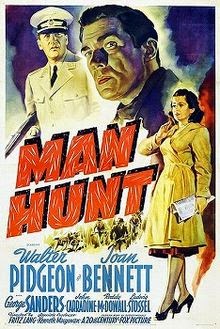
I stayed up past my bedtime Wednesday night to watch Man Hunt through to its conclusion. I had never thought of Walter Pidgeon as an action hero, but he is tall enough and physical enough for sure, as Captain Alan Thorndike, famous big game hunter. Joan Bennett plays the Vivien Leigh role as a "streetwalker" as in Waterloo Bridge. George Sanders plays Major Quive-Smith, the SS Officer who has Thorndike tortured, tries to murder him in Germany, and then tracks him down to London and Lyme Regis.

The movie was issued in 1941, in an age of neutrality toward Germany and the National Socialist Party. Throughout the film, the issue of neutrality and even appeasement is important, as Thorndike was caught while seeming to attempt Hitler's assassination. He insists that he was just testing to see if he COULD kill Hitler, something that Quive-Smith does not believe. He wants Thorndike to sign a confession implicating the British government in the assassination attempt. Thorndike refuses and the plot goes on from there, with our hero in constant danger, and our heroine, Jerry Stokes, shares that danger after she saves him and falls in love with him.

The director of the movie is Fritz Lang of Metropolis fame, who had left Nazi Germany--Hitler both admired and hated Lang's talents, destroying some of his movies and then offering him an official role in Germany's film industry. Lang was Jewish (but his estranged wife was a Nazi party member) so he was probably right not to accept the office.

The New York Times liked the movie in its 2009 DVD release:

As propaganda “Man Hunt” is a movie of undisguised practical aims. During a confrontation in Quive-Smith’s office the German contemptuously tells his captive, “You’re symbolic of the English race.” Thorndike answers, “I’m beginning to think that you’re symbolic of yours!” — one of the lines that apparently roused the fury of Hollywood’s self-censorship board, the Production Code Administration, which objected to the picture’s lack of “balance.” (The administration also insisted that a sewing machine be placed in Bennett’s apartment to suggest that this young woman of suspiciously independent means was in fact a seamstress.) As agitprop the film could not be more effective: during its climax Thorndike finds a way to continue his stalking under more official circumstances, and the audience yearns to go along with him.

And yet, seen again in this excellent restoration from 20th Century Fox Home Entertainment, “Man Hunt” has the timeless quality of a work of pure imagination. Each image contains what the German critic Frieda Grafe called “the hidden geometry” of Lang’s work: that mysterious tendency of shots to resolve themselves into intersecting planes (the banked floors that seem to be rising to meet lowered ceilings), the crisscrossing lines of force traced by streets and the angles of buildings, the circles and squares and triangles that emerge from the décor and seem to dominate the tiny human figures. One of the film’s most prominent characters is an inanimate object, a brooch in the shape of an arrow that passes from Pidgeon to Bennett to Sanders and back to Pidgeon again.

I have to admit I did not notice all the angles and geometry noted above--I did think the pace of the story was excellent and the touches of humor welcome. As far as the propaganda goes, if the Production Code Administration had trouble with Man Hunt, how it must have struggled letting The Mortal Storm be produced and distributed!

Peter O'Toole played the role of Captain Thornton in 1976's Rogue Male for the BBC (with Alistair Sim--Scrooge--as his brother). O'Toole's character was named Captain Robert HUNTER.

Saturday, August 10, 2013

Crime, Torture and Punishment in the 16th Century

Peter Marshall reviews this new book on torture and execution as practiced in Nuremburg, Germany for the Literary Review:

This is a marvellous book about a fascinating subject. It is, in a sense, a portrait of a serial killer. Frantz Schmidt was employed between 1578 and 1618 as the official executioner (and torturer) of the prosperous German city of Nuremberg. Over the course of his career he personally despatched 394 people, and flogged, branded or otherwise maimed many hundreds more. His life is also a tale of honour, duty and a lasting quest for meaning and redemption.

The penal regimes of pre-modern European states were harsh and violent, heavy on deterrence and the symbolism of retribution. Towns such as Nuremberg needed professional executioners to deal with an ever-present threat of criminality through the public infliction of capital and corporal sentences. Punishing malefactors with lengthy periods of incarceration was an idea for the future, and would probably have struck 16th-century people as unnecessarily cruel. Methods ranged from execution with the sword (the most honourable) to hanging (the least), and from the relatively quick and merciful to the dreadful penalty of staking a person to the ground and breaking their limbs one after the other with a heavy cartwheel. This was not a world of mindless violence: the punishments Schmidt imposed were carefully prescribed by the city authorities, down to the number of 'nips' (pieces of flesh torn from the limbs with red-hot tongs) convicts were to receive on their way to the gallows.

This gruesome regimen can be reconstructed because, over the course of 45 years, Schmidt kept a personal journal - not a diary in anything like the modern sense, but a usually terse and impersonal chronological record of all the punishments he had inflicted, including some details of the crimes behind them. The journal is not a new discovery (a version of it was printed as long ago as 1801), but Joel Harrington, drawing on a previously unused, near-contemporary copy, is the first historian to realise its full potential. The source lends itself to a social history of crime and punishment, but Harrington also attempts something more interesting and ambitious: to enter imaginatively into the world-view of its compiler and construct a rounded portrait of a personality and a life. Cleverly, he weaves Schmidt's own words wherever possible into his historical narrative, placing them in italics to let us identify what he has reported and what the author has conjectured or imaginatively inferred (invariably pitched pleasingly between excessive caution and undue presumption). It is a virtuoso performance. Harrington is able to draw on a range of ancillary documents, but this is the best example of making a single, apparently unpromising historical source sing since Eamon Duffy breathed life into a set of dusty English churchwardens' accounts in The Voices of Morebath.

Macmillan, the U.S. publisher, provides some excerpts and other material here. A couple of years ago, I corresponded with Professor Frank W. Barlow of Mount Holyoke College, who is at work on a biography of Richard Topcliffe. I really doubt that Topcliffe would have kept such an impersonal journal of his work of pursuing and torturing Catholic priests. From all that I've read of Topcliffe he took personal satisfaction in capturing priests like St. Robert Southwell and may have even enjoyed inflicting pain.

Monday, May 6, 2013

London, May 6, 1590: Two Recusant Martyrs

As the Catholic Encyclopedia recounts, Blessed Edward Jones was one of Richard Topcliffe's victims, enduring the torture meted out by Elizabeth I's personal pursuivant:

Blessed Edward Jones: Priest and martyr, b. in the Diocese of St. Asaph, Wales, date unknown; d. in London, 6 May 1590. Bred an Anglican, he was received into the Church at the English College, Reims, 1587; he was ordained priest in 1588, and went to England in the same year. In 1590 he was arrested by a priest-catcher, who pretended to be a Catholic, in a shop in Fleet Street. He was imprisoned in the Tower and brutally tortured by Topcliffe, finally admitting he was a priest and had been an Anglican. These admissions were used against him at his trial, but he made a skillful and learned defense, pleading that a confession elicited under torture was not legally sufficient to ensure a conviction. The court complimented him on his courageous bearing, but of course he was convicted of high treason as a priest coming into England. On the same day he was hanged, drawn, and quartered, opposite the grocer's shop where he had been captured, in Fleet Street near the Conduit.

Blessed Anthony Middleton: On the same day there suffered Anthony Middleton, priest and martyr, born probably at Middleton-Tyas, Yorkshire, date unknown, son of Ambrose Middleton of Barnard Castle, Durham, and Cecil, daughter of Anthony Crackenthorpe of Howgill Castle, Westmoreland. He entered the English College at Reims 9 Jan., 1582; was ordained 30 May 1586, and went to England in the same year. His work lay in London and the neighbourhood and he laboured very successfully; he was captured at a house in Clerkenwell (London) by the same artifice which was practiced on Father Jones. On the ladder he said: "I call God to witness I die merely for the Catholic Faith, and for being a priest of the true Religion"; and someone present called out, "Sir, you have spoken very well". The martyr was cut down and disemboweled while yet alive.

The observer's outcry was certainly a dangerous act--the usual procedure would be that the executioner would hold the decapitated head up and proclaim: "The head of a traitor" and the crowd would proclaim: "God Save the Queen!" Most irregular. Also irregular was Topcliffe's torture of Blessed Father Jones: Elizabeth I's government knew this procedure was not only irregular but illegal.--"It was during the time of the Tudors that the use of torture reached its height," wrote historian L.A. Parry in his 1933 book The History of Torture in England. "Under Henry VIII it was frequently employed; it was only used in a small number of cases in the reigns of Edward VI and of Mary. It was whilst Elizabeth sat on the throne that it was made use of more than in any other period of history."

The Golden Age of Elizabeth, indeed.

Monday, March 4, 2013

St. Augustine of Canterbury a Traitor in 1590?

Blessed Christopher Bales, priest and martyr, and companions (laymen who assisted him) Blessed Alexander Blake, and Blessed Nicholas Horner, were all executed on March 4, 1590 at three different sites in London. According to the Catholic Encyclopedia, his career as a missionary priest in England was brief:
 
Priest and martyr, b. at Coniscliffe near Darlington, County Durham, England, about 1564; executed 4 March, 1590. He entered the English College at Rome, 1 October, 1583, but owing to ill-health was sent to the College at Reims, where he was ordained 28 March, 1587. Sent to England 2 November, 1588, he was soon arrested, racked, and tortured by Topcliffe, and hung up by the hands for twenty-four hours at a time; he bore all most patiently. At length he was tried and condemned for high treason, on the charge of having been ordained beyond seas and coming to England to exercise his office. He asked Judge Anderson whether St. Augustine, Apostle of the English, was also a traitor. The judge said no, but that the act had since been made treason by law. He suffered 4 March, 1590, "about Easter", in Fleet Street opposite Fetter Lane. On the gibbet was set a placard: "For treason and favouring foreign invasion". He spoke to the people from the ladder, showing them that his only "treason" was his priesthood. On the same day Venerable Nicholas Horner suffered in Smithfield for having made Bales a jerkin, and Venerable Alexander Blake in Gray's Inn Lane for lodging him in his house.
 
They were  beatified on December 15 in 1929 by Pope Pius XI.
 
Philip Caraman, SJ, includes Blessed Christopher Bales' question to Judge Anderson in his collection of primary sources, The Other Face: Catholic Life Under Elizabeth I:
 
He was asked by the judge according to custom . . . when judgment was about to be pronounced, if he had anything to say for himself. He answered, "This only to I want to know, whether St. Augustine sent hither by St. Gregory was a traitor or not." They answered that he was not . . . He answered them, "Why then do you condemn me to death as a traitor? I am sent hither by the same see: and for the same purpose as he was. Nothing is charged against me that could not also be charged against the saint." But for all that they condemned him. (Greene, Collections); page 230.

The Catholic Encyclopedia also has an entry on Blessed Nicholas Horner and his sufferings and consolations:

Layman and martyr, born at Grantley, Yorkshire, England, date of birth unknown; died at Smithfield, 4 March, 1590. He appears to have been following the calling of a tailor in London, when he was arrested on the charge of harbouring Catholic priests. He was confined for a long time in a damp and noisome cell, where he contracted blood poisoning in one leg, which it became necessary to amputate. It is said that during this operation Horner was favoured with a vision, which acted as an anodyne to his sufferings. He was afterwards liberated, but when he was again found to be harbouring priests he was convicted of felony, and as he refused to conform to the public worship of the Church by law established, was condemned. On the eve of his execution, he had a vision of a crown of glory hanging over his head, which filled him with courage to face the ordeal of the next day. The story of this vision was told by him to a friend, who in turn transmitted it by letter to Father Robert Southwell S.J., 18 March, 1590. Horner was hanged, drawn and quartered because he had relieved and assisted Christopher Bales . . .

Thursday, February 21, 2013

St. Robert Southwell, SJ

St. Robert Southwell was 33 years old when he was executed at Tyburn on February 21, 1595. When he cited his age during his trial, his torturer Richard Topcliffe mocked him for claiming equality with Jesus Christ. Southwell answered that he was but a worm.
It is hard to be temperate when writing about his arrest, torture and execution--it is obviously a horrendous blot against the Elizabethan "regime". He was betrayed by a woman that Elizabeth's pursuivant Richard Topcliffe had raped and blackmailed--he promised to find her a husband since she was pregnant with his child if she would turn Southwell in; he was tortured--illegally and excruciatingly--numerous times, starting with a visit to Topcliffe's personal torture chamber, while Elizabeth's officials looked on; then he was held in fetid conditions until his father visited him in Westminster's gatehouse and petitioned the queen to put him to death rather than leave him there, in his own filth.
Moved to the Tower of London he was held in greater but solitary comfort, but Queen Elizabeth allowed the sadistic Topcliffe to continue torturing Southwell, who had readily admitted his priesthood. Prior to his trial on February 20 he was moved into a hole called Limbo; the government did not even try to implicate him in any plot against the Queen; he was executed just because he was a Catholic priest. When he was executed on February 21st, the crowds made sure he was dead before the butchery began--and no one cheered when his severed head was displayed to the crowd. Indeed, Elizabeth's government recognized that they had gone too far--there was lull in executions of Catholic priests in London. Lord Cecil even ignored Topcliffe's desires to get started on new victims.
Robert Southwell was canonized by Pope Paul VI among the group called The Forty Martyrs of England and Wales. In addition to be a great saint and steadfast martyr, he is regarded as one of the great poets of the Elizabethan Age. Much of his poetry was written while he was held in solitary confinement in the Tower of London and was published posthumously.
 
One of the best accounts of his mission and his suffering is Philip Caraman's study of St. Robert Southwell's friendship with Father Henry Garnet, SJ, which I reviewed here.

Friday, August 31, 2012

St. Edmund Campion in St. John's Chapel, Tower of London

File:St John's Chapel, Tower of London.jpgFresh from his latest torture session, bereft of books or any sources but his memory and his wit, the Jesuit priest Edmund Campion debated, with other seminary priests, a group of Protestant divines on August 31, 1581. They all had a copy of his book, "Rationes Decem" and they could ask him questions, while he could only answer questions, not ask them. This was the first of four debates and was held in the Chapel of St. John in the Tower of London (image to the left from wikipedia commons).  Campion had offered the challenge to hold such debates, but perhaps had not reckoned with the fairness of the situation.

James V. Holleran recounts the story of these debates, records and reports of them in his 1999 book, A Jesuit Challenge: Edmund Campion's Debates at the Tower of London in 1581, published by Fordham University Press. As Holleran notes, Campion's "Brag" to the Queen's Council called for these debates and his "Ten Reasons" gave the debates their starting point. A brief summary of the Ten Reasons:

1. Protestants reject the parts of Scripture that don't support their doctrine.
2. Protestants distort the parts of Scripture to support their doctrine.
3. Protestants have a weak notion of the Church.
4. Protestants should accept Catholic teaching on the Mass, the Communion of Saints, and the authority of the Pope as Vicar of Christ in His Church.
5. The Fathers of the Church don't support Protestant views of the Church, the Eucharist, the Communion of Saints, and the authority of the Pope as Vicar of Christ in His Church.
6. Protestants ignore the authority of the Fathers of the Church, even of the Apostolic Fathers, since they can't find support for their doctrine in their lives and works.
7. Anticipating Blessed John Henry Newman: "To be deep in [Church] history is to cease to be a Protestant": Church History does not support Protestant doctrine of the Church, the Sacraments, the Priesthood, etc.
8. Some bad Protestant mottos (like "good works are mortal sins")
9. General weakness of Protestant arguments (as against clerical celibacy because marriage is a good thing),
10. Catholicism is the True Christian religion, the Church founded by Jesus Christ on St. Peter and the Apostles (the Pope and the Bishops as their successors): for 1500 years, everyone agreed this was true.

The plan of the debates was to go through these Reasons with the Protestants asking Campion to defend his position. The debates did not go through all the Reasons because Campion did too well defending his position and the organizers did not want to allow Campion the opportunity the argument from history. Once he had the opportunity to remind the audience at the debates of England's Catholic history: monasticism, the close relationship with the Papacy, the saints of England, the Blessed Virgin Mary, Marian devotion (Our Lady of Walsingham), St. Augustine of Canterbury sent from the Pope to Canterbury, the beauty of the churches before desecration and destruction--as Campion would say after he and the other priests had been condemned to death, "In condemning us you condemn all your own ancestors--all the ancient priests, bishops and kings--all that was once the glory of England, the island of Saints, and the most devoted child of the See of Peter. For what have we taught, however you may qualify it with the odious name of treason, that they did not uniformly teach? To be condemned with these lights--not of England only, but of the world--by their degenerate descendants, is both gladness and glory to us." Te Deum Laudamus!

Here are some more resources on St. Edmund Campion from the Jesuit Institute, including the text of his "Brag" and a link to the Ten Reasons and this prayer:

Father,
throughout the ages you inspire heroic men and women
to preach your gospel
and proclaim the truth of your love.
We pray that the example of St Edmund Campion
may encourage us to stand up for what it right;
to hold to what is true;
and to love even those who persecute us,
for Christ's sake. Amen.

Thursday, July 26, 2012

Martyrs and Relatives

These two martyrs, executed on July 26 in 1600, had relatives were also suffered martyrdom for their priesthood in recusant England:

Edward Thwing was born in Yorkshire. He went to Reims, France in the summer of 1583 to study for the priesthood and then went to the Jesuit community at Pont-a-Mousson, evidently intending to enter the order. But within two years, he was back at the English College. After completing his studies with a stay in Rome, he returned to France for his ordination in Laon on December 20, 1590. His return to England was delayed by health problems. In 1597, he was finally able to go to England but was captured by the Elizabethan authorities as soon as he arrived. He and a fellow priest, (Blessed) Robert Nutter, managed to escape from their prison, and eluded arrest for the next three years. In May of 1600, they were re-captured. On July 26, 1600, Father Thwing was executed at Lancaster by drawing and quartering, together with Father Nutter. They were beatified by Pope John Paul II in 1982 as two of the 85 Martyrs of England and Wales. His nephew was also martyred, during the Popish Plot craziness: Blessed Thomas Thwing.

Blessed Robert Nutter was born at Burnley, Lancashire, c. 1550; executed at Lancaster, 26 July, 1600. He entered Brasenose College, Oxford in 1564 or 1565, and, with his brother John, also a martyr (executed at Tyburn on February 12, 1584 with four other priests and beatified by Pope Pius XI in 1929) became a student of the English College, Reims. Having been ordained priest, 21 Dec., 1581, he returned to England. On 2 Feb., 1583-4 he was committed to the Tower, where he remained in the pit forty-seven days, wearing irons for forty-three days, and twice subjected to the tortures of "the scavenger's daughter". On 10 November, 1584, he was again consigned to the pit, where he remained until, on 21 Jan., 1584-5, he, with twenty other priests and one layman, was shipped aboard the "Mary Martin" of Colchester, at Tower Wharf. Landing at Boulogne, 2 Feb., he revisited Rome in July, but, on 30 November, was again committed to prison in London, this time to Newgate, under the alias of Rowley. In 1587 he was removed to the Marshalsea, and thence, in 1589-90, was sent to Wisbech Castle, Cambridgeshire. There, in 1597, he signed a petition to Father Garnet in favour of having a Jesuit superior, but, on 8 Nov., 1598, he and his fellow martyr, Edward Thwing, with others, besought the pope to institute an archpriest.

Friday, July 6, 2012

Blessed Thomas Alfield, Fallen and Risen

(AUFIELD, ALPHILDE, HAWFIELD, OFFELDUS; alias BADGER).

Priest, born at Gloucestershire; martyred at Tyburn, 6 July, 1585. He was educated at Eton and Cambridge (1568). He was afterwards converted and came to Douai College in 1576, but the troubles there compelled him to intermit his studies for four years, and he was eventually ordained and sent forth from Reims in 1581. Here he was associated with the celebrated mission of Blessed Edmund Campion and Father Persons, and he persuaded the latter to take as his servant his brother Robert Alfield, then recently converted, but who afterwards became a traitor of note. Thomas seems to have laboured chiefly in the north, where after a time he was arrested and sent to the Tower of London, 2 May, 1582. Here he at first made a "glorious" confession, and even endured torture; but being afterwards sent back to the north, he fell, and went to the Protestant Church. Upon regaining liberty he was deeply penitent for his fall, and returned to Dr. Allen at Reims to gather new resolution. Returning again to England he was induced by the famous seaman John Davis (about March, 1584) to make for him offers — presumably insincere on Davis's part — of services to Spain. In August of the same year Dr. Allen's celebrated "True and modest Defence" appeared in answer to Burghley's "Execution of Justice". To circulate such books as Allen's was of the greatest service to the Faith. Alfield undertook the dangerous task with the help of a dyer by the name of Thomas Webley, and of one Crabbe. After some months he was again arrested, and again sent to the Tower, whence he was removed to Newgate and tried. Crabbe renounced the pope and thereby saved his life; the other two were hanged. A reprieve had, for some unknown reason, been granted for Alfield, but it arrived too late.

Blessed Thomas Alfield was executed 50 years after St. Thomas More. He was beatified in 1929. Thomas Webley's cause progressed to his being declared Venerable.

Monday, June 25, 2012

St. Thomas More and Torture

Wolf Hall, the first volume in Hilary Mantel's trilogy of novels about Thomas Cromwell casts St. Thomas More in an unflattering light, one that reviewers might be relishing. The Mirror of Justice blog posted this discussion on whether Chancellor More, in the process of enforcing England's heresy laws, used torture:

This past Sunday's NY Times Book Review includes a review of Bring Up the Bodies, the much-anticipated sequel to Hilary Mantel's Booker Prize-winning novel Wolf Hall about Henry VIII and his court. The hero, of sorts, in Mantel's novels about the period is Thomas Cromwell, whom Mantel sets off against Thomas More (depicted in Wolf Hall as an eager torturer of Protestants). The reviewer, Charles McGrath (former editor of the Book Review), writes: "In Mantel’s version, More is no saint, as he almost certainly was not in real life: he’s fussily pious, stiff-­necked and unnaturally fond of torturing heretics."


Let me be clear: Thomas More generally shared in the prejudices of his age and was complicit in practices (most especially the use of state coercion with regard to religious belief) that we would today regard as morally odious. That's just to say that he lived in the early sixteenth century and not the early twenty-first century, and we could have a lively discussion about how the Catholic Church should assess the sanctity of people with the benefit of historical and moral hindsight.

And Michael Moreland, the author of the post, goes on:

But a couple of further observations about the review:


1. McGrath's statement (characterizing Mantel's view) that More was "fussily pious" and "stiff-necked" is open to debate based on the contemporaneous accounts of More, though I'd simply make the point for now that More's canonization in 1935 was largely based on the manner of his death--the fact that More (alongside John Fisher and later joined by the 1970 canonization of 40 martyrs and the 1987 beatification of 85 martyrs from the sixteenth and seventeenth centuries in England) suffered martyrdom for the Catholic faith rather than acquiescing to Henry VIII's assertion of power over the Church in England.

2. It's another thing altogether to make the slanderous claim that More was "unnaturally fond of torturing heretics," for the scholarly consensus is that there is no historical evidence that More engaged in torture. As summarized by John Guy in The Public Career of Sir Thomas More (Yale, 1980), "Serious analysis precludes the repetition of protestant stories that Sir Thomas flogged heretics against a tree in his garden at Chelsea. It must exclude, too, the accusations of illegal imprisonment made against More by John Field and Thomas Phillips. Much vaunted by J.A. Froude, such charges are unsupported by independent proof. More indeed answered them in his Apology with emphatic denial. None has ever been substantiated, and we may hope that they were all untrue" (165-66). See also G.R. Elton, Studies in Tudor and Stuart Politics and Government, Papers and Reviews 1946-1972, Volume 1, 158 ("It is necessary to be very clear about More's reaction to the changes in religion which he saw all around him. No doubt, the more scurrilous stories of his personal ill-treatment of accused heretics have been properly buried, but that is not to make him into a tolerant liberal.").

I posted the following comment about the charge that St. Thomas More was "fussily pious" and "stiff-necked", which I find ridiculous, given the "contemporaneous accounts of More's life" with the examples of his humor, charity, and friendship that even detractors have to acknowledge. I'd also have to say that the comments about St. Thomas More in a review about a book in which he does not appear are rather gratuitous. The reviewer just wants to attack More since More is the patron saint of conscience, politicians and statesmen:

Beyond the issue of St. Thomas More and the persecution of heretics, how can a man be called "fussily pious" and "stiff-necked" who expresses the hope that he and his judges will meet merrily in Heaven?--"More have I not to say, my lords, but that like as the blessed apostle Saint Paul, as we read in the Acts of the Apostles, was present and consented to the death of Saint Stephen, and kept their clothes that stoned him to death, and yet be they now twain holy saints in heaven, and shall continue there friends forever: so I verily trust and shall therefore right heartily pray, that though your lordships have now in earth been judges to my condemnation, we may yet hereafter in heaven merrily all meet together to our everlasting salvation."

Desiderius Erasmus, who could not abide fussy piety, would certainly disagree with Mantel's characterization of "More"--"Friendship he seems born and designed for; no one is more open-hearted in making friends or more tenacious in keeping them, nor has he any fear of that plethora of friendships against which Hesiod warns us.... Nobody is less swayed by public opinion, and yet nobody is closer to the feelings of ordinary men."

Wednesday, May 9, 2012

The Tudors and Torture

Nancy Bilyeau, author of The Crown, provides some information on torture in Tudor and early Stuart England on the English Historical Fiction Authors blog:

It was in the 16th century that prisoners were unquestionably tortured in the Tower of London. The royal family rarely used the fortress on the Thames as a residence; more and more, its stone buildings contained prisoners. And while the Tudor monarchs seem glittering successes to us now, in their own time they were beset by insecurities: rebellions, conspiracies and other threats both domestic and foreign. There was a willingness at the top of the government to override the law to obtain certain ends. This created a perfect storm for torture.

"It was during the time of the Tudors that the use of torture reached its height," wrote historian L.A. Parry in his 1933 book The History of Torture in England. "Under Henry VIII it was frequently employed; it was only used in a small number of cases in the reigns of Edward VI and of Mary. It was whilst Elizabeth sat on the throne that it was made use of more than in any other period of history."

Bilyeau mentions the Little Ease, a cell in which the occupant, if normal size, could not either stand upright or lay down completely, and some other forms of torture:

Besides Little Ease, the most-used torture devices were the rack, manacles, and a horrific creation called the Scavenger’s Daughter. For many prisoners, solitary confinement, repeated interrogation, and the threat of physical pain were enough to make them tell their tormentors anything they wanted to know.

The Scavenger's Daughter was the opposite of the Duke of Exeter's Daughter, aka the rack--instead of stretching the victim, it compressed the body. Blessed Thomas Cottam, executed on May 30, 1582, endured both the Duke's and the Scavenger's Daughters while in the Tower. Prisoners were also laden with chains and heavy fetters; starved and refused water; left to endure exposure, and had pins stuck up under their fingernails.

Richard Topcliffe, Good Queen Bess's personal priest-hunter and appointed torturer, devised the famous method of hanging the victim by the wrists. Father John Gerard described it thus:

I fell on my knees for a moment's prayer. Then they took me to a big upright pillar, one of the wooden posts which held the roof of this huge underground chamber. Driven into the top of it were iron staples for supporting heavy weights. Then they put my wrists into iron gauntlets and ordered me to climb two or three wicker steps.

My arms were then lifted up and an iron bar was passed through the rings of one gauntlet, then through the staple and rings to the second gauntlet. This done, they fastened the bar with a pin to prevent it from slipping, and then, removing the wicker steps one by one from under my feet, they left me hanging by my hands and arms fastened above my head. The tips of my toes, however, still touched the ground, and they had to dig the earth away from under them. They had hung me up from the highest staple in the pillar and could not raise me any higher, without driving in another staple.

Hanging like this I began to pray. The gentlemen standing around me asked me whether I was willing to confess now.


'I cannot and I will not,' I answered.


But I could hardly utter the words, such a gripping pain came over me. It was worst in my chest and belly, my hands and arms. All the blood in my body seemed to rush up into my arms and hands and I thought that blood was oozing from the ends of my fingers and the pores of my skin. But it was only a sensation caused by my flesh swelling above the irons holding them.


The pain was so intense that I thought I could not possibly endure it, and added to it, I had an interior temptation. Yet I did not feel any inclination or wish to give them the information they wanted. The Lord saw my weakness with the eyes of His mercy, and did not permit me to be tempted beyond my strength. With the temptation He sent me relief. Seeing my agony and the struggle going on in my mind, He gave me this most merciful thought: the utmost and worst they can do is to kill you, and you have often wanted to give your life for your Lord God. The Lord God sees all you are enduring - He can do all things. You are in God's keeping.


With these thoughts, God in His infinite goodness and mercy gave me the grace of resignation, and with a desire to die and a hope (I admit) that I would, I offered Him myself to do with me as He wished. From that moment the conflict in my soul ceased, and even the physical pain seemed much more bearable than before, though it must, in fact, I am sure, have been greater with the growing strain and weariness of my body...

At the end of her post, Bilyeau states that these forms of torture ended during the reign of Charles I--and that is true. But during his son's reign, the Popish Plot hysteria revived some of these terrors, especially the use of chains and fetters.

Sunday, May 6, 2012

Blessed Edward Jones and Blessed Anthony Middleton

As the Catholic Encyclopedia recounts, Blessed Edward Jones was one of Richard Topcliffe's victims, enduring the torture meted out by Elizabeth I's personal pursuivant:

Blessed Edward Jones:  Priest and martyr, b. in the Diocese of St. Asaph, Wales, date unknown; d. in London, 6 May 1590. Bred an Anglican, he was received into the Church at the English College, Reims, 1587; he was ordained priest in 1588, and went to England in the same year. In 1590 he was arrested by a priest-catcher, who pretended to be a Catholic, in a shop in Fleet Street. He was imprisoned in the Tower and brutally tortured by Topcliffe, finally admitting he was a priest and had been an Anglican. These admissions were used against him at his trial, but he made a skillful and learned defense, pleading that a confession elicited under torture was not legally sufficient to ensure a conviction. The court complimented him on his courageous bearing, but of course he was convicted of high treason as a priest coming into England. On the same day he was hanged, drawn, and quartered, opposite the grocer's shop where he had been captured, in Fleet Street near the Conduit.

Blessed Anthony Middleton: On the same day there suffered Anthony Middleton, priest and martyr, born probably at Middleton-Tyas, Yorkshire, date unknown, son of Ambrose Middleton of Barnard Castle, Durham, and Cecil, daughter of Anthony Crackenthorpe of Howgill Castle, Westmoreland. He entered the English College at Reims 9 Jan., 1582; was ordained 30 May 1586, and went to England in the same year. His work lay in London and the neighbourhood and he laboured very successfully; he was captured at a house in Clerkenwell (London) by the same artifice which was practiced on Father Jones. On the ladder he said: "I call God to witness I die merely for the Catholic Faith, and for being a priest of the true Religion"; and someone present called out, "Sir, you have spoken very well". The martyr was cut down and disemboweled while yet alive.

Thursday, March 22, 2012

St. Nicholas Owen, Redux

Because of the Julian/Gregorian calendar confusions of 16th and 17th century Europe, and their intermingling with Catholic v. Protestant conflicts at the same time, dates can be a problem for a historian and a reader. I wrote about St. Nicholas Owen on March 2 this year, but The Catholic Herald has featured him on-line this week for his martyrdom's anniversary on March 22. Since he is such a great martyr, here's a link to their post and a quotation:

Nicholas Owen (c 1550-1606) was one of four sons of Walter Owen, a carpenter who lived in Oxford. Inheriting his father’s skill, he came to specialise in the construction of concealed priest-holes in country houses. Many Catholics on the run owed their lives to him.

“I verily think,” noted Fr John Gerard, “that no one can be said to have done more good of all those who laboured in the English vineyard.

“He was the immediate occasion of saving many hundreds of persons, both ecclesiastical and secular, which had been lost and forfeited many times over if the priests had been taken in their houses.”

Owen is first encountered in 1581 in connection with the martyrdom of Edmund Campion, whose servant he may have been. At all events, he maintained Campion’s innocence of treason with such force that he himself was imprisoned.

He must have been tough to survive the appalling conditions, which killed one of his fellow prisoners. Yet he was a small man who walked with a pronounced limp after a pack horse fell on top of him and broke his leg.


St. Nicholas Owen suffered to keep the missionary priests safe while he lived and he gave his life for their safety, too. St. Nicholas Owen, Pray for Us.

Friday, March 2, 2012

The Master Builder of Priest's Holes

St. Nicholas Owen died of torture in the Tower of London on March 2, 1606. This article from the National Catholic Register tells his story:

"St. Nicholas Owen was one of many who suffered and died in the Tower. He was known as “Little John.” He was a tiny slip of a Jesuit, but, as the old hagiographies commonly attested, he was big of heart. Owen was slightly taller than a dwarf and suffered from a hernia and a badly set leg, fractured when a horse fell on him. On March 2, 1606, Nicholas Owen was tortured to death in the Tower of London. He had, in fact, already been here before — when he helped two Jesuit priests escape. . . .

"At night, St. Nicholas would create small hiding places — trap doors, sliding doors, hidden crawl spaces and subterranean passages — in order to hide priests and other Catholic fugitives from priest hunters. He would use trompe l’oeil: perspective and many of the modern principles of stage illusion design that magicians often take for granted. Whenever St. Nicholas would design and build such hiding places, he would always begin with prayer and receive the Eucharist. Because of his incredible building skills, he was even able to help two Jesuit priests escape from the Tower. "

St. Nicholas Owen was captured in the aftermath of the Gunpowder Plot. The English government rejoiced when he was captured--they hoped to find out where he had built all those hiding places. Once they found out where they were, they could accuse the owners of treason, seize their property, add it to their holdings, and destroy the network of safe houses for Catholics and Catholic priests in England. Because of his infirmity, it was illegal to torture him, but they did it anyway--and then tried to indicate that he had committed suicide!

The image above depicts the torture of St. Edward Oldcorne, who would finally be executed on April 7, 1607, and St. Nicholas Owen. The engraving is by Gaspar Bouttats and does not represent St. Nicholas's true physical stature.