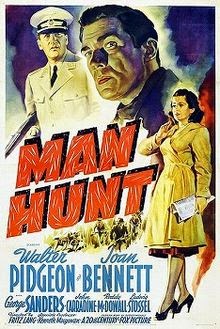
I stayed up past my bedtime Wednesday night to watch
Man Hunt through to its conclusion. I had never thought of Walter Pidgeon as an action hero, but he is tall enough and physical enough for sure, as Captain Alan Thorndike, famous big game hunter. Joan Bennett plays the Vivien Leigh role as a "streetwalker" as in
Waterloo Bridge. George Sanders plays Major Quive-Smith, the SS Officer who has Thorndike tortured, tries to murder him in Germany, and then tracks him down to London and Lyme Regis.
The movie was issued in 1941, in an age of neutrality toward Germany and the National Socialist Party. Throughout the film, the issue of neutrality and even appeasement is important, as Thorndike was caught while seeming to attempt Hitler's assassination. He insists that he was just testing to see if he COULD kill Hitler, something that Quive-Smith does not believe. He wants Thorndike to sign a confession implicating the British government in the assassination attempt. Thorndike refuses and the plot goes on from there, with our hero in constant danger, and our heroine, Jerry Stokes, shares that danger after she saves him and falls in love with him.
The director of the movie is Fritz Lang of
Metropolis fame, who had left Nazi Germany--Hitler both admired and hated Lang's talents, destroying some of his movies and then offering him an official role in Germany's film industry. Lang was Jewish (but his estranged wife was a Nazi party member) so he was probably right not to accept the office.
The New York Times liked the movie in its 2009 DVD release:
As propaganda “Man Hunt” is a movie of undisguised practical aims. During a confrontation in Quive-Smith’s office the German contemptuously tells his captive, “You’re symbolic of the English race.” Thorndike answers, “I’m beginning to think that you’re symbolic of yours!” — one of the lines that apparently roused the fury of Hollywood’s self-censorship board, the Production Code Administration, which objected to the picture’s lack of “balance.” (The administration also insisted that a sewing machine be placed in Bennett’s apartment to suggest that this young woman of suspiciously independent means was in fact a seamstress.) As agitprop the film could not be more effective: during its climax Thorndike finds a way to continue his stalking under more official circumstances, and the audience yearns to go along with him.
And yet, seen again in this excellent restoration from 20th Century Fox Home Entertainment, “Man Hunt” has the timeless quality of a work of pure imagination. Each image contains what the German critic Frieda Grafe called “the hidden geometry” of Lang’s work: that mysterious tendency of shots to resolve themselves into intersecting planes (the banked floors that seem to be rising to meet lowered ceilings), the crisscrossing lines of force traced by streets and the angles of buildings, the circles and squares and triangles that emerge from the décor and seem to dominate the tiny human figures. One of the film’s most prominent characters is an inanimate object, a brooch in the shape of an arrow that passes from Pidgeon to Bennett to Sanders and back to Pidgeon again.
I have to admit I did not notice all the angles and geometry noted above--I did think the pace of the story was excellent and the touches of humor welcome. As far as the propaganda goes, if the Production Code Administration had trouble with
Man Hunt, how it must have struggled letting
The Mortal Storm be produced and distributed!
Peter O'Toole played the role of Captain Thornton in 1976's
Rogue Male for the BBC (with Alistair Sim--Scrooge--as his brother). O'Toole's character was named Captain Robert HUNTER.