Showing posts with label saints. Show all posts

Tuesday, August 23, 2022

Saint J.H. Newman on Shakespeare and Catholic Churches

There were two other passages in Newman's "Letter Addressed to the Rev. E.B. Pusey, D.D., on the Occasion of his Eirenicon" that impressed me. They don't immediately touch upon the topic of Newman and Marian doctrine and devotion in the Catholic Church, our subject for this month's Son Rise Morning Show series, which will conclude on August 29th. So that's why I'm posting them separately.

One concerns the waxing and waning of Shakespeare's reputation in England. Newman uses it as an example of the distinction he wants to make between faith and devotion. Shakespeare has been considered a great poet and playwright (faith) but national affection has varied; he has fallen out of fashion or returned to center stage:

By "faith" I mean the Creed and assent to the Creed; by "devotion" I mean such religious honours as belong to the objects of our faith, and the payment of those honours. Faith and devotion are as distinct in fact, as they are in idea. We cannot, indeed, be devout without faith, but we may believe without feeling devotion. Of this phenomenon every one has experience both in himself and in others; and we bear witness to it as often as we speak of realizing a truth or not realizing it. It may be illustrated, with more or less exactness, by matters which come before us in the world. For instance, a great author, or public man, may be acknowledged as such for a course of years; yet there may be an increase, an ebb and flow, and a fashion, in his popularity. {27} And if he takes a lasting place in the minds of his countrymen, he may gradually grow into it, or suddenly be raised to it. The idea of Shakespeare as a great poet, has existed from a very early date in public opinion; and there were at least individuals then who understood him as well, and honoured him as much, as the English people can honour him now; yet, I think, there is a national devotion to him in this day such as never has been before. This has happened, because, as education spreads in the country, there are more men able to enter into his poetical genius, and, among these, more capacity again for deeply and critically understanding him; and yet, from the first, he has exerted a great insensible influence over the nation, as is seen in the circumstance that his phrases and sentences, more than can be numbered, have become almost proverbs among us.

Indeed, the Folger Library and other sites provide many examples of those "phrases and sentences" from Shakespeare's works that have been become so commonly used that we forget their source.

And the other passage--both of these are from Chapter 3. The Belief of Catholics concerning the Blessed Virgin, as distinct from their Devotion to her--is Newman's description of the interior of a Catholic church. It is so vivid that it calls to mind many memories of churches I've visited. It's a demonstration of what we talked about so often in the class I taught for Newman University in June and July this summer: Newman's ability to help his congregation or audience see something in a new way by engaging their imaginations:


This distinction is forcibly brought home to a convert, as a peculiarity of the Catholic religion, on his first introduction to its worship. The faith is everywhere one and the same, but a large liberty is accorded to private judgment and inclination as regards matters of devotion. Any large church, with its collections and groups of people, will illustrate this. The fabric itself is dedicated to Almighty God, and that, under the invocation of the Blessed Virgin, or some particular Saint; or again, of some mystery belonging to the Divine Name or the Incarnation, or of some mystery associated with the Blessed Virgin. Perhaps there are seven altars or more in it, and these again have their several Saints. Then there is the Feast proper to this or that day; and during the celebration of Mass, of all the worshippers who crowd around the Priest, each has his own particular devotions, with which he follows the rite. No one interferes with his neighbour; agreeing, as it were, to differ, they pursue {29} independently a common end, and by paths, distinct but converging, present themselves before God.
  

Then there are confraternities attached to the church,—of the Sacred Heart, or of the Precious Blood; associations of prayer for a good death, or for the repose of departed souls, or for the conversion of the heathen; devotions connected with the brown, blue, or red scapular; not to speak of the great ordinary Ritual observed through the four seasons, or of the constant Presence of the Blessed Sacrament, or of its ever-recurring rite of Benediction, and its extraordinary forty hours' Exposition. Or, again, look through such manuals of prayers as the Raccolta, and you at once will see both the number and the variety of devotions, which are open to individual Catholics to choose from, according to their religious taste and prospect of personal edification.
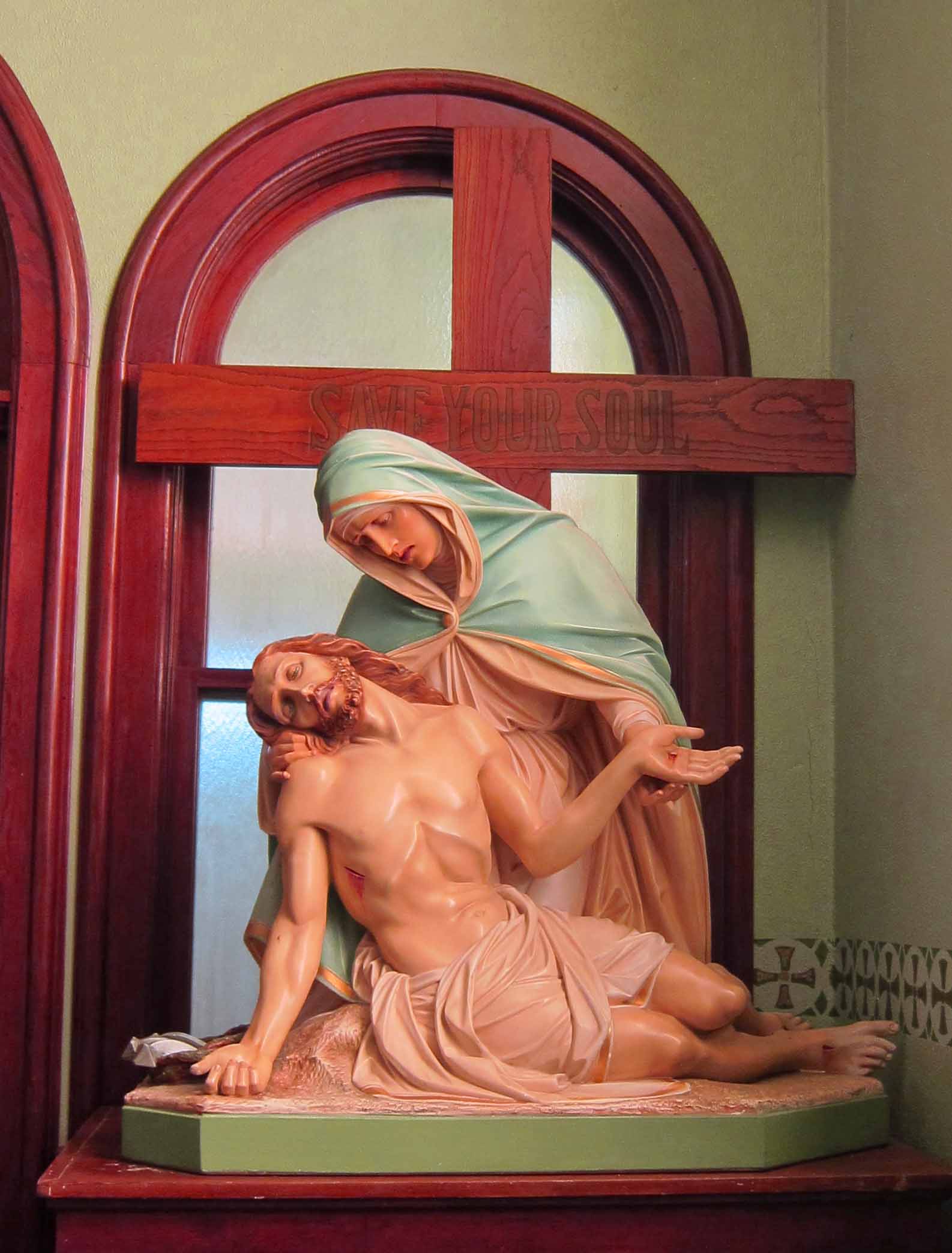

I took the pictures above at St. Joseph's Parish in Andale, Kansas, after it had been restored and renovated after a fire (the first two) and at St. Martin's church in Piqua, Kansas, which has been closed for years as an active parish but is maintained by Catholics in the area to be open for visitors.

And from Servant of God, Chaplain Emil J. Kapaun's home parish in Pilsen, Kansas, honoring the church's patron saint, St. John Nepomucene, which I visited in 2016 on the Solemnity of the Assumption:


And two other side altars in that church:
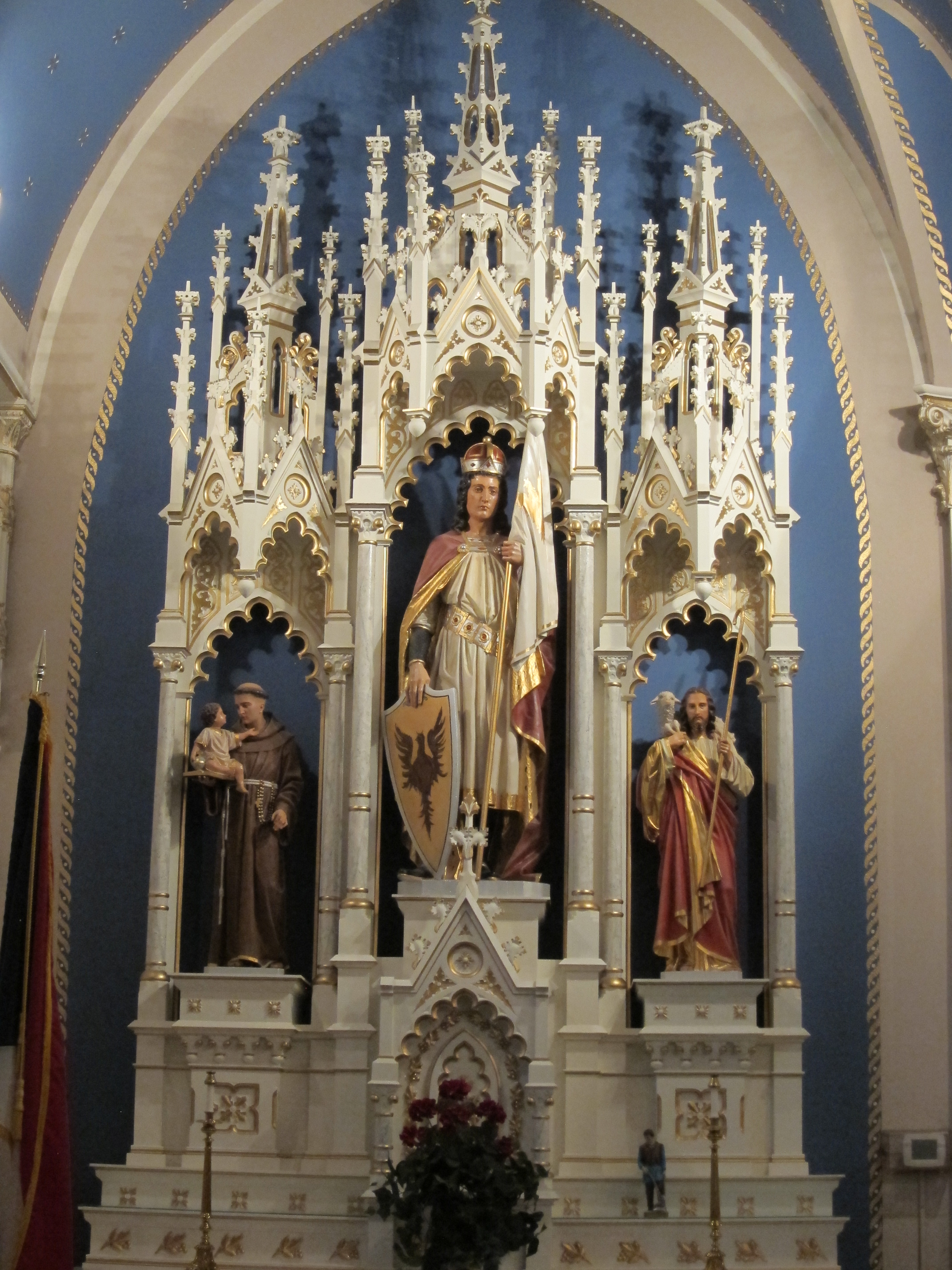


And finally, here's a picture Mark took during Mass on Christmas Day in 2013 at St. Anthony of Padua Church in Wichita, Kansas (Traditional Latin Mass), depicting the Franciscan saints honored at that parish:


As usual, I'll post my preview of the Son Rise Morning Show discussion this Friday, August 26!

Holy Mary, Mother of God, pray for us!
Saint Joseph, pray for us!
Saint John Nepomucene, pray for us!
Saint Anthony of Padua, pray for us!
Saint Clare of Assisi, pray for us!
Saint Francis of Assisi, pray for us!
Saint John Henry Newman, pray for us!

Image Credit for Shakespeare's Works (public domain): Title page of the First Folio, 1623. Copper engraving of Shakespeare by Martin Droeshout. All other images (c) Stephanie A. Mann (2013-2022).

Wednesday, July 1, 2020

Saint Junipero Serra and the Precious Blood

I'm going to attend Mass twice today, God willing: first in the Ordinary Form for the memorial of Saint Junipero Serra and then in the Extraordinary Form for the Feast of the Precious Blood of Our Lord Jesus Christ. I want to offer the first Mass in expiation for the outrages committed against Saint Junipero Serra and at the second pray for the Precious Blood of Jesus to heal our country.

I'll also be remembering Saint Oliver Plunkett, the last Catholic priest executed at Tyburn, Blessed Thomas Maxfield, one of the 85 Martyrs of England and Wales from the reign of James I, and the trial of St. Thomas More at Westminster Hall 485 years ago today.

If you see me driving down the street, be careful: I might be distracted with so much on my mind!

Five years ago (2015), when Pope Francis was going to visit the USA and was set to canonize Junipero Serra, there was a lot of controversy. Matt Swaim, Anna Mitchell, and I were doing a series on Catholic historical apologetics that year on the Son Rise Morning Show and cited this historian's commentary, Professor Ruben Mendoza of California State University, Monterey Bay, in our segment on those who attacked Serra and the Catholic Church for abuse of Native Americans:

The professor has been involved in research and conservation projects at several California missions founded by Serra. He said many of the Spanish missionary's critics are confusing the impact of Spanish colonizing and missionary activity on the native communities with what happened after California became a U.S. territory in 1848.

"A decimation of the Native American population," Mendoza said, occurred "in the period after 1850; Serra had no connection to that phenomenon. Those who criticize Serra the most tend to conflate the American period with that of the missionaries."

Another major objection to Serra's canonization involves reports that Native American adults at his mission were beaten.

"There is no documentation that Serra himself abused any Native American," Mendoza said. "The system under which he operated did use corporal punishment, but that was also used for transgressors from all walks of life, including soldiers."


Mendoza supports the canonization and said he believes it "has much to offer the peoples of Latin America, especially those of us of Mexican-Indian heritage who currently live under a shadow of doubt and denigration."

More about Saint Junipero Serra here. Pope Francis spoke of the newly-canonized saint in his homily at the National Shrine of the Immaculate Conception, Washington, D.C. Wednesday, September 23, 2015:

Today we remember one of those witnesses who testified to the joy of the Gospel in these lands, Father Junípero Serra. He was the embodiment of “a Church which goes forth”, a Church which sets out to bring everywhere the reconciling tenderness of God. Junípero Serra left his native land and its way of life. He was excited about blazing trails, going forth to meet many people, learning and valuing their particular customs and ways of life. He learned how to bring to birth and nurture God’s life in the faces of everyone he met; he made them his brothers and sisters. Junípero sought to defend the dignity of the native community, to protect it from those who had mistreated and abused it. Mistreatment and wrongs which today still trouble us, especially because of the hurt which they cause in the lives of many people.

Father Serra had a motto which inspired his life and work, not just a saying, but above all a reality which shaped the way he lived: siempre adelante! Keep moving forward! For him, this was the way to continue experiencing the joy of the Gospel, to keep his heart from growing numb, from being anesthetized. He kept moving forward, because the Lord was waiting. He kept going, because his brothers and sisters were waiting. He kept going forward to the end of his life. Today, like him, may we be able to say: Forward! Let’s keep moving forward!


Image Credit: shared under a CC BY-SA 4.0 license: Statue of Saint Junípero Serra in Golden Gate Park in San Francisco, recently desecrated.

Last week I received my copy of the new Magnificat Adoration Companion, which happily contains both the Litany to the Sacred Heart of Jesus and the Litany of the Precious Blood of Jesus. The entire month of July is dedicated to our devotion towards the Precious Blood of Jesus by which we are redeemed:

The Precious Blood which we worship is the Blood which the Savior shed for us on Calvary and reassumed at His glorious Resurrection; it is the Blood which courses through the veins of His risen, glorified, living body at the right hand of God the Father in heaven; it is the Blood made present on our altars by the words of Consecration; it is the Blood which merited sanctifying grace for us and through it washes and beautifies our soul and inaugurates the beginning of eternal life in it.

Blood of Christ, only-begotten Son of the Eternal Father, Save us.
Blood of Christ, Incarnate Word of God, Save us.
Blood of Christ, of the New and Eternal Testament, Save us.
Blood of Christ, falling upon the earth in the Agony, Save us.
Blood of Christ, shed profusely in the Scourging, Save us.
Blood of Christ, flowing forth in the Crowning with Thorns, Save us.
Blood of Christ, poured out on the Cross, Save us.
Blood of Christ, price of our salvation, Save us.
Blood of Christ, without which there is no forgiveness. Save us. . . .

Sunday, August 25, 2019

King St. Louis of France


Today, August 25, would be the memorial of St. Louis, King of France if it were not a Sunday. He is one of the patron saints of France and his equestrian statue stands across from St. Joan of Arc on the facade of Sacre Coeur in Paris. St. Louis is also on the sanctoral calendar of the Episcopalian Church here in the USA:

(Apr. 25, 1214-Aug. 25, 1270). The patron saint for the Third Order of St. Francis. Born in Poissy, Louis IX became King of France on Nov. 29, 1226, and ruled until his death. He lived an austere and prayerful life, and embodied the highest ideals of medieval kingship. He sought to live a Franciscan life of poverty and self-denial in the midst of royal splendor. Louis built the Sainte-Chapelle in Paris as a reliquary for the Crown of Thorns which he acquired in 1239. He participated in crusades in 1248 and 1270. Louis endowed a number of religious houses and supported the theological college founded by Robert de Sorbon in 1257. While on crusade in 1270 he urged the Greek ambassadors to seek reunion with the Church of Rome. He was canonized by Pope Boniface VIII in 1297. Louis died in Tunis while on crusade. He is commemorated in the Episcopal calendar of the church year on Aug. 25.

St. Louis may be the patron saint for the Third Order of St. Francis, but he had contacts with Dominicans too. In particular, St. Thomas Aquinas. In his book about St. Thomas Aquinas, The Dumb Ox, Chesterton describes the famous encounter between the monarch and the friar:


It is a real case against conventional hagiography that it sometimes tends to make all saints seem to be the same. Whereas in fact no men are more different than saints; not even murderers. And there could hardly be a more complete contrast, given the essentials of holiness, than between St. Thomas and St. Louis. St. Louis was born a knight and a king; but he was one of those men in whom a certain simplicity, combined with courage and activity, makes it natural, and in a sense easy, to fulfil directly and promptly any duty or office, however official. He was a man in whom holiness and healthiness had no quarrel; and their issue was in action. He did not go in for thinking much, in the sense of theorising much. But, even in theory, he had that sort of presence of mind, which belongs to the rare and really practical man when he has to think. He never said the wrong thing; and he was orthodox by instinct. In the old pagan proverb about kings being philosophers or philosophers kings, there was a certain miscalculation, connected with a mystery that only Christianity could reveal. For while it is possible for a king to wish much to be a saint, it is not possible for a saint to wish very much to be a king. A good man will hardly be always dreaming of being a great monarch; but, such is the liberality of the Church, that she cannot forbid even a great monarch to dream of being a good man. But Louis was a straight-forward soldierly sort of person who did not particularly mind being a king, any more than he would have minded being a captain or a sergeant or any other rank in his army. Now a man like St. Thomas would definitely dislike being a king, or being entangled with the pomp and politics of kings; not only his humility, but a sort of subconscious fastidiousness and fine dislike of futility, often found in leisurely and learned men with large minds, would really have prevented him making contact with the complexity of court life. Also, he was anxious all his life to keep out of politics; and there was no political symbol more striking, or in a sense more challenging, at that moment, than the power of the King in Paris. . . .

Somehow they steered that reluctant bulk of reflection to a seat in the royal banquet hall; and all that we know of Thomas tells us that he was perfectly courteous to those who spoke to him, but spoke little, and was soon forgotten in the most brilliant and noisy clatter in the world: the noise of French talking. What the Frenchmen were talking about we do not know; but they forgot all about the large fat Italian in their midst, and it seems only too possible that he forgot all about them. Sudden silences will occur even in French conversation; and in one of these the interruption came. There had long been no word or motion in that huge heap of black and white weeds, like motley in mourning, which marked him as a mendicant friar out of the streets, and contrasted with all the colours and patterns and quarterings of that first and freshest dawn of chivalry and heraldry. The triangular shields and pennons and pointed spears, the triangular swords of the Crusade, the pointed windows and the conical hoods, repeated everywhere that fresh French medieval spirit that did, in every sense, come to the point. But the colours of the coats were gay and varied, with little to rebuke their richness; for St. Louis, who had himself a special quality of coming to the point, had said to his courtiers, "Vanity should be avoided; but every man should dress well, in the manner of his rank, that his wife may the more easily love him."

And then suddenly the goblets leapt and rattled on the board and the great table shook, for the friar had brought down his huge fist like a club of stone, with a crash that startled everyone like an explosion; and had cried out in a strong voice, but like a man in the grip of a dream, "And that will settle the Manichees!"

The palace of a king, even when it is the palace of a saint, has it conventions. A shock thrilled through the court, and every one felt as if the fat friar from Italy had thrown a plate at King Louis, or knocked his crown sideways. They all looked timidly at the terrible seat, that was for a thousand years the throne of the Capets: and many there were presumably prepared to pitch the big black-robed beggarman out of the window. But St. Louis, simple as he seemed, was no mere medieval fountain of honour or even fountain of mercy but also the fountain of two eternal rivers: the irony and the courtesy of France. And he turned to his secretaries, asking them in a low voice to take their tablets round to the sear of the absent-minded controversialist, and take a note of the argument that had just occurred to him; because it must be a very good one and he might forget it. . . . 

In the painting above by Niklaus Manuel, the two saints sit across the table from one another. There are two dark discs above their heads, which represent halos. Notice too the dog sitting under the table next to St. Louis's feet, while a dove (the Holy Spirit) inspires St. Thomas Aquinas!

St. Louis of France, pray for us!
St. Thomas Aquinas, pray for us!

Monday, August 20, 2018

Cistercian Martyrs of England

According to the blog of Silverstream Priory in County Meath, Ireland, St. Bernard of Clairvaux's Cistercian order recognizes these English Reformation martyrs:

From the Romano–Cistercian Martyrology:
In England, in the sixteenth century, the passion of a number of Cistercian monks cruelly put to death for different pretexts by order of King Henry VIII.
In the months of March and May 1537, died for the Catholic faith:
— the Lord Abbot of Kirkstead, Dom John Harrison and his brethren Dom Richard Wade, Dom William Small, and Dom Henry Jenkinson;
— the Lord Abbot of Whalley, Dom John Paslew and his brethren, Dom William Haydock and Dom Richard Eastgate.
Also died: the Lord Abbot of Fountains and a monk of Louth Park.
In the following year 1538, were martyred:
— the Lord Abbot of Woburn, Dom Robert Hobbes and the monks Dom Rudolph Barnes and Dom Laurence Blunham.
Recognized as authentic confessors of the faith:
Dom Thomas Mudd, monk of Jervaulx, who died on September 7, 1583;
Dom John Almond, who died on April 18, 1585,
and Dom Gilbert Browne, the last Abbot of Sweet Heart (Dulce Cor), who died on March 14, 1612.

The Catholic Encyclopedia provides some detail about the history of St. Bernard's order in England: 

St. Stephen Harding, third Abbot of Cîteaux (1109-33), was an Englishman and his influence in the early organization of the Cistercian Order had been very great. It was natural therefore that, when, after the coming of St. Bernard and his companions in 1113, foundations began to multiply, the project of sending a colony of monks to England should find favourable consideration. In Nov., 1128, with the aid of William Giffard, Bishop of Winchester, a settlement was made at Waverly near Farnham in Surrey. Five houses were founded from here before 1152 and some of them had themselves produced offshoots. But it was in the north that the order assumed its most active developments in the twelfth century. William, an English monk of great virtue, was sent from Clairvaux by St. Bernard in 1131, and a small property was given to the newcomers by Walter Espec "in a place of horror and dreary solitude" at Rivaulx in Yorkshire, with the hearty support of Thurston, Archbishop of York. By 1143 three hundred monks had entered there, including the famous St. Ælred, known for his eloquence as the St. Bernard of England. Among the offshoots of Rivaulx were Melrose and Revesby. Still more famous was Fountains near Ripon. The foundation was made in 1132 by a section of the monks from the great Benedictine house of St. Mary's, York, who desired to lead a more austere life. After many struggles and great hardships, St. Bernard agreed to send them a monk from Clairvaux to instruct them, and in the end they prospered exceedingly. The great beauty of the ruins excites wonder even today, and before 1152 Fountains had many offshoots, of which Newminster and Meaux are the most famous. Another great reinforcement to the order was the accession of the houses of the Savigny foundation, which were incorporated with the Cistercians, at the instance of Eugenius III, in 1138. Thirteen English abbeys, of which the most famous were Furness and Jervaulx, thus adopted the Cistercian rule. By the year 1152 there were fifty-four Cistercian monasteries in England, some few of which, like the beautiful Abbey of Tintern on the Wye, had been founded directly from the Continent. Architecturally speaking the Cistercian monasteries and churches, owing to their pure style, may be counted among the most beautiful relics of the Middle Ages. To the wool and cloth trade, which was especially fostered by the Cistercians, England was largely indebted for the beginnings of her commercial prosperity.

The last Cistercian monastery in England to be suppressed was Meaux Abbey in Yorkshire in December, 1539, ending more than 400 years of St. Bernard's order in England. More about the suppression of the Cistercians here.

Image creditBernard of Clairvaux, true effigy by Georg Andreas Wasshuber (1650–1732)

Wednesday, May 30, 2018

St. Joan of Arc, France's Heroine

Thinking about St. Joan of Arc and the English Reformation--I remember hearing the celebrant of Mass on EWTN on her feast day a few years ago mention that if she had not led France in defeating the English during the Hundred Years War, at least of part of France (more than Calais!) might have been under English control. And that would have had consequences.

St. Joan was burned alive at the stake on May 30 in 1431. In 1531, one hundred years later, Henry VIII started his break away from the one, holy, catholic, and apostolic Church. In May of 1532 he forced the Convocation of Bishops to acknowledge his authority over the Church in England "as far as God allows", and proclaimed himself through Parliament to be the Supreme Head and Governor of the Ecclesiae Anglicanae in the Act of Supremacy three years later. 

Thus if St. Joan of Arc had not helped rally France to defeat the English, "France" would have participated in the English Reformation, her great monasteries suppressed (250 years before the French Revolution's suppression), statues and paintings of Notre Dame crushed and burned along with other great Christian art, and many glorious Gothic cathedrals despoiled and destroyed, their shrines and relics, treasures and art plundered--Chartres without the Sancta Camisa, Sainte Chapelle without the relic of the Crown of Thorns--again anticipating much of the iconoclasm that did occur after the French Revolution. But without St. Joan of Arc, hearing the voices of the saints, going to her country's weak king, and leading France to victory, France would have been Anglican (Protestant) in the 16th century, and western culture, Catholic culture, would have lost the same things in France as were lost in England: art, music, visual beauty, books, monasticism, and worship. 

O God, Who didst raise up the Blessed
Maiden Jeanne to defend Faith and fatherland, grant to us,
we beseech Thee, by her intercession,
that Thy Church, overcoming the snares
of the enemy, may rejoice in a perpetual peace.
Through Our Lord Jesus Christ.
Amen.

She was canonized in 1920 after having been beatified in 1909: three miracles were accepted as demonstration of her sanctity. More about her canonization here.

This 
website suggests other aspects of an alternative history without St. Joan of Arc:

What events might not have happened without Joan of Arc saving France? Without Joan of Arc it is very doubtful that France would have become the strong unified nation that it became. Without a strong France many of the later events that occurred in Europe and around the world would have been much different. It is even conceivable that American independence from Britain would never have happened because it was the French military assistance that made the difference and directly caused the surrender of Cornwallis at Yorktown.

Do you think France would've existed to this day without Joan of Arc's actions? Joan helped to give the people of France a national identity. Before Joan people would identify themselves as being from parts of France such as people from the region of Burgundy calling themselves Burgundians. After Joan of Arc the people were much more likely to identify themselves as being French. It was having a national identity that helped forge the great nation that France became and still is today.


In one of those strange ironies, the Church of England honors Joan of Arc on their liturgical calendar--as a visionary (not necessarily because her visions were true, but because she listened to them)! The Catholic Church honors St. Joan of Arc as a martyr and virgin, unjustly condemned to death; a holy Maiden who loved Jesus, Notre Dame and the saints

Sunday, March 12, 2017

Lenten Posts: Saints and the Rosary


I haven't kept you up to date on my posts at the National Catholic Register (unless you've been clicking on the Other Publications tab and finding them yourself). Last Monday (March 6), they posted my reflection on the liturgical calendar, especially how the saints's feast days are effected during Lent:

Except for St. Joseph’s, all of the feasts of the saints during the 40 days of Lent are demoted to Commemorations—even St. Patrick’s (outside of Ireland, where it is a Holyday of Obligation). St. Joseph is so special that his feast is a Solemnity, and since March 19 is the Third Sunday of Lent in 2017, his feast has been moved to Monday, March 20. Otherwise, the penitential season of Lent takes precedence over the feasts of the saints. We often refer to a saint’s “feast” day even though the Church has a hierarchy to honor the saints, Our Lady, and especially Our Lord, in different ways. We might be tempted to think that it doesn’t matter, but the Church has reasons for these distinctions. . . .

Violet and White

The USCCB issues a liturgical calendar each year with notes about the adjustments made because of the date of Easter or just how dates fall on the Gregorian calendar vis-à-vis the Liturgical and Sanctoral calendars. When you look at the months of March and April this year until Palm Sunday, the liturgical color designated is Violet nearly every day, except for White on March 20 and March 25 (and the option of Rose on the Fourth Sunday of Lent). Looking at the calendar page in the March issue of Magnificat, you see the words Lenten Weekday predominating with the commemoration of the saints relegated to italics in the righthand column. During Mass for those Lenten Weekdays when there is a saint to be commemorated only the Collect for the saint will be used and the prayers and readings will be for the season.

Please read the rest there--and share if you like!

Just in time for the Second Sunday of Lent with the Transfiguration of Christ as the Gospel, the Register has published my post on praying the Luminous Mysteries of the Rosary during Lent:

When Pope St. John Paul II introduced the Luminous Mysteries of the Rosary in 2002, there’s no indication that he saw them as Lenten devotions. He proposed them in an Apostolic Letter on Oct. 10 that year “to bring out fully the Christological depth of the Rosary” by including “the mysteries of Christ's public ministry between his Baptism and his Passion”. In the almost 15 years since their introduction, the Luminous Mysteries have been included in most Rosary devotionals and meditation aids.

Some have resisted the option to use these mysteries for various reasons, some of which Pope John Paul anticipated in his letter: Mary, the Mother of God, is absent in all but one of the mysteries (the second); the addition of five more mysteries breaks the linkage between the 150 Aves and the 150 Psalms, and one of the mysteries is termed hard to meditate upon (the third). The five Luminous Mysteries are: 1) The Baptism of Jesus; 2) The Marriage Feast of Cana; 3) The Proclamation of the Kingdom; 4) The Transfiguration; 5) The Institution of the Eucharist. Pope St. John Paul II provided some guidance for meditation on each of these mysteries in his Apostolic Letter, noting that “we contemplate important aspects of the person of Christ as the definitive revelation of God” because “each of these mysteries is a revelation of the Kingdom now present in the very person of Jesus”.

A Luminous Lent


For Lent this year, I decided to alternate between the Luminous Mysteries and the Sorrowful Mysteries, starting on Ash Wednesday with the Sorrowful. Each of the Luminous Mysteries lends itself to a Lenten interpretation.

Please read the rest there--and Happy Transfiguration Sunday! The illustration is Carl Heinrich Bloch's (1834-1890), “The Transfiguration of Christ” from the Register post.

Wednesday, March 1, 2017

Fact-Checking Pope Francis: Saints and Monasteries

I posted yesterday on Pope Francis's visit to All Saints, the Anglican Centre in Rome, on Sunday. In The Catholic Herald, Father Alexander Lucie-Smith commented on the Q and A that took place after Evensong, noting that "Ecumenism can't be based on wishful thinking about the past":

When wishing to emphasise what Anglicans and Catholics share, the Pope had this to say:

“We have a common tradition of the saints … Never, never in the two Churches, have the two traditions renounced the saints: Christians who lived the Christian witness until that point. This is important.

“There is another thing that has kept up a strong connection between our religious traditions: [male and female] monks, monasteries. And monks, both Catholic and Anglican, are a great spiritual strength of our traditions.”

This is interesting from a historical perspective and suggests that the Pope should perhaps take a close look at the history of England or the Thirty-Nine Articles.

Anglicanism was born out of a movement that saw the destruction of all of England’s religious houses, many of whose mute ruins stand as a witness to this catastrophe today. Moreover the Thirty-Nine Articles specifically forbid the cult of the saints, and our Tudor forebears made a point of destroying all the shrines of England bar one (that of Saint Edward the Confessor, who was spared as he was a king.) The XXII article states:

“The Romish Doctrine concerning Purgatory, Pardons, Worshipping, and Adoration, as well of Images as of Reliques, and also invocation of Saints, is a fond thing vainly invented, and grounded upon no warranty of Scripture, but rather repugnant to the Word of God.”

If ecumenism is to progress, it has to do so on a sound historical basis. There is no other way. It is true, as the Pope avers, that there are Anglican monks and nuns, but these religious foundations date to the nineteenth century at the earliest, and are fruits of the Oxford Movement. For four hundred years there was no religious life lived under vows in community in the Church of England. Many (though not I) would see the influence of Anglican religious life as marginal in the Church of England. Again, Anglican devotion to the saints of our own times is certainly present and to be encouraged . . .

Perhaps Pope Francis should read Supremacy and Survival: How Catholics Endured the English Reformation? A few people have mentioned to me that they were reading my book for Lent; my husband considers it to be perfectly penitential reading!

Tuesday, November 22, 2016

For St. Cecilia's Day

There is a Benedictine Abbey of nuns on the Isle of Wight named for St. Cecilia; the abbey is part of the Solesme community of Dom Prosper Gueranger, who revived Benedictine monasticism in France after the French Revolution. He wrote a life of St. Cecilia which is available from Loreto Publications:

In the nineteenth century there was a concerted effort on the part of liberal revisionists to undermine the Church’s history by challenging the veracity of the Acts of the Martyrs. Some miraculous events associated with the lives of very popular saints, whose names were canonized in the Roman Missal, were treated with ridicule by scholars more concerned with documents than the living evidence of common tradition. 

It was righteous indignation that moved Abbot Dom Guéranger to defend the cause of Saint Cecilia, whose holy celebrity had spanned fifteen centuries. The abbot’s strategy was to validate the traditional accounts of all the martyrs’ lives by exonerating just one. He achieved this in the holy virgin Cecilia’s case by presenting in book form every morsel of factual evidence available, especially that which modern archeological excavations offered. As a result of his labor, there arose a refreshing new devotion to the young martyr, and – at least for a time — the cynical scoffs of the proud were silenced. This particular biography was written in response to the request of his co-reformer and friend, the Benedictine Abbess Cécile Bruyère.

Prospér Louis Pascal Guéranger was born in France, in 1805, at Sablé-sur-Sarthe. In the Napoleonic era, 1827, during the continued anti-clerical aftermath of the French Revolution, he was ordained a parish priest. As a young curé he authored several works on church-state relations. In 1836, having purchased an abandoned priory that was for sale in Solesmes, he and five other parish priests took solemn vows as Benedictines, with the intention of restoring the monastic life in France according to the ancient rule of Saint Benedict. Until his death there in 1875, Abbot Dom Guéranger devoted himself to restoring the cenobitical life as originally cultured thirteen centuries earlier by the father of western monasticism. He did much by his writings and prayers to keep the church in France loyal to the person of the Sovereign Pontiff and away from the dangers of both Gallicanism and Jansenism.

You may also find an online version here.

I see the Benedictines of St. Cecilia's Abbey listed often as translators of various Latin hymns in the monthly Magnificat liturgical prayer book/magazine. For example, for the feast of St. Elizabeth of Hungary last week (November 17) they have translated "Fortem virili pectore" by Silvio Cardinal Antoniano (1540-1603).

Monday, October 31, 2016

Three Days and the Four Last Things


From All Hallows Eve, through All Saints Day, and then on All Souls Day, the Catholic Church is focused on the Four Last Things on these three days.

October 31, All Hallows Eve, is the vigil of All Saints Day and the reminder of Death, the first Four Last Thing. The ghosts and ghouls and phantoms of Halloween also remind us of Hell, which we fear, or should fear, even more than we fear Death.

November 1, All Hallows or All Saints, honors all the saints, known and unknown, those beatified and canonized and those who haven't been vetted and honored explicitly by the Church. That day is focused on Heaven.

November 2, All Souls Day, is focused on Judgment AND Heaven. Souls who have faced God's Judgment and are in need of purification prepare for Heaven in Purgatory. They have achieved salvation, but are not perfect or completely ready for Heaven. We pray for them and hope that others will pray for us when we are dead.

Throughout these three days, the theme is being united with God in Heaven forever after death by living and dying with Jesus. In the Early Church, particularly, the surest sign of this unity was the ultimate witness to Jesus as the Messiah and Savior, martyrdom. Since the Eighth Day Books Anniversary Sale (28 years!) last weekend, I've been reading Servais Pinckaers, OP's book The Spirituality of Martyrdom . . . to the Limits of Love, published by the Catholic University of America Press:

Originally published in French in 2000, The Spirituality of Martyrdom is a brief and accessible yet sweeping study of the spiritual significance attached to martyrdom in the early centuries of the Christian Church. Although studies of early Christian martyrdom have proliferated in recent decades, this book stands out by conveying to a wider audience the essence of this spirituality in its relevance to both theology and the life of every astute Christian today.

Pinckaers looks at the period from the New Testament through Augustine, with a concluding chapter tying in the theology of Thomas Aquinas. The volume is generally arranged chronologically, but also includes chapters on the 'Definition of Martyrdom,' 'Martyrdom as Eucharist' and 'Martyrdom and Eschatology' as well as more author-focused studies of the theologies of martyrdom of Ignatius of Antioch, Clement of Rome, Tertullian, and Augustine. An up-to-date bibliography on the topic is also provided by the translators to supplement the original citations.

This book aims to illuminate the intelligibility of the Church's veneration of martyrs in relation to its fundamental beliefs and practices, and seeks to relate this intelligibility to the broader Catholic moral tradition. The introduction by Patrick Clark highlights how this volume is specifically oriented towards the fields of moral theology and Thomistic ethics in light of the other key contributions that the late Fr. Pinckaers has made to those disciplines.


Pinckaers demonstrates that martyrdom is not merely an event: there's a spirituality that is essential to the Christian life, imitating Jesus in His Passion and Death completely. Even if we are not called to martyrdom--that's a line we often hear in modern Western culture--we are called to that imitation of and identification with Christ.

He begins his discussion with the Beatitudes from the Gospels according to St. Matthew and St. Luke. The eighth Beatitude from Matthew: "Blessed are you when people insult you, persecute you and falsely say all kinds of evil against you because of me. Rejoice and be glad, because great is your reward in heaven, for in the same way they persecuted the prophets who were before you" and the fourth Beatitude from Luke: "Blessed are ye, when men shall hate you, and when they shall separate you from their company, and shall reproach you, and cast out your name as evil, for the Son of man's sake." Then Pinckaers demonstrates how the early Church and subsequent theologians from St. Augustine to St. Thomas Aquinas have applied those Beatitudes to martyrdom. Soul-stirring and amazing!

Saturday, October 22, 2016

Pope John Paul II, The Saint and His Saints

Today is the Memorial of Pope St. John Paul II, the pope of my adulthood, whose encyclicals and books I've read, and whose life and death I've loved. He is famous for bringing down Communism in Poland, for urging us to embrace the Culture of Life, and for beatifying and canonizing many saints. Some thought he canonized too many, but in this article from 2006, Cardinal José Saraiva Martins, then the prefect of the Congregation for Sainthood Causes, gave Pope St. John Paul II's reasons for canonizing so many saints:

The first reason the Pope gave was that he, by beatifying so many Servants of God, did no more than implement the Second Vatican Council, which vigorously reaffirmed that holiness is the essential note of the Church; that the Church is holy: one, holy, catholic, apostolic. 

John Paul II also said that if the Church of Christ is not holy, it isn't the Church of Christ, the true Church of Christ, the one he desired and founded to continue his mission throughout the centuries. 

Therefore, John Paul II said, holiness is what is most important in the Church, according to the Second Vatican Council. Then no one should be surprised by the fact that the Pope wished to propose so many models of holiness to Christians, to the People of God. 

The second reason is the extraordinary ecumenical importance of holiness. 

In "Novo Millennio Ineunte," the Pope said that the holiness of the saints, blessed and martyrs is perhaps the most convincing ecumenism, these are his words, because holiness, he said with even stronger words, has its ultimate foundation in Christ, in whom the Church is not divided. 

Therefore, the ecumenism we all want calls for many saints, so that the convincing ecumenism of holiness is placed in the candelabrum of the holiness of the Church. 

The Pope's third reason was that "the saints and blessed manifest the charity of a local Church," that is, today, the Holy Father said, local Churches are far more numerous than in the last 10 centuries. 

Therefore, we shouldn't be surprised that there are also more saints, more blessed who express and manifest the holiness of these increased local Churches. 


The Vatican website has a list of all the saints he canonized and the Bunsons (Matthew and Margaret) wrote a book about those saints, published in 2007.

Monday, May 30, 2016

Samuel L. Clemens and St. Joan of Arc

Samuel L. Clemens had no respect for organized religion nor for the Catholic Church, yet he loved the Maid of Orleans, St. Joan of Arc. Unlike G.B. Shaw, who wrote about St. Joan of Arc to make political points and even to mock the Church's canonization of her whom an (English) ecclesiastical court had condemned as a heretic, Clemens focused on St. Joan's character, which he admired. For example, he wrote, as Mark Twain:

Great as she was in so many ways, she was perhaps even greatest of all in the lofty things just named -- her patient endurance, her steadfastness, her granite fortitude. We may not hope to easily find her mate and twin in these majestic qualities; where we lift our eyes highest we find only a strange and curious contrast -- there in the captive eagle beating his broken wings on the Rock of Saint Helena [Napoleon Bonaparte]. . . .

He even acknowledged and admired the depth of her faith, without skepticism or much difficulty, because he trusted her:

She was deeply religious, and believed that she had daily speech with angels; that she saw them face to face, and that they counselled her, comforted and heartened her, and brought commands to her direct from God. She had a childlike faith in the heavenly origin of her apparitions and her Voices, and not any threat of any form of death was able to frighten it out of her loyal heart. She was a beautiful and simple and lovable character. In the records of the Trials this comes out in clear and shining detail. She was gentle and winning and affectionate, she loved her home and friends and her village life; she was miserable in the presence of pain and suffering; she was full of compassion: on the field of her most splendid victory she forgot her triumphs to hold in her lap the head of a dying enemy and comfort his passing spirit with pitying words; in an age when it was common to slaughter prisoners she stood dauntless between hers and harm, and saved them alive; she was forgiving, generous, unselfish, magnanimous; she was pure from all spot or stain of baseness.

And Twain concludes with this remarkable statement, one which I would make of no one of my acquaintance, dead or alive:

There is no blemish in that rounded and beautiful character.

As Ignatius Press comments on their website about the novel he wrote about his heroine:

Very few people know that Mark Twain (Samuel Clemens) wrote a major work on Joan of Arc. Still fewer know that he considered it not only his most important but also his best work. He spent twelve years in research and many months in France doing archival work and then made several attempts until he felt he finally had the story he wanted to tell. He reached his conclusion about Joan's unique place in history only after studying in detail accounts written by both sides, the French and the English.

Because of Mark Twain's antipathy to institutional religion, one might expect an anti-Catholic bias toward Joan or at least toward the bishops and theologians who condemned her. Instead one finds a remarkably accurate biography of the life and mission of Joan of Arc told by one of this country's greatest storytellers. The very fact that Mark Twain wrote this book and wrote it the way he did is a powerful testimony to the attractive power of the Catholic Church's saints. This is a book that really will inform and inspire.

“ I like Joan of Arc best of all my books; and it is the best; I know it perfectly well. And besides, it furnished me seven times the pleasure afforded me by any of the others; twelve years of preparation, and two years of writing. The others needed no preparation and got none.”--— Mark Twain

You may also read the book online here. I read the novel many years ago in the Dover Thrift edition and was amazed by its verisimilitude and historical accuracy. When my husband and I were going often to Paris I enjoyed seeing all the statues of St. Joan of Arc in the churches and in the squares of that glorious city. They were often positioned near the lists of the young men from the parish who died in World War I. 

My husband and I took a day trip to Rouen, visiting the site of her martyrdom, the shrine church built there in her honor, the great abbey church in which she was rehabilitated by the by the Church, and the great Cathedral of Notre Dame. You can see the interiors of each of these edifices on the tourism page for Rouen,individually linked above: les visites virtuelles!

Thursday, April 21, 2016

Saint Anselm, the Reluctant Archbishop of Canterbury

The late, great Ralph McInerny wrote this about St. Anselm of Canterbury, today's saint:

Saint Anselm was born near Aosta in 1033. His education commenced under the tutelage of the local Benedictines. When his mother died, Anselm knew a period of grief and sadness and, after three years of wandering, came to the monastery at Bee, drawn there by the reputation of Lanfrane. He became a monk of Bec in 1060 and, when Lanfranc went to Caen in 1063, succeeded him as prior of the abbey. He was a teacher in the monastery and became abbot in 1078. After fifteen years in this post he was summoned to England in 1093 to become the archbishop of Canterbury. His years at Canterbury were filled with controversy, and it was in that post that death overtook him in 1109. A rather extensive biography by his pupil Eadmer has come down to us.

This skeletal outline of the life of Anselm seems to present us with a busy ecclesiastic. Despite this impression, it is generally held that Anselm was a reluctant administrator and that he had no real relish for the many controversies into which he was drawn. He seems to have been prompted by a sense of obligation rather than by any deep inclination of his own nature. His essential self, it would seem, was inclined to withdraw into study and contemplation. Eadrner suggests that Anselm was so intent on the life of a teacher that he considered leaving Bec because Lanfranc already occupied the teaching post there. Later Anselm was to chastise himself for this worldly ambition, which he felt to be incompatible with the cloistered vocation that was his. Nonetheless, that ambition symbolizes his deep-seated desire for study, for teaching, for the calm of contemplation. Anselm's dislike for administration and active posts was based on his conviction that he had no real competence for leadership. Twice he asked the pope to relieve him of the see of Canterbury. He sought to return to the peace and tranquillity of the cloister, to prayer, meditation, and the teaching that awaited him there. Although he was a reluctant archbishop, his troubles in the post seem not to have been due to any incompetence of his. He was nonetheless twice exiled from his see, something that caused him no little anguish, but perhaps he derived a kind of ambiguous pleasure from those absences, for during those periods he recaptured in some measure the life he truly desired. But even in his active periods as archbishop he was as much theologian as spiritual administrator, composing some of the works on which his fame was to repose. . . . 

Just as the sketch of his life can mislead us into thinking that in Anselm we are confronted principally with a Church leader, so this seemingly meager list of writings could cause us to think that we will not find Anselm to be a significant thinker. He is a major figure nonetheless. His teaching represents one of the highest points reached by what may be referred to as the Augustinian tradition. It has often been suggested that Anselm has suffered unfairly from the tendency of students to hurry past him in order to arrive at the giants of the thirteenth century. But Anselm is a man of the eleventh century, and it is in its terms that he must be viewed. Thus regarded, he looms above the men of his own time. If we must say, as we must, that the men of the thirteenth century knew much more than Anselm, we may add that Anselm was one of the sources of their knowledge.

Read the rest there, for more information about his theological works.

O God, who led the Bishop Saint Anselm
to seek out and teach the depths of your wisdom,
grant, we pray,
that our faith in you may so aid our understanding,
that what we believe by your command
may give delight to our hearts.
Through our Lord Jesus Christ, your Son,
who lives and reigns with you in the unity of the Holy Spirit,
one God, for ever and ever.

Wednesday, November 11, 2015

St. Martin of Tours versus St. Francis of Assisi

Via Louisa May Alcott:

Rose in Bloom contains an extended discussion of saints and devotion when Rose and her cousin Charlie debate the merits of St. Francis of Assisi and St. Martin of Tours:

"Some of my saints here were people of one idea, and though they were not very successful from a worldly point of view while alive, they were loved and canonized when dead," said Rose, who had been turning over a pile of photographs on the table and just then found her favorite, St. Francis, among them.

"This is more to my taste. Those worn-out, cadaverous fellows give me the blues, but here's a gentlemanly saint who takes things easy and does good as he goes along without howling over his own sins or making other people miserable by telling them of theirs." And Charlie laid a handsome St. Martin beside the brown-frocked monk.

Rose looked at both and understood why her cousin preferred the soldierly figure with the sword to the ascetic with his crucifix. One was riding bravely through the world in purple and fine linen, with horse and hound and squires at his back; and the other was in a lazar-house, praying over the dead and dying. The contrast was a strong one, and the girl's eyes lingered longest on the knight, though she said thoughtfully, "Yours is certainly the pleasantest and yet I never heard of any good deed he did, except divide his cloak with a beggar, while St. Francis gave himself to charity just when life was most tempting and spent years working for God without reward. He's old and poor, and in a dreadful place, but I won't give him up, and you may have your gay St. Martin if you want him."

"No, thank you, saints are not in my line but I'd like the golden-haired angel in the blue gown if you'll let me have her. She shall be my little Madonna, and I'll pray to her like a good Catholic," answered Charlie, turning to the delicate, deep-eyed figure with the lilies in its hand.

"With all my heart, and any others that you like. Choose some for your mother and give them to her with my love."

So Charlie sat down beside Rose to turn and talk over the pictures for a long and pleasant hour. But when they went away to lunch, if there had been anyone to observe so small but significant a trifle, good St. Francis lay face downward behind the sofa, while gallant St. Martin stood erect upon the chimneypiece.

As this site notes, however, St. Martin of Tours did much more than divide his cloak:

He was ordained an exorcist and worked with great zeal against the Arians. He became a monk, living first at Milan and later on a small island. When Hilary was restored to his see after exile, Martin returned to France and established what may have been the first French monastery near Poitiers. He lived there for 10 years, forming his disciples and preaching throughout the countryside.

The people of Tours demanded that he become their bishop. He was drawn to that city by a ruse—the need of a sick person—and was brought to the church, where he reluctantly allowed himself to be consecrated bishop. Some of the consecrating bishops thought his rumpled appearance and unkempt hair indicated that he was not dignified enough for the office.

Along with St. Ambrose, Martin rejected Bishop Ithacius’s principle of putting heretics to death—as well as the intrusion of the emperor into such matters. He prevailed upon the emperor to spare the life of the heretic Priscillian. For his efforts, Martin was accused of the same heresy, and Priscillian was executed after all. Martin then pleaded for a cessation of the persecution of Priscillian’s followers in Spain. He still felt he could cooperate with Ithacius in other areas, but afterwards his conscience troubled him about this decision.

As death approached, his followers begged him not to leave them. He prayed, "Lord, if your people still need me, I do not refuse the work. Your will be done."

Thursday, June 18, 2015

All Kinds of Saints

Author and essayist Joseph Bottum (formerly of First Things) writes about sanctity for Aleteia, particularly the sanctity of today's saint, Gregory Barbarigo, whose feast was removed from the Roman Calendar in 1969:

Work is not exactly made holy when done with awareness of Christ. It’s the worker, rather, who aims toward sanctification by working with God. The dignity of work is actually the dignity of the worker, who is both laboring and being with God.

All this was prompted in my mind by St. Gregory Barbarigo, whose feast day is June 18—today: a day perhaps for thinking about work. A powerful seventeenth-century cardinal from Venice, St. Gregory might be, in a sense, the most likely kind of saint: From the Renaissance to the early twentieth century, the Vatican’s official canonizations ran to a large number of Italian churchmen.

Of course, in another sense, he was an unlikely saint—a nobleman in the days of unchecked nobility. An advisor to Pope Alexander VII in the days of unapologetic Vatican nepotism. A political mover and shaker in the days when too many senior positions in the Church were considered the permanent fiefdoms of the noble Italian families, as they played the local form of Game of Thrones in their Italian principalities. Even today, it’s hard for a senior churchman to find the time, the energy, and the grace for personal sanctity in the endless press of the business at hand. But in the days of St. Gregory Barbarigo, the temptations—the lures of temporal power offered by the Church—were far greater and harder to resist.


To think about St. Gregory is to realize that you know this man—or, at least, you’ve read a profile of people of his kind in a business magazine or a Sunday newspaper supplement. He’s that senior bureaucrat the government needs regardless of the party of the president. He’s that CFO making a major corporation succeed. He’s your college president, your governor’s friend, your church’s major donor. Polished, important, organized, multi-talented, standing behind the scenes, he gives off an air that’s hard to describe, except perhaps with the word competent. A proficient man, an efficient man. A fixer.

Read the rest there. St. Gregory may have been removed from the Roman Calendar, but he is being celebrated today in Maryville, Missouri at the parish dedicated to him and there are Catholic schools and parishes dedicated to him in Houma, Louisiana and Garnerville, New York. St. Gregory's story reminds me of St. Francis Borgia, an unlikely saint from most unlikely circumstances--a Borgia saint.

Saturday, March 14, 2015

Saints and Beauty: Pope Benedict XVI's "Holy Men and Women"


Father Benedict, the former Pope Benedict XVI and Joseph Cardinal Ratzinger, expressed the link between beauty and holiness often, for example, in this message to a gathering of Communion and Liberation in 2002:

Nothing can bring us into close contact with the beauty of Christ himself other than the world of beauty created by faith and light that shines out from the faces of the saints, through whom his own light becomes visible.

Another great quotation extends that link to its impact on evangelization and apologetics:

I have often affirmed my conviction that the true apology of Christian faith, the most convincing demonstration of its truth…are the saints and the beauty that the faith has generated.

In this volume of addresses from his General Audiences in 2010 and 2011, Pope Benedict XVI beautifully conveyed the individual holiness of each of these Holy Men and Women of the Middle Ages and Beyond. For each saint (or holy man and woman NOT yet canonized), he delineates what made them holy, how they "let Jesus so totally overwhelm their life that they could say with Saint Paul, "it is no longer I who live, but Christ who lives in me" (Gal. 2:20)" (chapter 36, "Holiness"). Pope Benedict presents them as examples for us to follow to be united with Jesus--he points out their special contributions to the Church and the world and does not neglect to speak of their difficulties with Church hierarchy or their own communities. 

Benedict dedicated three addresses to Saints Bonaventure and Thomas Aquinas, and two to St. Hildegard of Bingen, whom he had canonized. He highlights many of the great saints of the Counter-reformation or Catholic reformation era, but omits St. Ignatius of Loyola and St. Philip Neri from his survey; obviously there is a big chronological gap between St. Alphonsus Liguori and St. Therese of Lisieux, the two saints he describes last.

He did speak of St. Ignatius in 2006:

On April 22, 2006, Pope Benedict XVI presided over a Eucharistic concelebration for the Society of Jesus. He addressed the fathers and brothers of the Society present at the Vatican Basilica, calling to mind the dedication and fidelity of their founder.

“St. Ignatius of Loyola was first and foremost a man of God who in his life put God, his greatest glory and his greatest service, first,” the Pope said. “He was a profoundly prayerful man for whom the daily celebration of the Eucharist was the heart and crowning point of his day.”

“Precisely because he was a man of God, St Ignatius was a faithful servant of the Church,” Benedict continued, recalling the saint's “special vow of obedience to the Pope, which he himself describes as 'our first and principal foundation.'”Highlighting the need for “an intense spiritual and cultural training,” Pope Benedict called upon the Society of Jesus to follow in the footsteps of St. Ignatius and continue his work of service to the Church and obedience to the Pope, so that it's members “may faithfully meet the urgent needs of the Church today.”

I'm not sure that Pope Benedict wrote much about St. Philip Neri.

Since Pope Francis is encouraging Catholics to visit their parishes for Confession and Adoration today, it does seem appropriate to cite his predecessor's comments about St. Alphonsus Liguori and the forgiveness of sins:

In his day, there was a very strict and widespread interpretation of moral life because of the Jansenist mentality which, instead of fostering trust and hope in God’s mercy, fomented fear and presented a grim and severe face of God, very remote from the face revealed to us by Jesus. Especially in his main work entitled Moral Theology, St Alphonsus proposed a balanced and convincing synthesis of the requirements of God’s law, engraved on our hearts, fully revealed by Christ and interpreted authoritatively by the Church, and of the dynamics of the conscience and of human freedom, which precisely in adherence to truth and goodness permit the person’s development and fulfilment.

Alphonsus recommended to pastors of souls and confessors that they be faithful to the Catholic moral doctrine, assuming at the same time a charitable, understanding and gentle attitude so that penitents might feel accompanied, supported and encouraged on their journey of faith and of Christian life.

St Alphonsus never tired of repeating that priests are a visible sign of the infinite mercy of God who forgives and enlightens the mind and heart of the sinner so that he may convert and change his life. In our epoch, in which there are clear signs of the loss of the moral conscience and — it must be recognized — of a certain lack of esteem for the sacrament of Confession, St Alphonsus’ teaching is still very timely.

Reading this book does whet my appetite for the other two series, on the early Church Fathers from Clement of Rome to St. Augustine and on the Father and Teachers of the Church from Leo the Great to Peter Lombard, especially the latter, which I've already ordered on my Kindle!