Showing posts with label Catholic Churches. Show all posts

Tuesday, August 23, 2022

Saint J.H. Newman on Shakespeare and Catholic Churches

There were two other passages in Newman's "Letter Addressed to the Rev. E.B. Pusey, D.D., on the Occasion of his Eirenicon" that impressed me. They don't immediately touch upon the topic of Newman and Marian doctrine and devotion in the Catholic Church, our subject for this month's Son Rise Morning Show series, which will conclude on August 29th. So that's why I'm posting them separately.

One concerns the waxing and waning of Shakespeare's reputation in England. Newman uses it as an example of the distinction he wants to make between faith and devotion. Shakespeare has been considered a great poet and playwright (faith) but national affection has varied; he has fallen out of fashion or returned to center stage:

By "faith" I mean the Creed and assent to the Creed; by "devotion" I mean such religious honours as belong to the objects of our faith, and the payment of those honours. Faith and devotion are as distinct in fact, as they are in idea. We cannot, indeed, be devout without faith, but we may believe without feeling devotion. Of this phenomenon every one has experience both in himself and in others; and we bear witness to it as often as we speak of realizing a truth or not realizing it. It may be illustrated, with more or less exactness, by matters which come before us in the world. For instance, a great author, or public man, may be acknowledged as such for a course of years; yet there may be an increase, an ebb and flow, and a fashion, in his popularity. {27} And if he takes a lasting place in the minds of his countrymen, he may gradually grow into it, or suddenly be raised to it. The idea of Shakespeare as a great poet, has existed from a very early date in public opinion; and there were at least individuals then who understood him as well, and honoured him as much, as the English people can honour him now; yet, I think, there is a national devotion to him in this day such as never has been before. This has happened, because, as education spreads in the country, there are more men able to enter into his poetical genius, and, among these, more capacity again for deeply and critically understanding him; and yet, from the first, he has exerted a great insensible influence over the nation, as is seen in the circumstance that his phrases and sentences, more than can be numbered, have become almost proverbs among us.

Indeed, the Folger Library and other sites provide many examples of those "phrases and sentences" from Shakespeare's works that have been become so commonly used that we forget their source.

And the other passage--both of these are from Chapter 3. The Belief of Catholics concerning the Blessed Virgin, as distinct from their Devotion to her--is Newman's description of the interior of a Catholic church. It is so vivid that it calls to mind many memories of churches I've visited. It's a demonstration of what we talked about so often in the class I taught for Newman University in June and July this summer: Newman's ability to help his congregation or audience see something in a new way by engaging their imaginations:


This distinction is forcibly brought home to a convert, as a peculiarity of the Catholic religion, on his first introduction to its worship. The faith is everywhere one and the same, but a large liberty is accorded to private judgment and inclination as regards matters of devotion. Any large church, with its collections and groups of people, will illustrate this. The fabric itself is dedicated to Almighty God, and that, under the invocation of the Blessed Virgin, or some particular Saint; or again, of some mystery belonging to the Divine Name or the Incarnation, or of some mystery associated with the Blessed Virgin. Perhaps there are seven altars or more in it, and these again have their several Saints. Then there is the Feast proper to this or that day; and during the celebration of Mass, of all the worshippers who crowd around the Priest, each has his own particular devotions, with which he follows the rite. No one interferes with his neighbour; agreeing, as it were, to differ, they pursue {29} independently a common end, and by paths, distinct but converging, present themselves before God.
  

Then there are confraternities attached to the church,—of the Sacred Heart, or of the Precious Blood; associations of prayer for a good death, or for the repose of departed souls, or for the conversion of the heathen; devotions connected with the brown, blue, or red scapular; not to speak of the great ordinary Ritual observed through the four seasons, or of the constant Presence of the Blessed Sacrament, or of its ever-recurring rite of Benediction, and its extraordinary forty hours' Exposition. Or, again, look through such manuals of prayers as the Raccolta, and you at once will see both the number and the variety of devotions, which are open to individual Catholics to choose from, according to their religious taste and prospect of personal edification.
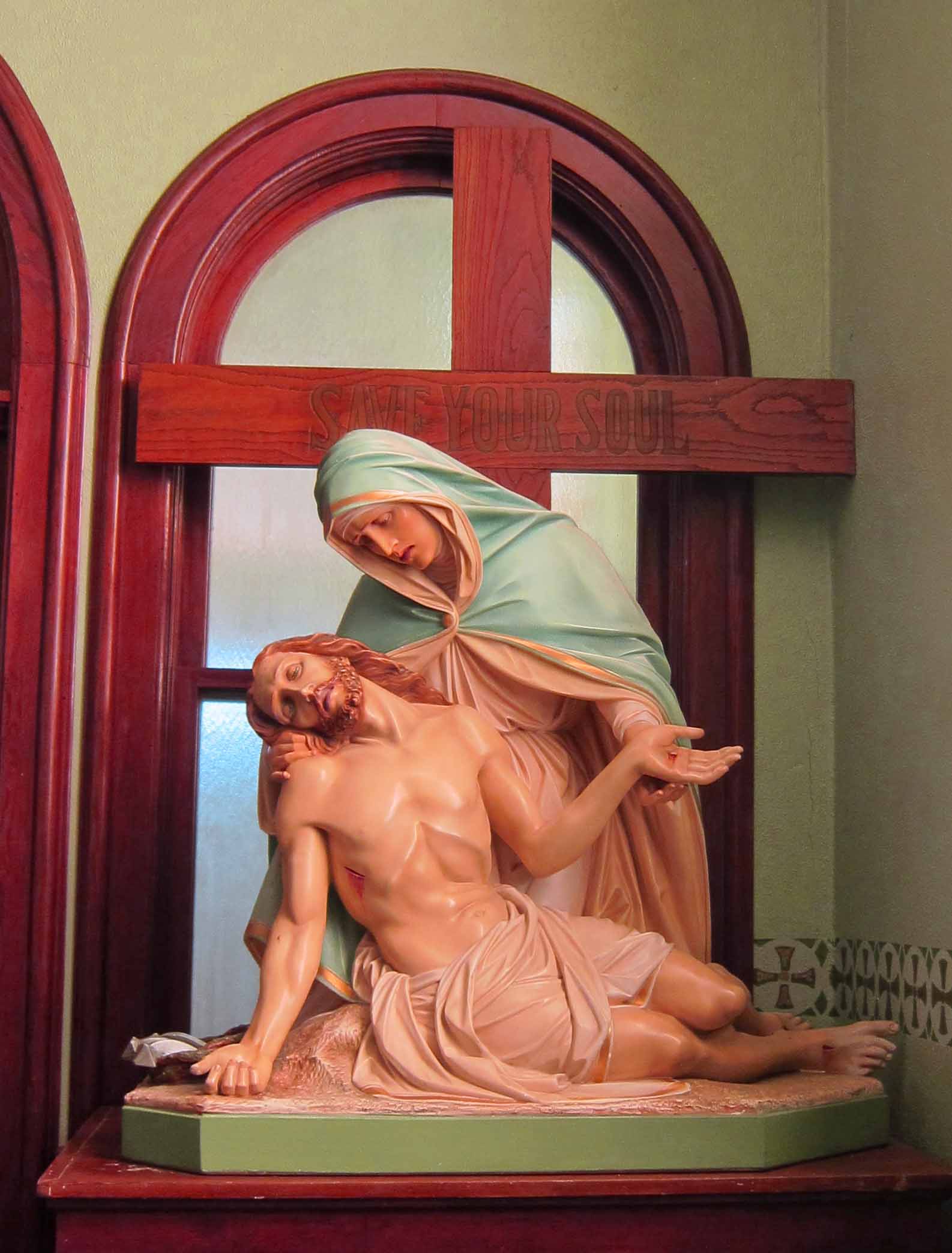

I took the pictures above at St. Joseph's Parish in Andale, Kansas, after it had been restored and renovated after a fire (the first two) and at St. Martin's church in Piqua, Kansas, which has been closed for years as an active parish but is maintained by Catholics in the area to be open for visitors.

And from Servant of God, Chaplain Emil J. Kapaun's home parish in Pilsen, Kansas, honoring the church's patron saint, St. John Nepomucene, which I visited in 2016 on the Solemnity of the Assumption:


And two other side altars in that church:
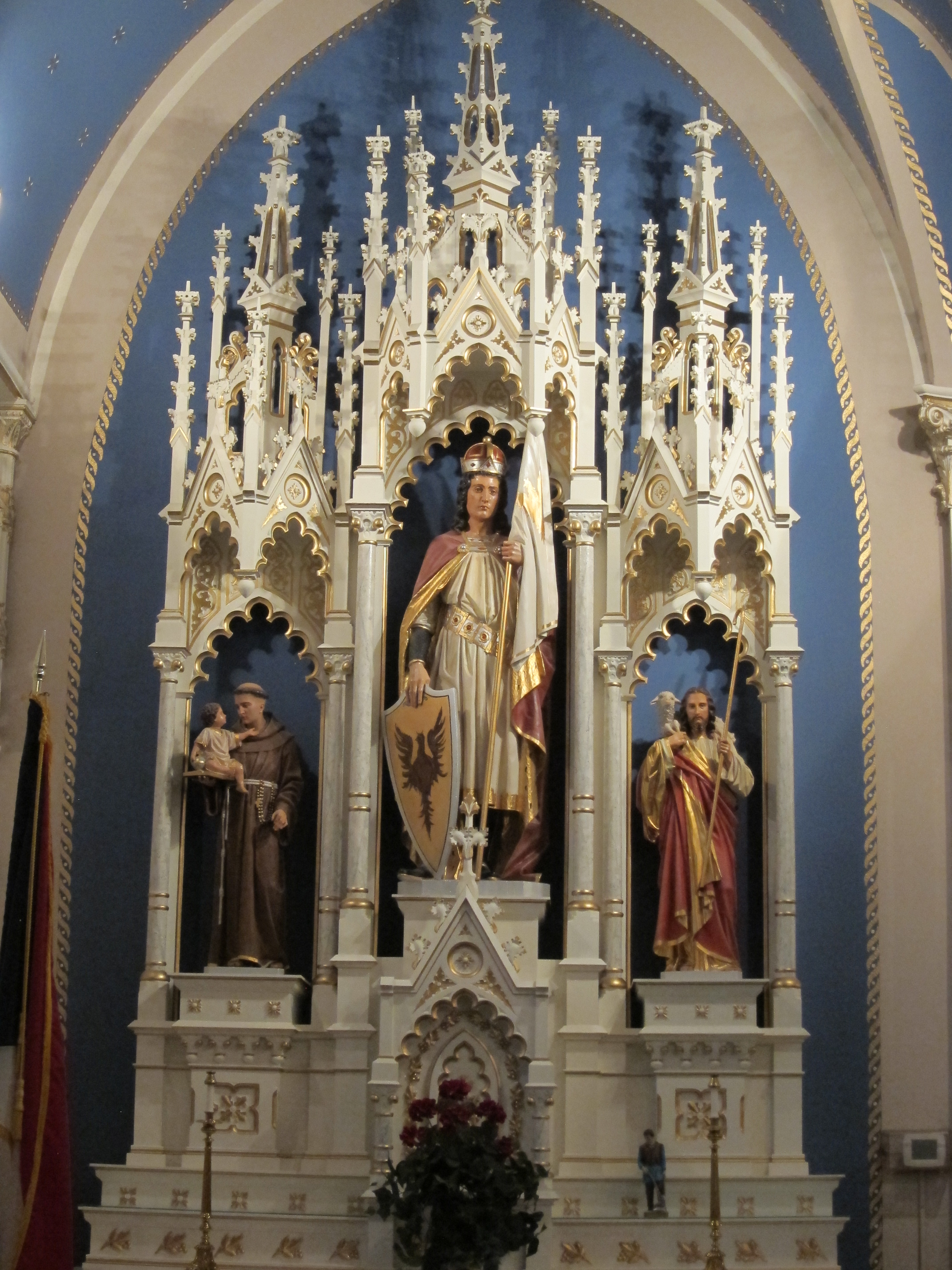


And finally, here's a picture Mark took during Mass on Christmas Day in 2013 at St. Anthony of Padua Church in Wichita, Kansas (Traditional Latin Mass), depicting the Franciscan saints honored at that parish:


As usual, I'll post my preview of the Son Rise Morning Show discussion this Friday, August 26!

Holy Mary, Mother of God, pray for us!
Saint Joseph, pray for us!
Saint John Nepomucene, pray for us!
Saint Anthony of Padua, pray for us!
Saint Clare of Assisi, pray for us!
Saint Francis of Assisi, pray for us!
Saint John Henry Newman, pray for us!

Image Credit for Shakespeare's Works (public domain): Title page of the First Folio, 1623. Copper engraving of Shakespeare by Martin Droeshout. All other images (c) Stephanie A. Mann (2013-2022).

Sunday, January 22, 2017

To Give Glory to God: Beautiful Catholic Churches


Patti Armstrong writes for The National Catholic Register about beautiful churches built in North and South Dakota built in the nineteenth and early twentieth centuries by German immigrants:

Many of the Catholic churches in North Dakota and South Dakota bespeak the legacy of Catholic German immigrants who worked hard and worshipped even harder.

Four of them in particular are notable because they tower above small prairie towns, too large for their shrinking communities, but too magnificent not to maintain.

The early settlers in the Dakota Territory erected beautiful churches similar to the ones they had left behind in Europe. They wanted places of worship to glorify God and to last for generations.

In the Diocese of Bismarck, North Dakota, are: St. Mary’s in Richardton, Sts. Peter and Paul in Strasburg and St. Mary’s in Hague. Their total populations are 548; 392; and 67 respectively, according to the 2014 census poll. Hoven, South Dakota, home to St. Anthony of Padua, has 407 residents.

The churches are relics of the pre-Vatican II era, where people worshipped alongside a multitude of angels and saints captured in stained-glass windows, statues and paintings. Although they still function as active parishes, the churches have also become tourist destinations. Motorists detour off highways, and busloads of pilgrims come to see this Old World beauty surviving in the New World.

Their operation and maintenance costs are not practical, but the Catholic Church is about faith, beauty, courage and sacrifice.


The comment about keeping churches open even when the costs are prohibitive reminded me of some churches in Kansas that are kept open, often by the laity, even though they aren't active parishes now. Last February I visited St. Martin of Tours in Piqua, Kansas (pictured above) and many years ago my parents and I took a tour of the German/Volga German churches around Hays, Kansas. The Cathedral of the Plains, St. Fidelis Catholic Church, in Victoria is still a parish church, but Holy Cross in Pfeifer is maintained by a charitable foundation and the church is open every day for visitors. St. Joseph Church in Liebenthal is still an active parish of the Diocese of Dodge City, as is St. Anthony's in Schoenchen, although on a limited basis.

The church of St. Francis (not of Assisi, but St. Francis de Hieronymo, a Jesuit saint) in St. Paul, Kansas is still an active parish in the Diocese of Wichita; the pastor is from Burma. It is a beautiful church and a tremendous part of the history of Catholics in Kansas. This site describes all that it had been when the Jesuits and then Passionists had organized first a mission and then a monastery and retreat house. 

These churches were built by poor people, struggling to make their homesteads prosper, who wanted to see the same beauty in the New Country as they'd known in the Old when they went to Mass or to Confession, or a new baby's baptism, or a wedding--or a funeral. They wanted to give glory to God.Some of the artwork and decoration they scrimped and saved for was costly at the time but it is priceless today. These churches are monuments and memories of the German (or Irish or Italian or Polish) immigrants' faith and devotion. It may be inevitable that the population in the parishes declines to the point that they have to be moved or consolidated and certain churches closed, but it's wonderful when the laity help to maintain the closed churches, even though they may be empty (no Blessed Sacrament reserved in the Tabernacle). 

Sunday, June 10, 2012

Corpus Christi in England after Emancipation and Restoration

My first post today was about the Solemnity of Corpus Christi before the English Reformation, and I mentioned the first procession after the Reformation led by Blessed Dominic Barberi. With Emancipation in 1829 and the restoration of the hierarchy in 1850, devotion to the Most Holy Body and Blood of Christ became manifest in England again with churches (including Westminster Cathedral, which is dedicated to the Most Precious Blood) and processions.

For example, Corpus Christi Catholic Church in London's West End:

The Parish of Maiden Lane is situated in the Westminster Deanery. It was founded in 1873 and consecrated on the 18th of October, 1956. Often referred to as the “hidden gem” of the West End, the then Archbishop Cardinal Henry Manning said during his homily at the opening mass that “a sanctuary has been opened to be specifically devoted to the Adoration of the Blessed Sacrament”.

This was the first church dedicated to the Blessed Sacrament after the Reformation. The famous hymns Sweet Sacrament Divine and O Sacred Heart were written by the parish priest Fr Francis Stanfield (1835-1914). It is also known as “the actors’ church” and is the home of the Catholic Association of the Performing Arts (formerly, the Catholic Stage Guild).

This link provides some pictures of the interior of the church, and here are the lyrics to the first hymn mentioned above:

Sweet Sacrament divine,
hid in thine earthly home;
lo! round thy lowly shrine,
with suppliant hearts we come;
Jesus, to thee our voice we raise
In songs of love and heartfelt praise
sweet Sacrament divine.

Sweet Sacrament of peace,
dear home of every heart,
where restless yearnings cease,
and sorrows all depart.
there in thine ear, all trustfully,
we tell our tale of misery,
sweet Sacrament of peace.

Sweet Sacrament of rest,
ark from the ocean's roar,
within thy shelter blest
soon may we reach the shore;
save us, for still the tempest raves,
save, lest we sink beneath the waves:
sweet Sacrament of rest.

Sweet Sacrament divine,
earth's light and jubilee,
in thy far depths doth shine
the Godhead's majesty;
sweet light, so shine on us, we pray
that earthly joys may fade away:
sweet Sacrament divine.

This article describes the revival of the Corpus Christi procession in Arundel, home of the Dukes of Norfolk in Sussex. The Arundel Cathedral website has notes about the procession, which was celebrated on Thursday, June 7 this year.