Showing posts with label Dangers to the Faith. Show all posts

Wednesday, March 12, 2014

"Bad Religion" and "Dangers to the Faith": Book Review, Part Two


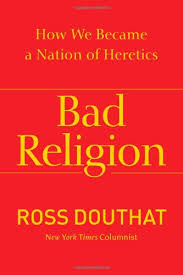
I read Ross Douthat's Bad Religion: How We Became a Nation of Heretics last month and then followed it up by reading Al Kresta's Dangers to the Faith: Recognizing Catholicism's 21st-Century Opponents. The two books are related, as both authors examine the Church's competition for what to believe, how to pray, how to live, and how to think. Douthat tells a story, tracing a history of change and secularization and focusing on a handful of heresies--teachings about Christianity that over-emphasize one doctrine or another and thus distort Christian orthodoxy (using a Mere Christianity view). Kresta writes about 14 opponents of the Catholic Church divided into four groups: Abusers of Spirituality and Revelation; Abusers of Science and Reason; Abusers of the Past and Future, and Abusers of Wealth and Power. Douthat's book is a narrative to be absorbed and analyzed, with a conclusion that emphasizes personal action; Kresta's is is a compendium of information to be consulted and used as a reference for refutation and argument. As I reviewed Bad Religion yesterday, today I focus on Dangers to the Faith.

To begin, I think I should note that Al Kresta has interviewed me a few times on his radio program; he and Nick Thomm even reached out to me to set up an interview on site at the Catholic Writers Guild Conference. Nevertheless, neither he nor OSV sent me a review copy or asked for my opinion. I bought my copies of both Bad Religion and Dangers to the Faith at Eighth Day Books. I have also listened to Al Kresta's program often and was more familiar with his way of reasoning and presenting his arguments than I was with Douthat's--in fact, although I've heard of Douthat and seen and heard interviews on broadcast media, this was the first work of his I'd read. Reading Dangers to the Faith is like listening to Al Kresta: his story-telling method; his way of presenting his side of the argument and deflating the other side's argument--they come through clearly here. His voice is unmistakable on the printed page.

As Kresta presents the 14 dangers to the Faith, he quotes extensively from the sources of the dangers' founders and exponents. Each chapter is dedicated to a specific danger, outlining its tenets and contradiction of Catholic Truth, and then describing arguments against it. The book does not have an index, but it does have pages of notes so you have the sources and resources for further reading. I saw Mr. Kresta on Raymond Arroyo's The World Over program and he commented that these 14 dangers are all abusers of goods. They take something good, like understanding nature through the scientific method, and twist it so that the scientific method becomes the only way to understand life. In that way, these abusers of goods resemble Christian heretics, who take some aspect of the truth, for example, Christian teaching on Who Jesus is and over emphasize it like the Arians or the Monophysites. In a way, both Kresta's "abusers of goods" and Douthat's "heretics" are narrow minded and limited: they cannot see the complexity of reality and so try to manage it by bringing reality down to their level. It may be difficult to understand the relationship between Faith and Reason or how Jesus could be True God and True Man, but it's better to try and fail than to adopt an unrealistic minimalization of the truth so you can handle either truth.

In addition to commenting on the voice so evident in these chapters, I'd like to mention the tone: Kresta is always charitable, sometimes a little exasperated, but never demeaning or disparaging. He speaks of these "enemies" with love, because he wishes they knew the truth. Using the example of Oprah Winfrey's encounter with the Dominican Sisters of Mary, Kresta demonstrates how much she knew something great and good was there--she just didn't recognize Who was there. 

Kresta achieves his goals in helping his readers "know and love the faith" and "love the mission field" (from the Introduction). I did find the subheads, used not just for sections but for paragraphs, rather distracting, and I do wish the book had an index. Dangers to the Faith is an excellent resource and reference. Kresta ends his book just as Douthat did: with a call to sanctity for all Catholics as the best apologetic argument we can make.

Tuesday, March 11, 2014

"Bad Religion" and "Dangers to the Faith": Book Reviews, Part One


I read Ross Douthat's Bad Religion: How We Became a Nation of Heretics last month and then followed it up by reading Al Kresta's Dangers to the Faith: Recognizing Catholicism's 21st-Century Opponents. The two books are related, as both authors examine the Church's competition for what to believe, how to pray, how to live, and how to think. Douthat tells a story, tracing a history of change and secularization and focusing on a handful of heresies--teachings about Christianity that over-emphasize one doctrine or another and thus distort Christian orthodoxy (using a Mere Christianity view). Kresta writes about 14 opponents of the Catholic Church divided into four groups: Abusers of Spirituality and Revelation; Abusers of Science and Reason; Abusers of the Past and Future, and Abusers of Wealth and Power. Douthat's book is a narrative to be absorbed and analyzed, with a conclusion that emphasizes personal action; Kresta's is is a compendium of information to be consulted and used as a reference for refutation and argument.

In Bad Religion, Douthat starts (in Part I) from a time in the mid-twentieth century when the Catholic Church (in the person of Archbishop Fulton J. Sheen), the mainline Protestant churches (Reinhold Niebuhr); the evangelical/fundamentalist churches (Billy Graham), and the African-American Christian churches (Martin Luther King, Jr) each presented an effective, persuasive, and cohesive vision of Christian orthodoxy. Within the limits of their Reformation driven divisions, they were agreed upon the influence Christianity should have on culture. Douthat highlights the Civil Rights movement as the case study of that unity and effectiveness.

But then it all fell apart: secularization and accommodation to the cultural and moral shifts of the 1960's and 1970's weakened the prophetic voice of Christianity in America. Douthat particularly examines the decline of the Catholic Church in the wake of the Second Vatican Council--the decline in vocations, Mass attendance, orthodoxy and orthopraxy--although he also analyzes the revival of Catholicism during the pontificate of Blessed John Paul II, and the many Catholic organizations, colleges, and publications that drove that revival. I have often heard comments that when the history of the Catholic Church in twentieth century America is written someday, Mother Angelica's EWTN will be commended for its influence--but Douthat does not mention it in this book. He analyzes the alliance between Catholics and Evangelicals at the same time noting the separation between Catholics and mainline Protestant churches, both centering around social issues like abortion, the definition of marriage, and the place of religion in public discourse.

In Part II he examines four heresies (and here he and Kresta overlap in both the heresies/dangers they highlight): the campaign to displace the New Testament with the Gnostic gospels and an alternative view of orthodox doctrine about the Incarnation of Jesus; the popularity of the Prosperity gospel; New Age spirituality; and over identification of Christianity with the American nation and republic (Christian Nationalism). All four present versions of Christian teaching that are more attractive than Christian orthodoxy because they reduce the moral and spiritual demands of religion for anyone who wants to follow Jesus. For example: instead of "pick up your cross", bear sufferings in unity with Christ, and observe poverty of spirit and material possessions, the Prosperity gospel says enjoy life now, see your wealth and comfort as signs of God's favor, expect great things now. Just like the Gnostic gospels, the Prosperity gospel cannot face the real example of suffering and redemption held out by the true Good News. But they seem easier and less demanding, just like the other two heresies--until you realize that they do nothing to help you face the real sorrows and joys of human life (that's my interpretation, not necessarily Douthat's). If, like Elizabeth Gilbert, you base your current and eternal happiness on the realization of "the God Within", you have a pretty weak foundation: fallible, mortal, self-serving and ultimately ineffective. (Kresta is particularly effective with his analysis of New Age spirituality.)

Finally, I appreciate Douthat's concluding remarks about what Christians need to do if they want to see Orthodoxy thrive again, because he focuses on what you and I can do. He cites G.K. Chesterton's comment from The Everlasting Man that the Church should have died at least five times before in its two thousand (2,000) year history--but didn't. His suggestions focus on knowing what Christians believe, knowing the reasons for our hope so we can express it, and living according to those beliefs and reasons are better than any master plan--well, I guess they are the Master's plan! He also encourages Christians to avoid syncretism as they work together on certain issues, to be true to their own community's beliefs, and he quotes Joseph Cardinal Ratzinger, before he became pope: "The only really effective apologia for Christianity comes down to two arguments, namely, the saints the Church has produced and the art which has grown in her womb." (from The Ratzinger Report). Therefore, Douthat says, be saints and artists!

Table of Contents

Prologue: A Nation of Heretics

Part I Christianity in Crisis
1 The Lost World
2 The Locust Years
3 Accommodation
4 Resistance

Part II The Age of Heresy
5 Lost in the Gospels
6 Pray and Grow Rich
7 The God Within
8 The City on the Hill
Conclusion: The Recovery of Christianity

Notes
Acknowledgments
Index

More on Dangers to the Faith: Recognizing Catholicism's 21st-Century Opponents tomorrow.