Showing posts with label Father Bowden. Show all posts

Friday, May 19, 2023

Preview: Two Martyrs from Campion's Class of 1581-1582


On Monday, May 22, I'll be on the Son Rise Morning Show at my usual time to discuss Father Henry Bowden's "Mementoes" of two martyrs executed on May 28, 1582. Blesseds John Shert and Thomas Ford were among the 20 priests, including St. Edmund Campion, accused of conspiring against Queen Elizabeth I in the fictitious "Rome and Reims" plot.

Please listen live here at about 6:50 a.m. Central/7:50 a.m. Eastern, or check out the podcast later here.

In 1581, it was not yet Treasonous for an Englishman to return to his native land as a Catholic priest: the 1585 Act Against the Jesuits and the Seminary Priests made it easier to condemn him to death. So when 20 (twenty) priests were arrested in 1581, they had to be charged under existing treason laws. So they were accused of conspiracy, one they'd developed in meetings held in Rome and Reims. Except they hadn't formed any conspiracy, and they testified at trial that they were in England when they were supposed to be in Rome or Reims. Since the guilty verdicts were a foregone conclusion, even after Campion and others had been questioned and tortured, that didn't matter.

On page 175 of  Mementoes of the English Martyrs and Confessors, Father Henry Sebastian Bowden recounts Blessed John Shert's last words at Tyburn on May 28, 1582, with the title "Praise and Thanksgiving" and the verse "Offer to God the Sacrifice of Praise and pay thy vows to the Most High" (Psalm 49:14). Blessed Thomas Ford, who had been captured with Campion at Lyford Grange in Berkshire, was still hanging from Tyburn Tree and Shert exclaimed:

"O happy Thomas! Happy art thou that didst run the happy race! O benedicta anima! O blessed soul, thou art in a good case! Thou blessed soul, pray for me."

When he was rebuked for "praying to the dead", he continued:

"O Blessed Lady, Mother of God, pray for me, and the saints of heaven, pray for me."

Then he made an Act of Thanksgiving:

"O Blessed Lord, to Thee be all honor and praise" and rejoiced that he would die "so happy a death for Thy Sake"!

Then he was hanged, drawn, and quartered. 
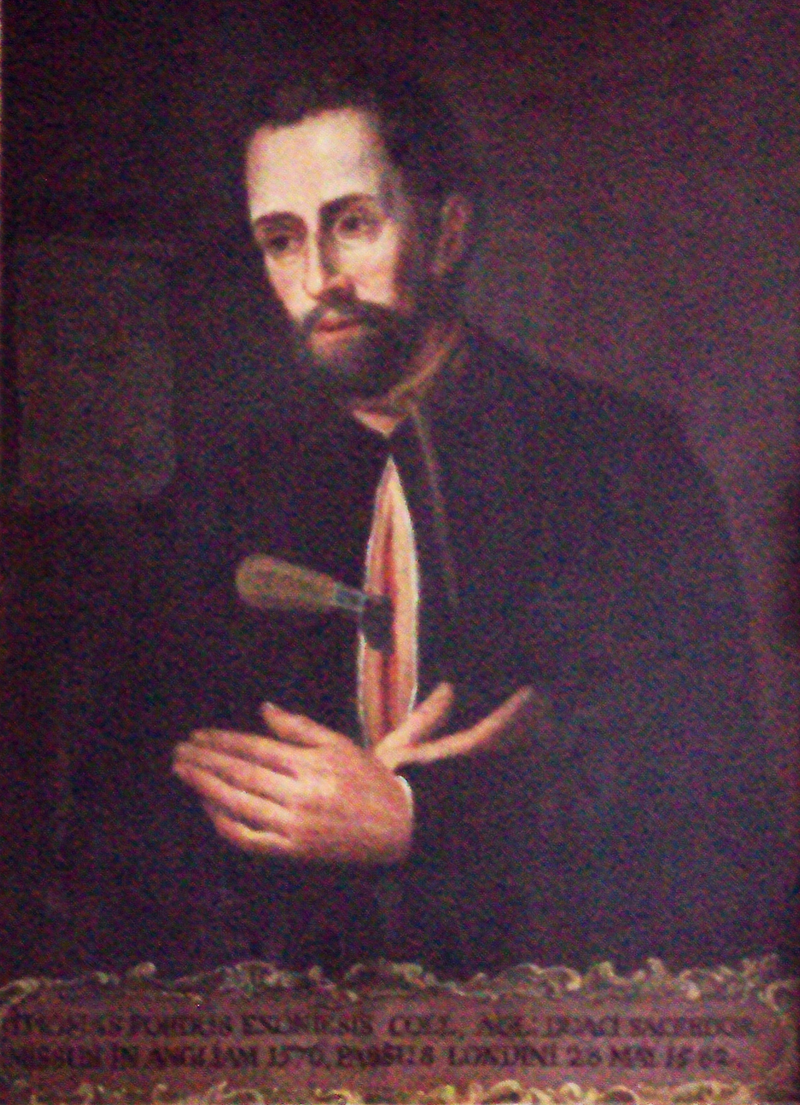
As for Blessed Thomas Ford, Bowden provides some insight into the traps the authorities tried to catch him in--to prove the conspiracy--in an entry titled "The Snares of the Pharisees" with the verse "And the Pharisees watched . . . that they might find an accusation against Him " (Luke 6:7) on page 177. 

They wanted him to say that he was in England to enforce Pope Pius V's Bull Regnans in Excelsis and further the efforts of the Northern Rebellion. He answered them:

. . .  He could not reply as to the legality of the bull of Pius V against Elizabeth, as he was not privy to its circumstances . . .

. . . As to the pope's authorization of the Northern Rebellion, being a private subject, he cannot answer . . .

As Bowden notes, this questioning "was a mere pretext, and Fr. Ford saw through the device . . ."

He, like Saint John Henry Newman centuries later, was a graduate of Trinity College at the University of Oxford. As Bowden notes, Ford began to express "Catholic sympathies," and he "abjured Protestantism and went to Douay" in 1570, and returned to England in 1576. Blessed John Shert was also an Oxford man, earning his degree from Brasenose College. The Catholic Encyclopedia offers this brief outline:

Successively schoolmaster in London, and servant to Dr. Thomas Stapleton at Douai, he entered the seminary in 1576, and was ordained subdeacon. He was ordained priest from the English College, Rome, of which he was the senior of the first six scholars. He left Reims for England 27 August, 1579, and was sent to the Tower 14 July 1581.

Along with Blessed John Shert and Thomas Ford, Blessed Robert Johnson was also executed at Tyburn on May 28. 1582. Father Bowden provides a memento of his martyrdom on page 169: Father Johnson began to pray in Latin and was admonished to "Pray as Christ taught." He replied, "Do you think Christ taught in English?"

The spirit of the martyrs! Keeping their wits about them and being witty too!

Blessed John Shert, pray for us!

Blessed Thomas Ford, pray for us!

Blessed Robert Johnson, pray for us!

Saint Edmund Campion, pray for us!

Image Credit (Public Domain): Portrait of Blessed Thomas Ford in The English Convent in Bruges (NB: the long wound on his chest and the knife protruding, signifying that he was disemboweled at his execution.)

Friday, May 12, 2023

Preview: A Martyr and a Confessor in York

Again I'm matching up a martyr and a confessor for our series recollecting the stories of the English Martyrs and Confessors on Monday, May 15 on the Son Rise Morning Show. Blessed Richard Thirkeld or Thirkell and Mary Hutton were contemporaries of Saint Margaret Clitherow--in fact, he had been one of her confessors! She was one of the female Catholic recusants who, like Clitherow, caused the Church of England and secular authorities in York so much trouble, sheltering priests and teaching their children the Catholic Faith.

So please listen live here about about 6:51 a.m. Central/7:51 a.m. Eastern. You may also find the podcast later that day here.

According to the old Catholic Encyclopedia, Thirkeld was:

Educated at Queen's College, Oxford, 1564-1565. Studied at Douai and Rheims, France. Ordained on 18 April 1579 at an age somewhat older than his confreres. Returned to England on 23 May 1579 as a home missioner around York. Confessor to Saint Margaret Clitherow. Arrested on Annunciation Eve in 1583 for the crime of priesthood; the authorities became suspicious when he visited a Catholic prisoner. Lodged in Ousebridge Kidcote prison, York, for two months. He wore a cassock and biretta to trial, was convicted on 27 May 1583 of hearing confessions and bringing the lapsed back to the Church, and was sentenced on 28 May 1583 to death. He used his time in jail to minister to other prisoners, working especially with others sentenced to death. Martyred in secret on May 29 for fear his covert parishioners would cause a civil disturbance. Six of his letters have survived. [This site excerpts two of those letters.]

In this entry for Blessed Richard Thirkeld in Mementoes of the English Martyrs and Confessors (and there are several, including some of those letters he wrote from prison), Father Bowden emphasizes how the martyr engaged in debate with the Dean of York (Matthew Hutton, later Archbishop of York). The dean attacked the practice of asking the intercession of the saints, and when Thirkeld offered to give him some explanation from St. Augustine, changed the subject. He declared the pope to be the anti-christ and when Thirkeld proclaimed that the pope was the Vicar of Christ and the Supreme Head of the Church, the dean "in a fury of passion leaped from his chair, declaring he would not suffer such language." The title for this entry is "Points in Controversy" and the verse is "Carefully study to present thyself approved unto God, a workman that needeth not to be ashamed, rightly handling the worth of truth." (2 Timothy 2:15)

After Thirkeld's execution, his head and the head of another martyred priest, Blessed William Hart, was displayed in front the Ousebridge Kidcote prison. Mary Hutton, a recusant Catholic, was accused of removing those heads as relics--and her children were threatened with beating with birches, and so they admitted their mother had done it.

As this site explains, female Catholic recusants were particularly troublesome for the authorities:

. . . After priests the second most feared rebel group were female recusants. There was strict surveillance within the city, monitoring movements and keeping track of church attendance.

Once a month, commissioners conducted a survey of all Catholic prisoners within the prison which outlined females to be manipulators and religious converters as well as the largest group to miss church services. Their imprisonments were often stricter than men, excluding the treatment of priests. . . .

Records show that Catholic women harboured the most priests. In 1593, Ann Thwing was imprisoned for harbouring a priest and was sentenced along with another woman, a Mrs Stapleton. Both women were in York Castle until 1600. Mrs Stapleton was pardoned, Ann’s fate is unknown. In 1599, Eleanore Hunt received a death sentence for harbouring Christopher Wharton, a priest who was also sentenced to death at York Castle.

In 1575, a group of York women – ‘Mrs Dorothy Vavasour’, Frances Hall, Janet Geldad and Isabel Porter – became the first women to stand in front of the High Commission and be charged with ’causes ecclesiastical’. This was the refusal to attend church service.

The following year, the Lord President of Huntingdon, Henry Hastings, was instructed by the council to provide further details into church attendance. His list had 33 names, 23 being women, and included Vavasour, Geldad, Hall and Porter. Also on the list was Margaret Clitherow.

When Mary Hutton was arrested, her husband William Hutton was already in prison for recusancy. Mary was not executed, but she was put in "the low place" in prison and left to die there of fever sometime after Blessed Richard Thirkeld's execution. The title for her Confessor's entry is "Devotion to Relics" and the verse is from Psalm 33/34, verse 20 (cited in John 19:36): "The Lord keepeth all their bones; not one of them shall be broken."

The juxtaposition of these two memories certainly demonstrates the cooperation between the Catholic recusant laity and the missionary priests, both risking their lives. The missionary priests knew what tortures and executions they could/would face. The Catholic laity also knew the monetary and mortal dangers they faced. They were prepared to suffer so the Sacraments could be celebrated, especially the Holy Mass, and the Catholic Faith would survive the Penal times in England.

Blessed Richard Thirkeld, pray for us!
Saint Margaret Clitherow, pray for us!

Friday, May 5, 2023

Preview: A Royal Confessor and an Observant Martyr

We'll continue our series on Father Henry Sebastian Bowden's book, Mementoes of the English Martyrs and Confessors for Every Day in the Year on the Son Rise Morning Show next Monday, May 8 at a little after 6:45 a.m. Central/7:45 a.m. Eastern. Please listen live here or find the podcast later that day here.

This time we'll feature an exchange of letters between one whom Father Henry Sebastian Bowden terms a Confessor, one who suffered for the faith during the English Reformation but was neither martyred nor considered for canonization, and a martyr, both from the reign of Henry VIII.

The Confessor, who writes to her priestly confessor, is Catherine of Aragon, and the Martyr is Blessed John Forest, her "venerated Father" who would suffer a unique martyrdom. On page 159, in "A Royal Penitent", Queen Catherine writes to the Observant Franciscan Father John Forest because she thinks he will be executed soon for his early and lasting opposition to Henry VIII's plans to have the marriage between himself and Catherine dissolved so he may marry Anne Boleyn. (You might recall that the Observant Franciscans at Greenwich, so associated with the royal family, supported the validity of that marriage from the very beginning of the King's Great Matter. The couple was married at the Observant's chapel at the Royal Palace on June 22, 1509, after all.) 

Queen Catherine had been exiled from Court since 1531 and after Thomas Cranmer, the Archbishop of Canterbury had declared her marriage to Henry VIII null and void in May 1533, the king would not allow her any other title than Dowager Princess of Wales, although she continued to refer to herself as the Queen (she had been anointed and crowned Queen of England and Wales on June 24, 1509)! Cranmer also had to declare Henry VIII's marriage to Anne Boleyn, which had been celebrated before that annulment, was valid.

The dates of this correspondence, which Bowden might have accessed through Don Bede Camm's The Lives of the English Martyrs, are not certain. Bowden does include Camm's work as one of his sources in his Introduction (p. 7). Father John Morris, SJ, who wrote Forest's entry in Camm's book, dates it to sometime in 1534 when Forest was in prison because of his opposition to Henry's actions.

So, perhaps in 1534, by then in Cambridgeshire at either Buckton Towers* or Kimbolton Castle, Queen Catherine of England and Wales wrote her confessor, lamenting that he will die before her, leaving her without his counsel for he was "the man who had taught me the most in divine things." She says she would be willing to suffer "a thousand torments than follow you after a time." She asks for his prayers, for him to "commend me always to God, now and from your place in heaven" and call herself his "most sorrowful daughter." The verse for her entry is Ruth 1:16: "whither thou goest . . ."

Father John Forest answers her from prison that he "was filled with incredible joy" because he "saw how great is your constancy in the faith." He begs her prayers and commends her to Saint Francis of Assisi and especially Saint Catherine of Siena (whose feast we just celebrated at the end of April); especially "when you hear of my execution, I heartily beg of you to pray for me to her. I send to you my rosary, as I have but three days to live." Father Bowden gives his memento the title "One Only Gospel" with the verse from Galatians 1:18 as Forest reminds her to reject any doctrine of "heretics" and remain true to the Church's teaching.

What Bowden does not tell us is that Queen Catherine of England and Wales died before Blessed John Forest after a long illness and much distress that she could not see her daughter Mary before she died (unless she accepted her Dowager title and Mary's illegitimacy), on January 7, 1536 at age 50. She was buried in Peterborough Cathedral on January 29. Her tomb bears the title "Katharine Queen of England", courtesy of Queen Mary of Teck, King George V's consort. The Cathedral holds a festival every January in her honor, with a Catholic Mass celebrated.

According to Camm's book, Forest was released from prison for a time to the Grey Friar Franciscan house near Smithfield until he was finally brought to trial for heresy and burned at the stake on May 22, 1538 at Smithfield. On page 171, on the anniversary of his martyrdom, Bowden remembers him with the title "A Living Holocaust". According to the 1913 Catholic Encyclopedia:

On 22 May following he was taken to Smithfield to be burned. The statue of Saint Derfel which had been brought from the church of Llanderfel in Wales, was thrown on the pile of firewood; and thus, according to popular belief, was fulfilled an old prophecy, that this holy image would set a forest on fire. The holy man's martyrdom lasted two hours, at the end of which the executioners threw him, together with the gibbet on which he hung, into the fire. 

He was beatified by Pope Leo XIII in 1886.

Blessed John Forest, pray for us! and may the Soul of Queen Catherine of England, rest in peace.

*I think of Catherine of Aragon would be pleased that Buckton Towers is now The Claret Centre, a retreat and conference center, run by the Claretians, with the Church of Saint Hugh of Lincoln on the grounds, and two chapels, one dedicated to Our Lady and the other to Saint Anthony Claret! (She might not be thrilled with the plainness of the church and chapels, however--not quite what she was used to in her era!)